tires AUDI A8 2012 Owner's Guide
[x] Cancel search | Manufacturer: AUDI, Model Year: 2012, Model line: A8, Model: AUDI A8 2012Pages: 300, PDF Size: 75.06 MB
Page 255 of 300

or ridges on the road, particularly if the tire is underinflated .
I n o rder to m inim ize the occu rrence of impact
damage to the t ires of your veh icle, we recom
mend that you observe the following precau
tions :
- Always maintain recommended inflat ion
pressures. Chec k your tire pressure every
2,000 miles (3 ,000
km) and add air if neces
sary.
- Drive carefu lly on roads with potholes, deep
gullies or ridges. The impact from driving
through or over such obstacles can damage
your tires. Impact with a curb may a lso
cause damage to your tires.
- After any impact, immediately inspect your
tires or have them inspected by the nearest
authorized Aud i dealer. Replace a damaged
t ire as soon as possible .
- Inspect your t ires every 2,000 miles (3,000
km) for damage and wear . Damage is not al
ways easy to see. Damage can lead to loss of
air and underinflation, wh ich could eventu
ally cause tire failure . If you be lieve that a
t ir e may have been damaged , replace the
t ire as soon as possible.
- T hese tires may wea r mo re qui ck ly than ot h
ers.
- Please a lso remember that, whi le these tires
deliver respons ive handling, they may ride
l ess comfortably and make mo re noise than
othe r choices.
Reduced performance in winter /cold
season condition s
All tires are des igned for certa in pu rposes.
The low aspect ratio, ultra high performance
tires originally installed on your veh icle are in
tended for maximum dry and wet road per
formance and handling . They are not suitable
for cold , snowy or icy weather condit ions .
If
you dr ive under those circums tances, you
should equip your veh icle with all -season or
winter tires, which offer better traction under
those cond itions . We suggest you use the rec
ommended snow or all-season tires specified
for your ve hicle, or their equ ivalent.
Tire s an d wheel s 253
Refer to q page 250 for more detailed infor
mation regard ing winter tires.
Tire pressure
monitoring system
ill General notes
Applies to veh icles: w ith t ire pressure monitoring system
Each tire, incl uding the spare (i f provided),
shou ld be checked monthly when co ld and in
flated to the inf lation pressure recommended
by the veh icle manufacturer on the veh icle
placard or tire inflation pressure label. (If your
vehicle ha s tires of a different size than the
s ize indicated on the vehicle placard or tire i n
flat ion pressu re labe l, you shou ld dete rm ine
the p roper t ire inflation p ress ure fo r th ose
t ir es).
As an added safety feature , your ve hicle has
been equipped with a tire pressure mon ito ring
system ( TPMS) that illum inates a low ti re
pressure te lltale when one or more of your
tires is significant ly under -inflated . Acco rding
l y, when the low tire pressure te lltale i llumi
nates, you shou ld stop and check your tires as
soon as possib le, and inflate them to the
proper pressure. Driving on a sign ificantly un
der- inflated t ire causes the tire to overheat
and can lead to tire fa ilure. Under -inflation al
so reduces fuel effic iency and tire tread life,
and may affect the vehicle 's hand ling and
stopp ing ability.
Please note that the TPMS is not a substitute
for proper tire ma intenance, and it is the driv
er's respons ibility to maintain co rrect tire
pressure, even if under-inflation has not
rea ched the leve l to tr igger illum inat ion of the
T PMS low tire p ressure tellta le .
Your vehicle has also been equipped with a
T PMS ma lfunction indicator to ind icate when
the system is not operating prope rly . T he
T PMS ma lfunction indicator is combined w ith
the low tire pressure te lltale. When the sys
tem detects a malfunction , the telltale wi ll
flash for approximate ly one min ute and then ..,_
•
•
Page 256 of 300

254 Tires and wheels
remain continuously illuminated. This se
quence will continue upon subsequent vehicle
start-ups as long as the malfunction exists.
When the malfunction indicator is illuminat
ed, the system may not be able to detect or
signal low tire pressure as intended. TPMS
malfunctions may occur for a variety of rea
sons, including the installation of replace
ment or alternate tires or wheels on the vehi
cle that prevent the TPMS from functioning
properly. Always check the TPMS malfunction
tellta le after replacing one or more tires or
wheels on your veh icle to ensure that the re
placement or alternate tires and wheels allow
the TPMS to continue to function properly.
Tire pressure indicator appears
Appl ies to vehicles: with tire pressure monitoring sys te m
The tire pressure indicator in the instrument
cluster informs you if the tire pressure is too
low or if there is a system malfunction.
Fig. 188 Display: underinflation warning
Fig. 189 Display: System malfu nction
Using the ABS sensors, the tire pressure moni
toring system compares the tire tread circum
ference and vibration characteristics of the in
dividual tires. If the pressure decreases in one
or more tires, this is indicated in the instru- ment
cluster with a warning symbol
[I] and a
message
r=> fig. 188.
The tire pressure monitoring system must be
reset via MMI each time the pressures are ad
justed (e.g. when switching between partial
and full load pressure) or after changing or re
plac ing a tire on your vehicle
r=> page 255. You
can find the recommended tire pressures for
your vehicle on the Label on driver's side 8-pil lar
¢ page 239.
Tire tread circumference and vibration charac
teristics can change and cause a tire pressure
warning if:
- the tire pressure in one or more tires is too
low,
- the tire has structural damage,
- the tire pressure was changed, wheels rotat -
ed or replaced but the TPMS was not reset
r=> page 255.
Warning symbols
[I] Loss of pressu re in at least one tir e ¢ ,&. .
Check the tire or tires and replace or repa ir if
necessary. The indicator light
[I] in the instru
ment cluster also illuminates
¢page 11 .
Check/correct the pressures of all four tires
and reset TPMS via MMI.
IIQllfl (Tir e Pressure Monitoring System) Tire
pressure! System malfunction .
If IIQIS, appears after switching the ignition
on or while driving¢
fig. 189 and the indica
tor light
[I] in the instrument cluster blinks
f or approximately one minute and then stays
on, there is a system malfunction . See your
authorized Audi dealer as soon as possible.
A WARNING
-- If the tire pressure indicator appears in
the instrument cluster display, one or more of your tires is significant ly under
inflated. Reduce you r speed immediately
and avoid any hard steering or braking
maneuvers. Stop as soon as possible and
check the tires and their pressures. In
flate the tire pressure to the proper pres-
sure as indicated on the vehicle's tire .,..
Page 257 of 300

pressure label¢ page 239. Driving on a
significantly under-inflated tire causes
the tire to overheat and can lead to tire
failure. Under-inflation also is likely to
impair the vehicle's handling and stop
ping ability .
- The driver is responsible for maintaining the correct tire pressures. You must check the tire pressures regularly.
- Under certain conditions (such as a spor ty driving style, winter conditions or unpaved roads), the pressure monitor indi
cator may be delayed.
-Ask your authorized Audi dealer if run
flat tires may be used on your vehicle.
Your vehicle registration becomes invalid if you use these tires when not permit
ted. Damage to your vehicle or accidents
could also result.
@ Tips
- The tire pressure monitoring system
stops working when there is an ESC/ABS
malfunction.
- Using snow chains may result in a system
malfunction.
- To ensure a proper TPMS function use
AUDI Original Tires which are marked
with "AO" or "RO" on the tire sidewall.
¢page 246.
- The tire pressure monitoring system on
your Audi was syntonized using tires with
the "AO" or "RO" identification. We rec
ommend using these tires.
Reset tire pressure monitoring system
App lies to vehicles: with tire pressure monitoring syste m
If the tire pressure is adjusted , wheels are ro
tated or changed, the TPMS must be reset via
MMI.
~ Switch on the ignition.
~ Select in the MMI: !CAR !function button>
Car systems control button > Servicing &
checks > Tire pressure monitoring > Store
tire pressures> Yes, store now .
Tires and wheels 255
(D Tips
Before resetting the TPMS, the current
pressures of all four tires must correspond
to the specified values. Adjust the tire
pressure and reset the pressure in the tire
pressure monitoring system according to
the load you are carrying ¢
page 239.
-Do not store the tire pressures if you are
driving with snow chains. Otherwise, a
system malfunction may occur .
•
•
Page 262 of 300
260 What do I do now ?
in its storage area properly and tighten
the knurled retaining screw securely.
@ Tips
Before changing the wheel, you m ust acti
vate t he jacking mode , so that the auto
matic controls for the Adaptive Air Sus
pension do not make it more diff icu lt to
lift the vehicle with the jack
q page 262.
Changing a wheel
When you change a wheel, follow these
quence de scribed below s tep-by-s tep and in
exac tly tha t order.
1. Act ivat e the vehicle jack mod e
¢page 262.
2. Remove the de corat ive wh eel co ver* . For
more details see also¢
page 260, Deco
rative wheel covers
or ¢ page 261 ,
Wheels with wheel bolt cops.
3 . Loosen the wheel bolts¢ page 261 .
4. Locate the proper mo unt ing po int for the
jack and align the jac k below that point
¢ pag e 262.
5. R ais e the car with the jack¢ page 262.
6. Remove the wheel with the fl at tire and
then in stall
the spare ¢ page 263 .
7. Tigh ten all wheel bol ts ligh tly.
8 .
Lo wer the veh icle with the jack .
9 . Use the whee l bolt wrench and
firml y
tighte n all whee l bolts ¢ page 261.
10. Replace the decorative wheel c over*.
11. De activate the veh icle jack mode in the
MMI:
! CARI function button> Ca r syst em s
control button > Se rv icing & chec ks > Air
sus p.: jack mode > Off.
The vehicle jac k mode sw itches off automati
cally at speeds above 10 km/h.
A WARNING
Always read and follow all WARNINGS and
information
¢ &. in Raising the vehicle on
page 262
and ¢ page 264.
After changing a wheel
A wheel change is not complete without the
doing the following .
.,. Alw ays store the vehicle tool kit, the jack*
and the repl aced tire in the luggage com
pa rtment
¢ page 130.
... Check the tir e pres su re on the spare wheel
immed iate ly afte r mounting it.
.,. As soon as possib le, have the
tight ening
torque s
on all whee l bolts checked with a
torque wrench . The correc t tightening tor
que is 90 ft lb (120 Nm).
... Hav e the flat tire
repl aced as soon as possi
ble .
@ Tips
-If you notice that the wheel bo lts are
corroded and difficult to turn while
changing a tire, they should be rep laced
before you check the tightening torque.
- Dr ive at reduced speed until you have the
tightening torques checked.
- After changing a whee l, the t ire press ure
in all four tires must be checked/correct
ed and the tire pressure monitoring ind i
cator must be stored in the MMI
¢ page 255.
' Decorative wheel covers
Applies to vehicles: w ith decorative whee l covers
The decora tive wheel covers mus t be removed
first to access the wheel bolts.
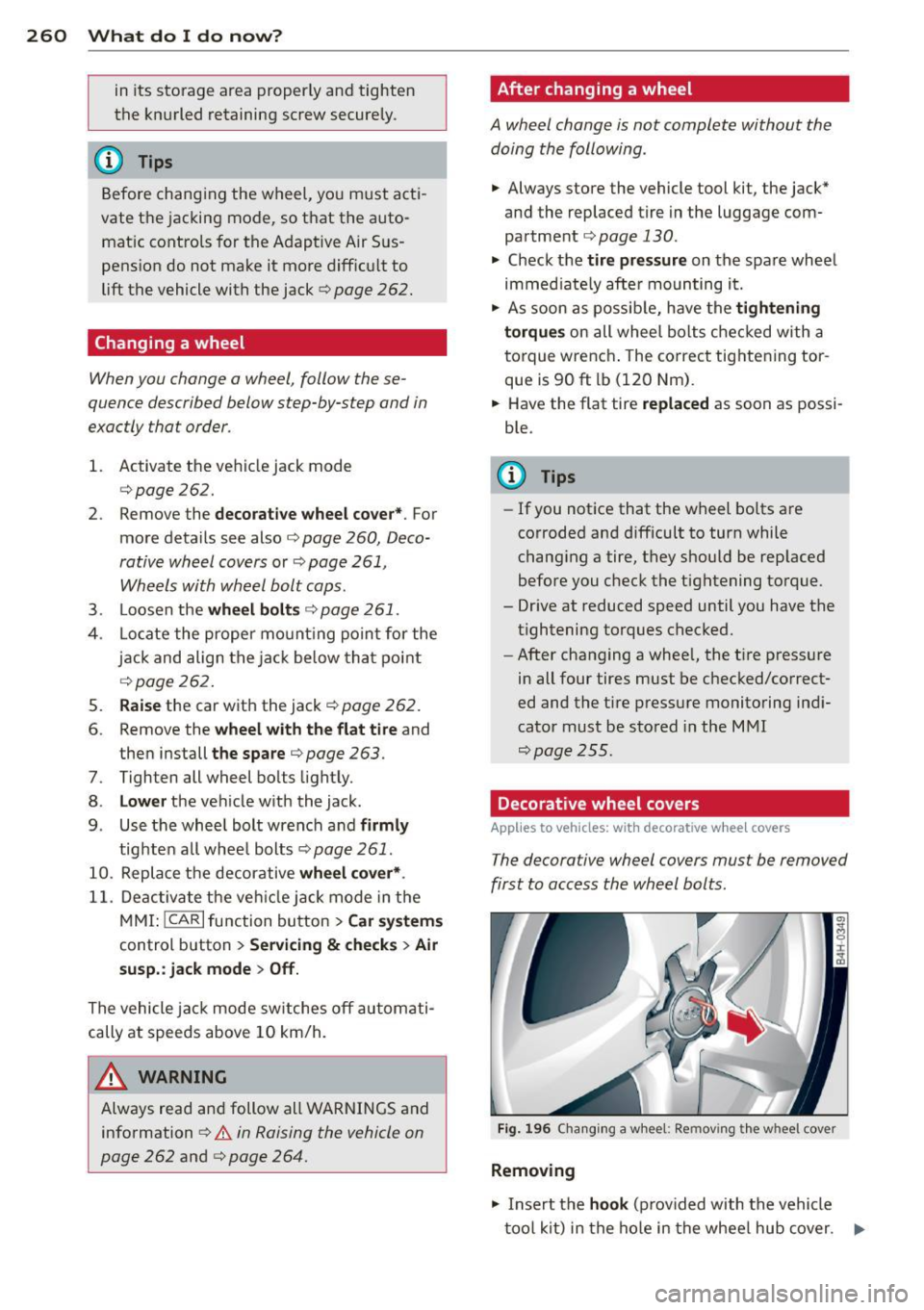
Fi g. 1 96 Chang ing a whee l: Re mov ing th e w hee l cov er
Removing
.,. Insert the hook (prov ided with the vehicle
too l kit) in the ho le in the whee l hub cover . .,..
Page 265 of 300
CD Note
Do not lift the vehicle by the sill. Position
the vehicle jack only at the designated lift ing points on the sill. Otherwise, your vehi
cle will be damaged.
(D Tips
The vehicle jack mode switches off auto
matically at speeds above 10 km/h.
Taking the wheel off/installing the spare
Follow these instructions step-by-step for
changing the wheel.
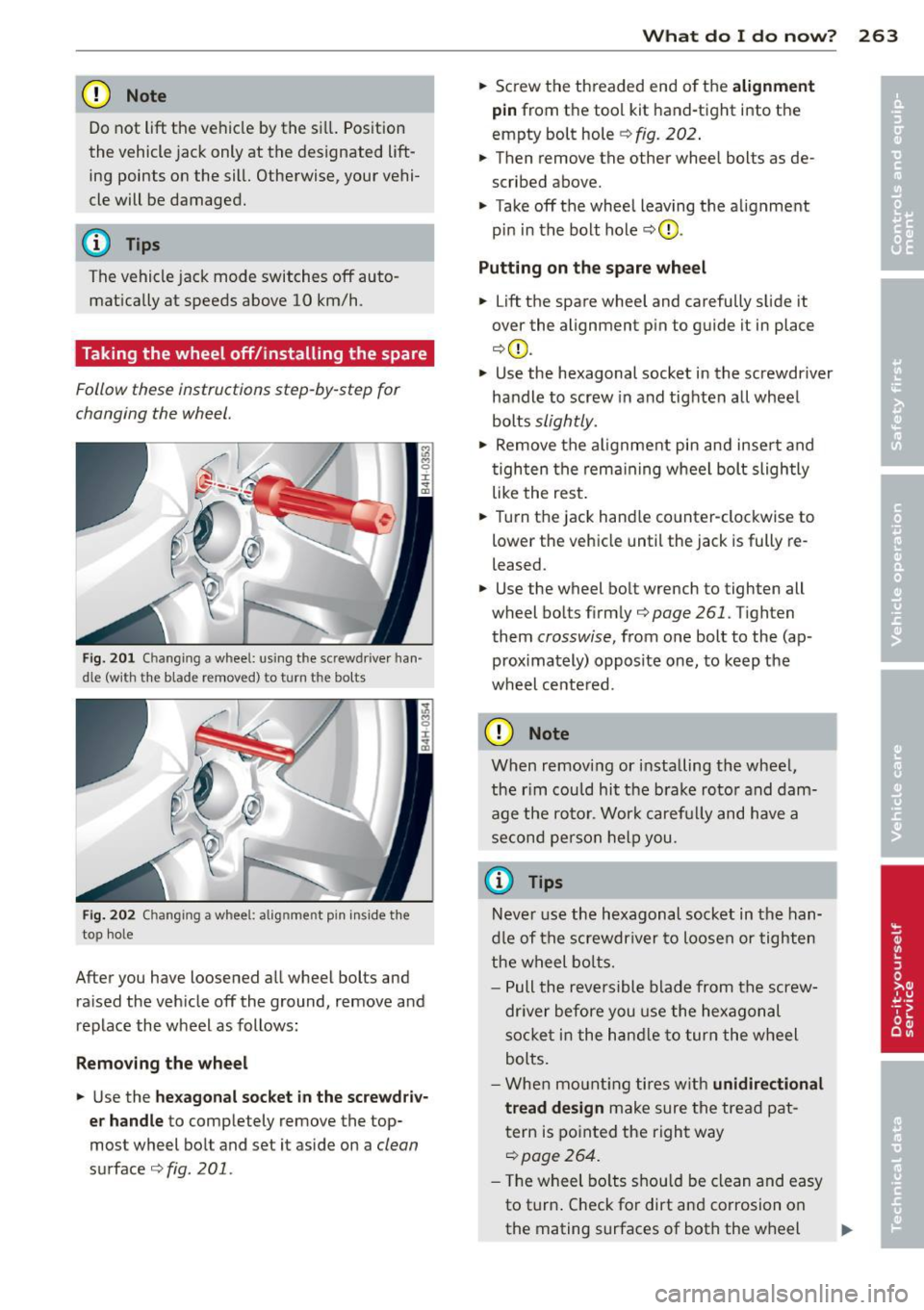
Fig . 201 Chang ing a whee l: using the screwdrive r han
dle (with the blade removed) to turn the bolts
Fi g. 202 Ch anging a wheel: alignment pin inside the
top hole
After you have loosened all wheel bolts and
raised the veh icle off the ground, remove and
replace the wheel as follows:
Re moving th e wh eel
.. Use the hex agon al so cket i n the s cre wdr iv
e r handle
to completely remove the top
most wheel bolt and set it aside on a
clean
surface ¢fig. 201.
What do I d o now ? 263
.. Sc rew the threaded end o f the alignment
pin
from the tool kit hand-tight into the
empty bolt hole¢
fig. 202 .
.. Then remove the other wheel bolts as de
scribed above.
.. Take off the wheel leaving the alignment
pin in the bolt hole
¢ (D .
Putting o n the spare w heel
.. Lift the spare wheel and carefully slide it
over the alignment p in to guide it in place
¢(]) .
.. Use the hexagonal socket in the screwdriver
handle to screw in and tighten all wheel
bolts
slightly.
.,. Remove the a lignment pin and insert and
tighten the rema ining wheel bolt slightly
like the rest .
.. Turn the jack hand le counter-clockwise to
lower the vehicle until the jack is fully re
leased .
.. Use the wheel bolt wrench to tighten all
wheel bolts firmly¢
page 261. Tighten
them
crosswise, from one bolt to the (ap
proximately) opposite one, to keep the
wheel cente red.
CD Note
When removing or installing the wheel,
the r im cou ld hit the b rake rotor and dam
age the rotor. Wor k carefully and have a
second pe rson help you.
@ Tips
Neve r use the hexagonal socket in the han
dle of the screwdr iver to loosen or tighten
the wheel bo lts.
- Pull the reversible blade from the screw
dr iver before you use the hexagonal
socke t in the hand le to turn the wheel
bolts.
- Whe n mount ing tires w ith
unidire ctional
t read de sign
make sure the tread pat
tern is pointed the right way
¢page 264.
- The wheel bo lts s hou ld be clean and ea sy
to turn . Check for dirt and corrosion on
the mating surfaces of both the wheel
Page 266 of 300
264 What do I do now?
and the hub. Remove all dirt from these
surfaces before remo unting the wheel.
Tires with unidirectional tread design
Tires with unidirectional tread design must be
mounted with their tread pattern pointed in
the right direction.
Using a spare tire with a tread pattern
intende d fo r use in a specific direction
When using a spare tire with a tread pattern
intended for use in a specific direction, p lease
note the fo llowing:
- T he direction o f rotation is marked by an a r
row on the side of the tire.
- If the spare t ire has to be installed in the in
correct di rection, use the spare tire only
temporarily since the tire will not be able to achieve its optimum performance character
ist ics with regard to aquaplaning, noise and
wear.
- We recommend that you pay particular at
tent ion to this fact during wet weather and
that you adjust your speed to matc h road
condit ions .
- Replace the flat tire w ith a new one and
have it installed o n your ve hicle as soon as
poss ible to restore the handling advantages
of a un id irect iona l tire .
Notes on wheel changing
Please read the information i:> page 246, New
t ires and repla cing tires and wheels
if you are
going to use a spare tire which is differen t
from the tires on your ve hicle.
Afte r you cha nge a tire :
-Check the t ire pressure on the spare imme
diately after installation .
- Have the wheel bolt tightening torque
checked with a torqu e wrench as soon as
possib le by your authorized Audi dealer or
a qualified servi ce station .
- With st eel and alloy wheel rims , the wheel
bolts are correctly tightened at a torque of
90 ft lb (120 Nm) . -
If you notice that the wheel bolts are cor
roded and difficult to turn while chang ing
a tire , they should be repl aced before you
check the t ightening torque.
- Repl ace the flat ti re w ith a new one and
have it installed on your vehicle as soon a s
possible. Remount the wheel cover .
Until then , dri ve with extra care and at re
duced speeds.
A WARNING
- I f you are going to equip your vehicle
with tires or rims which differ from those
which were factory installed, then be
sure to read the information
i:> page 246,
New tires and replacing tires and
wheels.
- Always make sure the damaged wheel o r
even a flat tire and the jack and tool ki t
are properly secu red in the luggage co m
p ar tment and are no t loo se in the pas
senger compartment .
- I n an accident or sudde n maneuver they
could fly forward, injuring anyone in the
veh icle.
- Always s to re dam aged wheel, j ack a nd
t oo ls sec urely in the l uggage compa rt
men t. Othe rwise, in an accident or s ud
den maneuver they could fly forwa rd,
causing injury to passengers in the vehi
cle.
Page 276 of 300

2 7 4 Emergency situations
@ Tips
Check carefully to make sure the hook-up
is secure before moving the car up the flat
bed truck ramp.
Vehicle transport
Whenever you have your vehicle transported,
be sure to note the following:
(D Note
Mount the tie-down chains/cables over the
running surface (circumference) of the
tires. Never secure the vehicle by the axle,
the suspension struts or the front or rear
towline eye. For technical reasons, the
pressure in the suspension struts may
change during the transport and this will
adversely affect vehicle handling.
Lifting vehicle
Lifting with workshop hoist and with
floor jack
The vehicle may only be lifted at the lifting
points illustrated.
Fig. 215 Front lift in g po int
Fig. 216 Rear lifti ng point
.,. Read and heed WARNING ¢ _&.
.,. Activate the vehicle jack mode in the MMI :
!CARI function button > Car systems control
button
> Servicing & checks > Air susp.:
jack mode
> On.
.,. Locate lifting points ¢ fig . 215 and
¢fig. 216 .
.,. Adjust lifting arms of workshop hoist or
floor jack to match veh icle lifting points .
.,. Insert a rubber pad between the floor jack/
wo rkshop hoist and the lifting points.
The vehicle jack mode must be act ivated so
that the automat ic adjustment of the Adap
tive Ai r Suspens ion does not make it more dif
ficult to raise the vehicle with the floor jack.
If you must lift your vehicle with a floor jack
to work underneath, be sure the vehicle is
safely supported on stand s intended for this
purpose.
Front lifting point
The lifting point is located on the floor pan re
i nforcement about at the same level as the
jack mounting point
¢ fig. 215 . Do not lift
the vehicle at the vertical sill reinforcement.
Rear lifting point
The lifting point is located on the vertical rein
forcement of the lower sill for the on-board
jack
¢fig. 216.
Lifting with vehicle jack
Refer to ¢page 262.
A WARNING ,= -
-To reduce the risk of serious injury and
veh icle damage.
- Always lift the vehicle only at the spe
cia l workshop hoist and floor jack lift
points illustrated
¢ fig . 215 and
¢ fig. 216 .
-Failure to lift the vehicle at these
points could cause the vehicle to tilt or
fall from a lift if there is a change in ve
hicle weight distribution and balance.
This might happen, for example, when heavy components such as the eng ine
block or transmission are removed .
Page 284 of 300
28 2 Con sum er Inf ormation
-Always make sure the transmission se
lector lever (automatic transmiss ion) is
in "P" (Park position) and the park brake
is f irmly app lied .
@) For the sake of the environment
-Changing the engine settings wi ll ad
versely affect em iss ion levels. This is det
rimental to the environment and increas
es fuel consumption .
- Always observe env ironmental regula
tions when dispos ing of old engine oil,
used brake fluid, dirty engine coolant,
spent batteries or worn out tires.
- Undeployed airbag modules and preten
s ioners might be classified as Perchlo
rate Material -spec ial handling may ap
ply, see www.dtsc.ca .gov/hazardous
was te/perch lorate . When the veh icle or
parts of the res traint system including
airbag modules safety belts wit h preten
sioners are scrapped, all applicable laws
and regulations must be observed. Your
authori zed Aud i dea ler is familiar with
these requirements and we recommend
that you have your dealer perform this
serv ice for you .
Additional accessories,
modifications and
parts replacement
Additional accessories and parts
replacement
Always consult an authorized Audi dealer be
fore purchasing accessories.
Your veh icle incorporates the latest safety de
sig n featu res ensu ring a high standard of a c
tive and passive safety .
This safety could be comp romised by non-ap
proved changes to the ve hicle. For this reason ,
if pa rts have to be replaced , please obse rve
the following points when install ing addition
a l accessories: Approved Audi accessories and genuine Aud
i
parts are available from authorized A udi deal
ers.
T hese dea le rs a lso have the necessary facili
ties, tools and tra ined specialists to install the
parts and acc essories proper ly .
A WARNING
-Using the wrong spare parts or using non-
approved accessories can cause damage to
the veh icle and ser ious persona l injury.
- Use on ly accessories express ly approved
by Audi and ge nuine Audi spare parts
- These parts and accessories have been
specia lly designed to be used on yo ur ve
h icle .
- Never install accessor ies such as tele
phone crad les or beverage ho lders on a ir
bag covers or within the airbag deploy
ment zones . Do ing so will increase the
risk of injury if a irbags are triggered in an
accident!
- Before you check anything in the engine
compa rtment, always read and heed a ll
WARNI NGS
9 page 213 .
(D Note
-If items other than genu ine Audi spare
parts, add-on equipment and accessory
items are used or if repair work is not
performed accord ing to specified meth
ods, this c an resu lt in seve re damage to
your vehicle's eng ine and body (such as
corrosion) and adversely affect yo ur vehi
cle's warranty .
- T he innovative a luminium concept of
your Audi AB means that all servicing, re
pairs or other work on the vehicle body
must be carr ied out exclusive ly by an Au
di workshop .
- If emergency repairs must be performed
elsewhere, have the veh icle examined by
an authorized Audi dealer as soon as
possible .
- The manufacturer cannot be held liable
for damage wh ic h occurs due to failure
to comply with these stipulations .
Page 287 of 300

A
Accessories .................. ... ... 282
AC (automatic climate control) ... .. .. .. 76
Adaptive air suspension/sport ......... 103
adaptive cruise control Stop-and-go traffic ................. 91
Adaptive cruise control . . . . . . . . . . . . . . . . 87
Messages . . . . . . . . . . . . . . . . . . . . . . . . . 94
Request for driver intervention . . . . . . . . 92
Sensoren/Kamera reinigen .......... 205
Adaptive Light (defective) ... .......... 21
Adding Engine coolant .............. ... ... 228
Eng ine oil ........................ 225
Windshield washer fluid ............ 234
Additives Engine oil .. ................. .. ... 225
Adjustable steering column ............ 79
Adjusting Air distribution (automatic climate con-
trol) . . . . . . . . . . . . . . . . . . . . . . . . . . . . . . 77
Front seats . . . . . . . . . . . . . . . . . . . . . . . . 54
Instrument illumination ............. 47
Steer ing column .............. ...... 79
Temperature (automatic climate control) 77
Airbag system . . . . . . . . . . . . . . . . . 142, 161
Advanced Airbag System ............ 146
Advanced Airbag System components . 149
Care ........................ ..... 155
Ch ildren ......................... 167
Ch ild restra ints ............... ..... 168
Components (front airbags) . ... .. .. . 149
Danger of fitting a child seat on the front
passenger seat .................... 144
Disposal . . . . . . . . . . . . . . . . . . . . . . . . . 155
Front airbags . . . . . . . . . . . . . . . . 146, 147
How do the front airbags work? ... .. . 151
How many airbags does my vehicle
have? ... ..... ........... ...... .. 149
H ow the Advanced Airbag System com-
ponents work together ............. 150
I mportant safety instructions on the
knee airbag system .......... ... .. . 159
Important things to know ... ... .. .. . 142
Knee airbags ...................... 157
Monitoring . . . . . . . . . . . . . . . . . . . . . . . 153
PASSENGER AIR BAG OFF light ...... . 153
Index 285
Repairs .......................... 155
Safety instructions .. .............. . 155
Side a irbags ... .. .. ............... 160
Side curtain airbags ................ 163
Warning/indicator lights ............. 18
Warning/Indicator lights .......... . 153
Weight-sensing mat ... .. ..... ..... 167
When must the system be inspected? 153
Aircraft Transporting your vehicle ........... 274
Alloy wheels .. .... .. ............... 208
All Wheel Drive ..................... 191
Winter tires ...................... 250
Ambience lighting ................... 46
Anti-freeze
refer to Engine coolant ............ . 227
Anti-lock braking system ............. 187
Warning/ind icator lights ............. 19
Anti-slip regulation ................. 187
Anti-theft systems Electronic immobilizer ............... 29
Audi braking guard
refer to b rak ing guard ............... 87
Audi drive select
refer to drive select 103
Audi Service Repair Manuals and Litera-
ture .............................. 280
AUTO Automat ic climat e control ............ 76
Automatic headlights ............... 43
Auto Lock . . . . . . . . . . . . . . . . . . . . . . . . . . 30
Automatic belt retractor ............. 137
Automat ic car wash ................. 204
Automatic climate control Air vents . . . . . . . . . . . . . . . . . . . . . . . . . . 77
Automatic recirculation .............. 78
Operation . . . . . . . . . . . . . . . . . . . . . . . . . 76
Setup ............................ 78
Automatic climate control system
synchronizing . . . . . . . . . . . . . . . . . . . . . . 77
Automat ic transmission (t iptronic) ..... 109
Emergency mode .................. 112
Kick-down ... ..................... 112
Manual shifting .. .. . .. .. ..... ..... 112
Parking lock emergency release ...... 113
Se lector lever positions ............. 109
Automatic wipers .................... 48
•
•
Page 288 of 300

286 Index .:..:..:..::....::.....:..._ ___________________________ _
Auto Safety Hotline ....... ... .. .... . 132
Average consumption ........... .. .... 24
Ave rage speed . . . . . . . . . . . . . . . . . . . . . . . 24
Avoid damaging the vehicle .. .. .. .... . 195
B
Battery ... .. .. . .. ..... ..... .. .. .. . 230
Charging . .. .. . ... ... .. .. .. .. .. .. . 233
Important warnings .. .... .. .. .... . 231
Location ... ... ............ .. .... . 231
low ..... .. ................ ..... . 192
Replacing the battery ....... ... ... . 234
State of cha rge .... .... ....... .. .. . 192
Winter operat ion .. ... .... .. .. .. .. . 230
Working on the battery .. ... ... .... . 231
Before driving .............. ... .... . 124
Blended gasoline ....... .... ... .. .. . 215
Blower (automatic climate control) . . . . . . 77
Body cavity sealing .. ..... .. .. .. .. .. . 208
Booster seats ................ ... ... 174
Brak e fluid
Ch anging the brake fluid ... .. .. .. .. .
230
Che cking the brake f luid level ... .. .. . 229
What is the correct brake flu id level? ..
229
What should I do if the brake fluid warn -
ing light comes on? ........ .... ....
229
Brake system
Anti-lock b raking sys tem ... .. .. .... ..
19
Brake a ssi st s ystem ...... ..... .. .. . 187
Brake booster ............. ... .. ... 190
Brake fluid .... ... .... ..... .. .. .. . 229
Brake fluid spec ificat ions for refill and re-
p lac ement ....... ....... .. .. .. .. .
230
Brake light defect ive .. .. .. .. .. .. .. . . 21
Brake pads ............... ... .... . 194
Electromechanica l parking brake .... .. 82
Fluid reservoir ............ ... .... . 229
How does moisture or road s alt affect the
br akes? .. ...... .. ... .... .. .. .. .. .
189
Warning/indicator lights .... .... ..... 14
Worn brake pads symbol ....... .. .... 19
braking guard .............. ... .... .. 87
Messages . . . . . . . . . . . . . . . . . . . . . . . . . 94
Se ttings . .. .. . .. ..... ..... .. .. .. .. 94
Break-in period .............. .. .... . 194
Brake pads ............... ... .... . 194
Tires 194
Bulbs ..... ..... .. ............. .... 269
C
Cal iforn ia Proposition 65 Warn ing . .. .. 220
Battery specific . .................. 232
Capacities .. .. .. .. .. ...... ..... .. .. 278
Engine oil ....... ................ . 222
Car care ...... .. .. .. ....... .... .... 203
Exterior ... .. .. .. ...... ..... .. .... 203
Interior .......... .... ........... . 209
Car carrier
Transporting your vehicle .......... .
274
Catalytic converter 195
Center armrest
Cockpit ...... ... .. .............. ..
5 7
Rear .... ... .. .. .. ...... ..... .. .. . 64
Central locking .. .. .... ... .. .. .. .. .. . 30
Eme rgency locking ... ... .... ... .. .. . 34
Certification .. .. . .. ... ..... ... ... .. 283
Chang ing a wheel .. .......... ...... . 259
Changing engine oil ................ . 226
Chassis (undercoating) .. ....... .... .. 208
Checking
Engine coolant level ............... .
227
Tire pressure ... .. ....... ...... .. .. 241
Child restraints
Danger of using child restraint s in the
front sea t . . . . . . . . . . . . . . . . . . . . . . . .
144
Where can I get additional information
about child restraints and the ir use? ..
184
Child restraint system anchors ..... ... 178
Child safety . .. .. .. ...... ..... .. .... 166
Convertib le locking retractor ..... .. .. 175
Guidance fixtures for lower anchorages 180
Important safety instructions for using
child saf ety seats ................. .
169
Important things to know when driving
wi th children .. .. ....... ...... ....
166
Tether anchors ... ....... ...... .. .. 1 82
Tether straps .. .. ................ . 182
Child safety lock
Rear doors (mechanical) . ..... .. .... .
37
Rear doors (power) ...... ..... ..... . 38
Child safety seats . ................. . 171
Booster seats .... ................. 174
Convertib le child sea ts . . . . . . . . . . . . . 172