belt AUDI A8 2012 Repair Manual
[x] Cancel search | Manufacturer: AUDI, Model Year: 2012, Model line: A8, Model: AUDI A8 2012Pages: 300, PDF Size: 75.06 MB
Page 184 of 300
182 Child Safet y
Relea sin g
.,. Loosen the tension on the straps following
the chi ld restraint manufacturer's instruc
tions.
.,. Depress the spring catches to release the
anchorage hooks from the lower anchorag
es.
Remember: Use tether straps to help keep the
child restraint firmly in p lace.
A WARNING
Improper use of the LATCH system can in
crease the risk of serious personal injury
and death in an acc ident.
- These anchors were developed only for
child safety seats us ing the "LATCH" sys
tem .
- Never attach other child safety seats,
belts or other objects to these anchors .
- Always make sure that you hear a click
when latching the seat in place. If you do
not hear a click the seat is not secure and
could fly forward and h it the interior of
the vehicle, or be ejected from the vehi
cl e.
&_ WARNING
Imprope r insta llation of chi ld restrai nts
w ill increase the risk of inju ry in an acc i
dent.
- Always fo llow the child restraint system
man ufa cturer's instr uctions for proper
installation of the child restraint system
and proper use of tether straps as we ll as
the lower anchorages or sa fety belts in
your vehicle .
- Always read and heed the important in
format ion and WARNINGS about child
safety and the installation of child re
straint systems
c:> page 166, Child Safe
ty.
(D Note
On veh icles with p ower adjustable rear
seats* some criteria must be observed when attaching the chi
ld restraint using
the
LATCH system:
- T o attach t he ch ild restraint sec urely, the
seat must be moved to the farthest rear
posit ion, the seat he ight set to the low
est position and the head restraint must
be adjusted to the vertical position
c:>page 57.
- If a child safety seat is attached to one of
the rear seats, this seat must not be ad
justed us ing the power controls under
any c ircumstances . T he
Entry as sistanc e
for this seat must also be deactivated in
the MM I
c:> page 60. The child safety seat
a s well as the rear se at can be damaged
by the adj ustment process .
Tether anchors and tether straps
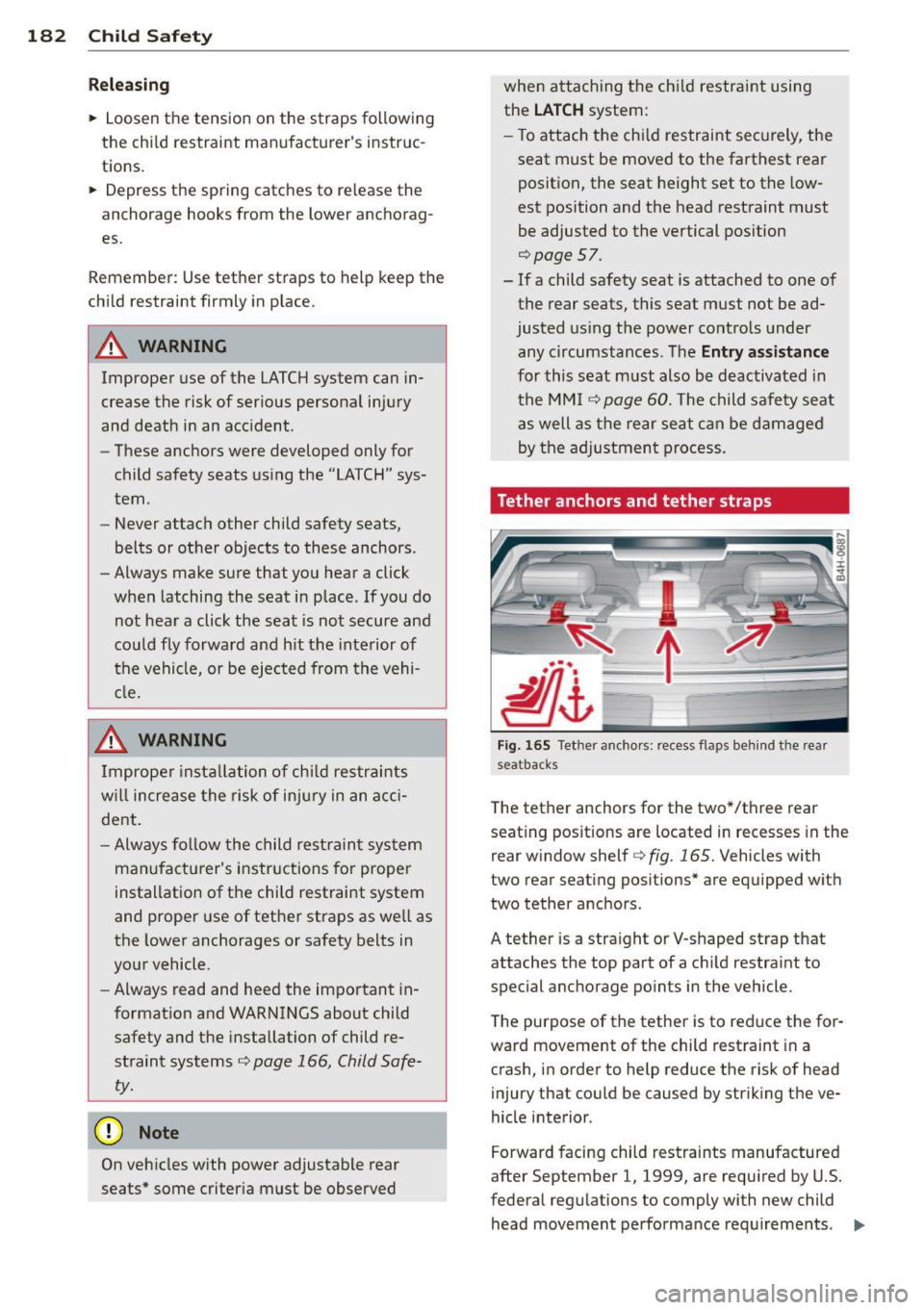
Fig. 1 65 Tet her ancho rs: recess flaps behind th e rea r
seatbacks
T he tether anchors for the two* /three rear
seat ing positions are located in recesses in the
rear w indow shelf
c:> fig . 165. Vehicles with
two rear seating positions* are equipped wit h
two tether anchors .
A tether is a stra ight or V-shaped strap that
attaches the top part of a ch ild restra int to
special anchorage po ints in the vehicle.
T he purpose of the tether is to reduce the for
ward movement of the child restraint in a crash, in order to help reduce the risk of head
injury that could be caused by strik ing t he ve
hicle interior .
Forward facing child restraints manufactured
after September 1, 1999, are requ ired by U.S.
federal regulations to comply with new child
head movement performance requirements . .,..
Page 185 of 300
These new performance requirements make a
tether necessary on most new chi ld safety
seats.
.&_ WARNING
Improper installation of child restraints
will increase the risk of injury and death in a crash.
- Always follow the instructions provided
by the manufacturer of the ch ild re
straint you intend to install in your Audi.
- Improper use of c hild restraint anchors
(including tether anchors) can lead to in
jury in a collision. The anchors are de
signed to withstand only those loads im
posed by correctly fitted ch ild restraints.
- Never mount two chi ld restraint systems
on one LATCH lower anc hor po int.
- Never attach two child restraint systems
to one tethe r strap or tether anchorage.
- Never attach a tether strap to a tie-down
hook in the luggage compartment .
- Never use child restraint tether ancho
rages to secure safety belts or other
k inds of occ upant restra ints.
- Never secure or attach any luggage or other items to the LATCH lowe r ancho
rages or to th e tethe r ancho rs.
- If a tether or other strap is used to at tach a child restraint to the front passen
ger seat, make sure that it is not so
t ight, that it causes the weight -sensi ng
mat to measu re mo re weight than is ac
t u a lly on the seat.
- T he he avier weig ht reg iste red ca n make
the Advanced Airbag Sys tem work as
tho ugh an adult were on the seat and de
ploy the Advanced Airbag w hen it must
be s uppressed causing serious or
even
fatal injury to the child .
- If you must install a rearward facing
child safety seat on the front passenger
seat because of exceptional circumstan
ces and the
PASS ENG ER AIR BAG OFF
light does not come on and stay on, im
med iate ly install the rear-facing chi ld
safety seat in a rear seating posit ion a nd
-
Child S afety 183
have the airbag system inspected by your
Aud i dealer.
Installing the upper tether strap on the
anchorage
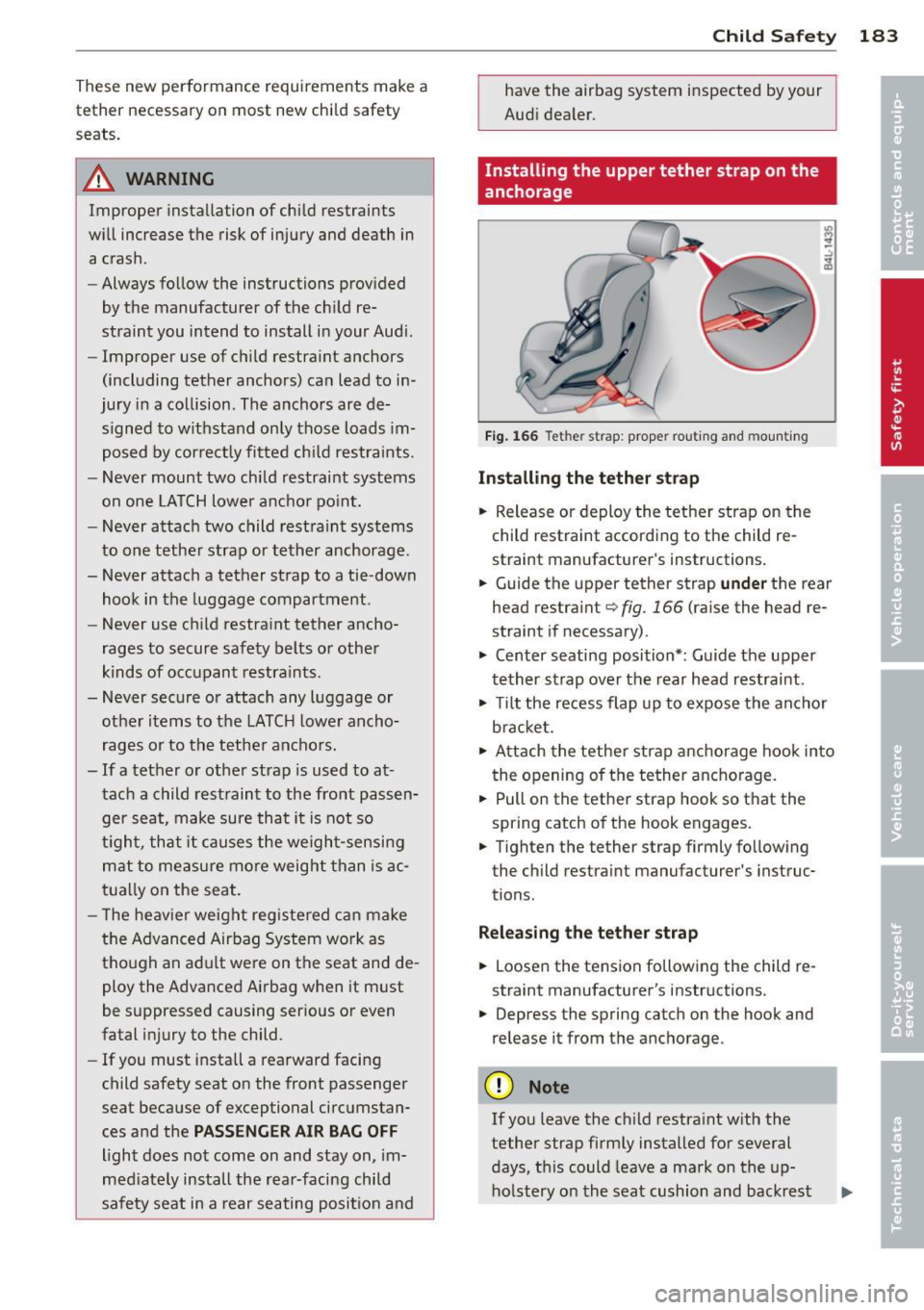
F ig . 1 66 Tet her st rap: proper ro uting and mounting
Installing the t eth er strap
.. Release or deploy the tether strap on the
child restraint according to the child re
straint manufacturer's instructions.
.. Guide the upper tether strap
unde r the rear
head restra int
qfig. 166 (ra ise the head re
straint if necessa ry) .
.. Center seating position*: Guide the upper
tether strap over the rear head restra int .
.. Til t the recess flap up to expose the an chor
bra cket.
.. Attach the tether strap anchorage hook into
the opening of the tether ancho rage .
.. Pull on the tether strap hook so that the
spring catch of the hook engages .
.. Tighten the tether strap firmly follow ing
the child restraint manufacturer's instruc
tions .
Relea sing the tether strap
.. Loosen the tension following the child re
straint manufacturer's instructions.
.. Depress the spring catch on the hook and
release it from the anchorage .
Q) Note
If you leave the child restraint w ith the
tether strap firmly installed for several
days, t his could leave a mark on the up
ho lstery o n the seat cushion and backrest
Page 186 of 300
184 Child Saf ety
in the area whe re the tether strap was in
stalled. The upholstery would a lso be per
manently stretched around the tether
strap. This applies especially to leather
seats.
Using tether straps on rearward-facing
child restraints
Currently , few rear-facing child rest rain t sys
tems come with a tether. P lease read and
heed the child restraint system manufactur
er's instructions carefully to determine how to
properly install the tether .
A WARNING
A child in a rearward -facing child safety
seat installed on the front passenger seat
w ill be seriously injured and can be k illed if
the front a irbag inflates -even with an Ad
vanced Airbag System .
- The inflating a irbag will hit the child
safety seat or infant carrier with great
force and w ill smash the ch ild safety seat
and child against the backrest, cente r
armrest, or door.
- A tight tet her or ot her st rap on a rear
wa rd-fa cing child restra int attached to
the front p assenger sea t ca n put too
much pressure on the weight -ma t in the
seat and register a heavier weight in the
Advanced Airbag System. The heavier
we ight registered can make the system
work as though an adu lt were on the seat
and dep loy the Advanced Airbag when it
must be suppressed ca using se rious or
even fatal injury to the child .
- If you must install a rearward facing child safety seat on the front passenger
seat because of exceptional circ umstan
c es and the
PASSENGER AIR BAG OFF
ligh t does no t come on and stay on, im
med iately install the rear -facing child
safety seat in a rear seating position and
have the a irbag system inspected by yo ur
Audi dealer.
Additional Information
Sources of information about child
restraints and their use
T he re a re a number o f sou rces of add itiona l
information abo ut child rest raint se lection, in
sta llation and use:
N HT SA advises that the bes t ch ild safety seat
is the one that fits your ch ild an d fits in you r
vehicle, and that yo u will use correct ly and
consistently .
T ry before yo u buy!
U.S National Highway Traffic Safety Admin
i s tration
T el.: 1-888-3 27-4 236 (TIY: 1-800- 424-9153)
www.n htsa.gov
National SAFE KIDS Campaign
T el.: (202) 662-0600
www.safe kids.o rg
Safety BeltSaf e U.S .A
Tel.: (800) 745-SAFE (English)
Te l.: (800) 7 47-SANO (Span is h)
www. carseat .org
Transport Canada Information C entre
Tel.: 1-800-333-0371 o r call
1-6 13-998-86 16 if you a re i n the Ottawa area
http://www.tc.gc.ca/e ng/ roadsafe ty/
men u.h tm
Audi Cu stomer R elation s
Tel.: (800) 822-2834
Page 187 of 300
Audi pre sense Preventative passenger
protection
App lies to veh icles: with Audi p re se nse
Audi pre sense can initiate steps to help pro
tect vehicle occupants in certain situations.
The funct ions descr ibed depend on equipment
installed in your vehicle:
Audi pre sense basic
The following functions can be triggered in
certain driving situations:
- Tightening of the safety belts (for example,
during heavy braking) : the front safety belts
have reversible belt pretensioners. If a colli
sion does not occur, the safety belts loosen
slightly and are ready to be tightened again.
- Closing the windows and the sunroof*: the
windows and the sunroof" close leaving a
small open gap .
Audi pre sense basic functions can be trig
gered at speeds above 20 mph (30 km/h).
Vehicles with Audi drive select*: the deploy
ment time is adapted in dynamic mode.
Audi pre sense front (vehicles with
adaptive cruise control*)
Audi pre sense front includes the functions in
Audi pre sense basic. In addition, within the
limits of the system, the likelihood of a colli
sion with the vehicle immediately ahead is al
so calculated . If the system senses an immi
nent collision the following functions can be
tr iggered:
- Audi braking guard
c> page 93
-Tightening the safety belts
- Closing the windows and the sunroof* ( leav-
ing a small open gap)
Audi pre sense rear (vehicles with Audi
side assist*)
Audi pre sense rear includes the functions in
Audi pre sense basic. In addition, the likeli
hood of a rear-end col lision with the vehicle
coming from behind is also calculated. If the
Audi pre sense 185
risk of a collision is detected, the following
functions can be triggered:
- Tightening the safety belts
- Closing the windows and the sunroof* (leav-
ing a small open gap)
- Adjusting the seats: the settings for the
power head restrains, the upper sections of
the backrests and the pneumatic side bol
sters* are optim ized for the front seats and
the outboard rear seats*. If a collision does
not occur, the previous seat settings are re
stored.
Audi pre sense plus
Audi pre sense plus includes the funct ions in
Audi pre sense front and Audi pre sense rear.
Error message
Audi pre sense: not available
Preventative passenger protection is not avail
able. See your authorized Audi dealer immedi
ately to have the malfunction corrected .
A WARNING
Audi pre sense cannot overcome the laws
of physics.
It cannot prevent a collision. Do
not let the increased safety provided
tempt you to take risks. This will increase
the risk of a collision and serious personal
injuries.
- The sensors cannot always detect all ob
jects . This increases the risk of a colli
sion.
-Audi pre sense does not detect people or
animals or objects that are crossing the
veh icle's path
c> page 87.
- The radar sensor's vision can be reduced
by heavy rain, ice, snow, heavy road spray
and reflections from guard rails, tunnel
entrances, etc. These and similar condi
tions can prevent vehicles from be ing ac
curately detected and in some cases they
may not be detected at all.
Ill-
•
•
Page 189 of 300
Intelligent technology Notice about data
recorded by vehicle
control modules
Your vehicle is not equipped with an Event Da
ta Recorder (EDR), installed by some manu
facturers for the express purpose of capturing
data for retrieval after an accident or crash
event. EDR's are sometimes called "crash re
corders".
Some state laws restrict the retr ieval or down
loading of data stored by EDR's that were in
stalled in a vehicle for the express purpose of
retrieving data after an accident or crash
event without the owner's consent.
Although your vehicle is not equipped with an
EDR, it is equipped with a number of electron
ic control modules for various vehicle systems
such as, for examp le, engine function, emis
sion control, as well as for the airbags and
safety belts.
These electronic control modules also record
vehicle-related data during norma l vehicle op
eration for diagnostic and repair purposes.
The recording capacity of the electronic con
trol modules is limited to data (no sound is re
corded) and only a small amount of data is ac
tually recorded over a very limited period of
time and stored when a system fault or other
condition is sensed by a control unit. Some of
the data then stored may relate to vehicle
speed, direction, braking as we ll as restraint
system use and performance in the event of a
crash or other condition. Stored data can only be read and downloaded with special equip
ment.
Electronic Stability
Control (ESC)
Description
ESC helps to improve road holding and vehicle
dynamics to help reduce the probability of
skidding and loss of veh icle control. It works
only when the engine is running. ESC detects
Intelligent technology 187
certain difficult driving situations, including
when the vehicle is beginning to spin (yaw)
out of control and helps you to get the veh icle
back under control by se lectively braking the
wheels, and/or reducing engine power and
providing steering ass istance to help hold the
vehicle on the driver's intended course. The in
dicator light
Ip.] in the instrument cluster
blinks when ESC is taking action to help you
control the vehicle.
ESC has limitations .
It is important to remem
ber that ESC cannot overcome the laws of
physics.
It will not always be able to help out
under all conditions you may come up against.
For example, ESC may not always be able to
help you master situations where there is a
sudden change in the coefficient of friction of
the road surface. When there is a section of
dry road that is suddenly covered with water,
slush or snow, ESC cannot perform the same
way it would on the dry surface . If the vehicle
hydroplanes (rides on a cushion of water in
stead of the road surface), ESC will not be
able to help you steer the vehicle because con
tact with the pavement has been interrupted
and the vehicle cannot be braked or steered .
During fast cornering, particularly on winding
roads, ESC cannot always deal as effectively
with difficult driving situations than at lower
speeds. When towing a trailer, ESC is not able
to help you regain control as it would if you
were not tow ing a trailer.
Always adjust your speed and driving style to road, traffi<; and weather conditions. ESC can
not override the vehicle's physical limits, in
crease the available traction, or keep a veh icle
on the road if road departure is a result of
driver inattention. Instead, ESC improves the
poss ibility of keeping the vehicle under con
trol and on the road dur ing extreme maneu
vers by using the driver's steering inputs to
help keep the vehicle going in the intended di
rection. If you are traveling at a speed that
causes you to run off the road before ESC can
provide any assistance, you may not experi
ence the benefits of ESC.
•
•
Page 214 of 300
212 Cleaning and protec tio n
• Apply the p roduct very sparing ly.
• Wipe it off with a damp cloth.
I f yo u have any questions about cleaning and
caring for the leather in your vehicle, it is best
to contact your authorized Audi dealer, who
will be glad to he lp you and te ll you about our
fu ll range of leather care products, such as:
- Leathe r cleaning and care kit
- Creams to care for colo red leather
- Spot removers for ballpo int pens, shoe po l-
ish, etc.
- Oil/grease dissolving spray
- New and upcoming products .
A WARNING ,_
Always read and heed all WARNINGS and
other information
~ page 203.
0 Note
- Never use chemical solvents (e.g. lighter
fluid, turpentine), waxes, shoe polish or
s imilar products on the leather surfaces
i n your Audi.
- To avoid damage, have stubborn stai ns
r emoved by a commerc ial cleaning spe
cia list.
Cleaning Alcantara ® (synthetic suede)
Applies to vehicles: with Alcantara upholstery
Removing dust and dirt
• Moisten a cloth, squeeze out excess water
and wipe down the seat su rfaces.
Removing stains
• Moisten a cloth w ith lukewarm water or
with diluted
ethyl (rubbing) alcoho l.
• Dab at the stain. Start at the outside and
work inwards.
• Once the stain is no longer visib le, use a
soft d ry cloth or tissue to soak up the mois
ture .
Do not use leather cleaning products on Al
cantara.
You may use a suitable shampoo for removing
dust and dirt. D
ust and grit in the po res and seams can
scratch and damage the surface. If the car is
l eft standing in the sun for long per iods, the
Alcantara covers should be protected aga inst
direct sunlight to prevent it from fad ing.
Slight co lor variations will develop in normal
use and are not an indication of material dete
rioration .
(D Note
-Never use chemical so lvents (e.g. lighter
fluid, turpentine), waxes, shoe polish or
simi la r products on A lca ntara® surfaces.
- To avoid damage, have stubborn sta ins
removed by a commercial clean ing spe
cialist.
- Do not use brushes, stiff sponges or sim
ilarly abrasive cleaning a ids.
Safety belts
Only well-maintained safety belts work relia
bly when needed .
.,. Keep belts clean.
• For cleaning, use a mild soap a nd water so l
ution. Let belts dry thoroug hly and away
from d irect sunlight .
• Do not allow inertia ree l safety belts to re
t ract before they are completely dry.
• Check the condition of you r safety be lts
reg
ularly .
Heavi ly so iled safety be lts may not ret ra ct
properly.
A WARNING ~
Damaged safety belts can break in a crash .
- Anyth ing th at might damage yo ur sa fety
be lts could mean that you and your pas
sengers would not be adeq uate ly pro
tected in an accident.
- Safety belt performance depends on co r
rect insta llation. Never remove be lts
from the vehicle to clean them.
- Do not use chemical cleaning agents, bleach or dyes. They have corrosive prop
erties which weaken the webb ing.
Page 215 of 300
-Wh en cl eaning your safety belts, inspect
them for damage. If you discover dam
age, see your Audi dealer .
- Always read and heed all WARNINGS and
other information ¢
page 203.
Cooler
Applies to veh icles: with coole r
A layer of ic e or frost in th e cool er interfer es
with its cooling performanc e.
Cleaning
The refr igerator sho uld be cleaned reg ula rly .
.,. Wash the cooler w ith lukewarm water a nd a
mild cleaning so lution, if necessary .
.,. The n w ipe the coole r dry.
.. Dust and dir t will acc umu late near the ven
t il ation openings in the luggage compar t
me nt due to normal coole r usage. This
sho uld be cleaned reg ularly.
Defrosting
.,. Switc h the coo ler off ¢ page 72.
.. Remove any food or beverages and al low
the coole r to defrost with the door open .
.. Wipe the inside of the coo ler dry and clean
the cooler , if necessary .
D efrost the cooler if yo u will no t be using it
for ex tended periods of time .
Q) Note
-Do no t try to speed up the defrosting
p rocess by applying heat.
- To red uce the risk of pe rsonal injury or
dam age to the refrige rator,
- do not use any abrasive cleaners, sol
vents, wax, aggressive cleaning solu
tions , so lutions with strong fragrances,
etc.,
- do not clean the coo ler with cleaning
tools such as stee l wool.
l ) U se o nly the co rr ec t cl ean in g so lu tio ns. Ne ve r use ga s
o line or d ie sel fuel.
Cleaning and protec tion 213
Engine compartment
Be especially careful when cleaning the en
gine compartment.
Always switch off the ignit ion before clean
ing the engine
¢ .& .
Plenum panel
Remove leaves from the plenum panel in front
of the windshield under the engin e compart
ment . This prevents the water drain holes
from becoming b locked , and it preve nts de
bris from entering the vehicle interio r through
the heat ing and ventilat ion ducts .
Corrosion protection
The eng in e compartm ent and transmission
have been corrosion-protected at the facto ry .
Good anti -corrosion treatment is very impor
tant , partic ularly in the w inte r.
If the vehicle
is frequently d riven on salt treated roads, th e
entire engine compartment and p lenum panel
shou ld be thoroughly cleaned at the end of
winter a nd retreated to p revent salt damage .
At the same time, the unde rside of the vehicle
shou ld be washed as well.
If the engine compar tment is cleaned at any
time with grease remov ing solutions
1> , or if
you have the engine washed, the ant i-corro
s io n treatment is almost always removed as
well.
It i s therefo re essentia l to have a long
lasti ng cor rosion pro tect ion rea pplied to all
s u rfaces , seams, joints and components in the
engine compartment .
A WARNING
Be aware: The engine com partment of any
motor veh icle is a potentially hazardous
area.
- Before work ing in the engine compart
ment, be sure to read the information
¢ page 219 .
•
•
Page 222 of 300
220 Check ing and filling
- Never smoke or work near heaters or
open flames. Fluids in the engine com
partment could start a fire.
- Keep an approved fire extinguisher im
mediately available.
- To avoid electrical shock and persona l in
jury while the engine is running or being
started, never touch:
- Ignition cables
- Other components of the high voltage
electronic ignition system.
- If you must perform a check or repa ir
with the engine running:
- First, fully apply the parking brake,
move selector lever to "P" (Park) .
- Always use extreme caution to prevent
clot hing, jewe lry, or long hair from get
ting caught in the radiator fan, V-belts
or other moving parts, or from contact ing hot parts. Tie back hair before
start ing, and do not wear cloth ing that
will hang or d roop into the eng ine.
- Min imize exposure to emission and
chem ica l hazards c:> &. .
A WARNING
California Propos ition 65 Warning:
- Engine exhaust, some of its constituents,
and certa in veh icle compone nts co nta in
o r emit chemicals known to the State of
Californ ia to cause cancer and b irth de
fects a nd rep roduct ive ha rm. In addition,
c ertain f luids con ta ine d in vehicles and
c ertain pro ducts of component wear co n
tain or emi t chemicals known to the
State of California to cause cancer and
birth defects or other reproductive harm.
- Battery posts, terminals and re lated ac
cessories contain lead and lead com- pounds, chemica
ls known to the State of
California to cause cancer and reproduc
tive harms. Wash hands after handling.
(D Note
When adding f luids, always make su re that
they are poured into the proper conta iner
or f iller opening, otherwise serious dam
age to vehicle systems w ill occur.
® For the sake of the environment
To detect lea ks in time, inspect the vehicle
floor pan from underneath regularly. If
you see spots from oil or other veh icle flu
i ds, have you r vehicle inspected by a n au
thorized Audi dealer.
Closing the engine hood
.. Pull the hood down until the pressure from
the struts is reduced.
.. Let the hood
drop down an d latc h in place.
Do not try to push it shut; it may fail to en
gage 9 /]}. .
A WARNING ,_ -
A hood that is not completely latched
could fly up and b lock your view while dr iv
i ng.
- When you close the engine hood, check it to make sure the safety catch has properly engaged. The hood shou ld be flush
wit h the surrou nding vehicle body pa rts .
- If you notice while driv ing that the hood
is not secured properly, stop at once and
close it.
Page 245 of 300
@ For the sake of the environment
Underinflated tires will a lso increase the
fue l consumption .
Tires and vehicle load limits
There are limits to the amount of load or
weight that any vehicle and any t ire can carry.
A vehicle that is overloaded w ill not handle
well and is more difficult to stop. Overload ing
can not only lead to loss of vehicle control, but can a lso damage importan t pa rts of the
ve hicle and can lead to s udden tire failure, in
cluding a blowout and sudden deflation that
can cause the veh icle to crash.
Your safety and that of yo ur passenge rs a lso
depends on making s ure that load limits are
not exceeded. Vehicle load includes everybody
and everything in and on the vehicle. These
load limits are technica lly referred to as the
vehicle's
Gros s Vehicle We ight R ating
("GVWR").
The "GVWR" includes the weight of the basic
vehicle, all factory insta lled accessories, a full
tank of fue l, oil, coolant and other fluids plus
maximum load. The maximum load includes
the number of passengers that the vehicle is intended to carry ("seating capacity") with an
assumed weight of 150 lbs (68 kg) for each
passenger at a des ignated seat ing pos ition
and the total we ight of any l uggage in the ve
hi cle. If you tow a trailer, the weight of the
trailer hitch and the tongue weight of the loaded trailer must be included as part of the
vehicle load.
The
Gro ss Axl e W eight R ating ("GAWR") is
the maximum load that can be app lied at each
of the vehicle's two axles.
The Gross Vehicle Weight Rating and the
Gross Axle Weight Rating a re listed on the
safety compliance sticker labe l located on the
driver's side B -pillar . Your Audi has 5 seating
positions, 2 in the front and 3 in the rear for
total seating capacity of 5. Vehicles with pow
er individual rear seats* have 4 seating posi
tions, 2 in the front and 2 in the rear for total
Tire s an d wheel s 243
seating capacity o f 4 . Each seating position
has a safety belt~ page 134, Safety belts .
T he fact th at there is a n upper limit to yo ur
vehicle's G ross Vehicle Weight Rating means
that the total weight of whatever is being car
ried in the vehicle (including the weight of a
tra iler hitch and the tongue weight of the
l oaded tra iler) is lim ited. The more passen
gers in the vehicle or passengers who are
heavier than the standard we ights assumed
mea n that less we ight can be carried as lug
gage .
The tire pressure label on your Audi also lists
the maximum combined weight of all of the
occupants and luggage or other cargo that
the vehicle can carry . For the locat ion of the
label ~page239, fig.183.
A WARNING
Overloading a vehicle can cause loss of ve
hicle contro l, a crash or other accident, se
rious personal injury, and even death.
- Ca rrying more we igh t than your veh icle
was des igned to carry wi ll prevent the
vehicle from handling properly and in
crease the risk of the loss of vehicle con
trol.
- The brakes on a vehicle that has been
overloaded may not be able to stop the
veh icle w ith in a safe distance.
- Tires on a vehicle that has been over load
ed can fail suddenly, incl uding a blowout
and sudden deflation, causing loss of
control and a crash .
- Always make sure that the total load be
ing transported -includ ing the weight of
a trailer hitch and the tongue we ight of a
loaded trailer -does not make t he vehi
cle heavier than the vehicle's Gross Vehi
cle Weight Rating.
Determining correct load limit
U se the exa mple be lo w t o cal
c ulat e th e t otal weight of the
pa sse ngers a nd lu gg age or
•
•
Page 269 of 300

Fuse s and bulb s 267
Luggage compartment fuse assignment
Fig. 207 Luggage compartment: fuse pa nel with plastic bracket
Fuse panel @ (black ) Fuse panel @ (b la ck)
No . Equi pment Amps No. Equipment Amps
[ru button, data logger, diag-
11 Dynamic
steering
5
l nostic connector, BCM -1,
5
Selector lever, BCM-2 5
adaptive light ing system
Audi side assist
5
2 Networking gateway 5
Engine control module 5
3 adaptive air suspension
5
Starter 40
4 Parking system 5
Left headlight/Headlight
16 10/5
5 Steer
ing column lever
5
range control system
Suspension control system
6 5 Fuse panel @ (red ) sensor
Belt tensioners, airbag con-
No. Equipment Amps
7
trol module 5 1 Left
reversible be lt tens ione r
25
Heated washer fluid nozzles, 2 Right reversible belt ten-
25
Homelink (garage door sioner
8 opener), night vision system
5 3 Starter diagnosis 5
control module, sport differ- 4 DC/DC converter
7,5
ential, ioni zer
5 Adaptive cruise contro l 7,5
9
Electromechan ica l parking
5 Right headlight (headlight
brake contro l modu le
6 with adaptive light) 10 -
10 Rear seat heating, cooler, in-
5 7 ESC co ntrol modu le 5 ... terior rearview mirror