ignition AUDI A8 2012 Repair Manual
[x] Cancel search | Manufacturer: AUDI, Model Year: 2012, Model line: A8, Model: AUDI A8 2012Pages: 300, PDF Size: 75.06 MB
Page 221 of 300
Checking and filling Engine hood
Releasing the engine hood
The engine hood is released from inside the
vehicle .
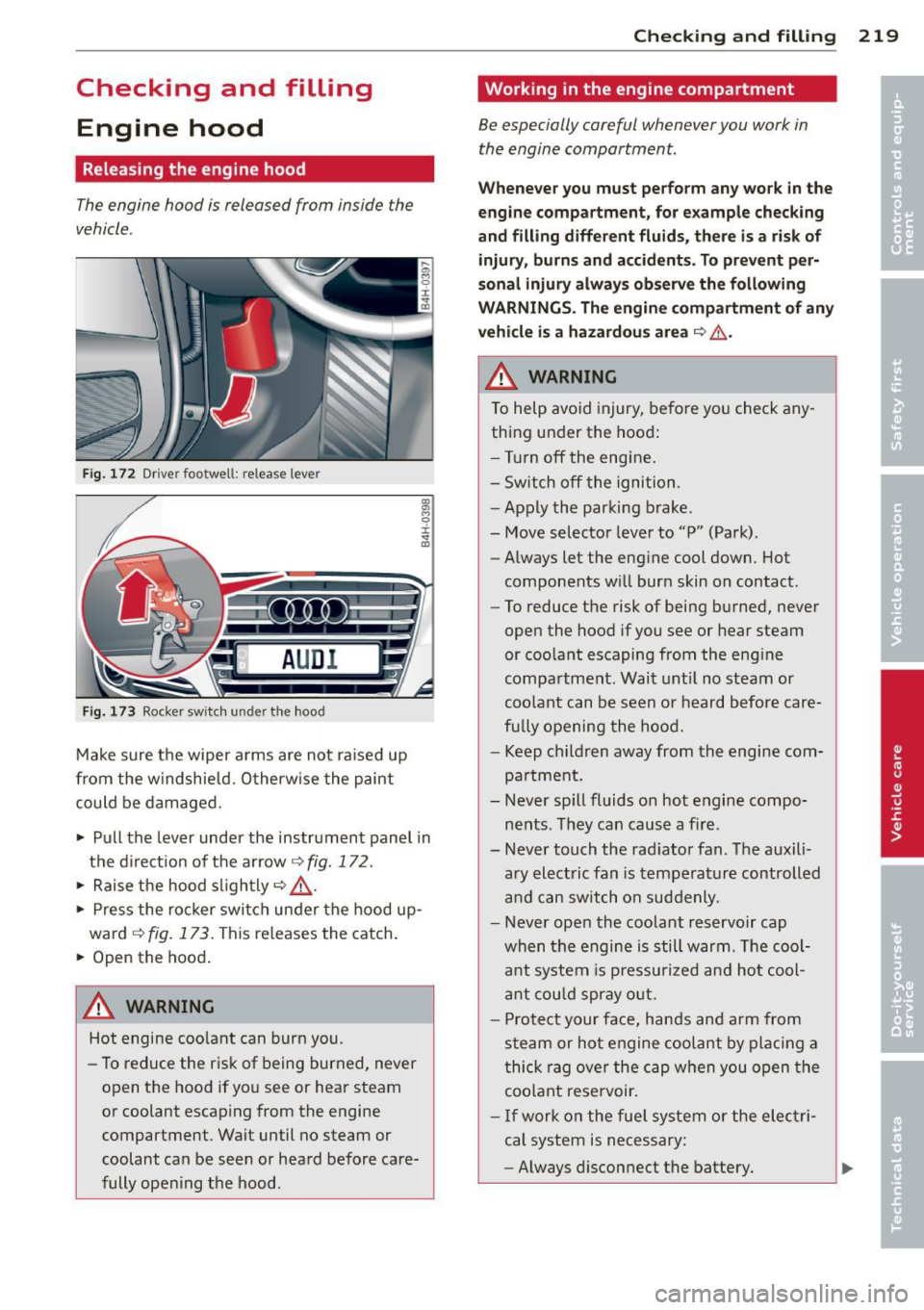
Fig. 172 Dr iver footwell: release lever
AUD I
Fig. 173 Rocker switch under the hood
Make sure the wiper arms are not raised up
from the w indshield. Otherw ise the paint
could be damaged.
.. Pull the lever under the instrument panel in
the d irect ion of the arrow
<=> fig. 172.
.. Raise the hood slightly<=> _&.
.. Press the rocke r switc h under the hood up
ward
<=> fig. 173. This re leases the catch .
.. Open the hood .
A WARNING
Hot engine coo lant can burn you.
- To reduce the r isk of being burned, never
open the hood if you see or hear steam
or coolant escaping from the engine
compartment . Wait until no steam or
coolant can be seen or heard before care
fully opening the hood.
Checkin g and fillin g 219
Working in the engine compartment
Be especially careful whenever you work in
the engine compartment.
Wh ene ve r y ou must perform an y wo rk in the
eng ine com pa rtm ent , for e xample checking
a nd filling diff ere nt fluids, th ere is a risk of
inju ry, burn s and accid ent s. To pr event per
so nal injury alwa ys observe the foll owing
WARNING S. The engin e compartment of an y
v e hicle i s a h az a rdou s are a
<=> ,&.
_&. WARNING
To help avoid injury, be fore yo u check any
thing under the hood:
- Turn off the engine .
- Sw itch off the ignition.
- Apply the parki ng brake.
- Move selector leve r to "P" (Park).
- Always let the engine cool down. Hot
components w ill burn skin on contact .
- To reduce the risk of being burned, never
open the hood if you see or hear steam
or coo la nt escaping from the engine
compa rtment. Wait unt il no steam or
coolant can be seen o r heard before care
fu lly opening the hood.
- Keep ch ildren away from the engine com
pa rtment.
- Never sp ill fluids on hot engine compo
nents . They can cause a fire .
- Never touch the rad iator fan. The auxili
ary electric fan is temperat ure controlled
a nd can sw itch on suddenly .
- Never open the coolant reservoir cap
when the engine is still warm. The cool
a nt system is p ressu rized and hot cool
a nt cou ld spray o ut.
- Protect your face, hands and arm from
steam or hot engine coolant by plac ing a
thick rag ove r the cap when you open the
coo lant rese rvoir.
- If work on the fue l system o r the elec tri
cal system is necessary:
- Always disconnect the battery.
Page 222 of 300
220 Check ing and filling
- Never smoke or work near heaters or
open flames. Fluids in the engine com
partment could start a fire.
- Keep an approved fire extinguisher im
mediately available.
- To avoid electrical shock and persona l in
jury while the engine is running or being
started, never touch:
- Ignition cables
- Other components of the high voltage
electronic ignition system.
- If you must perform a check or repa ir
with the engine running:
- First, fully apply the parking brake,
move selector lever to "P" (Park) .
- Always use extreme caution to prevent
clot hing, jewe lry, or long hair from get
ting caught in the radiator fan, V-belts
or other moving parts, or from contact ing hot parts. Tie back hair before
start ing, and do not wear cloth ing that
will hang or d roop into the eng ine.
- Min imize exposure to emission and
chem ica l hazards c:> &. .
A WARNING
California Propos ition 65 Warning:
- Engine exhaust, some of its constituents,
and certa in veh icle compone nts co nta in
o r emit chemicals known to the State of
Californ ia to cause cancer and b irth de
fects a nd rep roduct ive ha rm. In addition,
c ertain f luids con ta ine d in vehicles and
c ertain pro ducts of component wear co n
tain or emi t chemicals known to the
State of California to cause cancer and
birth defects or other reproductive harm.
- Battery posts, terminals and re lated ac
cessories contain lead and lead com- pounds, chemica
ls known to the State of
California to cause cancer and reproduc
tive harms. Wash hands after handling.
(D Note
When adding f luids, always make su re that
they are poured into the proper conta iner
or f iller opening, otherwise serious dam
age to vehicle systems w ill occur.
® For the sake of the environment
To detect lea ks in time, inspect the vehicle
floor pan from underneath regularly. If
you see spots from oil or other veh icle flu
i ds, have you r vehicle inspected by a n au
thorized Audi dealer.
Closing the engine hood
.. Pull the hood down until the pressure from
the struts is reduced.
.. Let the hood
drop down an d latc h in place.
Do not try to push it shut; it may fail to en
gage 9 /]}. .
A WARNING ,_ -
A hood that is not completely latched
could fly up and b lock your view while dr iv
i ng.
- When you close the engine hood, check it to make sure the safety catch has properly engaged. The hood shou ld be flush
wit h the surrou nding vehicle body pa rts .
- If you notice while driv ing that the hood
is not secured properly, stop at once and
close it.
Page 226 of 300

224 Check ing and filling
With all these variab les coming in to p lay, no
standard rate of oil consumption can b e es
tablished or specif ied. There is no alternative
to regular and frequent checking of the oi l lev
el, see
Note .
If the ye llow engin e oi l level warning symbol
in the instrument cluster
1\1 li ghts up, you
should check the o il level as soon as possible
¢
page 224 or ¢ page 225. Top off the oil at
your earliest convenience¢
page 225.
A WARNING
Before yo u check anything in the engine
compartment, always read and heed all
WARN INGS
¢ .&. in Working in the engine
compartment on page
219.
(D Note
Dr iving with an insuffic ient oi l level is like
ly to ca use seve re damage to the eng ine .
{D) Tips
-The oil pressure warning display. is
not an indicator of the oil lev el. Do not
r ely on it . Instead, check the oil level in
your engine at regular intervals, pref
erably ea ch time you refuel , and always
befor e going on a long trip .
-If yo u have the impres sion you r engine
consumes excessive amo unts o f oi l, we
r ecommend that yo u consult your Audi
dealer to have the ca use of yo ur concern
properly diagnosed . Keep in mind that
the accurate measurement of oil con
sumption requires great care and may
take some time . Your Audi dealer has in
str uctions about how to measure oil con
sumption accurate ly .
Checking the engine oil level
Applies to veh icles: w ith oil level indicator
Fig. 17 6 Display : o il leve l in dicator
.,. Par k yo ur vehicle on a level surface.
.,. Shut the eng in e off when it is warm.
.,. Switch on ly the ignition back on .
.,. Wait approx imately two minutes.
.,. Select:
!CAR ! function button> Car systems
contro l butto n > Servicing & che cks > Oil
level.
.,. Check the oil level i n the display ¢ fig. 176.
Add eng ine o il if the bar o f th e oil leve l ind i
cato r is near "min"¢
page 225.
Depend ing on the way the vehicle is dr iven
and t he ope ra ti ng cond it ions, oi l consu mption
can be up to 1/ 2 quart pe r 600 miles (0 .S liter
per 1,000 km) . Consumption may be hig her
within the first 3,000 miles (S ,000 km) .
(D Tips
The oil leve l indic ato r in t he MMI Disp lay is
on ly an information display.
If the oi l level
i s low, a minimum oil war ning appea rs in
the instr ument cluster. Add oil
¢
page 225. If the hood has been opened,
the cur rent oil level is shown in t he instru
ment cluster the next t ime the ignition is
swi tched on.
Page 229 of 300
Engine cooling system
Coolant
The engine coolant performs two functions: it
keeps the engine from overheating and it pro
te cts the engine from freezing in the winter .
The cooling system is sealed and generally re
qu ires little attention .
The cooling system has been filled at the fac
tory with a permanent coolant which does not need to be changed. The coolant consists of a
mixture of water and the manufacturer's gly
col-based coolant additive G13 ant ifreeze
w ith anticorrosion add itives (SO% fo r USA
models; 60% for Canad ian models). This mix
ture bot h assu res the ne cessary frost protec
tion and protects metal components in the
engine's coo ling system from corrosion and
scaling. It also raises the boili ng po int of t he
coolant.
D o not red uce the concentration o f the coo l
ant in the summer by adding plain water .
The
proportion of coolant addit ive must be at
least 50% but not mo re than 60 %
to main
tain antifree ze protection and cooling efficien
cy. If the coolant frost protection is too low,
the coolant cou ld freeze and damage the veh i
cle heating and eng ine cooling system .
For year-round driving, antifree ze is added at
the factory for temperatures down to:
- -3 1°F (-3S°C)USA
- -40 ° F ( - 4 0 °C) Canada.
A WARNING
Before yo u check anything in the engine
compartment , always read and heed a ll
WARNINGS ¢
& in Working in the engine
compartment on page 219.
(D Note
- Befo re winter sets i n, have the coolant
chec ked to see i f th e coo lant ad dit ive i n
you r vehicle is suffic ient to meet the cli
mate cond itions . T hi s is especially impor
ta nt if yo u live in a regi on whe re the w in-
-
Checkin g and fillin g 22 7
ter is ex treme ly co ld. If necessary, i n
crease t he p ro po rtion of coo lant additive
to 60%.
- W hen a dding coolant additive to yo ur
cooling system , remembe r:
- We recommend us ing on ly coo la nt ad
di tive G 12++ or G 13 for your v ehicle .
T his co olan t ad ditive is av ailab le at au
t hor ized A udi dealers . O ther types of
an tifree ze can signi fican tly reduce cor
r osion pro te ction . The resulti ng cor ro
sion can ca use a loss of coolant a nd se
rious engine damage.
- Do not add any ty pe of rad iator leak seal
ant to you r vehicle's engine coo lant .
Add ing radiator repair flu id may adverse
ly affect t he fu nction and performance of
your cooling system and cou ld result in
damage not covered by yo ur New Ve hicle
L imited Warranty .
Checking the engine coolant level
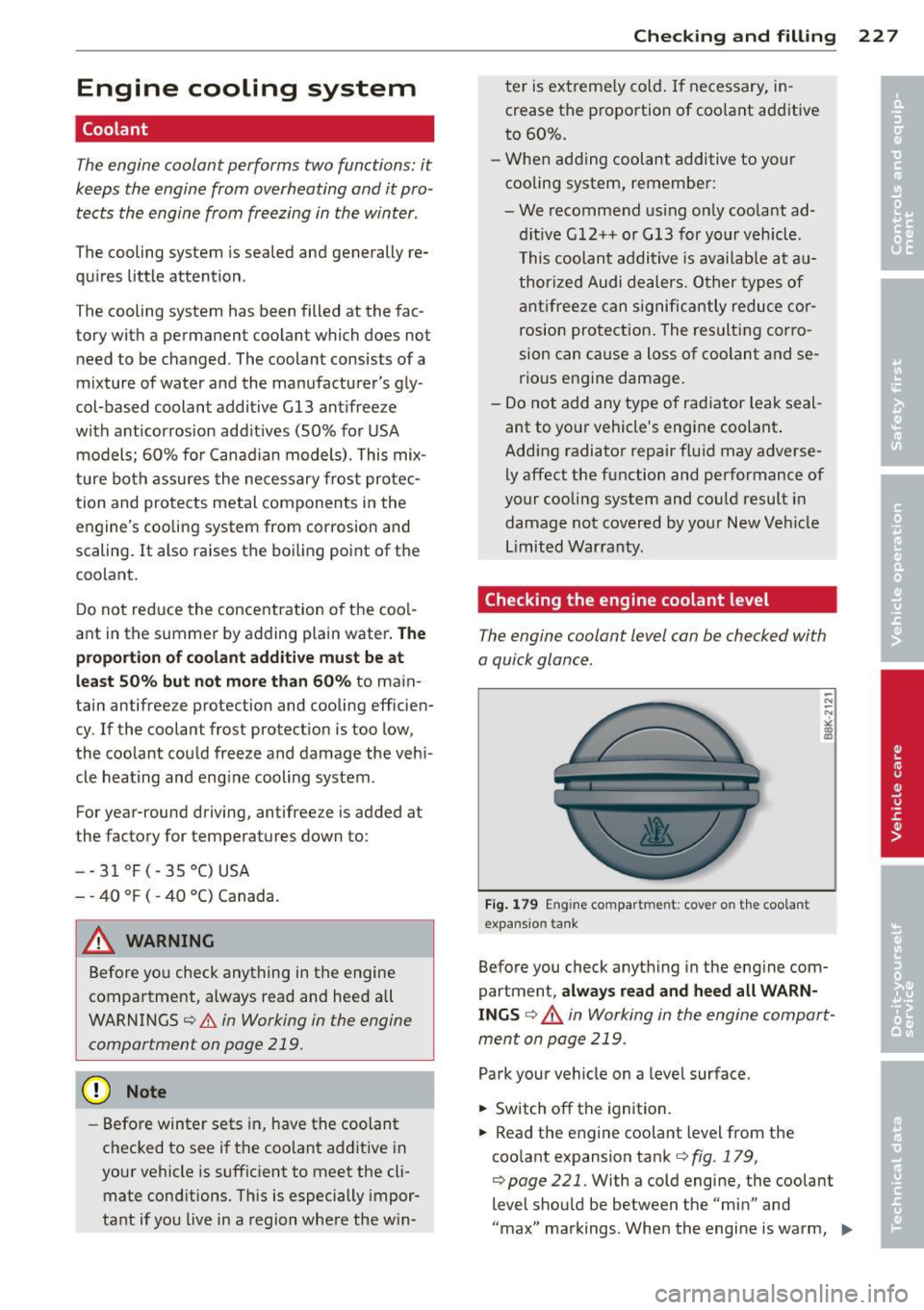
The engine coolant level can be checked with
a quick glance.
Fig. 179 En gine co mpart ment: cover on t he coo la nt
expansio n ta nk
Before you check a nyth ing in the eng ine com
partment,
always read and heed all WARN
INGS <=>&.
in Working in the engine compart
ment on page 219 .
Park your vehicle on a level surface.
.., Switch off t he ignition.
.., Read t he engine coolant level from the
coo lant expansion tank¢
fig. 179,
¢ page 221 . With a cold engine, the coolant
level shou ld be between the "min" and
"ma x" markings . When the engi ne is warm, ..,.
Page 231 of 300
scalding from hot coo lant by following
these steps.
- Turn
off the engi ne and a llow it to cool
down.
- Protect your face, hands and arms from
escapi ng fl uid and steam by cover ing
the cap with a large, thick rag .
- Turn the cap slowly and very ca refully
i n a cou nte r-clockw ise dir ect ion while
a pply ing lig ht, downwa rd p ress ure on
the top of the cap.
- T o avo id being burned, do no t sp ill an
tifree ze o r coolan t on t he exh aust sys
tem or ho t engine parts . Un der certain
conditions, the ethylene glyco l in en
gine coolant can catch fire .
- Antifree ze is poisono us. Always store an
tifreeze in its or iginal co ntainer and we ll
o ut o f the reac h of children.
- If you drain the coolant , it must be
caught and safely stored in a p roper con
tainer clear ly marked "poison".
(D Note
- Coolant po llutes the env ironment and
could ca use a n engine fire . Excess coo l
ant wi ll be forced out through the pres
sure re lief va lve in the cap when the en
gine becomes hot.
- If, in an emergency, only water can be
added , the correct ratio between water
and antifreeze¢
page 22 7 must be re
stored as soon as possib le .
@ For the sake of the environment
Drained coolant should not be re used . Al
ways dispose of used c oolant while observ
ing all envir onmental regulations .
Radiator fan
The radiator fan switches on automa tically by
itself
T he radiator fan is driven by the engine via the
V-be lt. The viscous clutch regulates the speed
of the fan according to the temperature of the
coolant .
Checkin g and fillin g 229
An auxiliary electric radiato r fan* sw itches on
and
off depending on coolant temperature
and othe r vehicle ope rat ing con ditions.
After yo u switc h the engi ne off, the aux iliary
f an can con tinue r unning for up to 10 minutes
- even with the ignition off. It can even switch
on again later by itself¢ & , if
- t he temperatu re of the engine coo lant rises
due to the heat b uild -up from the en gine in
the engi ne compartment, or
- the engine compartment heats up be cause
the vehicle is parked in intense sunlight.
A WARNING
- To reduce the risk of personal in jury nev
er touch the radiator fan.
- The a uxiliary electric fan is temperat ure
contro lled and can switch on sud denly
even when the engine is not running.
- The a uxiliary radiator fa n switches on a u
tomatically when the engine coo lant
reaches a certain temperature and will
continue to run until the coo lant temper
ature drops .
Brake fluid
Checking brake fluid level
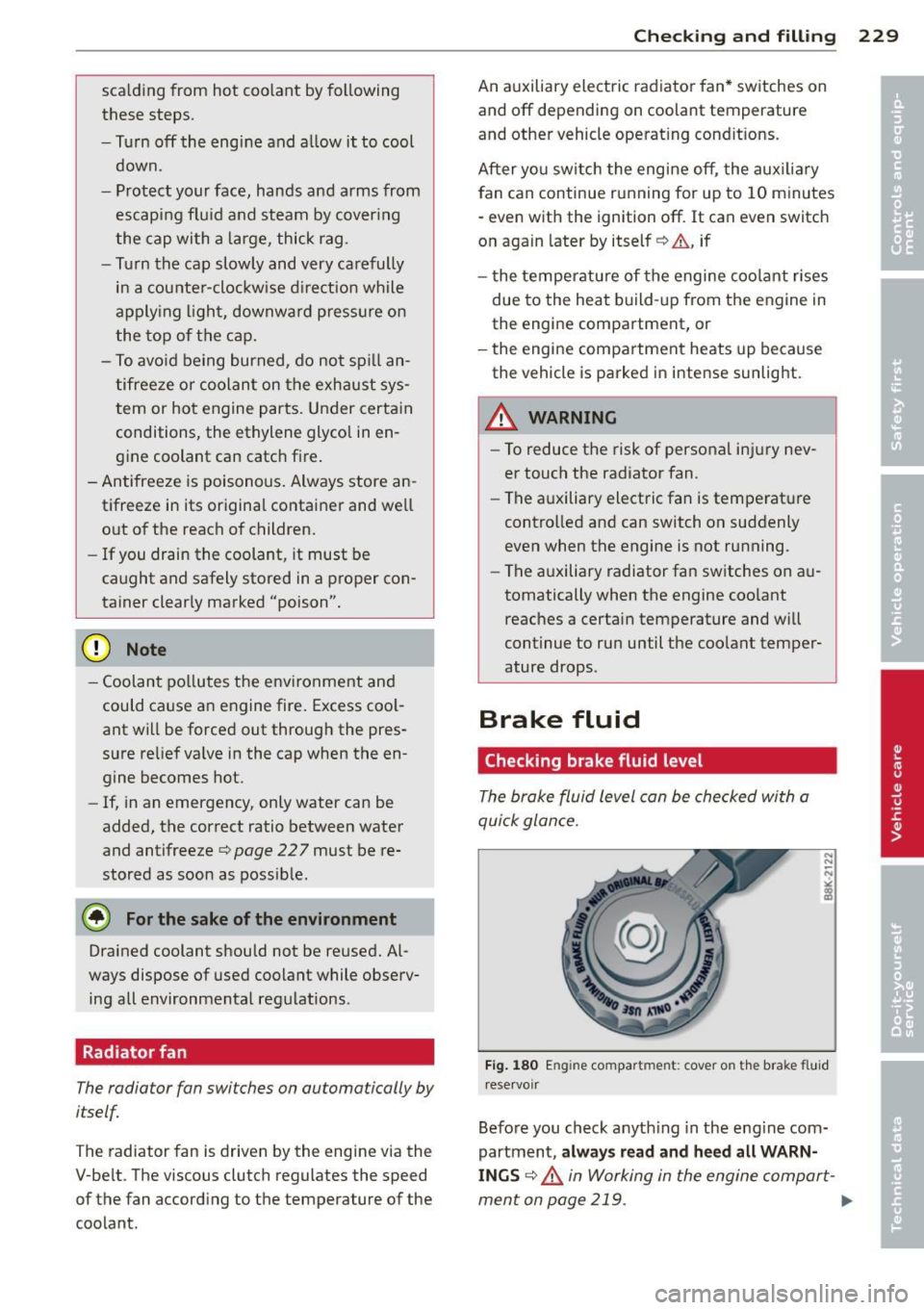
The brake fluid level can be checked with a
qui ck glance.
Fig. 180 En gin e compar tment: cov er o n th e bra ke fluid
r ese rvoir
Befo re you check anyth ing in the eng ine com
partment ,
always re ad and heed all WARN
INGS c::> ,& in Working in the engine compar t-
ment on page 219 . .,..
Page 233 of 300

Have the battery checked when you take your
vehicle in for service. Yo u are well advised to
replace a battery that is older than 5 years .
W ith certa in types o f airbag deployment, the
battery is disconnec ted from the vehicle elec
trica l system for safety reasons
c::> &. in Re
pair, care and disposal of the airbags on
page 156.
Disconn ecting the battery terminal s
Some vehicle functions (power w indow regu
l ators, for example) are lost if the battery ter
minals are disconnected . These functions have
to be re learned after the battery terminals are
connec ted again. To prevent this, the battery
should only be disconnected from the vehicle
e lectrical system when absolutely necessary
for repairs .
Vehicles not driven for long period s
If you do not drive your vehicle over a period
of several days or weeks, electrical compo
nents are gradually cu t back or switched off .
This reduces energy consumption and main
tains starting capability over a longer per iod
c::> page 192. Some of the convenience func
tions may not operate, s uch as the inte rior
lights o r the power sea t adjustment . T he con
ve nience fun ct ions wi ll be available again
when yo u switch on the ignition and start the
engine.
Winter operation
During the winter mont hs, ba ttery capaci ty
t ends to decrease as tempe rat ures d rop . Th is
is because more powe r is also consumed while
starting , and the headlights, rear window de
fogger, etc., are used more oft en.
Avoid unnecessary power cons umption, par
ticularly in c ity t ra ff ic or when t raveling on ly
short distances. Let your a uthorized Audi
dealer check the capac ity of the vehicle bat
tery before winter sets inc::>
page 233. A well
charged battery w ill not only prevent starting
problems whe n the weather is cold, but will
also last longer .
Checkin g and fillin g 231
(D Tips
If your vehicle is left standing for seve ral
weeks at extremely low temperatures, the
vehicle battery shou ld be removed and
stored where it w ill not freeze. This will
prevent it from be ing damaged and having
to be replaced .
Working on the battery
Be especially careful when working on or near
the battery.
The battery is located in the l uggage compart
ment under the floor. Before you check any
th ing in the luggage compartment,
read and
h eed all WARNINGS
c::> &_ .
Always heed the safety warnings , when work
ing on the vehicle battery or the vehicle e lec
trical system to prevent injury.
The following WARNINGS are very
important when working on the battery:
Al ways heed the follo wing WARNING SYM
BOLS and safety precautions when working on the battery.
@
®
Always wear eye protection.
Battery acid contains sulfuric acid.
Always w ear glove s and eye prot ec
tion .
No
- sparks
-flames
- smoking .
When a battery i s charged, it produ
ce s hydrogen gas wh ich i s ex plosive
and could cause per sonal injury .
Always keep the battery well out of ]
reach of children .
_& WARNING ~
Whenever working on the battery o r on
the electrical system, there is the risk of injury, accident and even fire . Read and
heed the following WARNINGS:
•
•
Page 234 of 300

232 Checking and filling
-Always wear eye protection. Do not let
battery acid or any lead particles get on
your skin or clothing . Shield your eyes .
Explosive gases can cause blindness or
other injury .
- Battery acid contains sulfuric acid . Sulfu
ric acid can cause blindness and severe
burns .
- Always wear gloves and eye protection.
Do not tilt the battery because acid
could leak out of the ventilation open
ings.
- If you get battery acid in your eyes or
on your skin, immediately rinse with
cold water for several minutes and get
medical attention .
- If you should ingest any battery acid,
seek medical attention immediately.
- Do not expose the battery to an open
flame, electric sparks or an open light.
- Do not smoke.
- Do not interchange the positive and neg-
ative cables.
= When working on the battery , be sure
not to short-circuit the terminals with
tools or other metal objects. This would cause the battery to heat up very quickly,
which could lead to damage or explosion
and personal injury.
- When a battery is charged, it produces hydrogen gas which is explosive and
could cause personal injury .
- Always keep the battery well out of the
reach of children .
- Before work is done on the electrical sys tem, disconnect the negative ground cable.
- Before performing any work on the elec
trical system, switch
off the engine and
ignition as well as any electrical equip
ment . The negative cable on the battery
must be disconnected . If you are just go
ing to replace a light bulb, then it is
enough to switch
off the lights.
- Before disconnecting the battery, switch
off the anti-theft alarm system! Other
wise you will set off the alarm. -
When disconnecting the battery, first
disconnect the negative cable and then
the positive cable.
- Before reconnecting the battery, make
sure all electrical consumers are switch
ed off. Reconnect the positive cable first
and then the negative cable . Never inter
change the cables - this could start a fire!
- Never charge a frozen or a thawed-out
battery .
It could explode! If a battery has
frozen, then it must be replaced . A dis
charged battery can freeze over at 32 °F
(0 °C) .
-Make sure the vent hose is always attach
ed to the opening on the side of the bat
tery .
- Never use batteries which are damaged.
There is the danger of an explosion! Al
ways replace a damaged battery.
A WARNING
California Proposition 6S Warning:
- Battery posts, terminals and related ac
cessories contain lead and lead com
pounds, chemicals known to the State of
California to cause cancer and reproduc
tive problems. Wash hands after han
dling.
(D Note
- Do not disconnect the vehicle battery
when the ignition is on or when the en gine is running, otherwise, you will dam
age electronic components in the electri
cal system.
- If your vehicle is going to stand for a
long period of time without being driven,
protect the battery from "freezing", oth
erwise it will be damaged and will then
have to be replaced .
Page 256 of 300

254 Tires and wheels
remain continuously illuminated. This se
quence will continue upon subsequent vehicle
start-ups as long as the malfunction exists.
When the malfunction indicator is illuminat
ed, the system may not be able to detect or
signal low tire pressure as intended. TPMS
malfunctions may occur for a variety of rea
sons, including the installation of replace
ment or alternate tires or wheels on the vehi
cle that prevent the TPMS from functioning
properly. Always check the TPMS malfunction
tellta le after replacing one or more tires or
wheels on your veh icle to ensure that the re
placement or alternate tires and wheels allow
the TPMS to continue to function properly.
Tire pressure indicator appears
Appl ies to vehicles: with tire pressure monitoring sys te m
The tire pressure indicator in the instrument
cluster informs you if the tire pressure is too
low or if there is a system malfunction.
Fig. 188 Display: underinflation warning
Fig. 189 Display: System malfu nction
Using the ABS sensors, the tire pressure moni
toring system compares the tire tread circum
ference and vibration characteristics of the in
dividual tires. If the pressure decreases in one
or more tires, this is indicated in the instru- ment
cluster with a warning symbol
[I] and a
message
r=> fig. 188.
The tire pressure monitoring system must be
reset via MMI each time the pressures are ad
justed (e.g. when switching between partial
and full load pressure) or after changing or re
plac ing a tire on your vehicle
r=> page 255. You
can find the recommended tire pressures for
your vehicle on the Label on driver's side 8-pil lar
¢ page 239.
Tire tread circumference and vibration charac
teristics can change and cause a tire pressure
warning if:
- the tire pressure in one or more tires is too
low,
- the tire has structural damage,
- the tire pressure was changed, wheels rotat -
ed or replaced but the TPMS was not reset
r=> page 255.
Warning symbols
[I] Loss of pressu re in at least one tir e ¢ ,&. .
Check the tire or tires and replace or repa ir if
necessary. The indicator light
[I] in the instru
ment cluster also illuminates
¢page 11 .
Check/correct the pressures of all four tires
and reset TPMS via MMI.
IIQllfl (Tir e Pressure Monitoring System) Tire
pressure! System malfunction .
If IIQIS, appears after switching the ignition
on or while driving¢
fig. 189 and the indica
tor light
[I] in the instrument cluster blinks
f or approximately one minute and then stays
on, there is a system malfunction . See your
authorized Audi dealer as soon as possible.
A WARNING
-- If the tire pressure indicator appears in
the instrument cluster display, one or more of your tires is significant ly under
inflated. Reduce you r speed immediately
and avoid any hard steering or braking
maneuvers. Stop as soon as possible and
check the tires and their pressures. In
flate the tire pressure to the proper pres-
sure as indicated on the vehicle's tire .,..
Page 257 of 300

pressure label¢ page 239. Driving on a
significantly under-inflated tire causes
the tire to overheat and can lead to tire
failure. Under-inflation also is likely to
impair the vehicle's handling and stop
ping ability .
- The driver is responsible for maintaining the correct tire pressures. You must check the tire pressures regularly.
- Under certain conditions (such as a spor ty driving style, winter conditions or unpaved roads), the pressure monitor indi
cator may be delayed.
-Ask your authorized Audi dealer if run
flat tires may be used on your vehicle.
Your vehicle registration becomes invalid if you use these tires when not permit
ted. Damage to your vehicle or accidents
could also result.
@ Tips
- The tire pressure monitoring system
stops working when there is an ESC/ABS
malfunction.
- Using snow chains may result in a system
malfunction.
- To ensure a proper TPMS function use
AUDI Original Tires which are marked
with "AO" or "RO" on the tire sidewall.
¢page 246.
- The tire pressure monitoring system on
your Audi was syntonized using tires with
the "AO" or "RO" identification. We rec
ommend using these tires.
Reset tire pressure monitoring system
App lies to vehicles: with tire pressure monitoring syste m
If the tire pressure is adjusted , wheels are ro
tated or changed, the TPMS must be reset via
MMI.
~ Switch on the ignition.
~ Select in the MMI: !CAR !function button>
Car systems control button > Servicing &
checks > Tire pressure monitoring > Store
tire pressures> Yes, store now .
Tires and wheels 255
(D Tips
Before resetting the TPMS, the current
pressures of all four tires must correspond
to the specified values. Adjust the tire
pressure and reset the pressure in the tire
pressure monitoring system according to
the load you are carrying ¢
page 239.
-Do not store the tire pressures if you are
driving with snow chains. Otherwise, a
system malfunction may occur .
•
•
Page 267 of 300
Fuses and bulbs
Fuses
Replacing fuses
Fuses that have blown will have metal strips
that have burned through.
Fig. 203 Dr iver side of the cockp it: fuse panel cover
~~
-----~ ~~
F ig. 20 4 Luggage compartment: fuse panel cover
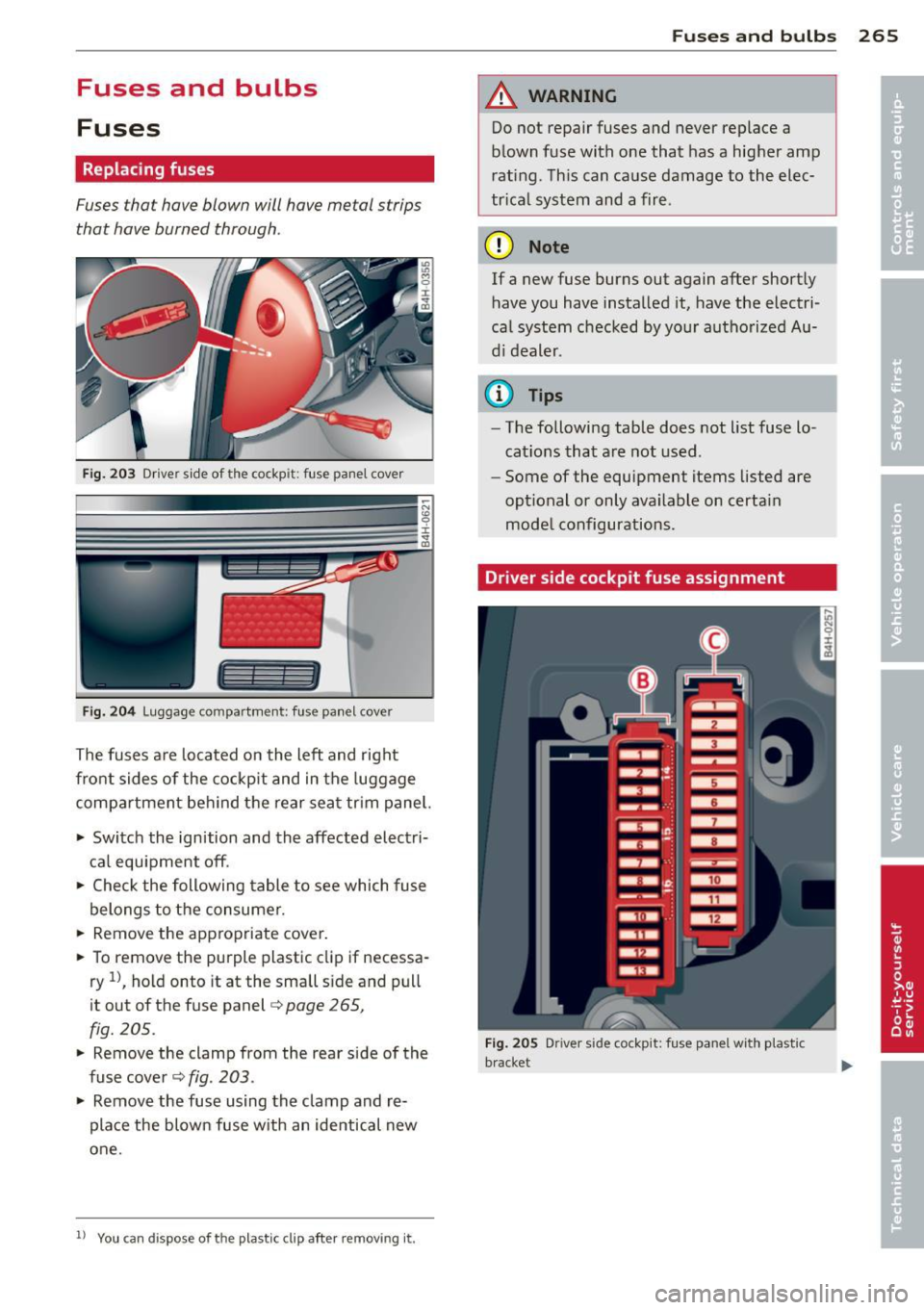
The fuses a re located on the left and right
front sides of the cockp it and in the luggage
compartment behind the rear seat tr im panel.
.. Switch the ignition and the affected electri-
ca l equipment off .
.. Check the following table to see which fuse
belongs to the consume r .
.. Remove the appropriate cover .
.. To remove the purple plastic clip if necessa
ry
1l, hold onto it at the small side and pull
it out of the fuse panel
c> page 265,
fig. 205.
.. Remove the clamp from the rear side of the
fuse cover
c> fig. 203 .
.. Remove the fuse using the clamp and re
pla ce the blown fuse w ith an identical new
one.
11 You can dis pose of the plastic clip after remov ing it.
Fu se s and bulb s 265
A WARNING
Do not repair fuses and never replace a
blown fuse with one that has a higher amp
rating . Th is can ca use damage to the elec
tr ical system and a fire .
(D Note
If a new fuse burns out again after shortly
have you have installed it, have the electri
ca l system checked by your authorized Au
d i dealer.
{i) Tips
- The following table does not list fuse lo
cat ions that are not used .
- Some of the equipment items listed are
opt ional or only available on certa in
model configurations.
Driver side cockpit fuse assignment
Fig . 205 Dr iver side cockpit: fuse pane l with p lastic
b racket