heating AUDI A8 2014 User Guide
[x] Cancel search | Manufacturer: AUDI, Model Year: 2014, Model line: A8, Model: AUDI A8 2014Pages: 314, PDF Size: 78.47 MB
Page 207 of 314
temperature. This determines the current
state of charge and the power of the battery.
Idling current management
Idling current management reduces energy
consumpt ion while the vehicle is stand ing.
With the ignition switched off, it contro ls the
energy supply to the various e lectrica l compo
nents . Data from battery diagnosis is consid
ered.
D epending on the battery's state of charge,
individua l consumers are gradua lly turned off
to prevent excessive discharge of the battery
and thus maintain starting capability.
Dynamic energy management
While the veh icle is being driven, dynamic en
ergy management dist ributes the energy gen
erated according to the needs of the individu
a l components . It regu lates consumption, so
that more electrical energy is not being used
than is being generated and ensures an opti
mal state of charge for the battery.
- But even energy management cannot negate the limits of physics. Consider
that the power and life of a battery are
limited.
- If starting ab ility is threatened, the indi
cator light(•) appears
c> page 16, D
Battery.
What you should know
The highest priority is given to maintaining
starting capability .
The battery is severely taxed in short-distance
driving, in city traffic and during the co ld time
of year. Abundant electrical energy is re
qu ired, but only a little is generated. It is also
cr itica l if the engine is not running and electri
cal components are turned on. In th is in
stance energy is being consumed but none is
be ing generated .
Intelligent technology 205
It is in precisely these situations that you will
notice energy management active ly regu lat
ing the distribution of energy.
Vehicle stands for an extended period
If you do not drive your vehicle over a period
of several days or weeks, e lectrica l compo
nents are gradually cut back or switched off.
This reduces energy consumption and main
tains starting capability over a longer period .
Some of the convenience functions may not
operate, such as the interior lights or the
power seat adjustment . The convenience
functions will be available again when you
switch on the ignition and start the eng ine.
With the engine turned off
If you listen to the radio, for example, with
the engine turned off or use other MMI func
tions, the battery is being discharged.
If starting capability is jeopardi zed due to en
ergy consumption, the following warning ap
pears in the MM I display:
Please start the engine soon or the system
will be turned off.
The warning indicates that the system will be
turned off automatically after 3 minutes. If
you w ish to continue using the functions, you
have to start the engine.
With the engine running
Although electrical energy is generated when
the vehicle is being driven, the battery can be
come discharged. This happens mostly when
li ttle energy is being generated and a great
deal consumed and the battery's state of
charge is not optimal.
T o b ring the energy ba lance back into equili
brium, consumers wh ich requ ire espe cially
large amounts of energy are temporarily cut
back or switched off . Heating systems in par
ticular require a great deal of energy. If you
notice, for examp le, that the heated seats* or
the heated rear window are not heating, they
have been temporarily cut back or switched .,.
•
•
Page 210 of 314
208 Driving and en vir onm ent
Catalytic converter
Appl ies to vehicles: with gasoline e ngin e
It is very important that your emission con
trol system (catalytic converter) is function
ing properly to ensure that your vehicle is run
ning in an environmentally sound manner .
.. Always use lead-free gasoline i=> page 222,
Fuel supply .
.. Never run the tank down all the way to emp-
ty .
.. Never put too much motor oil in your engine
¢ page 23 7, Adding engine oil
The catalytic converter is an eff ic ient "clean
up" device built into the exhaust system of
the vehicle. The catalyti c converter burns
many of the pollutants in the exhaust gas be
fore they are released into the atmosphere.
The exclus ive use of unleaded fuel is cr itically
important for the l ife of the cata lytic convert
e r and proper functioning of the engine.
A WARNING
T he temperature of the exhaust system is
high, both when driving and after stopping
the engine .
- Never touch the exhaust tail pipes once
they have become hot. This could result
in burns.
- Do not park or operate the vehicle in
areas where the hot exhaust system may
come in contact with dry grass, brush,
fuel spill or other material which can
cause a fire.
- Do not apply additional undercoating or
rustproofing on or near the exhaust
man ifold, exhaust p ipes, catalytic con
verter or heat shields . During driving, the
substance used for undercoating cou ld
overheat and cause a fire.
@) Note
- Be aware that just one tank f illing with
leaded fuel will already seriously de
grade the performance of the cata lytic
conve rter. -
Do not exceed the correct engine oil level
i=>page 237.
-Do not drive until the fue l tank becomes
completely empty . The engine co uld mis
fire . Unburned fuel could also get into
the exhaust system and this cou ld cause
the catalytic converter to overheat.
- Do not switch off the ignition while the
vehicle is mov ing.
- Do not continue to operate your vehicle
under these conditions, as otherwise fuel
can reach the catalyt ic converter. Th is
cou ld result in overheating of the con
verter, requir ing its replacement .
- To assure efficient operation of the Emis
sion Control System:
- Have you r vehicle maintained p roperly
and in accordance w ith the service rec
ommendations in your Warranty & Maintenance book let.
- Lack of prope r maintenance as we ll as
improper use of the vehicle wi ll impair
the function of the em ission contro l
system and could lead to damage.
@) For the sa ke of the en vironment
Even when the Emission Control System is
ope rat ing properly, the exhaust gas can
have a sulfur-like exhaust gas smell under
some operat ing states. This depends on
the sulfur content of the fuel being used .
Using a different brand of fuel may help,
or f illing the tank with lead-free super
grade gasoline.
Diesel particulate filter
Applies to vehicles: with diese l eng ine
The diesel part icu late filter filters nearly all of
the soot pa rticles out of the exhaust . T he fil
ter cleans itself automat ica lly unde r no rma l
dr iv ing cond itions . If the filte r cannot clean it
self (for example, because you are on ly driving
short distances), the filter becomes clogged
with soot and the
II symbol for the diesel
particulate filter i lluminates
i=> page 21. ..,.
Page 212 of 314

210 Driving and environment
The consumption estimates as published
by ENVIRONMENTAL PROTECTION AGENCY
(EPA) and Transport Canada may not corre
spond to your actual consumption on the
road, which will vary depending upon vehi
cle load and speed, road and weather con
ditions, trip length, etc.
Drive smoothly and keep a lookout
ahead
Vehicles use the most fuel when they are ac
celerating.
• Avoid unnecessary accelerating and braking.
Vehicles use the mo st fuel when they are ac
celerating. If you anticipate what is going to happen next, you will need to brake less and,
thus , accelerate less. Let the vehicle coast
whenever possible -for example when you see
that the next traffic light is red.
Avoid full throttle
Driving at moderate speeds saves fuel and
improves your mileage.
• Try and keep well below your car's maximum
speed .
Accelerating gently reduces fuel consump
tion, engine wear, and does not disturb the
environment .
Fuel consumption, exhaust emissions and en
gine noise increase disproportionately at high
speeds. If you drive at approximately three
quarters of top speed, fuel consumption will
be reduced by one half. Never drive faster
than the posted speed limit and weather con
ditions permit.
Reducing unnecessary idling
Even when your car is just idling it burns up
fuel.
• Shut the engine off when you are not driving
the vehicle. •
Do not warm up the vehicle by letting the
engine run at idle.
The idling phase is automatically reduced for
vehicles with the Start/Stop system. It is effi
cient to switch off the engine in vehicles with
out the Start-Stop-System when stopped at
railroad crossings and long red lights. Turning
the engine off for jus t 30-40 seconds saves
more fuel than is burned by starting the en-
. . gme again.
It takes a long time for the engine to warm up
fully when it is running at idle. However, wear
and noxious emissions are especially high
when the engine is warming up . So you should
drive away as soon as you start the engine and
avoid running at high rpms while the engine is
still warming up.
W Note
Do not leave engine idling unattended af
ter starting . If warning lights should come
on to indicate improper operation, they
would go unheeded. Extended idling also
produces heat, which could result in over
heating or other damage to the vehicle or
other property.
Regular maintenance
A badly tuned engine unnecessarily wastes a lot of fuel.
• Have your vehicle serviced at regular inter-
vals.
By having your vehicle regularly serviced by an
Audi dealer helps to ensure that it runs prop
erly and economically. The condition of your
vehicle not only affects its safety and ability to
hold its value, it also affects
fuel consump
tion.
Check your oil each time you
fill your tank.
The amount of oil used is related to engine
load and speed.
It is normal for the oil consumption of a new
engine to reach its lowest value after a certain
mileage has been driven . ..,.
Page 222 of 314

220 Vehicle care and cleaning
-Wheels
-Never use any paint polish or other
abrasive materials.
- Damage to the protective layer on the
rims such as stone chips or scratches
must be repaired immediately.
- Sensors/camera lenses
- Never use warm or hot water to re-
move snow or ice from the camera
lens. This could cause the lens to crack.
- Never use abrasive cleaning materials
or alcohol to clean the camera lens.
This could cause scratches and cracks.
-Windows
- Remove snow and ice on windows and
exterior mirrors with a plastic scraper.
To avoid scratches, move the scraper only in one direction and not back and
forth.
- Never remove snow or ice from win
dows and mirrors using warm or hot
water because this could cause cracks
to form.
- To avoid damage to the rear window
defogger, do not apply any stickers on
the heating wires on the inside of the
window.
- Decorative parts/trim
- Never use chrome care or cleaning
products.
- Paint
-To reduce the risk of scratches, the ve-
hicle must be free of dirt and dust be
fore polishing or waxing.
- To prevent paint damage, do not polish
or wax the vehicle in direct sunlight.
- To reduce the risk of paint damage, do
not polish away rust film.
- Trim
- To reduce the risk of damage, do not
treat the trim around the panorama
sunroof with paint polish.
- Decorative decals
-To reduce the risk of damage, do not
use any rough powder or abrasive
cleaning products. - To reduce the risk of damage, do not
polish decorative parts that have a
matte finish.
-Displays
-To avoid scratches, do not use dry
cleaning methods on displays.
- Controls
- Make sure that no fluids enter the con-
trols, because this could cause dam
age.
- Safety belts
- Do not remove the safety belts to clean
them.
- Never clean safety belts or their com
ponents chemically or with corrosive
fluids or solvents and never allow
sharp objects to come into contact
with the safety belts. This could cause
damage to the belt webbing.
- If there is damage to the webbing, the
connections, the retractors or the buck
les, have them replaced by an author
ized Audi dealer or a qualified work
shop.
- Textiles/Vinyl/Alcantara
- Never treat Vinyl/Alcantara with leath-
er care products, solvents, floor polish,
shoe polish, stain remover or similar products.
- To avoid damage, have stubborn stains
removed by an authorized Audi dealer
or a qualified workshop.
- Never use steam cleaners, brushes,
hard sponges, etc. when cleaning.
- Objects with sharp edges such as zip
pers, rivets on clothing or belts can
cause damage to the surface.
- Open hook and loop fasteners, for ex
ample on clothing, can damage seat
covers. Make sure hook and loop fas
teners are closed .
-Natural leather
- Never treat leather with solvents, floor
polish, shoe polish, stain remover or
similar products.
Page 226 of 314
224 Fuel supply and filling your fuel tank
Winter operation
At temperatures below 20° F (-7° C), Diesel
fuel No.
2 loses its fluidity due to wax separa
tion, which may clog the fuel filter or tank fil
ter and keep the engine from running .
To help the filter from being clogged by wax,
the fue l filter in your vehicle is automatically
preheated. Preheating the fuel filter makes
operation of your vehicle possible with Diesel
fuel No. 2 down to -10° F (-24° C).
If you expect temperatures below
5° F
(-15° C)
ask your fuel dealer whether their
Diese l fuel No.
2 is sufficiently winterized for
the prevailing and expected temperatures.
If not winterized or insufficiently winterized
Diesel fuel has already thickened to the extent
that the engine will not start, warm the vehi
cle up by leaving it in a heated garage.
It is normal that the engine noise leve l (die
seling) is louder during the warm-up period in
winter. It is also norma l when whitish-blue
smoke comes out of the tailpipe after starting
and during warm-up . The amount of smoke
depends on the outs ide temperature.
Do not let your Diese l engine idle unnecessari
ly after a cold start. Driving off slowly will
shorten the warm-up period.
A WARNING
- Never use "starting assist fluids." They
may be potent ially explosive or cause a
"run-away" engine condition. This could
result in ser ious engine damage and per
sonal injur y.
- Never use fuel line anti-freeze offered for
gasoline engines.
(D Note
- Your Diesel engine has been specifically designed to operate only on Ultra Low
Sulfur Diesel fuel. Therefore, never use
home heating oil or regular gasoline. The
properties of these fuels may cause seri
ous damage to the fuel injection system
and to the engine. Using these fuels can
-
cause expensive engine repairs and will
also adversely affect your New Vehicle
Limited Warranty.
- If Diesel fuel sho uld get on any rubber
hose, it must be wiped off immediately.
Then wash the contaminated hose por
tion with soap and warm water. Do not allow D iesel fuel to remain on connect
ing hoses . They may develop leaks and
cause serious damage.
Fuel tank
Fuel filler neck
The fuel filler neck is located on the right rear
side panel behind the fuel filler flap.
If the power locking system shou ld fail, you
can still open the flap manua lly -for detailed
instructions see ¢
page 22 7.
You can find the fuel tank capacity of your ve
hicle in ¢
page 290.
The label on the inside of the fuel filler flap
te lls you the correct fuel for your vehicle. For
more information about fuel specifications,
see ¢
page 222.
Your vehicle fuel tank has an on board refuel
ling vapo r recovery system. This feature helps
to prevent fue l vapors from escaping from the
tank and polluting the environment while you refuel your vehicle. In order to fi ll the tank
proper ly while protecting the environment,
please fo llow this refueling procedure careful
ly.
A WARNING
-Under normal operating conditions, never
carry addit ional fuel conta iners in your car .
Gas canisters and other conta iners used to
transport fuel can be dangerous. Such con
tainers, full or empty, may leak and could
cause a fire in a collision.
If you must
transport fuel to use for your lawn mower,
snow blower, etc., be very careful and al
ways observe loca l and state laws regard
ing the use, transportation and storage of
such fuel containers. Make certain the ..,.
Page 241 of 314
@ For the sake of the environment
-Before changing your oil, first make sure
you know where you can properly dispose
of the used o il.
- Always dispose of used engine oil proper
l y. Do not dump it on garden soi l, wood
ed areas, into open streams or down
sewage dra ins.
- Recycle used engine oil by taking it to a
used engine oil collection facility in your
area, or contact a service station .
Engine cooling system
Coolant
The engine coolant performs two functions: it
keeps the engine from overheating and it pro tects the engine from freezing in the winter.
The cooling system is sea led and generally re
q uir es lit tle atten tion .
The cooling system has been filled at the fac
tory with a pe rmanent coo lant which does not
need to be c hanged. The coolant consists of a
mixture o f spec ial ly conditioned water and the
manuf acturer 's glyco l-based cool ant ad di-
tiv e G13 antifreeze with ant icorros ion addi
tives (50% for USA models ; 60% for Canadian
mod els) . This mixture both assures the neces
sary frost protection and p rotect s metal com
ponents in the engine's coo ling system from
corrosion and scaling . It a lso raises the boil
i ng point of the coolant .
Do not reduce the concentration o f the coo l
ant in the summer by adding plain water.
The
proportion of coolant add it ive must be at
l e a st 50 % but not mor e than 60 %
to main
tain antifreeze protection and coo ling efficien
cy .
If the coolant frost protect io n is too low,
the coolant cou ld free ze and dam age the veh i
cle heating and eng ine cooling system.
For yea r-round driving, antifreeze is added at
the fac to ry for tempera tures down to:
-- 31°F( -35°C)USA
- -40 °F ( -40 °C) Canada.
Checkin g and fillin g 239
If you must add coo lant, use a mixture of wa
ter and coolant additive . Mix ing the coo lant
additive with distilled water is recommended.
_& WARNING
Before you c heck anything in the engine
compartment, always read and heed a ll
WARNINGS
c> .& in Working in the engine
comportment on page 231.
Q) Note
- Before winter sets in, have the coo lant
checked to see if the coolant additive in
your vehicle is sufficient to meet the cli mate condi tions. This is especi ally impor
tan t if you live i n a region wher e th e win
ter is ex treme ly co ld. If necessary, i n
crease t he p ropo rtion of coo lant add itive
to 60% .
- Whe n ad ding coolant additive t o yo ur
c ooling sys tem, reme mbe r:
- We recommend using on ly coolant ad
d itive G12++ or Gl3 for your vehicle .
This coolant additive is availab le at au
thor ized Audi dealers . O ther types of
a ntifreeze can s ignifica ntly reduc e cor
rosion prote ction. The result ing cor ro
sion can cau se a loss o f coolan t and se
rio us engine d amage .
- Do not add any ty pe of rad iator leak seal
a nt to yo ur vehicle 's engine c oolant .
A dd ing radia tor repair fl uid may adverse
ly affect the f unction and pe rformance of
your cooling system and co uld resu lt in
damage not covered by your New Ve hicle
L imited Warranty.
-
•
•
Page 242 of 314
24 0 Ch eck ing and filling
Checking the engine coolant level
The engine coolant level can be checked with
a quick glance .
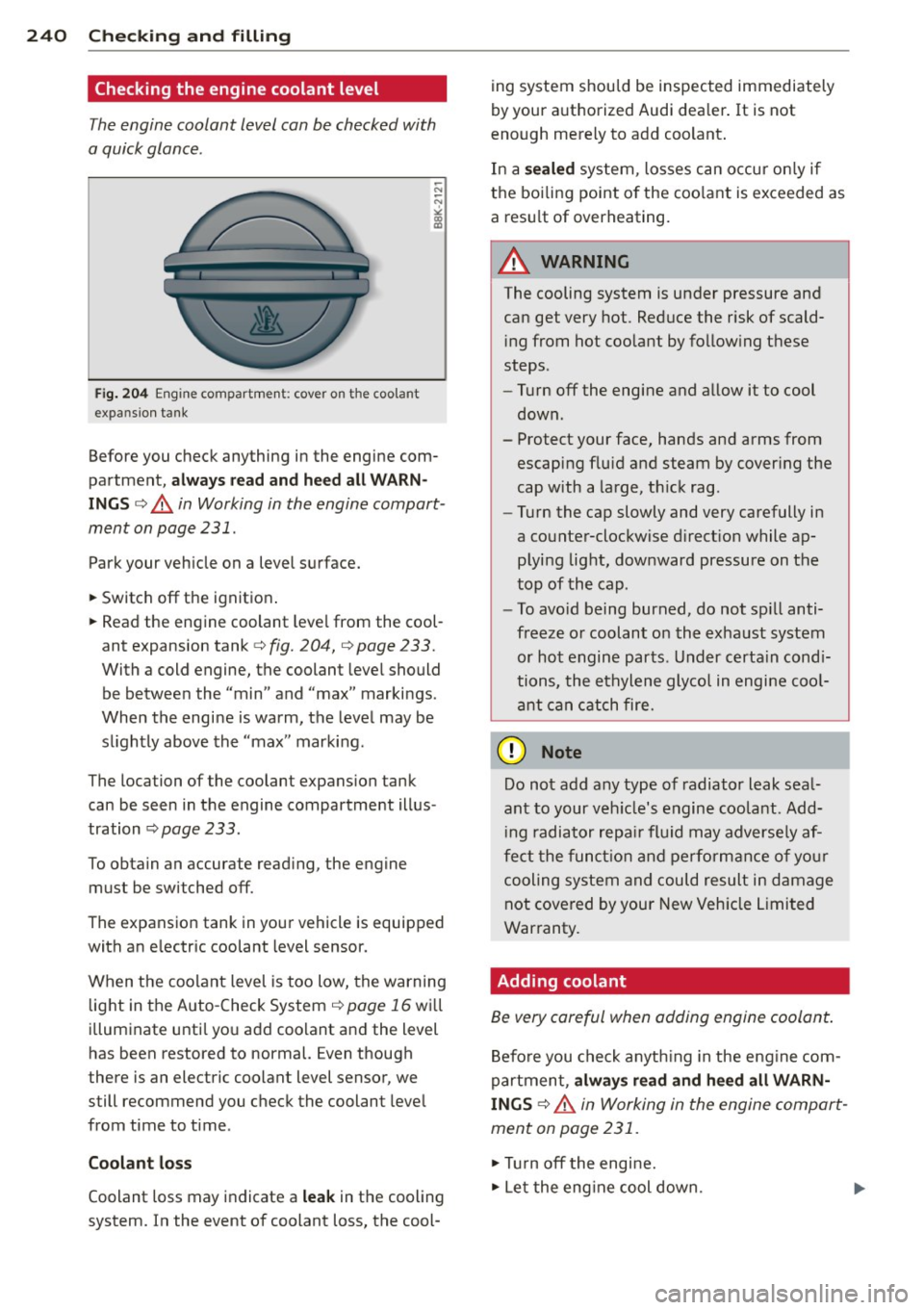
Fig . 204 Eng ine compartment: cover on the coolant
expa nsion tank
Before you check anything in the engine com
partment,
a lwa ys re ad and h eed a ll WA RN
INGS o .A in Working in the engine compart
ment on page 231 .
Park your vehicle on a level surface.
• Switch
off the ignition .
• Read the engine coolant leve l from the cool
ant expansion tank
o fig. 204, o page 233.
With a cold engine, the coolant level should
be betwee n the "min" and "max" markings.
When the engine is warm, the level may be slightly above the "max" marking .
The location of the coolant expans ion tank
can be seen in the engine compartment illus
tration
o page 233.
To obtain an accurate reading, the engine
must be switched
off.
The expansion tank in your vehicle is equipped
with an e lectric coolant level sensor.
When the coolant level is too low, the warning
light in the Auto-Check System
o page 16 wi ll
illuminate unti l you add coolant and the level
has been restored to normal. Even though
there is an electric coolant level sensor, we
still recommend you check the coolant level
from time to time.
Coolant l oss
Coolant loss may indicate a le ak in the cooling
system. In the event of coolant loss, the cool- ing system shou
ld be inspected immediately
by your authorized Audi dea ler . It is not
enough mere ly to add coo lant .
In a
sea le d system, losses can occur on ly if
the boiling point of the coo lant is exceeded as
a res ult of overheating.
A WARNING
-The cooling system is under pressure and
can get very hot. Red uce the risk of scald
i ng from hot coolant by fo llow ing these
steps.
- Turn
off the engine and allow it to cool
down.
- Protect your face, hands and arms from
escaping flu id and steam by covering the
cap with a large, th ick rag.
- Turn the cap slowly and very carefully in
a counter-clockwise d irect ion while ap
plying light, downward pressure on the
top of the cap.
- To avo id being burned, do not sp ill anti
freeze or coolant on the exhaust system
or hot engine parts. Under certa in cond i
tions, the ethylene glycol in engine cool
ant can catch fire.
0 Note
Do not add any type of radiator leak seal
ant to your veh icle's engine coolant . Add
i ng radiator repa ir fluid may adverse ly af
fect the funct io n and performance of your
cooling system and could result in damage not covered by your New Vehicle Limited
Warranty.
Adding coolant
Be very careful when adding engine coolant .
Before you check anyth ing in the eng ine com
partment,
alw ay s re ad and h eed all WARN
IN GS o .A in Working in the engine compart
ment on page 231.
• Tu rnoff the engi ne.
• Let the eng ine cool down.
Page 281 of 314
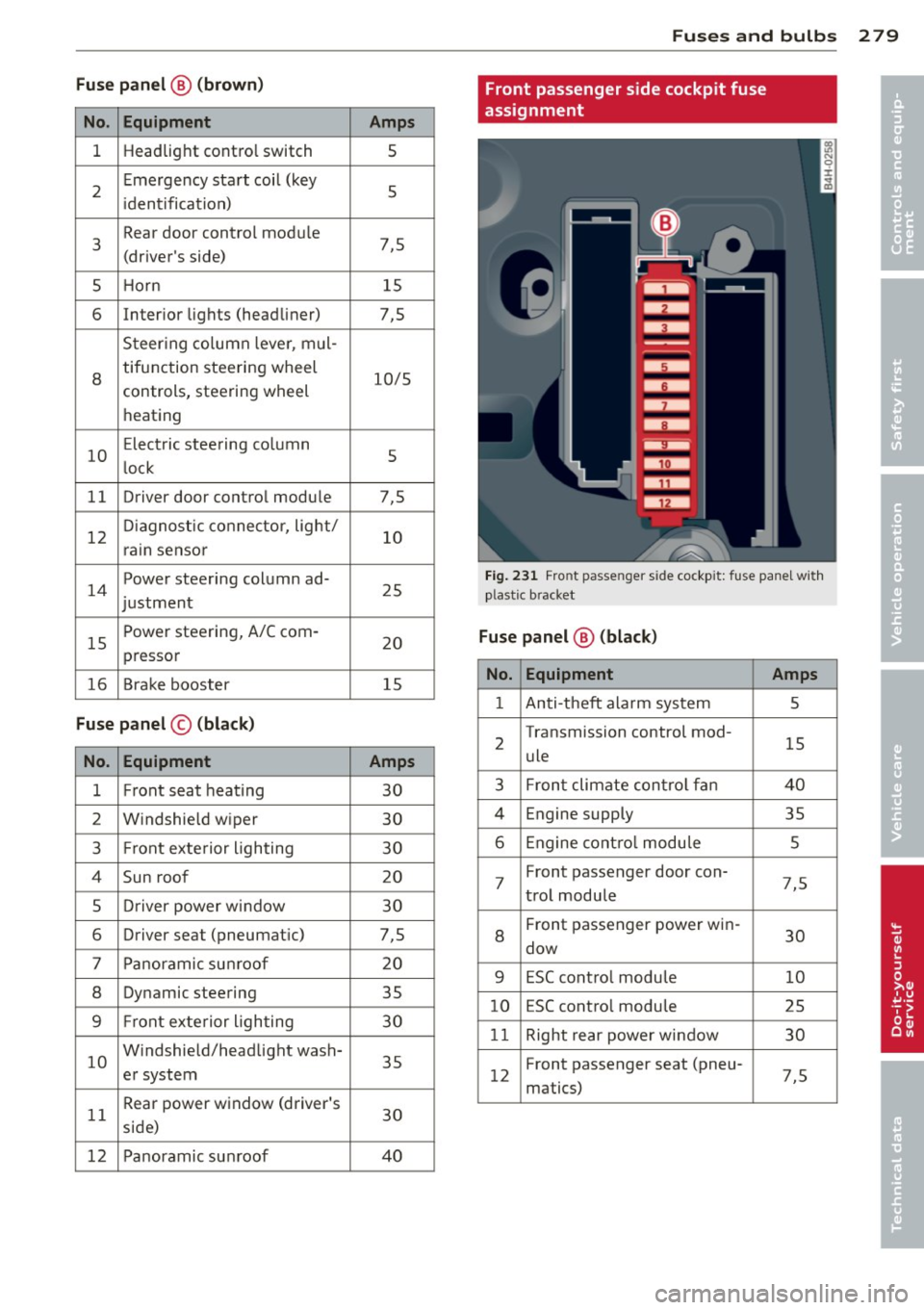
Fuse pa nel @ (brown )
No . Equipment
1 Headlight contro
l switch
2 Emergency
start coil (key
i dentification)
3 Rear door
control module
(driver's side)
5 Horn
6 Interior
lights (headliner)
Steer ing column leve r, mul-
8
tifunction steering wheel
controls, steering wheel
heating
10 E
lectric steering column
l ock
11 Driver door
control module
12 D
iagnostic connector, light/
rain sensor
14 Powe
r steering column ad-
justment
15 Power steering, A/C com-
presser
16 Brake booster
Fu se p anel © (black )
No. Equipment
1 Front seat heating
2 Windshield
wiper
3 Front exte rior lighting
4 Sun roof
5 D river power window
6 Driver
seat (pneumatic)
7 Pano ramic sunroof
8 Dynamic
steering
9 Front exterior lighting
10 W
indshield/headlight wash-
er system
11 Rear power
window (driver's
side)
12 Panoramic sunroof
Amp s
5
5
7,5 15
7,5
10/5
5
7,5
10
25
20 15
Amp s
30
30 30
20
30
7,5 20
35
30
35
30
40
Fu ses and bulb s 2 79
Front passenger side cockpit fuse
assignment
Fig . 231 Front passenger side cockpit: f use pane l with
plast ic bracket
Fu se panel @ (bl ac k)
No. Equipment Amps
1 Anti-theft alarm system 5
2 Transmission control
mod-
15
ule
3 Front climate control fan
40
4 Engine supply 35
6 Engine cont ro l modu le 5
7 Front
passenger door con-
7,5
trol module
8
Front passenger power win-
30
dow
9 E5C contro l module 10
10 ESC
contro l modu le
25
1 1 Right rear power window 30
1 2 Front
passenger seat (pneu-
7,5
matics)
•
•
Page 282 of 314

280 Fuses and bulbs
Luggage compartment fuse assignment
Fig. 23 2 Luggage compartment: fuse pa nel with plas tic bracket
Fuse panel @ (black )
No. Equipment Amps
No. Equipment Amps
11 Dynam ic steer ing 5
E SC button, da ta logger, di· 12
Selector lever,
BCM-2
5
1 agnostic connector, BCM · 1,
5 13 Audi s ide ass ist 5
adap tive light ing system
14 Engine control modu le
5
2 Networking gateway
5
15 Sta rter 40
3 adap tive air s usp ension 5
4 Parking system
5 16 Left headlight/Headlight
10/5
range control system
5 Steering colum n leve r 5
6
Suspension contro l system
5
sensor
Fu se panel @ (red)
No. Equipment Amps
7 Bel
t tensione rs, airbag con-
5
trol module
Heated washe r fl uid no zzles, 1
Left reversible be
lt tens ioner
2S
2 Right revers
ible belt ten -
25
sioner
H ome link (garage door
Starter diagnos is, DC/DC
8 opener), nig ht vision system 5
3 co
nverter (S tart-Stop-Sys·
5
con trol mod ule, sport diffe r-
tern)
ent ia l, ionizer
9
Electromechan ica l park ing
5
brake contro l modu le 4
DC/DC converter (Start-
7,5
Stop-System)
5 Image proce ssing 7,5
10 Rear seat heating, coo
ler, in·
5
terior rearview mirror
Page 283 of 314
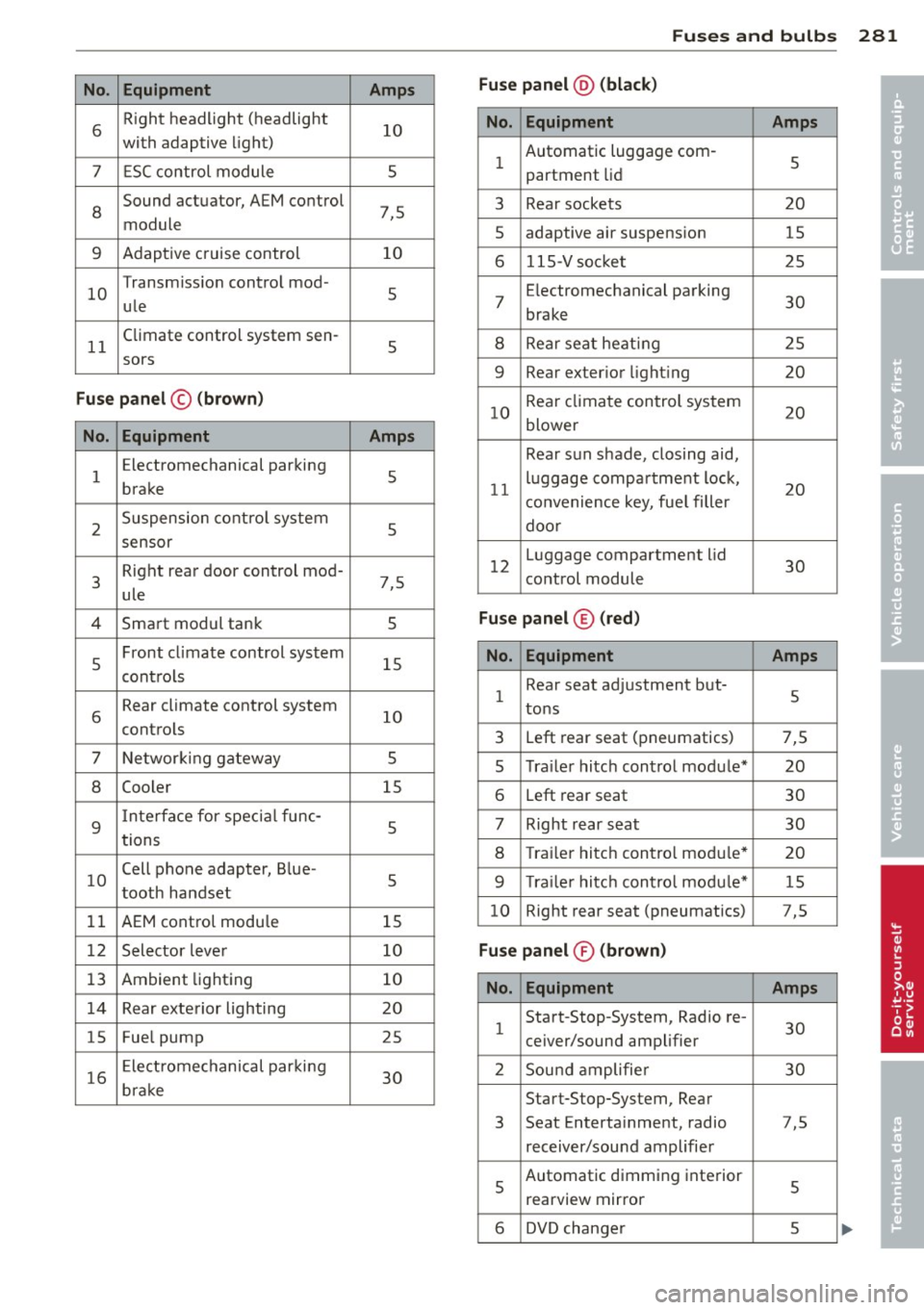
Fuses and bulb s 281
No . Equ ipment Amps Fus
e pan el@ (bla ck)
•
6 R
ight headlight (headlight
10
with adaptive light)
7 ESC control module 5 No. Equipment Amps
1 Automatic luggage com
-
5
partment lid
•
8
Sound actuator, AEM control
7,5
module 3 Rear
sockets 20
5 adaptive air suspension
15
9 Adaptive cruise control 10
6 115-Vsocket 25
10 Transmiss
ion control mod-
5
ule 7 E
lectromechanical parking
30
brake
11 Climate control
system sen-
5
8 Rear seat heating 25
sors
9 Rear exterior lighting 20
Fuse pan el© (bro w n)
No. Equipment Amps
10 Rear climate control system
20
blower
1 E
lectromechanical parking
5
brake
2 Suspension control system
5 Rear
sun shade, closing aid,
11 luggage
compartment lock,
20
convenience key, fue l filler
door
sensor
3 Right rear door
control mod-
7,5
ule 12
Luggage compartment
lid
30
control module
4 Smart modul tank 5
Fuse panel ® (red)
5 Front
climate control system
15
contro ls
6 Rear climate control
system
10
controls N o. Eq uipm ent Amps
1 Rear
seat adjustment but-
5
tons
3 Left rear seat (pneumatics) 7,5
7 Networking gateway 5
5 Tra
iler hitch control module* 20
8 Cooler
15
6 Left rear seat 30
9
Interface for specia l func-
5
tions 7 Right rear seat
30
8 Trailer hitch contro l module*
20
10 Cell phone
adapter, Blue-
5
tooth handset
9 T ra iler hitch control modu le* 15
11 AEM control modu le 15 10
Right rear
seat (pneumatics) 7,5
12 Selector lever 10
Fuse pan el® (bro wn)
13 Ambient lighting
10 No. Equipment Amps
14 Rear exterior lighting 20
15 Fuel
pump
25 1 Start-Stop-System,
Radio re-
30
ceiver/sound amplifier
16 Electromechanical parking
30
brake 2 Sound amplifie
r 30
Start-Stop-System, Rear
3 Seat
Entertainment, radio 7,5
receiver/sound amplifier
5 Automatic dimming interior
5
rearview mirror
6 DVD changer 5