air condition AUDI A8 2015 User Guide
[x] Cancel search | Manufacturer: AUDI, Model Year: 2015, Model line: A8, Model: AUDI A8 2015Pages: 312, PDF Size: 79.18 MB
Page 165 of 312

,....,
N ,....,
N
0 J:
'SI: ,...., \!) 1.1'1 ,...., 1.1'1 ,....,
If the front passenger seat is not occupied,
the front airbag will not deploy, and the
PAS
SENGER AIR BAG OF F
light will stay on. Nev
er insta ll a rearward-fac ing ch ild restra int on
the front passenger seat, the safest place for
a child in any kind of child restraint is at one
of the seating positions on the rear seat
¢ page 153, Child restraints on the front seat
- some important things to know
and
¢ page 174, Child Safety .
If the PASSENGER AIR BAG OFF light c omes
on
when one of the conditions listed above is
met, be sure to check the light regularly to
make certa in that the
PASSENGER AIR BAG
O FF
ligh t stays on cont inuous ly whenever the
ignition is on . If the
PASSENGER AIR BAG
OFF
light does not appear on and does not
stay on all the time, stop as soon as it is safe
to do so and
- reactivate the system by switc hing the igni
tion off and then switching it on again;
- remove and reinstall the chi ld restraint .
Make sure that the child restraint is properly
insta lled and that the sa fety be lt for the
front passenger seat has been correct ly
ro uted th roug h the child restraint as descri
bed in the chi ld restraint manufacturer 's in
structions;
- make sure that the convertible locking fea
ture on the safety be lt for the front passen
ger seat has been activated and that the
safety belt has been pulled t ight . The belt
mus t not be loose o r have loops of slack so
that the senso r below the safety be lt latch
on the seat can do its job ¢
page 184.
-make su re that th ings that may increase the
weight of t he ch ild and child sea t are no t be
ing transported on the front passenger sea t;
- make su re that the safety be lt tension sen
so r is not b locked . Shake the safety be lt
latch on the front passenger seatbac k and
forth;
- If a st rap or tether is being used to tie the
child seat to the front passenger seat , make
s ur e that it is not so tig ht that it ca uses the
weight-sensing mat to meas ure more
weight than is actually on the seat.
A irbag system 163
If the PASSENGER AIR BAG OFF light still
does not come on
and does not stay on con
ti nu ous ly (when the ignition is switched on),
- take the child restra int off the front passen -
ge r seat and install it properly at one of the
rear seat positions. Have the airbag system
inspected by yo ur Audi dealer immed iate ly .
- move the child to a rear seat position and
make s ure that the c hild is properly restrain
ed in a ch ild rest ra int that is appropriate for
its si ze and age.
T he
PASSENGER AIR BAG OFF lig ht sho uld
NOT come on when t he ignitio n is on and an
adult is s itting in a proper seating position on
the front passenger seat. If the
PASSENGER
AIR BAG OFF
light comes on and stays on or
flashes fo r about 5 seconds wh ile driving, un
der these c ircumstances, make sure that:
- the adult on the front passenger seat is
properly seated on the center of the seat
cushion with his or her back up aga inst the
backrest and the backrest is not recl ined
¢ poge 134, Prope r occupant seating posi
tions,
-the adult is not tak ing weight off the seat by
holding on to the passenger assist handle
a bove the fron t passenger door o r su pport
ing their weight on the armres t,
- the safe ty be lt is be ing properly wo rn and
t ha t the re is no t a lot o f sla ck in the safety
be lt webb ing ,
- acce sso ry sea t covers or cushions or other
t hings tha t may cause an in correct reading
or imp ression on the weight-sensing mat
unde r th e upho lstery of the seat have been
removed from the front passenger seat,
- a safety belt extender has not bee n left in
the safety be lt latch for the front passenger
seat.
I n add ition to the
PASSENGER AIR BAG OFF
li ght in the center of the instrument panel,
the message
PASSENGER AIR BAG OFF or
PASSENGER AIR BAG ON wi ll briefly appear
i n the instrument cluster disp lay. This is to in
form the dr iver of the current front passenge r
a irbag status.
•
•
Page 176 of 312

174 Child Saf ety
Child Safety
Important things to
know
Introduction
The rear seat is generally the safest place in a
collision.
The physical principles of what happens when
your veh icle is in a crash app ly also to chi ldren
~ page 144, What happens to occupants not
wearing safety belts?.
But unlike adults and
teenagers, their muscles and bones are not
fu lly developed. In many respects children are
at greater risk of serious injury in crashes than
adults.
Because children's bodies are not fully deve l
oped, they require restraint systems especial
ly designed for their size, weight, and body
structure. Many countries and all states of the
United States and provinces of Canada have
laws requiring the use of approved child re
straint systems for infants and small ch ildren.
In a fronta l crash at a speed of 20 -35 mph
(30-56 km/h) the forces acting on a 13-pound
(6 kg) infant w ill be more than 20 t imes the
weight of the child. This means the weight of
the child would suddenly be more than 260 pounds (120 kg). Under these conditions,
only an appropriate ch ild restraint properly
used can reduce the risk of ser ious injury.
Child restraints, like adult safety belts, must
be used properly to be effective. Used improp
erly, they can increase the risk of serious in
jury in an accident.
Consult the child safety seat manufacturer's instructions in order to be sure the seat is
right for your ch ild's size ~
page 177, Impor
tant safety instructions for using child safety
seats.
Please be sure to read and heed all of
the important information and WARNINGS
about child safety, Advanced A irbags, and the
installation of child restraints in this chapter .
There is a lot you need to know about the Ad
vanced Airbags in your vehicle and how they
work when infants and children in child re- straints are on the front passenger seat
. Be
cause of the large amount of important infor
mation, we cannot repeat it all here . We urge
you to read the detailed information in this
owner's manual about airbags and the Ad
vanced Airbag System in your vehicle and the
very important information about transport
ing children on the front passenger seat.
Please be sure to heed the WARNINGS -they
are extremely important for your safety and
the safety of your passengers, especially in
fants and small children.
A WARNING
-Accident statistics have shown that chil
dren are generally safer in the rear seat
area than in the front seating position.
Always restrain any child age 12 and un
der in the rear.
- All vehicle occupants and especially chil
dren must be restrained properly when
ever riding in a vehicle. An unrestrained
or improperly restrained chi ld could be
injured by str iking the i nterior or by be
ing ejected from the vehicle during a
sudden maneuver or impact. An unre
strained or improperly restrained chi ld is
also at greater risk of injury or death
through contact with an inflating airbag.
- A suitable chi ld restraint properly instal
led and used at one of the rear seating positions provides the highest degree of
protection for infants and small children
in most accident situations.
A WARNING ,_
Children on the front seat of any car even
with Advanced Airbags can be ser iously in
jured or even killed when an airbag in
flates. A child in a rearward-facing child
safety seat installed on the front passen
ger seat will be ser iously injured and can
be killed if the front airbag inflates.
- The inflating airbag will hit the child
safety seat or infant carrier with great
force and will smash the child safety seat and child against the backrest, center
armrest, or door.
II>-
Page 198 of 312

196 Intelligent technology
Intelligent technology
Notice about data
recorded by the Event
Data Recorder and
vehicle control modules
E ve nt Data Recorder
This vehicle is equipped with an Event Data
Recorder (EDR) . The main purpose of an EDR
is to record, in certain crash or near crash-like
situations, such as an airbag deployment or hitting a road obstacle, data that will assist in
understand ing how a veh icle's systems per
formed. The EDR is designed to record data
re lated to vehicle dynamics and safety sys
tems for a short period of time, typically
30 seconds or less. The EDR in this vehicle is
designed to record such data as:
- How various systems in you r vehicle were
operating;
- Whether or not the d river and passenger
safety belts were buckled/fastened;
- How far (if at all) the driver was dep ress ing
the accelerator and/or brake pedal; and,
- How fast the vehicle was traveling.
These data can help provide a better under
stand ing of the cir cumstances in which crash
es and injuries occur . NOTE : EDR data are re
corded by your vehicle only if a non-trivial
crash situation occurs; no data are recorded by
the EDR under normal driving conditions and
no personal data (e.g., name, gender, age,
and crash location) are recorded. However,
other parties, such as law enforcement, cou ld
comb ine the EDR data with the type of per
sonally identifying data routinely acquired
during a crash investigation.
To read data recorded by an EDR, special
equipment is required, and access to the vehi
cle or the EDR is needed. In addition to the ve hicle manufacturer, other parties, such as law
enforcement, that have the special equip
ment, can read the information if they have
access to the vehicle or the EDR. Some state
laws restrict the retrieval or down
loading of data stored by ED Rs installed in a
vehicle for the express purpose of retrieving
data after an accident or crash event without
the owner's consent .
Audi will not access the EDR and/or simi lar
data or g ive it to others -
- un less the vehicle owner (or lessee if the ve
hicle has been leased) agrees; or
- upon the official request by the police; or
- upon the ord er of a court of law or a govern-
ment agency; or
- for the defense of a lawsuit through the ju
dicia l discovery p rocess.
- Aud i may also use the data for research
about vehicle operat ion and safety perform
ance or provide the data to a third party for
research purposes without identifying the
specif ic vehicle or information about the
identity of its owner or lessee and only after
the recorded vehicle data has been ac
cessed.
Vehicle control modules
You r vehicle is also equ ipped with a number of
electron ic control modules for various vehicle
systems, such as engine management, emis
sion control, airbags, and safety belts.
T hese electronic control mod ules record data
during norma l vehicle operation that may be
needed by trained technicians for diagnostic
and repair purposes. The recording capability
of these modu les is limited to data (no sound
is recorded). Only a small amount of data is
actually recorded over a very lim ited period of
t ime, or stored when a system fault is detect
ed by a contro l modu le. Some of the data
stored may relate to vehicle speed, direction,
o r braking, as well as restraint system use and
performance in the event of a crash. Stored
data can also only be read and downloaded
with special equipment that is directly con-
nected to the vehicle. .,..
Page 208 of 312

206 Driving and en vir onm ent
Catalytic converter
Appl ies to vehicles: with gasoline e ngin e
It is very important that your emission con
trol system (catalytic converter) is function
ing properly to ensure that your vehicle is run
ning in an environmentally sound manner .
.. Always use lead-free gasoline i=> page 220,
Fuel supply .
.. Never run the tank down all the way to emp-
ty .
.. Never put too much motor oil in your engine
¢ page 234, Adding engine oil
The catalytic converter is an eff ic ient "clean
up" device built into the exhaust system of
the vehicle. The catalyti c converter burns
many of the pollutants in the exhaust gas be
fore they are released into the atmosphere.
The exclus ive use of unleaded fuel is cr itically
important for the l ife of the cata lytic convert
e r and proper functioning of the engine.
A WARNING
T he temperature of the exhaust system is
high, both when driving and after stopping
the engine .
- Never touch the exhaust tail pipes once
they have become hot. This could result
in burns.
- Do not park or operate the vehicle in
areas where the hot exhaust system may
come in contact with dry grass, brush,
fuel spill or other material which can
cause a fire.
- Do not apply additional undercoating or
rustproofing on or near the exhaust
man ifold, exhaust p ipes, catalytic con
verter or heat shields . During driving, the
substance used for undercoating cou ld
overheat and cause a fire.
@) Note
- Be aware that just one tank f illing with
leaded fuel will al ready seriously de
grade the perfo rmance of the cata lytic
conve rter. -
Do not exceed the correct engine oil level
i=>page 234.
-Do not drive until the fue l tank becomes
completely empty . The engine co uld m is
fire . Unburned fuel could also get into
the exhaust system and this cou ld cause
the catalytic converter to overheat.
- Do not switch off the ignition while the
vehicle is mov ing .
- Do not continue to ope rate your vehicle
under these conditions, as otherwise fuel
can reach the catalyt ic converter. Th is
cou ld result in overheating of the con
verter, requir ing its replacement .
- To assure efficient operation of the Emis
sion Control System:
- Have you r vehicle maintained p roperly
and in accordance w ith the service rec
ommendations in your Warranty & Maintenance book let.
- Lack of prope r maintenance as we ll as
improper use of the vehicle wi ll impair
the function of the em ission contro l
system and could lead to damage.
@) For the sa ke of the en vironment
Even when the Emission Control System is
ope rat ing properly, the exhaust gas can
have a sulfur-like exhaust gas smell under
some operat ing states. This depends on
the sulfur content of the fuel being used .
Usi ng a different brand of fuel may help,
or f illing the tank with lead-free super
grade gasoline.
Diesel particulate filter
Applies to vehicles: with diese l eng ine
The diesel part icu late filter filters nearly all of
the soot pa rticles out of the exhaust . T he fil
te r cleans itself automat ica lly unde r no rma l
dr iv ing cond itions . If the filte r cannot clean it
self (for example, because you are on ly driving
short distances), the filter becomes clogged
with soot and the
Cl symbol for the diese l
particulate filter i lluminates
i=> page 21. ..,.
Page 242 of 312
24 0 Ch eck ing and filling
Always check wi th your a uthorized Audi
dealer to make s ure you are using the
correct brake flu id. The correct type of
brake fluid is also indicated on the
brake fluid reservoir.
- The brake fluid must be new. Heavy use
of the brakes can cause a vapor lock if
the brake fluid is left in the system too
long. This can ser ious ly affect the effi
ciency of the b ra kes as well as yo ur
safety. This could result in an acc ident.
(D Note
Brake flu id will damage the paint of your
veh icle.
@ For the sake of the environment
Because of the problem of proper d isposa l
of brake flu id as wel l as the special tools
requ ired and the necessary expert ise, we
recommend that you have the b rake fluid
changed by your author ized Audi dealer.
Battery
General information
Under
normal operating conditions, the bat
tery in your Audi does not need any mainte
n ance . With
high outside temperatures or
l ong daily dr ives we recommend that you have
the elec trolyte level checked by a service fa
cili ty. The e lec trolyte level sho uld a lso be
checked each time the battery is charged
¢ page 242.
Have the b attery checked when you ta ke yo ur
ve hicl e in for service. Yo u are well adv ise d to
replace a battery that is older than S years .
W ith certa in types of airbag deployment, the
battery is d isconnected from the vehicle ele c
tr ica l system for sa fety reasons¢
& in Re
pair, care and disposal of the airbags on
page 165.
Disconnecting the battery terminals
Some veh icle func tions (power w indow regu
l ato rs, for example) a re los t if the b attery ter- mina
ls are disconnected. These functions have
to be relearned after the battery termina ls are
connected aga in. To prevent th is, the battery
sho uld only be disconnected from the ve hicle
electrical system when abso lutely necessary
for repairs.
Vehicle s not driven for long peri ods
If you do not d rive your vehicle over a period
of several days or weeks, e lectr ica l compo
nents are gradually cut back or sw itched off.
This reduces energy consumption and ma in
ta ins start ing capability over a longer period
¢
page 202. Some of the convenience func
t ions may not ope rate, such as the inter ior
li gh ts or the power seat adjus tment. The con
venience func tions will be ava ilable ag ain
when you switch on the ignition and start the
engine .
Winter operation D uring the winte r months, battery capac ity
tends to de crease as temperatures drop. This
is beca use more power is also consumed wh ile
sta rting, and the headlights, rear window de
fogger, etc ., are used more often .
Avoid unnecessary power consumpt ion, p ar
t icu lar ly in city traffic or whe n traveling only
short distances. Let yo ur au thorized Aud i
dealer check the capacity of the vehicle bat
tery before winter sets in ¢
page 242. A well
charged battery will not on ly prevent starting
problems when the weather is cold, but will
also last longer.
(!) Tips
If your vehicle is left standing for several
weeks at extremely low temperatures, the
vehicle battery sho uld be removed and
stored where it w ill not freeze. This will
prevent it from be ing damaged and having
to be repla ced.
Page 252 of 312
250 Tires and wheels
Bear in mind that the tire pressure monitoring
system* can only monitor the tire pressures
you have stored . The system does not recog
nize the load condit ion of your vehicle.
The effectiveness of the tire pressure monitor
ing system* will be impaired if you store nor
mal load pressures but then operate the vehi
cle at its max imum load
c:> &. .
See the illustration c:> fig. 208 for the location
of the label on driver's side B-pillar (color of
the act ua l label and exact location on the ve
hicle will vary slightly). Note
that the following table is accurate at
the time of going to press and is subject to
change. In the event of d iscrepancies, the t ire
pressure label is located on the driver's side B
pillar always takes precedence.
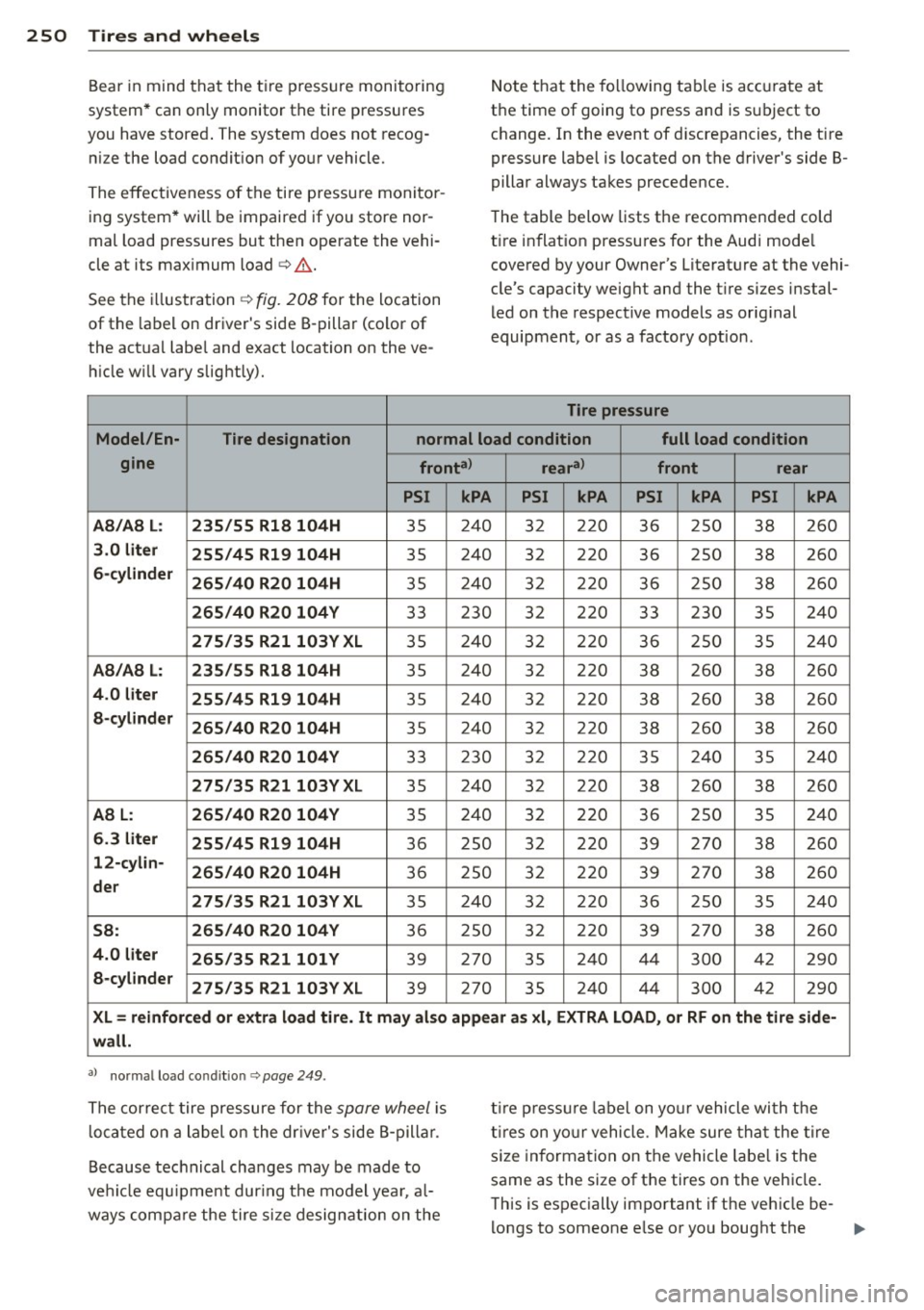
The table below lists the recommended cold
t ir e inflation pressures for the Audi mode l
covered by your Owner's Literature at the vehi
cle's capacity weight and the t ire sizes instal
led on the respective models as orig inal
equipment, or as a factory opt ion.
Tire pressure
Model/En- Tire designation normal load condition full load condition
gine fronta> reara>
front rear
PSI kPA
PSI kPA PSI kPA PSI kPA
A8/A8 L: 235/55 R18 104H
35 240 32 220 36 250 38 260
3.0 liter
255/45 R19 104H 35 240 32 220 36 250 38 260
6-cylinder
265/40 R20 104H 35 240 32 220 36 250 38 260
265/40 R20 104V 33 230 32 220 33 230 35 240
275/35 R21103Y XL 35 240 32 220 36 250 35 240
A8/A8 L: 235/55 R18 104H 35 240
32 220 38 260 38 260
4.0 liter
255/45 R19 104H 35 240 32 220 38 260 38 260
8-cylinder
265/40 R20 104H 35 240
32 220
38 260
38 260
265/40 R20 104V 33 230 32 220
35 240 35 240
275/35 R21103Y
XL 35 240
32 220
38 260
38 260
ASL
: 265/40 R20 104V 35 240 32 220 36 250 35 240
6.3 liter
255/45 R19 104H 36 250 32 220
39 270
38 260
12-cylin-
265/40 R20 104H 36 250 32 220 39 270 38 260
der
275/35 R21103Y XL
35 240 32 220 36 250
35 240
58: 265/40 R20 104V 36 250 32 220
39 270 38 260
4.0 liter
265/35 R21101 Y 39 270 35 240 44 300 42 290
8-cylinder
275/35 R21103Y XL 39 270
35 240
44
300 42
290
XL= reinforced or extra load tire. It may also appear as xl, EXTRA LOAD, or RF on the tire side-
wall.
al n orma l lo ad co ndi tio n~ page 249.
The correct tire pressure for the spare wheel is
locat ed on a label on the driver's side B-pillar.
Because technical changes may be made to
ve hicl e equipment during the model year, al
ways compa re the tire size designation on the tire
pressu re lab el on your vehicle wi th the
tires on your vehicle. Make sure that the tire
s iz e inform ation on the vehicle label is the
same as the size of the tires on the vehicle.
This is espec ially important if the vehicle be-
l ongs to someone e lse or yo u bought the ..,.
Page 258 of 312

256 Tires and wheels
Incorrect wheel alignment
Incorrect wheel alignment can cause exces
sive tire wear, impairing the safety of the vehi
cle. If tires show excessive wear, have the
wheel alignment checked by an authorized
Audi dealer or qualified workshop.
All Wheel Drive
Vehicles with quattro must always have tires
of the same size, construction and tread type.
For details see Qpage 202 .
.&_ WARNING
Sudden tire failure can lead to loss of con
trol, a crash and serious personal injury!
- Never drive a vehicle when the tread on
any tire is worn down to the wear indica
tors.
- Worn tires are a safety hazard, they do
not grip well on wet roads and increase
your risk of"hydroplaning" and loss of
control.
- Always keep chemicals that can cause
tire damage, such as grease, oil, gasoline
and brake fluid away from tires.
- Tires age even if they are not being used
and can fail suddenly, especially at high
speeds. Tires that are more than 6 years
old can only be used in an emergency
and then with special care and at lower speeds.
- Never mount used tires on your vehicle if
you are not sure of their "previous histo
ry." Old used tires may have been dam
aged even though the damage cannot be
seen that can lead to sudden tire failure
and loss of vehicle control.
New tires and replacing tires and wheels
New tires and wheels have to be broken in .
Fig. 212 Tir e specificat ion codes on the s idewall of a
t ire
No. Description
® Ratio of height to width (aspect ratio)
© Radial
® Rim diameter code
® Load index and speed rating
(J) U.S . DOT tire identification number
® Audi Original tire
® Sever snow conditions
@ Tire ply composition and materials
used
@ Maximum load rating
@ Treadwear, traction and temperature
grades
@ Maximum permissible inflation pres-
sure
The tires and rims are essential parts of the
vehicle's design . The tires and rims approved
by Audi are specially matched to the charac
teristics of the vehicle and can make a major .,..
Page 259 of 312

,....,
N ,....,
N
0 J:
'SI: ,...., \!) 1.1'1 ,...., 1.1'1 ,....,
contribution to good road holding and safe
handling when in good condition and properly
inflated
¢ .&. .
We recommend that all work on t ires and
wheels be performed by an authorized A udi
dealer. They are familiar with recommended
procedures and have the necessary spec ial
too ls and spare parts as we ll as the proper fa
cilities for dispos ing of the old tires .
Authorized Audi dealers have the necessary information about techn ica l requ irements for
installing or changing tires and r ims.
R eplacing t ires and wheel s
Tires shou ld be rep laced at least in pairs and
not individua lly (for example both front tires
or both rear tires together).
Be s ure to read and heed the information to
the tire pressure monitoring system*
¢page 263.
Always buy rep lacement radial tires that have
the same specifications as the t ires approved
for your ve hicle by Audi. Replacement tires
must always have the same load rating speci
fication as the original equipment or approved
optional tires listed in the table¢
page 249.
Audi-approved specification tires are specially
matched to your vehicle and its load limits,
and can contribute to the important road hold
ing, driving character istics, and safety of the
veh icle. The table(¢
page 249) lists spec ifica
tions of the t ires approved for the Audi mod
e ls covered by your Owner's Literature .
The tire pressure labe l located on dr iver 's side
B-pillar
( ¢ page 249, fig. 209) lists the speci
fications of the orig inal equipment tires in
stalled on your veh icle at the time it was man
ufactured .
Federal law requires t ire manufacturers to
p lace standard ized information on the s ide
wall of all tires ¢
fig. 212 . This information
i dent ifies and desc ribes the fundamental
characterist ics, the quality grade of the tire
and a lso provides a tire ide ntificat io n number
Tire s an d wheel s 257
for sa fety standard certification and in case of
a reca ll.
Tire specifications
Knowledge of tire specifications makes it eas
ier to choose the co rrec t tires . Radial ti res
have the tire specifications marked on the
sidewa ll, for examp le:
255 /45 R 19 104 H
This co nta ins the following information :
P Indicates the tire is for passenger cars
(where app licab le)
255 Nom inal tire width i n mm of the tire
from sidewall edge to sidewall edge. In
general, the larger the number, the wider
the tire
45 Height/w idth ratio in percent (aspect ra -
t io)
R Tire construct ion: Radial
1 9 Rim diameter code (i n inches)
104 Load ra ting code
H Speed ra ting letter code
XL (or "xl", "EXTRA LOAD" or "RF") Indicates
t h at the t ire is a "Reinfo rced" or an " Ext ra
Load " tir e
M+S (or "M/S") Indicates that the ti re has
some mud and snow capab ility
The tires could also have the informat ion of
direction of rotat ion ¢
page 245 .
Tire manufacturing d ate
The manufact uring date is also indicated on
the tire sidewall (possibly only on the
inner
s ide of the wheel):
"DOT ... 2214 .. . " means, for example, the tire
was produced in the 22nd week of 2014.
Speed rating (letter code )
The speed rating le tter code on the whee ls in
dicates the maximum permiss ible road speeds
¢ .&. in Winter tires on page 261.
P up to 93 mp h (150 km/h)
Q up to 99 mph (158 km/h)
R up to 106 mph (170 km/h)
S up to 110 mph (180 km/h)
•
•
Page 261 of 312

,....,
N ,....,
N
0 J:
'SI: ,...., \!) 1.1"1 ,...., 1.1"1 ,....,
Driving with different tires reduces vehi
cle handling and can lead to a loss of
control.
- If the spare tire is not the same as the
tires that are mounted on the vehicle -
for example with winter tires -only use
the spare tire for a short period of time and drive with extra care. Refit the nor
mal road wheel as soon as safely possi
ble.
- Never drive faster than the maximum
speed for which the tires on your vehicle
are rated because tires that are driven
faster than their rated speed can fail
suddenly.
- Overloading tires cause heat build-up,
sudden tire failure, including a blowout
and sudden deflation and loss of control.
- Temperature grades apply to tires that
are properly inflated and not over or un
deri nflated.
- For technical reasons it is not always
possible to use wheels from other
vehicles -in some cases not even wheels
from the same vehicle model.
- If you install wheel trim discs on the ve
hicle wheels, make sure that the air flow
to the brakes is not blocked. Reduced air
flow to the brakes can them to overheat, increasing stopping distances and caus
ing a collision.
- Run flat tires may only be used on
vehicles that were equipped with them at the factory . The vehicle must have a
chassis designed for run flat tires. Incor
rect use of run flat tires can lead to vehi
cle damage or accidents. Check with an
authorized Audi dealer or tire specialist
to see if your vehicle can be equipped
with run flat tires. If run flat tires are used, they must be installed on all four
wheels. Mixing tire types is not permit
ted.
(D Note
- For technical reasons, it is not generally
possible to use the wheel rims from oth-
Tires and wheels 259
er vehicles. This can hold true for wheels
of the same vehicle type.
- If the spare tire is different from the
tires that you have mounted on your ve
hicle (for example winter tires or wide
profile tires), then use the spare tire for a
short period of time only and drive with
extra care. Replace the flat tire with the
tire matching the others on your vehicle
as soon as possible.
- Never drive without the valve stem cap .
The valves could get damaged .
(® For the sake of the environment
Dispose of old tires in accordance with the
local requirements.
Uniform tire quality grading
-Tread wear
- Tract ion AA A B C
- Temperature AB C
Quality grades can be found where applicable
on the tire side wall between tread shoulder
and maximum section width
c;, page 256,
fig. 212.
For example: Tread wear 200, Traction AA,
Temperature A.
All passenger car tires must conform to Feder
al Safety Requirements in addition to these
grades.
Tread wear
The tread wear grade is a comparative rating
based on the wear rate of the tire when tested
under controlled conditions on a specified
government test course.
For example, a tire graded ISO would wear
one and one half (11/2) times as well on the
government course as a tire graded 100.
The relative performance of tires depends upon the actual conditions of their use, how
ever, and may depart significantly from the
norm due to variations in driving habits, serv
ice practices and differences in road character-
istics and climate.
ll-
•
•
Page 262 of 312

260 Tire s and wheel s
Traction
The traction grades, from highest to lowest,
are AA, A, Band
C. T hose grades represent the
tire's ability to stop on wet pavement as
measured under controlled conditions on
specified government test surfaces of asphalt
and concrete. A tire marked C may have poor
traction performance
c:> .&. .
Te mp eratu re
The temperature grades are A (the highest),
B, and
C, representing the t ire's resistance to
the generat ion of heat and its ability to dissi
pate heat when tested under con trolled cond i
tions on a specified i ndoor laboratory test
wheel.
Sustained high temperature can cause the material of the tire to degenerate and reduce
tire life, and excessive temperature can lead
to sudden tire failure
c:> ,& .
The grade C corresponds to a level of perform
ance which all passenger car tires must meet under the Federa l Motor Veh icle Safety Stand
ard No . 1 09 . Grades Band A represent h igher
l eve ls of pe rformance on the laboratory test
wheel than the m inimum required by law.
.&_ WARNING
T he traction grade assigned to this t ire is
based on stra ight-ahead braking traction
tests, and does not include acceleration,
cornering, hydrop laning o r peak traction
character istics.
A WARNING
The temperature grade for this t ire is es
tablished for a t ire that is properly inflated
and not ove rloaded. Excessive speed, un
derinflation, or excessive loading, either
separately or in combination, can cause
heat buildup and possible ti re fa ilu re.
-
Winter tires
Winter tires can improve vehicle handling on
snow and ice . At temperatures below 45 °F
(7 °C) we recommend changing to winter
tires.
In some heavy snow areas, local governments
may require true w inter o r "snow" t ires , those
with very deeply cut tread . Th ese tires should
o n ly be used in pairs and be installed on a ll
f o ur wheels . Make sure you p urch ase snow
t ir es that are the same size and cons truction
type as the othe r tires on yo ur vehicle.
If your vehicle i s equ ipped w ith all-whee l
drive, this will improve tra ction during w inte r
driv ing, even with the standard tires . Howev
er, we strongly recommend that you always
equip all four wheels on your vehicle w ith cor
rect ly fitted winter tires or all-season t ires,
when winter road condit ions are expected.
This also improves the veh icle 's brak ing per
formance and reduces stopping d istances .
Summer tires provide less grip on ice and
snow.
Winter tires (snow tires) must always be fitted on all fo ur whee ls .
As k your au thori zed A udi dealer or qualified
workshop for permit ted
winter tire size s. Use
only radial winter tires .
Winter tires lose their effec tivenes s whe n the
tread is wo rn down to a depth o f 0 .1 57 inch
(4 mm) .
Only d rive w ith w inter t ires under w inte r co n
di tions. S umme r tir es handle be tte r whe n
the re is no snow o r ice on the roa ds an d the
temperatu re is above 45 °F (7 °C) .
If you have a flat ti re, see notes on spare
whee l
c:> page 256.
Please a lways remember that winter tires may
have a lowe r speed rating than the tires o rigi
nally i nstalled on your vehi cle at the time it
was manuf actu red. P lease see
c:> page 257,
Speed ra ting (Letter code) fo r a lis ting o f the
speed rating lette r codes and the max imum
speed at which the tires can be driven . ..,.