change time AUDI A8 2015 User Guide
[x] Cancel search | Manufacturer: AUDI, Model Year: 2015, Model line: A8, Model: AUDI A8 2015Pages: 312, PDF Size: 79.18 MB
Page 151 of 312

,....,
N ,....,
N
0 J:
'SI: ,...., \!) 1.1"1 ,...., 1.1"1 ,....,
The shoulder belt should lie as close to the
center of the collar bone as possib le an d
should fit well on the body¢
A in Saf ety belt
position on page 147.
Power safety belt h eight adjustment*
You can ad just the height of the safety belts
using the mu lti function b utton on the driver
or fro nt passenge r seat ¢
page 60.
&_ WARNING
-Always read and heed all WARNINGS and
other important informat ion¢
page 146.
You can also a djust the height of the front
seats to change the position of the safety
be lts.
Improperly worn safety belts
Incorrectly positioned safety belts can cause
severe injuries.
Wear ing sa fe ty be lts imprope rly can cause se
rio us in jury or death. Safety be lts can only
wo rk when they are correct ly positioned on
the body. Improper seating positions reduce
the effect iveness of safety belts and w ill eve n
increase the r isk of injury and death by mov
in g the safety belt to cr itical a reas of the
body. Imprope r seat ing pos itions also in
crease the risk of serio us in jury and death
when an air bag deploys and strikes an occu
p a nt who is not in the cor re ct seating posi
tion. A driver is responsib le for the sa fe ty of
all vehicle occupants and especially for chi l
dren . Therefore:
""N ever permit anyone to ass ume an inco rrec t
s itting position in the veh icle w hile traveling
¢.&, .
&_ WARNING
Imprope rly worn safety belts increase the
r isk of se rious personal injury and death
whenever a veh icle is being used .
Safety belts 149
- Always ma ke s ure that all ve hicle occu
pants are co rrectly restrained and stay in
a co rrect seating position whenever the
veh icle is being used .
- Always read and heed all WARNI NGS and
o ther impo rtant inf ormation
¢page 146.
Safety belt preten
sioners
How safety belt pretensioners work
In front, side and rear-end collisions above a
particular severity and in a rollover, safety belts are tensioned automatically.
Reversible safety belt tensioners
T he s afety belts o n the fro nt seats ar e eq uip
ped with powe r reversi ble tensioners. The fo l
l ow ing functions a re ava ila bl e when the driv
er 's/fro nt passenge r's safety belts are fas
tened :
- Au tomatic tens ioners : at the star t of a drive,
the safety be lts automat ica lly adjust to the
passenger afte r a certain time period or ve
hicle speed. To switch the automatic ten
sioners off, select the following in t he M MI:
!CARI fu nction button > Car systems > Vehi
cle settings > Seats > Driver's seat or Pas
senger's seat > Automatic belt tensioner
>
Off .
-In ce rtain dr iv ing s ituations , the safety b elts
may tight en with a reve rs ible tens ion ing
fu nction
¢ page 194.
- The safety be lts m ay a lso tighten with th is
reve rsible te nsion ing functio n in m inor co ll i
s ion s.
Pyrotechnic safety belt pretensioners
The safety belts are equipped with safety be lt
pre tensioners . The system is act ivated by se n
so rs in front, s id e and r ear-end co llisions of
great seve rity and in a rollover. T his tig hte ns
t he be lt and t akes up belt slack ¢.&.
in Service
and disposal of s afe ty belt pretensioner on
page 150.
Tak in g up the s lack helps to reduce .,. •
•
Page 199 of 312

,....,
N ,....,
N
0 J:
'SI: ,...., \!) ..,.,
,...., ..,., ,....,
@ Tips
Your vehicle may be equipped with Audi
connect. Your use of certain Aud i connect
features req uires wireless serv ices that are
provided by a third party wireless telecom
municat ions provider. For details regard
ing how information obtained through
Aud i connect is collected, processed,
transmitted, used, and shared, please see
your contra ct w ith the wire less telecom
municat ions provider and the "About A udi
connect" tab in your vehicle's MMI:
!MENU !
button > Audi connect > About Audi con·
nect .
Electronic Stabilization
Control (ESC)
Description
ESC helps to improve road holding and vehicle
dynamics to help reduce the probability of
skidd ing and loss of veh icle control. It works
only when the eng ine is running. ESC detects
certain difficult driv ing s ituations, including
when the vehicle is beginning to spin (yaw)
out of cont ro l and helps you to get the vehicle
back under control by select ively brak ing the
wheels, and/or red ucing engine powe r and
p roviding steering assistance to help hold the
ve hicle on the driver's intended course . The in
dicator light
m in the instrument cluster
blinks when ESC is taking action to help you
control the vehicle.
ESC has limitations.
It is important to remem
ber that ESC cannot overcome the laws of
phys ics. It will not a lways be able to help out
under all conditions you may come up against.
For example, ESC may not always be able to
h elp you master situat ions where there is a
sudden change in the coefficient of fr iction of
the road surface. When there is a sect io n of
d ry road that is s udden ly cove red with water,
slush o r snow, ESC canno t perform the same
way it would on the dry su rface.
If the vehicle
hydroplanes (rides on a c ush ion of wate r in
stead of the road surface), ESC wi ll not be
ab le to he lp you steer the veh icle because con-
Int ellig ent technolog y 197
tact with the pavement has been interrupted
and the vehicle cannot be braked or steered .
D uring fast corner ing, particular ly on wind ing
roads, ESC cannot always deal as effectively
with difficult dr iv ing s ituations than at lower
speeds. When towing a trailer, ESC is not able
to help you regain control as it would if you
were not tow ing a trailer.
Always adjust your speed and driving style to road, traffic and weather conditions . ESC can
not override the vehicle's physical lim its, in
crease the availab le tract ion, or keep a veh icle
o n the road if road departu re is a result of
driver ina ttent io n. Instead , ESC imp roves the
poss ibility of keep ing t he vehicle under con
trol and on the road during extreme maneu
vers by using the driver's steering i nputs to
help keep the vehicle go ing in the intended di
rect ion. If you are traveling at a speed that
causes you to run off the road before ESC can
provide any assistance, you may not experi
ence the benefits of ESC.
ESC includes and/or works together with the
anti-lock braking system
(ABS), brake assist
system, anti -slip regulation (ASR), electronic
differential lock (EDL), dynam ic steer ing* and
selective wheel torque contro l. ESC is switch
ed on all the time. In cer tain situations when
yo u need less traction, yo u can switch off ASR
by press ing the b utton above ~
page 199,
fig. 188 the se lector lever. Be sure to switch
ASR on again when you no longer need less
traction.
Anti -lock braking system (ABS )
ABS prevents the whee ls from loc king up
when b rak ing. The vehicle can st ill be stee red
even during hard braking . App ly steady pres
su re to the brake peda l. Do not pump the ped
al. A pulsing in the brake pedal indicates that
the system is helping you to brake the vehicle.
Brake assi st sy stem
T he brake ass ist system can dec rease braking
distance . It increases braking power when the
driver presses the brake peda l quickly in emer
gency s ituations. You must press and hold the
brake pedal unti l the situation is over. In
I),
•
•
Page 223 of 312

,....,
N ,....,
N
0 J:
'SI: ,...., \!) ..,.,
,...., ..,., ,....,
-Blend must contain not more than 1S%
MTBE.
Seasonally adjusted gasoline
Many gasoline grades are blended to perform
espec ially we ll for winter or summer driving.
During seasonal change-over, we suggest that
you fill up at busy gas stat ions where the sea
sonal adjustment is more likely to be made in
time .
(D Note
-Methanol fuels which do not meet these
requirements may cause corrosion and
damage to plastic and rubber compo
nents in the fuel system.
- Do not use fue ls that fail to meet the
specified criter ia in this chapter.
- If you are unable to determine whether
or not a particular fue l blend meets the
specifications, ask your service station or
its fuel supp lier.
- Do not use fuel for which the contents
cannot be identified.
- Fuel system damage and performance
problems resulting from the use of fuels
different from those specified are not
the responsibility of Audi and are not
covered under the New Vehicle or the Emission Control System Warranties.
- If you experience a loss of fuel economy
or driveability and performance prob l ems due to the use of one of these fuel
blends, we recommend that you switch
to unblended fuel.
Gasoline additives
Appl ies to vehicles : wit h gasoli ne e ng in e
A majo r concern among many auto manufac
ture rs is carbon deposit build-up caused by
the type of gasoline you use.
Although gasoline grades differ from one manufacturer to another , they have certain
things in common. All gasoline g rades contain
substances that can cause deposits to collect
on vital engine parts, such as fuel injectors
and intake valves. Although most gasoline
Fuel supply and filling your fuel tank 221
brands include additives to keep engine and
fuel systems clean, they are not equally effec
tive .
Audi recommends using TOP TIER Detergent
Gasoline . For more information on TOP TIER
Detergent Gasoline, please go to the official
webs ite (www.toptiergas.com).
After an extended per iod of using inadeq uate
fuels, carbon deposit build-ups can rob your
engine of peak performance.
(D Note
Damage or malf unct ion due to poor fuel
quality is not covered by the Audi New Ve
hicle Limited Warranty.
Diesel fuel
Applies to veh icles : w ith diese l en gine
Always use ULSD (Ultra Low Sulfur Diesel)
No. 2. The ULSD No. 2 meets the ASTM D97S.
Diesel fuel with concentrations of biodiesel
highe r than S % such as Bll, B2O or BlOO are
strictly prohib ited .
Se rv ice stat ion fuel pumps are labeled with
the cor rect fuel informat ion for easy recogn i
tion by the user. If the diesel fuel pump is not
labeled ask the station operator what fuel is
being dispensed before filling up your vehicle.
ULSD No. 2 may not be available outside the
USA and Canada. Be sure to check before trav
eling to other countries .
Winter operation
ULSD No. 2 can become thicker in the winter .
Because of this, gas stations sell ULSD No. 2
with imp roved flow when cold during the win
ter. Ask the gas stat ion attendant if the diesel
sold is winterized sufficient ly for the current
and the predicted temperatures.
If not winterized o r insuff icient ly w interized
ULSD No. 2 has already thickened to the ex
tent that the engine will not start, warm the
vehicle up by leaving it in a heated garage.
Ill-
•
•
Page 234 of 312
232 Check ing and filling
when you need it, we strongly recommend
that you always carry with you an extra quart (liter) of o il that expressly conforms to the
VW 502 00 (vehicles with gasoline engine) or
VW 507 00 (veh icles with diesel engine) spec
ification, in case you have to top off the oil
while o n the road .
Applies to veh icles w ith g asol ine eng ine on
l y:
Only if the level of the oil is at or below the
minimum mark on the oil dipstick - and no oil
that expressly conforms to Aud i oil standard
VW 502 00 specif ications is avai lab le - may
you top off with a high quality eng ine oil, pref
e rably synthetic -based, that meets ACEA A3
or AP I SM specifications, but even then, only
in viscosity grades SAE SW-40, SAE SW-30, or
SAE OW-40. However, during the entire time between oi l change interva ls, never top off
with more than a total of 0.5 qt/liter eng ine
oil that does not conform to Audi oil specifica
tion VW 502 00 .
Applies to veh icles with diesel engine onl y:
Only if the level of the oil is at or below the
minimum mark on the oil dipstick - and no oil
that expressly conforms to Aud i oil standard
VW 507 00 specifications is available - may
you top off with a high quality eng ine oil, that
meets AC EA C3 or A PI CF specifications, but
even then, only in v iscosity grades SAE
SW-40, SAE SW-30, or SAE OW-40 . However,
during the entire time between oil change in
tervals, never top off with more than a tota l
of 0.5 qt/ liter engine oil that does not con
form to Audi oil specif ication VW 507 00.
F or more information about engine oil that
has been approved for yo ur vehicle, please
contact either your authorized Audi dea ler or
Aud i Customer Relations at 1 (800) 822-2834
or visit our web site at www.audiusa.com or
www.audicanada.ca . Here you will a lso find a
current list of oils (manufacturers, b rand
names etc.) that conform to Audi o il standard
VW 502 00 (vehicles wi th gasoline engine) or
VW 507 00 (veh icles w ith diese l engine) .
Changing th e engine oil
The eng ine oi l and oil fi lter m ust be changed
according to the mileage (kilometers) and
t ime intervals specified in your veh icle's War
ranty
& Maintenance booklet. Do not exceed
these interva ls - harmful deposits from old
engine oil ca n reduce engine performance and
can lead to expensive e ngine repa irs.
Changi ng the oil at the recommended inter
vals is so very important because the lubricat
ing propert ies of oil decrease gradually during
normal veh icle use . If you are not sure when
you have your oil changed, ask your author ized Audi Serv ice Adv isor.
Under some circumstances the engine oil
should even be changed more frequent ly .
Change oil more often if you drive most ly
sho rt distances, operate the ve hicl e in dusty
areas o r most ly unde r stop-and-go traff ic con
ditions, or when you use your vehi cle where
temperatures stay be low freezing point for
long pe riods .
Detergent addi tives in the oil will make fresh
o il look dark after the engine has been run
ning for a short time. This is normal and is not
a reason to change the oil more often t han
recommended.
Damage or malfunction s du e to l ack of
maintenance
It is essentia l th at you c hange yo ur oil at the
recommended intervals using on ly eng ine oil
t h at complies with Audi oil standa rd
VW 502 00 (veh icles with gasoline engine) or
VW 507 00 (vehicles wit h diese l engine). Your
Limited New Veh icle Warranty does not cover
damage or malfunctions due to fail ure to fo l
low recommended maintenance and use re
quirements as set forth in the Audi Owner's
Manual and Warranty
& Mai ntenance booklet.
Your dealer w ill have to deny wa rranty cover
age unless you present to the dealer proof in
t h e form o f Service or Repair Orders that all
scheduled maintenance was performed in a
timely manner.
Page 237 of 312

.... N .... N
0 J:
'SI: .... \!) 1.1'1
.... 1.1'1 ,....,
-The oil filler cap must be properly se
cured to prevent oil from being sprayed
on the hot engine and exhaust system
when the engine is running - fire hazard!
-If your skin has come in contact with the
engine oil, you must subsequently
cleanse it thoroughly .
@ Note
-Check the oil level. If the message
Please reduce oil level appears, contact
your authorized Audi dealer or other qualified workshop to have excess oil ex
tracted if necessary .
-Audi does not recommend the use of oil
additives. They may damage the engine
and adversely affect your New Vehicle
Warranty.
@ For the sake of the environment
-Under no circumstances can the oil come
in contact with the sewage network or
the soil.
- Observe and follow legal regulations
when disposing of empty oil containers.
Changing the engine oil
We recommend that have your oil changed by
an authorized Audi dealer or a qualified serv
ice station .
Before you check anything in the engine com
partment,
always read and heed all WARN
INGS
~ .&. in Working in the engine compart
ment on page 228.
T he engine oil must be changed according to
the intervals specified in your Warranty
&
Maintenance booklet . This is very important
because the lubricating properties of oil di
minish gradually during normal vehicle use.
Under some circumstances the engine oil
should be changed more frequently . Change
oil more often if you drive mostly short dis
tances , operate the vehicle in dusty areas or
under predominantly stop-and-go traffic con
ditions , or have your vehicle where tempera-
Checking and filling 235
tu res remain below freezing for extended pe
riods.
Detergent additives in the oil will make fresh
oil look dark after the engine has been run ning for a short time. This is normal and is not
a reason to change the oil more often than
recommended.
Because of the problem of proper disposal,
along with the special tools and necessary ex
pertise requir ed, we strongly recommend that
you have your oil changed by an authorized
Audi dealer or a qualified service station.
If you choose to change your oil yourself,
please note the following important informa
tion:
_& WARNING
To reduce the risk of personal injury if you
must change the engine oil in your vehicle
yourself:
- Wear eye protection.
- To reduce the risk of burns from hot en-
gine oil, let the engine cool down to the
touch.
- When removing the oil drain plug with
your fingers, stay as far away as possible.
Always keep your forearm parallel to the
ground to help prevent hot oil from run
ning down your arm.
- Drain the oil into a container designed
for this purpose, one large enough to hold at least the total amount of oil in
your engine .
- Engine oil is poisonous. Keep it well out
of the reach of children.
- Continuous contact with used engine oil
is harmful to your skin. Always protect
your skin by washing oil
off thoroughly
with soap and water.
(D Note
Never mix oil additives with your engine
oil. These additives can damage your en
gine and adversely affect your Audi Limit
ed New Vehicle Warranty .
•
•
Page 241 of 312
- the temperature of the engine coolant rises
due to th e heat bui ld-up from the engine in
the engine compartment, or
- the engine compartment heats up because
the vehicle is parked in intense sunlight.
.&_ WARNING
- To reduce the r isk of personal injury nev
er touch the radiator fan.
- The auxiliary electr ic fan is temperature
controlled and can switch on sudden ly
even when the engine is not runn ing.
- The auxiliary radiator fan switches on au tomat ically when the engine coolant
reaches a certain temperature and will
continue to run until the coolant temper
at ure drops.
Brake fluid
Checking brake fluid level
The brake fluid level can be checked with a
quick glance.
N N
-N
i
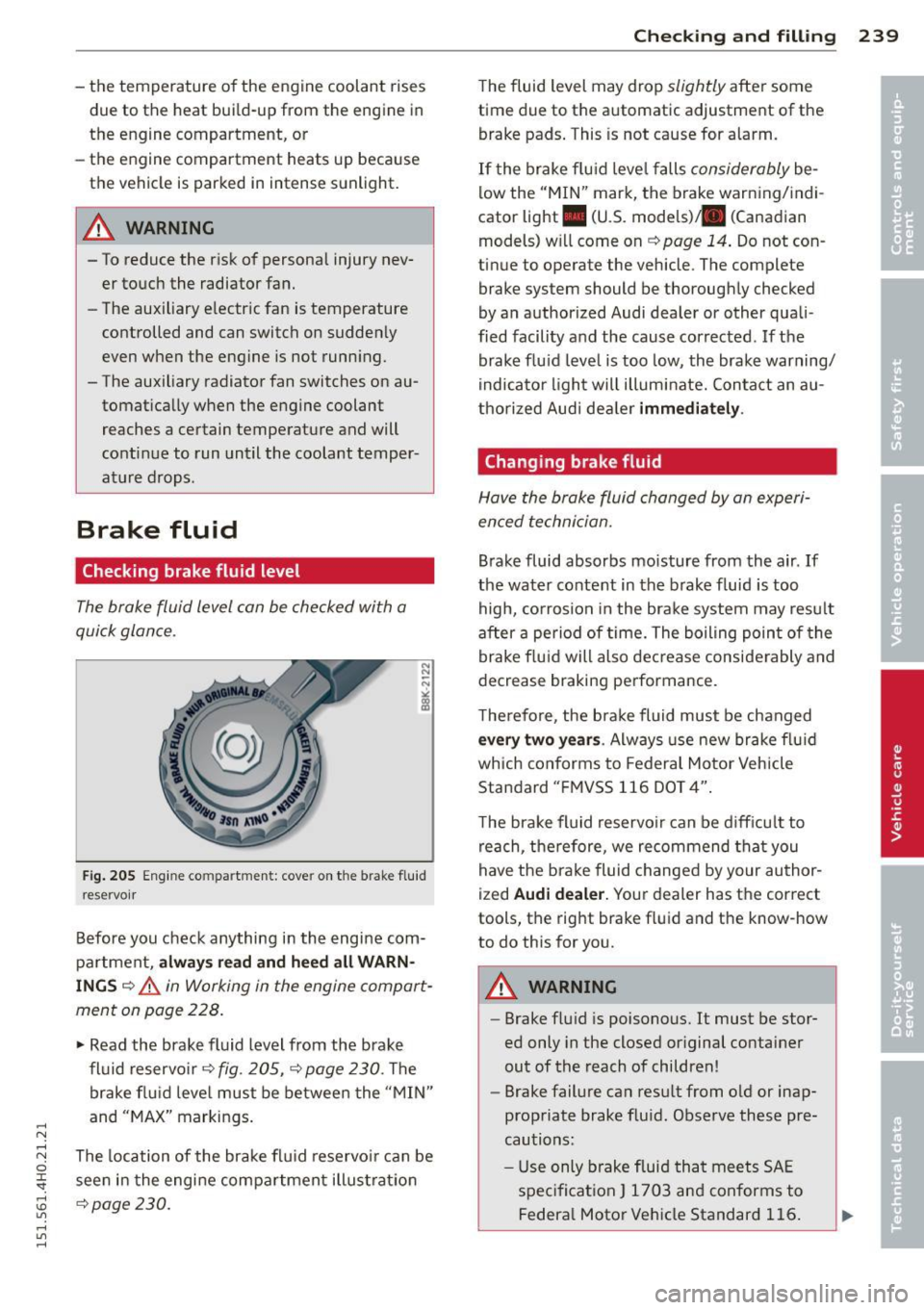
F ig . 2 05 Eng ine co mpartmen t: cove r on the b rake f lui d
r eservo ir
Before you check anything in th e engine com
partment,
alwa ys read and he ed all WARN
INGS c::> .&. in Working in the engine compart
ment on page 2 28.
~ Read the brake fluid level from the brake
fl uid reservo ir ~
fig . 205, c::> page 230. The
brake f luid leve l must be betwee n the "M IN"
and "M AX" marki ngs.
The location of the brake fl uid reservo ir can be
see n in t he engi ne comp artment illus trati on
c::> page 230.
Checkin g and fillin g 239
The fluid level may d rop slightly afte r some
time due to the automatic adjustment of the
brake pads . T his is not cause for alarm .
If the brake flu id leve l falls considerably be
low the "MIN" mark, the brake warning/indi
cator light . (U.S. models) . (Canadian
models) w ill come on
~ page 14 . Do not con
tin ue to operate the vehicle . The complete
brake sys tem should be thoroughly checked
by an authorized Audi dea ler or other quali
fied facility and the cause corrected.
If the
brake f lu id leve l is too low, the brake warning/
indica tor ligh t will illumi nate. Conta ct an au
thorized Aud i de aler
immediately .
Changing brake fluid
Have the brake fluid changed by an experi
en ced technician.
B rake fluid absorbs moisture from the air . If
the water content in the brake fluid is too
high, co rrosion in the brake system may resu lt
after a pe riod of time. The boiling point of the
brake f lu id will also dec rease conside rably and
decrease brak ing performance.
T herefo re , the bra ke fluid must be changed
every tw o year s. Always use new br ake f lu id
which con forms to Federal Mo tor Veh icle
Standard " FMVSS 116 DOT 4".
T he bra ke fluid reservo ir can be d iff icu lt to
reach, the refore, we recommend that you
have the bra ke fluid changed by your author
ized
Audi dealer. Your dealer has the cor rect
tools, the right brake fluid and the know -how
to do this for you.
A WARNING
---- Brake flu id is poisonous. It must be stor
ed only in the closed or iginal container
out of the reach of children!
- Brake failure can resu lt from old or inap
prop riate brake f lu id. Observe these pre
cautions:
- U se only brake fluid tha t meets SAE
specificat ion
J 1703 and conforms to
Federa l Motor Vehicle Standard 116.
Page 242 of 312
24 0 Ch eck ing and filling
Always check wi th your a uthorized Audi
dealer to make s ure you are using the
correct brake flu id. The correct type of
brake fluid is also indicated on the
brake fluid reservoir.
- The brake fluid must be new. Heavy use
of the brakes can cause a vapor lock if
the brake fluid is left in the system too
long. This can ser ious ly affect the effi
ciency of the b ra kes as well as yo ur
safety. This could result in an acc ident.
(D Note
Brake flu id will damage the paint of your
veh icle.
@ For the sake of the environment
Because of the problem of proper d isposa l
of brake flu id as wel l as the special tools
requ ired and the necessary expert ise, we
recommend that you have the b rake fluid
changed by your author ized Audi dealer.
Battery
General information
Under
normal operating conditions, the bat
tery in your Audi does not need any mainte
n ance . With
high outside temperatures or
l ong daily dr ives we recommend that you have
the elec trolyte level checked by a service fa
cili ty. The e lec trolyte level sho uld a lso be
checked each time the battery is charged
¢ page 242.
Have the b attery checked when you ta ke yo ur
ve hicl e in for service. Yo u are well adv ise d to
replace a battery that is older than S years .
W ith certa in types of airbag deployment, the
battery is d isconnected from the vehicle ele c
tr ica l system for sa fety reasons¢
& in Re
pair, care and disposal of the airbags on
page 165.
Disconnecting the battery terminals
Some veh icle func tions (power w indow regu
l ato rs, for example) a re los t if the b attery ter- mina
ls are disconnected. These functions have
to be relearned after the battery termina ls are
connected aga in. To prevent th is, the battery
sho uld only be disconnected from the ve hicle
electrical system when abso lutely necessary
for repairs.
Vehicle s not driven for long peri ods
If you do not d rive your vehicle over a period
of several days or weeks, e lectr ica l compo
nents are gradually cut back or sw itched off.
This reduces energy consumption and ma in
ta ins start ing capability over a longer period
¢
page 202. Some of the convenience func
t ions may not ope rate, such as the inter ior
li gh ts or the power seat adjus tment. The con
venience func tions will be ava ilable ag ain
when you switch on the ignition and start the
engine .
Winter operation D uring the winte r months, battery capac ity
tends to de crease as temperatures drop. This
is beca use more power is also consumed wh ile
sta rting, and the headlights, rear window de
fogger, etc ., are used more often .
Avoid unnecessary power consumpt ion, p ar
t icu lar ly in city traffic or whe n traveling only
short distances. Let yo ur au thorized Aud i
dealer check the capacity of the vehicle bat
tery before winter sets in ¢
page 242. A well
charged battery will not on ly prevent starting
problems when the weather is cold, but will
also last longer.
(!) Tips
If your vehicle is left standing for several
weeks at extremely low temperatures, the
vehicle battery sho uld be removed and
stored where it w ill not freeze. This will
prevent it from be ing damaged and having
to be repla ced.
Page 245 of 312

.... N .... N
0 J:
'SI: .... \!) 1.1"1
.... 1.1"1 ,....,
Fa st charging the b att ery (charging rate
abo ve 14.8 Vo lt s)
Fo r technical reasons do not use a batt ery
charger that uses vo ltage g reater than 14.8
Volts to charge your vehicle's battery.
A WARNING
-
Charging a battery can be dangerous.
- Always follow the operating instructions
provided by the battery charger manu
facturer when charging your battery.
- Never charge a fro zen battery. It may ex
plode because of gas trapped in the ice.
Allow a frozen battery to thaw out first .
- Do not reuse batteries which were fro
zen. The battery housing may have
cracked and weakened when the battery
froze .
- Charge the battery in a well ventilated
area . Keep away from open flame or elec
trical spark . Do not smoke . Hydrogen gas
gene rated by the battery is exp losive.
- To reduce the danger of explosion , never
co nnect or disconnect cha rger cables
wh ile the charger is operating.
- Fast charg ing a battery is dangerous and
should only be attempted by a compe
t ent technicia n w ith the proper eq uip
ment.
- Battery a cid that may spill d uring charg
ing should be washed off wit h a solution
of warm wa ter and ba king soda to neu
tralize the acid .
CD Note
Never use a fast charge r as a booster to
s tart the engine. This will se rio usly d am
age sensitive elect ronic components, such
as control units, relays, radio, etc., as we ll
as the battery charger .
Checking and fillin g
Battery replacement
The new battery must have the same specifi
cations and dimensions as the original equip
ment battery.
In telligen t energy managemen t in your vehi
cle is responsible for distributing the electri
cal ene rgy throughout your vehicle
¢ page 202. The intelligent energy manage
ment system will keep the engine battery
c h arged better than vehicles without this sys
tem. To make sure the additional electrica l en
ergy is avai lab le once again afte r yo u have
changed the battery, we recommend that you
insta ll batteries of the same type and m anu
facture only (the same as those installed at
the time your ve hicle was delivered) . Specif i
cat ions are listed on the battery housing . Your
authorized dea le r must code the battery in
the energy management system to enab le you
to use the ene rgy manageme nt func tions cor
re ct ly afte r replacing the battery.
The new battery must have the same capacity,
vo ltage
( 1 2 volts), amperage, const ruction
and plug seal ing .
When installing the battery, make sure the ig nition and a ll elect rical consume rs are switch
ed off .
CD Note
- Make sure the ventilation hose on the
side of the battery is connected, other
w ise fumes or battery a cid ca n leak out .
- Veh icles with the Start-Stop-System* are
e quipped with a spec ial cycle-p roof AGM
battery. Install ing a d iffe rent type of
ba ttery c an cause problems in the vehi
cle e lectrical system. Whe n replacing the
vehicle battery, always install one w ith
the same specifications as the origina l
battery.
- Battery mounts and clamps must a lways
be sec ured correct ly .
- Read and fo llow the wa rnings under
¢ page 241, Working on the battery be-
fore per forming any work on the battery . ..,_
243
•
•
Page 249 of 312
,....,
N ,....,
N
0 J:
'SI: ,...., \!) 1.1"1 ,...., 1.1"1 ,....,
Tires and wheels 24 7
Gross Vehicle Weight Rating ("GVWR") Ply
means the maximum total loaded weight of
the vehicle .
Groove
means the space between two adjacent tread
ri bs.
Load rating (code)
means the maximum load that a tire is rated
to carry for a given inflat ion pressure . You
may not find this informat ion on all tires be
cause it is not requ ired by law.
Maximum load rating
means the load rating for a t ire at the max i
mum permissible inflation pressure for that
tire .
Maximum loaded vehicle weight
means the sum of:
(a) Curb weight
(b) Accesso ry weight
(c) Vehicle capacity weight, and
(d) Production opt ions we ight
Maximum (permissible) inflation pressure
means the maximum co ld inf lation pressure
to which a tire may be inflated . Also called
"maximum inflation press ure."
Normal occupant weight
means 150 lbs . (68 kilograms) times the
number of occupants seated in the vehicle up
to the tota l seating capacity of your vehicle.
Occupant distribution
means distribution of occupants in a veh icle.
Outer diameter
means the overall diameter of an inflated new
tire .
Overall width
means the linear distance between the exteri
ors of the sidewalls of an inflated tire, includ
ing e levations due to labeling, decorations, or
protective bands or ribs. means a layer of
rubber-coated parallel cords.
Production options weight
means the combined weight of those installed
regular production opt ions we ighing over 5
lbs. (2.3 kg) in excess of those standa rd items
which they replace, not previously considered
in curb weight or accessory weight, including
heavy duty brakes, ride levelers, roof rack,
heavy duty battery, and spec ial trim.
Radial ply tire
means a pneumatic tire in which the ply cords
that extend to the beads are laid at substan
tially 90 degrees to the centerline of the
tread.
Recommended inflation pressure
see ~ page 246, Cold tire inflation pressure .
Reinforced tire
means a tire design to operate at higher loads
and at higher inflation pressures than t he cor
responding standard tire. Reinforced tires
may be identified as "XL", "xl", "EXTRA LOAD",
or "RF" on the sidewal l.
Rim
means a metal support for a tire or a t ire and
tube assembly upo n which the tire beads are
seated .
Rim diamete r
means nominal diameter of the bead seat. If
you change your wheel s ize, you wi ll have to
purchase new tires to match the new r im di
ameter .
Rim size designation
means rim diameter and width.
Rim width
means nominal distance between rim flanges.
Sidewall
means that portion of a t ire between the
tread and bead .
•
•
Page 252 of 312
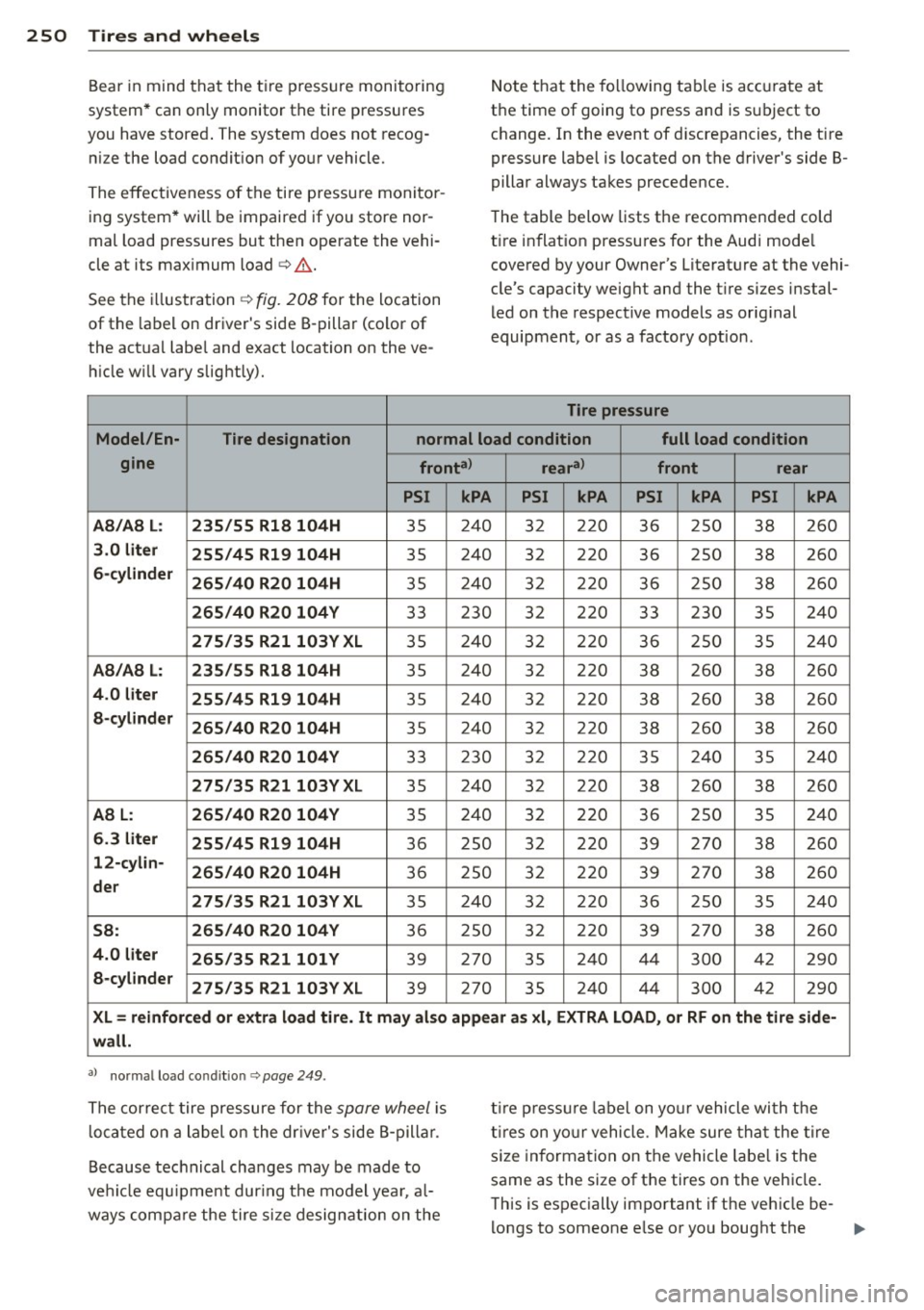
250 Tires and wheels
Bear in mind that the tire pressure monitoring
system* can only monitor the tire pressures
you have stored . The system does not recog
nize the load condit ion of your vehicle.
The effectiveness of the tire pressure monitor
ing system* will be impaired if you store nor
mal load pressures but then operate the vehi
cle at its max imum load
c:> &. .
See the illustration c:> fig. 208 for the location
of the label on driver's side B-pillar (color of
the act ua l label and exact location on the ve
hicle will vary slightly). Note
that the following table is accurate at
the time of going to press and is subject to
change. In the event of d iscrepancies, the t ire
pressure label is located on the driver's side B
pillar always takes precedence.
The table below lists the recommended cold
t ir e inflation pressures for the Audi mode l
covered by your Owner's Literature at the vehi
cle's capacity weight and the t ire sizes instal
led on the respective models as orig inal
equipment, or as a factory opt ion.
Tire pressure
Model/En- Tire designation normal load condition full load condition
gine fronta> reara>
front rear
PSI kPA
PSI kPA PSI kPA PSI kPA
A8/A8 L: 235/55 R18 104H
35 240 32 220 36 250 38 260
3.0 liter
255/45 R19 104H 35 240 32 220 36 250 38 260
6-cylinder
265/40 R20 104H 35 240 32 220 36 250 38 260
265/40 R20 104V 33 230 32 220 33 230 35 240
275/35 R21103Y XL 35 240 32 220 36 250 35 240
A8/A8 L: 235/55 R18 104H 35 240
32 220 38 260 38 260
4.0 liter
255/45 R19 104H 35 240 32 220 38 260 38 260
8-cylinder
265/40 R20 104H 35 240
32 220
38 260
38 260
265/40 R20 104V 33 230 32 220
35 240 35 240
275/35 R21103Y
XL 35 240
32 220
38 260
38 260
ASL
: 265/40 R20 104V 35 240 32 220 36 250 35 240
6.3 liter
255/45 R19 104H 36 250 32 220
39 270
38 260
12-cylin-
265/40 R20 104H 36 250 32 220 39 270 38 260
der
275/35 R21103Y XL
35 240 32 220 36 250
35 240
58: 265/40 R20 104V 36 250 32 220
39 270 38 260
4.0 liter
265/35 R21101 Y 39 270 35 240 44 300 42 290
8-cylinder
275/35 R21103Y XL 39 270
35 240
44
300 42
290
XL= reinforced or extra load tire. It may also appear as xl, EXTRA LOAD, or RF on the tire side-
wall.
al n orma l lo ad co ndi tio n~ page 249.
The correct tire pressure for the spare wheel is
locat ed on a label on the driver's side B-pillar.
Because technical changes may be made to
ve hicl e equipment during the model year, al
ways compa re the tire size designation on the tire
pressu re lab el on your vehicle wi th the
tires on your vehicle. Make sure that the tire
s iz e inform ation on the vehicle label is the
same as the size of the tires on the vehicle.
This is espec ially important if the vehicle be-
l ongs to someone e lse or yo u bought the ..,.