brakes AUDI A8 2015 Owner's Manual
[x] Cancel search | Manufacturer: AUDI, Model Year: 2015, Model line: A8, Model: AUDI A8 2015Pages: 312, PDF Size: 79.18 MB
Page 242 of 312
24 0 Ch eck ing and filling
Always check wi th your a uthorized Audi
dealer to make s ure you are using the
correct brake flu id. The correct type of
brake fluid is also indicated on the
brake fluid reservoir.
- The brake fluid must be new. Heavy use
of the brakes can cause a vapor lock if
the brake fluid is left in the system too
long. This can ser ious ly affect the effi
ciency of the b ra kes as well as yo ur
safety. This could result in an acc ident.
(D Note
Brake flu id will damage the paint of your
veh icle.
@ For the sake of the environment
Because of the problem of proper d isposa l
of brake flu id as wel l as the special tools
requ ired and the necessary expert ise, we
recommend that you have the b rake fluid
changed by your author ized Audi dealer.
Battery
General information
Under
normal operating conditions, the bat
tery in your Audi does not need any mainte
n ance . With
high outside temperatures or
l ong daily dr ives we recommend that you have
the elec trolyte level checked by a service fa
cili ty. The e lec trolyte level sho uld a lso be
checked each time the battery is charged
¢ page 242.
Have the b attery checked when you ta ke yo ur
ve hicl e in for service. Yo u are well adv ise d to
replace a battery that is older than S years .
W ith certa in types of airbag deployment, the
battery is d isconnected from the vehicle ele c
tr ica l system for sa fety reasons¢
& in Re
pair, care and disposal of the airbags on
page 165.
Disconnecting the battery terminals
Some veh icle func tions (power w indow regu
l ato rs, for example) a re los t if the b attery ter- mina
ls are disconnected. These functions have
to be relearned after the battery termina ls are
connected aga in. To prevent th is, the battery
sho uld only be disconnected from the ve hicle
electrical system when abso lutely necessary
for repairs.
Vehicle s not driven for long peri ods
If you do not d rive your vehicle over a period
of several days or weeks, e lectr ica l compo
nents are gradually cut back or sw itched off.
This reduces energy consumption and ma in
ta ins start ing capability over a longer period
¢
page 202. Some of the convenience func
t ions may not ope rate, such as the inter ior
li gh ts or the power seat adjus tment. The con
venience func tions will be ava ilable ag ain
when you switch on the ignition and start the
engine .
Winter operation D uring the winte r months, battery capac ity
tends to de crease as temperatures drop. This
is beca use more power is also consumed wh ile
sta rting, and the headlights, rear window de
fogger, etc ., are used more often .
Avoid unnecessary power consumpt ion, p ar
t icu lar ly in city traffic or whe n traveling only
short distances. Let yo ur au thorized Aud i
dealer check the capacity of the vehicle bat
tery before winter sets in ¢
page 242. A well
charged battery will not on ly prevent starting
problems when the weather is cold, but will
also last longer.
(!) Tips
If your vehicle is left standing for several
weeks at extremely low temperatures, the
vehicle battery sho uld be removed and
stored where it w ill not freeze. This will
prevent it from be ing damaged and having
to be repla ced.
Page 248 of 312
24 6 T ire s and whee ls
- Never mount used tires on yo ur vehicle if
you are not sure of their "previous histo
ry." Old used tires may have been dam
aged even though the damage cannot be
seen that can lead to sudden tire failure
and loss of vehicle control.
- If you notice unusual vibration or if the
vehicle pulls to one side when driving, al
ways stop as soon as it is safe to do so and check the wheels and tires for dam
age.
(D Note
- Please note that summer and winter
tires are designed for the cond itions that
a re typ ica l in those seasons. Aud i recom
mends using w inter t ires d uring the win-
Glossary of tire and loading terminology
Accessory weight
means t he comb ined weight (in excess of
those standard items which may be rep laced)
of automatic transmission, power steering,
power brakes, power windows, power seats,
radio, and heater, to the extent that these
items are available as factory-installed equip
ment (whether installed or not).
Aspect ratio
means t he ratio of the height to the width of
the tire in percent. Numbers of 55 or lower in
d icate a low sidewall for improved steer ing re
sponse and better overall handling on dry pavement .
Bead
means the pa rt of the tire t hat is made of
steel wires, wrapped or reinforced by ply cords
and that is shaped to fit the r im.
Bead separation
means a breakdown of the bond between
components in the bead.
Cord
means t he strands forming the plies in the
tire. ter months.
Low tempe ratu res signifi
cantly decrease the elasticity of summer
tires, which affects traction and braking ability. If summer tires are used in very
co ld temperatures, cracks can form on
the tread bars, resu lting in permanent
tire damage that can cause loud driving noise and unbalanced tires. Aud i is not
responsib le for this type of damage.
- Burn ished, polished or chromed rims
must not be used in winter weather. The
surface of the rims does not have suff i
c ien t corrosion protect io n for this and
cou ld be pe rmanently damaged by road
salt or simi lar substances. This damage
is not covered by war ranty.
Cold tire inflat ion pre ssure
means the t ire press ure recommended by the
vehicle manufacturer for a tire o f a des ignated
size that has not been driven for more than a
coup le of miles (ki lometers) at low speeds in
the three hour period before the tire press ure
is measured or adjusted.
Curb weight
means the weight of a motor vehicle w ith
standard equipment including the maximum
capacity of fuel, o il, and coolant, air cond i
tion ing and additional weight of optiona l
equipment.
E x tra load tire
means a tire design to operate at higher loads
and at higher inflation pressures than the cor
responding standard tire. Extra load tires may
be identified as "XL", "xl", "EXTRA LOAD", or
"RF" on the sidewall.
Gross A xle Weight Rating ("GAWR ")
means the load-carrying capacity of a single
axle system, measured at the tire-ground in -
terfaces.
IJ>,
Page 249 of 312
,....,
N ,....,
N
0 J:
'SI: ,...., \!) 1.1"1 ,...., 1.1"1 ,....,
Tires and wheels 24 7
Gross Vehicle Weight Rating ("GVWR") Ply
means the maximum total loaded weight of
the vehicle .
Groove
means the space between two adjacent tread
ri bs.
Load rating (code)
means the maximum load that a tire is rated
to carry for a given inflat ion pressure . You
may not find this informat ion on all tires be
cause it is not requ ired by law.
Maximum load rating
means the load rating for a t ire at the max i
mum permissible inflation pressure for that
tire .
Maximum loaded vehicle weight
means the sum of:
(a) Curb weight
(b) Accesso ry weight
(c) Vehicle capacity weight, and
(d) Production opt ions we ight
Maximum (permissible) inflation pressure
means the maximum co ld inf lation pressure
to which a tire may be inflated . Also called
"maximum inflation press ure."
Normal occupant weight
means 150 lbs . (68 kilograms) times the
number of occupants seated in the vehicle up
to the tota l seating capacity of your vehicle.
Occupant distribution
means distribution of occupants in a veh icle.
Outer diameter
means the overall diameter of an inflated new
tire .
Overall width
means the linear distance between the exteri
ors of the sidewalls of an inflated tire, includ
ing e levations due to labeling, decorations, or
protective bands or ribs. means a layer of
rubber-coated parallel cords.
Production options weight
means the combined weight of those installed
regular production opt ions we ighing over 5
lbs. (2.3 kg) in excess of those standa rd items
which they replace, not previously considered
in curb weight or accessory weight, including
heavy duty brakes, ride levelers, roof rack,
heavy duty battery, and spec ial trim.
Radial ply tire
means a pneumatic tire in which the ply cords
that extend to the beads are laid at substan
tially 90 degrees to the centerline of the
tread.
Recommended inflation pressure
see ~ page 246, Cold tire inflation pressure .
Reinforced tire
means a tire design to operate at higher loads
and at higher inflation pressures than t he cor
responding standard tire. Reinforced tires
may be identified as "XL", "xl", "EXTRA LOAD",
or "RF" on the sidewal l.
Rim
means a metal support for a tire or a t ire and
tube assembly upo n which the tire beads are
seated .
Rim diamete r
means nominal diameter of the bead seat. If
you change your wheel s ize, you wi ll have to
purchase new tires to match the new r im di
ameter .
Rim size designation
means rim diameter and width.
Rim width
means nominal distance between rim flanges.
Sidewall
means that portion of a t ire between the
tread and bead .
•
•
Page 256 of 312
254 Tires and wheels
A WARNING
Overloading a vehicle can cause loss of ve
hicle control, a crash or other accident, se
rious personal injury, and even death.
- Carrying more weight than your vehicle
was designed to carry will prevent the
vehicle from handling properly and in crease the risk of the loss of vehicle con
trol.
- The brakes on a vehicle that has been
overloaded may not be able to stop the
vehicle within a safe distance.
- Tires on a vehicle that has been overload
ed can fail suddenly, including a blowout
and sudden deflation, causing loss of
control and a crash.
- Always make sure that the total load be
ing transported -including the weight of
a trailer hitch and the tongue weight of a
loaded trailer -does not make the vehi
cle heavier than the vehicle's Gross Vehi
cle Weight Rating.
Determining correct load limit
Use the example below to cal
culate the total weight of the
passengers and luggage or oth
er things that you plan to trans
port so that you can make sure
that your vehicle will not be
overloaded.
Steps for Determining
Correct Load Limit
1. Locate the statement "THE
COMBINED WEIGHT OF OC
CUPANTS AND CARGO
SHOULD NEVER EXCEED XXX
KG OR XXX LBS" on your ve
hicle's placard (tire inflation pressure label)
¢ page 249,
fig. 208.
2.
Determine the combined
weight of the driver and pas
sengers that will be riding in
your vehicle.
3. Subtract the combined weight of the driver and pas
sengers from
"XXX" kilo
grams or
"XXX" pounds
shown on the sticker
c> page 249, fig. 208.
4. The resulting figure equals
the available amount of car
go and luggage load capaci
ty. For example, if the
"XXX"
amount equals 1400 lbs.
and there will be five 150
lbs. passengers in your vehi
cle, the amount of available
cargo and luggage load ca
pacity is 650 lbs. (1400-7 SO
(5
X 150) = 650 lbs.)
5. Determine the combined weight of luggage and cargo
being loaded on the vehicle.
That weight may not safely
exceed the available cargo
and luggage load capacity
calculated in Step 4.
6. If your vehicle will be towing
a trailer, load from your trail
er will be transferred to your .,.
Page 261 of 312

,....,
N ,....,
N
0 J:
'SI: ,...., \!) 1.1"1 ,...., 1.1"1 ,....,
Driving with different tires reduces vehi
cle handling and can lead to a loss of
control.
- If the spare tire is not the same as the
tires that are mounted on the vehicle -
for example with winter tires -only use
the spare tire for a short period of time and drive with extra care. Refit the nor
mal road wheel as soon as safely possi
ble.
- Never drive faster than the maximum
speed for which the tires on your vehicle
are rated because tires that are driven
faster than their rated speed can fail
suddenly.
- Overloading tires cause heat build-up,
sudden tire failure, including a blowout
and sudden deflation and loss of control.
- Temperature grades apply to tires that
are properly inflated and not over or un
deri nflated.
- For technical reasons it is not always
possible to use wheels from other
vehicles -in some cases not even wheels
from the same vehicle model.
- If you install wheel trim discs on the ve
hicle wheels, make sure that the air flow
to the brakes is not blocked. Reduced air
flow to the brakes can them to overheat, increasing stopping distances and caus
ing a collision.
- Run flat tires may only be used on
vehicles that were equipped with them at the factory . The vehicle must have a
chassis designed for run flat tires. Incor
rect use of run flat tires can lead to vehi
cle damage or accidents. Check with an
authorized Audi dealer or tire specialist
to see if your vehicle can be equipped
with run flat tires. If run flat tires are used, they must be installed on all four
wheels. Mixing tire types is not permit
ted.
(D Note
- For technical reasons, it is not generally
possible to use the wheel rims from oth-
Tires and wheels 259
er vehicles. This can hold true for wheels
of the same vehicle type.
- If the spare tire is different from the
tires that you have mounted on your ve
hicle (for example winter tires or wide
profile tires), then use the spare tire for a
short period of time only and drive with
extra care. Replace the flat tire with the
tire matching the others on your vehicle
as soon as possible.
- Never drive without the valve stem cap .
The valves could get damaged .
(® For the sake of the environment
Dispose of old tires in accordance with the
local requirements.
Uniform tire quality grading
-Tread wear
- Tract ion AA A B C
- Temperature AB C
Quality grades can be found where applicable
on the tire side wall between tread shoulder
and maximum section width
c;, page 256,
fig. 212.
For example: Tread wear 200, Traction AA,
Temperature A.
All passenger car tires must conform to Feder
al Safety Requirements in addition to these
grades.
Tread wear
The tread wear grade is a comparative rating
based on the wear rate of the tire when tested
under controlled conditions on a specified
government test course.
For example, a tire graded ISO would wear
one and one half (11/2) times as well on the
government course as a tire graded 100.
The relative performance of tires depends upon the actual conditions of their use, how
ever, and may depart significantly from the
norm due to variations in driving habits, serv
ice practices and differences in road character-
istics and climate.
ll-
•
•
Page 298 of 312
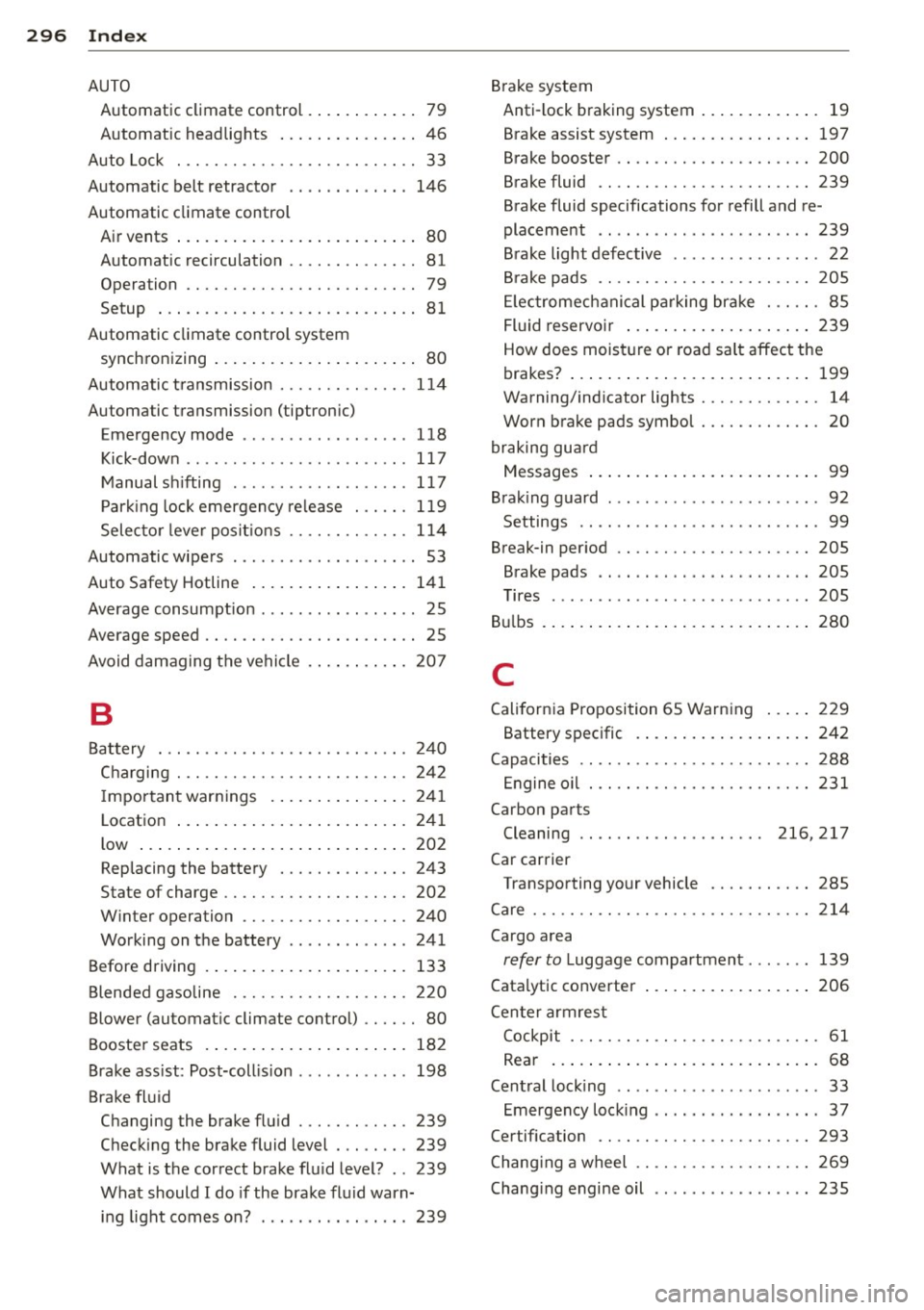
296 Index
AUTO Automatic cl imat e control . ... ... ... .. 79
Automatic headlights ....... .. .... . . 46
Auto Lock 33
Automatic belt retractor . . . . . . . . . . . . . 146
Automatic climate control Air vents ... ................ ..... .. 80
Automatic recirculation .............. 81
Operation . . . . . . . . . . . . . . . . . . . . . . . . . 79
Se tup . .. .. .. . .......... .. .. .... .. 81
Automatic climate control system synchronizing ................ .... .. 80
Automatic t ransmission ... .. .. .. .. .. . 114
Automatic transmission (tiptronic)
Eme rgency mode .............. .... 118
Kick-down . . . . . . . . . . . . . . . . . . . . . . . . 117
Manual shifting ........... ... .. ... 117
Parking lock emergency release . .... . 119
Selector lever posit ions ............. 114
Automatic wipers . . . . . . . . . . . . . . . . . . . . 53
Auto Safety Hotline ................ . 141
Average consumption ........... .. .. .. 25
Average speed . . . . . . . . . . . . . . . . . . . . . . . 25
Avoid damaging the vehicle ...... .... . 207
B
Batt ery . . . . . . . . . . . . . . . . . . . . . . . . . . . 240
Charging . ............... .. .. .... . 242
I mportant warnings ....... ... .. .. . 241
Loc ation ... ................ ..... . 241
low .. ... .................. ..... . 202
Replacing the battery ..... .. .. .. .. . 243
State of charge ........... .. .. .... . 202
Winter operation .................. 240
Working on the battery ............. 241
Before driving .............. ... .... . 133
Blended gasoline ........ .. .. .. .. .. . 220
Blower (automatic climate control) . . . . . . 80
Boost er seats .............. ... .... . 182
Brake assist : Post-collision ..... .. .. .. . 198
Brake fluid Changing the brake flui d ... .. .. .. .. . 239
Checking the brake fluid level . .. ..... 239
What is the correct brake fluid level? .. 239
What should I do if the brake fluid warn-
ing light comes on? ............... . 239 Brake system
Anti- lock braking system ............. 19
Brake assist system ................ 197
Brake booster ..................... 200
Brake fluid .... .. ............. .... 239
Brake fluid specifications for refill and re -
placement .. .. .. .. ..... ........ .. 239
Brake light defective . . . . . . . . . . . . . . . . 22
Brake pads .. .. . .. ............ .. .. 205
El ec tromechanical parking brake ...... 85
Fluid reservoir ... ................. 239
How does moisture or road salt affect the
brakes? ......... .. .............. . 199
Warning/indicator lights ........ .... . 14
Worn brake pads symbol . . . . . . . . . . . . . 20
braking guard Messages ..... .. .. .............. .. 99
Braking guard ..... ................ .. 92
Settings . . . . . . . . . . . . . . . . . . . . . . . . . . 99
Break-in period .. .. ............. .. .. 205
Brake pads .. .. .. ...... .... .... ... 205
Tires 205
Bu lbs ..... ..... .. .. .............. . 280
C
California Proposition 65 Warning ... .. 229
Battery specific . . . . . . . . . . . . . . . . . . . 242
Capacities .. .. .. .. ............. .. .. 288
Engine oil ..... ... .............. .. 231
Carbon parts
Cleaning .................... 216,217
Car carrier Transporting your vehicle ........... 285
Care ... .. .. .. .. .. ............. .. .. 214
Cargo are a
refer to Luggage compartment ...... .
Catalytic converter
Center armrest 139
206
Cockpit ... .... .. ............. .... . 61
Rear
Central locking .. .................. . .
Emergency locking .......... ..... .. . 68
33
37
Certification .... .. ............. .... 293
Changi ng a wheel .. ... .......... .. .. 269
Ch . . 'l
angmg engine
01 ....••....•..... • 235