driver seat adjustment AUDI A8 2016 User Guide
[x] Cancel search | Manufacturer: AUDI, Model Year: 2016, Model line: A8, Model: AUDI A8 2016Pages: 302, PDF Size: 75.68 MB
Page 144 of 302
Safe ty belts
locks the belt when the belt is pu lled out fast,
during hard braking and in an accident. The belt
may a lso lock when you drive up or down a steep
h ill or through a sharp curve. Dur ing normal driv
ing the belt lets you move freely.
Safety belt p reten sion ers
The safety belts are equipped with a belt preten
sioner that helps to tighten the safety belt and
remove slack when the pretensioner is activated
c> page 144. The function of the pretensioner is
monitored by a warning light
c::> page 18.
Con vertibl e loc king r etracto r
Every safety belt except the one on the driver
seat is equipped with a convertible locking retrac
tor that
must be used when the safety belt is
used to attach a child seat. Be sure to read the
important information about this feature
c>page 177.
_&. WARNING
Improperly pos it ioned safety be lts can cause
ser ious injury in an accident
c::> page 142,
Safety belt position.
- Safety belts offer optimum protection only
when the seatback is upright and belts are
prope rly positioned on the body.
- Never a ttach the safety belt to the buck le
for ano ther seat. Attaching the belt to the
wrong b uck le wi ll reduce safe ty belt effec
t iveness and can cause ser ious persona l in
jury.
- A passenger who is not p roper ly restrained
can be seriously injured by the safety be lt it
self when it moves from the stronger parts
of the body into critical areas like the abdo
men.
- Always lock the convert ible lock ing retractor
when you are securing a child seat in the ve
hicle
c::> page 179.
@ Tips
For information on safety be lt pretensioners,
refer to
c::> page 144.
142
Safety belt position
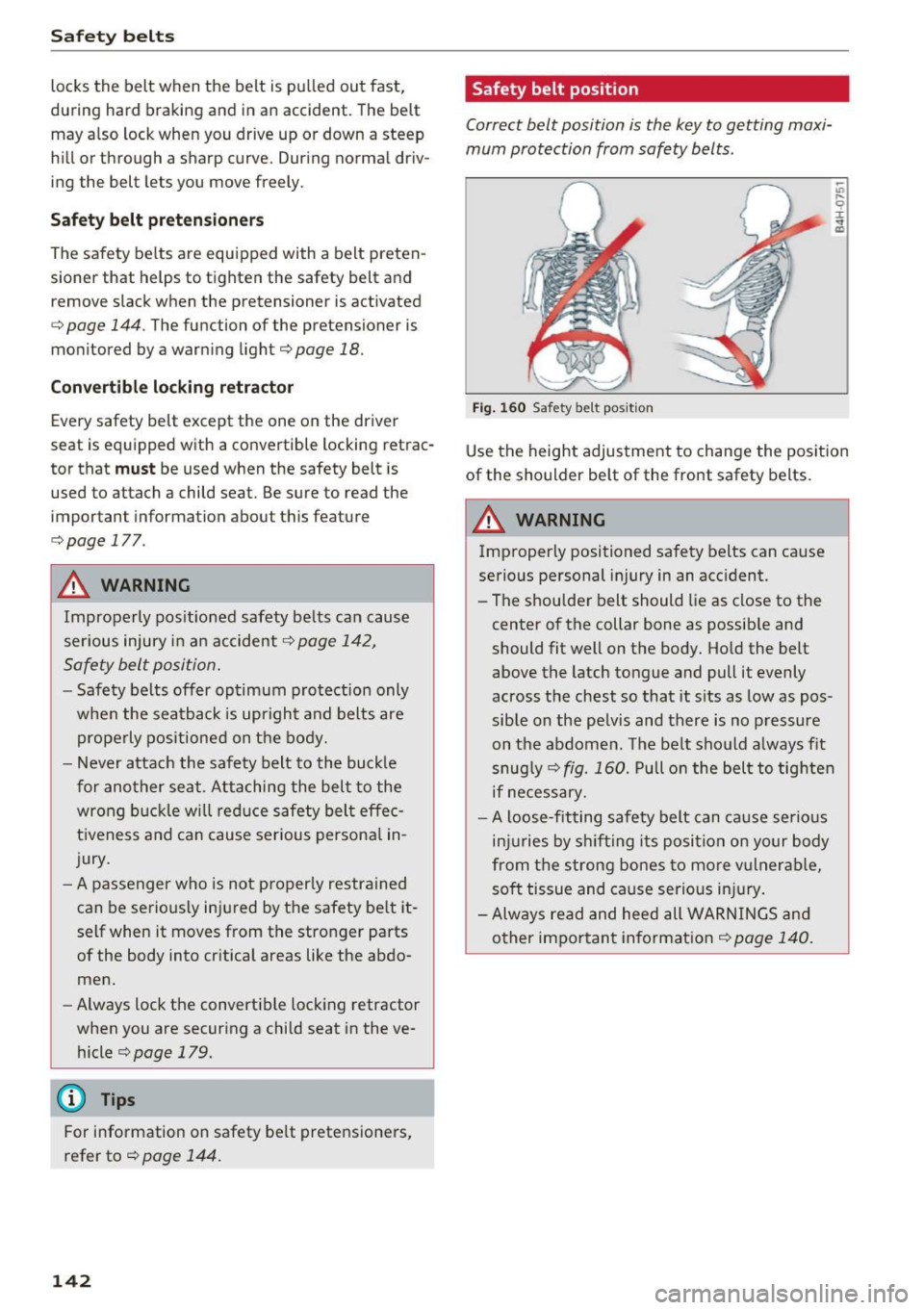
Correct belt position is the key to getting maxi
mum protection from safety belts .
Fig. 160 Safety belt position
Use the height adjustment to change the positio n
of the shoulder belt of the front safety belts.
_&. WARNING
Improperly positioned safety belts can cause
serious personal injury in an accident.
- The shou lder belt should lie as close to the
center of the collar bone as possib le and
should fit well on the body. Hold the belt
above the latch tongue and pull it evenly
across the chest so that it s its as low as pos
sible on the pe lvis and there is no p ressure
on the abdome n. T he belt sho uld a lways fit
snug ly
c::> fig. 160. Pu ll on the bel t to tigh ten
if necess ary.
- A loose-fit ting safety belt can ca use serious
in ju ries by s hifting its posi tion on yo ur body
from the strong bones to mo re v ulnerab le,
so ft tissue and cause serious in jury.
- Always read and heed all WARNINGS an d
other impor tan t information
c::> page 140 .
Page 145 of 302
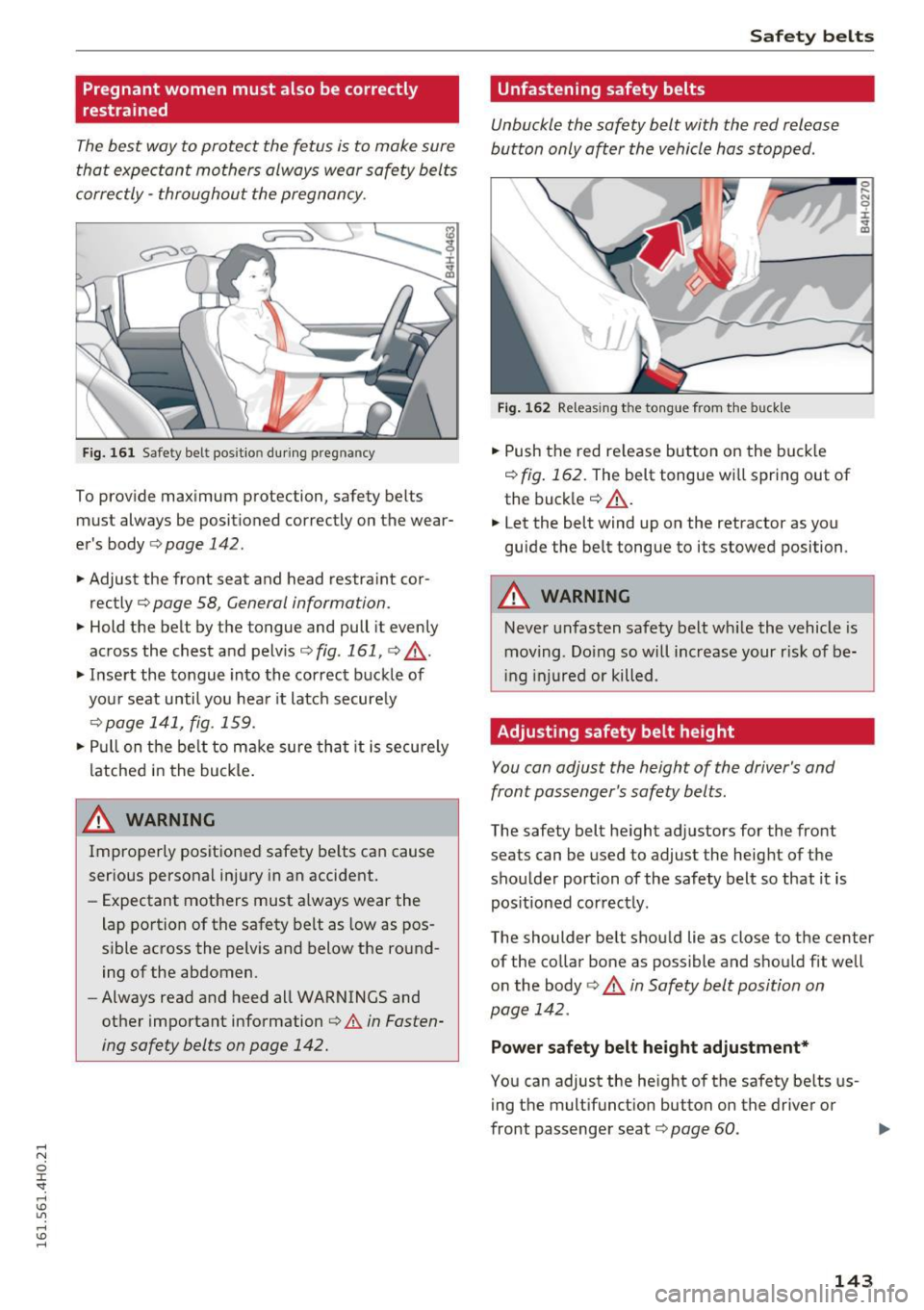
Pregnant women must also be correctly
restrained
The best way to protect the fetus is to make sure
that expectant mothers always wear safety belts
corre ctly -throughout the pregnan cy.
F ig. 161 Safety belt pos itio n dur ing pregnancy
To provide max imum protection, safety belts
must always be posit ioned correctly on the wear
er 's body
¢ page 142.
.,. Adjust the front seat and head restraint cor
rectly
c> page 58, General information .
.,. Hold the belt by the tongue and pull it evenly
across the chest and pelvis
c> fig. 161, c> ,&. .
.,. Insert the tongue into the correct buckle of
your seat until you hea r it latch secure ly
c> page 141, fig . 159.
.,. Pull on the be lt to ma ke sure that it is securely
latched in the buckle .
A WARNING
Improperly positioned safety be lts can cause
serious personal inju ry in an accident.
- Expectant mothers must a lways wear the
lap po rtion of the safety belt as low as pos
sible across the pelvis and below the round
ing of the abdomen .
- Always read and heed all WARNINGS and
other important information
¢ .&. in Fasten
ing safety belts on page 142.
Safet y bel ts
Unfastening safety belts
Unbuckle the safety belt with the red release
button only o~er the vehicle hos stopped .
J-L
Fig . 1 62 Re leasing t he tong ue from the buckle
.. Push the red re lease button on the buck le
¢ fig . 162. The belt tongue w ill spring out of
the buck le¢ ,&..
.,. Let the belt wind up on the retractor as you
guide the belt tongue to its stowed position .
_& WARNING ,-
Never unfasten safety belt wh ile the vehicle is
moving . Do ing so will increase your r isk of be
in g injured or killed .
Adjusting safety belt height
You con adjust the height of the driver's and
front passenger's safety belts .
The safety belt height adjusters for the front
seats can be used to adjust the height of the
shoulder portion of the safety belt so that it is
pos itioned correctly .
0 ..... N
0
:i:
"' CD
The shoulder belt shou ld lie as close to the center
of the collar bone as possible and s hou ld fit well
on the body
¢ .&. in Safety belt position on
page 142 .
Power safety belt height adjustment*
You can adjust the he ight of the safety be lts us
ing the multifunction button on the driver or
front passenger seat¢
page 60 .
143
Page 148 of 302
Airbag syste m
Airbag system
Important information
Importance of wearing safety belts and
sitting properly
Airbags are only supplemental restraints . For
airbags to do their job, occupants must always
properly wear their safety belts and be in a prop
er seating position.
For your safety and the safety of your passen
ge rs , before driving off, always :
"' Adjust the driver's seat and steering wheel
properly ¢
page 130,
"'Adjust the front passenge r's seat properly
¢ page 59,
"'Wear safety belts p roperly ¢ page 140,
"'Always properly use the proper child restraint
to protect children
¢ page 168.
In a coll is io n, airbags mus t inflate within the
blink of an eye and wi th considerab le force. The
supp lemental airbags can cause injuries if the
driv er or th e front s eat passeng er is not s eated
properly. Therefore in order to he lp the airbag to
do its job, it is important, both as a dr iver and as
a passenger to sit properly at all t imes.
By keeping room between your body and the
steering whee l and the front of the passenger
compartment, the a irbag can inflate fully and
completely and provide supplemental protect ion
in certain frontal collisions¢
page 130, Correct
passenger seating positions .
For details on the
operation of the seat adjustment con trols
¢ page 59.
It's especially important that children are proper
ly restra ined
¢ page 168 .
There is a lot that the driver and the passengers
can and must do to help the ind iv idual safety fea
tures installed in your Audi work together as a
system .
Proper seating posit ion is important so that the
front airbag on the drive r side can do its job. If
you have a physical impairment or cond ition that
prevents you from s itting properly on the driver
seat with the safety be lt properly fastened and
146
reaching the peda ls, or if yo u have concerns w ith
regard to the function or operation of the Ad
vanced Airbag System, please contact your a u
thori zed Audi dea ler or qua lified workshop, or
ca ll Audi Customer Relations at 1-800-822-2834
for poss ib le modifications to your vehicle .
When the airbag system dep loys, a gas generator
will fill the airbags, break open the padded cov ers, and infla te between the steering wheel and
the driver and between the instrument panel and
t h e front passenger . The airbags w il l deflate im
med iate ly after deployment so that the front oc
cupants can see t hrou gh the windsh ie ld again
without i nterruption.
All of th is takes p lace in the b link of an eye, so
fast that many people don't even rea lize that the
a irbags have deployed. The airbags a lso infla te
with a g re at deal of force and nothing should be
i n the ir way when they deploy. Front airbags in
combination with properly worn safety belts slow
down and limit the occupant 's forward move
ment . Together they he lp to prevent the driver
and front seat passenger from hitting pa rts of
the ins ide of the vehicle while reduc ing the fo rces
acting on the occupant dur ing the cras h. In th is
way they help to reduce the risk of injury to the
head and uppe r body i n the crash . Airbags do not
protect the arms or the lower pa rts of the body.
Both front airbags will not inflate in all frontal
collisions . The t riggering of the a irbag system de
pends on the veh icle decelerat ion rate caused by
t h e coll is io n and regis tered by the ele ctroni c con
tro l unit . If this ra te is be low the refe rence value
programmed in to the contro l unit, the airbags
will not be trigge red, even tho ugh the car may be
badly damaged as a resu lt of the collision. Vehi
cle damage, rep air costs or even the lack of vehi
cle damage is not necessarily an indication of
whether an a irbag should inflate or not .
Since the circumstances will vary cons iderab ly
between one co llision and another, it is not possi
ble to define a range of veh icle speeds that will
cover every poss ible kind and angle of impact
that w ill always t rigger t he a irbags . Important
factors i nclude, for examp le, the nat ure (hard or
soft) of the object which the ca r hits, the angle of
i mp act , vehicle speed , etc. The front airbags will .,.
Page 171 of 302
exceptional circumstances and the
PASS ENGER AIR BAG OFF light does not
come on and stay on, immed iately install
the rear-fac ing ch ild safety seat in a rear
seating pos it ion and have the airbag system
inspected immediately by your Audi dealer .
A WARNING
If, in exceptio nal circumstances, you must in
stall a forward-facing chi ld restraint on the
front passenger's seat:
- Always make sure the forward-fac ing seat
has been designed and ce rtified by its man
ufact urer fo r use on a front seat with a pas
senger front and side airbag .
- Always follow the manufact urer's instruc
tions prov ided with the ch ild safety seat or
carrier.
- Always move the passenger seat into its
rearmost position in the seat's fore and aft
adjustment range, as far away from the air
bag as possib le before installing the child
restraint. The backrest must be adjusted to
an upr ight position.
- Always make sure that the
PA SSENGER AIR
BAG OFF
light comes on and stays on all the
t ime whenever the ignition is switched on.
{D) Tips
Always replace chi ld restraints that were in
stalled in a vehicle dur ing a crash . Damage to
a child restraint that is not visible could cause
it to fail in another collision situation.
Advanced front airbag system and children
Your veh icle is equipped with a front "Advanced
Airbag System " in compliance w ith United States
F edera l Moto r Vehicle Safety Standard (FMVSS)
208, as well as Canada Motor Ve hicle Safe ty
Stand ard (CMVSS) 208 as appli cable at the t ime
your vehicle was manufactured .
The Advanced Airbag system in your ve hicle has
been ce rtified to meet the "low-risk " requ ire
ments for 3 -and 6-year old children on the pas
senger side and small adults on the driver side .
The low risk deployment criteria are intended to
Ch ild safety
reduce the risk of injury through interaction with
the airbag that can occur, for example, by being
too close to the steering wheel and instr ument
panel when the airbag inflates. In addition, the
system has been cert ified to comply with the
"suppression" requirements of the Safety Stand
ard, to turn off the front airbag for infants up to
12 months who are restrained on the front pas
senger seat in ch ild rest raints that are lis ted in
the S tanda rd .
Even thoug h your veh icle is equipped with an Ad
vanced Airbag system, all ch ildren, especially
those 12 yea rs and younger, sho uld a lways ride
i n the back seat properly restra ined for their age
and size . The airbag on the passenger side makes
the front seat a potentia lly dangerous p lace for a
child to ride. The front seat is not the safest place
for a ch ild in a forward-fac ing ch ild safety seat. It
can be a very dangerous place for an infant or a
larger ch ild in a rearward-facing seat .
Advanced Airbags and the weight -sensing
mat in the front seat
T he Advanced A irbag System in you r vehicle de
tects the presence of a n in fan t or child in a ch ild
restra int on the front passenger seat using the
weight-sensing mat in the seat cushion and the sensor below the safety belt latch on the front
passenger seat that measures the tension on the
safety belt.
The weight-sensing mat measures total weight
of the child and the chi ld safety seat and a child
blanket on the front passenger seat. The weight
on the front passenger seat is related to the de
s ign of the child restra int and its "footprint" , the
s ize and shape of the bottom of the c hild re
straint as it s its on the seat. The weight of a chi ld
r estra int and its "footprint " va ry for different
k inds of child restra ints and for the different
models of the same kind of ch ild rest raint of
fered by child restraint manufacturers.
T he weight ranges for the individ ual types,
makes and mode ls of chi ld restrain ts that the
N HT SA has spec ified in the Safety Standard to
gether with the weight ranges o f typical infants
and typical 1 year-old chi ld have been stored in .,.
169
Page 269 of 302
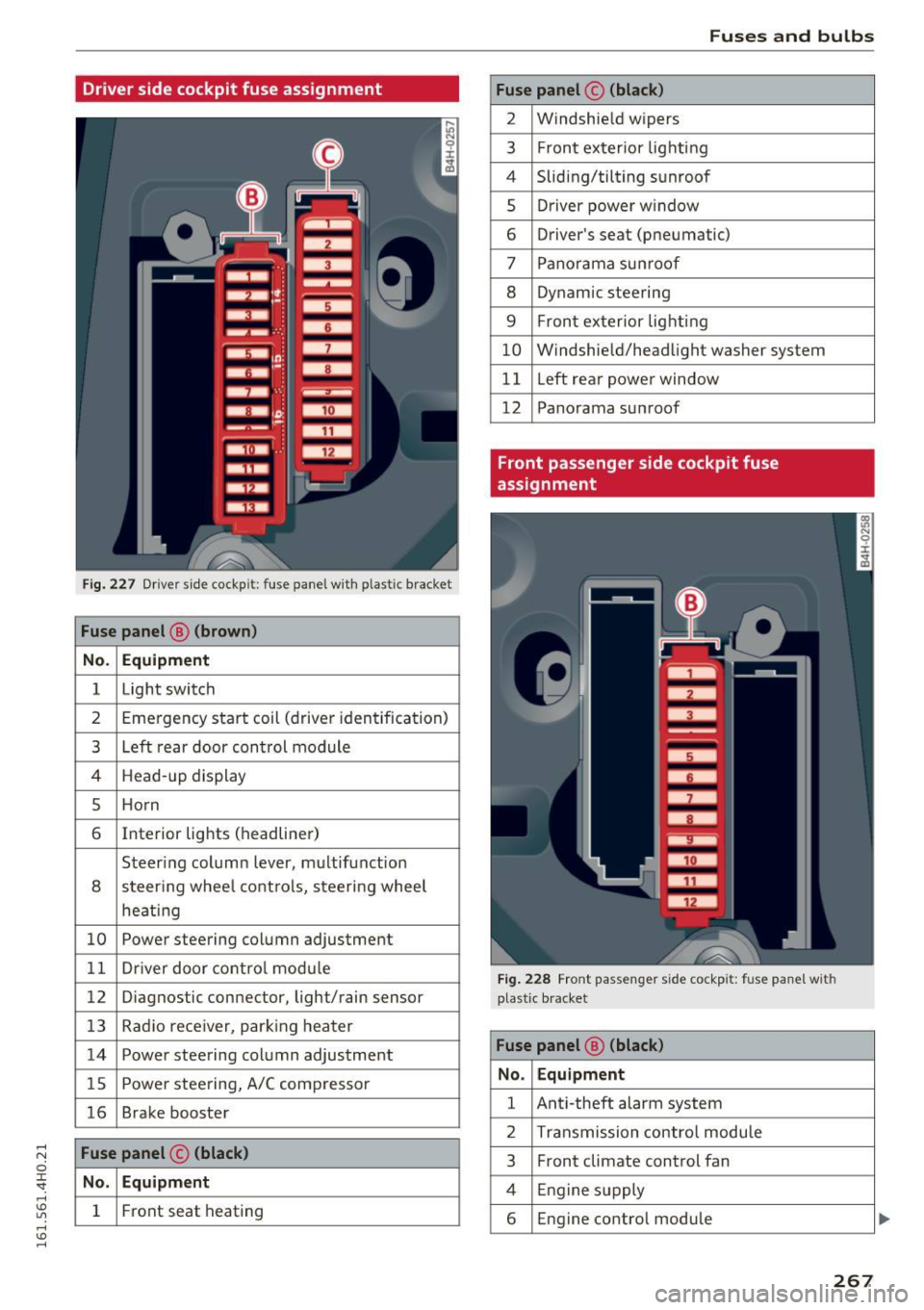
Driver side cockpit fuse assignment
Fig . 227 D river sid e cockpit: fuse panel with plastic bracket
Fuse panel @ (brown )
No . Equipment
1 Light switch
2 Emergency start coil (driver iden tification)
3 Left rear door con trol module
4 Head -up display
5 Ho rn
6 Interior lights (headliner)
Steering column lever, m ultifunction
8 steer ing whee l cont ro ls, steering wheel
heati ng
10 Powe r steering column adjustment
1 1 Dr iver door co ntro l mod ule
12 Diagnostic con nector, light/rain sensor
13 Radio rece iver, par king heater
14 Power steering column adjustment
15 Powe r stee ring, A/C comp resso r
16 Brake booster
Fuse panel © (black)
No . Equipment
1 Front seat heating
Fuses and bulbs
Fuse panel © (black)
2 Windshie ld w ipers
3 F ron t ex terior lig hti ng
4 Sliding/tilting s unroof
5 Dr iver power w indow
6 Driver's seat (pneumatic)
7 Pano rama su nroo f
8 Dynam ic steering
9 F ron t ex terior lig hting
10 W indshie ld/head light washer system
11 Left rea r powe r window
12 Panorama su nroof
Front passenger side cockpit fuse
assignment
Fig. 228 Front passenge r side cockp it: fuse panel with
p last ic b racket
Fuse panel @ (black)
No . Equipment
1 Ant i-theft alarm system
2 Transmission contro l modu le
3 Front climate control fan
4 Engine supply
6 Engine control module
267
Page 296 of 302
Index
Fastening . ..................... ... .
Improperly worn ................ ... .
Not worn .. .. .. ................ ... .
Safety belt position ........... .... .. . 141
144
139
142
Safety instructions . . . . . . . . . . . . . . . . . . . 140
Securing child safety seats . . . . . . . . . . . . 177
Special considerations for pregnant worn-
en ....... ... .. ................ ... . 143
Unfastening .. .. ............. .... .. . 143
Warning/indicator light ....... .. .. .. . 138
Warning light . . . . . . . . . . . . . . . . . . . . . . . . 16
Worn properly .................. ... .
Safety belt tensioner drive select . .. .... ........... .... .. .
Safety belt warning light ............ .. .
Safety compliance sticker .......... ... .
Safety equipment ........... ...... ... .
Safety features for occupant restraint and
protection . .. .. ............... .... .. .
Safety guidelines 140
106 138
277
129
129
Seat adjustment . . . . . . . . . . . . . . . . . . . . . 58
Safety instructions Eng ine compartment .......... .... .. .
for side curtain airbags ........ .. .. .. .
for using chi ld safety seats ..... .... .. .
for using safety belts ................ .
Monitoring the Advanced Airbag System .
Safety systems 220
167
171
140
158
Warning/indicator lights . . . . . . . . . . . . . . . 18
Saving fuel Cylinder on demand system . . . . . . . . . . . . 24
Efficiency program . . . . . . . . . . . . . . . . . . . . 25
Recuperation
Screwdriver .. .. ............... .... .. .
Seat adjustment 24
256
Controls (front seats) . . . . . . . . . . . . . . . . . 59
Controls (rear seats)
.................. 61
Driver's seat . . . . . . . . . . . . . . . . . . . . . . . . . 58
Front passenger's seat . . . . . . . . . . . . . . . . . 59
Head restraints . . . . . . . . . . . . . . . . . . . . . 132
Safety guidelines . . . . . . . . . . . . . . . . . . . . . 58
Seat covers Cleaning . . . . . . . . . . . . . . . . . . . . . . . . . . . 209
Seat heating/ventilation . . . . . . . . . . . . . . . . 78
Seating position Driver . . . . . . . . . . . . . . . . . . . . . . . . . . . . . 130
Front passenger ........... ...... ... . 131
294
How to adjust the front seats ......... .
Incorrect seat position .............. .
Occupants ........... .............. . 131
133
130
Rear passengers . . . . . . . . . . . . . . . . . . . . . 132
Seats Comfort seat side view
................ 66
Correct seating position . . . . . . . . . . . . . . 130
Seat symmetry . . . . . . . . . . . . . . . . . . . . . . . 66
Seats (number) . . . . . . . . . . . . . . . . . . . . . . . 138
Selective catalytic reduc tion
refer to Ad Blue. .. ... ...... ....... .. . 216
Selective unlock feature . . . . . . . . . . . . . . . . . 33
Selector lever . . . . . . . . . . . . . . . . . . . . . . . . 112
Service and disposal Safety belt pretens ioner . . . . . . . . . . . . . . 145
Service interval display . . . . . . . . . . . . . . . . . . 26
Service pos ition
refer to W indshield wipers . . . . . . . . . . . . . 55
Shift paddles .. .. .. .. .. .............. .
Ship (transporting your vehicle) ........ .
Shutting down vehicle
Side airbags Description .. .. .. .. .. ............. . .
How they work ... ... ............. .. .
llS
274
198
162
164
Side assist . . . . . . . . . . . . . . . . . . . . . . . . . . . 102
Activating and deactivating . . . . . . . . . . . . 104
Adjusting the brightness . . . . . . . . . . . . . . 104
Cleaning the sensors . . . . . . . . . . . . . . . . . 207
Sensor range .. .. .. .. ... ... .... ... . .
103
Side curtain airbags . . . . . . . . . . . . . . . . . . . 165
Description . . . . . . . . . . . . . . . . . . . . . . . . . 165
How they work . . . . . . . . . . . . . . . . . . . . . . 166
Safety instructions . . . . . . . . . . . . . . . . . . . 167
Side marker lights . . . . . . . . . . . . . . . . . . . . . 46
Ski sack
refer to Pass-through with ski sack . . . . . . . 69
Sliding/tilting sunroof Emergency closing . . . . . . . . . . . . . . . . . . . . 42
Emergency operation . . . . . . . . . . . . . . . . . . 44
Snow chains . . . . . . . . . . . . . . . . . . . . . . . . . 251
Sockets . . . . . . . . . . . . . . . . . . . . . . . . . . . 67, 72
Solar operation (automatic climate control) . 79
Sources of information about child restraints
and their use . . . . . . . . . . . . . . . . . . . . . . . . . 186
Space-saving spare tire . . . . . . . . . . . . . . . . 257