parking brake AUDI A8 2016 User Guide
[x] Cancel search | Manufacturer: AUDI, Model Year: 2016, Model line: A8, Model: AUDI A8 2016Pages: 302, PDF Size: 75.68 MB
Page 115 of 302
positions, you must press the button on the se
lector lever
c:::> fig. 124 and/or press the brake
pedal.
You must press the brake pedal to engage a se lector lever position when the engine is runn ing
while the vehicle is stationary. The arrows
c:::> fig . 125 indicate when you need to press the
button on the selector lever.
The selector lever does not lock if you shift from D to R within one second. This a llows you to
"rock" the vehicle to free it when it is stuck.
P -Par k
The whee ls are loc ked in this pos it ion. On ly shift
into park when the vehicle is stationary
c:::> .&. . To
engage the P selector lever position, press the
button on the selector lever and shift into the P
position .
You can on ly shift out of park when the engine is
running and you are pressing the brake pedal.
Press the button on the se lector lever to release
the parking lock and se lect the desired selector
lever position .
P engages automatically when you switch the en
gine off while D, Sor R is engaged or in manual
mode.
I f you sw itch the engine off when N is engaged,
the transmission remains in N for approximately
30 minutes and then Pis engaged .
You must use the emergency re lease proced ure
to release the parking lock before tow ing the ve
hicle
c:::> poge 117.
R - Reverse
The reverse gear is engaged in this pos ition. On ly
select reverse when the vehicle is stat iona ry and
the eng ine is r unning at idle speed
c:::> ,&. . To en
gage the R selector leve r position, press the but
ton on the selector lever, press the brake pedal
and move the selector lever into the R position.
The back-up lights turn on when yo u select the R
se lector lever posit ion while the engine is run
ning.
Autom atic tran sm iss ion
N -Neutral
The tra nsmission is in idle in th is position. To en
gage the N selector leve r position, press the but
ton on the selecto r lever and shift into the N po
sition .
If you swi tch the eng ine off when N is engaged ,
the transmission remains in N for approximately
30 minutes and then Pis engaged.
You cannot se lect t he N pos it ion when the igni
t ion is swit ched off. When dr iv ing th rough an au
tomatic car was h, fi rst select the N position and
then switch the engine off
c:::> table on page 208 .
The veh icle cannot be lo cked when the se lector
lever is in the N position .
DIS -Position for driving forw ard
In the D/S position, the transmission can be op
erated either in the normal mode Dor in the
spo rt mode S. Yo u can only se lect the S se lector
lever posit ion when D is engaged . Move t he selec
tor leve r bac k to engage the S selector lever posi
tion . To select the D selector lever position again
when S is engaged, move the se lector lever back
c:::> .&. . To shift from N to D when traveling at
speeds below 1 mph (2km/h), press the brake pedal and select the D selector lever pos it ion
c:::> .&. .
In the norm al mode D, the transmission auto
matically selects the suitable gear ratio . It de
pends on engine load, vehicle speed and driving
style.
Se lect the
sport mode S for sporty driving . Th e
vehicle makes full use of the eng ine 's power.
Sh ift ing may become noticeable when accelerat
i ng .
The S se lector lev er position engages automati
ca lly when you select the dynamic mode in Audi
drive select.
A WARNING ,.___
- Never engage R or P while driving . It could
cause a crash .
113
Page 116 of 302
Automatic transmissio n
-Power is sti ll transmitted to the w heels
w hen the eng ine is r unning at idle. To pre
vent the veh icle from "creeping", you must
keep your foot on the brake in all selector
lever positions except P and N when the en
gine is runn ing . Do not inadvertently press
t h e accelerator pedal when the vehicle is
s tationa ry. Otherwise the vehicle will start
to move immediately. This cou ld happen
even if the parking brake is activated.
- Before opening the hood, se lect the P sele c
tor leve r pos ition and se t the park ing bra ke .
This reduces the risk of a crash . Always read
and follow the applicab le warnings
<=> page 220.
- Never get out of the driver's seat when the
engine is running.
- If you must get out of the vehicle, move the
selector lever securely into the P position
and apply the parking brake.
(D Tips
- If you un intent ionally shift in to the N selec
tor lever position whi le driving, ta ke your
foot off the accelerator pedal and wait for
the engine to slow down unt il it is idling be
fore yo u shift into D or S.
Driving tips
Th e gears shi~ automatically .
Starting from a stop
.. Press and hold the brake pedal.
.. Start the engine<=>
page 81 .
.. Press the button on the selector lever and se
l ect the D, 5 or R selector lever position
<=> page 112.
.. Wait a moment unti l the transmission shifts.
You w ill not ice a slight moveme nt when the
gear engages .
"' Release the b rake pedal and press the acce lera
tor pedal <=>,&. .
Stopping temporarily
.. Press the b rake pedal to stop the vehicle, for
example at a traff ic light. Do not press the ac
celerator pedal when do ing th is.
114
.. To preven t the vehicle from ro lling when yo u
start driving, set t he parking brake when stop
ping on large inclines¢,&. .
.. The parking brake will release a utomat ica lly
and the vehicle will start moving once you press
the acce lerato r pedal.
Parking
If the se lector lever is not in the P position whe n
yo u open the drive r's door, the vehicle cou ld roll.
The message
Transmission: Car may roll! Shift
to park!
appears.
.. Press an d hold the b rake peda l
c::> ,&..
.. Set the park ing brake.
.. To engage the P selector lever position, press
the button on the selector lever and shift into
the P position
c::> page 112 .
Under certain conditions such as driving in the
mountains or when towing a trailer, it may be
helpful to switch to manua l mode temporar ily to
shift
manually to adapt to the driving conditions
c::> page 115.
On slopes, act ivate the park ing brake first and
then move the selector lever to the P position .
This prevents too muc h stress from be ing placed
on the locking mechanism .
A WARNING
Read and fo llow all WAR NING S c::> .&. in Se
le ct ing a selec tor lever posi tion on p age 113.
- The vehicle can also ro ll when the eng ine is
s t o pped .
- Do no t press the acce le ra t o r pedal when
chang ing t he selec to r lever posit io n while
t he vehicle is s tat ionary and the engine i s
r u nning. This co uld result in a crash.
- Never e ngage R or P while driving.
It co uld
cause a crash.
- P owe r is still transmitted to the wheels
when t he e ngine is runni ng at idle . To pre
vent the vehicle from "creeping", yo u m ust
keep your foot on the brake in a ll selector
lever positions except P and N when the en
gi ne is running. Do not inadvertent ly press
the acce le rator peda l when the veh icle is
stat ionary. Otherwise t he vehicle will start
-
Page 117 of 302
to move immediately, even if the parking brake is set. Th is could result in a crash.
- Do not ride the brakes or press the brake
peda l too often or too long when driving
down a hill. Constant braking causes the
brakes to overheat and substantially re
duces braking performance, increases brak
ing distance or causes complete failure of
the brake system.
Hill descent control
The hill descent control system assists the driver
when driving down declines.
Hill descent control is activated when the selec
tor lever is in D/S and you press the brake pedal.
The transm iss ion automatically selects a gear
that is suitable for the incl ine. Hill descent con
trol tries to mainta in the speed achieved at the
time of brak ing, within physical and technical
limitations. It may st ill be necessary to ad just the
speed with the brakes .
H ill descent contro l switches off once the decline
l eve ls out or yo u press the accelerator pedal.
H ill desce nt control is also act ivated when the
speed is set by starting the cruise control system
¢ page 88.
& WARNING
Hill descent contro l cannot overcome physical
limitations, so it may not be able to mai ntain
a constant speed under a ll conditions . Always
be ready to apply the brakes.
Aut oma tic tr ansm iss ion
Shifting manually
The shift paddles allow the driver to shift the
gears manually .
Fig. 126 Steering whee l: sh ift in g man ually
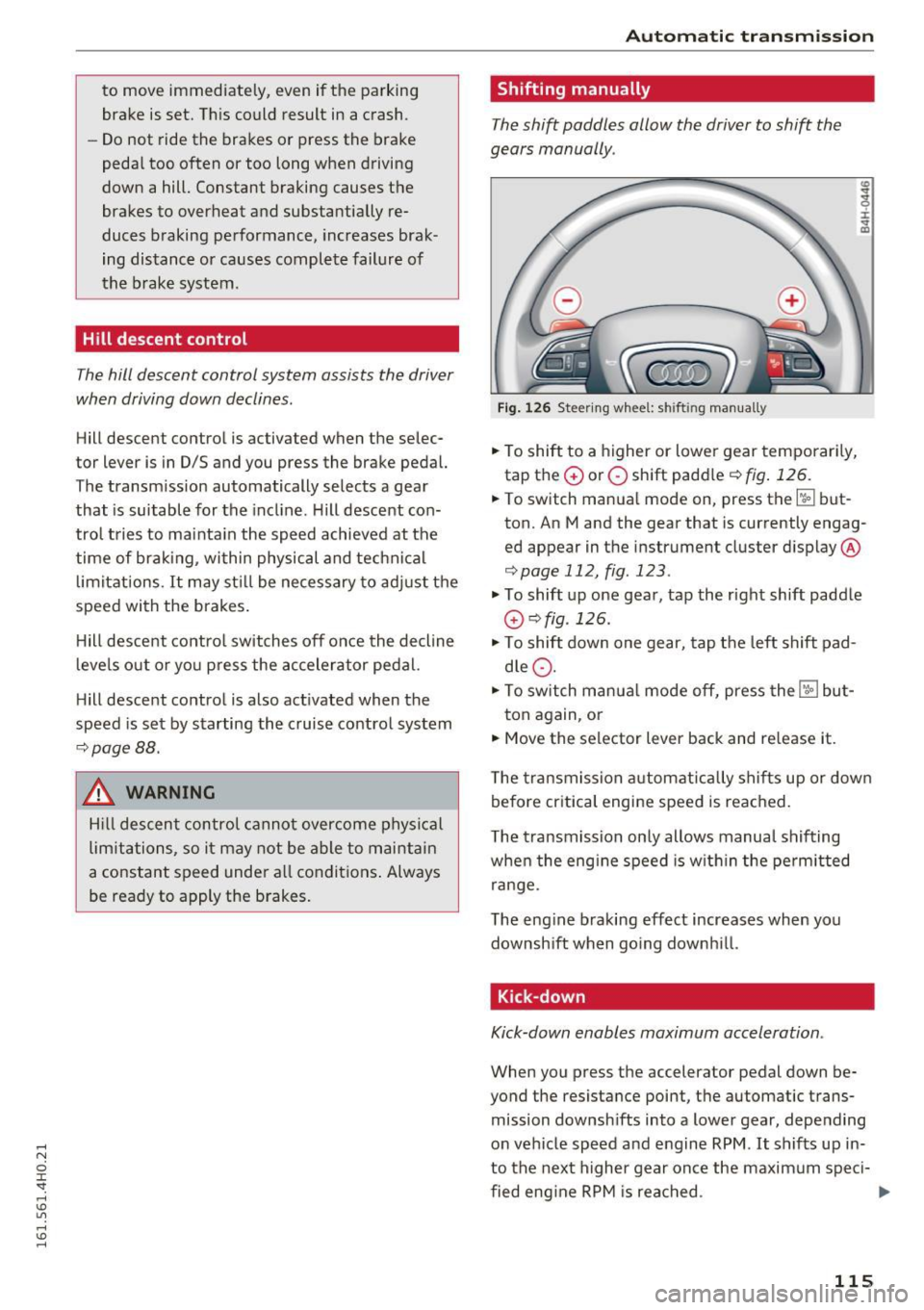
.. To shift to a higher or lowe r gear temporar ily,
tap the
G) or O shift paddle ¢ fig . 126.
:i:
"' CD
.. To switch manual mode on, press the~ but
ton. An M and the gear that is currently engag
ed appear in the instrument cluster display @
¢page 112, fig . 123 .
.., To shift up one gear, tap the right shift paddle
G) ¢fig .126.
.., To shift down one gear, tap t he left shift pad
d le
Q .
.., To switch manua l mode off, press the~ but-
ton again, or
.. Move the selector lever back and re lease it.
T he transmission automatically sh if t s up or down
before critica l engine speed is reached .
T he transmission on ly allows manual shifting
when the eng ine speed is w ith in the pe rm itted
range.
The eng ine braking effect increases when you
downsh ift when go ing downh ill.
Kick -down
Kick-down enables maximum acceleration .
When you press the accelerator pedal down be
yond the resistance point, t he automatic trans
mission downsh ifts into a lower gear, depe nding
on vehicle speed and e ngine RPM .
It shifts up in
to the next higher gear once the maxim um speci-
fied eng ine RPM is rea ched . ...,
115
Page 118 of 302
![AUDI A8 2016 User Guide Automatic transmission
A WARNING
Please note that the wheels could spin on
slick or slippery roads when kick-down is ac
tive .
Transmission malfunction
[O] Transmission: please pre](/img/6/57611/w960_57611-117.png "AUDI A8 2016 User Guide Automatic transmission
A WARNING
Please note that the wheels could spin on
slick or slippery roads when kick-down is ac
tive .
Transmission malfunction
[O] Transmission: please pre")
Automatic transmission
A WARNING
Please note that the wheels could spin on
slick or slippery roads when kick-down is ac
tive .
Transmission malfunction
[O] Transmission: please press the brake pedal
and select the position again
Press the brake pedal and select the desired se
lector lever position aga in. You can then continue
driving .
[O] Transmission hot: please modify driving
style
The transmission temperature has increased sig nificant ly due to the sporty driving manner. Drive
in a less sporty manner until the temperature re
turns to the normal range and the indicator light
sw itches of .
Dt) Gearbox malfunction : you can continue driv
ing
There is a system malfunction in the transm is
sion. You may continue driving. Drive to your au
thorized Audi dealer or qualified repair facility
soon to have the malfunction corrected.
[0]/(i) Gearbox malfunction: you can continue
driving in D only until engine is off
There is a system malfunctio n in the transmis
sion. The transmission is switching to emergency
mode . If you turn the engine off, you will not be
ab le to select any other selector lever positions
after starting the engine again. Drive to your au
thor ized Audi dealer or qualified repair facility
immed iately to have the malfunction corrected .
[O] Gearbox malfunction: you can continue driv
ing (limited functionality)
There is a system malfunction in the transmis
sion. The transmission is switching to emergency
mode . This mode only shifts into certain gears or
will not longer shift at all. The engine may stal l.
Drive to your authorized Aud i dea ler or qualified
repair fac ility immediately to have the malfunc
tion corrected .
116
~Ii) Gearbox malfunction: no reverse gear
(you can continue driving)
There is a system malfunction in the transm is
sion. The transmission is switching to emergency
mode. This mode only shi fts into certain gears or
will not longer shift at all. You cannot engage the
reverse gear. Drive to your authorized Audi dealer
i mmediately to have the malfunction corrected.
Dt) Vehicle may roll! Cannot shift to P. Please
apply parking brake
- Th e parking lock was re leased using the emer
gency release~
page 117. Or
- Th e parking brake cannot engage automatical
ly. Drive to your authorized Audi dealer or quali
fied repair facility immediately to have the mal
function corrected.
Dt) Gearbox malfunction: Stop and shift to P
Do not continue dr iving . Se lect the P selector lev
er posit ion and see your authorized Audi dealer
or qualified repair facility fo r ass istance.
Page 119 of 302
Parking lock emergency release
The parking lock must be released using the
emergency release before towing the vehicle .
®
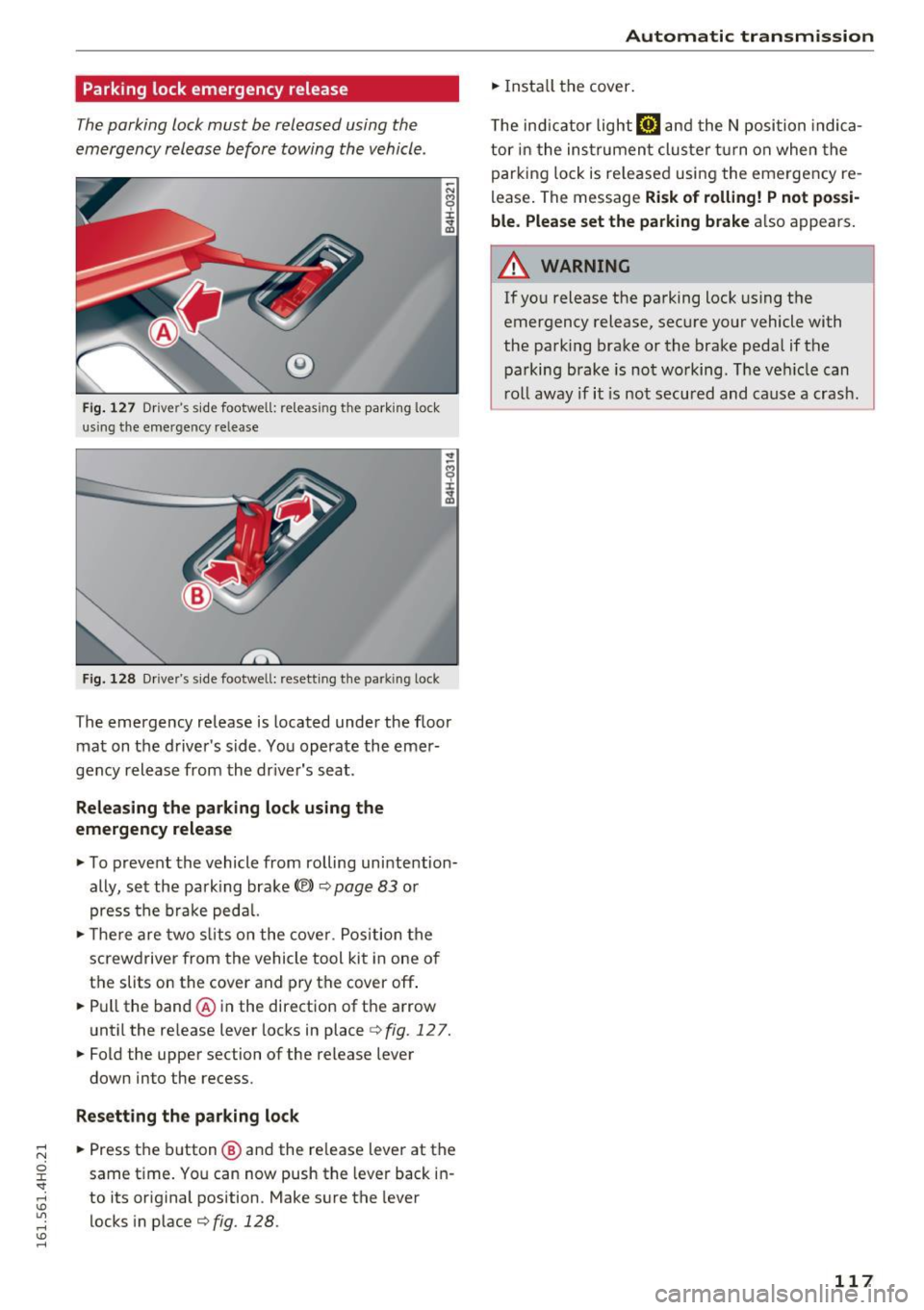
Fig. 127 Dr iver's s ide footwell: releas ing the par king lock
us ing the eme rge ncy re lease
F ig . 128 D rive r's s ide foo twe ll: rese tt in g th e pa rking lock
The emergency release is located under the floor
ma t on t he d river's side . Yo u opera te the emer
gency release from the dr iver's seat .
Releasing the parking lock using the
emergency release
... To prevent the vehicle from rolling uni nte ntion
ally, set the pa rking brak e<®>
r=.> page 83 or
press the brake ped al.
... The re are tw o sli ts on t he cove r. Po sition the
s c rew driver from the vehicle tool kit i n one o f
the slits on the cover and pry the cover off .
... Pull the band@ in the direct ion of t he a rrow
unt il the re lease lever locks in place
r=.> fig . 127 .
... Fold the upper section of the release leve r
down into the recess.
Resetting the parking lock
... Press t he b utton @ and the re lease lever at the
same t ime . Yo u can now push the leve r back in
to its or iginal position . Make sure the lever
locks in p lace
<=.> fig. 128 .
Automatic transmission
... Insta ll the cover .
T he in dicator light@] and the N position indica
tor in the ins trument cluster t urn on when the
parki ng lo ck is re leased usi ng the eme rgency re
lease . The message
Risk of rolling! P not possi
ble. Please set the parking brake
a lso appears .
A WARNING
--
If you release the parking lock using the
emergency release, sec ure yo ur vehicle with
the parking brake or the brake peda l if the
p arking brake is not wo rking. The ve hicle can
r o ll away if i t is no t secured and cause a crash .
117
Page 206 of 302
Trailer mod e
conditions are unfavorable - particularly when
going downhill.
Red uce veh icle speed
imm ediatel y if the tra ile r
shows the s lightest sign of swaying.
Do not try
to stop the sway in g b y accele rating .
Observe speed lim its . In some areas, speeds for
ve hicl es towing tra ilers are lower than for reg ula r
veh icles.
A lways apply brakes early . When dr iving down
h ill , sh ift into a lower gear to use the engine
b raking effect to slow the veh icle. Use of the
brakes a lone can cause them to overheat and fail.
Air suspension*
When driving with a tra iler, activate the trailer
mode of the air suspension . Switch the air sus
pens ion tra iler mode on when you a re towing a
tra ile r. This will limit the regulat ion by the air
suspens ion while driving . Select in the MM I:
ICARI function button > (Car )* sys tem s control
button >
Vehicle setting s > Air su sp .: to wi ng >
On .
Coolant temperature
The coolan t temperature gauge¢ page 10 must
be observed carefully. The coo lant temperature
can increase if you drive on long inclines in a low
gear at high engine speeds. Reduce your speed
immed iate ly if the LEDs in the top part of the dis
p lay turn on.
For more information about indicator lights, re
fer to.
¢page 15.
A WARNING
Anyone not properly restrained in a moving
vehicle is at a much greater risk in an acci
dent. Never let anyone ride in your car who is
not properly wearing the restraints provided
by Audi.
Trailer mode notes
Important to know
Your vehicle hand les different ly when towing a
trai ler because of the additiona l weight and dif
ferent weight distr ibut ion. Safety, performance
204
-
and economy will g reatly depend on how carefu l
l y you load your trai ler and operate your rig .
Befo re yo u actually tow yo ur t railer, pract ice
turning, stopping and backing up in an area away
from traffic. Keep practicing unti l you have be
come complete ly familiar with the way your vehi
cle-tra iler combination behaves and responds .
Backing up is diff icult and requ ires practice.
Backing up with a trailer genera lly req uires steer
ing action opposite to that when backing up your
vehicle witho ut a trailer .
Maintain a greater distance between yo ur vehicle
and the one in front of you. You will need more
room to stop . To compensate for the trailer, you
will need a larger than normal turning radius .
When passing, remember tha t you canno t accel
erate as fast as you normally wou ld because of
the added load . Make sure you have enough room
to pass. After passing, allow p lenty of room for
your trailer before changing lanes again.
Avoid jerky starts, sharp turns or rapid lane changes.
(D Tips
- Do not tow a trailer du ring the break-i n pe ri
od of your vehicle.
- If you tow a tr aile r, your A udi may requi re
more frequent ma intenance due to the ex
tra load ¢
page 281.
Parking on a slope
Do not park on a slope with a trailer . If it cannot
be avoided, do so only after doing the following:
When parking:
.,. App ly the foot brake.
.,. Have someone p lace chocks unde r both the ve
hicle and the trailer wheels .
.,. With chocks in place, slowly release the brakes
until the wheel chocks abso rb the load .
.,. Turn the whee ls towards the curb.
.,. App ly the parking brake .
.,. Select the P selector lever posit ion.
Page 207 of 302
When restarting after parking:
"'Apply the foo t brake.
"' St art the engi ne .
"' Se lect the D selector leve r position.
"' Release the parking brake an d slow ly pull out
and away from t he wheel choc ks .
"' Stop and have someone retrieve t he wheel
chocks .
(D Tips
If you move the selector lever of the a utomat
ic transm ission to P before applying t he park
ing brake and before block ing t he wheels, you
may have to use mo re force late r to move t he
lev er out of th e P position .
Trailer mode
205
Page 222 of 302
Checking and Filling
Checking and Filling
Hood
Releasing the engine hood
The engine hood is released from inside the vehi
cle .
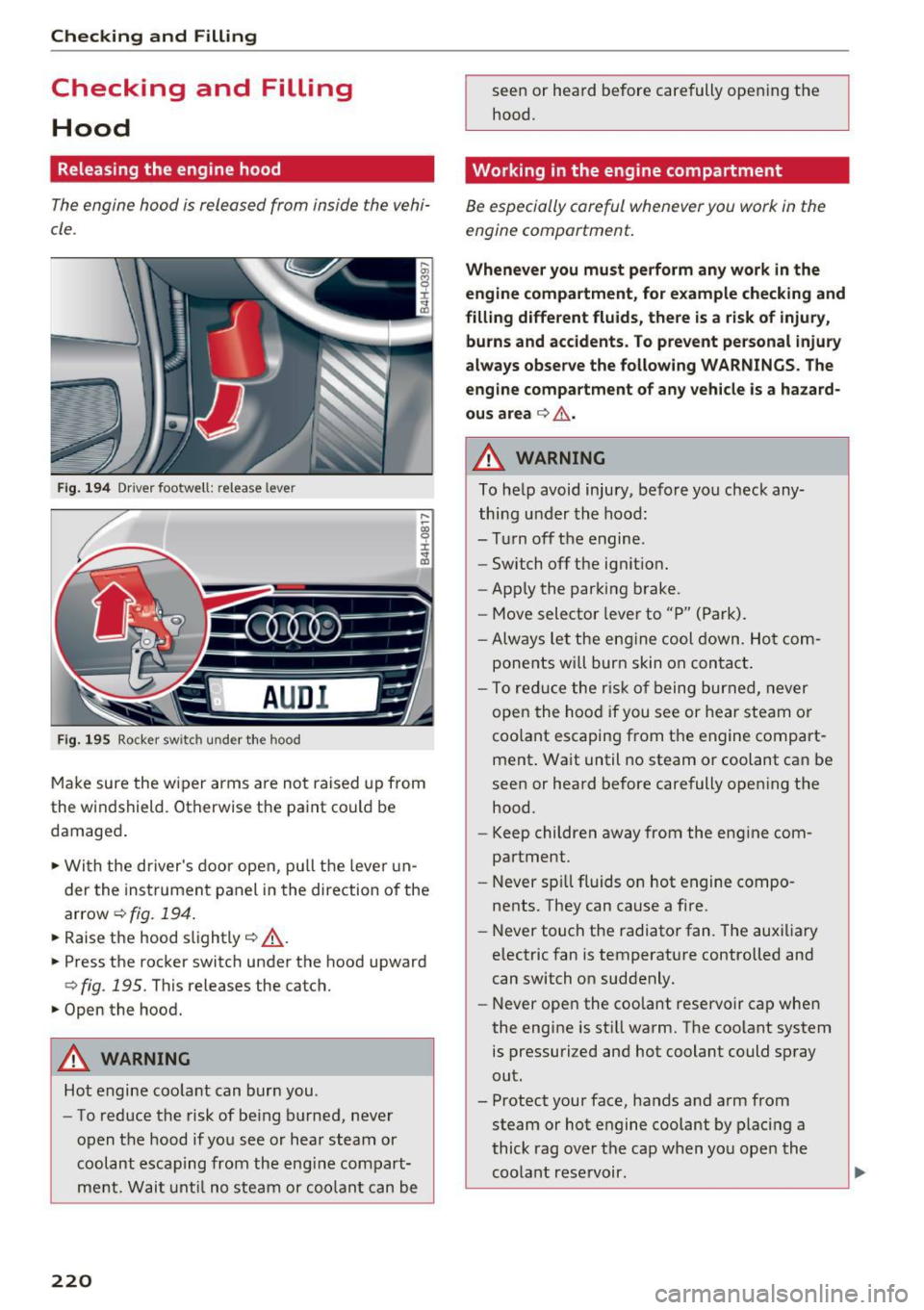
Fig. 194 Driver footwell : release leve r
Fig. 195 Ro cker switc h under the hood
Make sure the wiper arms are not raised up from
the windshield . Otherwise the paint could be
damaged .
.. With the driver's door open, pu ll the lever un
der the instrument panel in the direction of the
arrow ¢
fig. 194.
.. Raise the hood slightly Q _A .
.. Press the rocker switch under the hood upward
Q fig. 195. This releases the catch.
.. Open the hood.
A WARNING
Hot engine coo lant can burn you .
- To reduce the risk of be ing burned, never
open the hood if you see or hear steam or
coolant escaping from the eng ine compart
ment. Wait unt il no steam or coolant can be
220
seen or heard before carefully open ing the
hood.
Working in the engine compartment
Be especially careful whenever you work in the
engine comportment.
Whenev er yo u mu st perform an y work in the
engin e compartment , for exampl e chec king and
filli ng d iffe rent fl uids , the re is a ri sk of injur y,
bu rn s and accid ent s. T o preven t perso na l injur y
alway s obse rve the foll owing WARNING S. The
en gine compartment o f an y v ehicl e is a haz ard
ou s a rea
Q _6 .
A WARNING
To help avoid injury, before you check any
thing under the hood:
- Turn off the engine .
- Switch off the ignit ion.
- Apply the parking brake.
- Move selector lever to "P" (Park).
-Always let the eng ine cool down. Hot com-
ponents will burn skin on contact .
-
-To redu ce the risk of being burned, never
open the hood if you see or hear steam or
coo lant escaping from the engine compart
ment . Wait until no steam or coolant can be
seen or heard before carefully opening the
hood.
- Keep children away from the engine com
partment .
- Never sp ill fluids on hot engine compo
nents. They can cause a fire.
- Never touch the radiator fan. The auxiliary
electric fan is temperature controlled and
can switch on suddenly.
- Never open the coolant reservoir cap when
the engine is sti ll warm. The coolant system
is pressurized and hot coolant could spray
out.
- Protect your face, hands and arm from
steam or hot engine coolant by placing a
thick rag over the cap when you open the
coolant reservoir .
Page 223 of 302
-Do not remove the engine cover under any
circumstances. This increases the risk of
burns.
- If work on the fuel system or the electrical
system is necessary:
- Always d isconnect the battery.
- Never smoke or work near heaters or open
flames. Flu ids in the engine compartment
could start a fire.
- Keep an app roved fire ext inguisher imme
d iate ly availab le.
- To avo id electr ical shock and personal injury
wh ile the eng ine is running or being started,
never touch:
- Ignition cables
- Other components of the high voltage
electronic ignition system.
- If you must perform a check or repa ir with
the engine running:
- First, fully apply the parking brake, move
selector lever to "P" (Park).
- Always use extreme caution to prevent
cloth ing, jewelry, or long hair from get
ting caught in the radiator fan, V-belts or
other mov ing parts, or from contacting
hot parts. Tie back ha ir before starti ng,
and do not wear clothi ng that will hang or
d roop into t he engine.
- Min imize exposu re to emission and chem i
cal hazards¢ .&.-
_& WARNING
California Proposition 65 Warn ing:
- E ngine exhaust, some of its constituents,
and certain vehicle components contain or
em it chem ica ls known to the St ate of C ali
f orn ia to cause cancer and bi rth de fects and
reproductive harm . In addition, certain flu
ids contained in ve hicles and certain prod
ucts of component wear contain or emit
Ch eck ing and Filling
chemicals known to the State of California
to cause cancer and birth defects or other
reproductive harm.
- Battery posts, term inals and related acces
sories contain lead and lead compounds,
chemicals known to the State of Californ ia
to cause cancer and reproductive harms.
Was h hands afte r handling .
([) Note
When adding flu ids, always make sure that
they are poured into the proper co nta iner or
fille r opening, otherwise serious damage to
vehicle systems w ill occur.
® For the sake of the environment
To detect leaks in time, inspect the veh icle
floor pan from unde rneath regularly . If you
see spots from oil or other veh icle fluids, have
your vehicle inspected by an authorized Audi
dealer.
Closing the engine hood
.,.. Pull the hood down un til the press ure from the
struts is reduced.
.,.. Let the hood
drop down and latch in p lace . Do
not try to push it shut;
it may fail to engage
¢ _& .
_& WARNING
--A hood that is not completely latched co uld
fly up and block your view while driv ing.
- When you close the engine hood, check it to
make sure the safety catch has properly en
gaged . The hood s hou ld be flush with the
sur rounding vehicle body parts.
- If you notice while driv ing that the hood is
not secured properly, stop at once and close
it.
-
221
Page 261 of 302
Replacing wheels
Before changing a wheel
Observe the following precautions for your own
and your passenger's safety when changing a
wheel.
.,. After you experience a tire failure, pull the car
well away from moving traffic and try to reach
level ground before you stop¢.,&. .
.. All passengers should
leave the car and move
to a safe location (for instance, beh ind the
guardrail) ¢.,&. .
.,. Engage the
parking brake to prevent your vehi
cle from rolling unintentionally ¢.,&. .
.. Move
selector lever to position P ¢ .,&. .
1> lfyou are towing a trailer, unhitch the trailer
from your vehicle.
.,. Take the
jack and the spare tire out of the lug
gage compartment,
¢page 257.
..&, WARNING
You or your passengers could be injured wh ile
changing a wheel if you do not follow these
safety precautions:
- If you have a flat tire, move a safe distance
off the road. Turn off the engine, turn the
emergency flashers on and use other warn
ing devices to alert other motorists.
- Make sure that passengers wa it in a safe
place away from the vehicle and well away
from the road and traffic.
- T o help prevent the vehicle from moving
sudden ly and possibly slipping off the jack,
always fully set the parking brake and block
the wheel diagonally opposite the wheel be
ing changed. When one front wheel is lifted
off the ground, plac ing the Automatic
Transmission in "P" (Park) will
not prevent
the vehicle from moving.
- Before you change a wheel, be sure the
ground is level and firm . If necessary, use a
sturdy board under the jack .
- Always store the vehicle tool k it, the jack
and the replaced tire in the luggage com
partment ¢
page 135.
Emergency assistance
{!) Tips
Before changing the wheel, you must activate
the jacking mode, so that the automat ic con
tro ls for the Adaptive Air Suspension do not
make it more difficult to lift the vehicle with
the jack ¢
page 261 .
Changing a wheel
When you change a wheel , follow the sequence
described below step-by-s tep and in exactly tha t
order .
l. Activate the vehicle jack mode ¢ page 261 .
2. Remove the decorative wheel cover*. For
more details see also¢
page 260, Decora
tive wheel covers
or¢ page 260, Wheels
with wheel bolt caps .
3. Loosen the wheel bolts¢ page 260.
4. Locate the proper mounting point for the
jack and align the jack below that point
¢ page 261 or¢ page 262.
5. Raise the car with the jack¢ page 261 or
¢page 262.
6. Remove the wheel with the flat tire and then
install
the spare ¢ page 263.
7. Tighten all wheel bolts lightly .
8.
Lower the vehicle with the jack .
9. Use the wheel bolt wrench and
firmly tighten
all wheel bolts<=>
page 260.
10. Replace the decorative wheel cover*.
11. Deactivate the vehicle jack mode in the MMI :
I CAR! function button > Car systems contro l
button
> Servicing & checks > Air susp.: jack
mode > Off.
The vehicle jack mode switches off automatically
at speeds above 10 km/h .
..&, WARNING
Always read and follow all WARNINGS and in
formation
¢ .&. in AB: Raising the vehicle on
page 262
and ¢ page 264.
259