transmission AUDI A8 2016 User Guide
[x] Cancel search | Manufacturer: AUDI, Model Year: 2016, Model line: A8, Model: AUDI A8 2016Pages: 302, PDF Size: 75.68 MB
Page 195 of 302

Operating noi se
Noises may occur when braki ng depend ing on the
speed, braking force and outside cond itions s uch
as temperature and humidity.
Due to the na ture of t he mate ria ls used in ce ram
ic bra ke rotors*, noises m ay become mo re appa
ren t at low speeds.
Effect of wat er and road salt
In ce rtain situat ions, for example after driving
through water, in heavy ra in, afte r ove rnig ht con
densat ion or after washing your car, the braking
effe ct can be red uced by moisture or ice on the
b rake rotors and brake pads. The brakes must be
dried first w ith a few careful brake applications .
At highe r speeds and with t he windsh ie ld wipers
turned o n, the bra ke pads p ress against the bra ke
rotors for a short amount of time . This occ urs at
regular intervals without the driver noticing and
provides for better bra ke response time under
wet conditions.
The effectiveness of the brakes can be reduced
when the vehicle is dr iven on a salt-covered road
and the brakes are not used. L ikewise, you clean
off accumu lated salt coat ing from brake discs
and pads with a few cautious applications of the
brake
c::> ,& .
Due to their sur face characteristics, ceramic
brake rotors* absorb mo isture in such condit ions.
This can cause a temporary reduction in braking
force compared to dry brakes. You can compen
sate for this by pressing the brake peda l harder.
Cor rosion
There may be a tendency for dirt to b uild up on
the brake pads and corros ion to form on the discs
if the car is not driven regularly or only for short
tr ips with little use of the brakes.
If the brakes are not used frequently, or if corro
sion has formed on the discs, it is adv isable to
clean off the pads and discs by brak ing firmly a
few t imes from a moderately high speed
c::> ,& .
Sma rt Technology
Faults in the brake system
If you s hou ld notice a sudden increase in br ake
peda l travel, then one of the two bra ke circu its
may have fai led
c::> ,& .
Low brake fluid level
Malfunctions ca n occu r in the brake system if the
brake fluid level is too low . T he brake flu id leve l
is monitored elect ronically.
Brake boost er
The brake booster works w ith vacuum pressure
wh ich is created only when the engine is runn ing
c::> ,& .
Brake lining wear status
Brake lining wear may be checked by visua l in
spect ion of the cond ition of the brake pads
t hr ough the openings in the wheel. If necessary,
the wheel may be removed for t his inspection
c::> page 259, Replacing wheels .
.8_ WARNING
-New b rake p ads don't h ave the bes t stop
p ing power an d must be "broken-in" during
the initial 250 miles (400 km) . The break-in
pe riod can be considerably longer for
veh icles with ceramic brake rotors*. You can
compensate for this by pressing the brake
pedal more firmly. This also applies late r
when new pads are installed.
- You shou ld perform braking maneuvers for
the purpose of cleaning the brake system only i f road co ndit ions pe rmit . Other road
users m ust not be put at r is k -you may
cause an ac cident!
- Before descending a steep g rade, reduce
speed and sh ift transmission into a lower
gear o r lower dr iving range. Do not r ide the
b ra kes or hold the pe dal down too long or
too often. This cou ld cause the b rakes to ge t
hot and dimin ish b raking effic iency .
- Do not " ride the bra kes" by rest ing you r foot
on the pedal when you do no t intend to
brake. This may cause the brakes to over
heat, premature wear and increased stop
p ing distance.
193
Page 199 of 302
Driving and the
environment
Breaking in
New eng ine
The engine needs to be run-in during the first
1,000 miles (1 ,500 km).
For the first 600 miles (1 ,000 kilometers):
"' Do not use full throttle .
"' Do not drive at engine speeds that are more
than 2/3 of the max imum permitted RPM .
"' Avoid high eng ine speeds.
From 600 to 1 ,000 miles (1,000 to 1,500
kilometers ):
"' Speeds can gradually be increased to the maxi
mum pe rm issib le road or e ngine speed.
During and after b reak-in period
"' Do not rev the engine up to high speeds when it
is cold . This applies whether the transmission is
in N (Neutral) or in gear .
After the bre ak-in period
"' Do not exceed maximum engine speed under
any circumstances .
"' Upshift into the nex t higher gear
before reach
ing the red area at the end of the tachometer
sca le
c:::;, page 10.
During the first few hours of driving , the eng ine's
internal friction is higher than later when all the
mov ing parts have been broke n in. How well this
b reak-in process is done depends to a considera
b le exte nt o n the way the veh icle is d rive n du ring
the first 1,0 00 miles (1,500 kilome ters).
(D Note
E xtremely high eng ine speeds a re au toma ti
cally reduced. However, t hese rpm li mits are
p rogr amme d fo r an eng ine well run-in, not a
new engine .
Driving and the envir onment
{® For the sake of the environment
Do not drive with unnecessarily high engine
spe eds -upshifting early saves fuel, red uces
no ise and protects the environment.
New tires
If your vehicle is runni ng on new tires, drive par
t icularly careful for the first 3S0 m iles (500 kilo
meters) after fitting .
_&. WARNING
New tires tend to be slippe ry and mus t also
b e "bro ken- in". Be sure to remembe r th is dur
i ng the first 350 m iles ( 500 k ilome ters).
Brake gent ly . Avoid following closely behin d
other vehicles or other s ituations that might
require sudden, hard braking.
Avoid damaging the
vehicle
When you are dr iv ing on poor roads, or over
curbs, steep ramps, etc., make certai n that low
ly ing parts such as spo ile rs and exhaust system
parts do not bottom o ut and get damaged .
This is espec ially true for veh icles with low-s lung
chass is (sports c hass is)* and fully loaded
vehicles .
Catalytic converter
Applies to: vehicles with gasoline engine
It is very important that your emission control
system (catalytic converter) is functioning prop
erly to ensure that y our vehicle is running in an
environmen tally sound manner.
"' Always use lead-free gasoline c:::;, page 212,
F uel supply .
"' Never run t he tank down all the way to emp ty.
"' Never put too much motor o il in yo ur engine
c:::;, page 225, Adding engine oil ce:r..
"' Never try to push- or tow-start your vehicle.
T he ca talytic co nverter is an efficient "cle an-up"
device built into the exhaust sys tem o f th e vehi -
-
cle. The catalytic converter b urns many of the .,.
197
Page 240 of 302
Wheel s
® Mud and snow capability
"M/5" or "M+S" indicates the tire
has characteristics that make it
suitab le for driving on mud and
snow. ~ indicates a winter tire.
@ Composition of the tire cord
and materials
The number of plies indicates the
number of rubberized fabric lay
ers in the tire . In general : the
more layers, the more weight a
tire can carry. Tire manufacturers
must also specify the materials
used in the tire. These include
steel, nylon, polyester and other materials.
@ Ma ximum permitted load
This number indicates the maxi
mum load in kilograms and
pounds that the tire can carry.
@ Uniform tire quality grade
standards for treadwear,
traction and temperature resistance
T readwear, traction and tempera
ture ranges ~
page 253.
@ Running direction
The arrows indicate the running
direction of unidirectional t ires.
You must always follow the speci-
238
fied running direction
~ page 264 .
(8) Maximum permitted
inflation pressure
This number indicates the maxi
mum pressure to which a tire can
be inflated under normal operat
ing condit ions.
Glossary of tire and loading
terminology
Accessory we ight
means the combined weight (in
excess of those standard items
which may be replaced) of auto matic transmission, power steer
ing, power brakes, power win
dows, power seats, radio, and
heater, to the extent that these
items are available as factory -in
stalled equipment (whether in
stalled or not).
Aspect rat io
means the rat io of the height to
the width of the tire in percent.
Numbers of 55 or lower indicate a
low sidewall for improved steer
ing response and better overa ll
handling on dry pavement.
Page 261 of 302
Replacing wheels
Before changing a wheel
Observe the following precautions for your own
and your passenger's safety when changing a
wheel.
.,. After you experience a tire failure, pull the car
well away from moving traffic and try to reach
level ground before you stop¢.,&. .
.. All passengers should
leave the car and move
to a safe location (for instance, beh ind the
guardrail) ¢.,&. .
.,. Engage the
parking brake to prevent your vehi
cle from rolling unintentionally ¢.,&. .
.. Move
selector lever to position P ¢ .,&. .
1> lfyou are towing a trailer, unhitch the trailer
from your vehicle.
.,. Take the
jack and the spare tire out of the lug
gage compartment,
¢page 257.
..&, WARNING
You or your passengers could be injured wh ile
changing a wheel if you do not follow these
safety precautions:
- If you have a flat tire, move a safe distance
off the road. Turn off the engine, turn the
emergency flashers on and use other warn
ing devices to alert other motorists.
- Make sure that passengers wa it in a safe
place away from the vehicle and well away
from the road and traffic.
- T o help prevent the vehicle from moving
sudden ly and possibly slipping off the jack,
always fully set the parking brake and block
the wheel diagonally opposite the wheel be
ing changed. When one front wheel is lifted
off the ground, plac ing the Automatic
Transmission in "P" (Park) will
not prevent
the vehicle from moving.
- Before you change a wheel, be sure the
ground is level and firm . If necessary, use a
sturdy board under the jack .
- Always store the vehicle tool k it, the jack
and the replaced tire in the luggage com
partment ¢
page 135.
Emergency assistance
{!) Tips
Before changing the wheel, you must activate
the jacking mode, so that the automat ic con
tro ls for the Adaptive Air Suspension do not
make it more difficult to lift the vehicle with
the jack ¢
page 261 .
Changing a wheel
When you change a wheel , follow the sequence
described below step-by-s tep and in exactly tha t
order .
l. Activate the vehicle jack mode ¢ page 261 .
2. Remove the decorative wheel cover*. For
more details see also¢
page 260, Decora
tive wheel covers
or¢ page 260, Wheels
with wheel bolt caps .
3. Loosen the wheel bolts¢ page 260.
4. Locate the proper mounting point for the
jack and align the jack below that point
¢ page 261 or¢ page 262.
5. Raise the car with the jack¢ page 261 or
¢page 262.
6. Remove the wheel with the flat tire and then
install
the spare ¢ page 263.
7. Tighten all wheel bolts lightly .
8.
Lower the vehicle with the jack .
9. Use the wheel bolt wrench and
firmly tighten
all wheel bolts<=>
page 260.
10. Replace the decorative wheel cover*.
11. Deactivate the vehicle jack mode in the MMI :
I CAR! function button > Car systems contro l
button
> Servicing & checks > Air susp.: jack
mode > Off.
The vehicle jack mode switches off automatically
at speeds above 10 km/h .
..&, WARNING
Always read and follow all WARNINGS and in
formation
¢ .&. in AB: Raising the vehicle on
page 262
and ¢ page 264.
259
Page 269 of 302
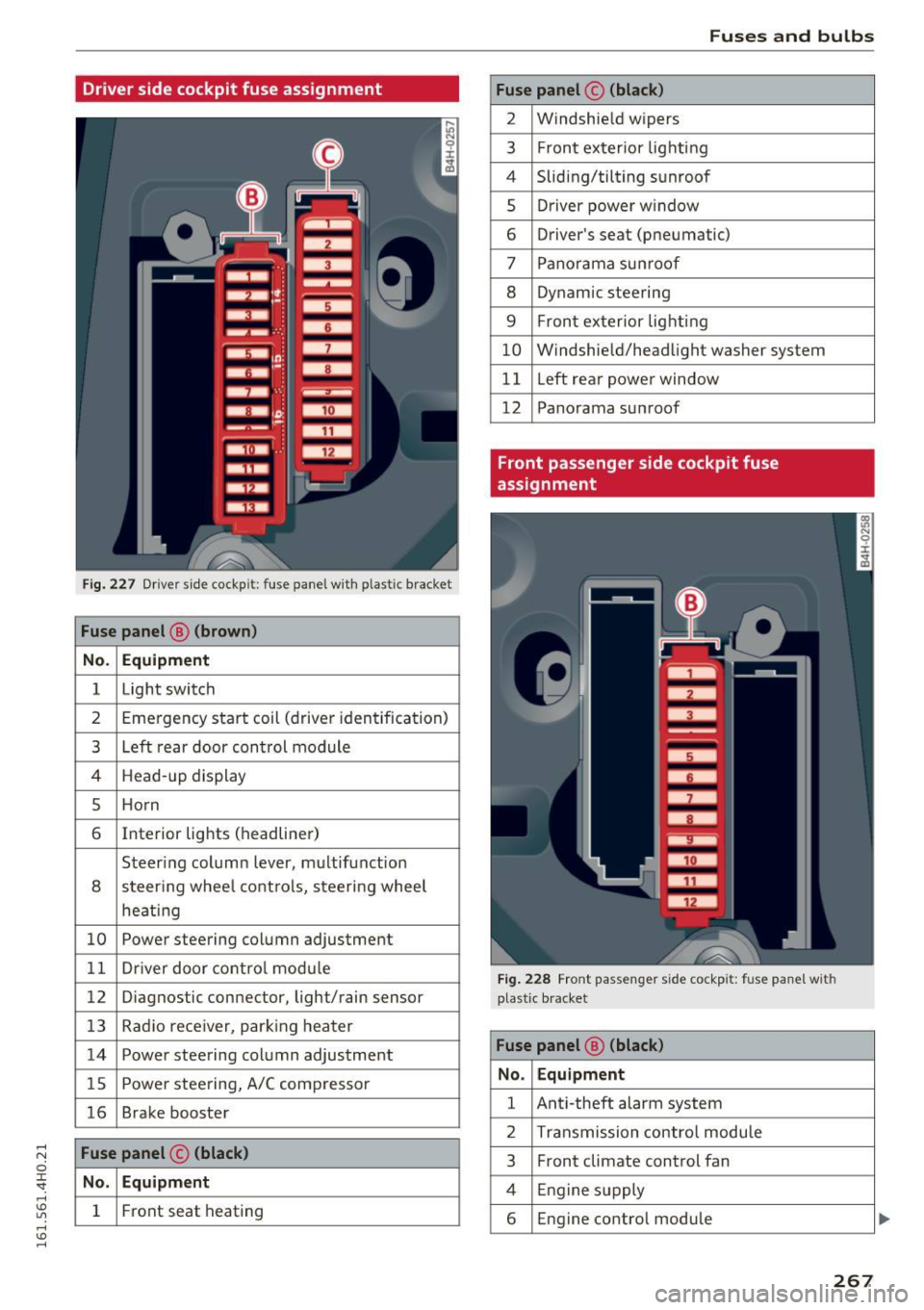
Driver side cockpit fuse assignment
Fig . 227 D river sid e cockpit: fuse panel with plastic bracket
Fuse panel @ (brown )
No . Equipment
1 Light switch
2 Emergency start coil (driver iden tification)
3 Left rear door con trol module
4 Head -up display
5 Ho rn
6 Interior lights (headliner)
Steering column lever, m ultifunction
8 steer ing whee l cont ro ls, steering wheel
heati ng
10 Powe r steering column adjustment
1 1 Dr iver door co ntro l mod ule
12 Diagnostic con nector, light/rain sensor
13 Radio rece iver, par king heater
14 Power steering column adjustment
15 Powe r stee ring, A/C comp resso r
16 Brake booster
Fuse panel © (black)
No . Equipment
1 Front seat heating
Fuses and bulbs
Fuse panel © (black)
2 Windshie ld w ipers
3 F ron t ex terior lig hti ng
4 Sliding/tilting s unroof
5 Dr iver power w indow
6 Driver's seat (pneumatic)
7 Pano rama su nroo f
8 Dynam ic steering
9 F ron t ex terior lig hting
10 W indshie ld/head light washer system
11 Left rea r powe r window
12 Panorama su nroof
Front passenger side cockpit fuse
assignment
Fig. 228 Front passenge r side cockp it: fuse panel with
p last ic b racket
Fuse panel @ (black)
No . Equipment
1 Ant i-theft alarm system
2 Transmission contro l modu le
3 Front climate control fan
4 Engine supply
6 Engine control module
267
Page 271 of 302
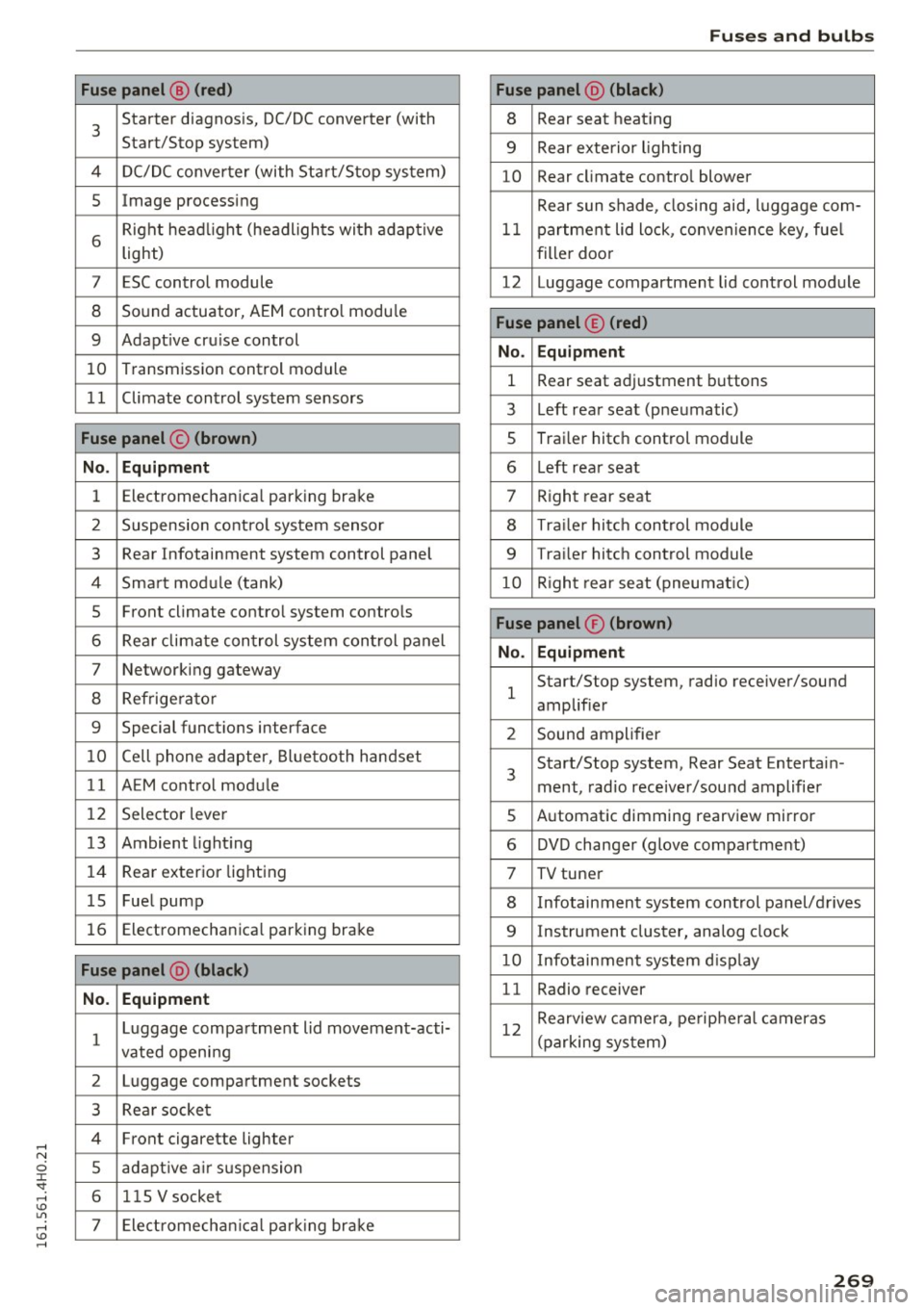
Fuses an d bulb s
Fuse p anel @ (red ) Fuse panel@ (black )
3 Starter diagnosis, DC/DC converter (with
Start/Stop system) 8 Rear
seat heating
9 Rear exterio r lighting
4 DC/DC converter (with Start/Stop system)
10 Rear
climate contro l blower
5 Image processing
Rear sun shade, closing aid, luggage com-
6 Right headl
ight (headlights with adaptive
light) 11 partment lid
lock, convenience key, fue l
filler doo r
7 ESC control module 12 Luggage compartment lid control module
8 Sound actuator, AEM control modu le
9 Adapt ive cru ise control
10 Transmission
control module
Fuse panel © (red )
No . Equ ipm en t
1 Rear seat adjustment buttons
1 1 Climate control system sensors
3 Left rear
seat (pneumatic)
Fuse panel © (br own ) 5 Trai
ler hitch control module
No. Equipm ent 6 L
eft rear seat
1 Electromechanical parking
brake
7 Right rear seat
2 Suspension control system sensor
8 Traile r hitc h control module
3 Rear Infotainment system control
panel
9 Trailer hitch control module
4 Smart module (tank) 10 Right rear seat (pneumatic)
5 Front climate contro
l system controls
6 Rear climate control system control panel
7 Networking gateway
8 Refrige rator
Fuse panel ® (brown )
No. Equipm en t
1 Start/Stop
system, radio receiver/sound
amplifier
9 Special functions interface
2 Sound amplifier
10 Cell phone adapter, Bluetooth handset
11 AEM control module 3 Start/Stop
system, Rear Seat Entertain-
ment, radio receiver/sou nd amplifier
12 Selector lever
5 Automatic dimming
rearview mirror
13 Ambient lighting 6 DVD changer (glove compa rtment)
14 Rear
exterior lighting
7 TV tuner
15 Fuel pump
8 Infotainment system control panel/drives
16 Electromechanica l parking brake
9 Instrument cluster, analog clock
Fuse panel @ (bl ack ) 10 Infotainment system d isp lay
N o. Equi pm en t 11 Radio receiver
1 Luggage compartment lid movement-acti-
vated openi ng 12
Rearview camera, pe
ripheral cameras
(parking system)
2 Luggage compartment sockets
3 Rear socket
4 Front cigarette lighter
5 adapt ive a ir suspension
6 115 V
socket
7 Electromechan ica l park ing brake
269
Page 273 of 302
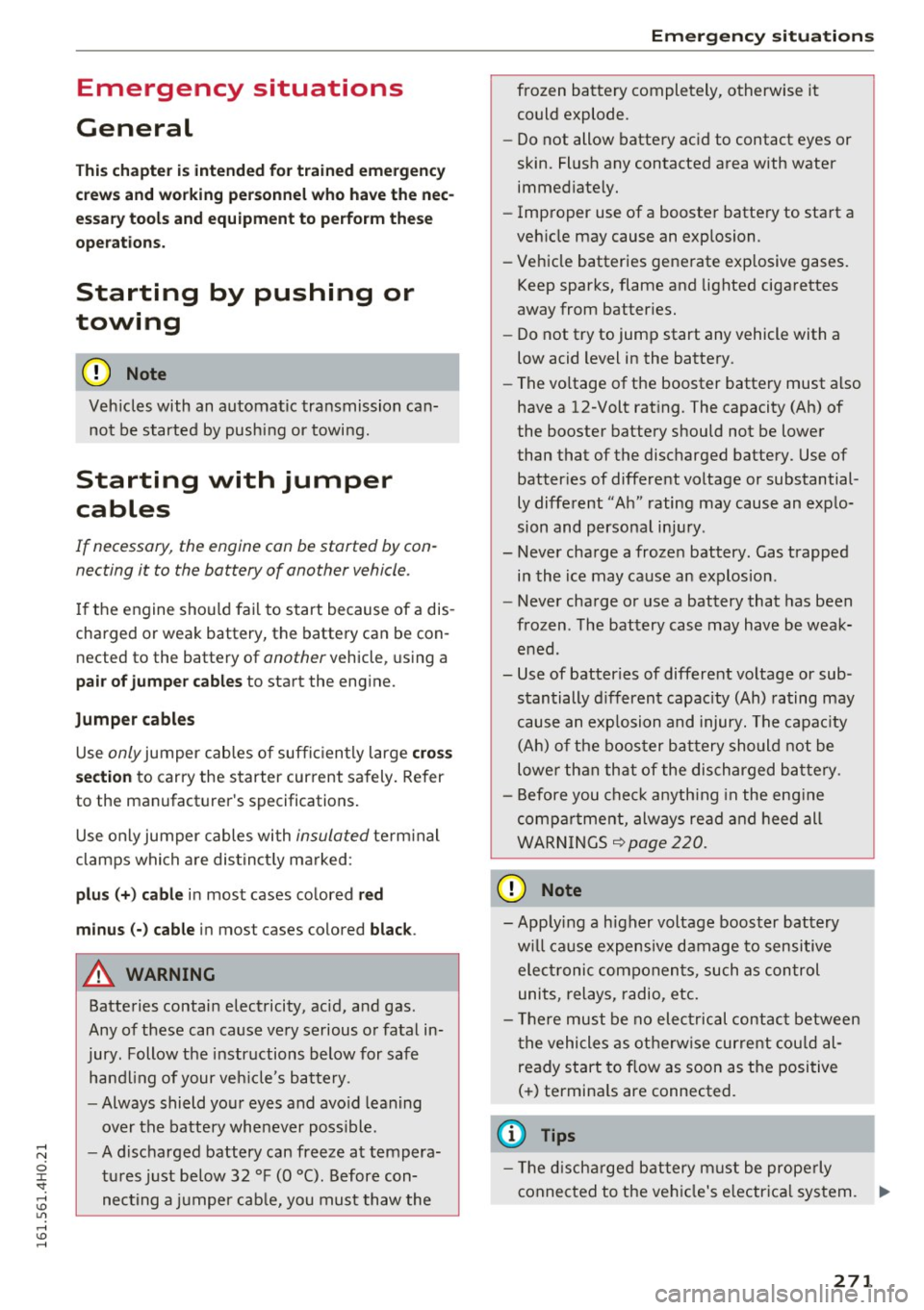
Emergency situations
General
This chapter is intended for trained emergency
crews and working personnel who have the nec
essary tools and equipment to perform these
ope rations.
Starting by pushing or
towing
(D Note
Veh icles with an automatic transmission can
not be started by pushing or towing.
Starting with jumper
cables
If necessary, the engine can be started by con
necting it to the battery of another vehicle .
If the engine shou ld fail to start because of a dis
charged or weak battery, the battery can be con
nected to the battery of
another vehicle, using a
pair of jumpe r cables to start the engine.
Jumper cables
Use only jumper cables of suffic iently large cross
section
to carry the starter current safely. Refer
to the manufacturer's specifications.
Use only jumper cables with
insulated term inal
clamps which are dis tinct ly marked :
plus(+) cable in most cases colored re d
minus( -) cable
in most cases colored blac k.
A WARNING
Batteries contain electricity, acid, and gas.
Any of these can cause very serious or fatal in
jury. Follow the instructions below for safe
handling of your vehicle's battery.
- Always shield your eyes and avo id leaning
over the battery whenever poss ible.
- A discharged battery can freeze at tempera
tures just below 32 °F (0 °C) . Before con
necting a jumper cable, you must thaw the
Emergency situations
frozen battery completely, otherwise it
could explode .
- Do not allow battery acid to contact eyes or
skin. Flush any contacted area with water immediately.
- Improper use of a booster battery to start a
vehicle may cause an exp losion.
- Vehicle batteries generate exp losive gases.
Keep sparks, flame and lighted cigarettes
away from batteries.
- Do not try to jump start any vehicle with a
low acid level in the battery .
- The vo ltage of the booster battery must also
have a 12-Volt rating. The capacity (Ah) of
the booster battery should not be lower
than that of the discharged battery. Use of
batter ies of different voltage or substantial
ly different "Ah" rating may cause an exp lo
sion and personal injury .
- Never charge a frozen battery. Gas trapped
in the ice may cause an explosion.
- Never charge or use a battery that has been
frozen . The battery case may have be weak
ened .
- Use of batter ies of different voltage or sub
stantially different capacity (Ah) rating may
cause an exp losion and injury. The capac ity
(Ah) of the booster battery should not be
lowe r than that of the discharged battery.
- Before you check anything in the eng ine
compartment, always read and heed all
WARNINGS
r::!)page 220.
(D Note
-Applying a higher voltage booster battery
will cause expensive damage to sensitive
electronic components, such as control
units, relays, radio, etc.
- Th ere must be no electrical contact between
the vehicles as otherwise current could al
ready start to flow as soon as the positive
(+) terminals are connected.
(D Tips
- The discharged battery must be properly
connected to the vehicle's e lectrica l system. ..,.
271
Page 274 of 302
Emergency situations
When jump starting or charging the bat
tery, never connect the negative ground ca
ble to the battery negative post because the
battery manager system must be able to de
tect the battery's state of charge. Always
connect the negative ground cable to the
negative ground post of the battery manag
er contro l unit.
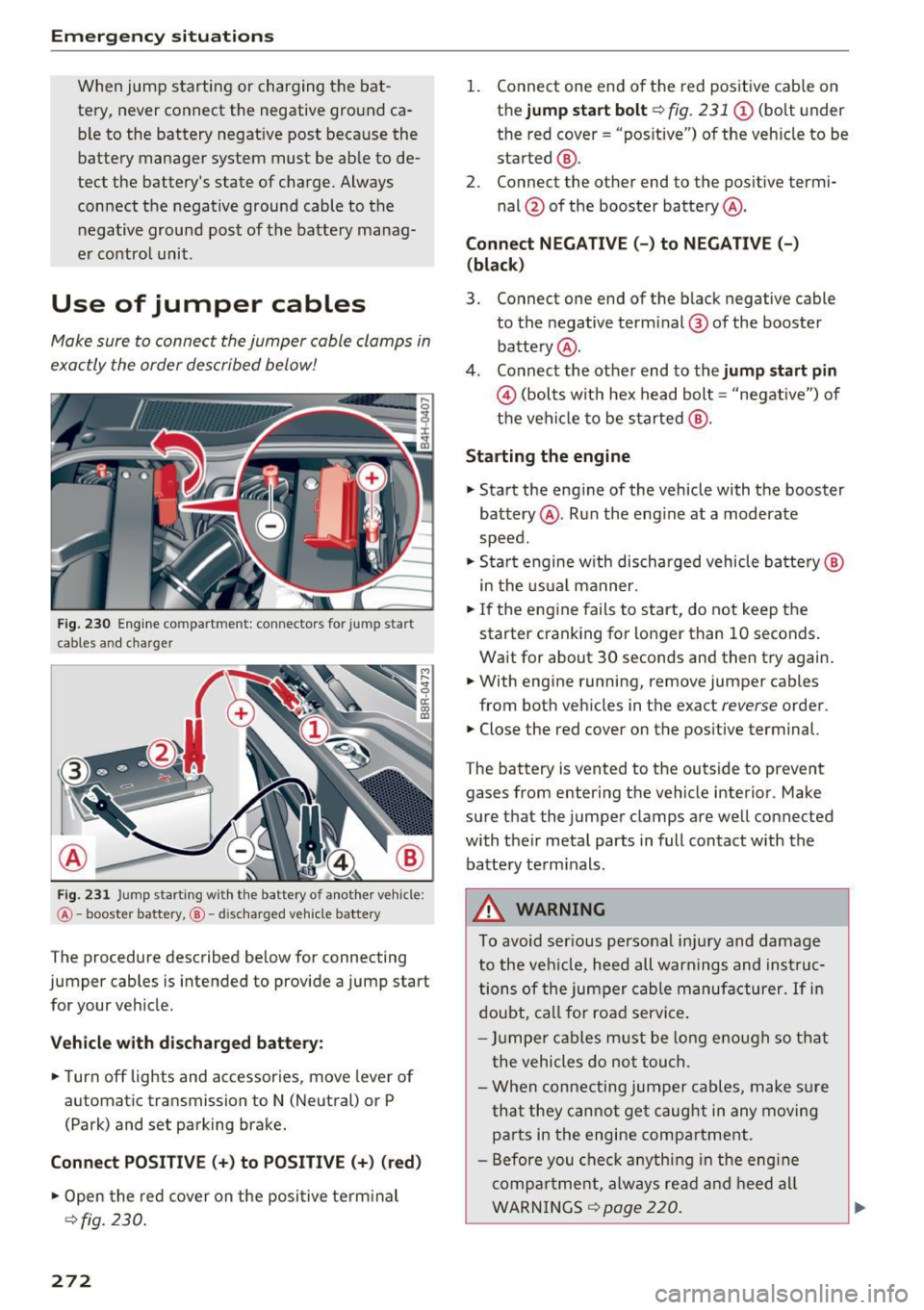
Use of jumper cables
Make sure to connect the jumper cable clamps in
exactly the order described below!
F ig . 230 Engine compar tment: connectors for jump start
cables and cha rger
F ig. 231 Jump starti ng wit h the battery of another veh icle:
@ -boos ter battery, @-disc harged vehicle battery
The procedure described be low for connecting
jumper cables is intended to provide a jump start for your vehicle.
Vehicle with discharged battery:
• Turn off lights and accessories, move leve r of
automatic transmission to N (Neutral) or P
(Park) and set parking brake.
Connect POSITIVE (+) to POSITIVE (+) ( red)
• Open the red cover on the positive term inal
¢ fig. 230.
272
1. Connect one end of the red positive cable on
the
jump start bolt 9 fig. 231 (D (bolt under
the red cover= "positive") of the veh icle to be
started @.
2. Connect the other end to the positive termi-
nal @ of the booster battery @.
Connect NEGATIVE (- ) to NEGATIVE(-)
(black)
3. Connect one end of the black negative cable
to the negative term inal @ of the booster
battery @.
4. Connect the other end to the
jump start pin
@ (bolts with hex head bolt= "negative") of
the vehicle to be started ®·
Starting the engine
• Start the eng ine of the vehicle with the booster
battery @. Run the eng ine at a moderate
speed.
• Sta rt engine w ith discharged vehicle ba ttery @
in the usual manner.
• If the engine fails to start, do not keep the
starter cranking for longer than 10 seconds.
Wait for about 30 seconds and then try again.
• With engine running, remove jumper cables
from both vehicles in the exact
reverse order.
• Close the red cover on the positive terminal.
The battery is vented to the outside to prevent
gases from entering the vehicle interior . Make
sure that the jumper clamps are well connected
with their metal parts in full contact with the battery terminals.
&_ WARNING
To avoid ser ious personal injury and damage
to the vehicle, heed all warnings and instruc
tions of the jumper cable manufacturer. If in
doubt, call for road service.
- Jumper cables must be long enough so that
the vehicles do not touch .
- When connecting jumper cables, make sure
that they cannot get caug ht in any moving
parts in the engine compartment.
- Before you check anything in the engine
compartment, always read and heed all
WARNINGS
¢ page 220.
Page 275 of 302
(D Note
Im pro per hook-u p of jum per cables can ru in
the gene ra tor.
- Always connect P OSITI VE( +) to POS ITI VE
( + ), and NEGATIVE( -) to NEGATIVE( -)
ground post of t he battery manager contro l
u nit .
- Check that a ll sc rew p lugs on the battery
ce lls a re sc rewed in firmly . If not, t igh ten
pl ugs p rio r to connecting clamp on negative
batte ry te rminal.
- Please note t hat the procedure fo r con nect
i ng a jumper cab le as desc ribe d above ap
p lies specifica lly to the case of yo ur vehicle
being jump s tarte d. W hen you are giv ing a
ju mp s ta rt to an othe r vehicl e, do
not con
n ect t he nega tive (- ) ca b le t o t he nega tive
(-) t ermin al on the di scharged battery @
c> fig . 23 1. Instead, securely connec t the
negative (-) cable to either a solid metal
com ponent that is f irm ly bolted t o the e n
gine block o r to t he engine bloc k itsel f. If
the batt ery that is be ing c ha rge d d oes not
vent to the outs ide, escap ing batte ry gas
could ignite and e xplode!
Towing with a tow truck
General hints
Your Audi require s speci al handling f or towing.
Th e follow ing informat ion is to be used by com
mercia l tow tr uck o pera tors who know how to op
e rat e the ir equip men t sa fely.
- Never tow your Audi. Towing will cause dam
age to the engine and transmission .
- Never wrap the safety chains or winch cables
around the brake lines.
- To prevent unnecessary damage, your Audi
must be transported with a flat bed truck.
- To load the vehicle on to the flat bed, use the
towing loop found in the vehicle tools and at
tach to the front or rear anchorage
¢page273 and ¢pag e 274 .
Emergency situations
A WARNING
-A ve hicle being towe d is not safe for passen-
ge rs. Neve r allow a nyo ne to ride in a vehicle
b eing towed, for any reason.
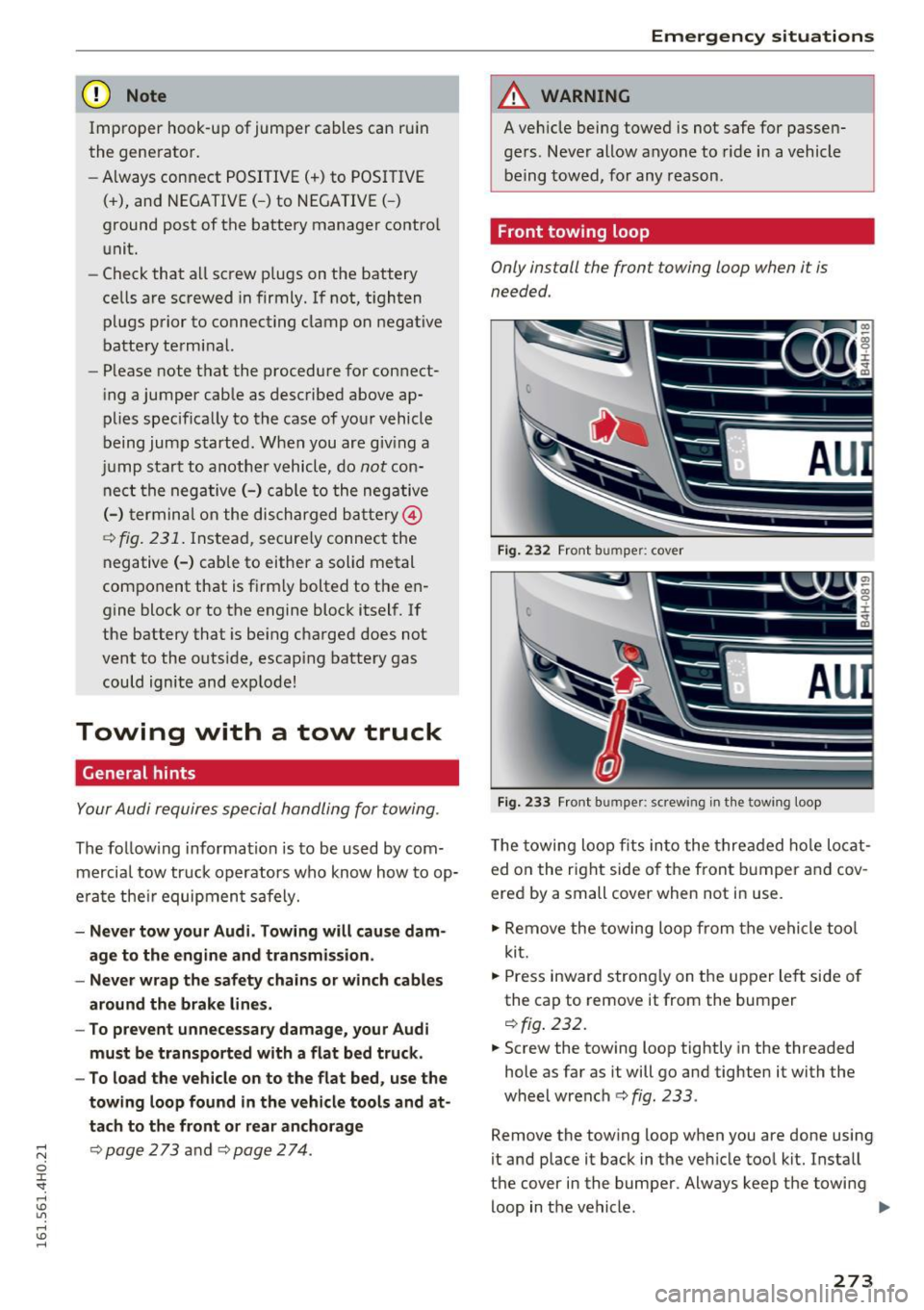
Front towing loop
Only install the front towing loop when it is
needed .
Fig. 232 Front bumper: cover
Fig. 233 Front bumper: screwing in th e towing loo p
The towing loo p fits in to the thre aded hole locat
ed o n the r ig ht side o f the fron t bumper a nd cov
ered by a small cover when not in use.
" Re move the towing loo p from the vehi cle too l
ki t.
" Press inward s tron gly on the up per left si de of
the cap to remove it from the bum per
¢ fig . 232.
" Screw the towing loop tightly in the threaded
hole as far as it will go and tighten it with the
wheel wrench
<=> fig . 233.
Remove the towing loop when you are done using
it and place it back in the ve hicle too l kit. Insta ll
the cover in the bumper . Always keep the towing
loop in the vehicle . ..,.
273
Page 277 of 302
eye. For technica l reasons, the pres sure in the
suspension st ruts may change during the
t ra nspo rt a nd this will adverse ly affect vehicle
handling.
Raising the vehicle
Lifting with workshop hoist and with floor
jack
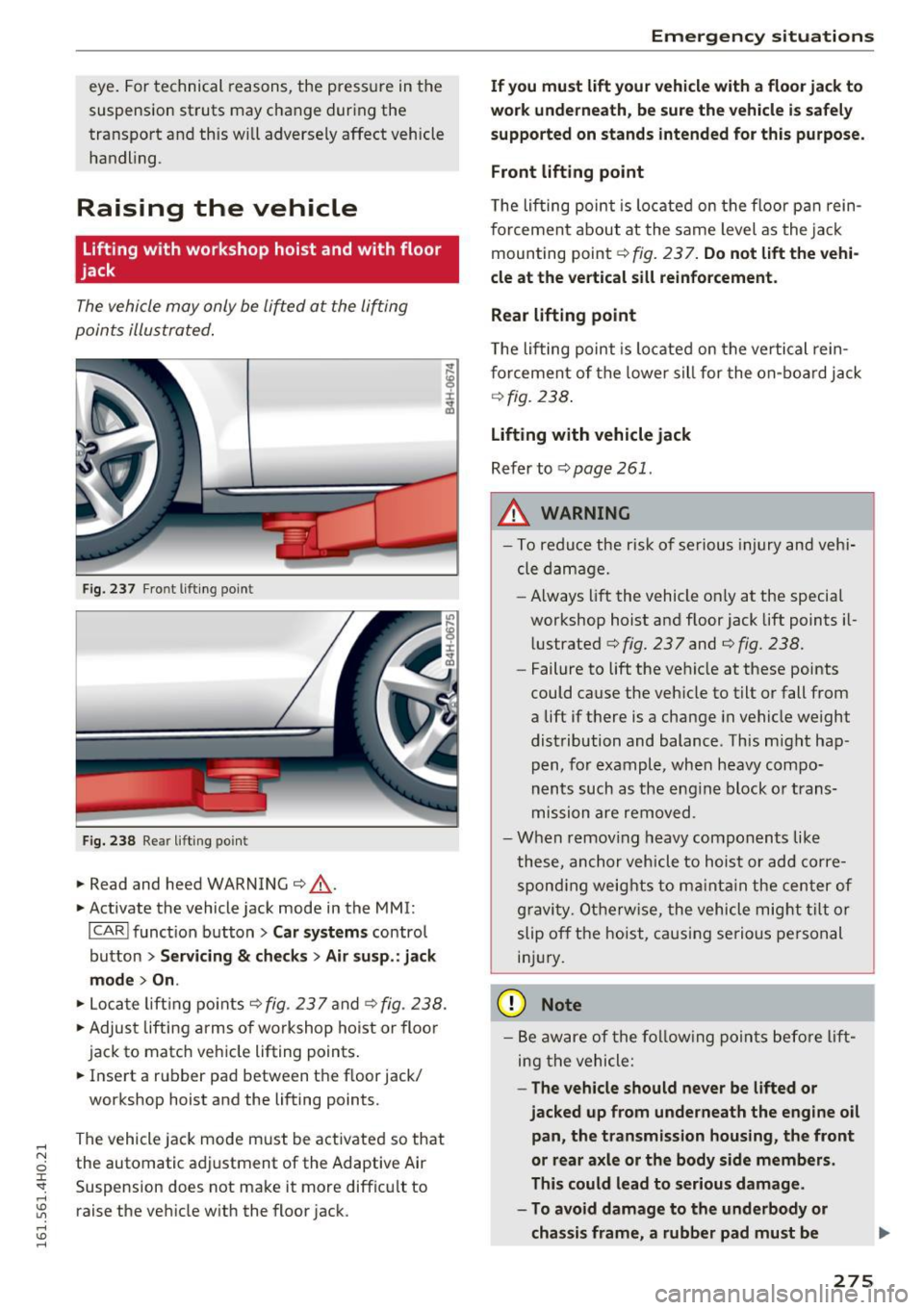
T he vehicle may only be lifted at the lifting
poin ts illus trated .
Fig . 237 Front lift ing point
F ig. 238 Rear lift ing po int
.,. Read and heed WARNING¢&_.
... Activate the vehicle jack mode in the MMI:
I CAR I funct io n button> Car system s control
button >
Servicing & checks > Air susp .: jack
mode > On .
... Loc ate lift ing po ints ¢fig. 237 and ¢ fig. 23 8 .
.,. Adjus t lifting arms of wo rkshop hoist or floo r
jack to matc h ve hicle lifting points .
... Inse rt a ru bber pad between t he f loor jack/
workshop hoist and the lifting points.
T h e vehicle jack mode m ust be act ivate d so that
the automatic adjustment of the Adaptive Air
Suspension does not ma ke it more diffic ult to
raise the ve hicle w it h the floor jack .
Emergency situations
If you must lift your vehicle with a floor jack to
work unde rneath , be sure the vehicle is safely
supported on stands intended for this purpose.
Front lifting point
T he li fting poi nt is locate d on the floor p an rein
f o rcement about at the sa me level as the ja ck
mounting point¢
fig. 237 . Do not lift the vehi
cle at the vertical sill re inforcement .
Rear lifting point
T he lif ting point is locate d on the vertical rei n
f o rcement of the lowe r sill for the on-bo ard j ack
¢fig. 238 .
Lifting with vehicle jack
Refer to¢ page 261 .
A WARNING
-- To reduce the r is k of se rious inju ry and veh i-
cle dama ge.
- Always lift the vehicle on ly at the special
w orkshop hoist and f loor jack lift points
il
lu strated¢ fig. 237 and¢ fig. 238.
- Failure to lift the ve hicle at these points
could cause the veh icle to tilt or fall fr om
a lift if t here is a change in vehicle weight
dist ribution and balance . Th is m ig ht hap
pen , fo r e xampl e, wh en heavy compo
n ents such as the eng in e block o r trans
mi ssion are removed.
- W hen re mov ing heavy componen ts like
t hese, anchor veh icle to hoist or add co rre
s p ondin g weig hts to maintai n the center of
g ra vity. O therw ise, the vehicle mig ht tilt or
slip
o ff th e hois t, c ausing se rious pe rsonal
i njur y.
(D Note
- Be aw are of the fo ll ow ing poi nts before lift
ing the vehicle:
-The vehicle should never be lifted or
jacked up from underneath the engine oil
pan, the transmission housing, the front
or rear axle or the body side members .
This could lead to serious damage .
- To avoid damage to the underbody or
chassis frame, a rubber pad must be
275