spare wheel AUDI A8 2017 Owners Manual
[x] Cancel search | Manufacturer: AUDI, Model Year: 2017, Model line: A8, Model: AUDI A8 2017Pages: 354, PDF Size: 88.68 MB
Page 292 of 354
Wheel s
Occupant loading and distri
bution for vehicle normal load
for various designated seat ing
capacit ies
Refer to the tire inflation pres
sure label ¢
page 293, fig . 268
for the number of seating posi
tions . Refer to the table¢
table
on page 295
for the number of
people that correspond to the ve
hicle normal load .
New tires or wheels
Audi recommends having all work
on tires or wheels performed by
an authorized Audi dealer or au
thorized Audi Service Facility .
These facilities have the proper knowledge and are equipped with
the required tools and replace
ment parts.
.,. New tires do not yet have the
optimum gripping properties. Drive carefully and at moderate
speeds for the first 350 miles (500 km) with new tires .
.,. Use tires of the same construc
tion, size (rolling circumference)
and as close to the same tread pattern as poss ible on all four
wheels .
290
.,.Do not replace tires individually .
At least replace both tires on the
same axle at the same time.
.,. Audi recommends that you use
Audi Original Tires. If you would
like to use different tires, please
note that the tires may perform
differently even if they are the
same size ¢
,&..
.,. If you would like to equip your
vehicle with a tire/rim combina
tion that is different from what
was installed at the factory, con
sult with an authorized Audi
dealer or authorized Audi Service Facility before making a pur
chase ¢&, .
The spare tire* is different from
the regular tires installed on the
vehicle -for example, if winter
tires or wide tires are installed -
so only use the spare tire* tempo
rarily in case of emergency and
drive carefully while it is in use. It
should be replaced with a regular
tire as soon as possible.
All four wheels must be equipped
with tires that are the same brand and have the same construction
and tread pattern so that the
drive system is not damaged by
different tire speeds. For this rea -
son, in case of emergency, only .,.
Page 293 of 354

0 a, .... N ,.... N .... g :r ..
use a spare tire* that is the same
circumference as the regular
tires.
&_ WARNING -
-Only use tire/rim combina tions and suitable wheel bolts
that have been approved by
Audi. Otherwise, damage to
the vehicle and an accident
could result.
-For technical reasons, it is not
possible to use tires from oth
er vehicles -in some cases,
you cannot even use tires from
the same vehicle model.
-Make sure that the tires you
select have enough clearance
to the vehicle. Replacement
tires should not be chosen
simply based on the nominal
size, because tires with a dif
ferent construction can differ greatly even if they are the
same size. If there is not
enough clearance, the tires or
the vehicle can be damaged
and this can reduce driving
safety and increase the risk of
an accident .
-Only use tires that are more
than six years old when abso-
Wheels
lutely necessary and drive
carefully when doing so .
-Do not use run-flat tires on
your vehicle . Using them when
not permitted can lead to ve
hicle damage or accidents.
-If you install wheel covers on
the vehicle, make sure they al low enough air circulation to
cool the brake system. If they
do not, this could increase the
risk of an accident.
Tire wear/damage
Fig. 266 T ire profile: treadwear indica
tor
Tire wear
Check the tires regularly for wear.
-Inflation pressure that is too low
or high can increase tire wear
considerably.
-Driving quickly through curves, rapid acceleration and heavy
braking increase tire wear.
291
Page 295 of 354
This can especially have a nega
tive effect on handling, on the
risk aquaplaning when driving
through water, when driving
through curves and when brak ing, which increases the risk of
an accident.
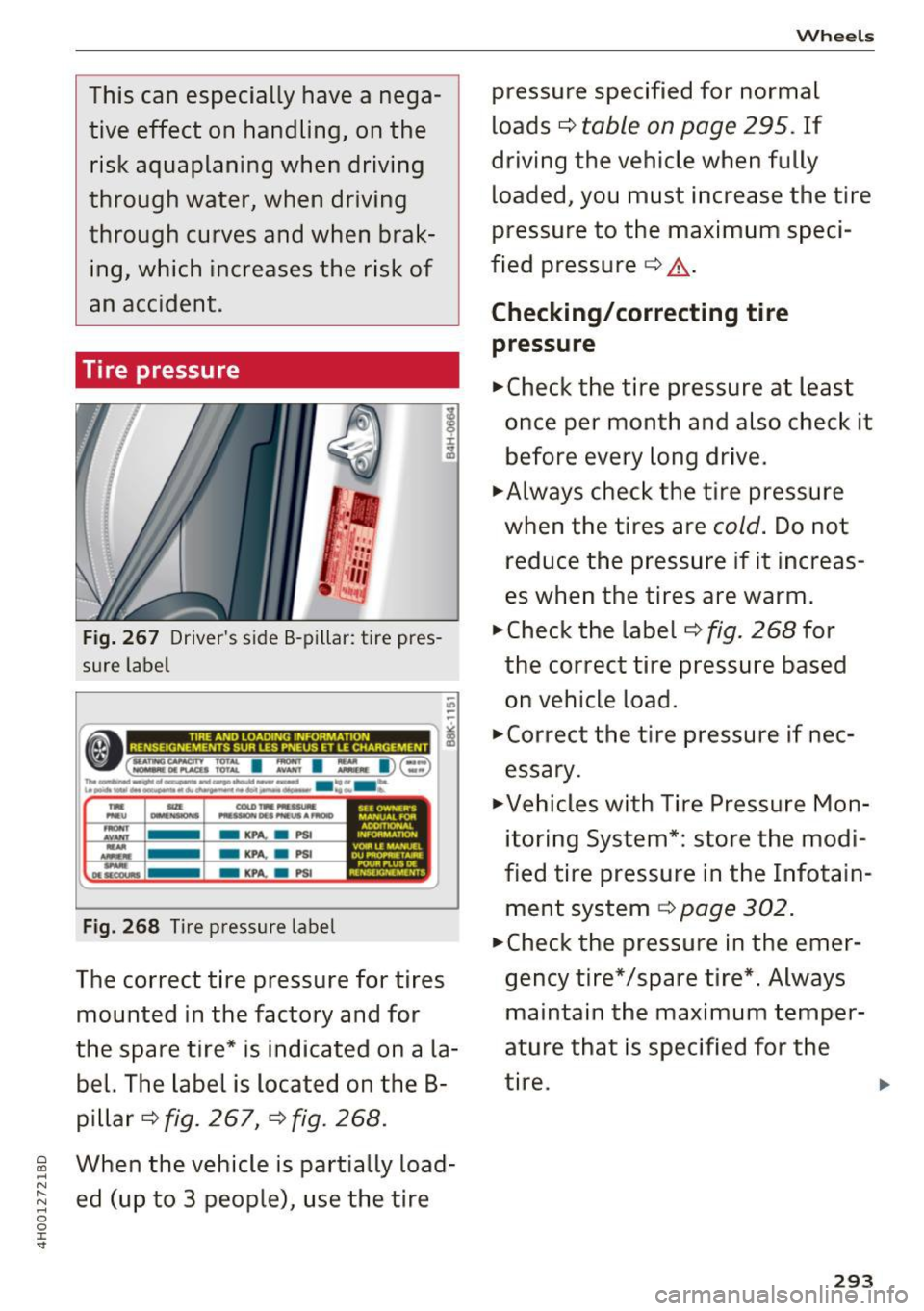
Tire pressure
Fig. 267 Driver's side B -pillar : tire pres
sur e label
-"' -,--------------- -
• ============ i (
:=:=a : I =:: I :.. I) (':: ~) n,.......,.._,.,.. ......... _.__......, _ _.., .... _ ... l ................... . __.......... .......... ..._ .. .,,, ..
Fig. 268 Tire pressure label
The correct tire pressure for tires
mounted in the factory and for
the spare tire* is indicated on a la
bel. The label is located on the B
pillar ¢
fig. 267, ¢ fig. 268.
~ When the vehicle is partially load-
N
~ ed (up to 3 peop le), use the tire
0
0
I
pressure specified for normal
loads¢
table on page 295. If
driving the vehicle when fully loaded, you must increase the tire
pressure to the maximum speci
fied pressure ¢.&, .
Checking/correcting tire
pressure
.,..Check the tire pressure at least
once per month and also check it before every long drive .
.,..Always check the tire pressure
when the tires are
cold. Do not
reduce the pressure if it increas
es when the tires are warm .
.,..Check the label ¢
fig. 268 for
the correct tire pressure based on vehicle load.
.,..Correct the tire pressure if nec
essary.
.,..Vehicles with Tire Pressure Mon
itoring System*: store the modi
fied tire pressure in the Infotain
ment system ¢
page 302.
.,..Check the pressure in the emer
gency tire* /spare t ire* . Always
maintain the maximum temper
ature that is specified for the
tire. .,.
293
Page 303 of 354

C) C0 ....
"' " "' .... 0 0 :r
Temperature grades apply to tires that are properly inflated and not over or underinflat
ed .
Tire Pressure Monitoring
System (AS, S8)
(D General notes
A ppl ies to: AS, 58
Each t ire, including the spare (if provided),
should be checked monthly when cold and inflat
ed to the inflation pressure recommended by the
veh icle manufact urer on the vehicle placard or
tire inflation pressure label. (If your vehicle has
tires of a different size than the size indicated on
the vehicle placard or tire inflation pressure la
be l, you should determine the proper tire infla
tion pressure for those tires).
As an added safety feature, your veh icle has been
equipped with a tire pressure monitoring system
(TPMS) that illuminates a low tire pressure te ll
tale when one or more of your tires is significant
ly under-inflated . Accordingly, when the low tire
pressure telltale illuminates, you should stop and
check your tires as soon as possible, and inflate
them to the proper pressure . Driving on a signifi
cantly under-inflated tire causes the tire to over
heat and can lead to tire failure. Under-inflation
also reduces fuel efficiency and tire tread life,
and may affect the vehicle's handling and stop
ping ability .
Please note that the TPMS is not a substitute for
p roper tire maintenance, and it is the driver's re
sponsib ility to ma intain correc t tire p ressure,
even if under-inflation has not reached the level
to trigger illumination of the TPMS low tire pres
sure telltale.
Your veh icle has also bee n eq uipp ed w ith a TPM S
mal function indicator to indicate when the sys
tem is not operat ing properly. The TPMS mal
function indicator is combined with the low tire
pressure telltale. When the system detects a
malfunction, the telltale will flash for approxi
mately one mi nute and then remain cont inuously
illuminated . This sequence will continue upon
Wheels
subsequent vehicle start-ups as long as the mal
function exists .
When the malfunction indicator is illuminated ,
the sys tem may not be able to detect or signal
low tire pressure as intended . TPMS malfunctions
may occur for a variety of reasons, including the
i nsta llation of replacement or alternate tires or
whee ls on the vehicle that prevent the TPMS
from functioning properly. Always check the
TPMS malfunction telltale after replac ing one or
more tires or wheels on your vehicle to ensure
that the replacement or a lternate tires and
whee ls allow the TPMS to continue to function
properly.
If the Tire Pressure Monitoring System
indicator appears
Applies to: A8, 58
The tire pressure indicator in the instrument
cluster informs you if the tire pressure is too low
or if there is a system malfunction.
Fig. 269 I n strument cluste r: indicator light with messa ge
Using the ABS sensors, the tire pressure monitor
ing system compares the tire tread c ircumfer
ence and vibration characteristics of the individu
al tires.
If the press ure changes in one or more
tires, this is indicated in the instrument cluster
display with an indicator light
[I] and a message.
If only one tire is affected, the location of that
tire will be indicated.
T he tire press ures must be stored in the Infotain
ment system again each time the pressures
change (switching between partial and full load
pressure) or after changing or replacing a tire on
your vehicle
c:> page 302. The tire pressure moni
toring system only monitors the tire pressure you have stored . Refer to the t ire pressure label for ..,.
301
Page 304 of 354

Wheels
the recommended tire pressure for your vehicle
¢page 293, fig. 268.
Tire tread circumference and vibration character
istics can change and cause a tire pressure warn
ing if:
- the tire pressure in one or more tires is too low.
- the tire has structural damage .
- the tire was replaced or the tire pressure was
changed and it was not stored¢
page 302.
-the spare tire* is installed.
Indicator lights
IE Loss of pressure in at least one tire¢&. .
Check the tires and replace or repair if necessary.
Check/correct the pressures of all four tires and
store the pressure again in the Infotainment sys
tem ¢
page 302 .
mm (Tire Pressure Monitoring System) Tire
pressure: System malfunction!.
Ifmm appears
after switching the ignition on or while driving
and the
IE indicator light in the instrument clus
ter blinks for approximately one minute and then
stays on , there is system malfunction . Try to
store the correct tire pressures¢
page 302. If
the indicator light does turn off or turns on again
after a short period of time, drive to an author
ized Audi dealer or authorized Audi Service Facili
ty immediately to have the malfunction correct
ed .
A WARNING
- If the tire pressure indicator appears in the
display, reduce your speed immediately and
avoid any hard steer ing or braking maneu
vers . Stop as soon as possible and check the
t ir es and their pressure .
- The driver is responsible for maintaining the
correct tire pressure. You must check the
t ire pressure regularly.
- Under certain conditions (such as a sporty
dr iv ing style, winter cond itions or unpaved
roads), the tire pressure monitoring system
indicator may be delayed.
- Do not use run-flat tires on your vehicle. Us
ing them when not permitted can lead to
vehicle damage or accidents .
302
(D Tips
-The tire pressure monitoring system can al
so stop working when there is an ESC mal
function.
- Using snow chains may result in a system
malfunction.
- The tires with the identification "AO" or
"RO" ¢
page 290 have been matched with
your Audi tire pressure monitoring system.
We recommend that you use these tires.
Storing tire pressures
App lies to: AB, 58
If the tire pressure changes or a tire is replaced ,
it must be confirmed in the Infotainment sys
tem.
... Make sure before storing that the tire pressur es
of all four tires meet the specified values and
are adapted to the load ¢
page 291.
... Switch the ignition on.
... Select: the
ICARI funct ion button> Car Systems
control button > Servicing & checks > Tire
pressure monitoring
> Store tire pressure >
Yes, store now.
(D Tips
Do not store the tire pressures if snow chains
are installed. Othe rw ise the system could
malfunction.
Tire Pressure Monitoring System (S8 plus)
(l) General notes
App lies to : 58 plus
Each tire, including the spare (if provided),
sho uld be checked monthly when cold and inflat
ed to the inflation pressure recommended by the
vehicle manufacturer on the vehicle placard or
tire inflation pressure label. (If your vehicle has
tires of a different size than the size indicated on
the vehicle placard or tire inflation pressure la
bel, you should determ ine the proper t ire infla-
tion pressure for those tires). .,.
Page 306 of 354

Wheels
@ For the sake of the environment
Low tire pressure inc reases fuel consumption
and tire wear.
@ Tips
- The pressure of the spare tire * is not moni
tored.
- If t ires are re pla ced, the sensors/valves do
not need to be removed or rep laced . Ju st re
placed the valve stem and, if necessary, the
valve and the wheel e lectron ics . If you have
quest ions, see your autho riz ed Aud i dea ler
or authorized Audi Service Facility.
Displaying tire pressures/temperatures
App lies to : 58 plus
Req uirement: the ign ition must be switched on .
.,. Select : the
ICARI function button > C ar s ystems
> Serv icing & checks > Tire pressure mon itor
ing
> Display tire pressures.
The current tire pressures are shown in green and
yellow numbers in the Infotainment system:
- Green : the current tire pressure and the speci
fied tire pressure are approximately the same .
-Yellow: the c urrent tire press ure is too low
compared to the specified tire pressure.
The spe cified t ire press ure is the la st tire pres
sure th at was s tored
c::> page 305.
No te that the tire pressure also depends on the
t emperature of the ti re . The ti re pressu re in
creases as the engine becomes wa rmer wh ile
d riving.
& WARNING
R ea d and follow t he important information
and notes
c::> page 303 .
@ Tips
The tire pressure or tem per ature are not dis
pl ayed in ada ptation mode. D ashe s·-.·- are
shown i n place of the press ure and tempera
ture .
304
-
Tire pressure loss
Applies to: 58 plus
Fig. 2 70 Dis pla y: ind icator light w it h a mess age
If the [I] ind icator light turns on, the pressure in
at least one tire is too low or new sensors were
not adapted:
RE indicator light s turn s on after turning the
ignition on
The tire pressure is too low compared to the
spec ified press ure .
.. Check and store the tire press ure(s) the next
time it is possible
c::> page 305.
RE indicator light turns on while dr iving
Wheels with new sensors we re not adapted or
the tire p ressure has reached a critica l level com
pared to the specif ied pressure.
.. Avoid unnecessary s teering and brak ing maneu-
vers .
.. Adapt your driving sty le to the s ituation.
.. Stop as soon as possib le and check the tire(s).
.. If it is possib le to cont inue dr iv ing, see an au-
thorized Audi dealer or authorized Audi Service
Facility immediately and have your tire(s) re
pai red or rep laced .
& WARNING
Read and f ollow the impo rtant inform ation
and notes
c::>p age 303.
-
Page 314 of 354

Emergency assistance
Emergency assistance
General information
... Park the vehicle as far as possible from moving
traffic in the event of a breakdown. In the event
of a flat tir e, park the vehicle on a level surface .
It you are on a steep hill, be especially careful.
.,. Set the parking brake .
.,. Switch the emergency flashers on .
... Set up the warning triangle
r=;, page 312 .
... Have the passengers exit the vehicle . They
should move to a safe place, for example be
hind a guard rail.
A WARNING
Follow the steps given above. This is for your
protection and the for the safety of other driv
ers.
Equipment
Warning triangle
Applies to: vehicles with warning triangle
Fig. 271 L uggage compa rtm ent lid : w arnin g triangle
The warning triangle placed in the vehicle at the
factory is located in the luggage compartment.
... To remove the warning triangle, press the fas-
tener in the direction of the arrow and fold the
holder down.
The luggage compartment lid is only designed to
hold the warning triangle offered by th e Audi
Genuine Accessories program.
312
Vehicle tool kit
Applies to: vehicles with vehicle toot kit
Fig. 272 L u gg age compartmen t: cargo floor cove r fo lded
upward
Fig. 273 Luggage co m partment: exa mple of veh icle toot
kit and vehicle j ack
The vehicle tools and vehicle jack* are stored in
the luggage compartment under the floor cover .
... Lift the cargo floor by the plastic handle .
... Hook the handle into the luggage compartment
seal
r::> fig. 272 .
.,. Turn the handwheel counter-clockwise and re
move it .
.,. Remove the spare tire* to access the vehicle
tool kit
r::;, fig. 2 72 .
Depend ing on the equipment , the veh icle tool kit
may be located under the spare tire, under an
other cover or in the tool box.
T he position of the vehicle jack* may vary .
A WARNING
Improper use of the veh icle jack can cause se
rious personal injuries.
- Never use the screw driver hex head to
tighten wheel bolts, since the bolts cannot
attain the necessary tightening torque if you .,..
Page 315 of 354

0 co .... N ,..._
N .... 0 0 :c '
cident.
- The factory-supplied jack is intended only
for your vehicle model. Under no circum
stances should it be used to lift heavy
vehicles or other loads; you r isk injuring
yourself .
- Never start the engine when the vehicle is
ra ised, which could cause an accident.
- Support the veh icle secure ly with appropri
ate stands if work is to be performed under
neath the vehicle; otherwise, there is a po
tent ial risk for injury .
- Never use the jack supplied with your Audi
on anothe r vehicle, particularly on a heav ier
one . The jack is only suitable for use on the
vehicle it came w ith.
(D Tips
The vehicle jack* in your vehicle is mainte
na nee-free.
Replacing wheels
Before changing a wheel
Observe the following precautions for your own
and your passenger's safety when changing a
wheel .
.,. After you experience a tire fail ure, pull the car
well away from moving t raff ic and try to reach
le vel ground before you stop¢,&. .
.,. All passengers should
lea ve the ca r and move
to a safe location (for instance, behind the
guardrail) ¢,&. .
.,. Engage the
parking brake to prevent your vehi
cle from rolling unintentionally¢,&. .
.,. Move
sel ecto r le ve r to pos it ion P ¢ ,&. .
.,. If you a re towing a trailer, unh itch the trailer
from your veh icle.
.,. Take the
jack and the s pare tir e out of the lug
gage compartment
¢ page 312.
WARNING
You or your passengers co uld be injured while
chang ing a wheel if you do not follow these
safety precautions:
Em ergenc y ass is tanc e
-If you have a flat tire, move a safe distance
off the road. Turn off the eng ine, turn the
emergency flashers on and use other warn ing dev ices to alert other motorists .
- Make sure that passengers wait in a safe
p lace away from the vehicle and well away
from the road and traff ic .
- To help prevent the veh icle from moving
suddenly and possib ly slipping off the jack,
always fully set the park ing brake and block
the wheel d iagonally opposi te the wheel be
ing changed. When one front whee l is lifted
off the groun d, p lacing the Automatic
Transmission in "P" (Park) w ill
not prevent
the vehicle from mov ing.
- Before you change a wheel, be sure the
g round is leve l and firm. If necessary, use a
sturdy board under the jack .
- Always s tore the vehicle tool kit, the jack
and the replaced tire in the luggage com
partment
r::> page 213 .
(D Tips
Befo re c hanging the w heel, you must activate
t he jacking mode, so that the a utomat ic co n
tro ls for the Adaptive Air Suspension do not
make it more difficult to lift the vehicle with
the jack
¢ page 315.
Changing a wheel
When you change a wheel, follow the sequence
described below step-by-step and in exactly that
order .
1. Activate the vehicle jack mode ¢ page 315 .
2. Remove the decorative wheel cover *. For
more detai ls see also
r:::> page 314, Decora
tive wheel covers
or ¢ page 314, Wheels
with wheel bolt caps.
3. Loosen the wheel bolts r:=> page 315 .
4. Locate the proper mounting point for the
jack a nd align the jack below that point
r:::> page 315 or ¢page 316.
5. Raise the ca r wi th the jack ¢ page 315 or
r:::> page 316 .
6. Remove the whee l with the flat tire and then
insta ll
the spare r:::>page 318 . IJII>
313
Page 320 of 354
Emergency assistance
Taking the wheel off/installing the spare
Follow these instructions step-by-step for chang
ing the wheel .
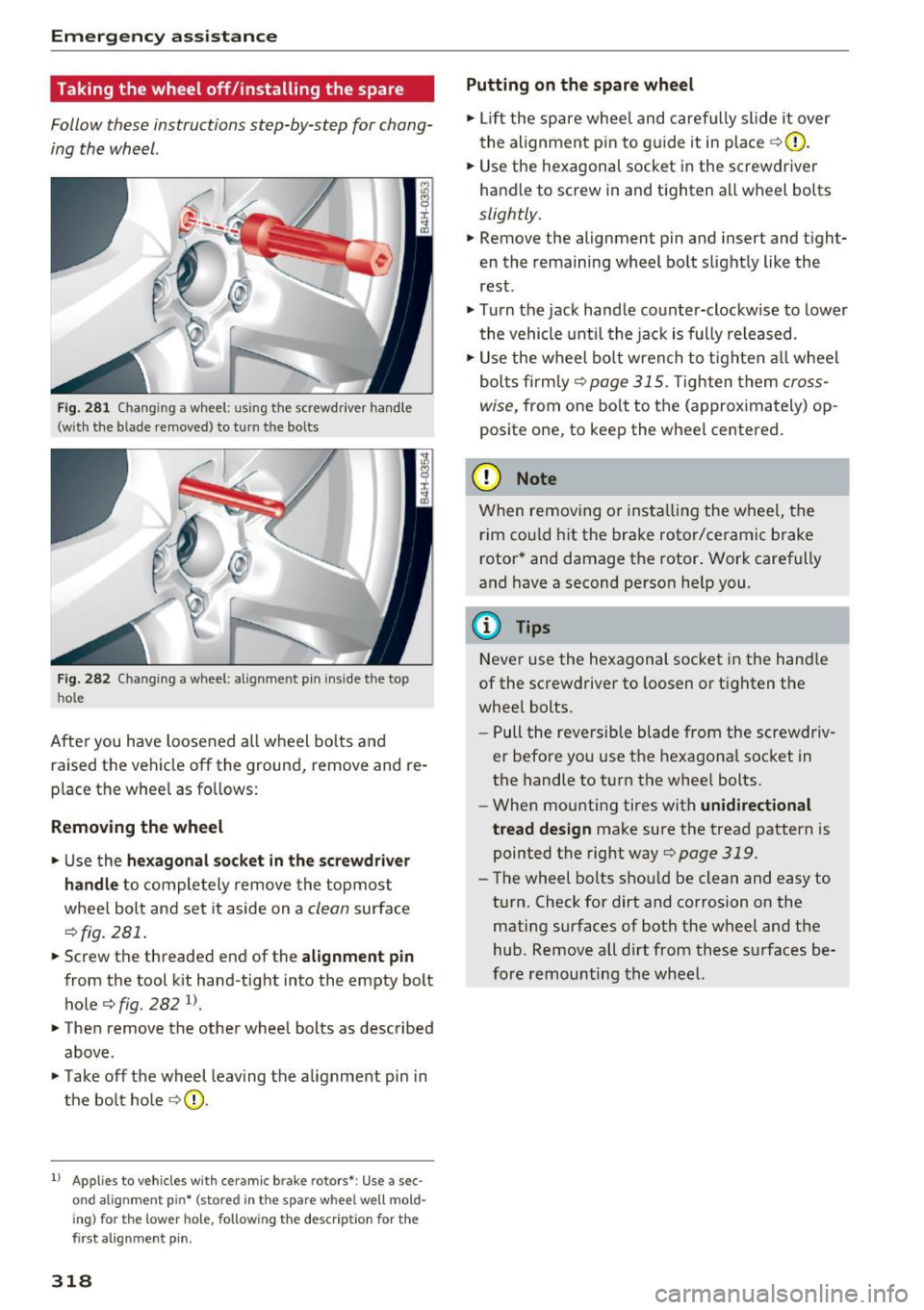
Fig. 281 Changing a wheel: using the screw driver handle
(with the blade removed) to turn the bolts
Fig. 282 Chang ing a whee l: alignment pin inside the top
hole
After you have loosened all wheel bolts and
raised the vehicle off the ground, remove and re
place the wheel as follows:
Removing the wheel
• Use the hexagonal socket in the screwdriver
handle
to completely remove the topmost
wheel bolt and set it aside on a
clean surface
¢fig. 281.
• Screw the threaded end of the alignment pin
from the tool kit hand-tight into the empty bolt
hole
c> fig. 282 1) _
• Then remove the other wheel bolts as described
above.
•Ta keoff the wheel leaving the alignment pin in
the bolt hole ¢0 .
l) Applies to vehicles w ith ce ram ic b rake rotors*: Use a sec
ond alignment pin* (sto red in th e spa re wheel well mo ld
ing) for the lower hole, follow ing the description for the
firs t alignment pin.
318
Putting on the spare wheel
• Lift the spare wheel and carefully slide it over
the alignment pin to guide it in place ¢0 .
• Use the hexagonal socket in the screwdriver
handle to screw in and tighten all wheel bolts
slightly.
• Remove the alignment pin and insert and tight
en the remaining wheel bolt slightly like the
rest.
• Turn the jack handle counter-clockwise to lower
the vehicle until the jack is fully released.
• Use the wheel bolt wrench to tighten all wheel
bolts firmly¢
page 315. Tighten them cross
wise,
from one bolt to the (approximately) op
posite one, to keep the wheel centered.
(D Note
When removing or installing the wheel, the
rim could hit the brake rotor/ceramic brake
rotor* and damage the rotor. Work carefully
and have a second person help you.
(D Tips
Never use the hexagonal socket in the handle
of the screwdriver to loosen or tighten the
wheel bolts.
- Pull the reversible blade from the screwdriv
er before you use the hexagonal socket in
the handle to turn the wheel bolts.
- When mounting tires with
unidirectional
tread design
make sure the tread pattern is
pointed the right way¢
page 319.
-The wheel bolts should be clean and easy to
turn. Check for dirt and corrosion on the
mating surfaces of both the wheel and the
hub. Remove all dirt from these surfaces be
fore remounting the wheel.
Page 321 of 354

C) C0 ....
"' " "' .... 0 0 :r
Tires with unidirectional tread design must be
mounted with their tread pattern pointed in the
right dir ection .
Using a spare tire w ith a tread pattern
intended for use in a specific direction
When using a spare t ire with a tread patte rn in
ten ded fo r use in a specific direction, please note
the following:
- The direct io n of rotat io n is ma rked by an a rrow
o n the side of the tire .
- If the spare tire has to be installed in the incor
rect d irection, use the spare tire only tempora
rily s ince the tire w ill not be ab le to achieve its
opt imum performanc e ch a rac teristics wi th re
g ard to a quaplaning, noi se and we ar.
- We recommend that you pay particular atten
t io n t o thi s fa ct du ring we t wea ther and that
y ou adju st your s peed to m atch r oad co ndi
ti ons .
- R eplace t he flat tir e wi th a new one and have i t
i n st alled on yo ur vehicle as soon as possible to
r es to re the handlin g advanta ges of a unidi rec
tiona l tire .
Notes on wheel changing
P lease read the info rmation
<=> page 29 0 if you
are going to use a spare tire which is different
from t he tires on your vehicle.
Afte r you change a ti re:
- Check the tire pressure on the spare immedi
ately after installation.
- Have the wheel bolt tightening torque
checked with a torque wrench as soon as pos
sible by your authorized Audi dealer or a
qualified service station.
- With steel and alloy wheel rims, the wheel
bolts are correctly tightened at a torque of 90
ft lb (120 Nm).
- If you notice that the wheel bolts are corroded
and diff icult to turn while changing a tire,
they should be replaced before you check the
tightening torque .
Emergency assistance
-Replace the flat tire with a new one and have
it installed on your vehicle as soon as possi
ble. Remount the wheel cover .
Until then , drive with extra care and at reduced
speeds.
A WARNING
- If you are goin g to equip yo ur ve hicle with
tires or r ims which diffe r from those which
were factory installed, the n be sure to read
the information
r:> page 290.
- A lways make sure the dama ged w heel or
e ven a flat tire and the jack and tool kit ar e
prope rly sec ured in the luggage compa rt
men t and a re not loose in the passenger
compa rtme nt.
- In an accident or sudde n maneuv er th ey
co uld f ly forward , inju ri ng a nyone in the ve
h icle.
- Always store damaged w he el, jack and tools
se cur ely in the luggage compartment. Ot h
e rw ise, i n an accide nt or sud den mane uve r
t hey could fly forw ard, causing inju ry to pas
s e ng ers i n th e ve hicle.
Spare tires
General information
App lies to : vehicles wi th spare tire/space-saving spare tire
(co mp act s pa re t ire)
Fig . 28 3 Lu ggage co mpart m ent: ca rgo floo r cover fo lded
up wa rd
The spare tire is intended for s hort-term use on-
-
ly . Have the damaged tire checked and, if neces
sary, rep laced by an authorized A udi dealer or au
tho rize d Au di Serv ice Facility as soon as p ossible.
II>-
319