seat adjustment AUDI A8 2017 User Guide
[x] Cancel search | Manufacturer: AUDI, Model Year: 2017, Model line: A8, Model: AUDI A8 2017Pages: 354, PDF Size: 88.68 MB
Page 228 of 354
Airbag syste m
Airbag system
Important information
Importance of wearing safety belts and
sitting properly
Airbags are only supplemental restraints . For
airbags to do their job, occupants must always
properly wear their safety belts and be in a prop
er seating position.
For your safety and the safety of your passen
ge rs , before driving off, always :
"' Adjust the driver's seat and steering wheel
properly ¢
page 208,
"'Adjust the front passenge r's seat properly
¢ page 54,
"'Wear safety belts p roperly ¢ page 220,
"' Always properly use the proper child restraint
to protect children ¢
page 248.
In a coll is io n, airbags mus t inflate within the
blink of an eye and wi th considerab le force . The
supp lemental airbags can cause injuries if the
driv er or th e front s eat passeng er is not s eated
properly. Therefore in order to he lp the airbag to
do its job, it is important, both as a dr iver and as
a passenger to sit properly at all t imes.
By keeping room between your body and the
steering whee l and the front of the passenger
compartment, the a irbag can inflate fully and
completely and provide supplemental protect ion
in certain frontal collisions¢
page 208, Correct
passenger seating positions .
For details on the
operation of the seat adjustment con trols
¢ page 54.
It's especially important that children are proper
ly restra ined
¢ page 248 .
There is a lot that the driver and the passengers
can and must do to help the ind iv idual safety fea
tures installed in your Audi work together as a
system .
Proper seating posit ion is important so that the
front airbag on the drive r side can do its job. If
you have a physical impairment or cond ition that
prevents you from s itting properly on the driver
seat with the safety be lt properly fastened and
226
reaching the peda ls, or if yo u have concerns w ith
regard to the function or operation of the Ad
vanced Airbag System, please contact your a u
thori zed Audi dea ler or qua lified workshop, or
ca ll Audi Customer Relations at 1-800-822-2834
for poss ib le modifications to your vehicle .
When the airbag system dep loys, a gas generator
will fill the airbags, break open the padded cov ers, and infla te between the steering wheel and
the driver and between the instrument panel and
t h e front passenger . The airbags w il l deflate im
med iate ly after deployment so that the front oc
cupants can see t hrou gh the windsh ie ld again
without i nterruption.
All of th is takes p lace in the b link of an eye, so
fast that many people don't even rea lize that the
a irbags have deployed. The airbags a lso infla te
with a g re at deal of force and nothing should be
i n the ir way when they deploy. Front airbags in
combination with properly worn safety belts slow
down and limit the occupant 's forward move
ment . Together they he lp to prevent the driver
and front seat passenger from hitting pa rts of
the ins ide of the vehicle while reduc ing the fo rces
acting on the occupant dur ing the cras h. In th is
way they help to reduce the risk of injury to the
head and uppe r body i n the crash . Airbags do not
protect the arms or the lower pa rts of the body.
Both front airbags will not inflate in all frontal
collisions . The t riggering of the a irbag system de
pends on the veh icle decelerat ion rate caused by
t h e coll is io n and regis tered by the ele ctroni c con
tro l unit . If this ra te is be low the refe rence value
programmed in to the contro l unit, the airbags
will not be trigge red, even tho ugh the car may be
badly damaged as a resu lt of the co llision. Vehi
cle damage, rep air costs or even the lack of vehi
cle damage is not necessarily an indication of
whether an a irbag should inflate or not .
Since the circumstances will vary cons iderab ly
between one co llision and another, it is not possi
ble to define a range of veh icle speeds that will
cover every poss ible kind and angle of impact
that w ill always t rigger t he a irbags . Important
factors i nclude, for examp le, the nat ure (hard or
soft) of the object which the ca r hits, the angle of
i mp act , vehicle speed , etc. The front airbags will .,.
Page 251 of 354
0 co .... N ,..... N .... 0 0 :c '
Child ren on the front seat of any car even w ith
Advanced Airbags can be seriously injured or
even killed when an airbag inflates. A child in
a rearward-facing child safety seat installed
on the front passenger seat will be seriously
injured and can be killed if the front airbag in
flates.
- The inflating airbag will hit the child safety
seat or infant carrier with great force and
will smash the ch ild safety seat and child
against the backrest, center armrest, or
door.
- Always install rear-facing child safety seats
on the rear seat.
- If you must install a rearward fac ing ch ild
safety seat on the front passenger seat in
exceptiona l circumstances and the
PA SSEN
GER AIR BAG OFF
light does not come on
and stay on, immediately insta ll the rear
facing child safety seat in a rear seating po
sition and have the airbag system inspected
immediately by your Audi dealer.
A WARNING
If, in except ional circumstances, you must in
stall a forward-facing chi ld restraint on the
front passenger's seat :
- Always make sure the forward-fac ing seat
has been designed and certified by its man
ufacturer for use on a front seat with a pas
senger front and s ide a irbag .
- Always follow the manufacturer's instruc
tions prov ided with the ch ild safety seat or
carrier.
- Always move the front passenger seat to
the highest position in the up and down ad
justment range and move it back to the
rea rmost position in the seat's fore and aft
adjustment range, as fa r away from the air
bag as possib le, before insta lling the for
ward- facing child restra int .
- Always ma ke sure that the s afety bel t upper
anchorage is beh ind the child restraint and
not next to or in front of the chi ld restraint
so that the safety belt will be properly pos i
t ioned.
Ch ild safety
-Always make sure that the PASSENGER AIR
BAG OFF
light comes on and stays on all the
time whenever the ignition is switched on.
@ Tips
A lways replace child restraints that were in
stalled in a vehicle du ring a c rash. Damage to
a child restraint that is not v is ible could cause
i t to fai l in another co llision situat ion.
Advanced front airbag system and children
You r vehicle is equipped with a front "Advanced
Airbag System" in compliance with Un ited States
Federal Motor Vehicle Safety Standa rd (FMVSS)
208, as we ll as Canada Moto r Vehicle Safety
Standard (CMVSS) 208 as app licab le a t the time
your vehicle was manufactured.
T he Advanced A irbag system in yo ur vehicle has
been certified to meet the "low-risk" require
ments fo r 3- and 6-year old ch ild ren on the pas
senger side and sma ll adu lts on the driver side.
T he low risk deployment criter ia are intended to
red uce the risk of inju ry t hrough interaction with
the airbag that can occur, for example, by be ing
too close to the steering wheel and instrument
panel when the airbag inflates. In addition, the
system has been cert ified to comply with the
"supp ression" requirements of the Safety Stand
ard, to turn off the front a irbag fo r infants up to
12 months who are restrained on the front pas
senger seat in c hild res traints t hat are lis ted in
t h e Standard.
E ven though your veh icle is eq uipped wit h an Ad
vanced Airbag system, all ch ild ren, especially
those 12 yea rs and you nger, sho uld a lways ride
in the back seat proper ly restrained for their age
and size . The airbag on the passenger side makes
the front seat a potentia lly dange rous p lace for a
child to ride. The front seat is not the safest place
for a child in a forward-fac ing ch ild safety seat. It
can be a very dangerous place fo r an infant o r a
larger ch ild in a rearward-facing seat .
249
Page 254 of 354
Child safety
A WARNING
Not using a child safety seat, using the wrong
child safety seat or improperly installing a
child restraint increases the risk of serious
personal injury and death.
- All vehicle occupants and especially children
must always be restrained properly whenev
er riding in a vehicle.
- An unrestrained or improperly restrained
child can be injured or killed by being
thrown against the inside of the vehicle or
by being ejected from it during a sudden
maneuver or impact.
- An unrestrained or improperly restrained
child is at much greater risk of injury or
death by being struck by an inflating air
bag.
- Commercially available child safety seats
are required to comply with U.S. Federal
Motor Vehicle Safety Standard (FMVSS) 213
(in Canada CMVSS 213).
- When buying a child restraint, select one
that fits your child and the vehicle.
- Only use child restraint systems that fully
contact the flat portion of the seat cush ion. The child restraint must not tip or
lean to either side. Audi does not recom
mend using child safety seats that rest on
legs or tube-like frames. They do not pro
vide adequate contact with the seat.
- Always heed all legal requirements per
taining to the installation and use of child
safety seats and carefully follow the in
structions provided by the manufacturer
of the seat you are using.
- Never allow children under 57 inches
(1.45 meters) to wear a normal safety belt.
They must always be restrained by a proper child restraint system. Otherwise, they
could sustain injuries to the abdomen and
neck areas during sudden braking maneu
vers or accidents.
- Never let more than one child occupy a child
safety seat.
- Never let babies or older children ride in a
vehicle while sitting on the lap of another
passenger .
252
-Holding a child in your arms is never a sub
stitute for a child restraint system.
- The strongest person could not hold the
child with the forces that exist in an acci
dent. The child will strike the interior of
the vehicle and can also be struck by the passenger.
- The child and the passenger can also in
jure each other in an accident.
- Never install rear-facing child safety seats
or infant carriers on the front passenger
seat . A child will be seriously injured and
can be killed when the passenger airbag in
flates -even with an Advanced Airbag Sys
tem.
- The inflating airbag will hit the child safety
seat or infant carrier with great force and
will smash the child safety seat and child
against the backrest, center armrest, door
or roof.
- Always install rear-facing child safety seats
or infant carriers on the rear seat.
- Make sure there is enough space in front of
the child in the child seat.
If necessary, ad
just the angle and position of the seat in
front of the child seat.
- Forward-facing child safety seats installed
on the front passenger's seat can interfere
with the airbag when it inflates and cause
serious injury to the child. Always install for
ward-facing child safety seats on the rear
seat.
- If exceptional circumstances require the use
of a forward-facing child restraint on the
front passenger's seat, the child's safety
and well-being require that the following
special precautions be taken:
- Make sure the forward-facing seat has been designed and certified by its manu
facturer for use on a front seat with a pas
senger front and side airbag.
- Always carefully follow the manufacturer's
instructions provided with the child safety
seat or carrier.
- Always move the front passenger seat to
the highest position in the up and down
adjustment range and move it back to the
rearmost position in the seat's fore and
~
Page 255 of 354
C) C0 ....
"' " "' .... 0 0 :r
the airbag as possible, before installing
the forward-facing child restraint.
- Always make sure that the safety be lt up
per anchorage is behind the child restraint
and not next to or in front of the child re
stra int so that the safety belt will be prop
erly positioned.
- Always make sure that nothing prevents
the front passenger's seat from be ing
moved to the rearmost posit ion in its fore
and aft adjustment range.
- Always make sure that the backrest is in the upr ight position.
-Always buckle the child safety seat firmly in
place even if a child is not sitting in it. A
loose child safety seat can fly around du ring
a sudden stop or in a collision.
- Always read and heed all WARN INGS when
ever using a child res tra ined in a veh i. cl e is
being used~
page 218, Safety belts,
~ page 226, Airbag system and
~ page 248, Child safety.
& WARNING
To reduce the risk of serious injury, make s ure
that the
PASSENGER AIR BAG OFF light
comes on and stays on whenever a child re
straint is installed on the front passenger seat
and the ignition is sw itched on.
- Take the child restraint off the front passen
ger seat and install it properly at one of the
rear seat positions if the
PASSEN GER AIR
BAG OFF
light does not stay on.
- Have the airbag system inspected by your
authorized Audi dealer immediately.
Ch ild sa fety
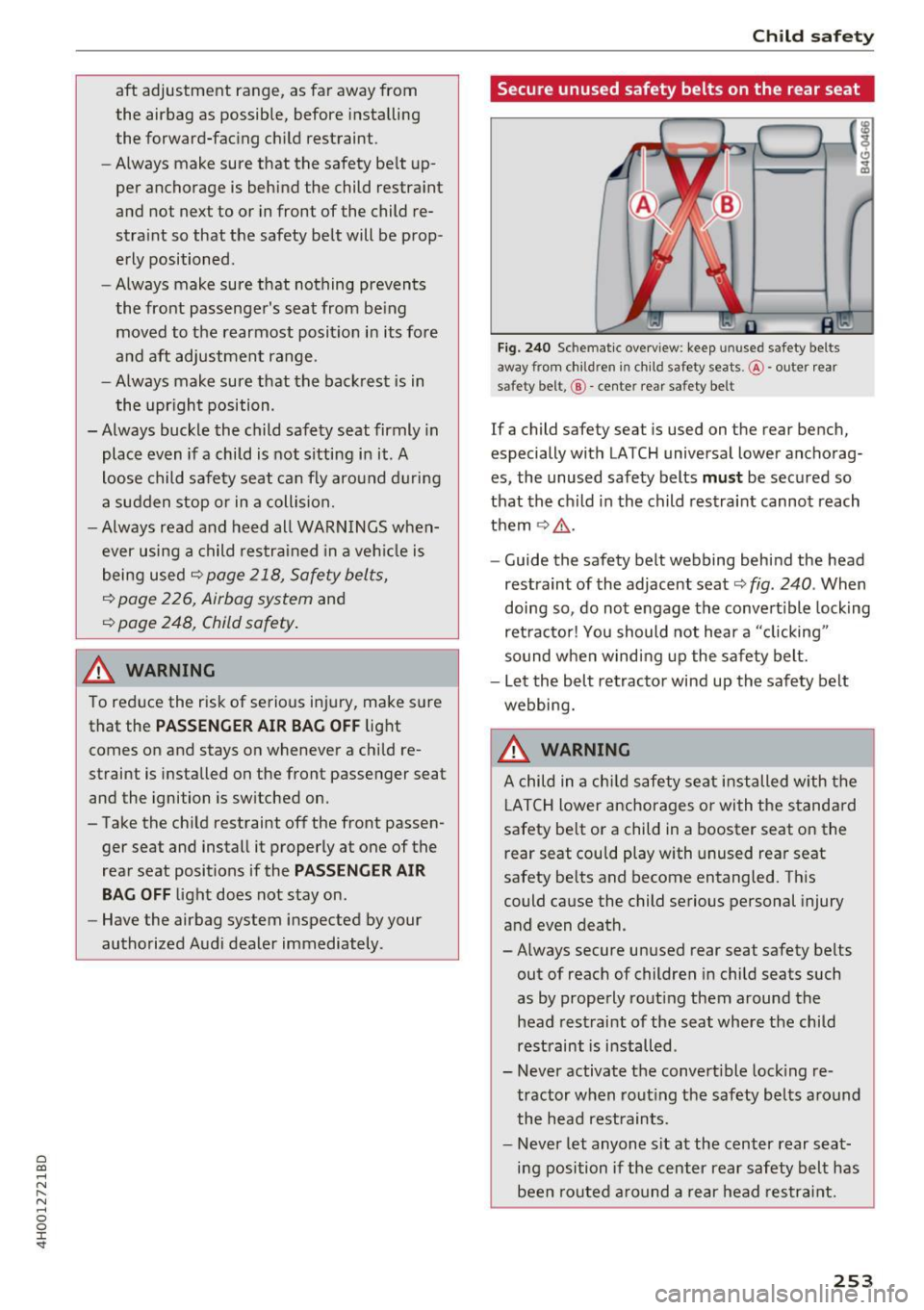
Secure unused safety belts on the rear seat
F ig. 2 40 Sc hema tic overv iew: keep unused safety belts
away from children in ch ild safety seats.@· ou ter rear
safety belt ,@ -center rear safety belt
If a child safety seat is used on the rear bench,
especially with LATCH universal lower anchorag
es, the unused safety belts
must be secured so
that the child in the child restra int cannot reach
them ~.&. -
- Guide the safety belt webbing behind the head
restraint of the adjacent seat~
fig. 240 . When
doing so, do no t engage the conve rt ible lock ing
ret ractor ! You should not hear a "clicking"
sound when wind ing up the safety belt.
- Le t the bel t re tracto r wind up the safety belt
webbing.
& WARNING
A child in a chi ld safety seat i nstalled with the
L ATCH lower anchorages o r with the s tandard
safety belt or a child in a booster seat on the
rear seat could play with unused rear seat
safety be lts and become entangled. Th is
could cause the child serious personal injury
and even death .
- Always secure unused rear seat safety belts
out of reach of children in child seats such
as by properly ro uting them around the
head restraint of the seat where the child
restraint is installed .
- Never activate the convert ible lock ing re
tractor when rout ing the safety belts a round
the head restraints.
- Never let anyone sit at the center rear seat
ing position if the center rear safety belt has
been ro uted a ro u nd a rear head restra int.
253
Page 258 of 354
Child safety
place Q page 210. Driving with head
restra ints that are not properly adjusted in
creases the risk of serious or fatal neck in
jury dramatically .
- Always read and heed all WARNINGS when
ever using a child restrained in a vehicle is
being used
c::> page 218, Safety belts,
¢ page 226 , Airbag system and
c::> page 248, Important information.
_& WARNING
If exceptional circumstances require the use
of a forward-facing child restra int on the
front passenger's seat, the child's safety and
well -being require that the fo llowing special
precautions be taken:
- Make s ure the fo rward-facing seat has been
designed and certified by its manu facturer
for use on a front seat with a passenger
front and side airbag.
- Always follow the manufacturer's instruc
tions prov ided with the child safety seat or
infant carrier.
- Always move the front passenger seat to
the highest position in the up and down ad
justment range and move it back to the
rearmost position in the seat's fore and aft
adjustment range, as far away from the air
bag as possible, before installing the for
ward-facing child restra int .
- Always make sure that the safety belt upper anchorage is beh ind the child restraint and
not next to or in front of the child restraint
so that the safety belt will be properly pos i
t ioned.
- Always make sure tha t noth ing p revents the
front passenge r's seat from being moved to
the rearmost position in its fore and aft ad
justment range .
- Always make sure the backrest is in an up
right position .
- Make s ure tha t the
PASSENGER AIR BAG
OFF
light comes on and s tays on all the time
whenever the ignition is switched on.
- If the ligh t does no t stay on, perform the
checks
c::> page 236, Monitoring the Ad
vanced Airbag System.
256
- Take the child restra int off the front passen
ger seat and install it properly at one of the rear seat positions if the
PASSENGER AIR
BAG OFF
light does not stay on whenever
the ignition is switched on .
Booster seats and safety belts
Properly used booster seats can help protect
children weighing between about 40 lbs . and 80
lbs . (18 kg and 36 kg) who are less than 4 ft.
9
in . (57 inches/1 .45 meters) tall .
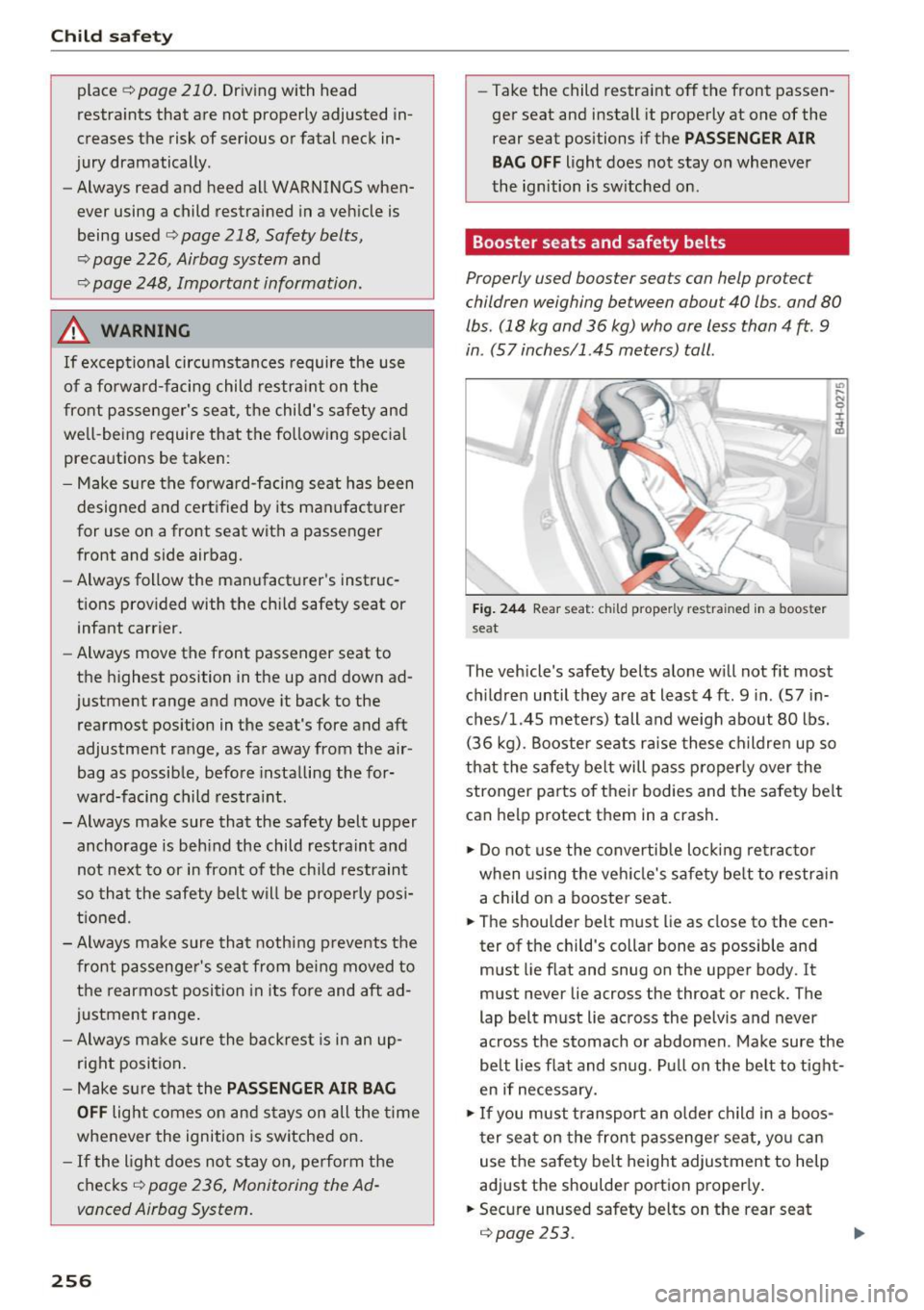
Fig. 244 Rear seat: ch ild prope rly restrained in a booster
se at
The vehicle 's safety belts alone w ill not fit most
ch ildre n until they are at least 4 ft. 9 in . (57 in
ches/1.45 meters) tall and weigh about 80 lbs. (36 kg). Booster seats raise these ch ildren up so
that the safety belt will pass p roperly over the
stronger parts of their bodies and the safety be lt
can he lp protect them in a crash.
.,. Do not use the convertib le loc king re trac to r
when using the ve hicle's safety be lt to restra in
a child on a booster seat.
.,. The shoulder belt must lie as close to the cen
ter of the chi ld's collar bone as possible and
must lie flat and snug on the upper body. It
must never lie across the throat or neck. The
lap belt must lie across the pelvis and never
across t he stomach or abdomen . Make sure the
belt lies flat and snug . Pu ll on the belt to tight
en if necessary.
.,. If you must transport an o lde r child in a boos
ter sea t on the front passenge r seat, yo u can
use the safety belt height adjus tment to help
adjust the shoulder portion p roperly .
.,. Secure unused safety belts on the rear seat
c::> page253 .
Page 261 of 354
0 co .... N ,..... N .... 0 0 :c '
tant things to know .
A WARNING
Always take special precautions if you must
install a forward or rearward-facing child re
straint on the front passenger's seat in excep
tional situations:
- Whenever a forward or rearward-facing
child restraint is installed on the front pas
senger seat, the
PASSENGER AIR BAG OFF
light must come on and stay on whenever
the ignition is switched on .
- If the
PASSENGER AIR BAG OFF light does
not come on and stay on, perform the
checks described~
page 236, Monitoring
the Advanced Airbag System.
- T ake the ch ild restraint off the front passen
ger seat and install it p roperly at one of the
rear seat positions if the
PAS SEN GER AIR
BAG OFF
light does not stay on whenever
the ignition is switched on .
- Improper installation of chi ld restraints can
reduce their effectiveness or even prevent
them from providing any protection.
- An improper ly installed chi ld restraint can
interfere with the airbag as it deploys and
seriously injure or even kill the child .
- Always carefu lly follow the manufacturer 's
instructions provided with the child safety
seat or carrier.
- Never place additional items on the seat
that can increase the total weight registered
by the weight-sensing mat and can cause in
jury in a crash .
A WARNING
Forward-facing child restraints :
-Always make sure the forward-facing seat has been designed and certified by its man
ufacturer for use on a front seat with a pas
senger front and s ide a irbag .
- Never put the forward-facing child restraint
up, against or very near the instrument pan
el.
-Always move the front passenger seat to
the highest position in the up and down ad-
Ch ild safety
justment range and move it back to the
rearmost posit ion in the seat's fore and aft
adjustment range, as far away from the air bag as possible , before installing the for
ward-facing child restraint.
- Always make sure that the safety belt upper
anchorage is behind the ch ild restraint and
not next to or in front of the child restraint
so that the safety be lt will be properly posi
tioned.
- Make sure that the
PASSENGER AIR B AG
OFF
li ght comes on and stays on a ll the time
wheneve r the ignit ion is switched on.
A WARNING
Rearward-facing ch ild restraints:
- A child in a rearward-fac ing ch ild safety sea t
installed on the front passenger seat will be
serio usly injured and can be killed if the
front airbag inflates -even with an Ad
vanced Airbag System.
- The inflating airbag will h it the ch ild safety
seat or infant carrier with great force and
will smash the child safety seat and child
aga inst the backrest, center armrest, door
or roof.
- Always be especially carefu l if you must in
stall a rearward facing child safety seat on
the front passenger seat in except iona l cir
cumstances.
- A t ight tether strap on a rearward-facing
child restraint attached to the front passen
ger seat can put too much pressure on the
weight-mat in the seat and reg ister a heav i
er weight in the Advanced Airbag System .
The heavier weight reg istered can make the
system work as though an ad ult we re on the
seat and deploy the Advanced A irbag when
it must be suppressed causing serious or
even fata l injury to the child.
- Make sure that the
PASSENGER AIR BAG
OFF
li ght comes on and stays on all the time
whenever the ignition is switched on .
- If the
PASSENGER AIR BAG OFF li ght does
not come on and stay on, immediately in
stall the rear-facing child safety seat in a rear seating posit ion and have the airbag
system inspected by your Audi dealer.
259
Page 282 of 354
Checking and Filling
@
Fire, sparks, open flame and smok ing are
forb idden.
~
A highly explosive mixture of gases can
form when charging batteries.
®
Keep c hildren away from bat tery acid and
batteries.
A WARNING
All work on the battery or electrica l system in
your vehicle can result in injuries, chemical
burns, accidents or burns. Because of this, a ll
work m ust be performed
only by an author
ized Aud i dea le r o r autho rized Aud i Serv ice
Facili ty.
A WARNING
California Proposit io n 65 Warning:
- Battery posts, termina ls and re lated acces
so ries contai n lead and lead compounds,
chemicals known to the Sta te of Californi a
to ca u se ca nce r and rep roduct ive p roblems.
Wash hands after handling.
0 Note
Protect the vehicle ba ttery against freezing if
t he vehicle will be p arked for long per iods of
time so th at it is not destroyed by "free zing"
c::>page 280.
@ For the sake of the environment
~ Batteries cont ain poll utin g substances suc h
as s ulfu ric ac id and lead. Contac t an a uthor
ized Audi dealer or aut horized Audi Service
Facility for more information.
Vehicle battery
The term "vehicle battery" refers to the 12 Volt
battery in your vehicle.
Not running the vehicle for long periods of
time
If you do not drive your ve hicle for seve ral days or
weeks, e lec trical equipment is gradually scaled
back or switched off. This reduces energy use and
ensures the veh icle wi ll be able to start after long
periods of time
c::> page 130 . Some conven ience
280
funct ions, such as interior lighting o r power seat
adjustment, may not be avai lab le under certain
c ircumstances. These convenience functions will
be available again once you switch the ignition on
and start the eng ine.
Even when electrical equipment is switched off,
the eq uipment can st ill dra in the vehicle batte ry
if the veh icle is not dr iven for long pe riods of
time . Deep drai ning results in a chemica l reaction
that destroys t he ins ide of the vehicle battery .
The vehicle battery must be charged every mon th
to reduce the risk of this happening
c::> page 280 .
Contact an a uth o rized Aud i dea le r or a uth o rized
Audi Se rvice Fac ility for mo re informa tion.
Winter operat ion
Co ld weather places higher demands on the vehi
cle battery . T his res ults in reduced starting ab ili
ty. Have the vehicle batte ry checked by an au
thorized Audi dea le r or authori zed Audi Service
Fac ility befo re t he cold time of year.
Charging the vehicle battery
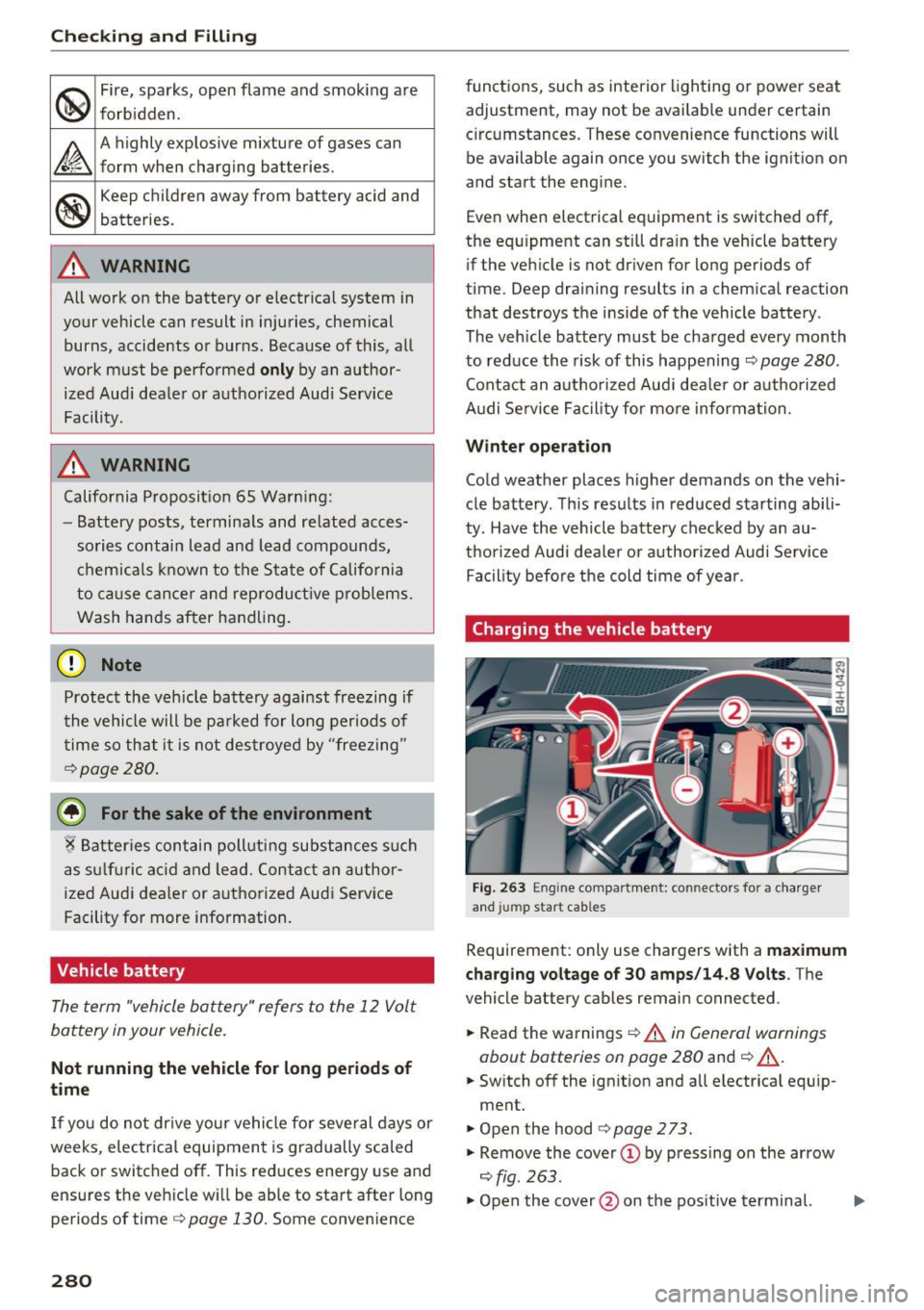
Fi g. 2 63 En g ine compa rt m ent: con nectors fo r a c ha rge r
and j ump start cab les
Requirement: only use chargers with a maximum
charging voltage of 30 amp s/14 .8 Volts .
The
vehicle battery cab les remain connected .
.. Read the warnings
c::> A in General warnings
about batteries on page 280
and c::> A .
.. Switch off the ign it ion and all electrica l equ ip
ment.
.. Open the hood
c::> page 273.
.. Remove the cover© by pressing on the ar row
¢ fig . 263 .
" Open the cover @on the pos itive terminal. .,.
Page 325 of 354
C) C0 ....
"' " "' .... 0 0 :r
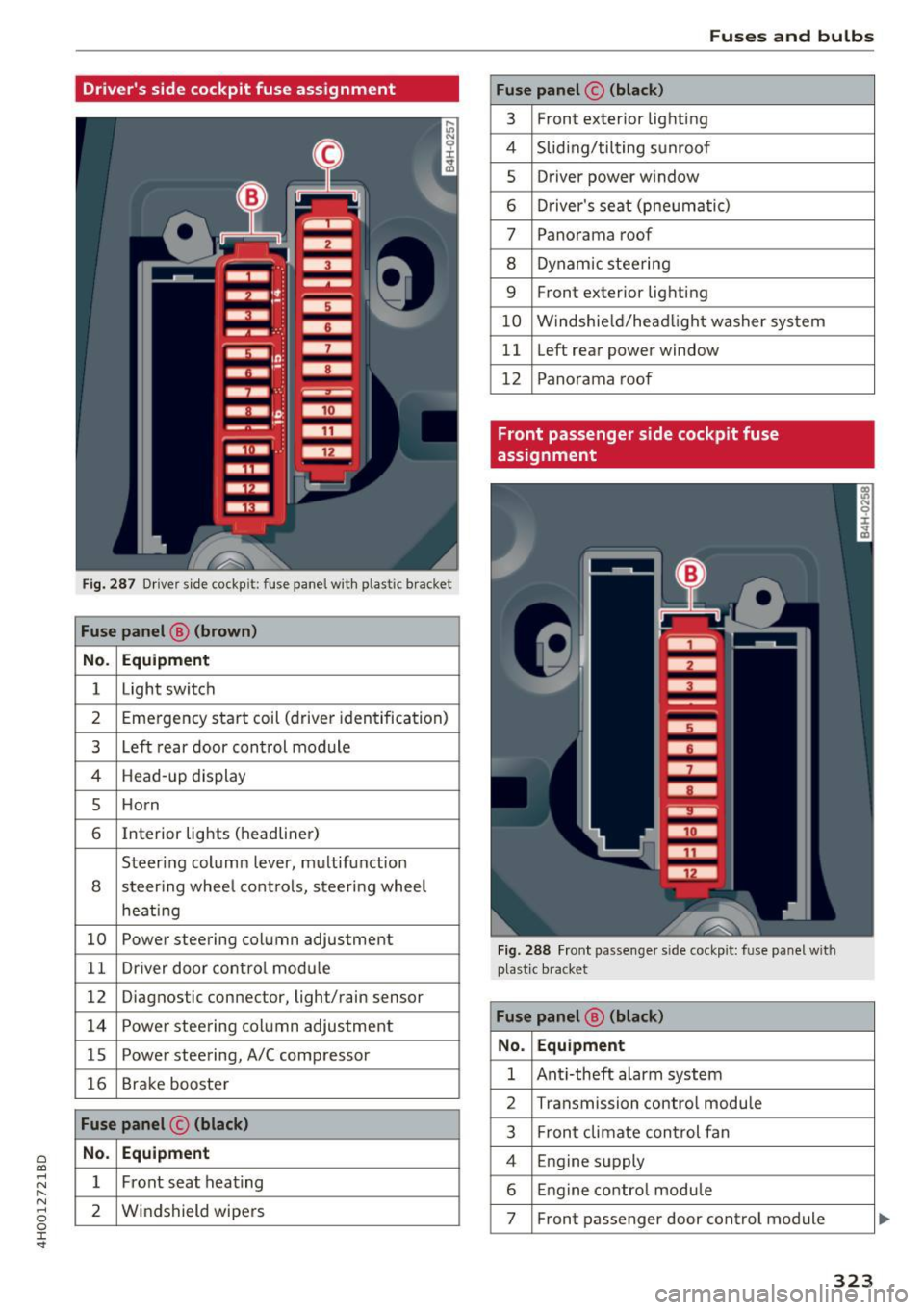
Fig. 287 Driver side cockpi t: fuse panel with plastic bracket
Fuse panel @ (brown)
No. Equipment
1 Light switch
2 Eme rgency start coil (driver identification)
3 Left rear door control module
4 Head-up display
5 Horn
6 Interior lights (headliner)
Steering column lever, multifunction
8 steering whee l controls, steering wheel
heating
10 Power steering column adjustment
11 Driver door control module
12 Diagnostic connector, light/rain sensor
14 Power steering column adjustment
lS Power steering, A/C compressor
16 Brake booster
Fuse panel © (black)
No. Equipment
1 Front seat heating
2 Windshield wipers
Fuses and bulbs
Fuse panel © (black)
3
Front exterior lighting
4 Sliding/tilting sunroof
s Driver power window
6 Driver's seat (pneumat ic)
7 Panorama roof
8 Dynamic steering
9 Front exterior lighting
10 Windshield/headlight washer system
11 Left rear power window
12 Panorama roof
Front passenger side cockpit fuse
assignment
Fig. 288 Fro nt passenger side cockpit: fuse panel with
plastic bracket
Fuse panel @ (black)
No. Equipment
1 Anti-theft alarm system
2 Transmission control module
3 Front climate control fan
4 Engine supply
6 Engine control module
7 Front passenger door control module
323
Page 327 of 354
0 co .... N ,..... N .... 0 0 :c '
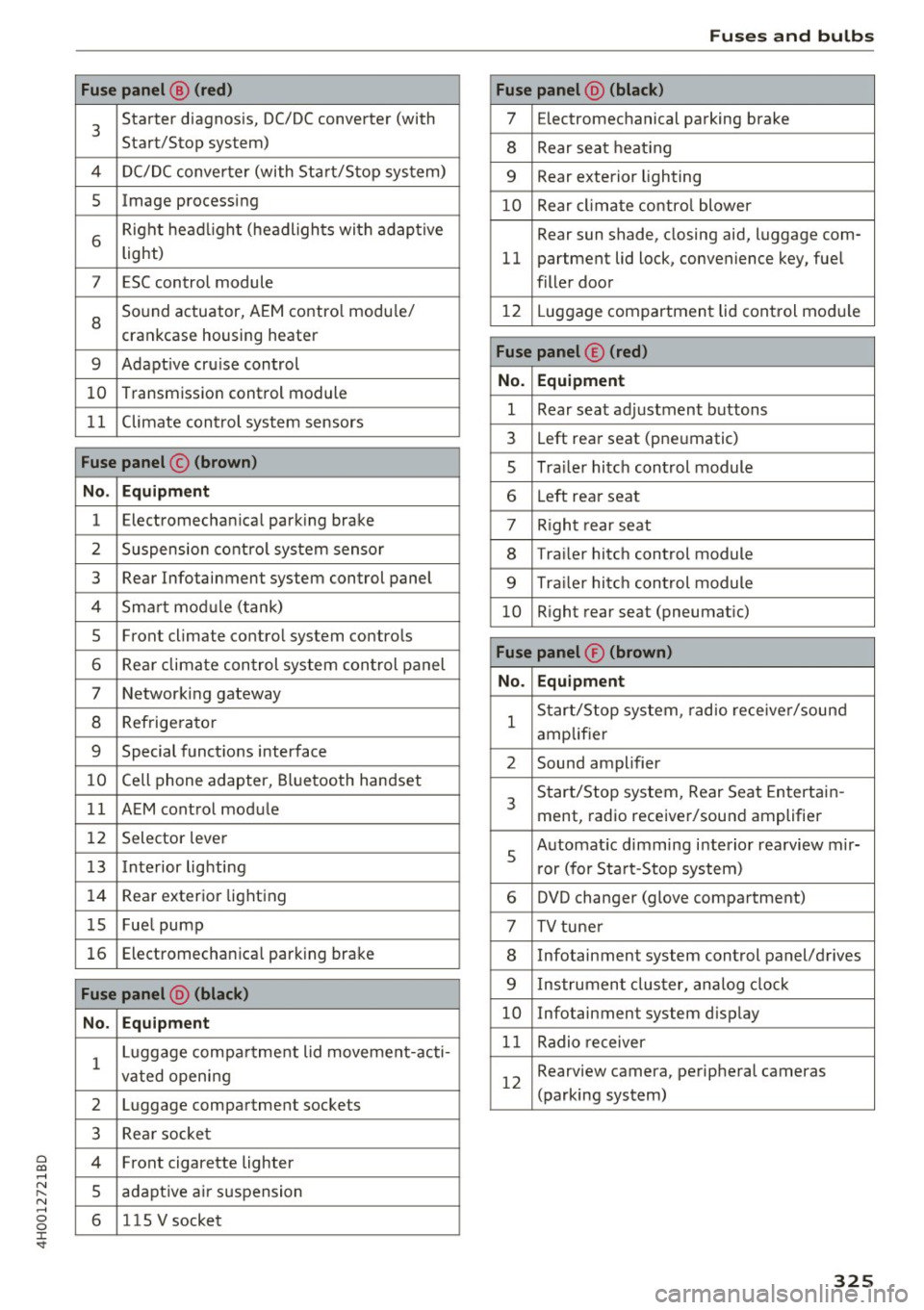
3
Starter diagnosis, DC/DC converter (with
Start/Stop system)
4 DC/DC converter (with Start/Stop system)
5 Image processing
6
Right headl ight (headlights with adaptive
light)
7 ESC control module
8
Sound actuator, AEM contro l modu le/
crankcase housing heater
9 Adapt ive cru ise control
10 Transmission control module
11 Climate control system sensors
Fuse panel © (brown)
No . Equipment
1 Electromechanical parking brake
2 Suspension control system sensor
3 Rear Infotainment system control panel
4 Smart mod ule (tank)
5 Front climate control system controls
6 Rear climate control system control panel
7 Networking gateway
8 Refrigerator
9 Special functions interface
10 Cell phone adapter, Bluetooth handset
11 AEM control module
12 Selector lever
13 Interior lighting
14 Rear exter ior light ing
15 Fue l pump
16 Electromechan ica l parking brake
Fuse panel @ (black)
No . Equipment
1 Luggage compa
rtment lid movement-acti-
vated opening
2 Luggage compartment sockets
3 Rea r socket
4 Front cigarette lighter
5 adaptive air suspension
6 1 lS V socket
Fuses and bulbs
Fuse panel @ (black)
7 Electromechanical parking brake
8 Rear seat heating
9 Rear exterior lighting
10 Rear climate control blower
Rear sun shade, closing aid, luggage com-
11 partment lid lock, convenience key, fuel
filler door
12 L uggage compartment lid control module
Fuse panel © (red)
No. Equipment
1 Rear seat adjustment buttons
3 Left rear seat (pneumatic)
s Trailer hitch control module
6 Left rear seat
7 R ight rear seat
8 Trailer hitch control module
9 Tra ile r hitch control module
10 Right rear seat (pneumatic)
Fuse panel® (brown)
No. Equipment
1
Start/Stop system, radio receiver/sound
amplifier
2 Sound amplifier
3
Start/Stop system, Rear Seat Entertain-
ment, radio receiver/sound amplifier
s
Automat ic dimming interior rearview mir-
r or (for Start-Stop system)
6 DVD changer (glove compartment)
7 TV tuner
8 Infotainment system control panel/drives
9 Instrument cluster, analog clock
10 Infotainment system display
11 Radio receiver
12
Rearview camera, peripheral cameras
(parking system)
325
Page 345 of 354

0 co .... N ,..... N .... 0 0 :c '
Emergency assistance . . . . . . . . . . . . . . . . . 312
Emergency braking function . . . . . . . . . . . . . 81
Em ergency flashe rs . . . . . . . . . . . . . . . . . . . . 46
Emergency locking the front passenger 's door .3.2
Emergency operation
Front passenger's door . . . . . . . . . . . . . . . .
32
Fuel filler door . . . . . . . . . . . . . . . . . . . . . . 270
Luggage compartment lid . . . . . . . . . . . . . . 36
Panoramic sunroof . . . . . . . . . . . . . . . . . . . . 40
Sliding/tilt ing sunroof . . . . . . . . . . . . . . . . . 39
Sun shade (roof) . . . . . . . . . . . . . . . . . . . . . 40
Emergency release
Parking lock . . . . . . . . . . . . . . . . . . . . . . . . .
88
Emergency starting . . . . . . . . . . . . . . . . . . . 327
Emissions data . . . . . . . . . . . . . . . . . . . . . . . 333
Energy consumers (efficiency program) . . . . 13
En ergy management . . . . . . . . . . . . . . . . . . 130
Engine
Start/Stop-System . . . . . . . . . . . . . . . . . . . .
78
Starting/stopping . . . . . . . . . . . . . . . . . . . . 76
Starting with jumper cables . . . . . . . . . . . 327
Engine compartment ......... .. .. .... . 271
Opening/closing the hood . . . . . . . . . . . . . 273
Engine oil
Changing 274
277
Specification and viscosity...... .. .... . 274
Engine sound . . . . . . . . . . . . . . . . . . . . . . . . 110
Entering a destination . . . . . . . . . . . . . 165, 169
Entering an address . . . . . . . . . . . . . . . . . . 165
From the map . . . . . . . . . . . . . . . . . . . . . . 166
La st destinations . . . . . . . . . . . . . . . . . . . . 168
Starting point (presentation mode) . . . . . 172
Entering letters (speller) . . . . . . . . . . . . . . . 137
Entering numbers/symbols (speller) ..... . 137
Entry assistance . . . . . . . . . . . . . . . . . . . . 58, 76
Environment
Catalytic converter . ... .. .... .. .. .. ...
271
Envi ronmenta Uy-friendly/ economical driv-
ing ...... ... ............. ...... ... .. 74
Fueling . . . . . . . . . . . . . . . . . . . . . . . . . . . . 269
Proper disposal of drained engine oil . . . . 277
Unleaded f uel . . . . . . . . . . . . . . . . . . . . . . . 267
EPC (engine control) . . . . . . . . . . . . . . . . . . . . 23
ESN
refer to Serial number (radio) . . . . . . . . . . 178
Index
Event Data Recorder (EDR) . . . . . . . . . . . . . 132
Exterior lighting . . . . . . . . . . . . . . . . . . . . . . . 43
Exterior mirrors . . . . . . . . . . . . . . . . . . . . . . . 4 7
F
Factory default settings
Multi Media Interface
................
RSE ...... .. .. .. .. ............... ..
Fader (sound)
Fastening Booster seats
.. .. .. ... ........... ...
Convertib le child safety seats ...... .. . .
Infant seats
... .. .. ............... ..
Fast forwarding/rewinding (audio/video
file)
......... ' . .. .. ................ .
206
196
205
256
255
254
190
Fast forwarding (audio/video file) . . . . . . . . 190
Favorite (navigation) . . . . . . . . . . . . . . 168, 172
File format (media) . . . . . . . . . . . . . . . . . . . 186
Floor mats.. .... .. .................. . 212
Folding table . . . . . . . . . . . . . . . . . . . . . . . . . . 62
Foot pedals . . . . . . . . . . . . . . . . . . . . . . . . . . 212
Free text search
T elephone. .... ................... ..
151
Freeze protection
Coo lant add itive . . . . . . . . . . . . . . . . . . . . .
277
Front airbags
Description . . . . . . . . . . . . . . . . . . . . . . . . .
230
Frontal collisions and the laws of physics . . 219
Front passenger seat adjustment . . . . . . . . . 58
Front seats
Adjusting . . . . . . . . . . . . . . . . . . . . . . . . . .
209
Child restraints in the front seat . . . . . . . . 227
also refer to Seats . . . . . . . . . . . . . . . . . . . . 54
Fuel
Additives . . . . . . . . . . . . . . . . . . . . . . . . . . .
267
Blended gasoline . . . . . . . . . . . . . . . . . . . . 267
Current economy . . . . . . . . . . . . . . . . . . . . . 12
Economy . . . . . . . . . . . . . . . . . . . . . . . . . . . 333
Fuel filler neck . . . . . . . . . . . . . . . . . . . . . . 268
Fuel gauge . . . . . . . . . . . . . . . . . . . . . . . . 9, 10
Fuel tank capacity . . . . . . . . . . . . . . . . . . . 334
Gasoline . . . . . . . . . . . . . . . . . . . . . . . . . . . 267
Gasoline additives 268
Octane rating . . . . . . . . . . . . . . . . . . . . . . . 267
Recommendation . . . . . . . . . . . . . . . . . . . . 267
Saving fuel .... .. ................ 74, 110
343