air condition AUDI A8 2018 User Guide
[x] Cancel search | Manufacturer: AUDI, Model Year: 2018, Model line: A8, Model: AUDI A8 2018Pages: 356, PDF Size: 54.71 MB
Page 210 of 356
Drivin g saf ety
Driving safety
Basics
Safe driving habits
Please remember -safety first!
The individua l safety features of your vehicle can
work together as a system to help protect you
and your passengers in a wide range of accidents.
These features cannot work as a system if they
are not always correctly adjusted and correctly
used .
This chapter contains important informat ion,
tips, instruct ions and warn ings that you need to
read and observe for your own safety, the safety
of you r passengers and others . We have summar
ized here w hat you need to know about safety
be lts, a irbags, child restra ints as well as child
safety. Yo ur safety is for us
priority number 1. Al
ways observe the information and warnings in
this section -for your own safety as we ll as that
of your passengers.
The information in this section applies to all
model versions of your vehicle . Some of the fea
tures described in this sections may be standard
equipment on some models, or may be optional
equ ipment on others. If you are not sure, ask
your author ized Audi dealer.
A WARNING
- Always make sure that you follow the in
structions and heed the WARNINGS in th is
Manua l.
It is in your interest and in the in
te rest of your passengers .
-
-Always keep the complete Owner's Litera
tu re in you r A udi when you lend or se ll you r
vehicle so that this import ant information
will always be available to the d river and
passengers.
- Always keep the Owner 's lite rature h andy so
that you can find it easily if you have ques
tions .
208
Important things to do before driving
Safety is everybody's job! Vehicle and occupant
safety always depends on the informed and care
ful driver .
For your safety and the safety of your passen
gers,
bef ore dri ving alw ays:
.. Make sure that a ll lights and signals are operat
ing correctly .
.. Make sure that the tire pressure is correct.
.. Make sure that all windows are clean and afford
good vis ibility to the outs ide .
.. Sec ure all luggage and othe r items ca refully
¢ page 65, ¢page 63 .
.. Make sure tha t noth ing ca n interfere wi th the
peda ls .
.. Adjust front seat, head restraint and mirrors
correctly for your height.
.. Instruct passengers to adjust the head re
straints according to their he ight.
.. Make sure to use the right child restraint cor
rectly to protect
children ¢ page 249, Child
safety .
• Sit proper ly in yo ur seat a nd make sure t hat
your passenge rs do the same
¢ page 54, Seats
and storage.
.. Fasten your sa fety belt and wear it p roperly . Al
so instruct your passengers to fasten their safe
ty be lts properly
¢ page 219 .
What impairs driving safety?
Safe driving is directly related to the condition of
the vehicle, the driver as well as the driver's abili
ty to concentrate on the road without being dis
tracted.
The driver is responsib le for the safety of the ve
hicle and a ll of its occupants. If your ability to
drive is impa ired, safety risks for everybody in the
vehicle increase and you a lso become a hazard to
everyone else on the road
¢ _&. . Therefore:
.. Do not let yourse lf be distracted by passenge rs
or by using a cellular telephone .
.. NEVER drive when your driving ability is im
paired (by med ications, alcohol, drugs, etc .) .
.. Observe all traffic laws, rules of the road and
speed lim its and plain common sense .
.,.
Page 211 of 356
lL t:0 ....
"' ......
"' .... 0 0 :c '
weather conditions.
~ Take frequent breaks on long trips. Do not drive
for more than two hours at a stretch.
~ Do NOT drive when you are tired, under pres
s ure or when you are stressed .
A WARNING
Impaired driv ing safety increases the risk of
ser ious personal inj ury and death whenever a
vehicle is being used .
Correct passenger
seating positions
Proper seating position for the driver
The proper driver sea ting po sit ion is impor tan t
for safe, relaxed driving .
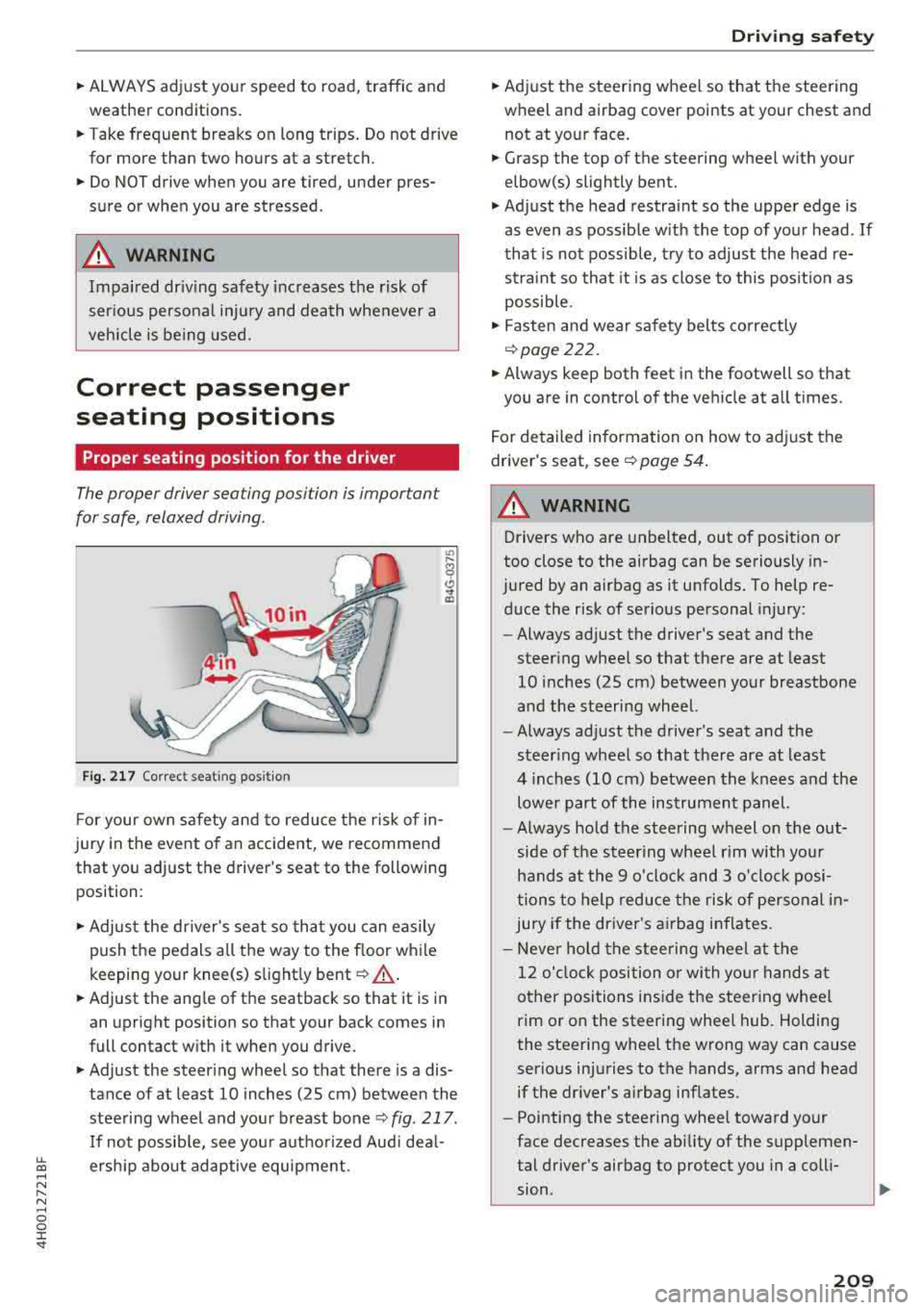
Fig. 217 Correc t seat ing posit ion
F or your own s afety and to reduce the risk of in
jury in the event of an accident, we recommend
that you adjust the driver 's seat to the following
position :
~ Adjust the dr iver's seat so tha t you can easily
push the pedals all the way to the f loor wh ile
keeping your knee(s) s light ly bent
c:!;> _& .
~ Adjust the ang le of the seatback so that it is in
an upright position so that your back comes in
full contact w ith it when you drive.
~ Adjust the steering wheel so that there is a dis
tance of at least 10 inches (25 cm) between the
stee ring wheel and you r breast bone
<:!;> fig . 217 .
If no t possib le, see you r autho riz ed Aud i dea l
ersh ip about adaptive equipment .
Driving safety
~ Adjust the steering wheel so that the steering
wheel and airbag
cover points at your chest and
not at yo ur face.
~ Grasp the top of the steering wheel with you r
elbow(s) slightly bent.
~ Adjust the head restraint so the upper edge is
as
even as possible w ith the top of your head . If
that is not possible, t ry to adjust the head re
s traint so that it is as close to this posit ion as
possible .
~ Fasten and wear safety belts correctly
c:!;> page 2 2 2.
~ Always keep both feet in the footwell so that
you are in contro l of the ve hicle at a ll times .
F or detailed information on how to adj ust the
driver's seat,
see r:!;> page 54 .
A WARNING
-
Drivers who are unbelted, out of position or
too close to the airbag can be se riously in
jured by an airbag as it unfolds. To help re duce the risk of serious personal injury:
- Always ad just the driver's seat and the
steer ing whee l so that there are at least
10 inc hes (25 cm) between you r breastbone
and the steer ing wheel.
- Always ad just the d river's seat and the
steer ing wheel so that there are at least
4 inches (10 cm) between the knees and the
lowe r part of the instrument panel.
- Always hold the steering w heel on the out
side of the steering wheel r im with yo ur
hands at the 9 o'clock and 3 o'clock posi
tions to help reduce the risk of personal in
jury if the driver's airbag inflates.
- N ever hold the stee ring wheel at the
12 o' clock position o r wi th yo ur hands at
other posi tions i nside the steer ing whee l
rim or on the steering wheel hub . Holding
the steering wheel the wrong way can cause
serio us injuries to the hands, arms and head
if the dr iver's airbag inf lates .
- Pointing the steering wheel toward your
face decreases the abi lity of the supplemen
tal driver's airbag to protect you in a coll i-
sion .
..,
209
Page 216 of 356
Drivin g saf ety
A WARNING
Improperly stored luggage or other items can
fly through the vehicle causing serious per sonal injury in the event of hard braking or an
accident. To help reduce the risk of serious
personal injury:
- Always put objects, for example, luggage or other heavy items in the luggage compart
ment.
- Always secure objects in the luggage com
partment using the tie-down hooks and
suitable straps .
A WARNING
Heavy loads will influence the way your vehi
cle handles. To help reduce the r isk of a loss
of control leading to serious pe rsonal injury:
- Always keep in mind when transporting heavy objects, that a change in the center of
grav ity can also cause changes in vehicle
hand ling:
- Always distribute the load as even ly as
possible.
- Place heavy objects as far forward in the
luggage compartment as poss ible.
- Never exceed the Gross Axle Weight Rating
o r the Gross Vehicle Weight Rating specified
on the safety compliance sticker on the left
doo r jamb. Exceed ing permissible weight
standards can cause the vehicle to slide and
hand le differently .
- Please observe information on safe driving
c> page 208.
A WARNING
To help prevent poisonous exhaust gas from
being d rawn into the vehicle, always keep the
rear lid closed whi le driving.
- Never transport objec ts larger than those
fi tt ing complete ly into the luggage a rea be
ca use the rear l id cannot be fully closed.
- If you absolutely mus t drive w ith the rea r lid
open, obse rve the follow ing notes to reduce
t h e risk of poisoning:
- Close all windows,
- Close the power roof,
214
-
- Open all a ir outlets in the instrument pan
el,
- Switch off the air reci rculat ion
'
- Set the fresh air fan to the highest speed .
A WARNING -
Always make su re that the doo rs, all win
dows, the powe r roof and the rear lid are se
curely closed and locked to re duce the risk of
in jury when the veh icle is not being used.
- After closing the rear lid, always ma ke sure
that it is properly closed and locked.
- Never leave your veh icle unattended espe
cially with the rear lid left open . A child
could crawl into the vehicle through the lug
gage compartment and close the rea r lid be
coming trapped and unab le to get o ut. Be
ing trapped in a vehicle can lead to ser ious
pe rsonal injury.
- Never let ch ildren play in o r around the vehi
cle.
- Never let passengers ride in the luggage
compa rtment . Vehicle occupants mus t al
ways be properly restrained in one of the ve hicle's seat ing pos itions.
(D Tips
- Air circulation helps to reduce w indow fog
ging . Stale ai r esca pes to the outs ide
through vents in the trim panel, on the left
side of the luggage compartment. Be sure
to keep t hese s lo ts free and open.
- T he tire p ressure must correspond to the
load. The t ire pressure is shown on t he tire
press ure label. The ti re pre ssure label is lo
c ated on the drive r's side B- pilla r. The tire
pressu re label lists the recommen ded cold
t ire inflation pressures fo r the veh icle at its
maximum capac ity we ight and the tires that
we re on your veh icle at the time it was man
ufactured . For recommended t ire pressures
for normal load conditions, p lease see chap
ter
c> page 294.
Page 233 of 356
Front airbags
Description of front airbags
The airbag system can provide supplemental
protection to properly restrained front seat occu
pants .
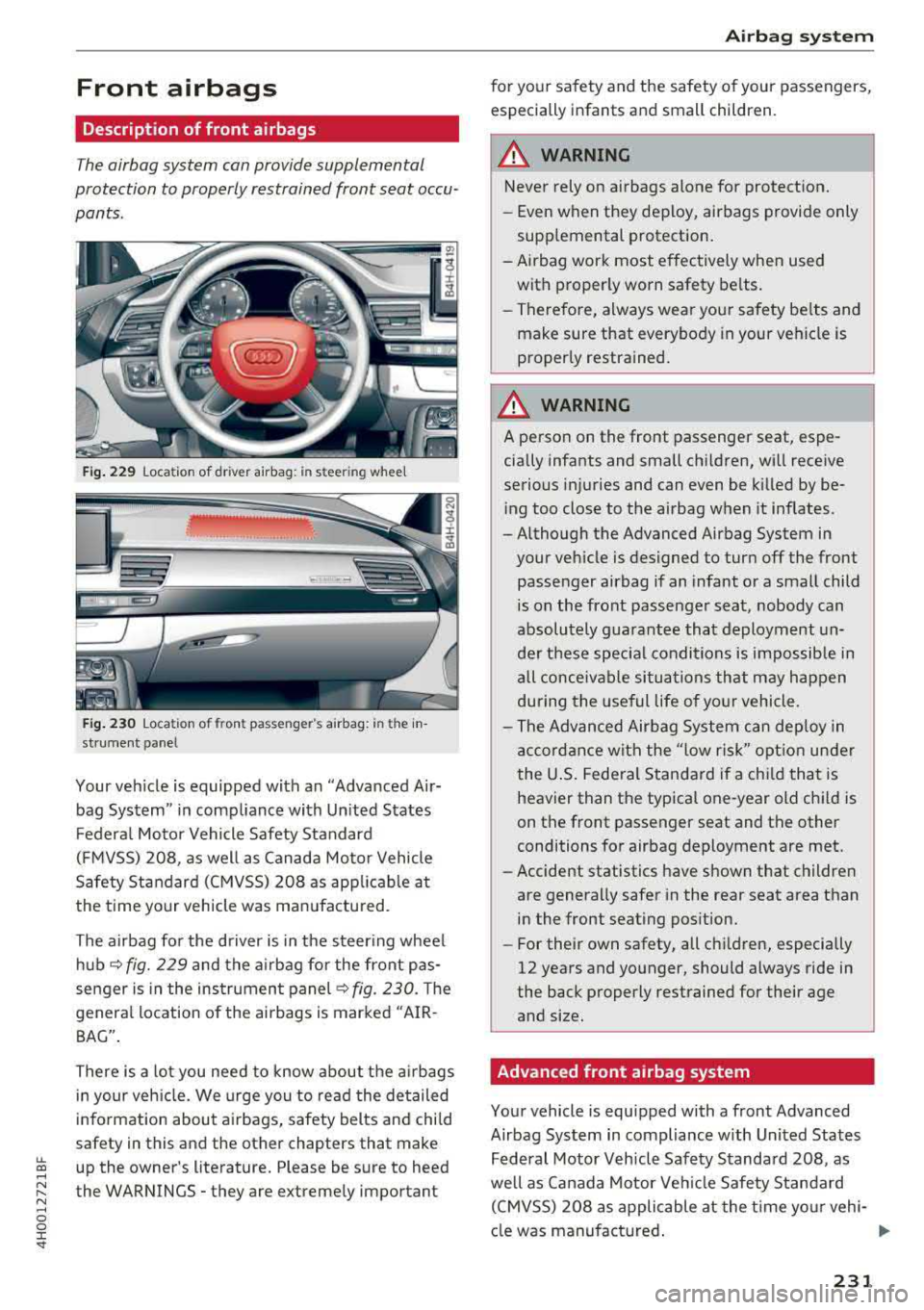
Fig. 229 Location of driver airbag: in steering wheel
Fig. 230 Location of front passenger's airbag : in the in
strument panel
Your vehicle is equipped with an "Advanced Air
bag System" in compliance with United States
Federal Motor Vehicle Safety Standard
(FMVSS) 208, as well as Canada Motor Vehicle
Safety Standard (CMVSS) 208 as applicable at
the time your vehicle was manufactured .
The airbag for the driver is in the steer ing wheel
hub ~ fig. 229 and the airbag for the front pas
senger is in the instrument panel
~ fig. 230. The
general location of the airbags is marked
"AIR
BAG" .
There is a lot you need to know about the airbags
in your vehicle. We urge you to read the detailed
information about airbags, safety belts and child
safety in this and the other chapters that make
lL ~ up the owner's literature. Please be sure to heed
~ the WARNINGS -they are extreme ly important N ...... 0 0 :c '
for your safety and the safety of your passengers,
especially infants and small children.
A WARNING
-
Never rely on airbags alone for protection.
- Even when they deploy, airbags provide only
supplemental protection.
-Airbag work most effectively when used with properly worn safety belts.
- Therefore, always wear your safety belts and
make sure that everybody in your vehicle is
properly restrained.
_&. WARNING
A person on the front passenger seat, espe
cially infants and small children, will receive
serious injuries and can even be killed by be ing too close to the airbag when it inflates.
- Although the Advanced Airbag System in
your vehicle is designed to turn off the front
passenger airbag if an infant or a small child
is on the front passenger seat, nobody can
absolutely guarantee that deployment un
der these specia l conditions is impossib le in
all conceivable situations that may happen
during the useful life of your vehicle.
- The Advanced Airbag System can dep loy in
accordance with the "low risk" opt ion under
the U.S. Federal Standard if a child that is
heavier than the typical one-year old child is
on the front passenger seat and the other
conditions for airbag deployment are met.
- Accident statistics have shown that children
are generally safer in the rear seat area than
in the front seating position.
- For their own safety, all children, especially
12 years and younger, should always ride in
the back properly restrained for their age
and size.
Advanced front airbag system
Your vehicle is equipped with a front Advanced
Airbag System in compliance with United States Federal Motor Vehicle Safety Standard 208, as
well as Canada Motor Vehicle Safety Standard (CMVSS) 208 as applicable at the time your vehi-
cle was manufactured .
IJJ,,
231
Page 234 of 356
Airbag syste m
The front Advanced Airbag System supp lements
the safety belts to provide additional protection
for the dr iver's and front passenger's heads and
upper bodies in frontal crashes. The airbags in
flate only in frontal impacts when the veh icle de
celerat ion is high enough.
The front Advanced Airbag System for the front
seat occupants is not a substitute for your safety belts. Rather, it is part of the overall occupant re
stra int system in your vehicle. Always remember
that the a irbag system can only help to protect
you, if you are sitt ing upr ight, wear ing your safe
ty belt and wear ing it prope rly. This is why you
and your passengers must always be prope rly re
stra ined, not just because the law req uires yo u to
be .
The Advanced Airbag System i n your veh icle has
been ce rt ified to meet the " low r isk" requ ire
men ts for 3 and 6 yea r-old children on the pas
senger side and very sma ll adults on the driver
side . The low risk dep loyment criteria are intend
ed to he lp reduce the risk of injury through inter
action with the front airbag that can occur, for
examp le, by being too close to the steering wheel
and instrument panel when the airbag inflates .
In addition, the system has been certified to
comp ly w ith the "suppression" requirements of
the Safety Standard, to turn
off the front a irbag
for infants 12 months old and younger who are
restrained on the front passenger seat in c hild re
stra ints that are listed in the Standa rd
¢ page 251, Child restraints and Advanced Air
bags.
"Suppress ion" requ ires t he front a irbag on the
passenger side to be turned
off if:
- a chi ld up to about one year of age is restra ined
on the front passenger seat in one of the rear
facing o r fo rward-fac ing infant restra ints listed
i n Federal Motor Vehicle Safety Standard
208
with wh ic h the Advanced Airbag System in your
vehicle was ce rt ified. For a l isting of the c hild
restra ints that were used to certify your veh i
cle's compliance with the US Safety Standard
¢ page 251,
232
-weight less than a threshold leve l stored in t he
control unit is detected on the front passenger
seat.
When a person is detected on the fron t passen
ger seat, weig hing more than the total weight of
a chi ld that is about 1 year old restrained in one
of the rea r-facing or forward-fac ing infant re
straints (listed in Federal Motor Vehicle Safety
Standard
208 with w hich the Advanced Airbag
System in your vehicle was certified), the front
a irbag on the passenger s ide may or may not de
ploy.
The
PASSENGER AIR BA G OFF light comes on
whe n the electronic control unit detects a tota l
weight on t he front passenger seat that requ ires
t h e front a irbag to be tur ned
off . If t he PASSEN
GER AIR BAG OFF
light does not come on, the
front a irbag on the passenge r side has no t been
tu rne d
off by t he control unit and can dep loy if
the control unit senses an impact t hat meets the
conditions stored in its memory.
If the total weig ht on the front passe nger sea t is
more than that of a typ ica l 1 year-o ld, but less
than the weight of a small adult, the front airbag
on the passenger side may dep loy (the
PASSEN
GER AIR BAG O FF
light does not come on).
For example , the airbag ma y deplo y if:
- a small ch ild that is heav ier than a typ ica l 1
year-old child is on the front passenger seat (regard less of whethe r the child is in one of t he
child seats listed
¢ page 251),
-a child who has outgrown c hild res traints is on
the front passenge r seat.
If the front passenger a irbag is tu rned
off, the
PA SSENGER AIR BAG OFF light in the center of
t h e i nstr ument pane l w ill come on and s tay on.
The front airbag on the passenger side may
not
deploy (the PASSENGER AIR BAG OFF light does
not ill uminate and stay lit) if:
- a small adult or teenager is on the front pas
senger seat
- a passenger who is not s itting upright with
their back against a no n-reclined backrest with
their feet on the veh icle floor in front of the
seat is on the front passenger seat .
Page 300 of 356
Wheels
the available cargo and luggage load capacity of your vehi
cle.
.,.Check the tire sidewall
(¢ page 283, fig. 264) to deter
mine the designated load rating
for a specific tire.
Wheel bolts and rims
Wheel bolts
Wheel bolts must be clean and loosen/tighten
easily .
Rims
Rims with a bolted rim ring* or with bolted wheel
covers* consist of multiple pieces . These compo
nents were bolted together using special bolts
and a special procedure. You must not repair or
disassemble
them £:=?.&. .
A WARNING
Wheel bolts that are tightened or repaired in
correctly can become loose and result in loss
of vehicle control, which increases the risk of
an accident. For the correct tightening specifi
cation, see
¢page 314.
- Always keep the wheel bolts and the
threads in the wheel hub clean and free of grease.
- Only use wheel bolts that fit the rim.
- Always have damaged rims repaired by an
authorized Audi dealer or authorized Audi
Service Facility. Never repair or disassemble
rims yourself, because this increases the risk
of an accident .
Winter tires
Winter tires significantly improve the vehicle's
handling when driving in winter conditions. Be
cause of their construction (width, compound,
tread pattern) , summer tires provide less trac
tion on ice and snow.
298
.. Use winter tires on all four wheels .
.. Only use winter tires that are approved for your
vehicle.
.. Please note that the maximum permitted
speed may be lower with winter
tires¢ _&.. An
authorized Audi dealer or authorized Audi Serv
ice Facility can inform you about the maximum
permitted speed for your tires .
.,. Check the tire pressure after installing wheels
¢page 293 .
The effectiveness of winter tires is reduced great
ly when the tread is worn down to a depth of
0.157 in (4 mm). The characteristics of winter
tires also decrease greatly as the tire ages , re
gardless of the remaining tread.
A WARNING
- Never drive faster than the maximum per
mitted speed for your tires. This could cause
the tires to heat up too much. This increases
the risk of an accident because it can cause
the tire to burst .
- Always adapt your driving to the road and
traffic conditions. Drive carefully and reduce
your speed on icy or slippery roads. Even
winter tires can lose traction on black ice .
® For the sake of the environment
Reinstall summer tires at the appropriate
time, because they provide better handling
when roads are free of snow and ice. Summer
tires cause less road noise, tire wear and fuel
consumption.
(D Tips
You can also use all season tires instead of
winter tires. Please note that in some coun
tries where winter tires are required, only
winter tires with the
& symbol may be per
mitted.
Snow chains
-
Snow chains not only improve the driving in win
ter road conditions, but also the braking.
.,. Only install snow chains on the front wheels. .,.
Page 301 of 356
u. co .... N
" N .... 0 0 :c '
chains after driving a few feet, if necessary. Fol
low the instructions from the manufacturer.
~ Note the maximum speed of 30 mph (SO km/
h). Note the loc al regulations.
Use of snow chains is only permitted with certain
rim/tire combinations due to technical reasons.
Check with an authori zed Audi dealer or author
ized Audi Service Facility to see if you may use
snow chains .
You must remove the snow chains on roads with
out snow. Otherwise, you could impair driving
ability and damage the tires.
A WARNING
Using incorrect snow chains or installing snow
chains incorrectly can result in loss of vehicle
control, which increases the risk of an acci
dent.
0 Note
-Snow chains can damage the rims/wheel
covers* if the chains come into direct con·
tact with them . Remove the wheel covers*
first. Use coated snow chains.
-Using snow chains that add more than 0.4
inch (10.5 mm) of height can severely dam
age the wheel housings and other vehicle
components.
-Do not install and use snow chains if there is
a malfunction in the adaptive air suspen
sion, because the vehicle height will be very
low. If you drive with snow chains anyway,
the wheel housings and other vehicle com ponents can be severely damaged.
@ Tips
When using snow chains, it may be useful to
switch on sport mode
¢ page 128.
Low-profile tires
Appl ies to: ve hicles w ith low-profile tires
Your vehicle is equipped with low-profile tires* at
the factory . Compared to other tire/rim combina
tions, low-profile tires offer a wider tread surface
and a larger rim diameter with shorter tire side-
Wheels
walls. This results in an agile driving style. How
ever, it may reduce the level of comfort and in
crease road noise when driving on roads in poor
condition.
Low-profile tires can become damaged more
quickly than standard tires when driving over
large bumps, potholes, manhole covers, speed
bumps and curbs. Therefore, it is particularly im
portan t to maintain the correct tire pressure
¢ page 293.
To reduce the risk of damage to the tires and
rims, drive very carefully on poor roads.
Check your wheels regularly every 2,000 mi
(3,000 km) for damage. For example, check for
bulges/cracks on the tires or deformations/
cracks on the rims.
After a heavy impact or damage, have the tires
and rims inspected or replaced immediately by
an authorized Audi dealer or authori zed Audi
Service Facility.
Low-profile tires can wear out faster than stand
ard tires.
Summer tires are not suitable for cold weather,
snow or black ice. If you are driving in these con
ditions, use winter or all season tires
¢ page 298.
Uniform tire quality grading
-Tread wear
-Traction AA AB C
-Temperature ABC
Quality grades can be found where applicable on
the tire side wall between tread shoulder and
maximum section width
¢ page 283, fig. 264.
For example: Tread wear 200, Traction AA, Tem
perature
A .
All passenger car tires must conform to Federal
Safety Requirements in addition to these grades .
Tread wear
The tread wear grade is a comparative rating
based on the wear rate of the tire when tested
299
Page 338 of 356
Consumer Information
Consumer Information
Warranty coverages
Your Audi is covered by the following warran
tie s:
- New Vehicle Limited Warranty
- Limited Warranty Against Corrosion Perfora-
tion
- Emissions Control System Warranty
- Emissions Performance Warranty
- California Emissions Con trol Warranty (USA
vehicles only)
- California Emissions Performance Warranty
(USA vehicles only)
Detailed information regarding your warranties
can be found in your
Warranty & Maintenance
booklet .
Operating your vehicle
outside the U.S.A. or
Canada
Government regulati ons in the United States and
Canada require that automobi les meet specific
emission regulations and safety standards.
Therefore, vehicles built for the U.S.A. and Cana
da differ from vehicles sold in other countries.
If you plan to take your vehicle outside the conti
nenta l limits of the United States or Canada,
there is the possibility that:
- un leaded fue ls for vehicles with catalytic con
verter may not be available;
- fuel may have a conside rably lower octane rat
ing . Improper fuel may cause engine damage;
- se rvice may be inadequate due to lack of proper
service facilities, tools or testing equipment;
- r eplacement parts may not be readily available.
- Nav igat ion systems for veh icles built for the
U .S .A . and Canada w ill not necessarily work in
Europe, and may not wo rk in other count ries
outside North America.
336
@ Note
Audi cannot be responsib le for mechanical
damage that could resu lt from inadequate
fuel, service or parts ava ilability.
Audi Service Repair
Manuals and Literature
Audi Official Factory Service Manuals and Litera
ture are published as soon as poss ible after mod
el introduction. Se rvice manuals and literature
are available to order from the Audi Technical Lit
erature Ordering Center at:
www.audi.techliterature.com
Maintenance
General
Your vehicle has been designed to help keep
maintenance requirements to a minimum. How
ever, a certain amount of regular maintenance is
still necessary to assure your vehicle's safety,
economy and reliability . For detailed vehicle
maintenance consult your Warranty & Mainte
nance booklet .
Under difficult operating conditions, for exam
ple at extremely low outside temperatures, in
very dusty regions, when towing a trailer very fre
quently, etc. , some service wo rk shou ld be per
fo rm ed between the intervals specified. This ap
plies particularly to:
- oil changes , and
- cleaning or replac ing the a ir filter .
@ For the sake of the environment
By regularly maintain ing your vehicle, you
help make sure that em iss ion standards are
maintained, thus minimizing adverse effects
on the enviro nment .
Important considerations for you and your
vehicle
The increasing use of electronics, sophisticated
fuel injection and emission control systems, and
the generally increasing technica l complexity of
.,,.
Page 339 of 356
u. co .... N
" N .... 0 0 :c '
scope of maintenance and repairs which can be
carried out by veh icle owners.
Al so , sa fet y a nd
en vironmental
concerns place very strict limits
on the nature of repairs and adjustments to en
g ine and transm ission parts wh ich a n owner can
perform .
Maintenance, adjustments and repairs usually re
qu ire special tools, test ing devices and other
equ ipment available to specially trained work
shop personnel in order to assure proper per
formance, re liability a nd safety of the veh icle and
its many systems .
Improper maintenance, adjustments and repairs
can impair the operation and reliab il ity of your
ve hicle and even void your veh icle warranty .
Therefo re, proof of se rvicing in accordance w ith
the ma intenance schedule may be a condition fo r
upho ld ing a possib le warranty claim made within
the warranty period.
Above all , ope rational safety can be adversely af
fected, creating unnecessa ry risks fo r yo u and
your passengers.
I f in do ubt about any servicing, have it done by
your author ized Audi dealer or any other prope rly
eq uipped and qua lified workshop. We strongly
u rge yo u to g ive your author ized Audi dealer the
opportunity to perform a ll scheduled mainte
nance and necessary repairs. Your dealer has the
facilities, original parts and trained specialists to keep your veh icle running properly .
Pe rforming limit ed maint enanc e yourself
The fo llowing pages describe a limited number of
procedures which can be performed on your ve hi
cle with ordinary tools, should the need arise and
trained personnel be unavailable. Before per
forming any of these procedures, always thor
oug hly read a ll of the app licable text and careful
ly follow the instructions g iven . Always rigorously
observe the
W ARNINGS prov ided .
Before you check an ything in the eng ine com
partment , alw ays read and he ed all WARNINGS
c:> &. and c:> &. in Working in the engine compart
ment on page 2
72 .
Con sum er In form ation
A WARNING
--
- Ser ious personal injury may occur as a result
of improperly performed maintenance, ad
justments or repairs .
- Always be extremely careful when work ing
on the vehicle . Always follow commonly ac
cepted safety practices and general com mon sense. Never risk pe rsonal inj ury.
- Do not attempt any of the maintenance,
checks or repairs described on the following pages if you are not fu lly famil iar with these
or other proced ures with respec t to the ve
h icle, or are uncerta in how to pro ceed.
- Do not do any work without the proper tools
and eq uipment. Have the necess ary wo rk
done by your authorized Audi dealer or an
other proper ly equipped and qualified work
shop.
- The engine compartment of any motor vehi
cle is a potentially hazardous area . Never
reach into the area around or touch the radi
ator fan.
It is temperature controlled and
can switch on suddenly - even when the en
g ine is off . The radiator fan switches on au
tomatically when the coolant reaches a cer
tain tempe rature and will cont inue to run
until the coolant temperature d rops.
- Always sw itch off the ignition before anyone
gets under the vehicle.
- Always support your veh icle with safety
stands if it is necessary to work underneath
the vehicle. The jack suppl ied with the veh i
cle is no t adequate for this pu rpose and
could collapse caus ing serious personal in
jury.
- If you must wor k unde rne ath the vehicle
with the wheels on the ground, always make
sure the vehicle is on level ground, that the
wheels a re always sec urely blocked and that
the engine cannot be started.
- Always make sure the transmission se lector
lever (automatic transmiss ion) is in
"P"
(Park position) and the pa rk brake is ap
plied.
337