brakes AUDI A8 2018 User Guide
[x] Cancel search | Manufacturer: AUDI, Model Year: 2018, Model line: A8, Model: AUDI A8 2018Pages: 356, PDF Size: 54.71 MB
Page 97 of 356
lL t:0 ....
'"" ......
'"" .... 0 0 :c '
Description
Applies to: vehicles with Audi adaptive cruise control
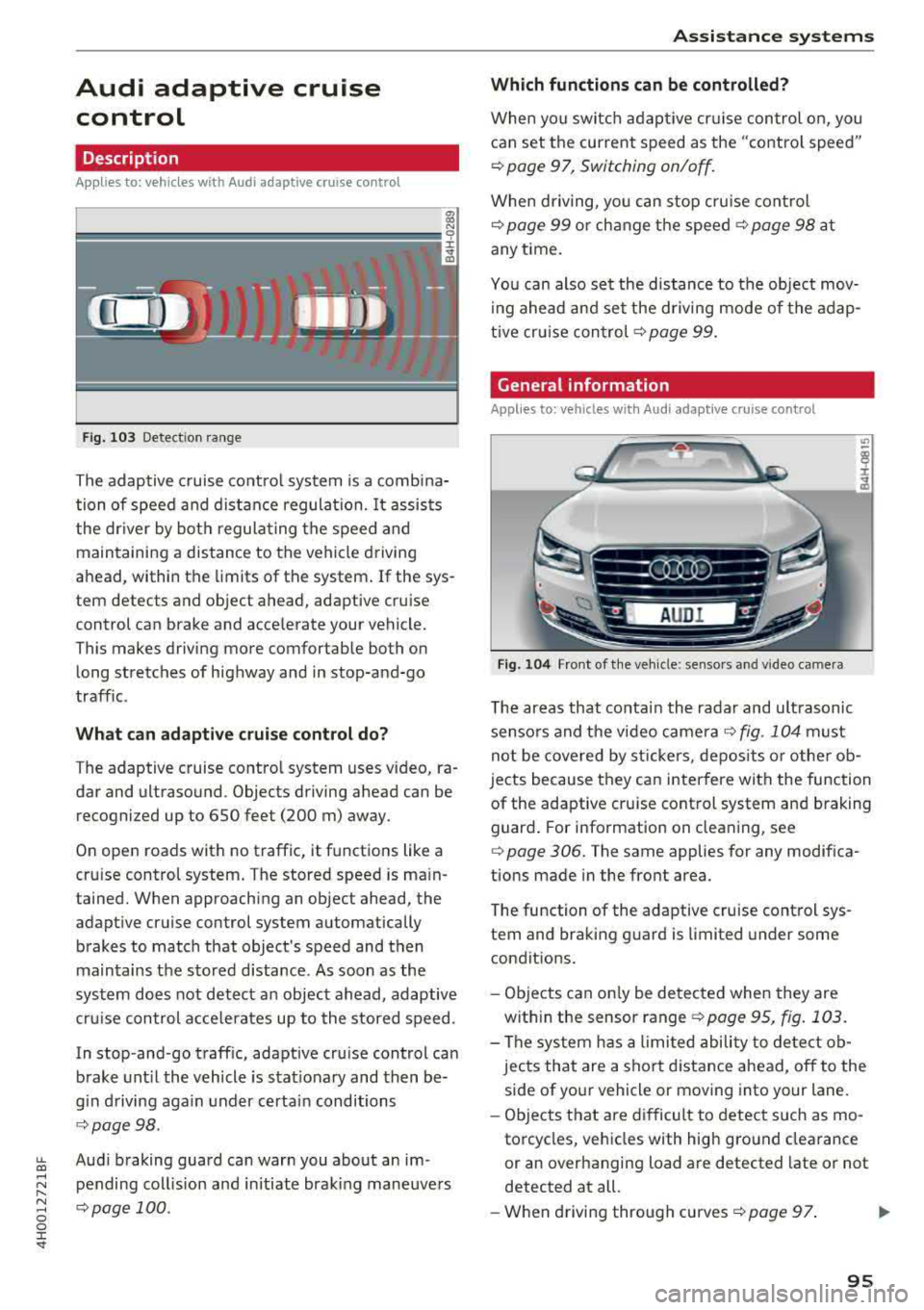
Fig . 1 03 Detect ion range
The adaptive c ruise co ntro l system is a comb ina
tion of speed and d ist ance regula tion. It assists
the dr iver by bot h regula ting the speed and
maintaining a distance to the vehicle driving
ahead , within the limits of the system . If the sys
tem detects and object ahead, adaptiv e cruis e
control can brake and acce lerate your vehicle.
Th is makes driving more comfortable both on
long stretches of highway and in stop-and-go
traffic .
What can adaptive crui se contr ol do?
The adaptive cruise contro l system uses video, ra
dar and ultraso und. Objects driving ahead can be
recogni zed up to 650 feet (200 m) away.
On open roads with no traffic , it functions like a
cru ise control system . T he stored speed is ma in
tained. When approaching an object ahead, the
adapt ive cruise con trol system automatically
brakes to match that object's speed and then
maintains the stored d istance. As soon as the
sys tem does not detect a n object ahead, adaptive
cru ise con trol acce lera tes up to the stored speed .
In stop-and -go traff ic, adaptive cru ise control can
brake unt il the vehicle is s tat io nary and then be
g in d riving aga in under certain conditions
¢ page 98.
Aud i braking guard can warn you about an im
pending col lision and initiate braking maneuve rs
¢ page 100 .
Assi st a nce systems
Which functions can be controlled?
When yo u swi tc h adap tive cr uise control on, you
can set t he current speed as the "contro l speed "
¢page 97, Switching on/off .
When driving, yo u can stop cru ise cont rol
¢ page 99 or ch ange t he speed ¢ page 98 at
any t ime.
Yo u c an also se t the distance to the object mov
i ng ahead and set the d riving mode of the adap
tive cr uise
con trol ¢ page 99.
General information
Applies to: vehicles with Audi adaptive c ruise con trol
Fi g. 10 4 Front of t he ve hicle: se nso rs and v ideo came ra
T he areas that co nta in the radar and ult rasonic
senso rs and the video
came ra¢ fig . 104 must
no t be cove red by st ickers, depos its o r othe r ob
jects because they can inter fere with the function
of the adaptive cru ise control system and braking
guard . For information on clea ning, see
¢ page 306. The same applies for any modifica
tions made in the front area.
T he function of the adaptive cru ise control sys
tem and bra king g uard is limited under some
condit ions.
- Objects can on ly be de tected when they are
w ith in the sensor range
¢ page 95 , fig . 103 .
-The sys tem h as a limited abili ty to detect ob
jec ts that are a shor t distance ahead, off to the
side of yo ur vehicle or mov ing into your lane.
- Ob jects that are difficult to detect such as mo
torcycles, vehicles with high g ro und clea rance
or an overhanging load a re detected late or not
detected at all.
- W hen drivi ng through cu rves
¢ page 97 . .,.
95
Page 101 of 356
lL t:0 ....
"' ......
"' .... 0 0 :c '
tap the accelerator peda l or
• P ull the lever toward you into position @
Qpage 99 , fig. 110 .
@ Tips
If an obstacle is detected when your vehicle
starts moving, the driver intervention request
appears
Q page 100. Your veh icle w ill drive
more s low ly when start ing . This may also
happen in some situations when there is no
apparent obstacle.
Interrupting cruise control
App lies to: veh icles with Audi adaptive cruise contro l
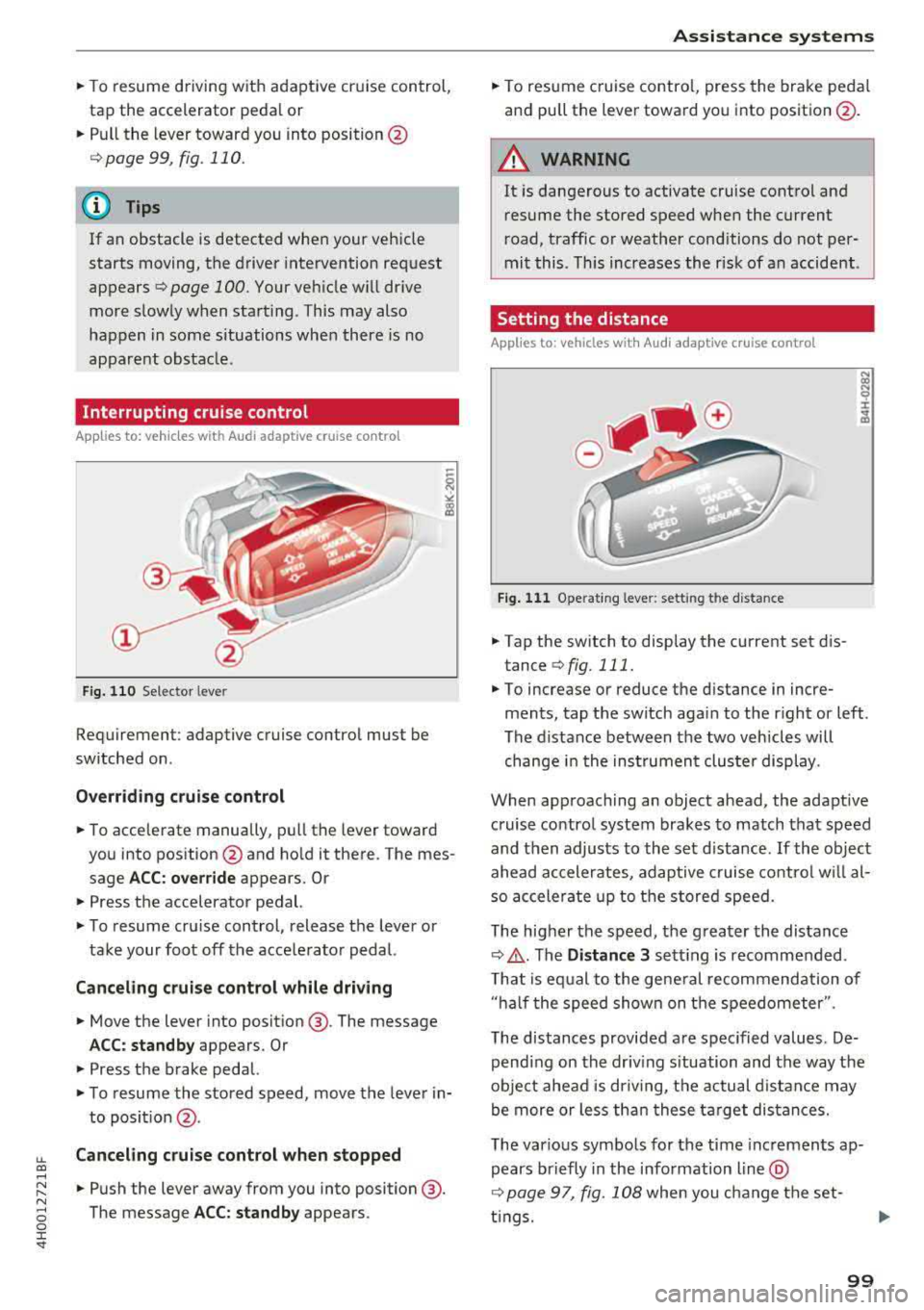
Fig. 1 10 Se lecto r leve r
Requiremen t: adaptive cruise control mus t be
switched on .
Overriding c rui se control
• To accelerate manually, pull the lever toward
you into pos ition @and ho ld it there . The mes
sage
A CC: over rid e appears. O r
• Press the a ccelerator pedal.
• T o resume cru ise control, release the lever or
take your foot off the acce lerator pedal.
Canceling cruise control while driving
• Move the lever into posit ion @. The message
AC C: standb y appears . Or
• Press the brake pedal.
• To resume the stored speed, move the lever in
to posit ion
@ .
Canceling crui se control when stopped
• Push the lever away from you into position @.
The message
A CC: standby appears .
A ssi st a nce systems
• To resume cruise contro l, press the brake peda l
and pu ll the lever toward you into position @.
A WARNING
It is dangerous to activate cruise control and
resume the stored speed when the current
r oad, traffic or weather cond itions do not per
mit this . This increases the risk of an accident .
Setting the distance
Applies to: vehicles with Aud i adaptive cru ise control
F ig . 11 1 Operat ing leve r: sett ing th e d is tan ce
• Tap the switch to display the current set d is
tance
Q fig . 111.
N (X) N 9 :I:
~
• To increase or reduce the d istance in incre
ments, tap the switch aga in to the r ight or left .
The distance between the two vehicles will change i n the inst rumen t cluste r display .
When approaching an object ahead , the adaptive
c ruise contro l system brakes to match that speed
and then adjusts to the set d istance .
If the object
ahead accelerates, adaptive cruise co ntro l w ill al
so accele rate up to the stored speed.
The higher the speed, the g reater the distance
Q ,& . The Distance 3 sett ing is recommended .
T hat is eq ual to the gene ral recommendation of
" ha lf the speed shown on the speedometer ".
The distances provided are spec ified values. De
pending on the driv ing s ituation and the way the
obje ct ahead is dr iv ing, the actual d istance may
be more or less th an these ta rge t distances.
The various symbo ls for the time inc remen ts ap
pears briefly in the info rmation line @
Q page 97, fig. 108 when you change the set-
t ings.
.,.
99
Page 103 of 356
u. co .... N
" N .... 0 0 :c '
When detected in time, the system can assess
dangerous sit uat ions where an object a head
brakes suddenly or if your own vehicle is traveling
at a high speed and approaching an object that is
mov ing more slowly. The brak ing guard does not
react if it cannot detect the situation.
The system advises you of various dangero us sit
uations :
- T he
distan ce warning occurs if you d rive too
closely to the object ahead for a long period o f
time . If the object ahead brakes strongly, you
would not be able to avoid a collision .
The.
indicator light appears as an indication for th is.
- The
app roach wa rning occurs when an object
ahead is traveling more s low ly or brakes
strongly. When th is warning occurs, it may on ly
be poss ible to avoid a co llision by swerving or
braking strongly . The danger is indicated by the
• ind icator light ¢ fig . 113 . An aud io signal
will a lso sound .
If you do not react early enough or at a ll to a dan
ge rous situation, the braking guard suppo rts you
w ith a brak ing intervent ion . T he approach warn
i ng indicators and the message
Braking guard :
e ngaged
also appea r.
- If a co llision is imminent, the system will first
provide a n
acute warning by braking sharply .
- If you do not react to the acute warning, the
brak ing guard can increase the braking force
withi n the l imits of the system . This reduces
the vehicle speed in the event of a co llision.
- T he system can init iate complete decelerat io n
sho rtly befo re a collis ion
l) . Full dece le ration at
high speeds occu rs on ly in vehicles with adap
t ive cr uise con trol and s ide ass ist (pre sense
p lu s) .
-If the bra king g uard determines tha t you are
not brak ing st rongly eno ugh when there is an
impending co llision, i t can increase the brak ing
force.
- T he pre se nse f unctions also engage when
there is an impending collision
¢ page 217 .
ll Mark et-sp ecific
A ss istance systems
Which functions can be controlled?
Yo u can swi tch t he b raking guard and t he d is
tance/approach warning on or
off in the Infotain
ment system
¢ page 102, Settings in the Info
tainment system .
A WARNING
--
Lack of attention can cause collisions, other
accidents and ser ious personal in juries . The
braking guard is a n assist system and cannot
pr event a collision by itself . T he dr iver m ust
a lways inte rvene . The d river is always respon
sib le for b raking at the co rrect t ime .
- Always pay close atten tion to traffic, even
when the b raking gua rd is switched on. Be
ready to in tervene and be rea dy to take
comp lete co ntro l wheneve r ne cess ary. A l
ways keep the sa fe and legal distance be
tween your vehicle a nd ve hicl es up ahead .
- B raki ng g uard works w it hi n limi ts a nd will
not respond o uts ide the system limits, fo r
examp le when approac hing a stopped veh i
cle or stationary obstacle (end of a traff ic
jam or vehicle that has broken down in traf
fic).
- Always remember that the radar sensor for
the brak ing guard works only within def ined
detection and range limits that may prevent
the proper detect ion of other vehicles.
- The radar sensor's function and range can
be reduced by rain, snow and heavy spray.
Mov ing vehicles up ahead may not be
p romptly de tected or may no t be detected
at a ll.
- Reflective surfaces includi ng crash ba rriers
or tunne l entra nces may impair the function
of t he rad ar senso r.
(D Tips
- You can cancel the braking with increas ing
force tha t is initiated by t he sys tem by brak
ing yourse lf, by acce le ra ting not iceably or
by swe rving.
101
Page 129 of 356
u. co .... N
" N .... 0 0 :c '
Control (ESC)
Description
The ESC increases driving safety. It reduces the
risk of slipping and improves driving stability.
ESC detects critical situations such as when the
vehicle is oversteering and understeering or the
wheels are spinning. The vehicle is stabilized by
applying the brakes or reducing engine torque .
When the ESC engages,
the G1 indicator light
b links in the instrument cluster.
The following systems are integrated in the ESC:
Anti-lock braking system (ABS)
ABS prevents the whee ls from locking when brak
ing. The vehicle can still be steered even during
hard braking. Apply steady pressure to the brake
pedal. Do not pump the pedal. A pulsing in the
brake pedal indicates that the system is acting to
stabilize the vehicle .
Brake assist system
The brake assist system can decrease braking dis
tance. It increases braking power when the driver
presses the brake pedal quickly in emergency sit
uations . You must press and hold the brake pedal
until the dangerous situat ion is over . In veh icles
w ith adaptive cruise contro l*, the brake assist
system is more sensitive if the distance detected
to the vehicle dr iv in g ahead is too small. On
ve hicl es w ith activated and functioning night vi
sion assist*, the brake assist system can respond
more sensitively if there is a warning .
Anti-Slip Regulation (ASR)
ASR reduces engine power when the drive wheels
begin spinning and adapts the force to the road
conditions. This makes it easier to start, acceler
ate and drive up hills.
Electronic differential lock (EDL)
EDL applies the brakes to a wheel that starts
sp inn ing and transfers the drive power to the
other driving wheels. This functio n is not availa
ble at higher speeds.
Intelligent Technology
In extreme cases, EDL automatica lly switches off
to keep the brake on the braked whee l from over
heating. The vehicle is still working correct ly. ED L
will switch on again automatically when condi
tions have returned to normal.
Steering recommendation
T he ESC he lp s to stabilize the vehicle by changing
the steering torque .
In veh icles with dynamic steer ing*, ESC also
helps to stab ilize the steer ing in crit ica l situa
tions.
Selective wheel torque control
Selective wheel torque control is used when driv
in g on curves.
The front wheel on the inside of the curve or both
wheels on the inside of the curve are braked se
lectively as needed. This allows more precise driv
in g in curves . The applicable system may not acti
vate when dr iv in g in wet or snowy conditions .
Automatic post -collision braking system
Th e "automat ic post-collis ion braking system"
can help to reduce the risk of sliding and of addi
t iona l co llisions after an acc ident. If the airbag
control module detects a co llision above a certa in
vehicle speed, the veh icle is braked by the ESC.
The vehicle does not brake automatically if :
- the dr iver presses the acce lerator pedal, or
- the braking force generated by the pressed
brake pedal is greater than the braking force
that would be initiated by the system, or
- the ESC, the brake system or the vehicle electri
cal system are not functioning.
A WARNING
,--
- The ESC and its integrated systems cannot
overcome the lim its imposed by natural
p hys ical laws. This is especially important
on slippery or wet roads. If the systems be
g in acting to stabilize your vehicle, you
should immediately alter your speed to
match the road and traffic conditions. Do
not let the increased safety provided tempt
127
Page 131 of 356
u. co .... N
" N .... 0 0 :c '
New brake pads
New brake pads do no t ac hieve t heir f ull b raking
effect during the firs t 25 0 mi (4 00 km). They
must be "b roken
in" fi rst . The b rea k-in per io d can
be considerably longe r for vehicles with ce ram ic
brake roto rs*. However, yo u can compensate for
the slightly reduced br aking fo rce by p ressing
firm ly on the brake pedal. Avo id heavy braking
d uring the brea k-in period .
Wear
Brake pad wear depends largely on the way the
ve hicle is driven and on operat ing cond itions.
This is especially true if you are driving frequently
i n the c ity and on curves o r with a sporty driving
style .
Operating noise
Noises may occur when bra king depend ing on the
speed, braking force and outs ide cond itions s uch
as temperature and humidity .
Noises may become more appare nt at lowe r
speeds d ue to the nature of the mater ia ls in the
ceramic brake rotors*.
Effect of water and road salt
I n ce rtain s it u at ions, for ex ample a fter dr iving
throu gh water, in heavy ra in, afte r overnig ht con
densat io n or after washing your car, the bra king
effect can be red uced by moisture or ice on the
brake rotors and b ra ke pads. The brakes must be
"dr ied" fi rst w it h a few careful brake applica
tions .
At highe r speeds and with the windsh ie ld w ipers
turned on, the brake pads press aga inst the brake
rotors for a sho rt amount of time. T his action,
which is not felt by the d rive r, happens a t regular
in te rvals a nd ens ures a bette r reac tion time fo r
the bra kes in wet weat her.
The braking ef fect can also be reduced if you are
d riving on salted roads and you do not apply t he
b rakes fo r long pe riods of time . The laye r of sa lt
on the br ake ro to rs and pads must be wo rn off
fi rs t when the br akes are app lied.
Intelligent Technology
Du e to its s urface, the ceram ic b rake rotor * ab
sorbs moistu re in ce rtain s ituations. The refore,
t h ere w ill tempora rily be less brak ing fo rce t han
whe n the brakes are d ry . Yo u can compensate for
t hi s by press ing t he b rake pedal harder.
Corrosion
L eaving t he vehi cle pa rked fo r lo ng p eriods o f
time, low mileage and avoidin g heavy b raking
can contrib ute to corros ion on the b rake roto rs
and to dirty brake pads.
If you usu a lly avoid heavy bra king or if the re is
cor rosion prese nt, occasiona l heavy bra king at
high speeds is recommended to clean the b ra ke
r oto rs and pads
c:> ,& .
Brake system malfunction
If
you notice that the br ake pe dal trave l has sud
denly in crease d, then a brake circuit in the dua l
c ir cuit b rake system may have malfu nctioned .
Drive to an authorized A udi dealer or autho rized
Audi Se rvice Facility immed iate ly to have the
prob lem cor rected . On the way there, drive w ith
red uced speed and kee p in mind that you will
need a longer dis tance to stop an d you will need
to press the bra ke pe dal harder.
Low brake fluid level
When the bra ke fluid level is low, malfu nctions in
the b rake system may occur . T he b rake fl uid level
i s e lec tron ically moni to red .
Brake booster
The brake booster ampli fies t he p ress ure you ap
ply to the brake pedal. It on ly works w hen the en
gine is runn ing.
A WARNING
-
- Onl y app ly the brakes for the purpos e of
cleani ng the bra ke sys tem when road and
t raffic cond ition s permi t. You mu st not en
dan ger oth er r oad users . T hi s incr ea ses the
r isk of a n accid ent.
- N eve r let t he ve hicle roll wh ile th e e ngi ne is
st opp ed bec au se this incr eas es th e risk o f an
a ccide nt.
ll),
129
Page 132 of 356
Intellig ent T echn olo gy
- New brake pads do not achieve their full
braking effect during the first 250 mi
(400 km). They must be "broken in" first.
However, you can compensate for the
sl ightly reduced brak ing force by pressing
firmly on the brake pedal. Avoid heavy brak
i ng dur ing t he break- in per iod.
- Certa in weather and operat ing cond it ions
such as dr iv ing through water, driving in
heavy ra in or driving after washing your ve
hicle can impair the effectiveness of the
brakes . In the winter, ice may build up on
the brake pads, rotors and drums . Check
these components by braking carefu lly. Ap
plying the brakes carefully severa l times
dr ies the brakes and removes ice bu ild-up.
- The effic iency of the brakes can also be im
paired by driving for long stretches on roads
covered w ith salt w ithout using the brakes.
You can remove salt deposits from the brake rotors and pads by carefully applying
the b rakes severa l t imes .
- If the front spo iler is damaged or you install
another spoiler, make sure the front wheel
bra kes are vent ilated properly. Otherwise,
the brake system could ove rheat, w hich re
duces the ir effectiveness.
- Failure of a b rake circuit impa irs b raking
perfo rmance, which inc reases brak ing dis
tance . Avoid driving the vehicle and have it
towed it to the nearest authorized Audi
dealer or authorized Audi Service Facility .
- If the brake booster is not working, you will
have to press m uch harder on the brake
peda l to compensate for the lack of the
booster.
@ Note
- Never let the brakes " rub" by pressing the
pedal light ly when braking is not actually
necessary. This causes the brakes to over
heat and increases braking distance and
causes wear.
- Before driving downhill a long distance on a
steep hill, decrease your speed and select a l ower gear. This makes use of the engine
braking effect and relieves the brakes. If
130
you need to brake add itiona lly, brake in in
terva ls and not continuous ly .
(D Tips
- If the bra ke boos ter is not wor king, you
must press the brake peda l with much more
force than normal.
- If you retrof it your vehicle with a front spoi l
er, wheel covers or simi lar items, make sure
that the air flow to the front wheels is not interrupted. Otherwise the brake system
can become too hot.
Electromechanical
steering, dynamic
steering
The electromechonicol steering supports the
driver's steering movements.
Power steering adapts electronically based on
the vehicle speed .
Indicator lights and messages
• Do not drive vehi cle: S tee rin g defect ive
If this indicator light turns on and stays on and
th is message appears, the power steering may
have failed .
Stop the vehicle in a safe location as soon as pos
s ible. Do
not conti nue driving. See an authorized
Audi dealer or authorized Audi Service Fac il ity for
ass istance.
l;rfl St ee ring: System faul t You ca n cont inue
dr ivi ng
If the indicator light turns on and the message
appears, the steering wheel may be more diffi
cu lt to move or more sensitive than usual. The
steering wheel may also be at an angle when driv ing stra ight .
Drive slowly to an authorized Audi dea ler or au
thori zed Audi Serv ice Facility to have the mal
funct io n corrected.
'-r-ij Dynamic stee ring: Init ializing
If the indicato r light is blinking and this message
appears, dynamic steering* is being initialized.
IJ>-
Page 287 of 356
....
"' -N .... N
-0
0
J: ..
® Mud and snow capability
"M/S" or "M+S" indicates the tire
has properties making it suitable
to drive in mud or
snow .~ indi
cates a winter tire .
@ Composition of the tire cord
and m aterials
The number of plies indicates the
number of rubberized fabric lay
ers in the tire. In general : the
more layers, the more weight a
tire can carry . Tire manufacturers
must also specify the materials
used in the tire . These include
steel, nylon, polyester and other
materials .
@Maximum permitted load
This number indicates the maxi
mum load in kilograms and
pounds that the tire can carry .
@Uniform ti re quality grade
standards for treadwear,
traction and temperature resistance
Treadwear , traction and tempera
ture
ranges¢ page 299 .
@ Running direction
The arrows indicate the running
direction of unidirectional tires .
You must always follow the speci- fied running direction
¢
page 319.
@ Maximum permitted
inflation p ressure
Wh eel s
This number indicates the maxi
mum pressure to which a tire can
be inflated under normal operat
ing conditions.
Glossary of tire and loading
terminology
Accessory weight
means the combined weight (in
excess of those standard items
which may be replaced) of auto matic transmission, power steer
ing, power brakes, power win
dows, power seats, radio, and
heater, to the extent that these
items are available as factory-in
stalled equipment (whether in
stalled or not) .
Aspect ratio
means the ratio of the height to
the width of the tire in percent .
Numbers of 55 or lower indicate a
low sidewall for improved steer
ing response and better overall
handling on dry pavement .
285
Page 289 of 356
....
"' -N .... N
-0
0
J: ..
(a) Curb weight
(b) Accessory weight
(c) Vehicle capacity weight, and
(d) Production options weight
Ma ximum (permissible }
inflation pres sure
means the maximum cold infla
tion pressure to which a t ire may
be inflated . Also called "maxi
mum inflation pressure."
Normal occupant weight
means 150 l bs. (68 kilograms)
times the number of occupants
seated in the veh icle up to the to
tal seating capacity of your vehi
c le.
Occupant distribution
means distribution of occupants
in a vehicle.
Outer diameter
means the overall diameter of an
inflated new tire .
Overall width
means the linear distance be
tween the exteriors of the side
walls of an inflated tire, including
elevations due to labeling, deco
rations, or protective bands or
ribs .
Wheels
Ply
means a layer of rubber-coated
parallel cords .
Production options weight
means the combined weight of
those installed regular production
options weighing over 5 lbs. (2.3 kg) in excess of those standard
items which they replace, not pre
viously considered in curb weight
or accessory weight, including heavy duty brakes , ride levelers ,
roof rack, heavy duty battery, and
special trim .
Radial ply tire
means a pneumatic tire in which
the ply cords that extend to the beads are laid at substantially 90
degrees to the centerline of the
tread .
Recommended inflation
pressure
see ~ page 286, Cold tire infla
tion pressure .
Reinforced tire
means a tire designed to operate
at higher loads and at higher in
flat ion pressures than the corre
sponding standard tire. Rein
forced tires may be iden tified as
.,.
28 7
Page 298 of 356
Wheels
sure that load limits are not ex
ceeded. Vehicle load includes ev
erybody and everything in and on
the vehicle. These load limits are
technically referred to as the vehi
cle's
Gross Vehicle Weight Rat
ing
("GVWR").
The "GVWR" includes the weight
of the basic vehicle, all factory in
stalled accessories, a full tank of
fuel, oil, coolant and other fluids plus maximum load. The maxi
mum load includes the number of
passengers that the vehicle is in
tended to carry ("seating capaci
ty") with an assumed weight of
150 lbs. (68 kg) for each passen
ger at a designated seating posi
tion and the total weight of any
l uggage in the vehicle. If you tow
a trailer, the weight of the trailer
hitch and the tongue weight of
the loaded trailer must be includ
ed as part of the vehicle load.
The
Gross Axle Weight Rating
("GAWR") is the maximum load
that can be applied at each of the
vehicle's two axles.
The fact that there is an upper
limit to your vehicle's Gross Vehi
cle Weight Rating means that the
total weight of whatever is being
296
carried in the vehicle (including
the weight of a trailer hitch and the tongue weight of the loaded
trailer) is limited. The more pas
sengers in the vehicle or passen
gers who are heavier than the
standard weights assumed mean
that less weight can be carried as l uggage .
The Gross Vehicle Weight Rating
and the Gross Axle Weight Rating
are listed on the safety compli
ance sticker label located on the
driver's side B-pillar
¢ page 293,
fig. 266.
_& WARNING ~
Overloading a vehicle can cause
loss of vehicle control, a crash
or other accident, serious per
sonal injury, and even death.
-Carrying more weight than
your vehicle was designed to
carry will prevent the vehicle
from handling properly and increase the risk of the loss of
vehicle control.
-The brakes on a vehicle that
has been overloaded may not
be able to stop the vehicle
within a safe distance.
Page 309 of 356
u. co .... N
" N .... 0 0 :c '
-Only wash the vehicle when the ignition is
off and follow the instructions from the car
wash operator to reduce the risk of acci
dents.
-To reduce the risk of cuts, protect yourself
from sharp metal components when wash
ing the underbody or the inside of the wheel
housings.
-After washing the vehicle, the braking effect may be delayed due to moisture on the
brake rotors or ice in the winter . This in
creases the risk of an accident. The brakes
must be dried first with a few careful brake
applications.
@ Note
-If you wash the vehicle in an automatic car
wash, you must fold the exterior mirrors in
to reduce the risk of damage to the mirrors.
Power folding exterior mirrors* must only
be folded in and out using the power folding
function.
-To reduce the risk of paint damage, do not
wash the vehicle in direct sunlight.
-
Care and cleaning
-To reduce the risk of damage, do not wash
the power top with a pressure washer.
-To reduce the risk of damage to the surface,
do not use insect removing sponges, kitchen
sponges or similar items.
-Matte finish painted vehicle components:
-To reduce the risk of damage to the sur-
face, do not use polishing agents or hard
wax.
-Never use protective wax. It can destroy
the matte finish effect .
-Do not place any stickers or magnetic
signs on vehicle parts painted with matte
finish paint. The paint could be damaged
when the stickers or magnets are re
moved .
@ For the sake of the environment
Only wash the vehicle in facilities specially de
signed for that purpose . This will reduce the
risk of dirty water contaminated with oil from
entering the sewer system.
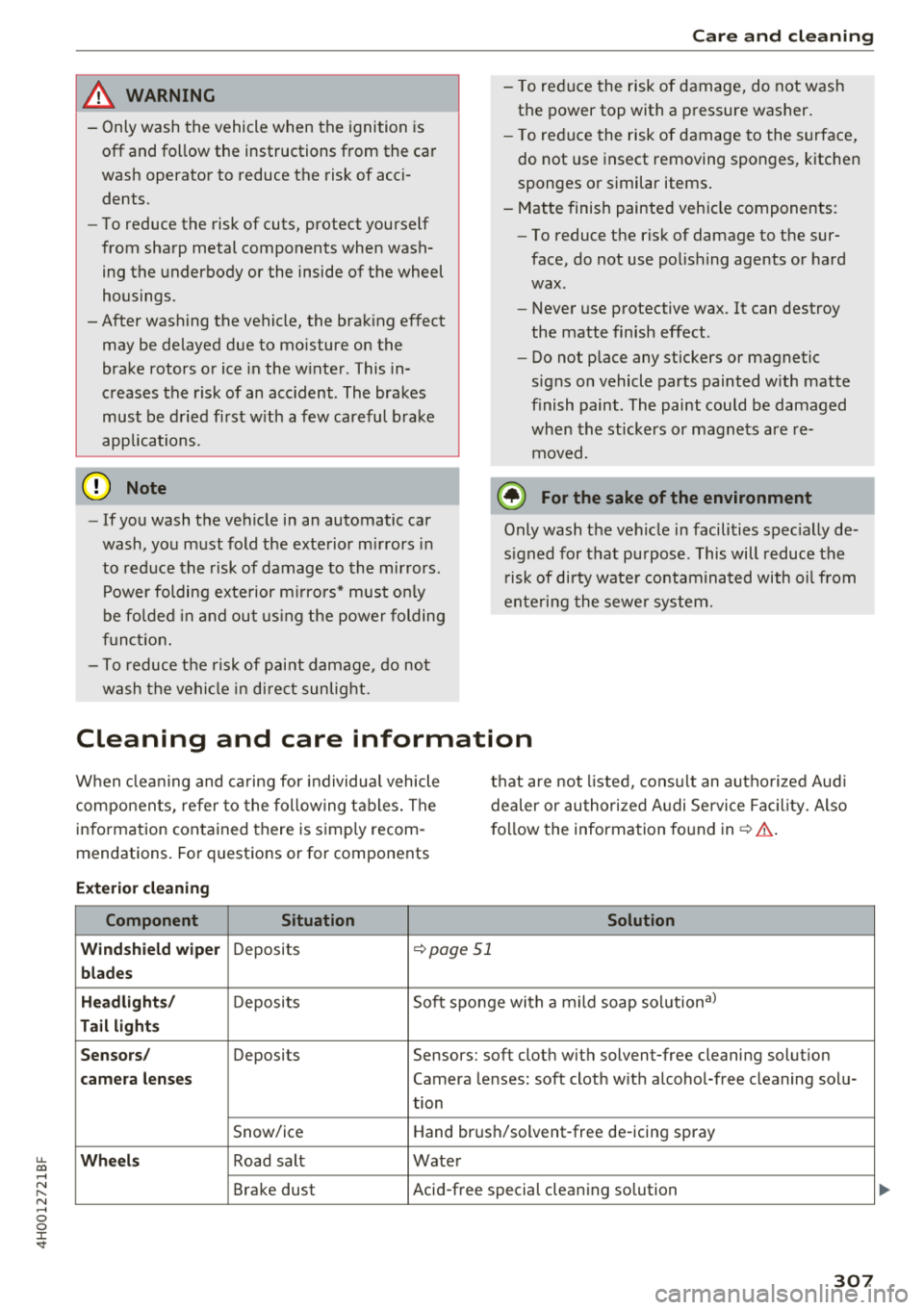
Cleaning and care information
When cleaning and caring for individual vehicle
components, refer to the following tables. The
information contained there is simply recom
mendations. For questions or for components that are
not listed, consult an authorized Audi
dealer or authorized Audi Service Facility. Also
follow the information found
in~.&. -
Exterior cleaning
Component Situation Solution
Windshield wiper
Deposits ~ page 51
blades
Headlights/
Deposits Soft sponge with a
mild soap solutiona)
Tail lights
Sensors/
Deposits Sensors: soft cloth with solvent-free cleaning solution
camera lenses Camera lenses: soft cloth with alcohol-free cleaning solu-
tion
Snow/ice Hand brush/solvent-free de-icing spray
Wheels Road salt Water
Brake dust Acid-free special cleaning solution
307
...