transmission AUDI A8 2018 User Guide
[x] Cancel search | Manufacturer: AUDI, Model Year: 2018, Model line: A8, Model: AUDI A8 2018Pages: 356, PDF Size: 54.71 MB
Page 115 of 356
u. co ..... N
" N ..... 0 0 :c '
.,. To se lect t he mode , se lect the following in the
Infota inment : ICAR !f u nct io n button>
Comfort ,
Auto , D ynami c or Individual.
You can change t he d riving mode when the vehi
cle is stat ionary o r w hil e d riving. If traffic per
m its, after cha ng ing modes, br iefly take yo ur
foot off the accelerator peda l so that t he recen tly
se lected mode is a lso activated for the engine.
Comfort -provides a comfort-o rie nted ve hicle
setup and is su ited for long dr ives on hig hways .
Adjusting the Individual mode
Ass istance systems
Auto -provides an overa ll comfortab le yet dy
namic driving feel and is suited for everyday use .
Dynamic -gives the dr ive r a spo rty d riving fee l
and is suited to a sporty driv ing style .
Individual -~page 113 .
A WARNING
Pay attention to t raff ic w hen ope rating the
dr ive sele ct to redu ce the r is k of a n accident.
-
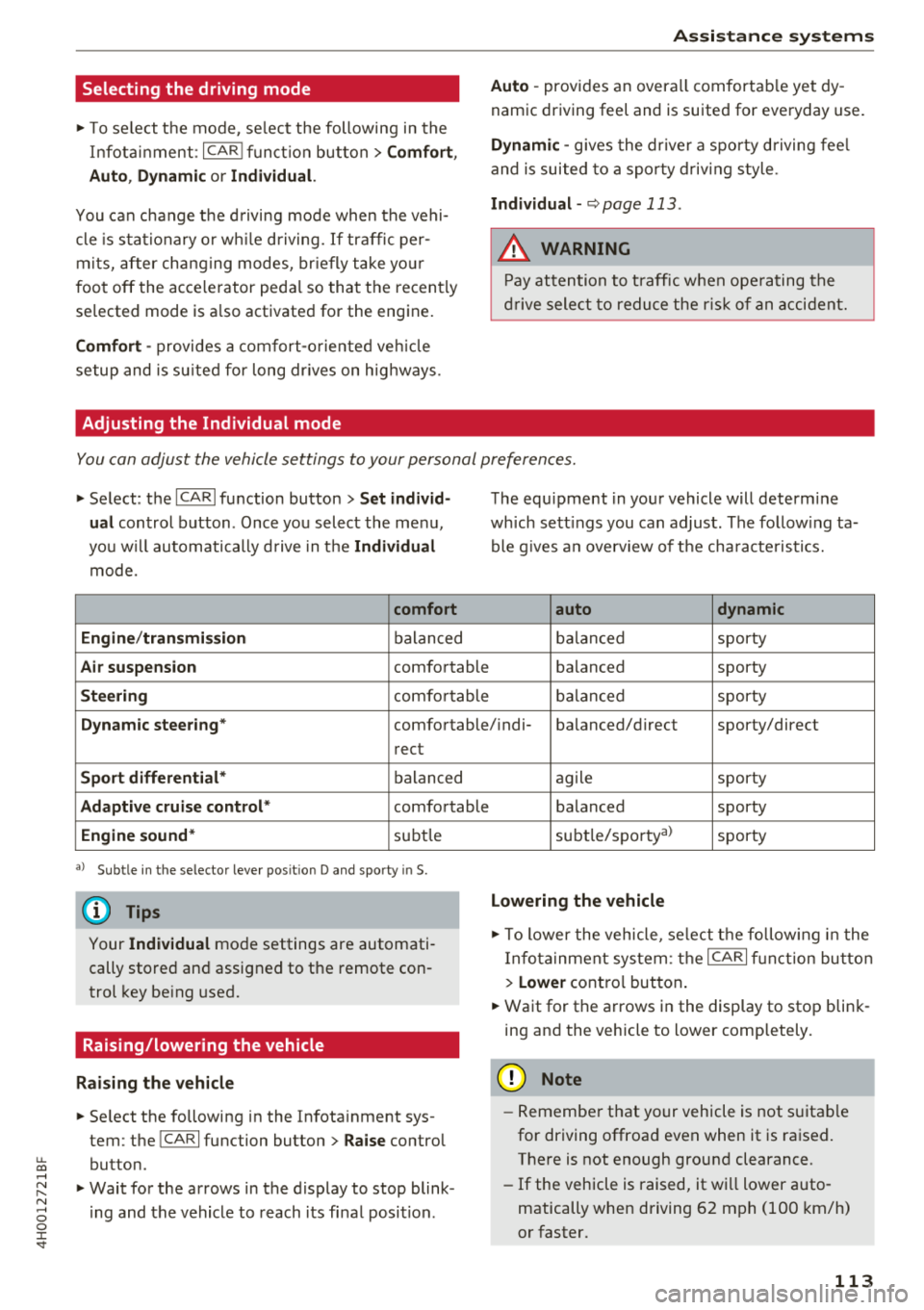
You can adjust the vehicle settings to your personal preferences .
.,. Select : the !CA RI fu nction button > Set individ
ual
control button . Once you select the me nu,
you w ill automatically d rive in t he
Individual
mode.
comfort
Engine /transmission
balan ced
Air suspension comfortable
Steering co mfo rtable The equ
ipment in you r vehicle will determ ine
wh ich sett ings you can adjust . The follow ing ta
ble g ives a n overv iew of t he cha racte ristics.
auto dynamic
balan ced sporty
b alanced sporty
ba lan ced sporty
Dynamic steering * comfortable/ ind i- balanced/direc t sporty/direct
rect
Sport differential * balanced
Adaptive cruise control * comfortable
Engine sound* subtle
a> Sub tle in t he se lector leve r po sit io n D and sporty in S.
(D Tips
Your Individual mode settings are automati
cally stored an d assigned to the remote con
trol key be ing used.
Raising/lowering the vehicle
Raising the vehicle
.,. Se lect the following in the Infota inment sys
tem : the
!CAR! function button> Raise control
button .
.,. Wait for the arrows in the display to stop blink
i ng and the vehicle to reach its fi nal posit ion . ag
ile sporty
balanced sporty
subt le/spor ty al
sporty
Lowering the vehicle
.,. To lower the vehicle, se lect t he follow ing in the
I nfota inment system: the
ICAR! f u nct ion bu tto n
>
Lower cont ro l button .
.,. Wait for the a rrows i n the display to stop blink
ing and the veh icle to lower comp letely .
@ Note
-Remember t hat yo ur vehicle is not s uitab le
for driving offroa d eve n when it is ra ised.
There is not enough ground clearance.
- If the vehicle is raised, it wi ll lower auto
matically when driving 62 mph (100 km/h)
o r faster.
113
Page 287 of 356
....
"' -N .... N
-0
0
J: ..
® Mud and snow capability
"M/S" or "M+S" indicates the tire
has properties making it suitable
to drive in mud or
snow .~ indi
cates a winter tire .
@ Composition of the tire cord
and m aterials
The number of plies indicates the
number of rubberized fabric lay
ers in the tire. In general : the
more layers, the more weight a
tire can carry . Tire manufacturers
must also specify the materials
used in the tire . These include
steel, nylon, polyester and other
materials .
@Maximum permitted load
This number indicates the maxi
mum load in kilograms and
pounds that the tire can carry .
@Uniform ti re quality grade
standards for treadwear,
traction and temperature resistance
Treadwear , traction and tempera
ture
ranges¢ page 299 .
@ Running direction
The arrows indicate the running
direction of unidirectional tires .
You must always follow the speci- fied running direction
¢
page 319.
@ Maximum permitted
inflation p ressure
Wh eel s
This number indicates the maxi
mum pressure to which a tire can
be inflated under normal operat
ing conditions.
Glossary of tire and loading
terminology
Accessory weight
means the combined weight (in
excess of those standard items
which may be replaced) of auto matic transmission, power steer
ing, power brakes, power win
dows, power seats, radio, and
heater, to the extent that these
items are available as factory-in
stalled equipment (whether in
stalled or not) .
Aspect ratio
means the ratio of the height to
the width of the tire in percent .
Numbers of 55 or lower indicate a
low sidewall for improved steer
ing response and better overall
handling on dry pavement .
285
Page 325 of 356
lL t:0 ....
'"" ......
'"" .... 0 0 :c '
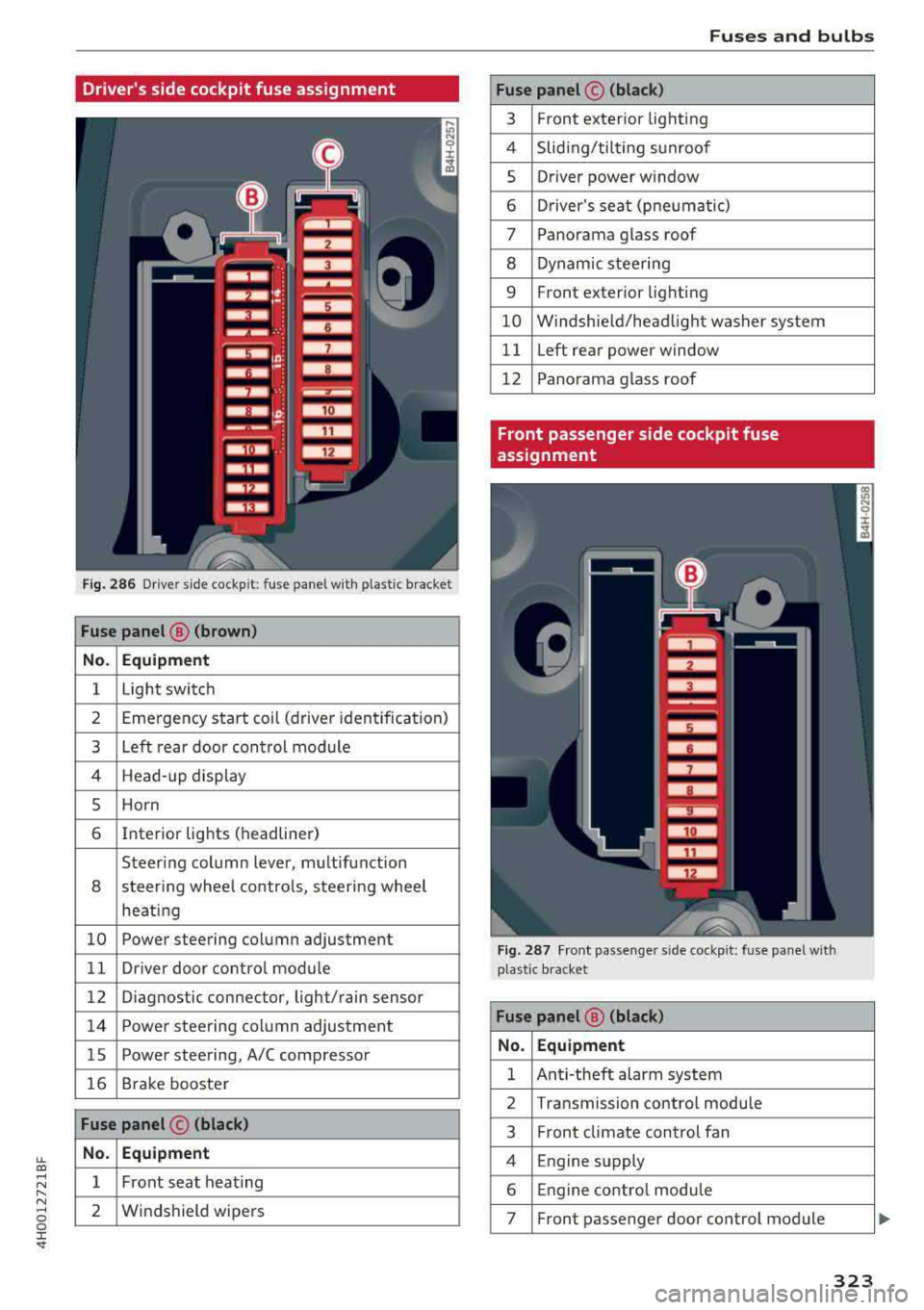
Fig. 286 Drive r side cockpit: fuse panel with plastic bracket
Fuse panel @ (brown)
No. Equipment
1 Light switch
2 Eme rgency start coil (driver iden tification)
3 Left rear door control module
4 Head-up display
5 Horn
6 Interior lights (headliner)
Steering column lever, multifunction
8 steer ing whee l controls, steering wheel
heating
10 Powe r steering column adjustment
11 Driver door control module
12 Diagnostic con nector, light/rain sensor
14 Power steering column adjustment
lS Power steering, A/C compressor
16 Brake booster
Fuse panel © (black)
No. Equipment
1 Front seat heating
2 Windshield wipers
Fuses and bulbs
Fuse panel © (black)
3 Front exterior lighting
4 Sliding/tilting sunroof
5 Driver power window
6 Dr iver 's seat (pne umat ic)
7 Panorama glass roof
8 Dynamic steering
9 Front exterior lighting
10 Windshield/headlight washer system
11 Left rear power window
12 Panorama glass roof
Front passenger side cockpit fuse
assignment
Fig. 287 Fro nt passe nge r side cockp it: fuse panel with
plastic bracket
Fuse panel @ (black)
No. Equipment
1 Anti-theft alarm system
2 Transmission contro l module
3 Front climate control fan
4 Engine s upply
6 Engine control module
7 Front passenger door control module
323
Page 327 of 356
u. co .... N
" N .... 0 0 :c '
3
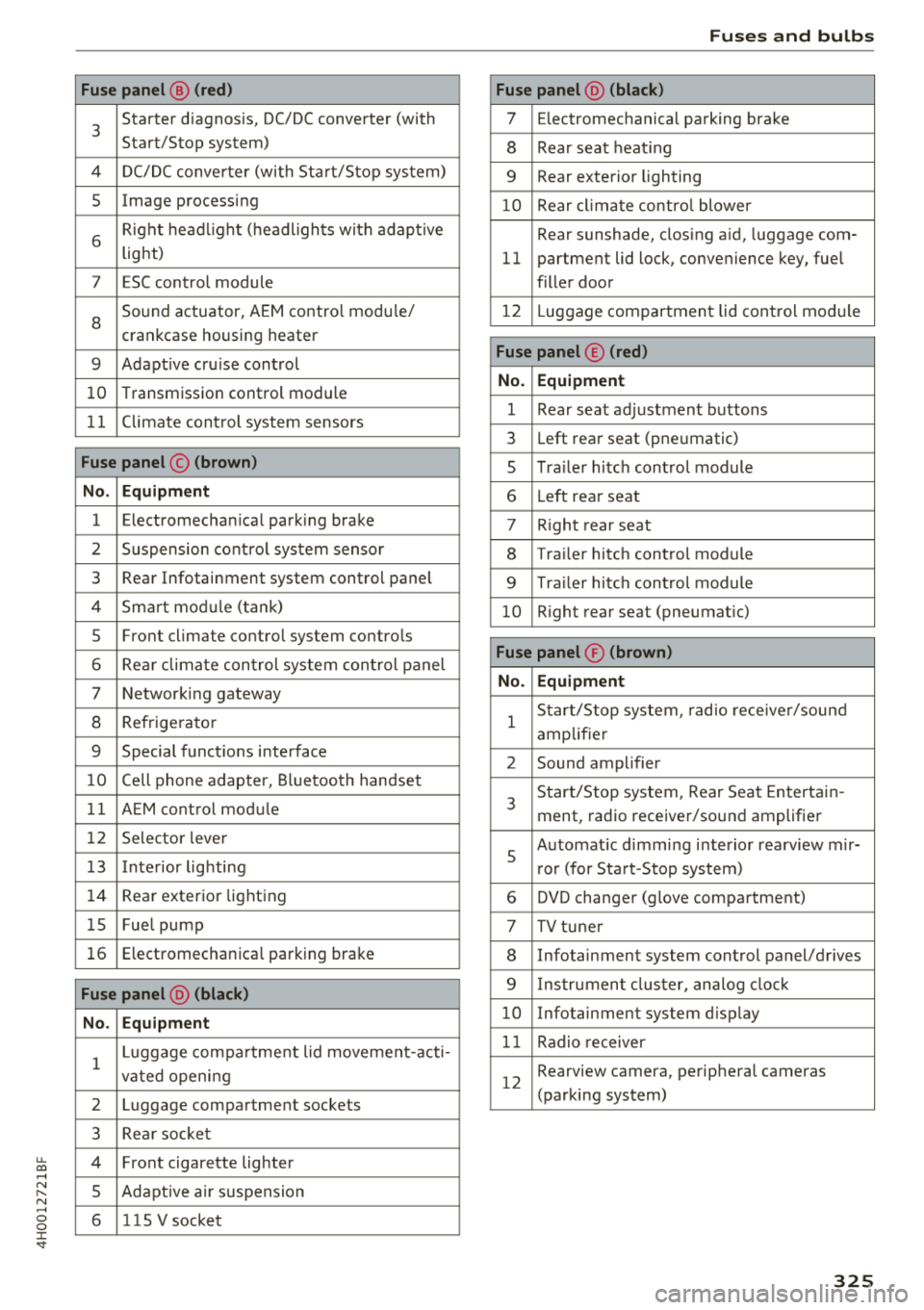
Starter diagnosis, DC/DC converter (with
Start/Stop system)
4 DC/DC converter (with Start/Stop system)
5 Image processing
6
Right headlight (headlights with adaptive
light)
7 ESC control module
8
Sound actuator, AEM control module/
crankcase housing heater
9 Adapt ive cru ise control
10 Transmission control module
11 Climate control system sensors
Fuse panel © (brown)
No. Equipment
1 Electromechan ica l park ing brake
2 Suspension control system sensor
3 Rear Infotainment system control panel
4 Smart module ( tan k)
5 Front climate control system controls
6 Rea r climate control system control panel
7 Networking gateway
8 Refrigerator
9 Special functions interface
10 Cell phone adapter, Bluetooth handset
11 AEM control module
12 Selector lever
1 3 Inte rior lighting
14 Rear exterior lighting
15 Fue l pump
16 Electromechanica l parking brake
Fuse panel @ (black)
No. Equipment
1
Luggage compa rtment lid movement-acti-
vated opening
2 Luggage compartment sockets
3 Rear socket
4 Fro nt cigarette lighter
5 Adaptive air su spension
6 115 V socket
Fuses and bulbs
Fuse panel @ (black)
7 Electromechanical parking brake
8 Rear seat heat ing
9 Rear exterior lighting
10 Rear climate control blower
Rear sunshade, closing a id, luggage com-
11 partment lid lock, convenience key, fue l
filler door
12 L uggage compartment lid control module
Fuse panel © (red)
No. Equipment
1 Rear seat adjustment buttons
3 Left rear seat (pne umatic)
5 Tra iler hitch control module
6 Left rea r seat
7 Right rear seat
8 Trailer hitch control module
9 Trailer hitch control module
10 Right rear seat (pneumat ic)
Fuse panel ® (brown)
No. Equipment
1
Start/Stop system , radio receiver/sound
amplifier
2 Sound amplifier
3
Start/Stop system, Rear Seat Entertain -
ment, radio receiver/sound amplifier
5
Automat ic dimming interior rea rview mir-
r or (for Start-Stop system)
6 DVD changer (glove compartment)
7 TV tuner
8 Infotainment system control panel/drives
9 Instrument cluster, analog clock
10 Infotainment system d isp lay
11 Radio receiver
12
Rearview camera, perip heral cameras
(parking system)
325
Page 329 of 356
u. co .... N
" N .... 0 0 :c '
General
This chapter is intended for trained emergency
crews and working personnel who have the nec
essary tools and equipment to perform these
operations.
Starting by pushing or
towing
~ Note
Vehicles with an automatic transmission can
not be started by pushing or towing.
Starting with jumper
cables
If necessary, the engine can be started by con
necting it to the battery of another vehicle .
If the engine should fail to start because of a dis
charged or weak battery, the battery can be con
nected to the battery of
another vehicle, using a
pair of jumper cables to start the engine.
Jumper cables
Use only jumper cables of sufficiently large cross
section
to carry the starter current safely. Refer
to the manufacturer's specifications.
Use only jumper cables with
insulated terminal
clamps which are distinctly marked :
plus(+) cable in most cases colored red
minus(-) cable
in most cases colored black.
A WARNING -
Batteries contain electricity, acid, and gas.
Any of these can cause very serious or fatal in
jury. Follow the instructions below for safe
handling of your vehicle's battery .
-Always shield your eyes and avoid leaning
over the battery whenever possible.
-A dead battery can freeze at temperatures
around 32 °F (0 °C) . If the vehicle battery is
frozen, you must thaw it before connecting
the jump start cables. If you do not, this in-
Emergency situations
creases the risk of an explosion and chemi
cal burns. After jump starting the vehicle,
drive to an authorized Audi dealer or author ized Audi Service Facility immediately to
have the vehicle battery checked.
- Do not allow battery acid to contact eyes or
skin . Flush any contacted area with water
immediately.
- Improper use of a booster battery to start a
vehicle may cause an explosion .
- Vehicle batteries generate explosive gases .
Keep sparks, flame and lighted cigarettes
away from batteries.
- Do not try to jump start any vehicle with a
low acid level in the battery .
- The voltage of the booster battery must also
have a 12-Volt rating . The capacity (Ah) of
the booster battery should not be lower
than that of the discharged battery. Use of
batteries of different voltage or substantial
ly different "Ah " rating may cause an explo
sion and personal injury.
- Never charge a frozen battery. Gas trapped
in the ice may cause an explosion.
- Never charge or use a battery that has been
frozen. The battery case may have be weak
ened.
- Use of batteries of different voltage or sub
stantially different capacity (Ah) rating may
cause an explosion and injury. The capacity
(Ah) of the booster battery should not be
lower than that of the discharged battery.
- Before you check anything in the engine
compartment, always read and heed all
WARNINGS
c>page 272.
@ Note
- Applying a higher voltage booster battery
will cause expensive damage to sensitive
electronic components, such as control
units, relays, radio, etc.
- There must be no electrical contact between
the vehicles as otherwise current could al
ready start to flow as soon as the positive
( + ) terminals are connected.
327
Page 330 of 356
Emergency situations
@ Tips
The discharged battery must be properly con
nected to the vehicle's electrical system .
When jump starting or charging the battery,
never connect the negative ground cable to
the battery negative post because the battery
manager system must be able to detect the
battery's state of charge. Always connect the
negat ive g round cable to the negative ground
post of the battery manager control unit.
Using the jump start
cable
Both jump start cables must be connected in the
correct order!
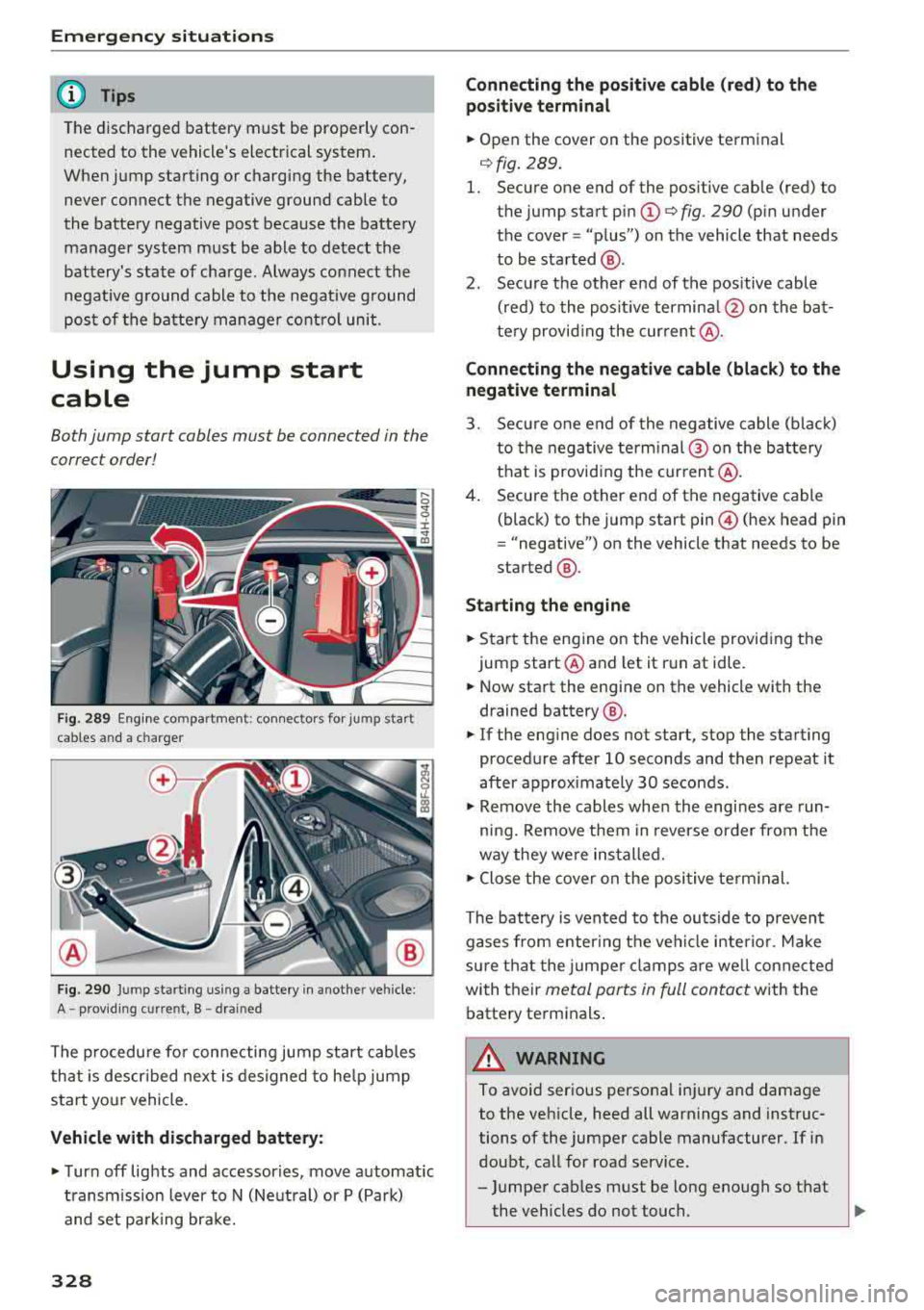
Fig. 289 E ngin e compartme nt: co nn ectors for jump start
cables and a charger
Fig. 290 Jump starting using a battery in anot her vehicle:
A
-p rov id in g current, B -drai ned
The procedure for connecting jump start cables
that is descr ibed next is designed to help jump
start your vehicle.
Vehicle with discharged battery:
~ Turn off lights and accessories, move automatic
transmission lever to N (Neutral) or P (Park)
and set parking bra ke.
328
Connecting the positive cable (red) to the
positive terminal
~ Open the cover on the positive terminal
qfig . 289.
1. Secure one end of the pos itive cable (red) to
the jump start pin
(D q fig. 290 (pin under
the cover =
"plus") on the vehicle that needs
to be started @.
2. Secure the other end of the positive cable
(red) to the posit ive terminal @on the bat
tery provid ing the cur rent @.
Connecting the negative cable (black) to the
negative terminal
3. Secure one end of the negative cable (black)
to the negative terminal @ on the battery
that is providing the current @.
4. Secure the other end of the negative cable
(black) to the jump start
pin @ (hex head pin
= "negative") on the vehicle that needs to be
started @.
Starting the engine
~ Sta rt the eng ine on the vehicle providing the
jump start @and let it run at idle.
~ Now start the engine on the vehicle with the
drained battery @.
~ If the engine does not start, stop the starting
procedure after 10 seconds and then repeat it
after approx imately 30 seconds.
~ Remove the cables when the engi nes are run
ning. Remove them in reverse order from the
way they were installed.
~ Close the cover on the posi tive terminal.
The battery is vented to the outside to prevent
gases from enter ing the vehicle interior. Make
sure that the jumper clamps are well connected
with their
metal ports in full contact with the
battery terminals .
A WARNING
-To avoid serious personal injury and damage
to the vehicle, heed all warnings and instruc
tions of the jumper cable manufacturer. If in
doubt, call for road service.
-Jumper cables must be long enough so that
the vehicles do not touch.
..,.
Page 331 of 356
-When connecting jumper cables, make sure
that they cannot get ca ught in any mov ing
parts in the engine compartment.
- Before you check anything in the engine
compartment, a lways read and heed a ll
WARNINGS
¢ page 272.
(D Note
Impro per hook-u p of jum per cables can ru in
the generato r.
- Always connect P OSITIVE( +) to POSITIV E
( + ), and NEGATIVE( -) to NEGATIVE( -)
g round post of the battery manager contro l
unit.
- Check that a ll sc rew p lugs on the battery
cells are sc rewed in firmly . If not, t ighten
pl ugs p rior to connect ing clamp on negative
b atte ry te rmi nal.
- Please note t hat the procedure fo r con nect
i ng a jumper cab le as desc ribed above ap
p lie s specifica lly to the case of yo ur vehicle
b eing ju mp starte d. When you are g iv ing a
ju mp s tart to ano ther vehicle, do
not con
n ect th e neg ative( -) ca b le to the neg ative
(-) t ermin al on t he disch arged batte ry @
¢ fig . 290. Instead, securely connect the
negat ive(- ) cab le to either a solid metal
component that is f irm ly bolted to the en
gine block o r to the engine bloc k itself. If
the battery that is be ing c ha rged does not
vent to the outs ide, escap ing batte ry gas
could ignite and ex plod e!
Towing with a tow truck
General hints
Yo ur Audi requires special h andling for towing .
The follow ing informa tion is to be used by com
mercia l tow tr uck o pera tors who know how to op
e rat e the ir equip men t sa fely.
- Never tow your Audi. Towing will cause dam
age to the engine and transmission.
- Never wrap the safety chains or winch cables
~ around the brake lines. ....
~ -To prevent unnecessary damage, your Audi N
8 must be transported with a flatbed truck. 0 :c '
-To load the vehicle on to the flatbed, use the
towing loop found in the vehicle tools and at
tach to the front or rear anchorage
¢ page 329 and c> page 330.
A WARNING
A veh icle being towed is not safe for passen
ge rs. Neve r allow a nyo ne to ride in a vehicl e
b eing towed, fo r any reason.
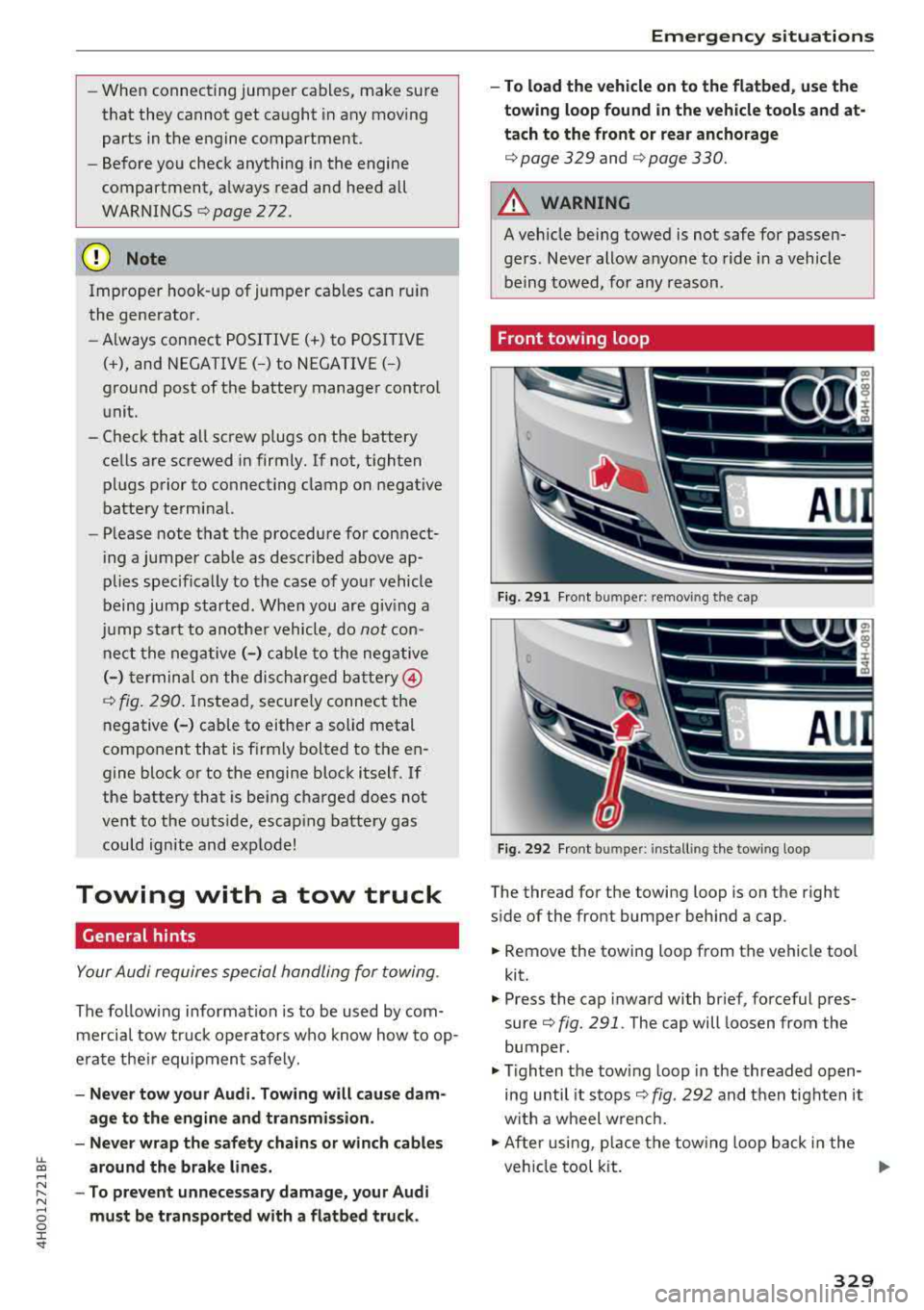
Front towing loop
Fi g. 291 Fron t bu mpe r: removing t he cap
Fig. 292 Fron t bu mpe r: insta llin g the tow ing loop
The thread for the towing loop is on the right
s ide of the front bumper beh ind a cap.
.,. Remove the towing loo p from the vehicle too l
kit.
.,. Press the cap inward with brief, forceful pres
sure
c> fig. 291 . The cap will loosen from the
bumper.
.,. T igh ten the tow ing loop in the threaded open
ing until it stops
c> fig. 292 and t hen tighten it
w ith a wheel w re nc h .
.,. Afte r usi ng, p lace the tow ing loop b ack in the
veh icle tool kit.
IJJ>-
329
Page 333 of 356
lL t:0 ....
"' ......
"' .... 0 0 :c '
Lifting with workshop hoist and with floor
jack
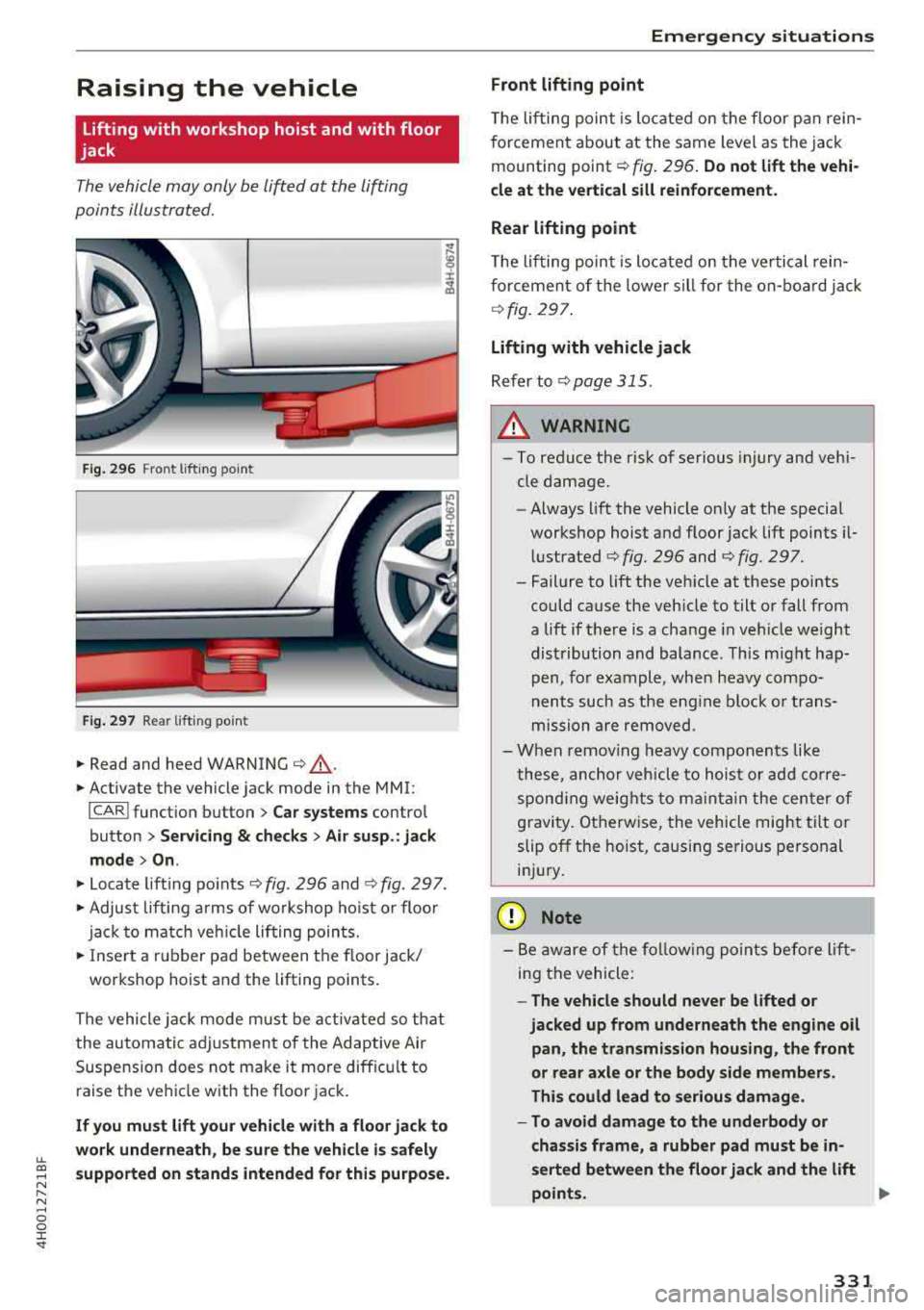
The vehicle may only be lift ed at the lifting
points illus tr at ed.
Fig. 296 Fro nt lift in g poin t
Fig. 29 7 Rear lift ing poin t
.,. Read and heed WARNING c::> &, .
.. Activate the veh icle ja ck mode in the MMI :
I CARI funct ion button> Car systems control
button >
Servicing & checks > Air susp.: jack
mode > On .
.. Loca te lift ing po ints c::> fig . 296 and c::>fig . 297 .
.. Adju st lifting arms of wo rkshop ho ist o r floo r
ja ck t o ma tch vehicle li fting poin ts.
.. In se rt a rubb er pa d between the floor j ack/
wor kshop ho ist and the lifting points .
T he vehicle ja ck mode m ust be a ct iv a te d so th at
the au tomatic a djustment of the Ad aptive Air
Suspension does not m ake it more diffic ult to
raise the ve hicle wit h the floor jack.
If you must lift your vehicle with a floor jack to
work underneath , be sure the vehicle is safely
supported on stands intended for this purpose .
Emergency situations
Front lifting point
The lifting poi nt is locate d on the floor p an rein
f o rcement about at the same level as the ja ck
mounting point
c::> fig . 296 . Do not lift the vehi
cle at the vertical sill reinforcement .
Rear lifting point
T he lifting p oin t i s lo cate d on the ve rtic al rei n
f o rceme nt o f th e lower s ill for the on- bo ar d jac k
c::>fig. 297 .
Lifting with vehicle jack
Refer to c::> pag e 315 .
A WARNING
- To reduce the r is k of se rious inju ry and veh i
cle dama ge.
- Always lift the vehicle o nly at the specia l
wor kshop h oist a nd f loor jack lift points
il
l ustrated c::> fig. 296 and c::> fig. 297.
- Failure to lift t he ve hicle at these points
could cause the veh icle to tilt o r fall from
a lift i f there is a change in vehicle weight
dist ribution and balance . This might hap
pen, fo r example, when h eavy compo
nents such as the eng ine block o r trans
missi on are re moved .
- Whe n re mov ing heavy comp onents like
these, an ch or veh icle t o hois t or ad d co rre
spon ding weig hts t o m aintai n the cen ter of
g ravi ty . Ot herw ise, the vehicle mig ht tilt or
slip off t he hoist, caus ing se rio us pe rsonal
i njur y .
(D Note
- Be aw are of the fo llow ing po ints b efor e lift
ing the vehicle:
-The vehicle should never be lifted or
jacked up from underneath the engine oil
pan, the transmission housing, the front
or rear axle or the body side members.
This could lead to serious damage .
- To avoid damage to the underbody or
chassis frame, a rubber pad must be in
serted between the floor jack and the lift
points .
.,.
331
Page 335 of 356

lL t:0 ....
"' ......
"' .... 0 0 :c '
Vehicle specifications
XXXXX XX · X · XXXX XXX xx
®-+ IAHRZG.-IOEN T · NR. Vllllll • WIT • NO. XXXXXXXX XX X XXXXX XXX
TYP /Tffl XXX XXX
xx xxxxxxx xx xx
xx
XXX KW XXX
~ t!lll /TRANS. lllllE xxxx XXX XXX ®-t 11)10111<8./GllllkS .
©+ IAO(NR.I IN NENAllSSl.
XXXX I XXXX XXX I XX PAI NT liO./ ffT[JIQI
II. · AIJSlit / OPTIONS
EOA 7D 5 4U B 6XM SSG SR W
2 EH JO Z 1LB 1AS 1 BA
3FC S MU 7Xl
F O A 9G3 OG7 O YH OJF
TL 6 3 KA 8EH UlA X 9B OZ7
l XW
803
908 8Z4 020
7 T6 CV7
71<0 4X3 21< 2
3L4 4 KC 3YO 413 5 02
1S A 7GB
01A 4GQ
XX . X XX X XX X xxxx
Fig. 298 Vehicle ident ifica tion labe l
Vehicle Identification Number (VIN )
The VIN n umber is located in the following pla
ces :
0
0
~ :x:
func tion b utton > Car sy stem s contro l bu tton >
Serv ice
& control > VIN number .
-on the vehicle identification label
- under the w indshield on the dr iver's side
Vehicle identification label
The vehicle identification l abe l¢ fig. 298 is locat
ed in the luggage compartment under the cargo
floor cover in the spare wheel well.
The information of the vehicle identification labe l
can also be found in your Warranty
& Mainte
nance booklet.
Technical data
T he sticke r contains the fo llow ing vehicle data:
(D Vehicle Identificat ion Numbe r (VIN)
@ Vehicle type, eng ine output, transm iss ion
@ Engine and transmission codes
@ Paint and interior codes
® Optional equipment numbers
Safety compliance sticker
T he safety compliance sticker is yo ur ass ura nce
that your new veh icle complies w ith all applicable
Federal Motor Vehicle Safety Standards which
were in effect at the time the vehicle was man u
factu red. Yo u can find this st icker on the door
jamb on the driver's side. It shows the month and
year of production and the ve hicle identificat ion
numbe r of your ve hicle (perforation) as well as
t h e Gross Vehicle Weight Rat ing (GVWR) a nd the
G ross Axle We igh t Rating (GAWR).
High voltage warning label
The high voltage warning label is located in the
engine compartme nt next to the engine hood re
lease. The spark ignition system comp lies with
the Canadian standard ICES-002 .
Notes about technical
data
T he values may vary b ased on s pecial eq uipmen t
as well as market -specific equipment and meas
u ring methods .
Please note that the specifications listed in the
vehicle documen ta ti on a lways take prece den ce.
(D Tips
Missing tec hnical data was no t ava ilable at
the time of pr int ing.
333
Page 339 of 356
u. co .... N
" N .... 0 0 :c '
scope of maintenance and repairs which can be
carried out by veh icle owners.
Al so , sa fet y a nd
en vironmental
concerns place very strict limits
on the nature of repairs and adjustments to en
g ine and transm ission parts wh ich a n owner can
perform .
Maintenance, adjustments and repairs usually re
qu ire special tools, test ing devices and other
equ ipment available to specially trained work
shop personnel in order to assure proper per
formance, re liability a nd safety of the veh icle and
its many systems .
Improper maintenance, adjustments and repairs
can impair the operation and reliab il ity of your
ve hicle and even void your veh icle warranty .
Therefo re, proof of se rvicing in accordance w ith
the ma intenance schedule may be a condition fo r
upho ld ing a possib le warranty claim made within
the warranty period.
Above all , ope rational safety can be adversely af
fected, creating unnecessa ry risks fo r yo u and
your passengers.
I f in do ubt about any servicing, have it done by
your author ized Audi dealer or any other prope rly
eq uipped and qua lified workshop. We strongly
u rge yo u to g ive your author ized Audi dealer the
opportunity to perform a ll scheduled mainte
nance and necessary repairs. Your dealer has the
facilities, original parts and trained specialists to keep your veh icle running properly .
Pe rforming limit ed maint enanc e yourself
The fo llowing pages describe a limited number of
procedures which can be performed on your ve hi
cle with ordinary tools, should the need arise and
trained personnel be unavailable. Before per
forming any of these procedures, always thor
oug hly read a ll of the app licable text and careful
ly follow the instructions g iven . Always rigorously
observe the
W ARNINGS prov ided .
Before you check an ything in the eng ine com
partment , alw ays read and he ed all WARNINGS
c:> &. and c:> &. in Working in the engine compart
ment on page 2
72 .
Con sum er In form ation
A WARNING
--
- Ser ious personal injury may occur as a result
of improperly performed maintenance, ad
justments or repairs .
- Always be extremely careful when work ing
on the vehicle . Always follow commonly ac
cepted safety practices and general com mon sense. Never risk pe rsonal inj ury.
- Do not attempt any of the maintenance,
checks or repairs described on the following pages if you are not fu lly famil iar with these
or other proced ures with respec t to the ve
h icle, or are uncerta in how to pro ceed.
- Do not do any work without the proper tools
and eq uipment. Have the necess ary wo rk
done by your authorized Audi dealer or an
other proper ly equipped and qualified work
shop.
- The engine compartment of any motor vehi
cle is a potentially hazardous area . Never
reach into the area around or touch the radi
ator fan.
It is temperature controlled and
can switch on suddenly - even when the en
g ine is off . The radiator fan switches on au
tomatically when the coolant reaches a cer
tain tempe rature and will cont inue to run
until the coolant temperature d rops.
- Always sw itch off the ignition before anyone
gets under the vehicle.
- Always support your veh icle with safety
stands if it is necessary to work underneath
the vehicle. The jack suppl ied with the veh i
cle is no t adequate for this pu rpose and
could collapse caus ing serious personal in
jury.
- If you must wor k unde rne ath the vehicle
with the wheels on the ground, always make
sure the vehicle is on level ground, that the
wheels a re always sec urely blocked and that
the engine cannot be started.
- Always make sure the transmission se lector
lever (automatic transmiss ion) is in
"P"
(Park position) and the pa rk brake is ap
plied.
337