weight AUDI A8 2018 Owner's Manual
[x] Cancel search | Manufacturer: AUDI, Model Year: 2018, Model line: A8, Model: AUDI A8 2018Pages: 356, PDF Size: 54.71 MB
Page 250 of 356
Airbag syste m
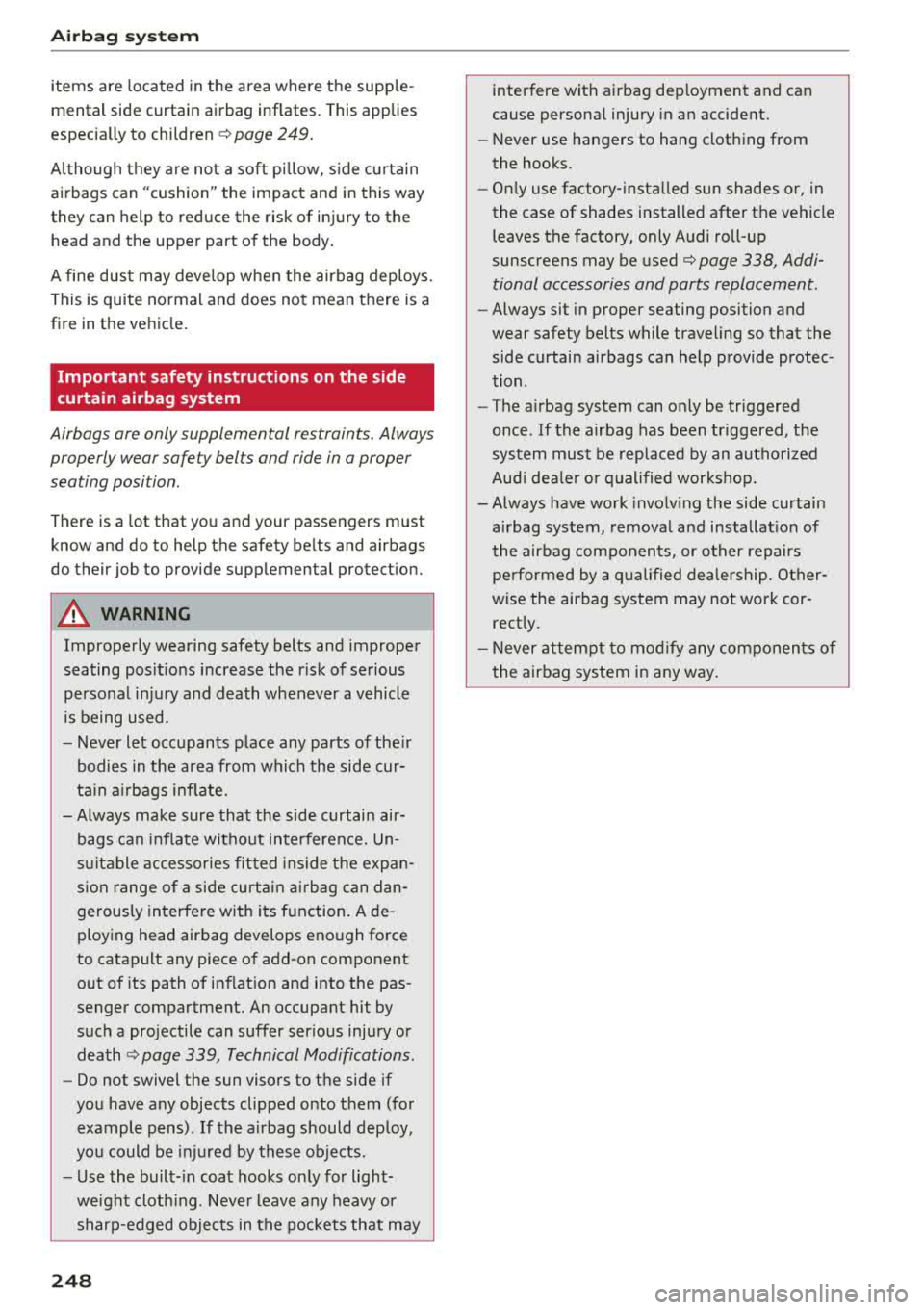
items are located in the area where the supp le
mental side curtai n airbag inflates . This applies
especia lly to
children ¢ page 249 .
Although they a re not a soft p illow, s ide c urtain
airbags can "cushion" the impact and in this way
they can help to reduce the risk of injury to the head and the upper part of the body .
A fine dus t may deve lop when the airbag deploys.
This is quite normal and does not mean there is a
fire in the vehicle .
Important safety instructions on the side
curtain airbag system
Airbags are only supplemental restraints. Always
properly wear safety belts and ride in a proper
seating position.
There is a lot that you and your passengers must
know and do to help the safety be lts and airbags
do their job to provide supp lemental protect ion.
A WARNING
Improperly wearing safety belts and improper
seating posit ions increase the risk of serious
personal injury and death whenever a vehicle
is being used .
- Never let occ upants place any parts of the ir
bodies in the area from which the side cur
ta in a irbags inflate.
- Always make sure that the side curtain air
bags can inflate witho ut interference. Un
s u itable accessories fit ted inside the expan
sion range o f a side curtain airbag can dan
gerously interfere with its function. A de
ploying head airbag develops enough force
to catapult any piece o f add-on component
o ut of its path of inflat ion and into the pas
senger compartment. An occupant hit by
s u ch a projectile can suffer ser ious injury or
death ¢ page 339, Technical Modifications .
-Do not swivel the sun visors to the side if
yo u have any objects clipped onto them (for
example pens) . If the airbag should deploy,
you could be injured by these objects.
- Use the built- in coat hooks on ly for light
weight cloth ing . Neve r leave any heavy or
sharp-edged objects in t he pockets that may
248
inter fere with a irbag deployment and can
cause persona l injury in an accident.
- Never use hangers to hang clothing from
the hooks.
- On ly use factory-insta lled sun shades or, in
the case of shades installed after the vehicle leaves the factory, only Audi roll-up
sunscreens may be
used¢ page 338, Addi
tional accessories and parts replacement .
-Always sit in p roper seating position and
wear safety belts while traveling so that the
side curtain airbags can help p rovide protec
tion .
- The a irbag system can only be triggered
once . If the airbag has been triggered, the
system must be replaced by an autho rized
Aud i dea le r o r qualified workshop.
- Always have wo rk involv ing the side curtain
airbag system, remova l and installat ion of
the airbag components, or other repairs pe rformed by a qualified dealers hip . Other
wise the airbag system may not work cor
rectly.
- Never attem pt to mod ify any com ponen ts of
the airbag system in any way .
Page 251 of 356
u. co .... N
" N .... 0 0 :c '
Important information
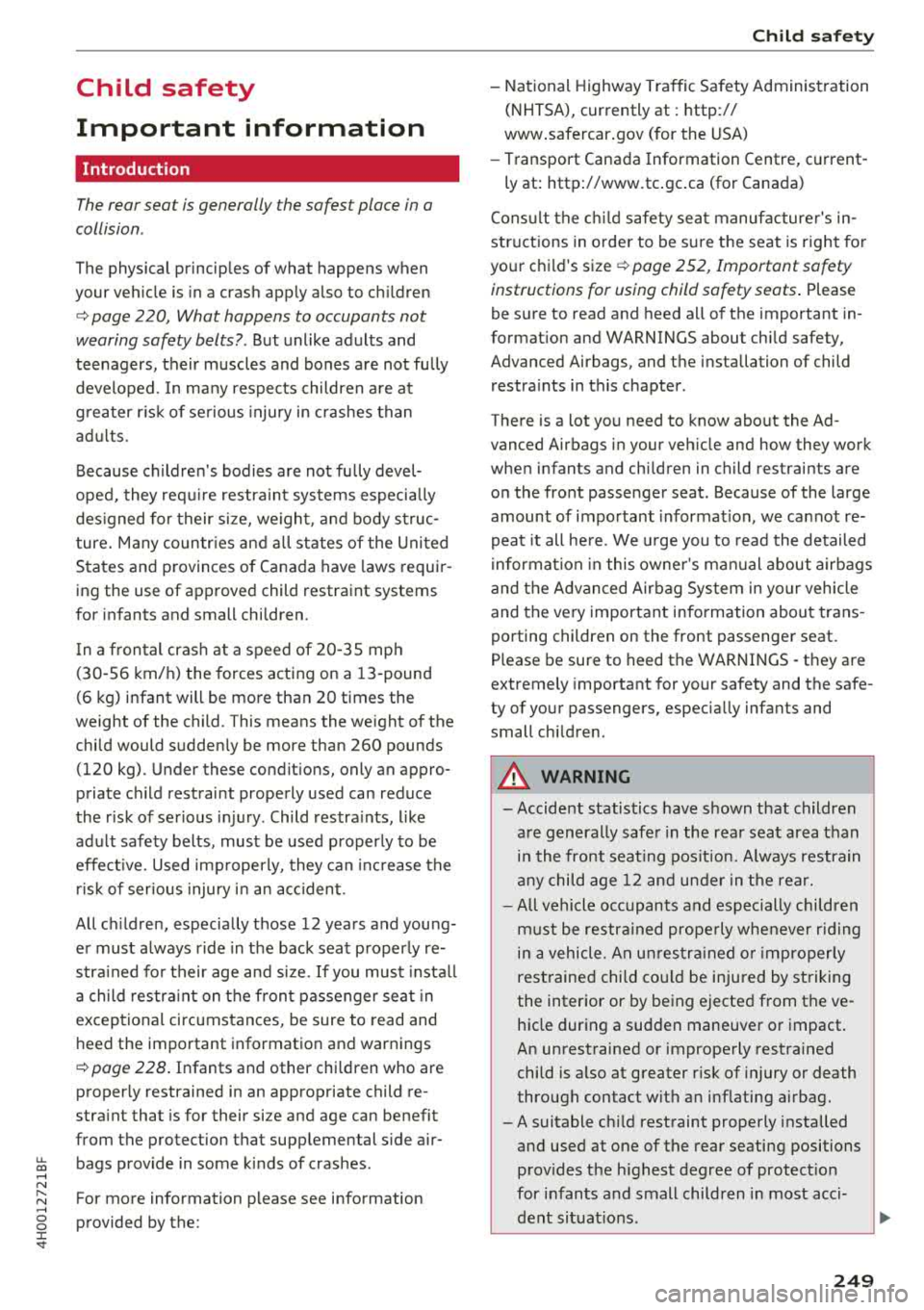
Introduction
The rear seat is generally the safest place in a
collision .
The physical principles of what happens when
your vehicle is in a crash apply also to children
c> page 220, What happens to occupants not
wearing safety belts? .
But unlike adults and
teenagers, their muscles and bones are not fully
developed. In many respects children a re at
greater r isk of se rious injury in c rashes than
ad ults .
Because ch ildren's bodies are not fully devel
oped, they requ ire restra int systems especially
des igned for their size, we ight, and body struc
ture. Many coun tries and a ll states of the United
States and p rovinces of Canada have laws requi r
ing the use of approved child restraint systems
for infants and small children .
In a frontal crash at a speed of 20 -3 5 mp h
(30-56 km/h) the forces acting on a 13-pound
(6 kg) infant will be more than 20 times the
weight of the child. This means the weight of the
child would sudden ly be more than 260 pounds
(120 kg) . Under these condit ions, only an appro
priate ch ild restraint properly used can reduce
the r isk of serious injury . Child restra ints, like
adu lt safety belts, must be used properly to be
effect ive. Used imp roperly, they can increase the
risk of ser ious injury in an acc ident .
All ch ildren, especially those 12 years and young
er must a lways r ide in the back seat properly re
stra ined fo r their age and size. If you must insta ll
a child restra int on t he front passenger seat in
exceptional circumstances, be sure to read and h eed the important information and warnings
c> page 228. Infants and other chi ldren who are
properly restrained in an appropriate child re
stra int that is for their size and age can benefit
from the protection that supplemental s ide air
bags provide in some kinds of crashes.
For more information please see information
provided by the:
Ch ild saf ety
- National Highway Traffic Safety Administration
(NHTSA), currently at: http ://
www .safercar .gov (for the USA)
- Transport Canada Information Centre, current-
ly at: http://www .tc .gc .ca (for Canada)
Cons ult the ch ild safety seat manuf acture r's in
structions in order to be sure t he seat is right for
yo ur chi ld's size
c> page 252, Important safety
instructions for using child safety seats .
Please
be sure to read and heed all of the important in
format ion and WARNINGS about ch ild safety,
Advanced Airbags, and the installation of child
restra ints in this chapter .
There is a lot you need to know about the Ad
vanced Airbags in your veh icle and how they work
whe n infants and children in child restraints are
on the fro nt passenger seat . Because of the large
amount of important informat ion, we cannot re
peat it all he re . We u rge you to read the detailed
i nformat ion in this owner 's ma nual about airbags
and the Advanced Airbag Sys tem in yo ur veh icle
and the very important information about trans
porting children on the front passenger seat.
Please be sure to heed the WARNINGS -they are
extremely important for your safety and the safe
ty of your passengers, especially infants and
small ch ildren .
A WARNING
-
-Accide nt statistics have shown that children
are generally safer in the rear seat area than
i n the front seat ing pos it ion. Always restrain
a ny child age 12 and unde r in t he rear.
- All vehicle occupants and especially children
m ust be restra ined prope rly whe never r id ing
i n a vehicle. An u nres tra ined o r improperly
rest rained chi ld cou ld be inju red by st riking
the interio r or by being ejected from the ve
hicle during a sudden maneuver or impact.
An unrestrained or improperly restrained
child is a lso at greater r isk of injury or death
through contact w it h an inflating a irbag.
- A suitable ch ild restraint properly installed
and used at one of the rear seating positions
prov ides the h ighest degree of protect io n
for infants and small children in most acc i
dent situat ions .
249
Page 253 of 356
u. co .... N
" N .... 0 0 :c '
The Advanced Airbag System in your vehicle de
tects the presence of an infant or child in a child restraint on the front passenger seat using the
weight-sensing mat in the seat cushion and the
sensor be low the safety belt latch on the front
passenger seat that measures the tension on the
safety belt.
The weight-sensing mat measures total weight
of the ch ild and the child safety seat and a ch ild
blanket on the front passenger seat. The weight
on the front passenger seat is related to the de
sign of the ch ild restraint and its "footprint", the
size and shape of the bottom of t he chi ld re
str aint as it sits on the seat. The weight of a child
restraint and its "footprint" vary for d ifferent
kinds o f child restraints and for the different
models of the same kind of child restraint of
fered by child restraint manufact urers.
The weight ranges for the individua l types,
makes and models of child restraints that the
NHTSA has specified in the Safety Standard to
gether with the weight ranges of typical infants
and typical 1 year-o ld child have been stored in
the control unit of the Advanced A irbag System.
When a child restraint is being used on the front passenger seat with a typ ical 1 year-old child, the
Advanced A irbag System compares the we ight
measured by the we ight sensi ng mat w ith the in
formation stored in the electronic contro l uni t.
The electron ic control u nit also registers the ten
sion on the front passenger safety belt. The ten
sion on the safety belt for the front passenge r
seat will be d iffe ren t fo r an ad ult who is p roperly
using the safety belt as compared to t he tension
on the belt when it is used to attach a c hild re
straint to the seat . The sensor below the latch for
the safety belt for the front seat passenger
measures the tens ion on the belt. The input from
this sensor is then used w ith the weight to "de
cide", whether there is a child restra int w ith a
typical 1 year-old child on the front passenge r
seat and w hethe r or not the airbag must be
turned off.
Ch ild saf ety
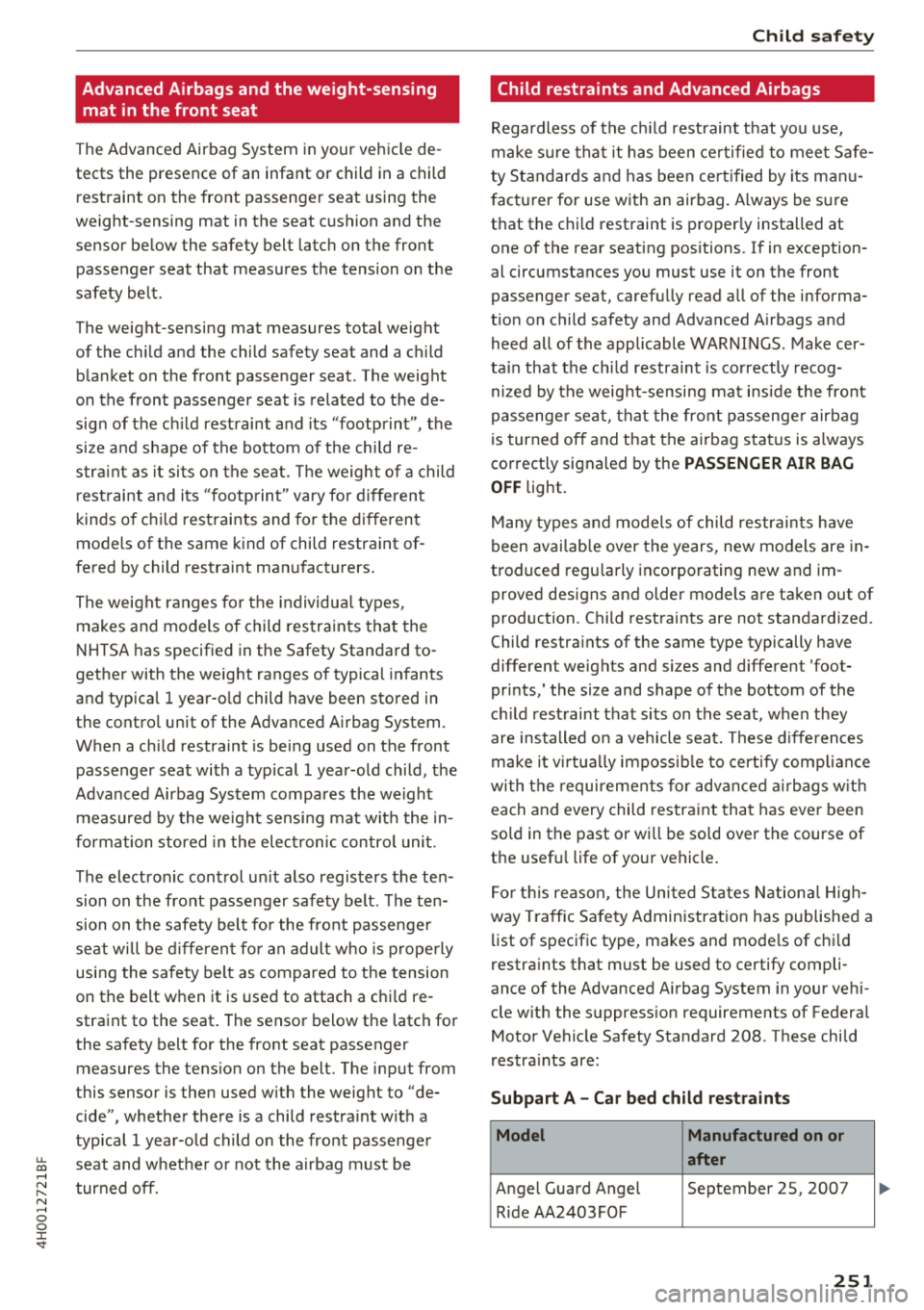
Child restraints and Advanced Airbags
Regardless of the c hild restraint t hat yo u use,
make s ure tha t it has been ce rt ified to mee t Safe
ty Standards an d has been cert ified by its man u
f act urer for use with an airbag. A lways be sure
t h at the c hild restraint is properly installed at
one of the rear seating positions. If in exception
al circumstances you must use it on the front
passenger seat, careful ly read all of the informa
t ion on child safety and Advanced A irbags and
heed all of the applicable WARNINGS. Make cer
ta in that the ch ild restraint is co rrectly recog
nized by the weight-sensing mat ins ide the front
passenge r seat, that the front passenge r airbag
is turned off and that the a irbag sta tus is always
correctly signaled by the
PASSENGER AIR BAG
OFF
light .
M any types and models of child restra in ts h ave
been avai lab le over the years, new models are in
t roduced regu larly incorporating new and im
proved designs and older models are taken out of
production. Child restraints are not standardized.
Child restra ints of the same type typically have
different weights and sizes and different 'foot
prints,' the size and shape of the bottom of the
ch ild rest raint that sits on the seat, when they
are installed on a vehicle seat. These d iffe rences
make it v irtu a lly imposs ib le to cert ify comp lian ce
wi th t he requi rements for adv anced airbags w it h
each and every child restra int tha t has ever been
sold in the past or wi ll be so ld over the course of
the usef ul life of your vehicle .
F o r thi s reason, the Uni ted Sta tes N ation al High
way Traffic Sa fety Admin istrat ion has published a
li st of specific type, makes and mode ls of chi ld
restraints that must be used to certify compli
ance of the Advanced Airbag System in your ve hi
cle w it h the suppress ion requirements of Federal
Motor Vehicle Safety Standard 208. These chi ld
restra ints are:
Subpart A - Car b ed child restraints
Model Manufactured on or
after
Angel Guard Angel September 2S, 2007 Ride AA2403FOF
251
Page 254 of 356
Child safety
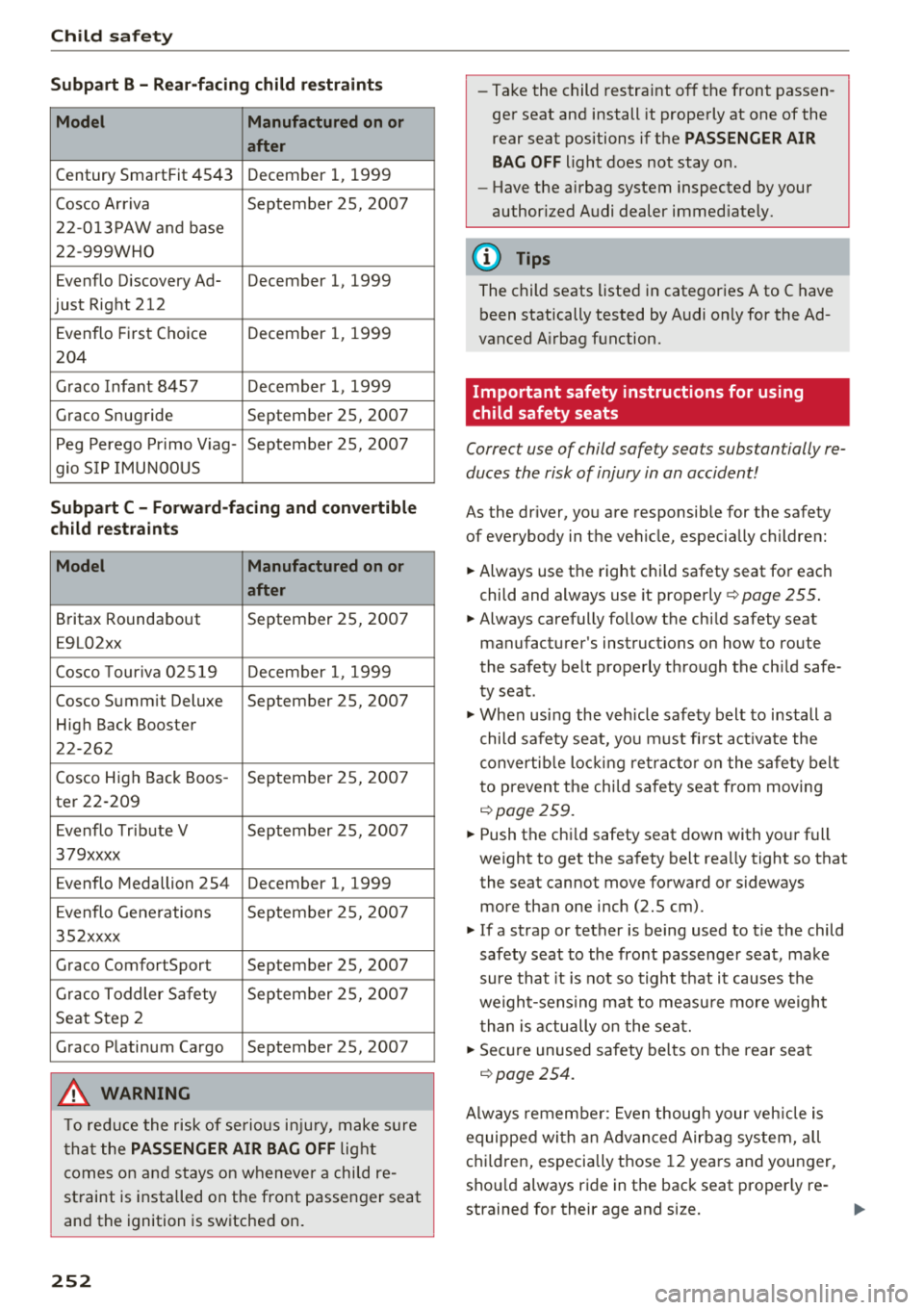
Subpart B - Rear-facing child restraints
Model Manufactured on or
after
Century SmartFit 4543 December 1, 1999
Cosco Arriva September 2S, 2007
22-013PAW and base
22-999WHO
Evenflo Discovery Ad- December 1, 1999
just Right 212
Evenflo First Choice December 1, 1999
204
Graco Infant 84S7 December 1 , 1999
Graco Snug ride September 25, 2007
Peg Perego Primo Viag- September 2S, 2007
gio S IP IMUN00US
Subpart C -Forward -facing and convertible
child restraints
Model Manufactured on or
after
Britax Roundabout September 2S, 2007
E9L02xx
Cosco Tour iva 02S19 December 1, 1999
Cosco Summ it Deluxe September 25, 2007
High Back Booster
22-262
Cosco High Back Boos-
September 25, 2007
ter 22-209
Evenflo Tribute V September 25, 2007
379xxxx
Evenflo Medallion 254 December 1, 1999
E venflo Generations September 25, 2007
352xxxx
Graco ComfortSport September 25, 2007
Graco Toddler Safety September 25, 2007
Seat Step 2
Graco Platinum Cargo September 25, 2007
A WARNING
To reduce the risk of serious injur y, make sur e
that the
PASSENGER AIR BAG OFF l ig ht
co mes on and stays on whenever a chi ld re
straint is installed on the front passenger seat
and the ignition is switched on.
252
-Take the child restraint off the front passen
ger seat and install it properly at one of the
rear seat positions if the
PASSENGER AIR
BAG OFF
light does not stay on.
- Have the airbag system inspected by your
author ized Audi dealer immed iately.
(D Tips
The child seats listed in categories A to C have
been statically tested by Audi only for the Ad
vanced Airbag function.
Important safety instructions for using
child safety seats
Correct use of child safety seats substantially re
duces the risk of injury in an accident!
As the dr iver, you are responsible for the safety
of everybody in the vehicle, especia lly children:
.,. Always use the right child safety seat for each
child and always use it properly
q page 255 .
.,. Always carefully follow the chi ld safety seat
manufacturer's instructions on how to route
the safety belt properly through the ch ild safe
ty seat .
.,. When using the vehicle safety belt to install a
child safety seat, you must first activate the
convertible locking retractor on the safety belt
to prevent the chi ld safety seat from moving
qpage 259.
.,. Push the chi ld safety seat down with your full
weight to get the safety belt really tight so that
the seat cannot move forward or sideways more than one inch (2.5 cm) .
.,. If a strap or tether is being used to tie the child
safety seat to the front passenger seat, make
sure that it is not so tight that it causes the
weigh t-sens ing mat to measure more weight
than is actually on the seat.
.,. Secure unused safety belts on the rear seat
,=;,page 254.
Always remembe r: Even though your vehicle is
equipped with an Advanced Airbag sys tem, all
children, especially those 12 years and younger,
shou ld always ride in the back seat proper ly re -
strained for their age and size.
.,,.
Page 257 of 356
Child safety seats
Infant seats
Babies and infants up to about one year old and
20 lbs. or 9 kg need special rearward -facing
child restraints that support the back, neck and
head in a crash .
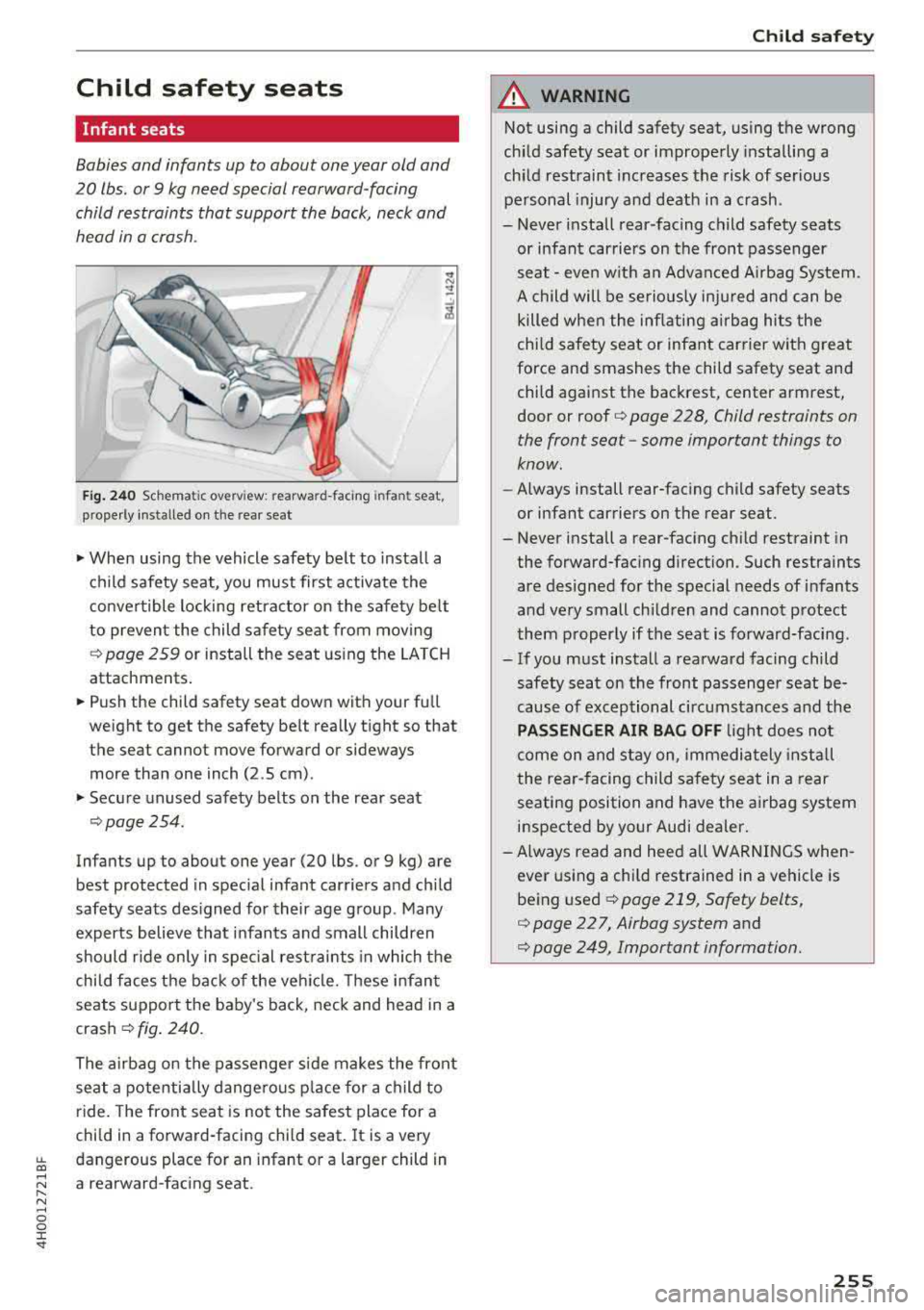
Fig. 2 4 0 Sche matic overview: rearward-facing infant seat,
properly installed on the rear seat
• When using the vehicle safety be lt to install a
child safety seat, you must first activate the
convertible locking retractor on the safety be lt
to prevent the child safety seat from moving
¢ page 259 or install the seat using the LA TCH
attachments.
• Push the child safety seat down with your full
weight to get the safety belt really tight so that
the seat cannot move forward or sideways
more than one inch (2.5 cm).
• Secure unused safety belts on the rear seat
¢page 254 .
Infants up to about one year (20 lbs. or 9 kg) are
best protected in spec ial infant carriers and child
safety seats des igned for their age group . Many
experts believe that infants and small children
should ride only in spec ial restraints in which the
chi ld faces the back of the veh icle. These infant
seats support the baby 's back, neck and head in a
crash
c!;> fig . 240.
The airbag on the passenger side makes the front
seat a potentially dangero us p lace for a child to
ride. The front seat is not the safest place for a
chi ld in a forward -facing child seat . It is a very
lL dangerous place for an infant or a larger child in t:0
;:::: a rearward-facing seat.
" N ...... 0 0 :c '
A WARNING
Not using a child safety seat, using the wrong
child safety seat or improperly installing a
child restraint increases the risk of ser ious
personal injury and death in a c rash .
-Never install rear-facing child safety seats
or infant car riers on the front passenger
seat
-even w ith an Advanced A irbag System .
A child will be serio usly inj ured and can be
killed when the inf lating airbag hits the
chi ld safety seat or infant carrier with great
force and smashes the child safety seat and
child against the backrest, center armrest,
door or roof
c!;> page 228, Child restraints on
the front seat
-some important things to
know.
- Always install rear-fac ing child safety seats
or infant carriers on the rear seat.
-Never install a rear-facing child restraint in
the forward-fac ing direction . Such restraints
are designed for the special needs of infants
and very small children and cannot protect
them p roperly if the seat is forward-facing .
-If you must install a rearward facing child
safety seat on the front passenger seat be
cause of exceptional circumstances a nd the
PASSENGER AIR BAG OFF li ght does not
come on and stay on, immedia tely install
the rea r-facing child sa fety seat in a rear
seating position and have the a irbag system
inspected by your Audi dealer .
-A lways read and heed all WARNINGS whe n
ever using a child restrained in a vehicle is
be ing used
c!;> page 219, Safety belts,
c!;> page 227, Airbag system and
c!;> page 249, Important information.
255
Page 258 of 356
Child safety
Convertible child safety seats
Properly used convertible child safety seats can
help protect toddlers and children over age one
who weigh between 20 and 40 lbs. (9 and 18 kg)
in a crash.
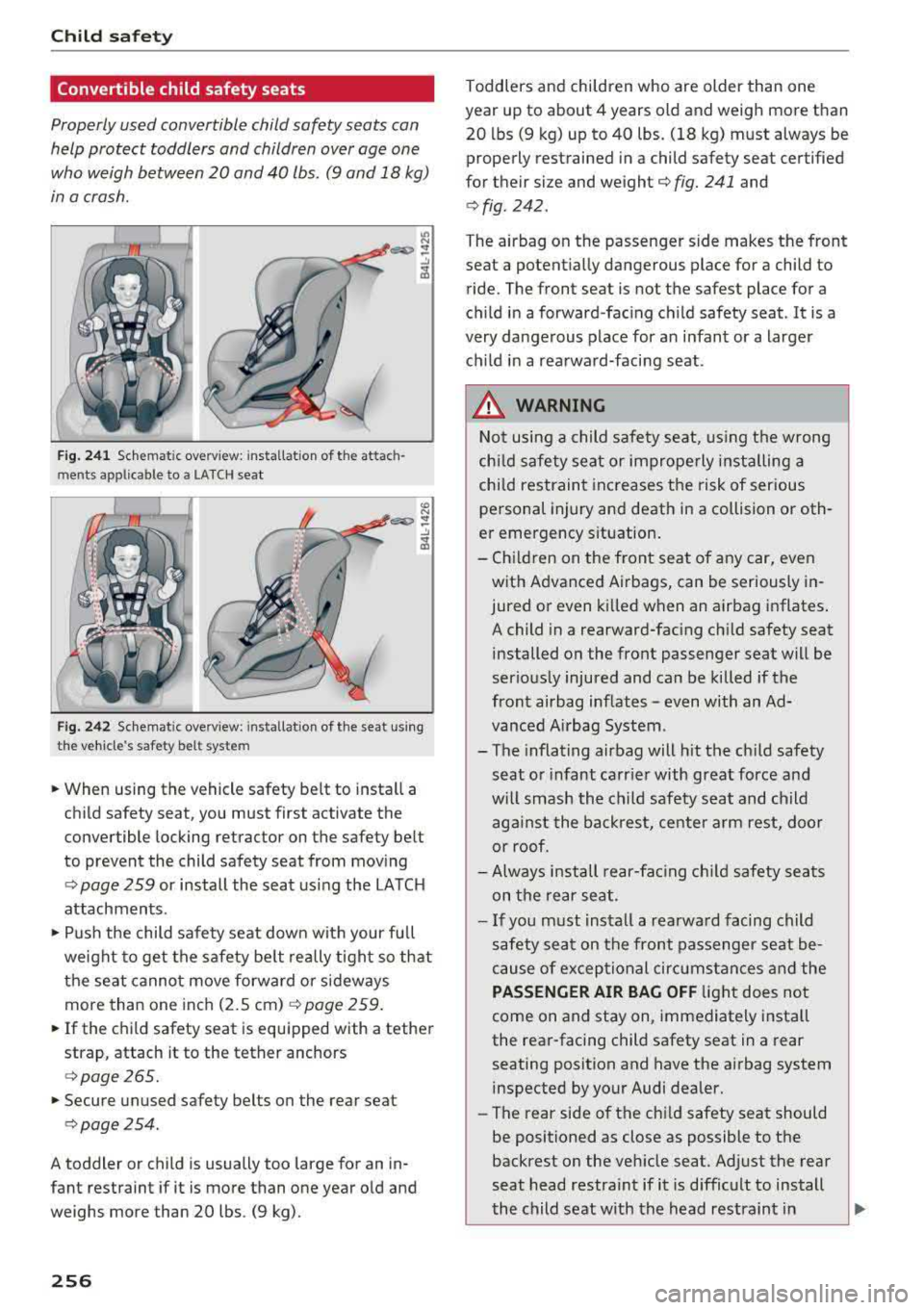
Fig. 241 Schematic overview: installat ion of the attach
ments app licable to
a LATCH seat
Fig. 242 Schematic overview: installat ion of the seat using
the vehicle 's safety belt system
... When using the vehicle safety belt to install a
child safety seat, you must first activate the
convertible locking retractor on the safety belt
to prevent the child safety seat from moving
c:>page 259 or install the seat using the LATCH
attachments .
... Push the child safety seat down with your full
weight to get the safety belt really tight so that
the seat cannot move forward or sideways more than one inch (2.5 cm)
c:>page 259.
... If the child safety seat is equipped with a tether
strap, attach it to the tether anchors
r::>page 265.
... Secure unused safety belts on the rear seat
r::>page254 .
A toddler or child is usually too large for an in
fant restraint if it is more than one year old and
weighs more than 20 lbs. (9 kg).
256
Toddlers and children who are older than one
year up to about 4 years old and weigh more than
20 lbs (9 kg) up to 40 lbs. (18 kg) must always be
properly restrained in a child safety seat certified
for their size and weight
c> fig. 241 and
c:>fig. 242 .
The airbag on the passenger side makes the front
seat a potentially dangerous place for a child to
ride. The front seat is not the safest place for a
child in a forward-facing child safety seat . It is a
very dangerous place for an infant or a larger
child in a rearward-facing seat .
.&_ WARNING
Not using a child safety seat, using the wrong
child safety seat or improperly installing a
child restraint increases the risk of serious
personal injury and death in a collision or oth
er emergency situation.
-Children on the front seat of any car, even
with Advanced Airbags, can be seriously in
jured or even killed when an airbag inflates. A child in a rearward-facing child safety seat
installed on the front passenger seat will be
seriously injured and can be killed if the
front airbag inflates -even with an Ad
vanced Airbag System .
-The inflating airbag will hit the child safety
seat or infant carrier with great force and
will smash the child safety seat and child
against the backrest, center arm rest, door
or roof.
-Always install rear-facing child safety seats
on the rear seat.
-If you must install a rearward facing child
safety seat on the front passenger seat be
cause of exceptional circumstances and the
PASSENGER AIR BAG OFF light does not
come on and stay on, immediately install
the rear-facing child safety seat in a rear seating position and have the airbag system
inspected by your Audi dealer .
- The rear side of the child safety seat should
be positioned as close as possible to the
backrest on the vehicle seat. Adjust the rear
seat head restraint if it is difficult to install
the child seat with the head restraint in
II>-
Page 262 of 356
Child sa fety
restraints on the front seat -some impor
tant things to know .
A WARNING
Always take special precautions if you must
install a forward or rearward-facing child re
straint on the front passenger's seat in excep
tional situations:
- Whenever a forward or rearward-facing
child restraint is installed on the front pas
senger seat, the
PASSENGER AIR BAG OFF
light must come on and stay on whenever
the ignition is switched on.
- If the PASSENGER AI R BAG OFF light does
not come on and stay on , perform the
checks descr ibed
~page 237, Monitoring
the Advanced Airbag System.
- T ake the ch ild restraint off the front passen
ger seat and install it p roperly at one of the
rear seat positions if the
PASSENGER AIR
B A G OFF
light does not stay on whenever
the ignition is switched on.
- Improper installation of chi ld restraints can
reduce their effectiveness or even prevent
them from providing any protection .
- An improper ly installed chi ld restraint can
interfere with the airbag as it deploys and
seriously injure or even kill the child.
- Always carefully follow the manufacturer's
instructions provided with the child safety
seat or carrier.
- Never place additional items on the seat
that can increase the total weight registered by the weight-sensing mat and can cause in
jury in a crash .
A WARNING
Forward-facing ch ild restraints:
- Always make sure the forward-facing seat has been designed and cert ified by its man
ufacturer for use on a front seat with a pas
senger front and side a irbag .
- Never put the forward-facing child restraint
up, against or very near the instrument pan
el.
-Always move the front passenger seat to
the h ighest position in the up and down
ad-
2 6 0
-
justment range and move it back to the
rearmost posit ion in the seat's fore and aft
adjustment range, as far away from the a ir
bag as poss ible, before install ing the for
ward-facing child restraint .
- Always make sure that the safety belt upper
anchorage is behind the ch ild restraint and
not next to or in front of the child restraint
so that the safety be lt will be properly posi
tioned.
- Make sure that the
PASSENGER AIR BAG
OFF
l ight comes on and stays on a ll the time
wheneve r the ignit ion is switched on.
A WARNING
Rearward-facing chi ld restraints:
- A child in a rearward-fac ing ch ild safety seat
installed on the front passenger seat will be
serious ly injured and can be killed if the
front airbag inflates -even with an Ad
vanced Airbag System.
- The inflating airbag will h it the ch ild safety
seat or infant carrier with great force and
will smash the child safety seat and child
aga inst the backrest, center armrest, door
or roof.
- Always be especially carefu l if you must in
stall a rearward facing child safety seat on
the front passenger seat in exceptiona l cir
cumstances .
- A t ight tether strap on a rearward-facing
child restraint attached to the front passen
ger seat can put too much pressure on the
weight-mat in the seat and reg ister a heav i
er weight in the Advanced Airbag System .
The heavier weight reg istered can make the
system work as though an ad ult were on the
seat and deploy the Advanced A irbag when
it must be suppressed causing serious or
even fata l injury to the child.
- Ma ke sure that the
PASSENGER AIR BAG
OFF
li ght comes on and stays on all the time
whenever the ignition is switched on .
- If the
PASSENGER AIR BAG OFF light does
not come on and stay on, immediately in
stall the rear-facing child safety seat in a rear seating posit ion and have the airbag
system inspected by your Audi dealer.
Page 268 of 356
Child safety
that could be caused by striking the vehicle inte
rior .
Forward facing child restraints manufactured af
ter September 1, 1999, are required by U .S. fed
eral regulations to comply with new child head
movement performance requirements. These
new performance requirements make a tether
necessary on most new child safety seats .
A WARNING
Improper installation of child restraints will
increase the risk of injury and death in a
crash.
- Always follow the instructions provided by
the manufacturer of the child restraint you intend to install in your Audi .
- Improper use of child restraint anchors (in
cluding tether anchors) can lead to injury in
a collision . The anchors are designed to
withstand only those loads imposed by cor rectly fitted child restraints.
- Never mount two child restraint systems on
one LATCH lower anchor point.
- Never attach two child restraint systems to
one tether strap or tether anchorage.
- Never attach a tether strap to a tie-down
hook in the luggage compartment.
- Never use child restraint tether anchorages
to secure safety belts or other kinds of occu pant restraints.
- Never secure or attach any luggage or other
items to the LATCH lower anchorages or to
the tether anchors.
- If a tether or other strap is used to attach a
child restraint to the front passenger seat,
make sure that it is not so tight, that it
causes the weight-sensing mat to measure
more weight than is actually on the seat.
- The heavier weight registered can make the
Advanced Airbag System work as though an
adult were on the seat and deploy the Ad
vanced Airbag when it must be suppressed causing serious or even fatal injury to the
child.
- If you must install a rearward facing child
safety seat on the front passenger seat be
cause of exceptional circumstances and the
266
'
PASSENGER AIR BAG OFF light does not
come on and stay on, immediately install
the rear-facing child safety seat in a rear
seating position and have the airbag system
inspected by your Audi dealer .
Installing the upper tether strap on the
anchorage
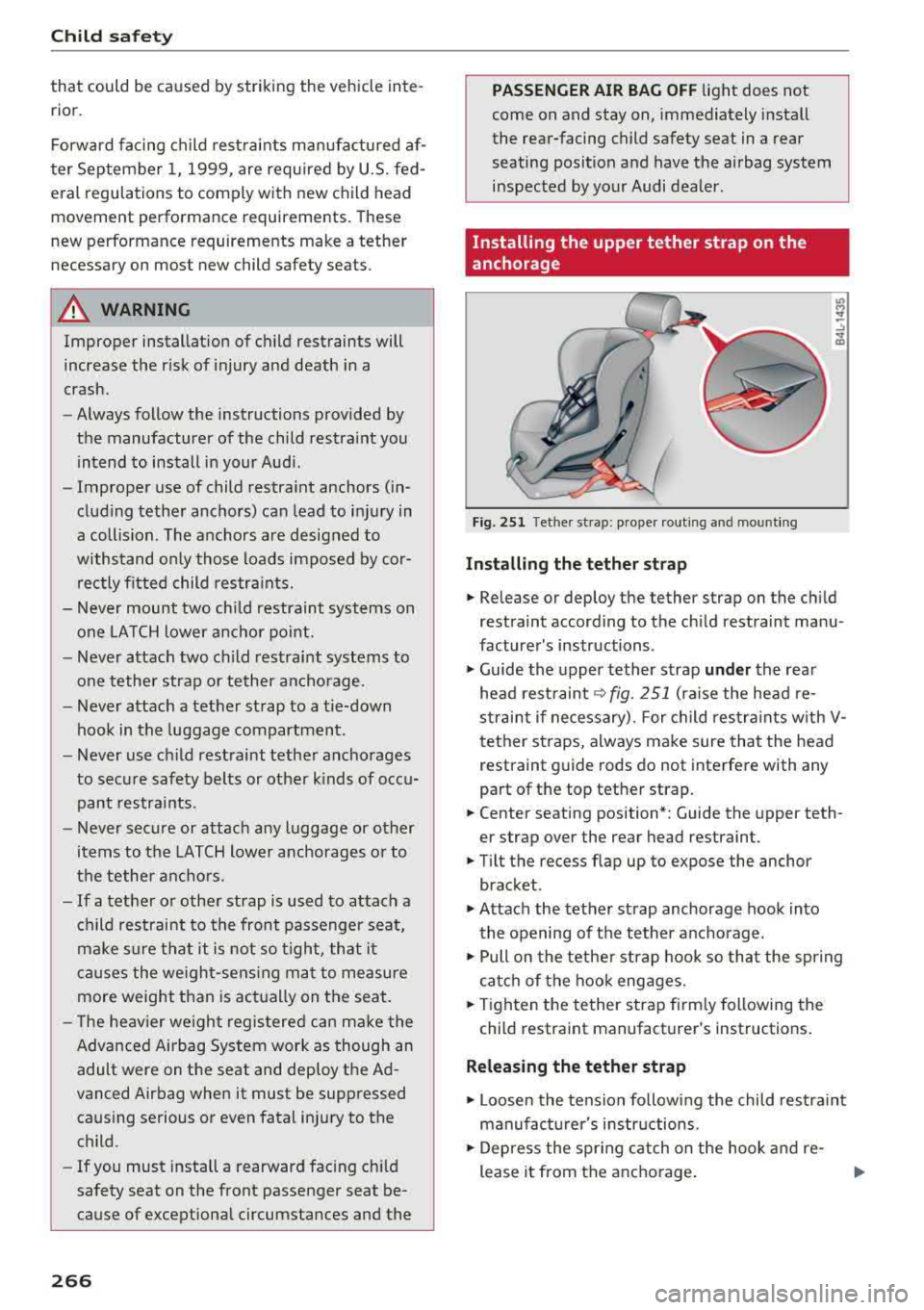
Fig. 251 Tet her s trap: pro per routing an d mo unting
Installing the tether strap
.,. Release or deploy the tether strap on the child
restraint according to the child restraint manu
facturer's instructions .
.,. Guide the upper tether strap under the rear
head
restraint ~ fig. 251 (raise the head re
straint if necessary). For child restraints with V
tether straps, always make sure that the head
restraint guide rods do not interfere with any
part of the top tether strap .
.,. Center seating position*: Guide the upper teth
er strap over the rear head restraint.
.,. Tilt the recess flap up to expose the anchor bracket .
.,. Attach the tether strap anchorage hook into
the opening of the tether anchorage .
.,. Pull on the tether strap hook so that the spring
catch of the hook engages.
.,. Tighten the tether strap firmly following the
child restraint manufacturer's instructions.
Releasing the tether strap
.,. Loosen the tension following the child restraint
manufacturer's instructions .
.,. Depress the spring catch on the hook and re
lease it from the anchorage.
Page 269 of 356
u. co .... N
" N .... 0 0 :c '
If you leave the child restraint with the tether
strap firm ly installed for severa l days, this
could leave a mark on the upholstery on the
seat cush ion and backrest in the area where
the tether strap was installed . The upholstery
would also be permanently stretched around
the tether strap . This applies especially to
leather seats .
Using tether straps on rearward-facing
child restraints
Current ly, few rear-facing chi ld restraint systems
come with a tether. Please read and heed the
child rest raint sys tem manufacturer 's instruc
tions carefully to determine how to properly in
stall the tether .
A WARNING
A child in a rea rward-facing ch ild safety seat
installed o n the fro nt passenge r seat w ill be
ser ious ly injured and can be killed if t he fron t
airbag infla tes -even w it h a n Advanced A irbag
System.
- T he inflat ing air bag w ill hit t he chi ld safety
sea t or infan t carrie r wi th g reat force and
wi ll smash the chi ld safety seat and chi ld
against t he backrest, center armrest, o r
door .
- A tight tether or other strap on a rearward
facing child restraint attached to the front
passenger seat can put too m uch pressure
on the weight-mat in the seat and register a
heav ier weight in the Advanced Airbag Sys
tem . The heav ier we ight registered can
make the system wo rk as though an adult
we re o n the seat and deploy the Adva nced
Airbag whe n it mus t be sup pressed ca u sing
ser ious o r even fa tal injur y to the c hild.
-If you must install a rearward fac ing c hild
safety seat on t he front passenger seat be
ca use of exceptiona l circumst ances and the
PASSENGER AIR BAG OFF lig ht does not
come on and stay on, immediate ly install
the rear-fac ing ch ild safety seat in a rear
seat ing pos it ion and have the airbag system
inspected by your Audi dealer.
Ch ild saf ety
Additional information
Sources of information about child
restraints and their use
T here are a number of sources o f additional in
formation about child restraint se lection, instal
l ation and use :
N HT SA advises that the best ch ild safety seat is
the one that f its your child and fi ts in your vehi
cle, and that you wi ll use correct ly and consis
tent ly.
T ry befo re yo u buy!
U.S . National Highway Traffic S afet y A dminis
tration
T el. : 1-888-3 27- 42 36 ( TTY: 1-800 -424-9153)
http:/ /www.nh tsa.gov
http:/ /www.sa ferca r.gov
National SAFE KIDS Camp aig n
Tel. : (202) 66 2-0600
http:/ /www.safekids .org
Safety BeltSaf e U.S .A
Te l.: (800) 745 -SA FE (E nglish)
T el. : (800) 747-SANO (Spanish)
http://www.ca rsea t.o rg
Tran sport C anada Information Centre
Tel. : 1-800-333-0371 o r ca ll 1 -613-998-86 16 if
yo u are in the Ottawa area
http://www.tc.gc.ca/ eng/ roadsafety/men u. h tm
Audi Cu stomer Relation s
Tel.: (800) 822-2834
267
Page 287 of 356
....
"' -N .... N
-0
0
J: ..
® Mud and snow capability
"M/S" or "M+S" indicates the tire
has properties making it suitable
to drive in mud or
snow .~ indi
cates a winter tire .
@ Composition of the tire cord
and m aterials
The number of plies indicates the
number of rubberized fabric lay
ers in the tire. In general : the
more layers, the more weight a
tire can carry . Tire manufacturers
must also specify the materials
used in the tire . These include
steel, nylon, polyester and other
materials .
@Maximum permitted load
This number indicates the maxi
mum load in kilograms and
pounds that the tire can carry .
@Uniform ti re quality grade
standards for treadwear,
traction and temperature resistance
Treadwear , traction and tempera
ture
ranges¢ page 299 .
@ Running direction
The arrows indicate the running
direction of unidirectional tires .
You must always follow the speci- fied running direction
¢
page 319.
@ Maximum permitted
inflation p ressure
Wh eel s
This number indicates the maxi
mum pressure to which a tire can
be inflated under normal operat
ing conditions.
Glossary of tire and loading
terminology
Accessory weight
means the combined weight (in
excess of those standard items
which may be replaced) of auto matic transmission, power steer
ing, power brakes, power win
dows, power seats, radio, and
heater, to the extent that these
items are available as factory-in
stalled equipment (whether in
stalled or not) .
Aspect ratio
means the ratio of the height to
the width of the tire in percent .
Numbers of 55 or lower indicate a
low sidewall for improved steer
ing response and better overall
handling on dry pavement .
285