automatic transmission AUDI ALLROAD 2000 User Guide
[x] Cancel search | Manufacturer: AUDI, Model Year: 2000, Model line: ALLROAD, Model: AUDI ALLROAD 2000Pages: 306, PDF Size: 9.95 MB
Page 138 of 306
---------------------CONTROLS AND
EQUIPMENT
Rear lid I door open
ind icator
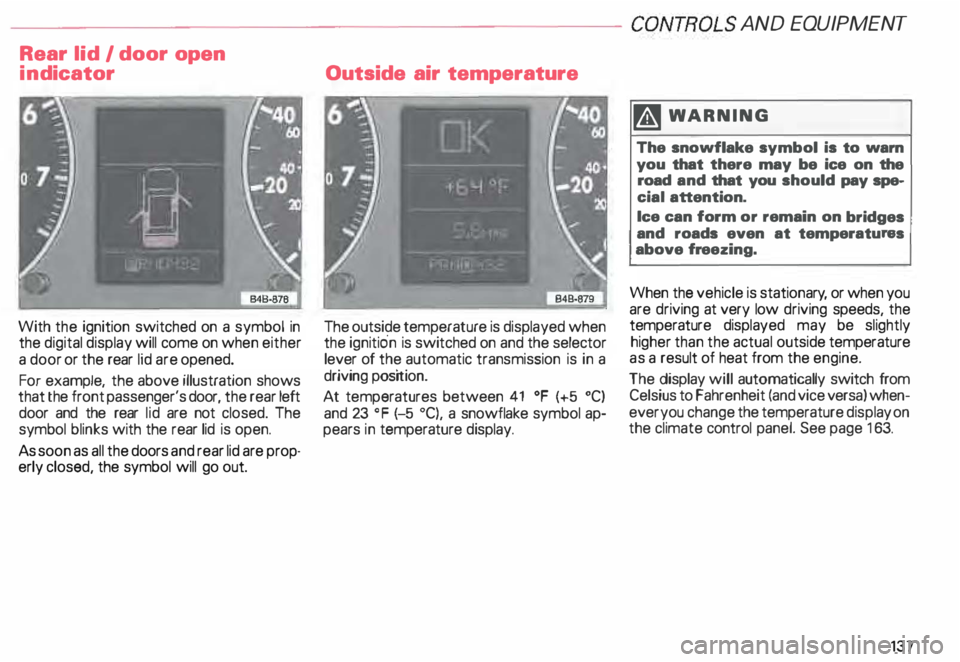
With the ignition switched on a symbol in
the digital display will come on when either
a door or the rear lid are opened.
For example, the above illustration shows
that the front passenger's door, the rear left
door and the rear lid are not closed. The
symbol blinks with the rear lid is open.
As soon as all the doors and rear lid are prop
erly closed, the symbol will go out. Outside air
temperature
The outside temperature is displayed when
the ignition is switched on and the selector
lever of the automatic transmission is in a
driving position.
At temperatures between 41 °F (+5 °C)
and 23 °F (-5 °C), a snowflake symbol ap
pears in temperature display. �W
ARNING
The snowflake symbol is to warn
you that there may be ice on the
road and that you should pay spe
cial attention.
Ice can form or remain on bridges
and roads even at temperatures
above freezing.
When the vehicle is stationar y, or when you
are driving at very low driving speeds, the
temperature displayed may be slightly
higher than the actual outside temperature
as a result of heat from the engine.
The display will automatically switch from
Celsius to Fahrenheit (and vice versa) when
ever you change the temperature display on
the climate control panel. See page 163.
137
Page 194 of 306
The
first 1,000 miles (1 500 km)
and afterwards
Break-in period
During the first few hours of driving, the en
gine's internal friction is higher than later
when all the moving parts have been broken
in. How well this break-in process is done
depends to a considerable extent on the
way the vehicle is driven during the first
1, 000 miles (1 500 kilometres").
For the first 600 miles
(1 000 kilometres):
As a rule of thumb:
• Do not use full throttle.
• Do not drive faster than 3/4 of top
speed shown on the speedometer.
• Avoid high engine speeds.
• If possible, avoid towing a trailer. �
WARNING
• New tires tend to be slippery
and must also be "broken-ln." Be
sure to remember this during the
first 300 miles (500 kilometres).
Brake gently. Avoid following
closely behind other vehicles or
other situations that might require
sudden, hard braking.
• New brake pads don't have the
best stopp ing power and must be
.. brok en-in" during the initial 100
to 150 miles (150 to 200 kilo
metres) of normal city driving. You
can compensate for this by press
ing the brake pedal more firmly.
This also applies later when new
pads are installed.
From 600 to 1,000 miles
(1 000 to 1 500 kilometres):
Speeds can gradually be increased to maxi
mum permissible road or engine speed. VE
HICL E OPER ATION
During and after break-in
period
• Do not rev the engine up to high speeds
when it is cold. This applies whether the
transmission is in N (Neutral) or in gear. dib Do not drive with unnece ssarily C!1'5 high engine speeds -upshifting
early saves fuel, reduces noise and
protects the environmeht -see also
page 195.
After the break-in period
Do not exceed maximum engine
speed under any circumstances. Up
shift into the next higher gear before reach
ing the red area at the end of the tachome
ter scale -see page 117.
Excessive engine speeds are automatically
reduced.
193
Page 205 of 306

VE
HICL E OPERA TION-----------------------
'4 WARN ING continued
• Before descending a steep
grade, reduce speed and shift
transmission into a lower gear or
lower driving position. Do not ride
the brakes or hold the pedal down
too long or too often. This could
cause the brakes to get hot and di
minish braking efficiency.
• If you damage the front spoiler,
or if you install a different spoiler,
be sure the air flow to the front
brakes is not obstructed. Other
wise the brake system could over
heat reducing the effective ness of
the entire brake system.
• Failure of one brake circuit will
impair the braking capability re
sulting in an increased stopping
distance.
Avoid driving the vehicle and have
it towed to the nearest Audi Dealer
or qualified workshop.
204 Electronic differential lock
(EDL)
The EDL operates in conjunction with the
ABS. The EDL acts automatically, i.e. with
out the driver's intervention.
With the aid of the ABS sensors, this sy
stem monitors the speed of the driven
wheels up to about 50 mph, 80 km/h .
Within the speed range at which this sy
stem operates, if the wheels spin (e.g. on
slippery surfaces) they are braked in a con
trolled manner , and more of the engine's
power is directed to whiche ver wheels
achieve greater traction.
Please note:
• When driving off, always be sure to keep
road conditions in mind as you accelerate.
If a drive wheel spins because it's on a slip
perier surface, gradually increase the pres
sure on the accelerator pedal until the car
starts to move. •
When accelerating on slippery surfaces,
such as on ice or snow, always be careful
when depressing the accelerator pedal.
Even with the EDL working, the drive
wheels can spin and reduce your ability to
control your car.
• To prevent the disc brake of the braked
wheel from overheating, if subjected to ex
cessive loads the EDL cuts out temporarily.
The vehicle remains operational and be
haves in the same way as a vehicle without
EDL
If a fault occurs in the ABS the EDL is also
not functioning. This is ind icated by the ABS
warning light-see page 125.
ftl WARNING
The increased safety afforded by
EDL does not mean that you can
take safety risks. Always adapt
your driving style to the road con
ditions and traffic situation.
Page 212 of 306
-----------------------VEHICL E OPER ATION
Tr ailer towing tips
Yo ur vehicle handles differently when tow
ing a trailer because of the additional weight
and weight distribution. Safety, perfor
mance and economy will greatly depend on
how carefully you load your trailer and oper
ate your rig.
Before you actually tow your trailer, practice
turning, stopping and backing up in an area
away from traffic until you learn the feel of
your vehicle and trailer unit.
Backing up is difficult and requir es practice.
Steering while backing up is generally oppo
site of that when backing your vehicle with
out a trailer.
Maintain a greater distance between your
vehicle and the one in front of you. You will
need more room to stop.
To compensate for the trailer, you will need
a larger than normal turning radius. When
passing, remember that you cannot
accelerate as fast as you normally would be
cause of the added load. Make sure you
have enough room to pass. After passing,
allow plenty of room for your trailer before
changing lanes again.
Avoid jerky starts, sharp turns or rapid lane
changes.
After parking, always block the wheels of
both vehicle and trailer. Do not park with a
trailer on a slope. If it cannot be avoided, do
so only after doing the following:
• Apply foot brake.
• Have someone place chocks under both
vehicle and trailer wheels.
• With chocks in place, slowly release
brakes until wheel blocks absorb the load.
• Turn wheels to curb.
o Apply parking brake.
• Place automatic transmission in "P". If
you move the selector lever of the auto
matic transmission to "P" before applying
the parking brake and before blocking the
wheels, you may require more force later to
move the lever out of the "P" position.
When restarting after parking on a slope, re
verse the procedure:
• Start the engine.
• Shift transmission into gear.
o Release the parking brake and slowly
move away from the wheel blocks.
• Stop and have someone retrieve the
wheel blocks.
Notes
• Do not tow a trailer during the
break-in period of your vehicle.
• If you tow a trailer, your Audi may require
more frequent maintenance due to the ex
tra load -see also page 228.
211
Page 231 of 306
VEHI
CLE CARE
J'4 WARN ING continued
• If you must work underneath
the vehicle with the wheels on the
ground, always make sure the ve
hicle is on level ground. that the
wheels are always securely
blocked and that the engine can
not be started. Always remove the
ignition key before anyone gets
under the vehicle.
Always make sure the transmis
sion selector lever (automatic
transmission) is in "P" (Park posi
tion) and the hand brake is firmly
applied.
• Always be extremely careful
when working on the vehicle. Always follow commonly accepted safety practices and general com
mon sense. Never risk personal in
jury.
230 �
Changing the engine settings
will adversely aHect emission
levels. This Is detrimental to the en
vi ronment and increases fuel con
sumption.
Always observe environmental reg
ulations when disposing of old en
gine oil. used brake fluid, dirty en
gine coolant, spent batteries or
worn out tires.
Page 268 of 306
•
The deflated full size spare tire cannot be
repaired or mounted using conventional
shop equipment. This work always has to
be performed by the man ufacturer of the
collapsible tire.
• All the air must be let out of the tire after
use before stowing it in the storage area
prov ided for it in the vehicle. Once all the air
is out, the tire will return to its original form.
To let the air out of the tire, either use a
sharp object to press down on the metal pin
in the valve, or use the valve-remo ving tool
on the back side of the dust cap to unscrew
the valve stem. Changing
a wheel
�W ARNING
You or your passengers could be
injured while changing a wheel if
you do not follow safety precau
tions:
• If you have a flat tire, move a
safe distance off the road. Turn off
the engine, turn the emergency
flasher on and use other warning
devices to alert other motorists.
• Passengers must not rema in in
the vehicle when it is jacked up.
This includes children as well as
adults.
• Make sure that passengers wait
in a safe place away from the ve
hicle and well away from the road
way and traffic.
• Before you change a wheel, be
sure the ground is level and firm.
If necessary, use a sturdy board
under the jack. DO-IT-YOURSELF
SERVICE
�� WARN ING continued
• After installing the spare wheel,
make sure that you remount the
flat tire/Wheel in its storage area
properly and tighten the plastic
knurled screw securely.
• To help prevent the vehicle from
moving suddenly and possibly
slipping off the jack, always fully
set the parking brake and block
the wheel diagonally opposite the
wheel being changed. When one
front wheel is lifted off the
ground, placing the automatic
transmission in P (Park) will not
prevent vehicle movement.
267
Page 276 of 306

Fuse
arrangement
No. 1 - Heated washer jets !
B45-087C I
A 11
- .. 5
2 - Turn signals . . . . . . . . .
. 10
3 - Headlight washer (relay)
illum ination for glove compartment,
climate control, Automatic
Tr ansmission, instrument cluster ... 5
4 - License plate light . . . 5
l) Amps No.
A1l
5 - Ins trument cluster, seat heating,
test connection for cruise control,
bulb monitor, Automatic
Tr ansmis sion display, switch lighting,
mirror switches and actuators,
airbag warning light, outside
temperature indicator, climate
control, solar roof, acoustic parking
assistance system, navigation
system, car telephone, 4 Level Air
Suspension ............ .. ...... 1 0
6 - Power locking system . . . . . . . . . 5
7 - Anti-lock brake system (ABS),
brake light switch . . . . . . . . . . . . 1 0
8 - Car telephone . . . . . . . . . . . . . . .
. 5
9 - Heated mirrors . . . . . . . . . . . . . . 1 0
1 0- Automatic headlight adjustment
. 5
11 -Cruise control
(Automatic Transmission) . . .
1 0
12- On Board Diagnostic system .... _ 10
13 -Brake lights . . . . . . 1 0 DO-IT-YOURSELF
SERVICE
No. 14 -Interior lights, reading lights,
anti-theft alarm system,
vanity mirror, seat memory ....... 10
15 -Instrument cluster, climate control,
mirror and seat mem ory, .
navigation system . . . . . . . . . . . . . . 1 0
16- Electronic Stability Programm ..... 5
17 -Navigation system, 4 Level Air
Suspension, automatic headlight
adjustment .............. ...... 10
18-Hig h-beam, right ......... ....... 10
19 -H igh-beam, left . . . . . . . . . . . . .. 1 0
20 � Low beam, right, headlight
adjustment . . . . . . . . . . . . . . . • . .
15
21 -Low beam, left, headlight
adjustment . . . . . . . . . . . . . . . .. 15
22 -Side marker and tail light, right . 5
23 -Side marker and tail light, left . . . . . 5
24 -Wiper and washer system . . 25
25 -Blower for heating (climate
control), solar roof 30
275
Page 277 of 306
DO-IT-YOURSELF
SERVICE----------------------
No.
A11 No.
A 11 Automatic
circuit breakers
26 -Rear window defogger,
air recirculation . . . . . . . .
30
27 -Heated steering wheel,
rear window wiper , . . . . . 15
28 -Fuel pump . . . . . . . , . . . . 20
29 - Engine timing . . . . . . . . . .
30
30 -Power roof . . . . . .
. ... 20
31 -Back-up lights, cruise control,
Automatic Transmission,
data link connector for
On Board Diagnostic,
automatic dimmng inside mirror
15
32 -Engine timing . . . . . . . . . . . . . . . . . 20
33 -Ciga rette lighter 15
34 - Engine timing
1l Amps
276 15 35
-Va cant
36 -Front fog lights,
rear fog light ...... .
37 -Radio ........... .
38 - Luggage compartment light, . . .
15
. . ... 20
power locking system . . . . . . . . . . 20
39 -Emergency flasher system ....... 15
40 -Horn . . . . . . . . . . . . . . . . . . . . . . . 25
41 -Anti-lock brake system (ABS) .. .. 25
42 -Electronic Stability Programm .... 25
43 -$-contact (radio) . . . . . . . . . . . . . . 5
44 -Seat heating . ... ... . ... ... ..... 30 The
electric power windows and the elec
tric seat adjusters are protected with circuit
breakers which reset automatically after
the circuit overload has been correcte d.
Page 280 of 306
----------------------DO-IT-YOURSELF SERVICE
Note
• Applying a higher voltage booster
battery will cause expensive dam
age to sensitive electronic compo
nents, such as control units, relays,
radio, etc.
• Ve hicle with discharged battery:
Turn off lights and accessories, move lever
of automatic transmission to N (Neutral)
or P (Park) and set parking brake. Use
of jumper cables
�W ARNING
• To avoid serious personal Injury
and damage to the vehicle, heed
all warnings and instructions of
the jumper cable manufacturer.
If in doubt, call for road service.
• The jumper cables must be long
enough so that the vehicles do not
touch.
• When
connecting jumper
cables, make sure that they cannot
get caught in any moving parts in
the engine compartment. Removing
the battery cover -see
page 245.
Improper hook-up of jumper cables
can ruin the generator.
Always connect POSITIVE (+ ) to
POSITIVE (+ ). and NEGATIVE (-)to
NEGATIVE (-).
279
Page 297 of 306
ALP
HABEnCAL INDEX----------------------------------------------
A
Acoustic park assist
Adding - Brake fluid ...
- Engine coolant
. . . . . • • •
- Engine oil . . . . .
... •.• .. __ 11
2
242
240
236
Additional accessories ..
262
Adjusta ble steering column . . . . . 98
Adjusting
- Climate controls . . . . . . . . . . 163
- Head restraints . • . . . . . 75, 79
-M irrors . . . . . . . . . • • . . . . . . . 72
-S eats .... ... ............ ... 76
- Washer jets . . . . . . . . . . . . . . . 250
Air circulation -luggage compart-
ment ........ .. ... .... .. . 89
Air cleaner ...... .. ... . _ .... . .. 248
Air conditioning . . . . . . . , . .
162
Air outlets . . . . . 165
Air recirculation
... ••• , • • . .
164
Air suspension .
153
Air vents . . . . . . • . . . . . . 165
Airbag . . . . . . . . . . . . . . . .
25
- System components
25
?00 Airbag
system . • . . . . • • • . . . . 25
-C are....... .. .. .. .. 41
- Disposal . . . . . . . . . • • . • . . .
41
- Front airbags . . . . . . . . . . . .
25
- How it works (front airbag) . . . 27
-S eating position . .
29
-S ervice .. .. .. .. ... _ ... 41
Alarm system . .
• . . . . • • • • . . . . 67
All Wheel Drive
. . . . 207
Alternator . . . . . 120, 127
Ambient lighting . . . . . . . _ . . . . . 172
Anti-Lock Brake System ..•.... 202
Anti-theft alarm system . . . . ...
67
Armrest . . . . . . . . . . . . . . . . . 85, 263
Armrest with telephone ..... _ . . 19 0
Ashtray . . . . . . . . . . . . . .
180
Auto-Check System . . .
1 38
Automatic air recirculation . . . . . . 164
Automatic headlight adjustment . 14 8
Automatic shift lock . . . . . . . . .
106
Automatic transmission . . . . . . 1 04
- Back-up lights . . . . . . . . . . .
1 08
- Ign ition key safety interlock 1
04
- Reverse 1
08
- Tiptronic
105 B
Back-up lights- Automatic
transmission .
1 08
Battery . . . . . . .
. . . . . • • • 244
-C harging . .
. . • . . • .... . 246
- Replacing . . . . . 248
- Winter operation .
. . . . . . . . . 245
Belt tensioner . . . . . . • • • . • . .
. 24
Body cavity sealing .
220
Bolt-on hubcap . . . . . . . . . • . . 269
Booster seats ....... .. .. ... .. _ . 48
Boo t.............. .
184
Brake booster. . . . . . . . . . . . . . . . . 201
Brake fluid . . . . . . . . . . . . . • • . . • . . 242
Brake fluid reservoir . . . 242
Braking . . . . . . . . . . . 201
Break-in period . . • . . . . . 193
Bulb replacing . • . . . • • • • . . • 277
Buzzer 113