tires AUDI ALLROAD 2000 User Guide
[x] Cancel search | Manufacturer: AUDI, Model Year: 2000, Model line: ALLROAD, Model: AUDI ALLROAD 2000Pages: 306, PDF Size: 9.95 MB
Page 254 of 306
lira
service life
The service life of your tires depends for the
most part on the following factors:
lire pressure
Requir ed cold tire inflation pressures are
listed on a sticker inside the fuel filler flap or
on the rear passenger's door pillar (right
side) -depending on the model.
�W ARNING
• Incorrect tire pressures can lead
to a serious or fatal accident:
• Incorrect tire pressures cause
increased tire wear and can affect
handling of the vehicle.
• Incorrect pressures can also
lead to sudden tire failure and
deflati on, causing loss of vehicle
contr ol.
c£' Low tire pressures increase fuel
consumption, which is detri
mental to the environment. Tire
pressures should be checked at least
once a month and always before a long trip.
Tire pressures are very important,
particularly when the vehicle is driv
en at higher speeds.
If you are going to be driving at higher
speeds (a lot of expressway driving), then it
is rec ommended to increase the tire pres
sure by 5 psi (0.3 bar).
Always check tire pressures when the tires
are cold. When the tires are warm, the pres
sure will be highe r. Do not reduce the
pressure of warm tires.
Don't forget to check the spare wheel. The
inflation pressure is marked on the tire side
wall.
Use an accurate tire pressure gauge when
checking inflation pressures. Never exceed
the maximum tire inflation pressure listed
on the tire sidewall. Cold tire inflation pres
sure means: the vehicle has been standing
for at least 3 hours or driven for less than
1 mile (1 km).
Do not forget to replace the valve stem caps
after checking tire pressure. VE
HICL E CA RE
Driving habits
Fast cornering, heavy acceleration and hard
braking all increase tire wear.
Wheel balancing
The wheels on new vehicles are balanced.
When driving, however, various conditions
can cause a wheel to become unbalanced.
This may be noticed as vibrations in the
steering.
Since tire imbalance can cause wear on the
steeri ng, suspension and tires, you should
have your wheels re-balanced. A wheel
should always be balanced if a new tire has
been mounted or a tire was repaired.
Incorrect wheel alignment
Incorrect wheel alignment causes exces
sive and uneven tire wear, impairing the
safety ofth e veh ide. If you notice excessive
tire wear, contact your authorized Audi
Dealer.
253
Page 255 of 306
VEHICLE
CARE----------------------------------------------------
Tire wear
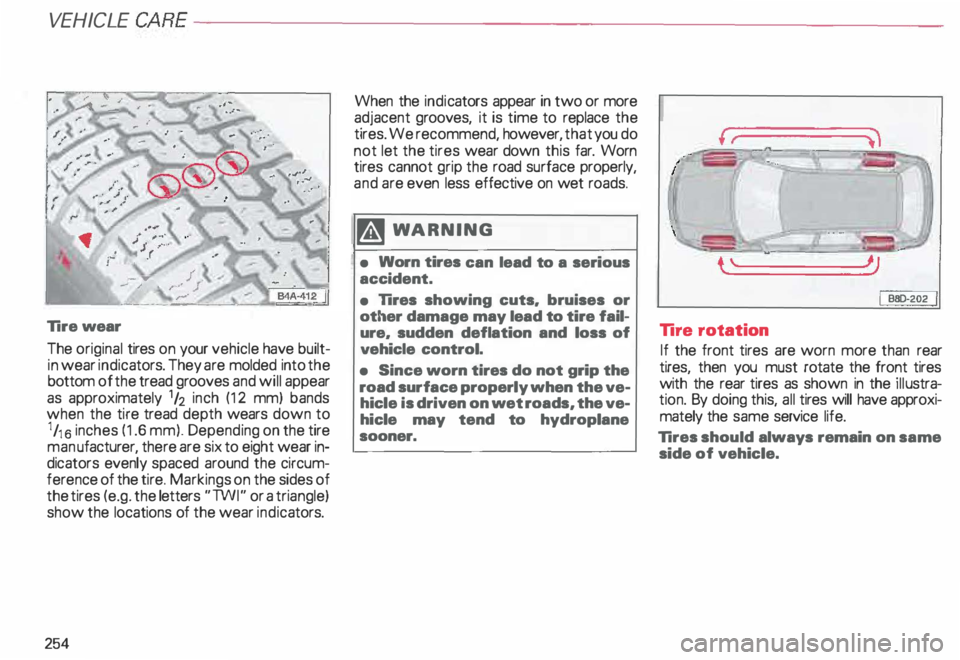
The original tires on your vehicle have built
in wear indicators. They are molded into the
bottom of the tread grooves and will appear
as approximately 1h inch (12 mm) bands
when the tire tread depth wears down to
1 /1 6 inches (1.6 mm). Depending on the tire
man ufacturer, there are six to eight wear in
dicators evenly spaced around the circum
ference of the tire. Markings on the sides of
the tires (e.g. the letters "TWI" or a triangle)
show the locations of the wear indicators.
254 When the
indicators appear in two or more
adjacent grooves, it is time to replace the
tires. We recommend, however, that you do
not let the tires wear down this far. Worn
tires cannot grip the road surface properly,
and are even less effective on wet roads.
�W ARNING
• Worn tires can lead to a serious
accident.
• lires showing cuts. bruises or
other damage may lead to tire fail
ure. sudden deflation and loss of
vehicle control.
• Since worn tires do not grip the
road surface properly when the ve
hicle is driven on wet roads, the ve
hicle may tend to hydroplane
sooner. I
BBD-2.02.
I
Tire rotation
If the front tires are worn more than rear
tires, then you must rotate the front tires
with the rear tires as shown in the illustra
tion. By doing this, all tires will have approxi
mately the same service life.
Tires should always remain on same
side of vehicle.
Page 256 of 306
Only
when tires show unusual wear such as
feather-e dging should they be rotated diag
� nall y. Yo ur vehicle may be equipped with
trres which have a specified rotation direc
tion. The rotation direction is identified by
arrow markings on the sides of the tires.
The rotation direction must not be revers ed.
Therefore, these tires cannot be switched
diagonally. If in doubt, discuss any unusual
tire wear with your authorized Audi Dealer's
service department.
After rotation adjust tire pressure and
torque wheel bolts diagonally to 90 tt lb
(120 Nm). Refer to "Changing a wheel" on
page 267 for details. Tire
replacement
Wheels and tires approved by the manu fac
turer have been specially matched to your
vehicle and contribute greatly to the road
holding, driving characteristics and safety of
the vehicle.
Make sure that the new tires also meet the
specifications listed on the label located on
the inside of the fuel filler flap or on the driv
er's door lock jamb.
It's �mporta nt to remember that in spite of
h �vrng the same tire designation, the actual
s1ze of a tire can vary from tire man ufacturer
to tire man ufacturer. Using different tire and
wheel rim combinations can result in re
duced clearance between the tire and the
vehicle body.
Therefore, never mount tires that
are of a different designation or
have different dimensions from
those of the factory supplied tires
which came equipped on your ve
hicle. VE
HICLE CARE
• If you must replace tires different from
those which were originally factory supplied
on your vehicle, always use the specific
brands, specifications and dimensions
which were specified by Audi for your ve
hicle.
Yo ur authorized Audi dealer or Audi Client
Relations have information regarding the
t1res and wheel rims specified for your car,
and can tell you which tires and tire
man ufacturers were approved by the fac
tory for original equipment installation.
• We recommend that you have your tires
changed by an authorized Audi Dealer, be
cause they have the special tools and nec
essary expertis e.
Furthermore, your authorized Audi Dealer
stocks a range of tires and wheels.
• If the spare tire is different from the tires
that you have mounted on your vehicle (for
example winter tires or wide profile tires),
then use the spare tire for a short period of
time only and drive with extra care. Replace
the flat tire with a tire matching the others
on your vehicle as soon as possible.
255
Page 257 of 306
VEH
ICLE CARE----------------------------------------------------
• For safety reasons, tires should be re
placed in pairs and not individually. The tires
with the deepest tread should always be
mounted on the front wheels.
�W ARNING
It is essential to the safe operation
of your vehicle that you use only
rims and tires that have the same
designation. sizes and types as
those with which your vehicle was
originally equipped.
Using tires and/or wheal rims dif
ferent from those which originally
came with your vehicle can reduce
the clearance between the wheels
and the vehicle body. The tires
could then rub against the vehicle
body damaging the tire or the ve
hicle body. or both. and seriously
effect your safety as well as the
safe operation of your vehicle.
256 •
Ve hicles with quattro ® must always
have tires of the same size, construction
and tread type. For details see page 207.
• Never mount used tires if you are not
sure of their previous history.
• Whenever replacing a tubeless tire, al
ways install a new valve stem. Tire repair
should only be performed by a specialist.
• In the interest of maximum safety and
best all-around vehicle handling, always buy
replacement radial tires that have the same
specifications with regard to tire size, de
sign, load carrying capacity, speed rating,
tread pattern, tread depth, etc. This also ap
plies to Audi recommended alternate re
placement tires. Tire
specifications
�W ARNIN G
Never mix tires of different design
such as steel belted radials with
radial bias belted or bias ply tires
etc. Mixing tire types will adverse
ly affect road holding and can lead
to loss of vehicle control and per
sonal injury.
A knowledge of tire designations makes it
easier to choose the correct tires. Radial ply
tires have the following designations:
e.g. 225 /55 R 17 97 H
225 lire width in mm
55 Heig ht/width ratio in %
R lire construction: Radial
17 Rim diameter in inches
97 Load rating code
H Speed rating code letter
Page 258 of 306
-------------------------VEHICL E
CA RE
The speed rating letter 9ode indicates the
maximum permissible road speeds:
Summer tires:
S - up to 11 0 mph (180 km/h)
T- up to 118 mph (190 km/h)
H- up to 130 mph (21 0 km/h)
V- up to 150 mph (240 km/h)
Z - over 150 mph (240 km/h)
W- up to 168 mph (270 k.m/h)
Y- up to 185 mph (300 km/h).
"Z" tires carry the speed rating code letter
in combination with the tire construction let
ter "R".
Winter tires see page 260. m
WARNING
• Driving faster than the maxi
mum speed for which tires are
rated and approved can lead to
sudden tire failure. This can cause
loss of vehicle control and lead to
an accident and personal injury.
• Never operate a vehicle at
speeds greater than the maximum
speed rating of its tires.
• Always observe speed limits
and adjust your vehicle to prevail
ing road and traffic conditions. Note
Yo ur vehicle is normally factory equipped
with all season tires. which possess excel
lent driving characteristics and give your
Audi optimum driving comfort. The speed
limit of this tire is 130 mph (21 0 km/ h). An
electronic speed limiter (see page 129) will
normally prevent your vehicle from going
faster then the tire speed ravng.
�W ARNING
Never operate this vehicle at
speeds greater than 130 mph. Ex
ceeding 130 mph (210 km I h) un
der any conditions will lead to sud
dan tire failure which can causa
loss of vehicle control and person
al injury. Always observe speed
limits and adjust your vehicle
speed to prev ailing road and traf
fic conditions.
257
Page 259 of 306
VEHICLE CA
RE--------------------------
The manufacturing date on the tire
side wall (possibly only on the inside of the
wheel):
DOT ... 12 00 ... means that the tire was
produced in the 12th week of 2000.
Tire strength and performance decline with
age -even if the tires are not used. Tire
manufacturers caution that a tire more than
six years old cannot be expected to perform
reliably and safely even in normal use.
�W ARNING
Old tires can fail in use, causing
loss of vehicle control and person
al injury.
Replace tires after six years re
gardless of tread wear. Always re
duce speed and drive cautiously if
you must use an old tire in an emer
gency. Replace the tire as soon as
possible.
258 Uniform
Tire Quality Grading
Quality grades can be found where applica
ble on the tire side wall between tread,
shoulder and maximum section width. For
example:
Treadwear 200, Traction AA, Tem
perature A.
All passenger car tires must conform to
Federal Safety Requirements in addition to
these grades.
Tr eadwear
The treadwear grade is a comparative rating
based on the wear rate of the tire when
tested under controlled conditions on a spe
cified government test course. For exam
ple, a tire
Qraded 15
0 would wear one and
one half (1112) times as well on the govern
ment course as a tire graded 1 00. The rei a·
tive perfo rmance of tires depends upon the
actual conditions of their use, however, and
may depart significantly from the norm due
to variations in driving habits, service prac
tices and differences in road characteristics
and climate. Tra
ction
The traction grades, from highest to lowest,
are AA, A, Band C. Those grades represent
the tire's ability to stop on wet pave ment as
measured under controlled conditions on
specified government test surfaces of as
phalt and concrete. A tire marked C may
have poor traction performa nce.
�W ARNING
The traction grade assigned to this
tire is based on straight-ahead
braking traction tests, and does
not include acceleration, corner
ing, hydr oplaning or peak traction
characteristics.
Page 260 of 306
-------------------------VEHICLE
CARE
Te mperature
The temperature grades are A (the highest),
8, and C, repres enting the tire's resistance to
the generation of heat and its ability to dissi
pate heat when tested under contro lled con
ditions on a specified indoor laboratory test
wheel. Sustained high temJ)erature can
cause the material of the tire to degenerate
and reduce tire life, and excessive tempera
ture can lead to sudden tire failure. The
grade C corres ponds to a level of perfor
mance which all passenger car tires must
meet under the Federal Motor Vehicle Safety
Sta ndard No. 1 09. Grades Band A represent
higher levels of performance on the laborato
ry test wheel than the minimum required by
law.
�W ARNIN G
The temperature grade for this tire
is est ablished for a tire that is
properly inflated and not over
loaded. Excessive speed, under
inflation, or excessive loading, ei
ther separately or in combination,
can causa heat buildup and pos
sible tire failure. Wheel
replacement
If you wish to equip your vehicle with tires
or wheels other than those installed at the
factory, please note the following:
• For technical reasons it is not al
ways possible to use wheels from
other vehicles -under certain condi
tions not even wheels from the same
vehicle model.
• Wheel rims and wheel bolts are
matched to fit your Audi. When
installing different wheels (for ax
ample, wheels with winter tires), the
correct wheel bolts with the proper
length and conical shape of the bolt
head must be used. The secure fit of
the wheels and the proper function
ing of the brake system and safety
are dependent upon this.
• Wheel rims and wheal bolts are
matched to fit your Audi. •
Before you plan on exchanging
steel wheels, light alloy wheals, or
winter tires already mounted on
wheel rims, consult your authorized
Audi Dealer. They have the technical
information necessary to advise you
which wheal rims and wheel bolts
are compatible with the original fac
tory installations.
1ft WARNING
• Incorrect tire/wheel parts may
cause an accident and personal in
jury. Such parts will adversely af
fect the safe operation of your ve
hicle. Always use tires, wheel rims
and wheel bolts that meat specifi
cations of the original factory
installed equipment.
• If wheel trim discs or a front
spoiler are Installed, make sura the
airflow for cooling the brakes is
not obstructed.
259
Page 261 of 306
VEH
ICLE CARE
Winter tires
The tires for your vehicle were selected for
optimal performance under a variety of driv
ing conditions.
If your Audi is equipped with high perfor
mance tires (identified by code letter V, W
or Z on the tire flank) and you drive frequent
ly on ice or sno w, you should consider the
installation of all season or winter tires. Let
your authorized Audi Dealer advise and as
sist you.
For winter driving, the driveability of your
vehicle can be improved by installing radial
winter tires (M+S) with or without studs1l.
The all season tires with which your ve
hicle may have been equipped at the factory
are perform ance tires advertised by the tire
manufacturer as suitable for all weather use
or with special mud and snow (M+S) capa
bility.
Winter tires, sometimes also called snow
tires, are designed for maximum traction in
mud and snow.
,, Check with your local Motor Vehicle Bu
reau for possible restrictions.
260 When
installing winter tires, please
note the following:
• Only radial ply winter tires may be
installed. Ask your authorized Audi Dealer
for the recommended tire size.
• Winter tires must be mounted on all four
wheels.
• Because of the special design character
istics of radial ply M+S tires, they must be
inflated 3 psi above the cold tire inflation
pressures required for the regular radial ply
tires. However, never exceed the maximum
tire inflation pressure listed on the tire side
wall.
• Winter tires will not do their job if the
tread depth is less than 5/32 of an inch
(4 mm). �
WARNING
• Tires with badly wom treads
and studs are very dangerous.
Make sure they are replaced imme
diately.
• Never mix tires of different de
sign such as steel belted radials
with radial bias belted or bias ply
tires, etc. Mixing tire types will ad
versely affect road holding and
can lead to loss of vehicle control
and personal inlury.
Page 262 of 306
• Winter tires with studs should be run
only at moderate speeds when new in order
to give the studs time to settle.
Do not drive a vehicle equipped with
winter tires at prolonged high
speed.
Winter tires use a softer rubber compound
and a deeper tread pattern and therefore
have a lower speed rating and reduced trac
tion and durability when used on dry roads.
• When winter tires or all season tires are
mounted, make sure you observe the
speed limitations for which the tire is rated.
The following speed rating code letters are
applicable:
0- up to 1 00 mph (160 km/h)
T- up to 118 mph (190km/h)
H- up to 130 mph (210 lcm/h). �W
ARNING
• Winter tires available for your
vehicle may have a maximum
speed rating which is less than the
maximum speed of your vehicle.
• Driving faster than the maxi
mum speed for which tires are
rated and approved will lead to
sudden tire failure. This can cause
loss of vehicle control and lead to
an accident and personal injury.
• Never operate a vehicle at
speeds greater than the maximum
speed rating of its tires.
• Always observe speed limits
and adjust your vehicle to prevail
ing road and traffic conditions.
Snow chains
• For engineering reasons, snow chains
must only be installed on special winter ti
res• 1).
11 Not available at the time of printing. VEHI
CLE CARE
• If you want to mount snow chains
on your vehicle, consult your Audi
Dealer for proper rim I tire combina
tion.
• Snow chains should only be
installed on the rear wheels, never
on the front wheels.
Where snow chains are mandatory
on certain roads, this normally also
applies to vehicles with All Wheel
Drive.
When you install snow chains,
check the tire air pressure first to
make sure it's correct, otherwise the
chains will not fit the wheel prop
erly.
Only use chains with fine pitch links protrud
ing no more than 1h inch (15 mm), including
tensioner, from tire tread and side walls.
Wheels must rotate freely in all steering
positions with chains mounted to prevent
damage to body, axle or brake components.
Drive slowly and follow the chain
manuf acturer's instructions.
Remove chains when roads are free of
snow. Otherwise, the chains can damage
the tires and impair vehicle handling.
261
Page 267 of 306
DO-IT-YOURSELF
SERVICE----------------------
Spare wheel
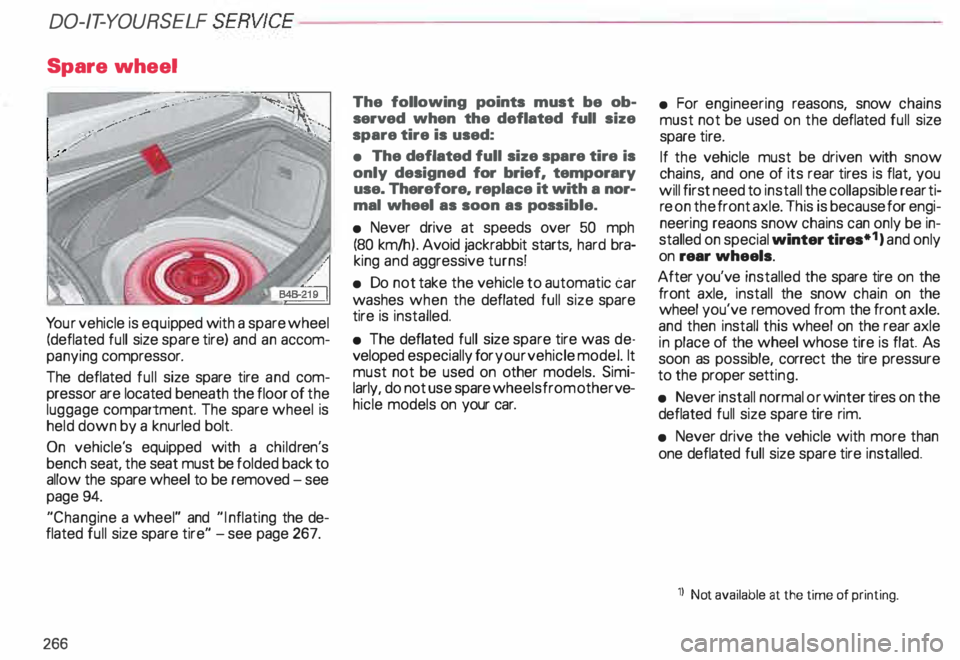
Yo ur vehicle is equip ped with a spare wheel
(deflated full size spare tire) and an accom
panying compressor.
The deflated full size spare tire and com
pressor are located beneath the floor of the
luggage compartment. The spare wheel is
held down by a knurled bolt.
On vehicle' s equipped with a childr en's
bench seat, the seat must be folded back to
allow the spare wheel to be removed -see
page 94.
"Changine a wheel" and "Inflating the de
flated full size spare tire" -see page 267.
266 The
following points must be ob
served when the deflated full size
spare tire is used:
• The deflated full size spare tire is
only designed for brief, temporary
use. Therefore, replace it with a nor
mal wheel as soon as poss ible.
• Never drive at speeds over 50 mph
(80 km/h). Avoid jackrabbit starts, hard bra
king and aggressive turns!
• Do not take the vehicle to automatic car
washes when the deflated full size spare
tire is installed.
• The deflated full size spare tire was de
veloped especially for your vehicle model. It
must not be used on other models. Simi
larly, do not use spare wheels from other ve
hicle models on your car. •
For engineering reasons, snow chains
must not be used on the deflated full size
spare tire.
If the vehicle must be driven with snow
chains, and one of its rear tires is flat, you
will first need to install the collapsible rear ti
re on the front axle. This is because for engi
neering reaons snow chains can only be in
stalled on special winter tires*1) and only
on rear wheels.
After you've installed the spare tire on the
front axle, install the snow chain on the
wheel you've removed from the front axle.
and then install this wheel on the rear axle
in place of the wheel whose tire is flat. As
soon as possible, correct the tire pressure
to the proper setting.
• Never install normal or winter tires on the
deflated full size spare tire rim.
• Never drive the vehicle with more than
one deflated full size spare tire installed.
11 Not available at the time of printing.