turn signal AUDI ALLROAD 2000 User Guide
[x] Cancel search | Manufacturer: AUDI, Model Year: 2000, Model line: ALLROAD, Model: AUDI ALLROAD 2000Pages: 306, PDF Size: 9.95 MB
Page 153 of 306
CONTROLS AND EQUIPMENT---------------------
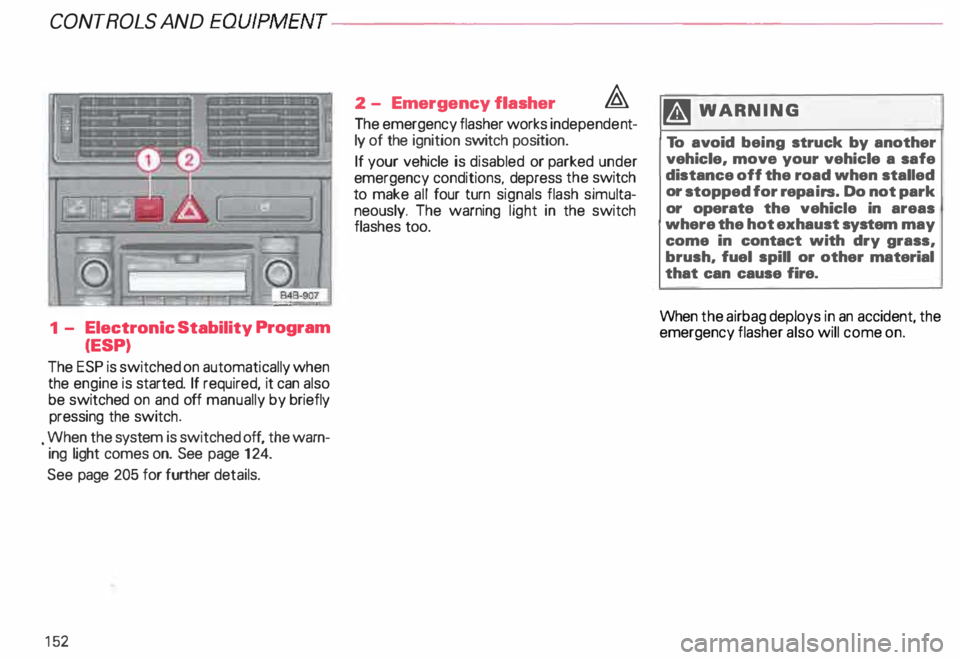
1
- Electronic Stability Program
(ESP)
The ESP is switched on automatically when
the engine is started. If required, it can also
be switched on and off manually by briefly
pressing the switch .
. When the system is switched off, the warn
ing light comes on. See page 124.
See page 205 for further details.
15 2 2
- Emergency flasher �
The emergency flasher works independe nt
ly of the ignition switch position.
If your vehicle is disabled or parked under
emergency conditions, depress the switch
to make all four turn signals flash simulta
neously. The warning light in the switch
flashes too. ftl
WARN ING
To avoid being struck by another
vehicle, move your vehicle a safe
distance off the road when stalled
or stopped for repairs. Do not park
or operate the vehicle in areas
where the hot exhaust system may
come in contact with dry grass,
brush, fuel spill or other material
that can cause fire.
When the airbag deploys in an accident, the
emergency flasher also will come on.
Page 157 of 306
CONTROLS
AND EQUIPMENT---------------------
Turn signals, headlight dimmer switch lever
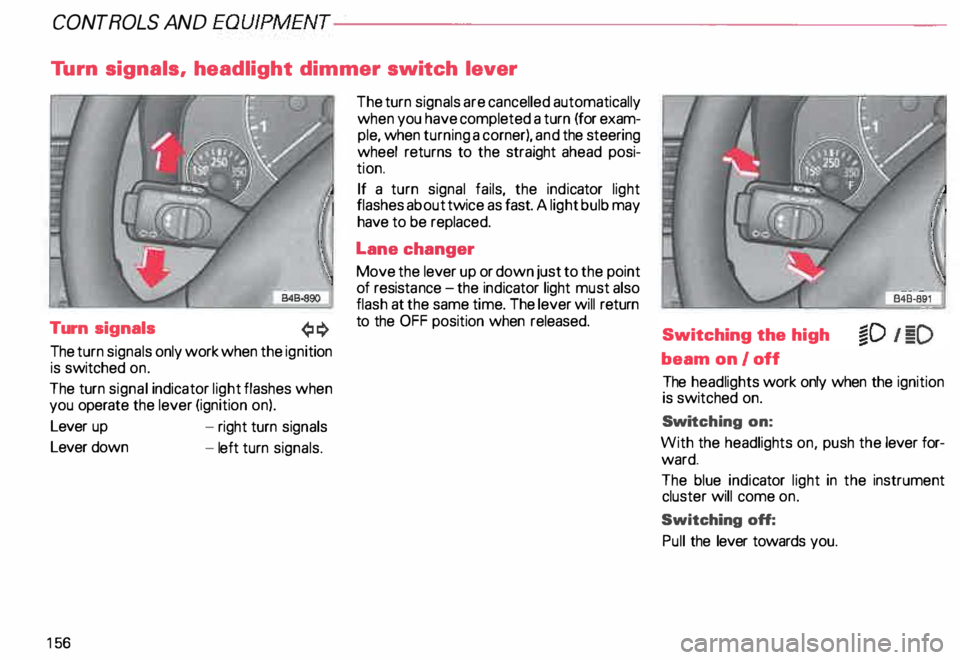
Turn signals
The turn signals only work when the ignition
is switched on.
The turn signal indicator light flashes when
you operate the lever (ignition on).
Lever up
Lever down
15 6 -
right turn signals
- left turn signals. The
turn signals are cancelled automatically
when you have completed a turn (for exam
ple, when turning a corner), and the steering
wheel returns to the straight ahead posi
tion.
If a turn signal fails, the indicator light
flashes about twice as fast. A light bulb may
have to be replaced.
Lane changer
Move the lever up or down just to the point
of resista nce-the ind icator light must also
flash at the same time. The lever will return
to the OFF position when released.
Switching the high
beam on/off
The headlights work only when the ignition
is switched on.
Swi tching on:
With the headlights on, push the lever for
ward.
The blue indicator light in the instrument
cluster will come on.
Switching off:
Pull the lever towards you.
Page 159 of 306
CONTROLS AND EQUIPMENT---------------------
Cruise
control
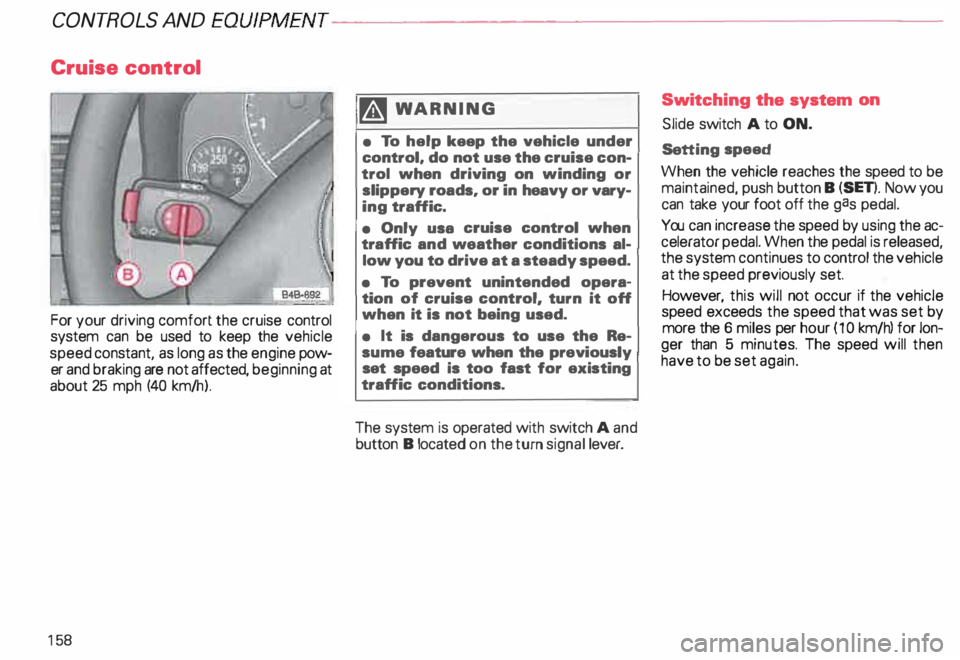
For your driving comfort the cruise control
system can be used to keep the vehicle
speed constant, as long as the engine pow
er and braking are not affected, beginning at
about 25 mph (40 km/h).
15 8 �W
ARNING
• To help keep the vehicle under
control, do not use the cruise con
trol when driving on winding or
slippery roads, or in heavy or vary
ing traffic.
• Only usa cruise control when
traffic and weather conditions al
low you to drive at a steady speed.
• To prevent unintended opera
tion of cruise control, turn it off
when it is not being used.
• It is dangerous to use the Re
sume feature when the previously
set speed is too fast for existing
traffic conditions.
The system is operated with switch A and
button B located on the tum signal lever. Switc
hing the system on
Slide switch A to ON.
Se tting speed
When the vehicle reaches the speed to be
maintained, push button B (SET). Now you
can take your foot off the gas pedal.
You can increase the speed by using the ac
celerator pedal. When the pedal is released,
the system continues to control the vehicle
at the speed previously set.
However, this will not occur if the vehicle
speed exceeds the speed that was set by
more the 6 miles per hour (10 km/hl for lon
ger than 5 minutes. The speed will then
have to be set again.
Page 195 of 306
VEHICLE OPERA
TION-----------------------
Operate your vehicle safely
The condition of the vehicle is es
sential for driving safety.
Therefore, always be sure to observe the
following points before you drive off:
• Check lights and turn signals.
• Check fuel level.
• Adjust the mirrors.
• Make sure that all lights and all
windows are clean.
• Make sure the air Intake slot be
tween the engine hood and the
windshield is free of leaves, snow
and ice.
• Check warning and indicator
lights when starting the engine.
For driving safety, always follow the speci
fied maintenance intervals in your Mainte
nance booklet -especially for changing
the brake fluid, see page 242.
Yo ur personal driving style and your
attitude affect driving safety to a
very great extent.
19 4 Therefore,
for your own safety:
• Wear your safety belts and wear
them properly, even if you're just
driving in the city or to the corner
store -see page 14.
• Make sure that all passengers are
wearing their safety belts properly,
even those sitting in the rear -
see page 14.
Passengers not wearing safety belts endan
ger not only themselves in case of an acci
dent, but also the driver and other passen
gers.
• Make sure that children always sit
on the rear seat properly restrained
by a res traint system appropriate
for their size and age.
• Never transport a child in a rear
facing child or infant seat on the
front passenger seat.
• Adjust your seat so that you can
easily reach all controls as far away
from the airbag as possible but no
closer than 10 in. (25 em) -
see page 76. •
The seating position is very im
portant for the airbag performance
- see page 29.
• Always adjust the head restra ints
to the correct height.
For maximum protection, the upper edge of
the head restraints should be at least at
eye level, or higher .
• Always make sure that the move
ment of the pedals is not restricted
In any way-see page 102.
• Store luggage and light items
properly
in the luggage compartment
see page 88.
of the roof - see page 191.
• If you drink, do not drive.
The use of alcohol, drugs and certain medi
cations will seriously impair perception,
reactions and driving ability, and substan
tially increase the risk of an accident and
personal injury.
Page 207 of 306
VEHICLE
OPER ATION----------------------
Operation
The Anti-Lock Brake System (ABS) and the
Electronic Differential Lock (EDU are inte
grat _ed in the Electronic Stability Progr am. In
a _ddrtron to the data provided by these func
tions, the ESP control unit requires addition
al measurement data provided by hig h-per
forman ?e sensors. The rotat ional speed of
the veh1cle about its vertical axis, vehicle lat
eral acceleration, brake pressure and the
steering angle are measured.
The direction in which the driverwishes to
travel is determined with the aid of the
stee �ing angle and the vehicle speed and is
contmually compared with the actual be
havior of the vehicle.
If the data do not match - for example when
a vehrcle is beginning to spin out of control
- the ESP applies the brakes to the appropri
ate wheels for the given situation and, if
necessar y, changes the vehicle traction
forces so as to reduce the slipping of individ
ual wheels (ASR anti-slip regulation).
206 The
vehicle is then stabilized by the forces
a ?tin � on the wheel during braking. If the ve
hicle IS overstee ring (rear tends to skid out
of the turn), the brakes are mainly applied on
the wheel that is on the outside ofthe curve.
In the case of a vehicle that is und ersteering
(tendency to slide out of the curve). the
brakes are applied at the rear wheel that is
on the inside of the curve. An audible signal
�rll accompany the brake application func
tion.
All �SP senso rs a�e monitored continuously
wh1le the vehicle IS being driven. However,
when the vehicle is driven at low speed on
ex tremely rugged terrain, it is not always
possrble to monrtor the ESP sensors contin
uously. Thus, in rare and exceptional cases
the ESP itself can deactivate (ESP and ABS
ind icator lights will be lit continuously).
In this case. the ride level adjustment sys
tem lowers the vehicle to the normal level
If this happens, you may need to select th�
ride level again (see page 153).
Operation of the ESP and ABS is restored
whenever you restart the engine. m
WAR NING
! he Electronic Stability Program
•• nevertheless subject to the laws
of physics. It is particularly impor
tant to pay attention to this fact on
wet and slippery roads.
It is therefore important that you
always adapt your driving to the
condition of the road and traffic
conditions. Do not allow the in
creased safety provided by the
Electro nic Stability Program sys
tem to lull you into accepting addi
tional safety risks.
Page 276 of 306

Fuse
arrangement
No. 1 - Heated washer jets !
B45-087C I
A 11
- .. 5
2 - Turn signals . . . . . . . . .
. 10
3 - Headlight washer (relay)
illum ination for glove compartment,
climate control, Automatic
Tr ansmission, instrument cluster ... 5
4 - License plate light . . . 5
l) Amps No.
A1l
5 - Ins trument cluster, seat heating,
test connection for cruise control,
bulb monitor, Automatic
Tr ansmis sion display, switch lighting,
mirror switches and actuators,
airbag warning light, outside
temperature indicator, climate
control, solar roof, acoustic parking
assistance system, navigation
system, car telephone, 4 Level Air
Suspension ............ .. ...... 1 0
6 - Power locking system . . . . . . . . . 5
7 - Anti-lock brake system (ABS),
brake light switch . . . . . . . . . . . . 1 0
8 - Car telephone . . . . . . . . . . . . . . .
. 5
9 - Heated mirrors . . . . . . . . . . . . . . 1 0
1 0- Automatic headlight adjustment
. 5
11 -Cruise control
(Automatic Transmission) . . .
1 0
12- On Board Diagnostic system .... _ 10
13 -Brake lights . . . . . . 1 0 DO-IT-YOURSELF
SERVICE
No. 14 -Interior lights, reading lights,
anti-theft alarm system,
vanity mirror, seat memory ....... 10
15 -Instrument cluster, climate control,
mirror and seat mem ory, .
navigation system . . . . . . . . . . . . . . 1 0
16- Electronic Stability Programm ..... 5
17 -Navigation system, 4 Level Air
Suspension, automatic headlight
adjustment .............. ...... 10
18-Hig h-beam, right ......... ....... 10
19 -H igh-beam, left . . . . . . . . . . . . .. 1 0
20 � Low beam, right, headlight
adjustment . . . . . . . . . . . . . . . • . .
15
21 -Low beam, left, headlight
adjustment . . . . . . . . . . . . . . . .. 15
22 -Side marker and tail light, right . 5
23 -Side marker and tail light, left . . . . . 5
24 -Wiper and washer system . . 25
25 -Blower for heating (climate
control), solar roof 30
275
Page 304 of 306
----------------------------------------------ALPHABETICAL
INDEX
-T echnical requiremen ts . . . 208
-li ps ........ ....... ... •.. .21 1
-T railer brakes .. .". . . . . . • . . 209
Tra nsporting heavy objects . . . . . . 88
fr ip computer . . . . . . . . .
. 146
Tr ip odometer . • . . . . • • .
. . 12 0
Tu rn signals .. .. .. .. . . ..
125, 156
u
Under coating ......... .
Unfast ening-Safety belt ..
Uni versal Transmi tter .. .
Unleaded fuel ...
Unp aved roads .
v
V- belt .. 19
8, 220
. . . . . 24
17 3
225 19 9
.. .. 249
Va let key .
Ve hicle battery .
Ve hicle care .
... ... ... ..... 56
245
- Exterior . . . . • • • • . . . • • . . . . • 212
- Interior · .. ..• .. ... ... ... .. . 217
-W indows . • • . . . . . . • . . . . 215 Vehicle
identification . . . . 290
Ve hicle identi fication label . .
291
Vehicle identification number . .
290
Vehicle jack . . . . . . . . . . . . .
265
Vehicle literature . . . • . . • • • • . . . . 2
Ventilati on . . . . . . . . . . . . • • • . . . 16
2
Vo ltage warning label ..• .. .... 291
Vo ltmeter 120
w
Warning and indicator lights . . . . . 1 0
Warn ing lights . . . . . . . . . . . . 1 0, 122
Warning I in dicator lights
- Airbag system . . . . . . . . . . . 125
- Anti-lock brake system . . . . . 125
- Battery voltage . . . . . . . . . . . . 143
-B rake.. ........ • • . . . . .
126
- Brake light . . . . . 141
- Brake pads worn
. . . . . • . 14
3
- Coolant level . . . . . .
. . .
141
- Coolant temperature 141
- Electronic power control . . . . 123
- Engine oil level . . . . . . . . . . . . 144
- Engine oil pressure . . . . . . . . . 143 -F
uel . . . . . . • • •• • . . • 143
- Gener ator 127
- Headlights I tail lights . . . . . . . 143
- High beam . . . . . . . . .
125
-M alfunction Indicator Lamp . 125
- Safety belts . . . . . . . . . . . . . . 127
- Speed warning . . . . • • • • 14
4
- Turn signals . . . . . •
125
-W asher fluid . . . • . . • • • • . . . 14
3
Warranty booklet . . . .. . . • . . . . . . 4
Was her reservoir . . . . . . . . . . . . 250
Washer system . . . . • . . . • . • . .. . . 16 0
Wheels ........... .... .. .. 252
Wheels replacement . . . . . . 255, 259
Window s.......... . • ... .. 69
- Cleaning . . . . . . . . . • . • • . . . . . 215
- Defrosting . . . . . . .
163
Wi ndshield washer container . . . 250
- Capacity . . . . . .
287
Wi oter operation
- Battery . . . . . . .
245
- Cooling system . . . .
238
- Snow chains 261
-T ires ...... .
- Ve hicle care 260
213
303