ESP AUDI ALLROAD 2000 Owner's Manual
[x] Cancel search | Manufacturer: AUDI, Model Year: 2000, Model line: ALLROAD, Model: AUDI ALLROAD 2000Pages: 306, PDF Size: 9.95 MB
Page 89 of 306

CONTROLS
AND EQUIPMENT---------------------
Luggage
compartment
Increasing size of the luggage
compartment
Yo u can fold the backrest forward to in
crease the size of the luggage compart
ment.
Tr ansporting heavy objects
Tra nsporting heavy objects can change the
way your vehicle behaves. For best han
dling under these conditions, distribute
loads evenly.
Always place heavy cargo as far forward as
possible in the luggage compartment.
When transporting heavy objects, drive
slowly and avoid sudden maneuvers.
�W ARNING
• Never exceed the Gross Axle
Weight Rating or the Gross Vehicle
Weight Rat�ng specified on the
safety compliance sticker on the
left door jamb. Exceed ing permis
sible weight ratings can change
the way the vehicle handles and
could result in accidents, personal
injur y, and vehicle damage.
88 M
WARNING continued
• Do not allow passengers to
occupy the rear load surface while
the vehicle Is in motion. Vehicle
occupants must always be prop
erly restrained.
• Loose items inside the passen
ger compartment, can fly forward
in an accident or sudden maneuver
and injure occupants. Always
store articles in the luggage
compartment and use the fasten
ing eyes, especially when the rear
seat backs have been folded down.
In particular, when traveling on
rough roads or rugged terrain, ma
ke cert ain that all luggage and
other items are stowed in the lug
gage compartment and that they
are secured in such a way that they
cannot shift. M
WARNING continued
• To help prevent poisonous ex
haust gas from being drawn into
the vehicle, always keep the rear
lid closed while driving. Never
transport objects larger than
those fitting completely into the
luggage area, because the rear lid
cannot be fully closed.
• If you must drive with the rear
lid open under exceptional circum
stances always take the following
precautions to help reduce the risk
of deadly carbon monoxide (CO)
from the exhaust system from be
ing drawn into the passengers
compartment:
open all of the windows
turn off the air recirculation
switch
- select maximum fan speed.
Page 113 of 306

CONTROLS AND
EQUIPMENT--------------------
Acoustic park assist*
The acoustic parking warning system will
help make parking and maneuvering in tight
places easier for you. But since there are
technical limitations to what it can do, al
ways exercise the utmost care and
attention when parking and when
maneuvering your vehicle in tight
places.
When you are backing up in parking maneu
vers, a _ park assist warning system using ul
trasonrc sensors helps you determine the
distance between your rear bumper, where
the sensors are located, and obstacles be
hind the vehicle.
The parking assist system is activated as
soon as you put the vehicle in Re
verse. A brief tone confirms that the sys
tem is activated.
Distance warning in reverse begins at a dis
tance of about 5.2 ft. (1.60 m) from the ob
stacle. As the distance becomes smaller,
the time inteNal between the audible tones
grows shorter.
112 The
danger zone begins at a distance of
about 1 ft. (0.30 m). Do not back up any fur
ther once you have reached the danger
z _one. The danger zone is signaled by a con
trnuous tone.
�W ARNING
• The park assist system is not a
substitute for the driver's own
caution and alertness. Ultimate re
sponsibility always lies with the
driver during parking and similar
maneuvers.
• Sensors have dead spaces in
which objects cannot be detected.
Be especially alert for small chil
dren and animals, since they are
not always detected by the sen
sors.
• Objects. such as trailer hitches,
thin painted rods, or fences, may
not always be detected by the sys
tem, but they can damage your ve
hicle. Note
• If a warning tone is audible for about 5
seco �ds when you turn on th e ignition, a
fault rs present in the system. Have the
problem corrected by your authorized Audi
dealer.
• The sensors must be kept clean and free
of ice for the park assist system to function
properly.
Page 125 of 306
CONTROLS AND
EQUIPMEN T--------------------
If the warning light is flashing, it can also
mean that the vehicle is riding ''too high"
(above the highest level). Once again, do
not drive off until the warning light stops
flashing.
If the .warning light stays on continuous ly,
there 1s a problem with the ride height ad
JUStment system. The light will also come
on continuously if the vehicle is on an ex
treme incline.
Tro uble in the ESP may also cause the warn
ing light to remain on continuously.
A system failure can cause the vehicle to
have too little or too much ground clear
ance. Drive very carefully and slowly to your
nearest authorized Audi dealer and have the
fault corrected.
See page 153 for additional information.
12 4 Electronic Stability
Program {ESP)
The indicator light lights up when the igni
tion is turned on, and it must go out after
about 2 seconds.
When the ESP system is in control mode,
this indicator light will flash while the ve
hicle is being operated.
When you start the engine, the ESP
may shut off for safety reasons. The indica
tor light also turns on to indicate this statu s.
If this should happen, you can reactivate the
ESP by turning the ignition off and then on
� gain. This indicator light will go out, indicat
Ing that the system is once again operating
properly.
If the system is off or is malfunctioning, the
indi cator light will remain on.
Since the ESP system works together with
the ABS system, the ESP indicator light will
also come on if the ABS stops operating. Electronic
immobilizer
�
When you turn on the ignition, the vehicle
key data are automatically scanned. The in
dicator light will come on briefly, indicating
that the data verification procedure has
been acknowledged.
If a non-coded vehicle key was used (for ex
ample a duplic ate key), the control light
goes to a continuous flashing mode. If this
happens, the vehicle cannot be started. See
also page 57
Page 127 of 306
CONTROLS
AND EQUIPMENT---------------------
If there is an ABS problem:
o The ABS warning light to come
on. The vehicle can still be braked,
however, the ABS will not work. See
your authorized Audl Dealer as soon
as possible.
• The ABS warning light and the
brake warning light come on to
gether. The ABS will not work and
you will notice a change in braking
characteristics and performance.
�W ARNING
If both warning lights (ABS and
BRAKE warning light) come on at
the same time, the rear wheels
could lock up first under hard
braking. Rear wheel brake lock-up
can cause loss of vehicle control
and an accident. Have your vehicle
repaired immediately by your au
thorized Audi Dealer or a qualified
workshop. Drive slowly and avoid
sudden, hard brake application.
12 6 If
the ABS fails, the ESP warning light will
come on. See page and pages 202 -205.
Electronic differential lock (EDL)
The electronic differential lock works in con
junction with the ABS system. A fault in the
ABS causes therefore a malfunction of the
electr onic differential lock.
For more details on how the EDL works, go
to page 204.
Brake
USA models:
BRAKE
Canada models:
(Q))
The light comes on while the engine is
cranking. It goes out after the engine has
been started and the parking brake is fully
released. This is your assurance that the
brake warning light is functioning properly. A If the brake warning light does ¥ not light up when the engine is
cra nking or the parking brake is ap
plied, there may be a malfunction in
the electrical system. In this case,
contact your Audi Dealer.
When the light comes on, an audible warn
ing signal is also given.
�W ARNING
• If both warning lights (ABS and
BRAKE warning light) come on at
the same time, the rear wheels
could lock up first under hard
braking. Rear wheel brake lock-up
can cause loss of vehicle control
and an accident. Have your vehicle
repaired immediately by your au
thorized Audi Dealer or a qualified
workshop. Drive slowly and avoid
sudden, hard brake application.
Page 129 of 306
CONT
ROLS AND EQ
UIPMEN T---------------------
On Board Diagnostic system
The Malfunction Indicator Lamp (MIL)-see
page 125- is part of the On Board Diagnos
tic system (OBD).
The lamp comes on when the ignition is
swi tched on and will go out after the engine
is started and the idle has stabilized. This is
to assure you that the Malfunction Indicator
Lamp is working properly.
If the lamp does not go out after the engine
is started, or if it comes on while you're
driving, there is a malfunction in the engine
system. If the lamp starts blinking, the cata
lytic converter could be damaged.
Continue driving with reduced power
and have the cause corrected right away by
an authorized Audi Dealer or a qualified
workshop.
12 8 If the lamp comes
on, the Electr onic speed
li miter can also be out of operation. See
next page.
The On Board Diagnostics in your vehicle
monitors the various components of your
emission control system. Each controlled
component in your engine system has been
coded. In case of a malfunction the respec
tive component in question will be identi
fied and the fault stored in the form of a
code in the control module's memory.
On Board Diagnostic
System (OBD)
The stored data can only be displayed with
special testing equipment (generic scan
tool for OBDl to assure an accurate diagno
sis.
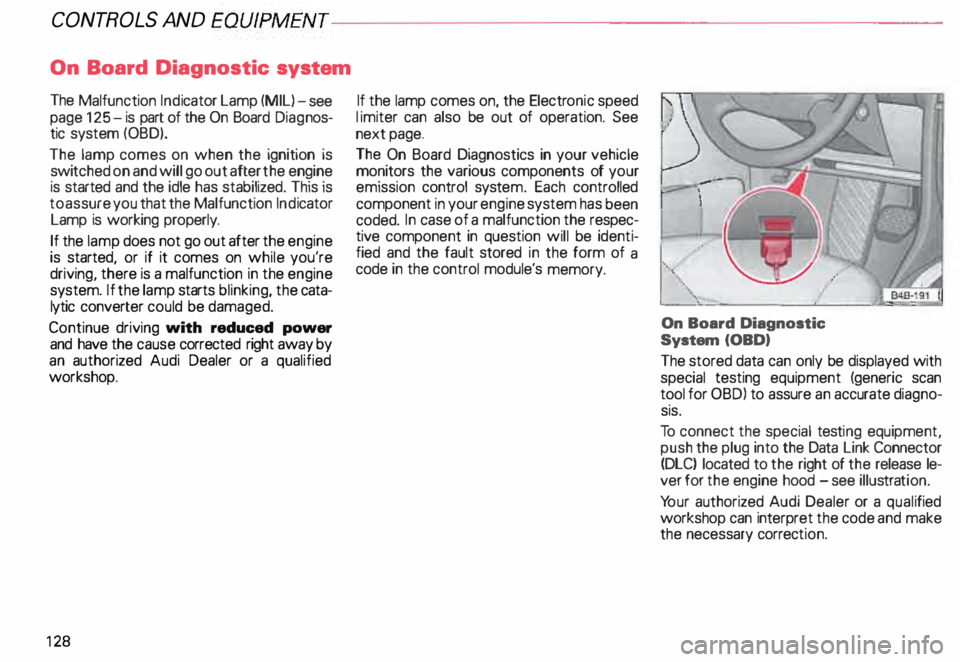
To connect the special testing equipment,
push the plug into the Data Link Connector
(DLC) located to the right of the release le
ver for the engine hood -see illus tration.
Yo ur authorized Audi Dealer or a quali fied
workshop can interpret the code and make
the necessary correction.
Page 149 of 306
CONTROLS ANDEO�PMENT-----------------------------------------
Switches
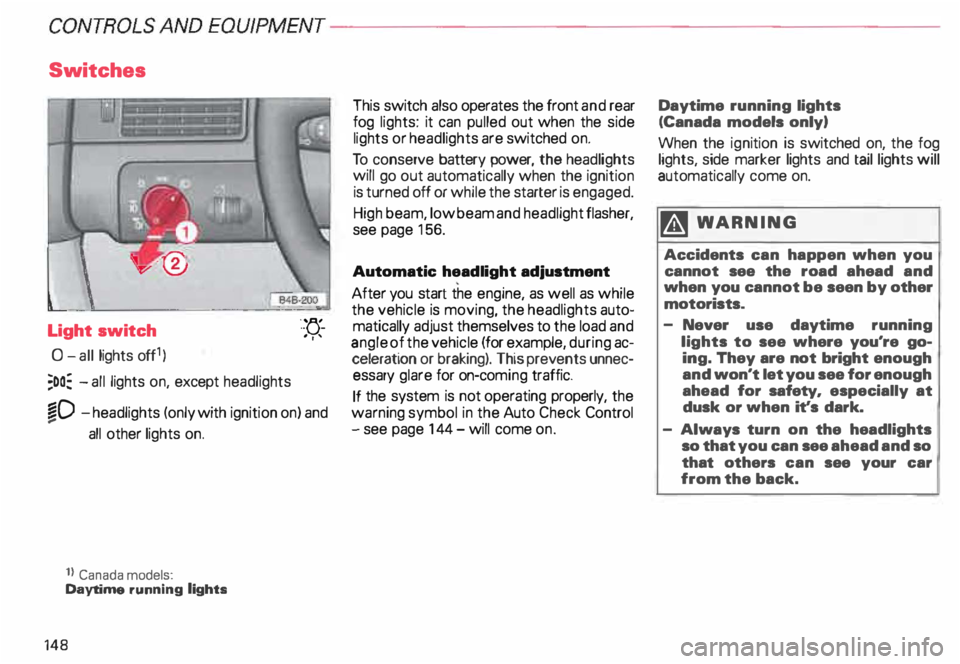
Light switch
0- all lights off1)
;oo: -all lights on, except headlights "-
YJ.-
. ''
�D -headlights (only with ignition on) and
...
all other lights on.
1} Canada models:
Daytime running lights
148 This
switch also operates the front and rear
fog lights: it can pulled out when the side
lights or headlights are switched on.
To conserve battery power, the headlights
will go out automatically when the ignition
is turned off or while the starter is engaged.
High beam, low beam and headlight flasher,
see page 156.
Automatic headlight adjustment
After you start the engine, as well as while
the vehicle is moving, the headlights auto
matically adjust themselves to the load and
angle of the vehicle (for example, during ac
celeration or braking). This prevents unnec
essary glare for on-com ing traffic.
If the system is not operating properly, the
warning symbol in the Auto Check Control
- see page 144- will come on. Daytime
running lights
(Canada models only)
When the ignition is switched on, the fog
lights, side marker lights and taillights will
automatically come on.
�W ARNING
Accidents can happen when you
cannot see the road ahead and
when you cannot be seen by other
motorists.
- Never use daytime running
lights to see where you're go
ing. They are not bright enough
and won't let you see for enough
ahead for safety, especially at
dusk or when it's dark.
- Always turn on the headlights
so that you can see ahead and so
that others can see your car
from the back.
Page 153 of 306
CONTROLS AND EQUIPMENT---------------------
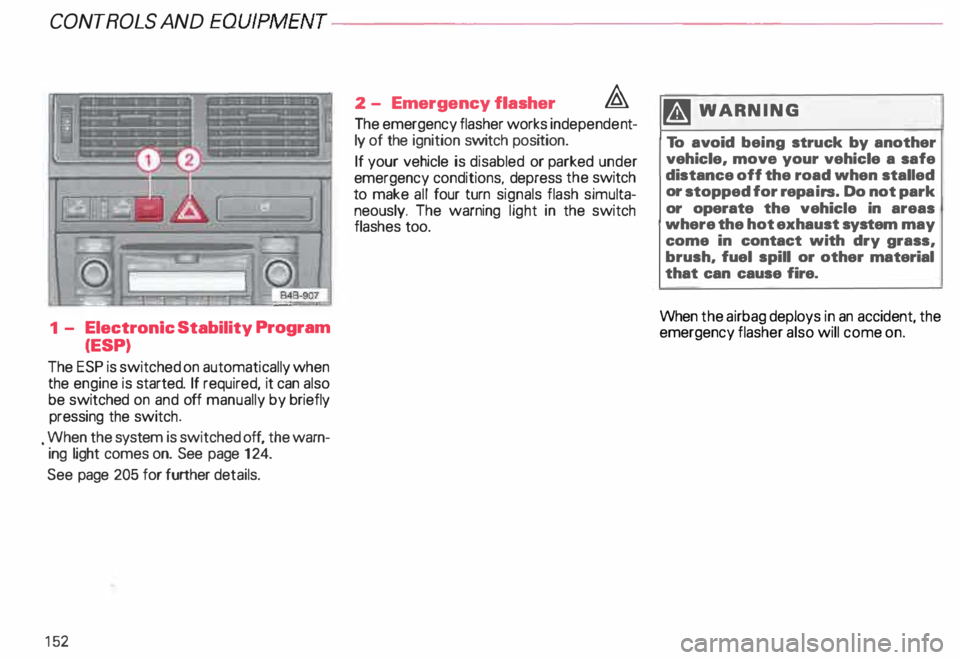
1
- Electronic Stability Program
(ESP)
The ESP is switched on automatically when
the engine is started. If required, it can also
be switched on and off manually by briefly
pressing the switch .
. When the system is switched off, the warn
ing light comes on. See page 124.
See page 205 for further details.
15 2 2
- Emergency flasher �
The emergency flasher works independe nt
ly of the ignition switch position.
If your vehicle is disabled or parked under
emergency conditions, depress the switch
to make all four turn signals flash simulta
neously. The warning light in the switch
flashes too. ftl
WARN ING
To avoid being struck by another
vehicle, move your vehicle a safe
distance off the road when stalled
or stopped for repairs. Do not park
or operate the vehicle in areas
where the hot exhaust system may
come in contact with dry grass,
brush, fuel spill or other material
that can cause fire.
When the airbag deploys in an accident, the
emergency flasher also will come on.
Page 156 of 306
---------------------CONTROLS AND EQUIPMEN T
Notes continued
• At excessive loads (for example, over
heating caused by frequent changes in the
ride height when the vehicle is stationary),
the system is temporarily deactivated for
safety reasons. The system will return to
full operation once it has cooled down.
• The system automatically switches to
the normal level if the ESP automatically
shuts off (see page 205). If this happens,
switch the ignition off, and then on again.
Now you can select the desired level once
again.
Jack mode
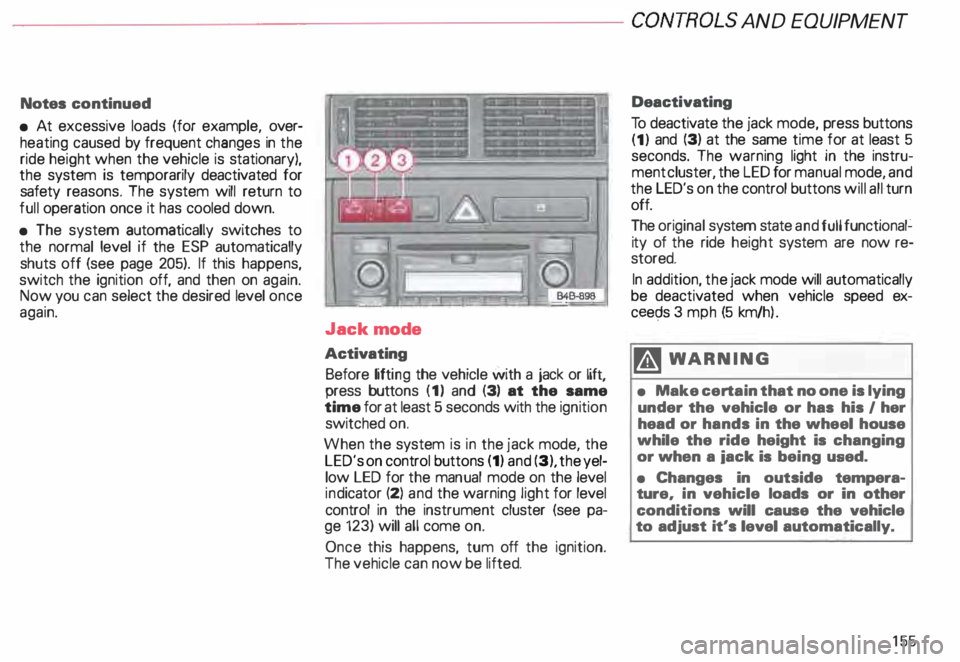
Activating Before lifting the vehicle with a jack or lift,
press buttons (1) and (3) at the same
time for at least 5 seconds with the ignition
switched on.
When the system is in the jack mode, the
LED's on control buttons (1) and (3), the yel
low LED for the manual mode on the level
ind icator (2) and the warning light for level
control in the instrument cluster (see pa
ge 123) will all come on.
Once this happens, tum off the ignition.
The vehicle can now be lifted. Deactivating
To deactivate the jack mode, press buttons
(1) and (3) at the same time for at least 5
seconds. The warning light in the instru
ment cluster, the LED for manual mode, and
the LED's on the control buttons will all turn
off.
The original system state and full functional�
ity of the ride height system are now re
stored.
In addition, the jack mode will automatically
be deactivated when vehicle speed ex
ceec;ls 3 mph (5 km/h ).
�W ARNING
• Make certain that no one is lying
under the vehicle or has his I her
head or hands in the wheel house
while the ride height is changing
or when a iack is being used.
• Changes in outside tempera
ture, in vehicle loads or in other
conditions will cause the vehicle
to adjust it's level automatically.
155
Page 163 of 306
CONTROLS AND EQUIPMENT---------------------
Cli
mate controls
�W ARNING
• For clear visibility and safe driv
ing, it is extremely important that
you follow the operating instruc
tions on the proper use and func
tion of the ventilation/heating, de
fogg ing{defr osting and air condi
tioning system in this manual. If in
doubt, consult your authorized
Audi Dealer.
• Good visibility comas with
clean windows free of fog, con
densation and frost.
• Maximum heating output and
fast defro sting will occur only af
ter the engine has reached operat
ing temperature. Wait until you
have good visibility before moving
your vehicle.
16 2 The
air conditioner is fully auto
matic, and is designed to maintain a com
fortable and uniform climate inside the ve
hicle .
The temperature of the air supplied to the in
terior, the fan speed, air distribution and vol
ume of air delivery are regulated automati
cally.
This automatic climate control program can
also be adjusted manually by the driver and
the front passenger.
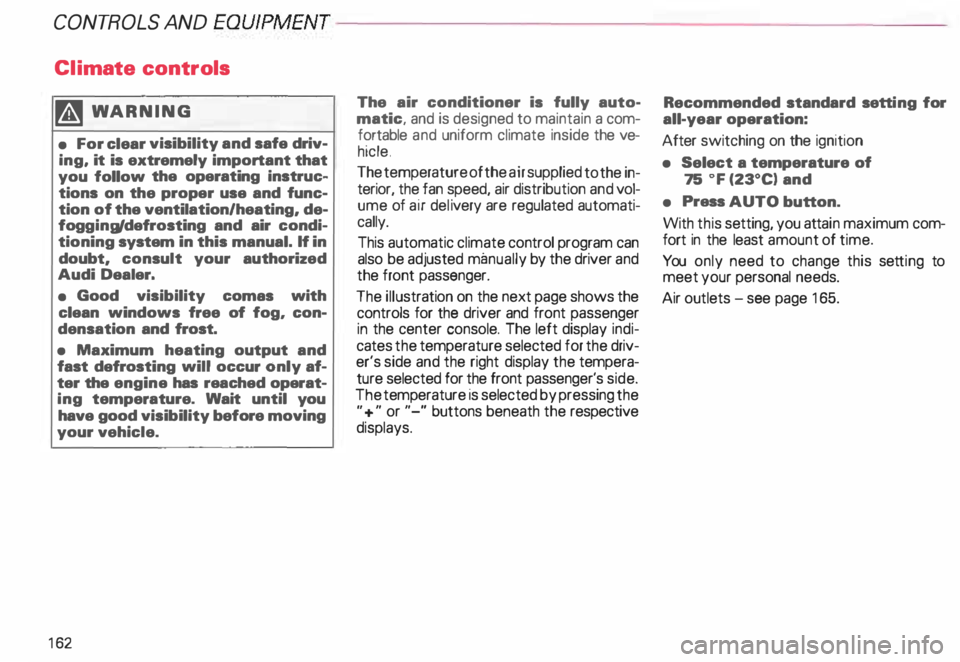
The illustration on the next page shows the
controls for the driver and front passenger
in the center console. The left display indi
cates the temperature selected for the driv
er's side and the right display the tempera
ture selected for the front passenger's side.
The temperature is selected by pressing the
"+" or "-" buttons beneath the respective
displays. Recommended
standard setting for
all-year operation:
After switching on the ignition
• Select a temperature of
75 oF (23°C) and
• Press AUTO button.
With this setting, you attain maximum com
fort in the least amount of time.
You only need to change this setting to
meet your personal needs.
Air outlets - see page 165.
Page 166 of 306
---------------------CONTROLS
AND EQUIP MENT
Air outlets
Depending on the operating mode se
lected, the air flow to the outlets is con
trolled either automatically or man ually.
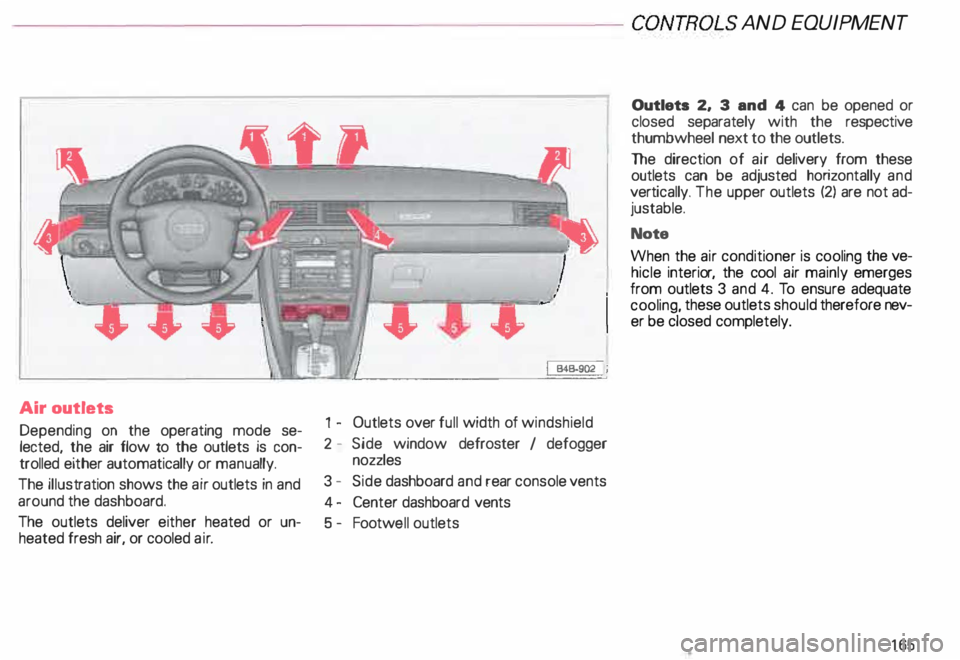
The illust ration shows the air outlets in and
around the dashboard.
The outlets deliver either heated or un
heated fresh air, or cooled air. I
848-902
1 - Outlets over full width of windshield
2 - Side window defroster I defogger
nozzles
3 - Side dashboard and rear console vents
4 - Center dashboard vents
5 - Footw all outlets Outlets
2, 3 and 4 can be opened or
closed separately with the respective
thumbwheel next to the outlets.
The direction of air delivery from these
outlets can be adjusted horizontally and
vert ically. The upper outlets (2) are not ad
justable.
Note
When the air conditioner is cooling the ve
hicle interior, the cool air mainly emerges
from outlets 3 and 4. To ensure adequate
cooling, these outlets should therefore nev
er be closed completely.
165