child seat AUDI ALLROAD 2000 Owner's Manual
[x] Cancel search | Manufacturer: AUDI, Model Year: 2000, Model line: ALLROAD, Model: AUDI ALLROAD 2000Pages: 306, PDF Size: 9.95 MB
Page 54 of 306
Child
restra int anchorages for
the rear seats
If your child restraint seat or seats are
equipped with a tether strap you will want
to use one or more of the anchor points pro
vided on the filler panel.
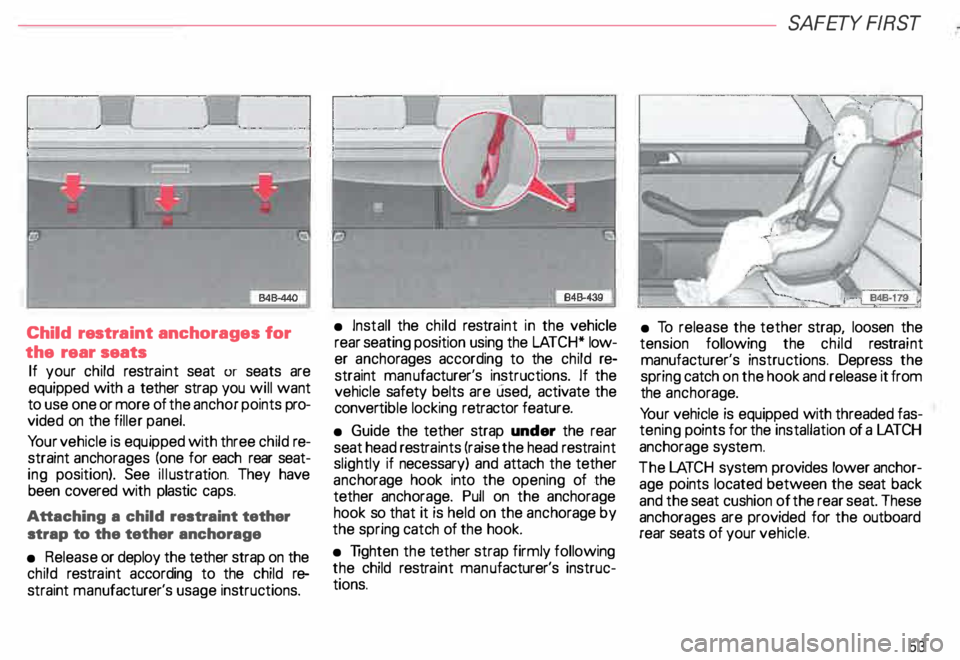
Yo ur vehicle is equipped with three child re
straint anchorages (one for each rear seat
ing position). See illustration. They have
been covered with plastic caps.
Attaching a child restraint tether
strap to the tether anchorage
• Release or deploy the tether strap on the
child restraint according to the child re
straint manufacturer's usage instructions. •
Install the child restra int in the vehicle
rear seating position using the LATCH* low
er ancho rages according to the child re
straint manufacturer's instructions. If the
vehicle safety belts are used, activate the
conver tible locking retractor feature.
• Guide the tether strap under the rear
seat head restraints (raise the head restraint
slightly if necessary) and attach the tether
anch orage hook into the opening of the
tether anchorage. Pull on the anchorage
hook so that it is held on the anch orage by
the spring catch of the hook.
• Tighten the tether strap firmly following
the child restra int man ufacturer's instruc
tions. SA
FETY FIRST
• To release the tether strap, loosen the
tension following the child restraint
manufacturer's instructions. Depress the
spring catch on the hook and release it from
the anch orage.
Yo ur vehicle is equipped with threaded fas
tening points for the installation of a LA TCH
anchorage system.
The LATCH system provides lower anchor
age points located between the seat back
and the seat cushion of the rear seat. These
anchorages are provided for the outboard
rear seats of your vehicle.
53
Page 55 of 306
SAFETYRRST----------------------------------------------------
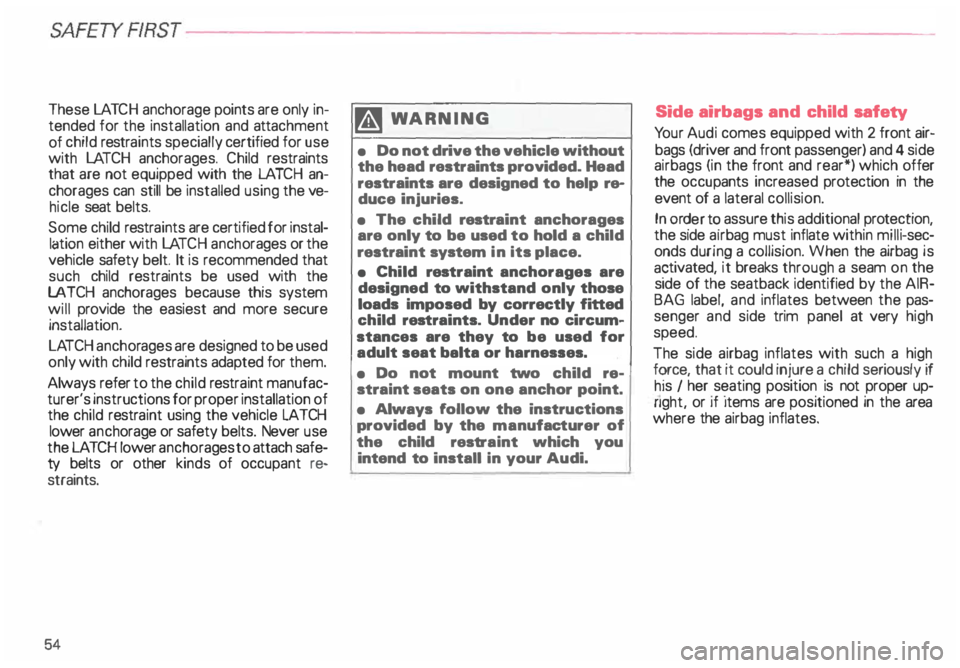
These LATCH anchorage points are only in
tended for the installation and attachment
of child restra ints specially certified for use
with LATCH anchorages. Child restraints
that are not equipped with the LATC H an
chorages can still be installed using the ve
hicle seat belts.
Some child restra ints are certified for instal
lation either with LATCH ancho rages or the
vehicle safety belt. It is recommended that
such child restraints be used with the
LATCH anchorages because this system
will provide the easiest and more secure
installation.
LA TCH anchor ages are designed to be used
only with child restraints adapted for them.
Always refer to the child restra int manufac
turer's instructions for proper installation of
the child restra int using the vehicle LATCH
lower anchorage or safety belts. Never use
the LATC H lower ancho rages to attach safe
ty belts or other kinds of occupant re
straints.
54 �W
ARNING
• Do not drive the vehicle without
the head restraints provided. Head
restraints are designed to help re
duce injuries.
• The child restraint anchorages
are only to be used to hold a child
restra int system in its place.
• Child restraint anchorages are
designed to withstand only those
loads imposed by correctly fitted
child restraints. Under no circum
stances are they to be used for
adult seat balta or harnesses.
• Do not mount two child re
straint seats on one anchor point.
• Always follow the instructions
provided by the manufacturer of
the child restraint which you
intend to install in your Audi. Side
airbags and child safety
Yo ur Audi comes equipped with 2 front air
bags (driver and front passenger) and 4 side
airbags (in the front and rear*) which offer
the occu pants increased protection in the
event of a lateral collision.
In or�er t� assure this additional protection,
the s1de a1rbag must inflate within milli-sec
onds during a collision. When the airbag is
a ?tivated, it breaks through a seam on the
s1de of the seatback identified by the AIR
BAG label, and inflates between the pas
senger and side trim panel at very high
speed.
The side airbag inflates with such a high
f ? rce, that it could injure a child seriously if
h1s I her seating position is not proper up
nght, or 1f 1tems are positioned in the area
where the airbag inflates.
Page 56 of 306
�W
ARNING
• To prevent serious injuries, chil
dren must always be secured in a
vehicle by a child restraint system
appropriate for their age and size.
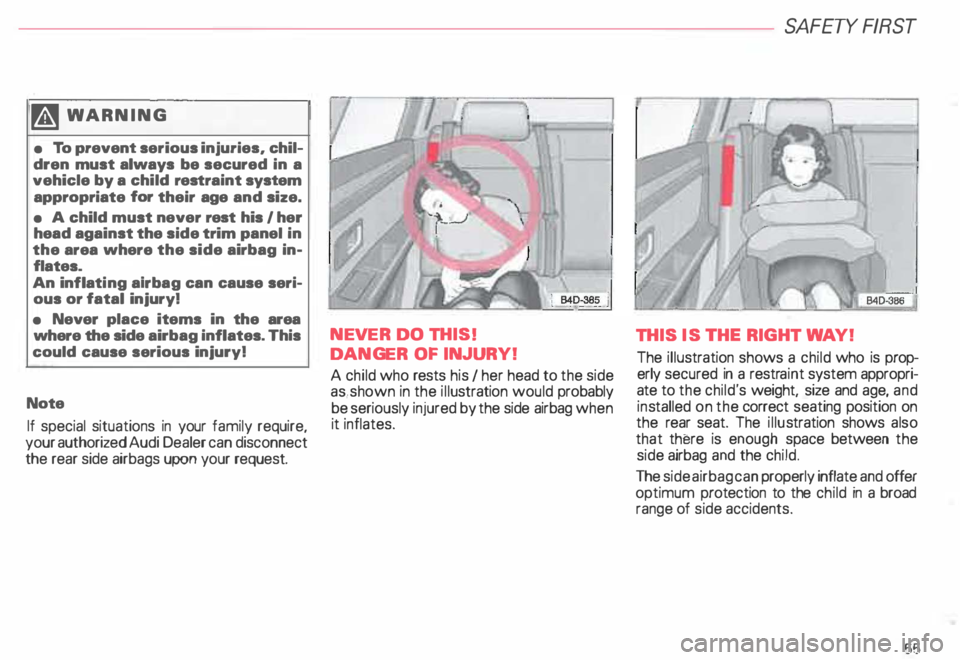
• A child must never rest his I her
head against the side trim panel in
the area where the side airbag in
flates.
An inflati ng alrbag can cause seri
ous or fatal injury!
• Never place items in the area
where the side airbag inflates. This
could cause serious injury!
Note If special situations in your family require,
your authorized Audi Dealer can disconnect
the rear side airbags upon your request. NEVER
DO THIS I
DANGER OF INJ URY !
A child who rests his I her head to the side
as, shown in the illustration would probably
be seriously injured by the side airbag when
it inflates. SA
FETY FIRST
THIS IS THE RIGHT WAY !
The illustration shows a child who is prop
erly secured in a restr aint system appropri
ate to the child' s weight, size and age, and
ins talled on the correct seating position on
the rear seat. The illustration shows also
that there is enough space between the
side airbag and the child.
The side airbag can properly inflate and offer
optimum protection to the child in a broad
range of side accidents.
55
Page 63 of 306
CONT
ROLS AND EQUIPMENT---------------------
Power locking switch
The entire vehicle can be locked I unlocked
from the inside by using the power locking
switch in the driver's door.
• To lock all doors, the rear lid and the
fuel filler flap simultaneous ly, press lower
part of power locking switch (see illustra
tion).
• To unlock all doors, the rear lid and
the fuel filler flap simul taneously, press the
upper part of the switch.
62 The
power locking switch can also be used
to lock and unlock the vehicle when the driv
er's door is open and the ignition key is re
moved from the steering lock.
�W ARNING
• H you use the power locking
switch with the doors closed, re
member that all the vehicle doors
will lock.
Locking doors from the inside can
help prevent inadvertent door
opening during an accident and
can also prevent unwanted entry
from the outside. Locked doors
can, however, delay assistance to
vehicle occupants and rescue
from the outside in an accident or
other emergency.
• Do not leave children Inside the
vehicle unsupervised. In an emer
gency it would be impossible to
open the doors from the outside
without the key. Child
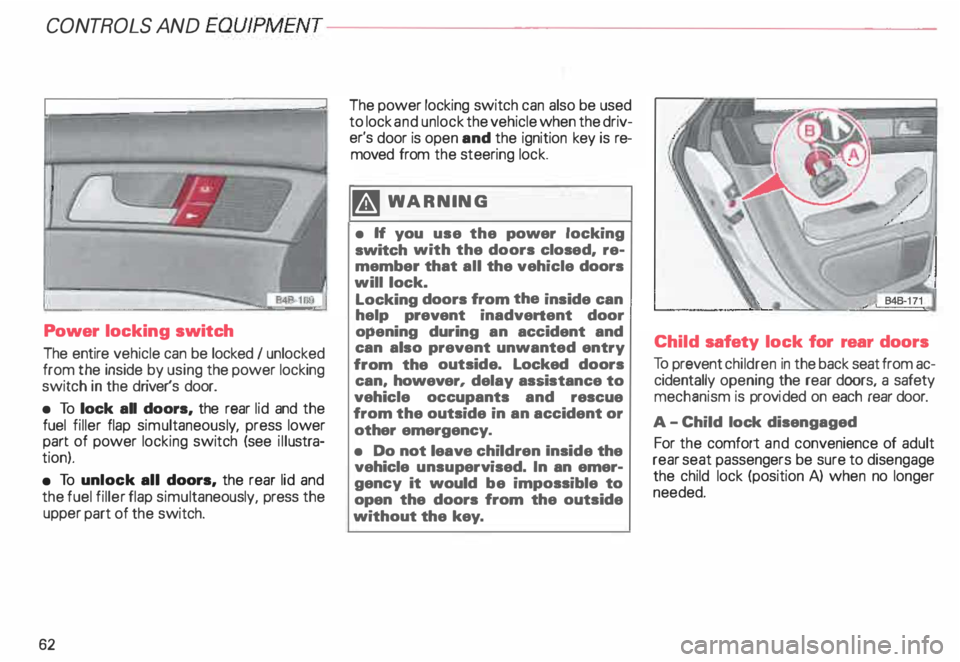
safety lock for rear doors
To prevent children in the back seat from ac
cidentally opening the rear doors, a safety
mechanism is provi ded on each rear door.
A -C hild lock disengaged
For the comfort and convenience of adult
rear seat passengers be sure to disengage
the child lock (position A) when no longer
needed.
Page 65 of 306
CONT
ROLS AND
EQUIPMENT------
L-----------------------�[_��� B-�3;�
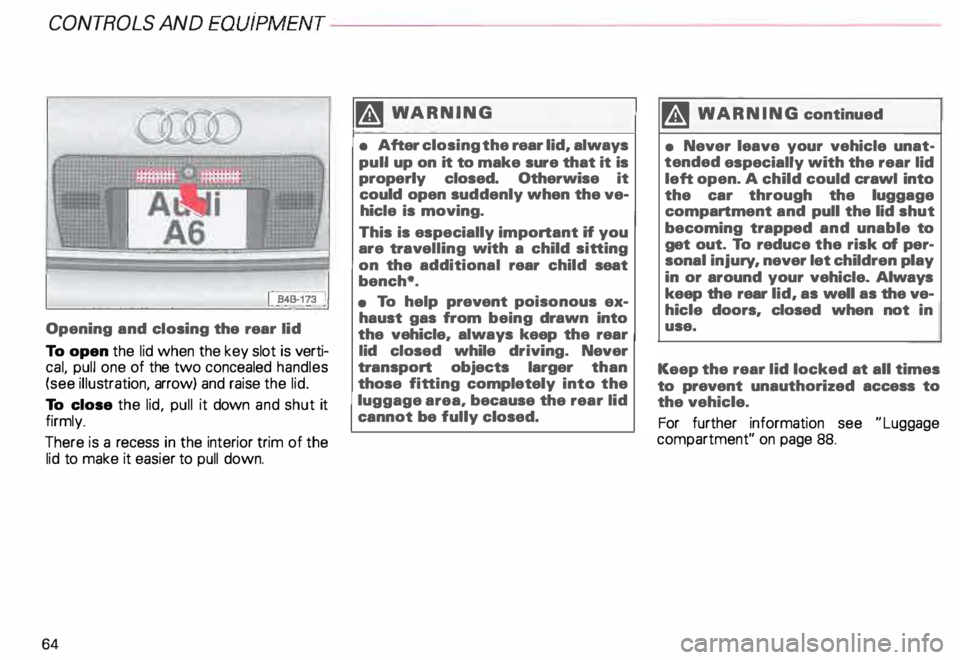
Opening and closing the rear lid
To open the lid when the key slot is verti
cal, pull one of the two concealed handles
(see illustration, arrow) and raise the lid.
To close the lid, pull it down and shut it
firmly_
There is a recess in the interior trim of the
lid to make it easier to pull down.
64 �W
ARNING
• After closing the rear lid, always
pull up on it to make sure that it is
properly closed. Otherwise it
could open suddenly when the ve
hicle is moving.
This is especially important if you
are trav elling with a child sitting
on the additional rear child seat
bench*.
• To help prevent poisonous ex
haust gas from being drawn into
the vehicle, always keep the rear
lid closed while driving. Never
tra nsport objects larger than
those fitting completely into the
luggage area, because the rear lid
cannot be fully closed. �,
WARNING continued
• Never leave your vehicle unat
tended especially with the rear lid
left open. A child could crawl into
the car through the luggage
compartment and pull the lid shut
becoming trapped and unable to
get out. To reduce the risk of per
sonal injury, never let children play
in or around your vehicle. Always
keep the rear lid, as well as the ve
hicle doors, closed when not in
use.
Keep the rear lid locked at all times
to prevent unauthorized access to
the vehicle.
For further information see "Luggage
compartment" on page 88.
Page 66 of 306
---------------------CONTROLS AND EQUIPMENT
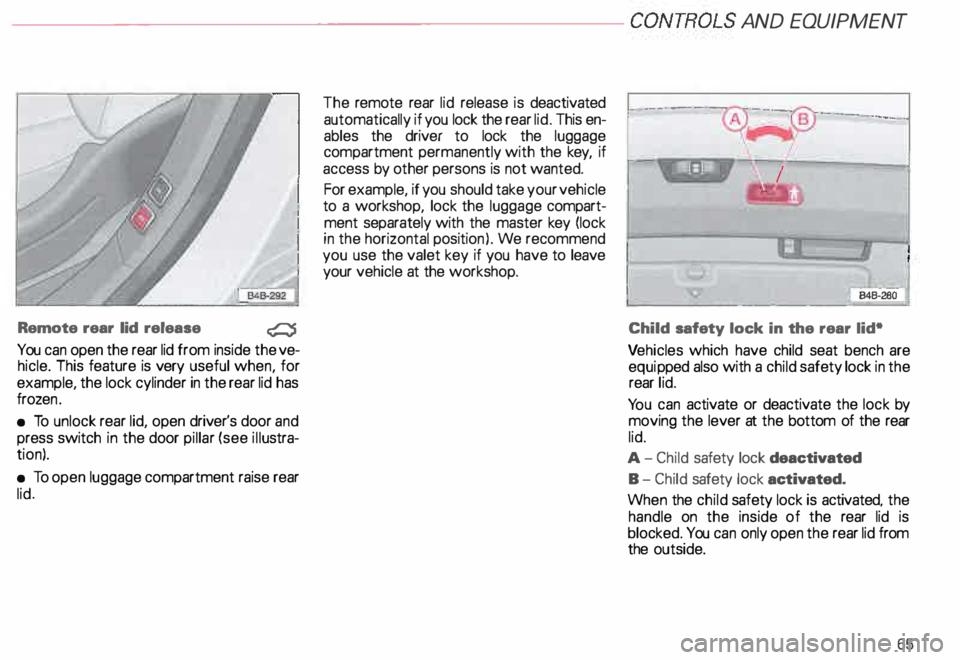
Remote rear lid release
�
You can open the rear lid from inside the ve
hicle. This feature is very useful when, for
example, the lock cylinder in the rear lid has
froze n.
• To unlock rear lid, open driver's door and
press switch in the door pillar (see illustra
tion).
• To open luggage compartment raise rear
lid. The
remote rear lid release is deactivated
automatically if you lock the rear lid. This en
ables the driver to lock the luggage
compartment permanently with the key, if
access by other persons is not wanted.
For example, if you should take your vehicle
to a workshop, lock the luggage compart
ment separately with the master key (lock
in the horizontal position). We recommend
you use the valet key if you have to leave
your vehicle at the workshop. I
I
B4B-
2Bo-i
Child safety lock in the rear lid•
Ve hicles which have child seat bench are
equi pped also with a child safety lock in the
rear lid.
Yo u can activate or deactivate the lock by
moving the lever at the bottom of the rear
lid.
A- Child safety lock deactivated
B- Child safety lock activated.
When the child safety lock is activated. the
handle on the inside of the rear lid is
blocked. You can only open the rear lid from
the outside.
65
Page 80 of 306
Before
adjusting your seat there are some
important considerations to keep in mind.
• To prevent interference with the seat ad
justment, never store anything under the
seats.
• The front seats should be adjusted be
fore fastening the safety belts.
• The position of the driver's seat you find
most comforta ble can be stored in the me
IT]Ory. See page 81 for details.
�W ARNING
Because the seats can be electri
cally adjusted with the ignition
key removed, never leave children
unattended in the vehicle. Unsu
pervised use of the electric seat
adjustments may cause serious in
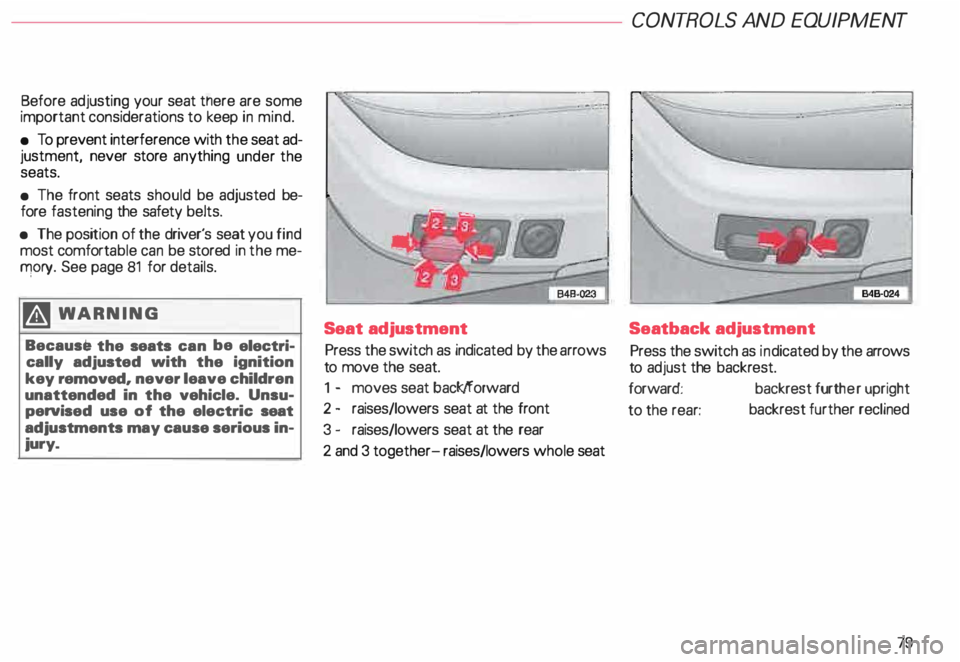
iury. Seat
adjustment
Press the switch as indicated by the arrows
to move the seat.
1 - moves seat back/forward
2 - raises/lowers seat at the front
3 - raises/lowers seat at the rear
2 and 3 together- raises/lowers whole seat CONT
ROLS AND EQUIPMENT
Seatback adjustment
Press the switch as indicated by the arrows
to adjust the backrest.
forward: backrest further upright
to the rear: backrest
further reclined
79
Page 91 of 306
CONTROLS AND EQUIPMENT---------------------
Luggage compartment
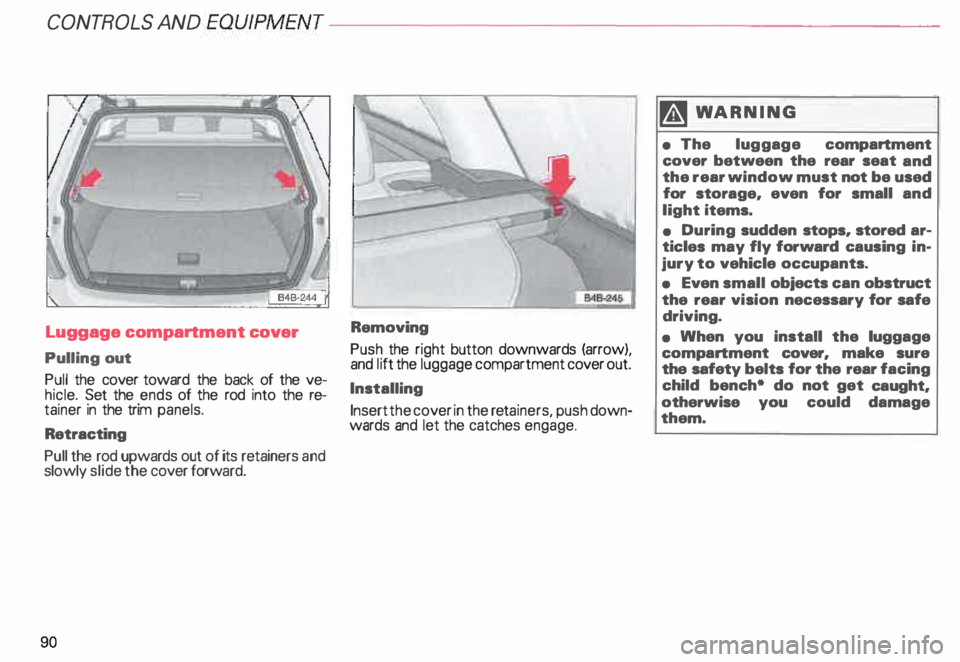
cover
Pulling out
Pull the cover toward the back of the ve
hicle. Set the ends of the rod into the re
tainer in the trim panels.
Retracting
Pull the rod upwards out of its retainers and
slowly slide the cover forward.
90 Removing
Push
the right button downwards (arrow),
and I itt the luggage compartment cover out.
Installing Insert the cover in the reta iners, push down
wards and let the catches engage. �W
ARNING
• The luggage compartment
cover between the rear seat and
the rear window must not be used
for storage, even for small and
light items.
• During sudden stops, stored ar
ticles may fly forward causing in
jury to vehicle occupants.
• Even small objects can obstruct
the rear vision necessary for safe
driving.
• When you install the luggage
compartment cover, make sure
the safety belts for the rear facing
child bench• do not get caught,
otherwise you could damage
them.
Page 93 of 306
CONTROLS AND
EQUIPMEN T---------------------
Rear facing child seat bench*
Two children starting at 3 years of age can
sit on the rear facing child seat bench. The
child must not be taller than 50 in. (1.3 m)
and must not weigh more th an 78 lbs
(36 kg). .
Children must always wear safety
belts f
Activating the child safety lock -see
page 65.
�W ARNING
• Do not place any other child
seats or child carriers on rear fac
ing child seat bench.
• For safety reason, never remove
the head restraints on the child
seat bench.
• The seatback for the rear seat
bench must always be in its up
right position and locked securely
in place. You shouldn't be able to
see the red marking on the release
latches -sea page 87.
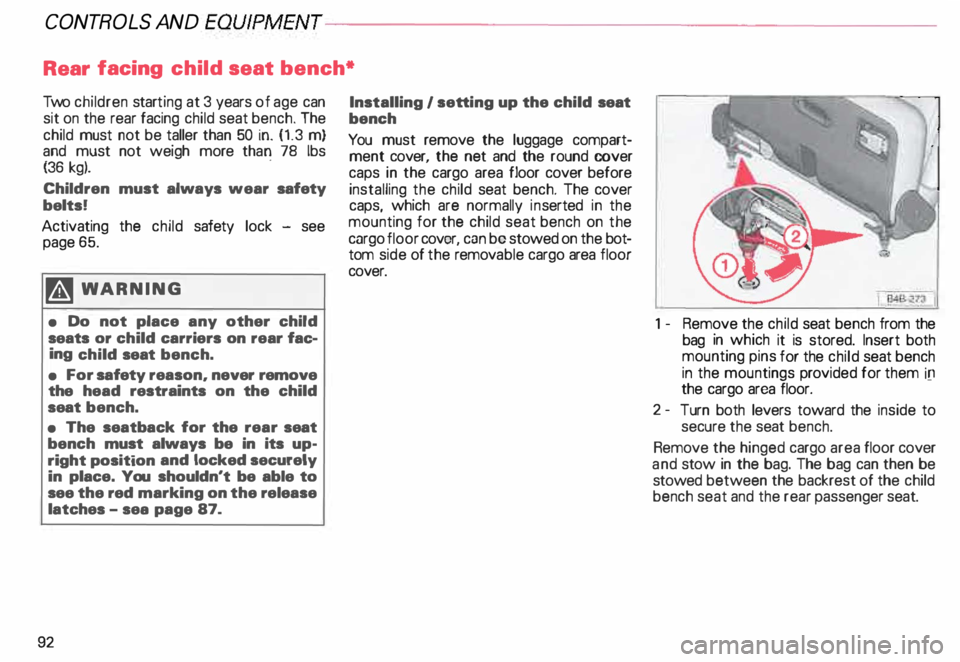
92 Installing
1 setting up the child seat
bench
Yo u must remove the luggage compart
ment cover, the net and the round cover
caps in the cargo area floor cover before
installing the child seat bench. The cover
caps, which are normally inserted in the
mounting for the child seat bench on the
cargo floor cover, con be stowed on the bot
tom side of the remova ble cargo area floor
cover.
1 -Remove the child seat bench from the
bag in which it is stored. Insert both
mounting pins for the child seat bench
in the mountings provided for them ill
the cargo area floor.
2- Turn both levers toward the inside to
secure the seat bench.
Remove the hinged cargo area floor cover
and stow in the bag. The bag can then be
stowed between the backrest of the child
bench seat and the rear passenger seat.
Page 95 of 306
CONTROLS ANDEO�PMENT-----------------------------------------
I 948-277
I
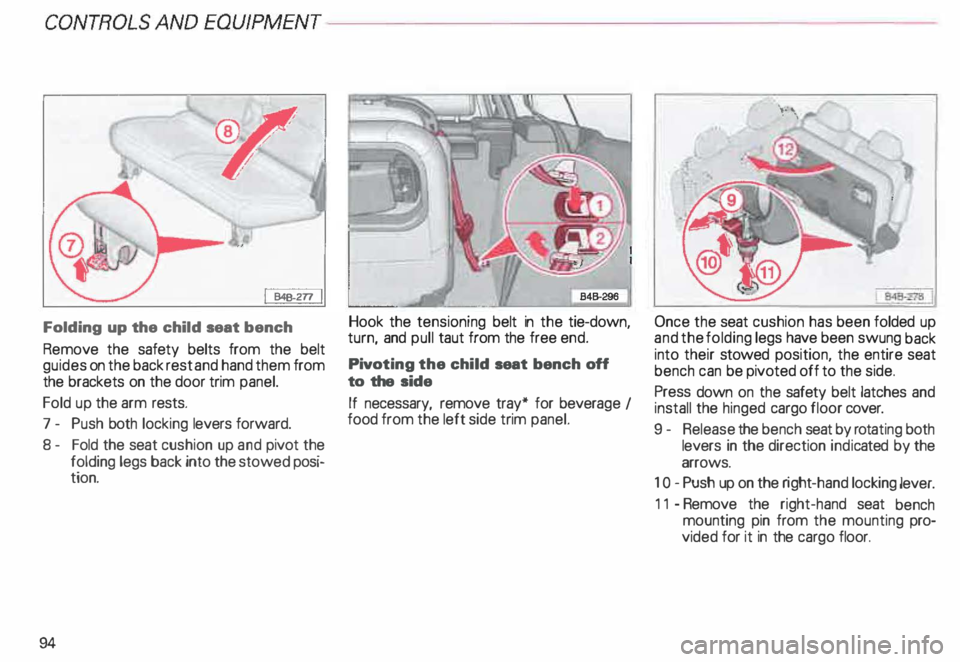
Folding up the child seat bench
Remove the safety belts from the belt
guides on the back rest and hand them from
the brackets on the door trim panel.
Fold up the arm rests.
7 - Push both locking levers forward.
8- Fold the seat cushion up and pivot the
folding legs back into the stowed posi
tion.
94 Hook
the tensioning belt in the tie-down,
turn, and pull taut from the free end.
Pivot ing the child seat bench off
to the side
If necessary, remove tray* for bever age I
food from the left side trim panel. Once
the seat cushion has been folded up
and the folding legs have been swung back
into their stowed position, the entire seat
bench can be pivoted off to the side.
Press down on the safety belt latches and
install the hinged cargo floor cover.
9 - Release the bench seat by rotating both
levers in the direction indicated by the
arrows.
1 0- Push up on the right -hand locking lever.
11 -Remove the right-hand seat bench
mounting pin from the mounting pro
vided for it in the cargo floor.