check engine AUDI ALLROAD 2000 Owner's Guide
[x] Cancel search | Manufacturer: AUDI, Model Year: 2000, Model line: ALLROAD, Model: AUDI ALLROAD 2000Pages: 306, PDF Size: 9.95 MB
Page 236 of 306
Engine
oil consumption
The rate of the oil consumption depends on
the quality and viscosity of oil, the speed at
which the engine is operated, the climate,
and road conditions as well as amount of
dilution and oxidation of the lubricant.
Because of these variables, no standard
rate of oil consumption can be established,
but drivers should expect higher oil con
sumption at high speeds and when the en
gine is new.
Therefore, we recommend that you check
the oil level at regular intervals (for example,
each time you are refuelling, or before going
on a long trip).
If the oil level should go below the minimal
level, the check engine oil level warn
ing light* in the instrument cluster will
come on. See page 144. You should check
the oil level using the oil dip stick as soon as
possible, and then top off the oil as neces
sary. Notes
• The engine in your vehicle de
pends on oil to lubricate and cool all
of its moving parts. Therefore the
engine oil should be checked regu
larly and kept at the required level.
• Lack of sufficient engine oil may
lead to severe engine damage.
• The oil pressure warning light is
not an oil level indicator.
A Always
heed all WAR NINGS
� on page 232.
Checking the engine oil level
The best time to check the engine oil level
is when the oil is warm.
To get a true reading, the vehicle must be on
level ground.
A Always heed all WAR NINGS
� on page 232.
• After turning off the engine, wait a few
minu tes for the oil to return to the oil pan. VE
HICLE CARE
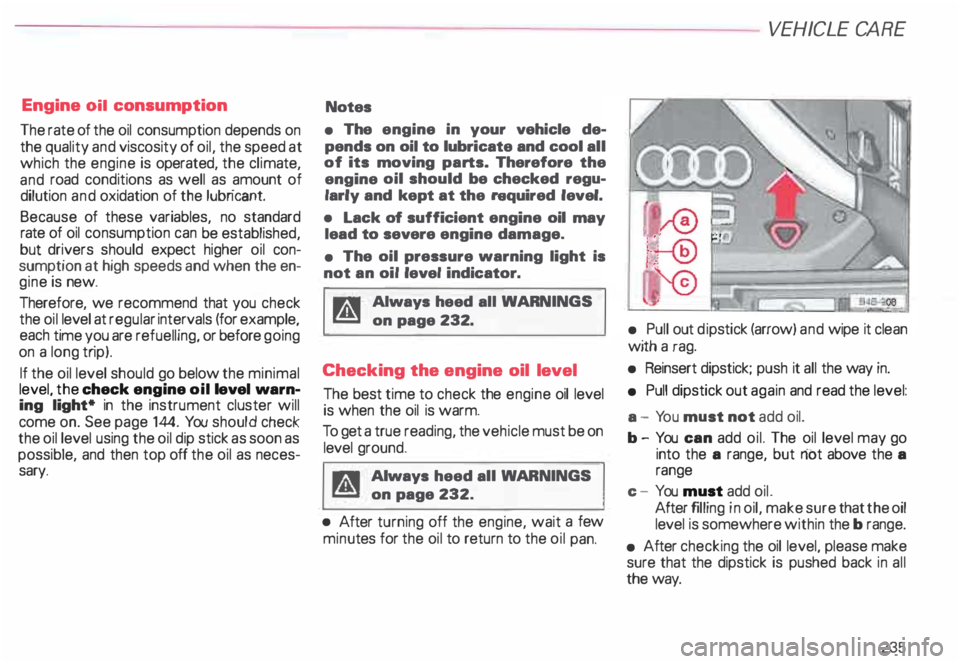
• Pull out dipstick (arrow) and wipe it clean
with a rag.
• Reinsert dipstick; push it all the way in.
• Pull dipstick out again and read the level:
a - Yo u must not add oil.
b- You can add oil. The oil level may go
into the a range, but riot above the a
range
c - You must add oil.
After filling in oil, make sure that the oil
level is somewhere within the b range.
• After checking the oil level, please make
sure that the dipstick is pushed back in all
the way.
235
Page 237 of 306
VEHICLE CA
RE---------------------------------------------------
Adding engine oil
A Always heed all WA RNINGS
r!!J on page 232.
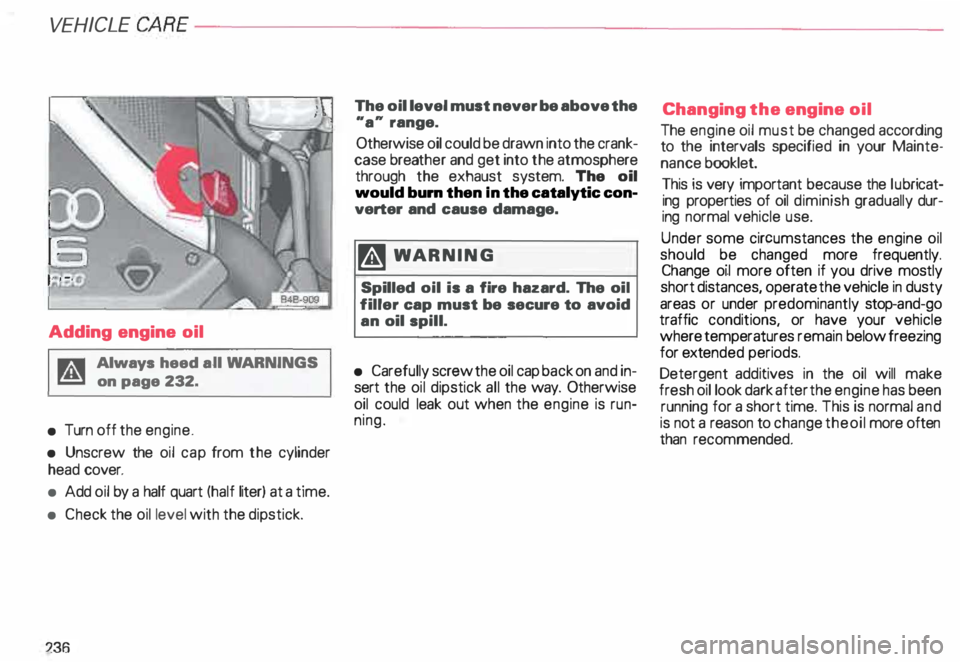
• Turn off the engine.
• Unscrew the oil cap from the cylinder
head cover.
• Add oil by a half quart (half liter) at a time.
• Check the oil level with the dipstick.
:236 The
oil level must never be above the
"a .. range.
Otherwise oil could be drawn into the crank
case breather and get into the atmosphere
through the exhaust system. The oil
would bum then In the catalytic con
verter and cause damage.
� WARNING
Spilled oil is a fire hazard. The oil
filler cap must be secure to avoid
an oil spill.
• Carefully screw the oil cap back on and in
sert the oil dipstick all the way. Otherwise
oil could leak out when the engine is run
ning. Changing
the engine oil
The engine oil must be changed according
to the intervals specified in your Mainte
nance booklet.
This is very important because the lubricat
ing properties of oil diminish gradually dur
ing normal vehicle use.
Under some circumstances the engine oil
should be changed more frequently.
Change oil more often if you drive mostly
short distances, operate the vehicle in dusty
areas or under predominantly stop-and-go
traffic conditions, or have your vehicle
where temperatures remain below freezing
for exte nded periods.
Detergent additives in the oil will make
fresh oil look dark after the engine has been
running for a short time. This is normal and
is not a reason to change the oil more often
than recommended.
Page 239 of 306
VEHICLE CA
RE----------------------------------------------------
Engine cooling system
The cooling system is sealed and generally
requires little attention.
The cooling system has been filled at the
factory with a permanent coolant which
does not need to be changed. The coolant
consists of a mixture of water and the
man ufacturer's coolant additive G 12 ABD
-ant ifreeze on a glycol base with anti-corro
sion additives (50% for USA models; 60o/o
for Canadian models). This mixture assures
the necessary frost protection and protects
alloy components in the engine's cooling
system from corrosion and scaling. It also
raises the boiling point of the coolant.
Do not reduce the concentration of the cool
ant in the summer by adding plain water.
The proportion of coolant additive
must be at least 500fa but not more
than 600fa to maintain antifreeze protec
tion and cooling efficiency.
238 For
year-r ound driving, antifreeze is added at
the factory for temperatures down to:
-31 °F (-35 °C) USA
-40 °F (-40 °C) Canada.
g Always heed all WA RNINGS
E!!1 on page 232.
Never use eny coolant additive
other than our G12 ABD additive
(check label) for your vehicle. This
coolant additive is available at au
thorized Audi Dealers.
Other types of antifreeze can. above
all. significantly reduce corrosion
protection. The resulting corrosion
can cause a loss of coolant and
therefore serious engine damage. When
adding coolant additive to
your cooling system. please remem
ber:
Under no circumstances may G12
ABD be mixed with other coolant ad
ditives (for example G 11 ).
You can recognize G12 ABD in the
expansion tank by its red color. If
the liquid in the expansion tank is
brown, G 12 ABD has been mixed
with another coolant additive. In
this case. your vehicle's coolant
must be changed as soon as pos
sible.
Note
Mixing coolant additives can result
in serious malfunction or engine
damage!
Page 240 of 306
Checking the
engine coolant
level
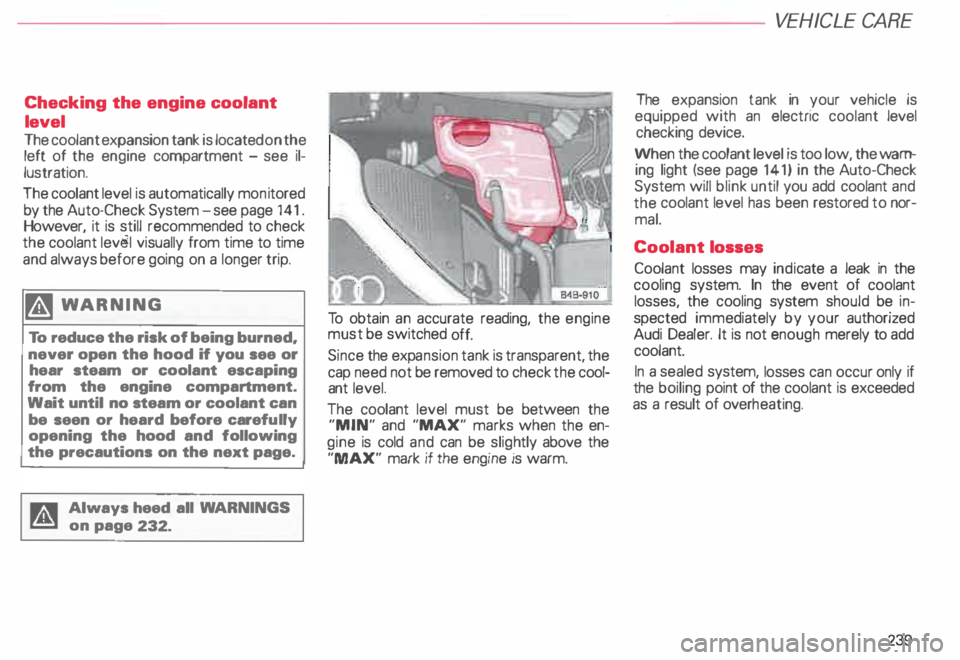
The coolant expansion tank is located on the
left of the engine compartment -see il
lustration.
The coolant level is automatically monitored
by the Auto-Check System -see page 141.
However, it is still recommended to check
the coolant lev�l visually from time to time
and always before going on a longer trip.
�W ARNING
To reduce the risk of being burned.
never open the hood if you see or
hear steam or coolant escaping
from the engine compartment.
Wait until no steam or coolant can
be seen or heard before carefully
opening the hood and following
the precautions on the next page.
Always heed all WA RNINGS
on page 232. To
obtain an accurate reading, the engine
must be switched off.
Since the expa nsion tank is transparent, the
cap need not be removed to check the cool
ant level.
The coolant level must be between the
"MIN" and "MAX" marks when the en
gine is cold and can be slig htly above the
"MAX" mark if the engine is warm. VE
HICLE CARE
The expansion tank in your vehicle is
equipped with an electric coolant level
checking device.
When the coolant level is too low, the warn
ing light (see page 141) in the Auto-Check
System will blink until you add coolant and
the coolant level has been restored to nor
mal.
Coolant losses
Coolant losses may indicate a leak in the
cooling system. In the event of coolant
losses, the cooling system should be in
spected immediately by your authorized
Audi Dealer. It is not enough merely to add
coolant.
In a sealed system, losses can occur only if
the boiling point of the coolant is exceeded
as a result of overheating.
239
Page 242 of 306
Radiator
fan
The radiator fan is driven by the engine via
the V-belt. The viscous clutch regulates the
speed of the fan according to the tempera
ture of the coolant.
An auxiliary electric radiator fan switches on
and off depending on coolant temperature
and other vehicle operation conditions.
� WARNING
• Always use extreme caution to
prevent clothing. jewelry, or long
hair from getting caught in the en
gine driven radiator fan, V-belt or
other moving parts.
• Never touch the auxiliary elec
tric radiator fan. The fan can
switch on suddenly and injure you.
Always heed all WA RNINGS
on page 232. Power
steering
Yo ur vehicle is equipped with a Servotro
nic power steering. The degree of
power assistance is regulated electronically
according to road speed.
The fluid reservoir is in the engine compart
ment near the windshield washer container.
The correct fluid level in the reserv oir is im
portant for the proper functioning of power
steer ing.
The power steering fluid level is checked
during the scheduled Maintenance ser
vices.
If the electronic regulating system is not
working properly, this is most noticeable
when turning the steering wheel at low
speeds (for example when parking) -more
effort will be required than usual. The fault
should be rectified by an Audi Dealer as
soon as possible. VEH
ICLE CARE
Note
• When the engine is running, never hold
the steering wheel turned all the way to the
right or to the left for longer than 15 sec
onds. The power steering pump will over
heat the hydraulic fluid if you hold the steer
ing wheel all the way turned.
This will damage the power steering
system.
Each time the steering wheel is turned all
the way to the right or left when stopped,
you will hear noises caused by the severe
stress placed on the power steering pump.
At the same time, engine idle speed drops.
• If the power steering system
should fail, or if the engine is not
running (for example, while being
towed). you will still be able to steer
the vehicle, however. more effort
will be required.
• If the power steering system should
have a leak, or is not functioning properly,
contact your authorized Audi Dealer imme
diately.
241
Page 243 of 306
VE
HICLE CA
RE----------------------------------------------------
Brake fluid
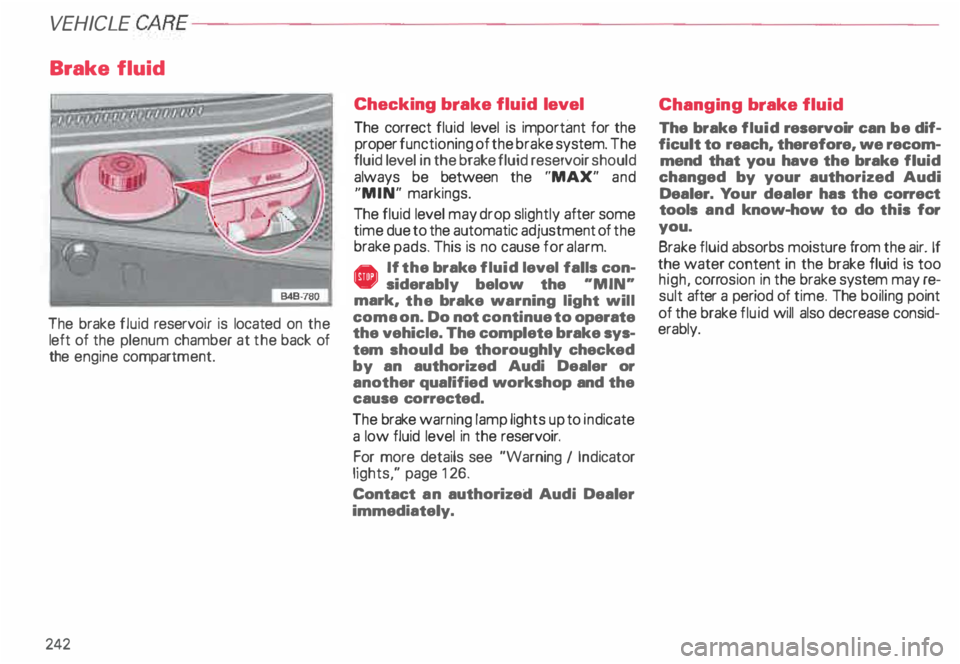
The brake fluid reservo ir is located on the
left of the plenum chamber at the back of
the engine compartm ent.
242 Checking
brake fluid level
The correct fluid level is important for the
proper functioning of the brake system. The
fluid level in the brake fluid reservoir should
always be between the "MAX" and
"MIN" markings.
The fluid level may drop slightly after some
time due to the automatic adjustment of the
brake pads. This is no cause for alarm.
• If the brake fluid level falls con
siderably below the "MIN"
mark, the brake warning light will
coma on. Do not continue to operate
the vehicle. The complete brake sys
tem should be thoroughly checked
by an authorized Audi Dealer or
another qualified workshop and the
cause corrected.
The brake warning lamp lights up to indicate
a low fluid level in the reservoir.
For more details see "Warning I Ind icator
lights," page 126.
Contact an authorized Audi Dealer
immediately. Changing
brake fluid
The brake fluid reservoir can be dif
ficult to reach, therefore, we recom
mend that you have the brake fluid
changed by your authorized Audi
Dealer. Your dealer has the correct
tools and know-how to do this for
you.
Brake fluid absorbs moisture from the air. If
the water content in the brake fluid is too
high, corrosion in the brake system may re
sult after a period of time. The boiling point
of the brake fluid will also decrease consid
erably.
Page 246 of 306
-------------------------VEHICL E CA RE
Do not disconnect the vehicle bat
tery when the ignition is switched
on or when the engine is running.
Otherwise, you will damage elec
tronic components in the electrical
system.
When working on the engine, pro
tect the battery housing from ultra
violet (UV) rays by not parking the
vehicle in direct sunlight. Winter
operation
During the winter months, battery capacity
tends to decrease as temperatures drop.
More power is also consumed while start
ing, and the headli ghts, rear window defog
ger, etc., are used more often.
Av oid unne cessary power consumption,
particularly in city traffic or when trave:ling
only short distances. Let your authonzed
Audi Dealer check the capacity of the ve
hicle battery before winter sets in. A well
charged battery will not only prevent start
ing problems but will also last longer.
If your vehicle is left standing for
several weeks at extremely low tem
peratures, the vehicle battery
should be removed and stored
where it will not freeze. This will
prevent it from being damaged. Location
of vehicle battery
g Always heed all WAR NINGS
� on page 232.
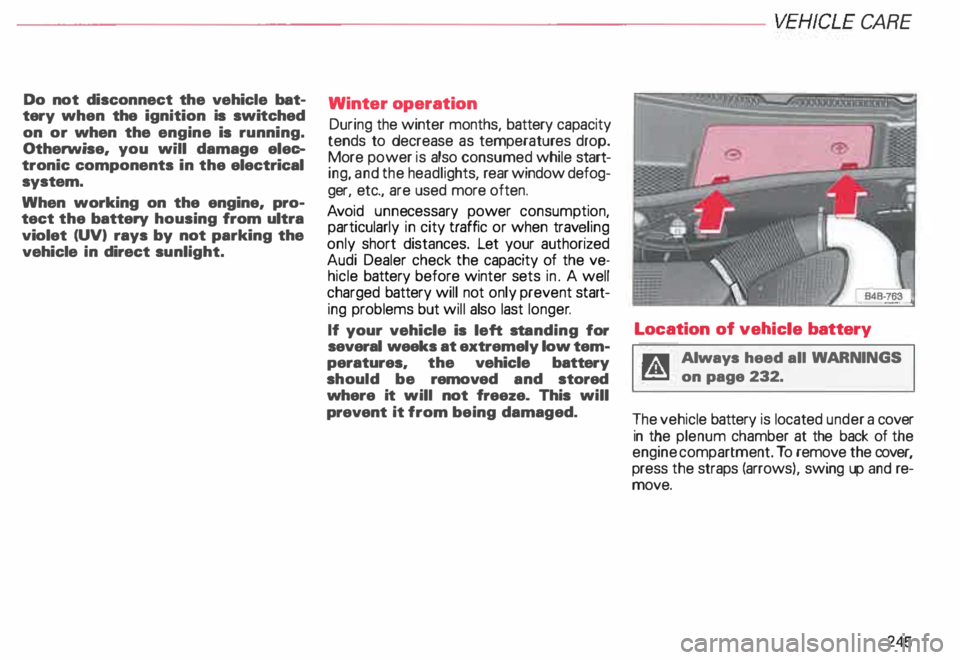
The vehicle battery is located under a cover
in the plenum chamber at the back of the
engine compartment. To remove the cover,
press the straps (arrows ), swing up and re
move.
245
Page 262 of 306
• Winter tires with studs should be run
only at moderate speeds when new in order
to give the studs time to settle.
Do not drive a vehicle equipped with
winter tires at prolonged high
speed.
Winter tires use a softer rubber compound
and a deeper tread pattern and therefore
have a lower speed rating and reduced trac
tion and durability when used on dry roads.
• When winter tires or all season tires are
mounted, make sure you observe the
speed limitations for which the tire is rated.
The following speed rating code letters are
applicable:
0- up to 1 00 mph (160 km/h)
T- up to 118 mph (190km/h)
H- up to 130 mph (210 lcm/h). �W
ARNING
• Winter tires available for your
vehicle may have a maximum
speed rating which is less than the
maximum speed of your vehicle.
• Driving faster than the maxi
mum speed for which tires are
rated and approved will lead to
sudden tire failure. This can cause
loss of vehicle control and lead to
an accident and personal injury.
• Never operate a vehicle at
speeds greater than the maximum
speed rating of its tires.
• Always observe speed limits
and adjust your vehicle to prevail
ing road and traffic conditions.
Snow chains
• For engineering reasons, snow chains
must only be installed on special winter ti
res• 1).
11 Not available at the time of printing. VEHI
CLE CARE
• If you want to mount snow chains
on your vehicle, consult your Audi
Dealer for proper rim I tire combina
tion.
• Snow chains should only be
installed on the rear wheels, never
on the front wheels.
Where snow chains are mandatory
on certain roads, this normally also
applies to vehicles with All Wheel
Drive.
When you install snow chains,
check the tire air pressure first to
make sure it's correct, otherwise the
chains will not fit the wheel prop
erly.
Only use chains with fine pitch links protrud
ing no more than 1h inch (15 mm), including
tensioner, from tire tread and side walls.
Wheels must rotate freely in all steering
positions with chains mounted to prevent
damage to body, axle or brake components.
Drive slowly and follow the chain
manuf acturer's instructions.
Remove chains when roads are free of
snow. Otherwise, the chains can damage
the tires and impair vehicle handling.
261
Page 281 of 306
DO-IT-YOURSELF SERVICE----------------------
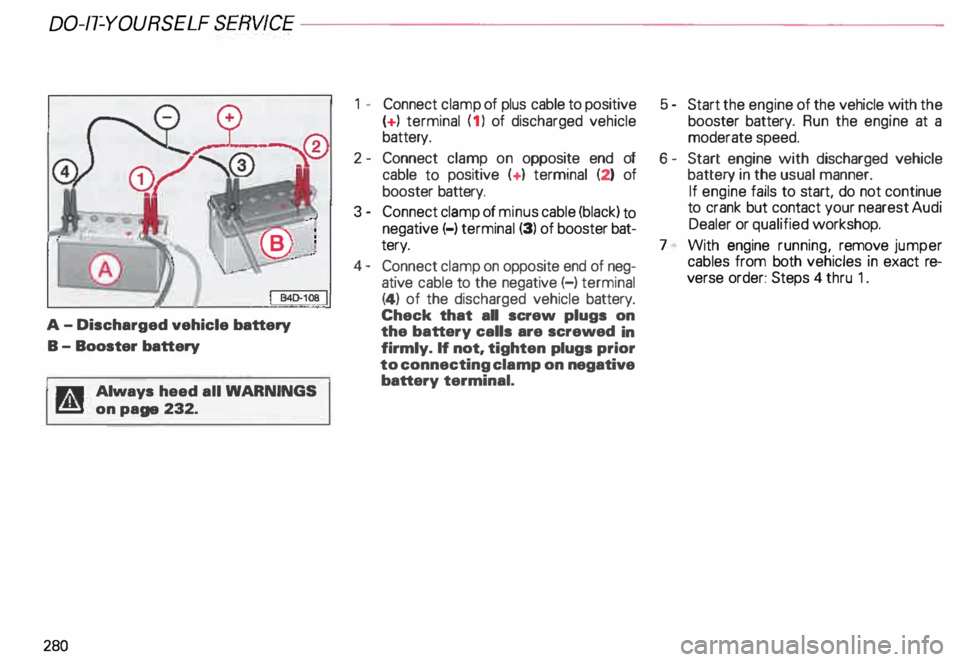
A-
Discharged vehicle battery
B - Booster battery
11r,:!1 Always heed all WAR NINGS
r!!l on page 232.
280 1
- Connect clamp of plus cable to positive
( + ) terminal (1 ) of discharged vehicle
battery.
2 - Connect clamp on opposite end of
cable to positive (+ ) terminal (2) of
booster battery.
3 - Connect clamp of minus cable (black) to
negative (-) terminal (3) of booster bat
tery.
4- Connect clamp on opposite end of neg
ative cable to the negative (-) terminal
(4) of the discharged vehicle battery.
Check that all screw plugs on
the battery calls are screwed in
firmly. If not, tighten plugs prior
to connecting clamp on negative
battery terminal. 5
- Start the engine of the vehicle with the
booster battery. Run the engine at a
moderate speed.
6- Start engine with discharged vehicle
battery in the usual manner.
If engine fails to start, do not continue
to crank but contact your nearest Audi
Dealer or qualified workshop.
7 With engine running, remove jumper
cables from both vehicles in exact re
verse order: Steps 4 thru 1.
Page 284 of 306
Lifting
vehicle
Lifting with workshop hoist
and with floor jack
Notes
• The vehicle should never be lifted
or jacked up from underneath the
engine oil pan, the transmission
housing, the front or rear axle or the
body side members. This could lead
to serious damage.
The same lifting points as illus trated on the
next page for the hoist also apply when a
floor jack is used.
e To avoid damage to the under
body or chassis frame, it is neces
sary to insert a rubber pad between
the floor jack and the lift points.
• To prevent damaging the shock
absorbers when lifting the vehicle
with a jack or on a hoist, the level
selection must be in the jack mode.
See next page. �W
ARNING
• To reduce the risk of serious in
jury and vehicle damage, lift the
vehicle only at the special work
shop hoist and floor jack lift points
illus trated. Failure to lift the ve
hicle at these points could cause
the vehicle to tilt or fall from a lift
if there is a change in vehicle
weight distribution and balance.
This might happen, for example,
when heavy components such as
the engine block or transmission
are removed.
• When removing such heavy
components, anchor vehicle to
hoist or add correspo nding
weights to maintain the center of
gravity. Otherwise, the vehicle
might tilt or slip oH the hoist,
causing serious damage or person
al injur y. DO-IT-YOU
RSELF SERVICE
�� WARNING continued
• If you must lift your vehicle with
a floor jack to work underneath,
be sure the vehicle is safely sup
ported on stands intended for this
purpose.
• Before driving over a workshop
hoist, check that the vehicle weight
does not exceed the permissible lift
ing capacity of the hoist.
• Before driving over a workshop
hoist, ensure that there is suHicient
clearance between the hoist and
low parts of the vehicle.
283