oil AUDI ALLROAD 2000 Owner's Guide
[x] Cancel search | Manufacturer: AUDI, Model Year: 2000, Model line: ALLROAD, Model: AUDI ALLROAD 2000Pages: 306, PDF Size: 9.95 MB
Page 253 of 306
VEHICLE
CARE-------------------------
Tires I Wheels
Tires are important but often abused parts
of a vehicle. They not only influence comfort
and ride, but perform vital safety functio �s.
This section is intended to provide you w1th
imp ortant information regarding their prop
er use, care and replacement.
• Be sure to inspect your tires at least ev
ery 2,000 miles (3 000 kilometres) for wear
and damage.
• Damage to wheels and tires is not always
easy to see. If you believe that a tire or
wheel has been damaged, it is best to have
it replaced as soon as possible. Internal tire
damage can never get better or ': heal" it
self, it can only get worse over t1me. Tire
damage can lead to tire failure and loss of
vehicle control. See your authonzed Aud1
Dealer for advice and assistance.
• Mark tires before removing them. Re
mount tires on the same vehicle side be
cause the rotation direction must stay the
same.
252 •
Store removed tires in a cool, dry and pre
ferably dark place. Tires which are not on
wheels should be stored standing up.
• New tires may have different tread
depths due to the configuration and des!gn
by the tire manufacturers. When replacing
tires, use ones with matching tread depth.
�W ARNING
• Tires age even if they are not be
ing used. Tires which are more
than 6 years should be used only in
an emergency and then with cau
tion.
• Avoid damaging tires and wheel
rims. If you must drive over a curb
or other obstacle, drive slowly and
as nearly as possible at a right
angle. Frequently check tires for
uneven wear and damage. M
WARNIN G continued
• Remove embedded material.
• Replace worn or damaged tires
immediately.
• Replace missing valve dust
caps.
• Keep oil, fuel, brake fluid, etc.
away from tires.
• Keep tires inflated correctly.
New tires
New tires tend to be slippery and cannot of
ferfull traction until they have been properly
broken in.
�W ARNING
To help avoid loss of control, al
ways operate a vehicle with new
tires at lower speeds and with spe
cial caution for the first 300 miles
(480 kilometres).
Page 260 of 306
-------------------------VEHICLE
CARE
Te mperature
The temperature grades are A (the highest),
8, and C, repres enting the tire's resistance to
the generation of heat and its ability to dissi
pate heat when tested under contro lled con
ditions on a specified indoor laboratory test
wheel. Sustained high temJ)erature can
cause the material of the tire to degenerate
and reduce tire life, and excessive tempera
ture can lead to sudden tire failure. The
grade C corres ponds to a level of perfor
mance which all passenger car tires must
meet under the Federal Motor Vehicle Safety
Sta ndard No. 1 09. Grades Band A represent
higher levels of performance on the laborato
ry test wheel than the minimum required by
law.
�W ARNIN G
The temperature grade for this tire
is est ablished for a tire that is
properly inflated and not over
loaded. Excessive speed, under
inflation, or excessive loading, ei
ther separately or in combination,
can causa heat buildup and pos
sible tire failure. Wheel
replacement
If you wish to equip your vehicle with tires
or wheels other than those installed at the
factory, please note the following:
• For technical reasons it is not al
ways possible to use wheels from
other vehicles -under certain condi
tions not even wheels from the same
vehicle model.
• Wheel rims and wheel bolts are
matched to fit your Audi. When
installing different wheels (for ax
ample, wheels with winter tires), the
correct wheel bolts with the proper
length and conical shape of the bolt
head must be used. The secure fit of
the wheels and the proper function
ing of the brake system and safety
are dependent upon this.
• Wheel rims and wheal bolts are
matched to fit your Audi. •
Before you plan on exchanging
steel wheels, light alloy wheals, or
winter tires already mounted on
wheel rims, consult your authorized
Audi Dealer. They have the technical
information necessary to advise you
which wheal rims and wheel bolts
are compatible with the original fac
tory installations.
1ft WARNING
• Incorrect tire/wheel parts may
cause an accident and personal in
jury. Such parts will adversely af
fect the safe operation of your ve
hicle. Always use tires, wheel rims
and wheel bolts that meat specifi
cations of the original factory
installed equipment.
• If wheel trim discs or a front
spoiler are Installed, make sura the
airflow for cooling the brakes is
not obstructed.
259
Page 263 of 306
VE
HICLE CARE
Difficult operating
conditions
Driving under difficult
conditions
Yo ur Audi has been designed and equipped
for normal operating conditions. This also
applies to the freq uency and the extent of
service requirements as stated in the Main
tenance brochure.
If you are planning to drive your vehicle un
der difficult operating conditions (for exam
ple, continuous trailer towing, very hot or
cold weather, very dusty conditions, poor
fuel quality, etc.) you may want to make
special preparations such as changing to an
appropriate oil viscosity, having your vehicle
thoroughly inspected, etc. Furthermore, the
main tenance should always be matched to
the operating conditions (see page 228).
262 Additional
accessories, Modifications and
Parts replacement
Yo ur vehicle incorporates the latest safety
design features ensuring a high standard of
active and passive safety. This safety could
be compromised by non-approved changes
to the original new-vehicle condition. For
this reason, if parts have to be replaced or
if any modifications are made to the vehicle,
please observe the following points when
installing additional accessories:
• Always cons�lt an author ized Audi
Dealer before purchasing accessories and
before any modifications are carried out. Cl
In your own interest, we advise
you to use only expressly approved
Audi accessories and genuine Audi
spare parts.
These parts and accessories have
been specially designed to be used
on your vehicle.
• Approved Audi accessories and genuine
Audi parts are available from authorized
Audi Dealers.
These dealers also have the necessary facil
ities, tools and trained specialists to install
the parts and accessories properly.
Page 275 of 306
DO-IT-YOURSELF
SERVICE----------------------
Fuses
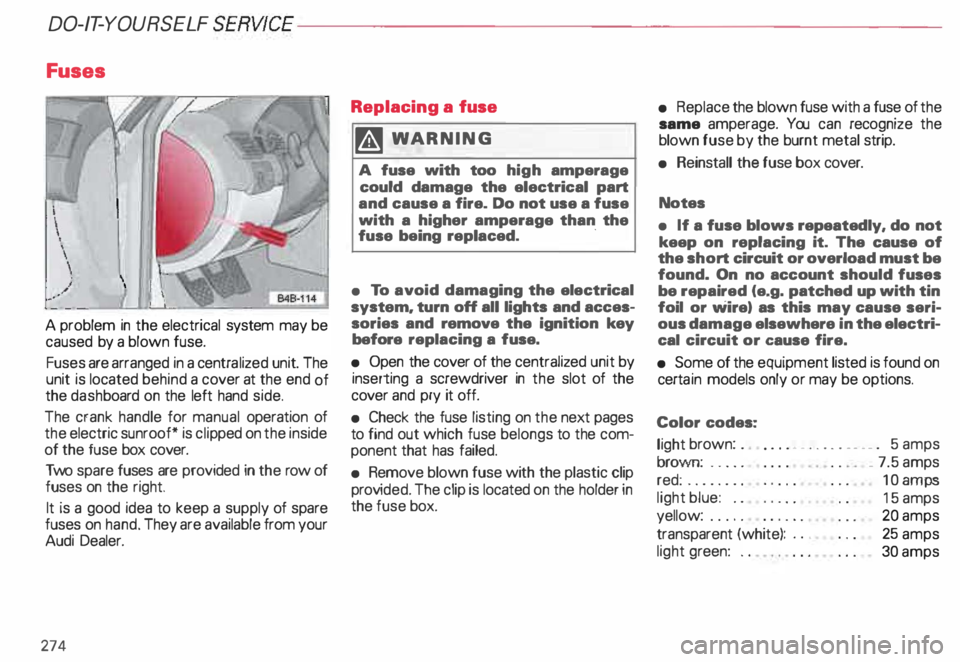
A problem in the electrical system may be
caused by a blown fuse.
Fuses are arranged in a centra lized unit. The
unit is located behind a cover at the end of
the dash board on the left hand side.
The crank handle for manual operation of
the electric sunroof* is cli pped on the inside
of the fuse box cover.
Two spare fuses are provided in the row of
fuses on the right.
It is a good idea to keep a supply of spare
fuses on hand. They are available from your
Audi Dealer.
274 Replacing
a fuse
� WARNING
A fuse with too high amperage
could damage the electrical part
and cause a fire. Do not use a fuse
with a higher amperage than the
fuse being replaced. ·
• To avoid damaging the electrical
system. turn off all lights and acces
sories and remove the ignition key
before replacing a fuse.
• Open the cover of the centralized unit by
inserting a screwdriver in the slot of the
cover and pry it off.
• Check the fuse listing on the next pages
to find out which fuse belongs to the com
ponent that has failed.
• Remove blown fuse with the plastic clip
prov ided. The clip is located on the holder in
the fuse box. •
Replace the blown fuse with a fuse of the
same amperage. You can recognize the
blown fuse by the burnt metal strip.
• Reinstall the fuse box cover.
Notes
• If a fuse blows repeatedly. do not
keep on replacing it. The cause of
the short circuit or overload must be
found. On no account should fuses
be repaired (e.g. patched up with tin
foil or wire) as this may cause seri
ous damage elsewhere in the electri
cal circuit or cause fire.
• Some of the equipment listed is found on
certa in models only or may be options.
Color codes:
light brown: . .
... • _ .. .. . __ . _ . 5 amps
brown: .... .
red: ....... .
light blue: ..
yellow: .....
transparent (white): ..•
light green: .. _
7.5 amps
10 amps
15 amps
20 amps
25 amps
30 amps
Page 284 of 306
Lifting
vehicle
Lifting with workshop hoist
and with floor jack
Notes
• The vehicle should never be lifted
or jacked up from underneath the
engine oil pan, the transmission
housing, the front or rear axle or the
body side members. This could lead
to serious damage.
The same lifting points as illus trated on the
next page for the hoist also apply when a
floor jack is used.
e To avoid damage to the under
body or chassis frame, it is neces
sary to insert a rubber pad between
the floor jack and the lift points.
• To prevent damaging the shock
absorbers when lifting the vehicle
with a jack or on a hoist, the level
selection must be in the jack mode.
See next page. �W
ARNING
• To reduce the risk of serious in
jury and vehicle damage, lift the
vehicle only at the special work
shop hoist and floor jack lift points
illus trated. Failure to lift the ve
hicle at these points could cause
the vehicle to tilt or fall from a lift
if there is a change in vehicle
weight distribution and balance.
This might happen, for example,
when heavy components such as
the engine block or transmission
are removed.
• When removing such heavy
components, anchor vehicle to
hoist or add correspo nding
weights to maintain the center of
gravity. Otherwise, the vehicle
might tilt or slip oH the hoist,
causing serious damage or person
al injur y. DO-IT-YOU
RSELF SERVICE
�� WARNING continued
• If you must lift your vehicle with
a floor jack to work underneath,
be sure the vehicle is safely sup
ported on stands intended for this
purpose.
• Before driving over a workshop
hoist, check that the vehicle weight
does not exceed the permissible lift
ing capacity of the hoist.
• Before driving over a workshop
hoist, ensure that there is suHicient
clearance between the hoist and
low parts of the vehicle.
283
Page 288 of 306
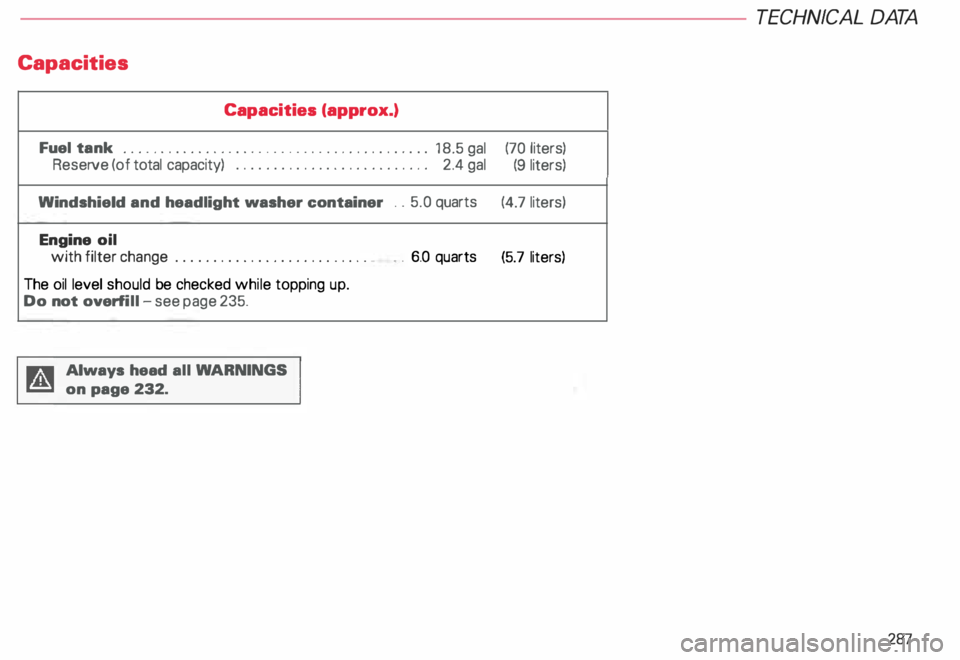
Capacities
Capacities (approx.)
Fuel tank
••••••• •••••••••• ••••••••••••••••• 0 ••• 0 ••
18.5 gal
Reserve (of total capacity) ............
..............
2.4 gal
Windshield and headlight washer container ..
5.0 quarts
Engine oil
with filter change .......................... •
The oil level should be checked while topping up.
Do not overf ill -see page 235.
Always head all WA RNINGS
on page 232. .
. 6.0 quarts TECHNICA
L DAT A
(70 liters)
(9 liters)
(4.7 liters)
(5.7 liters)
287
Page 289 of 306
TECHNICAL DAT
A-------------------------
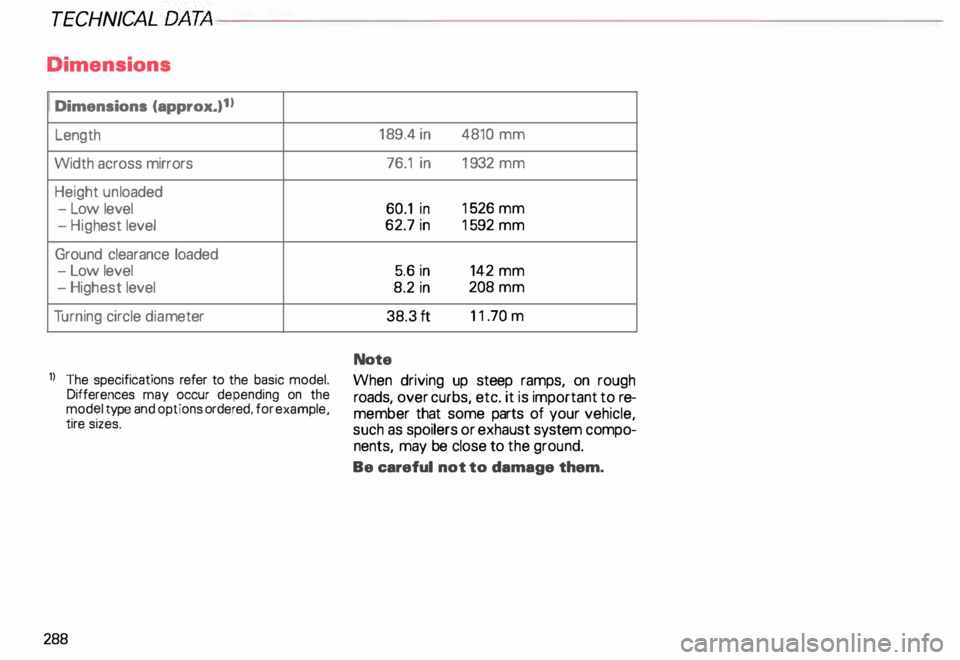
Dimensions
Dimensions (approx.) 1 I
Length
Width across mirrors
Height unloaded
- Low level
- Hig hest level
Ground clearance loaded
- Low level
- Highest level
Tu rning circle diameter
1J The specifications refer to the basic model.
Differences may occur depending on the
model type and options ordered, for example,
tire sizes.
288 18
9.4 in 4810 mm
76.1 in 1932 mm
60.1 in 15
26 mm
62.7 in 15
92 mm
5.6 in 142 mm
8.2 in 208
mm
38.3 ft 11
.70 m
Note
When driving up steep ramps, on rough
roads, over curbs, etc. it is important to re
member that some parts of your vehicle,
such as spoilers or exhaust system compo
nents, may be close to the ground.
Be careful not to damage them.
Page 290 of 306
Weights
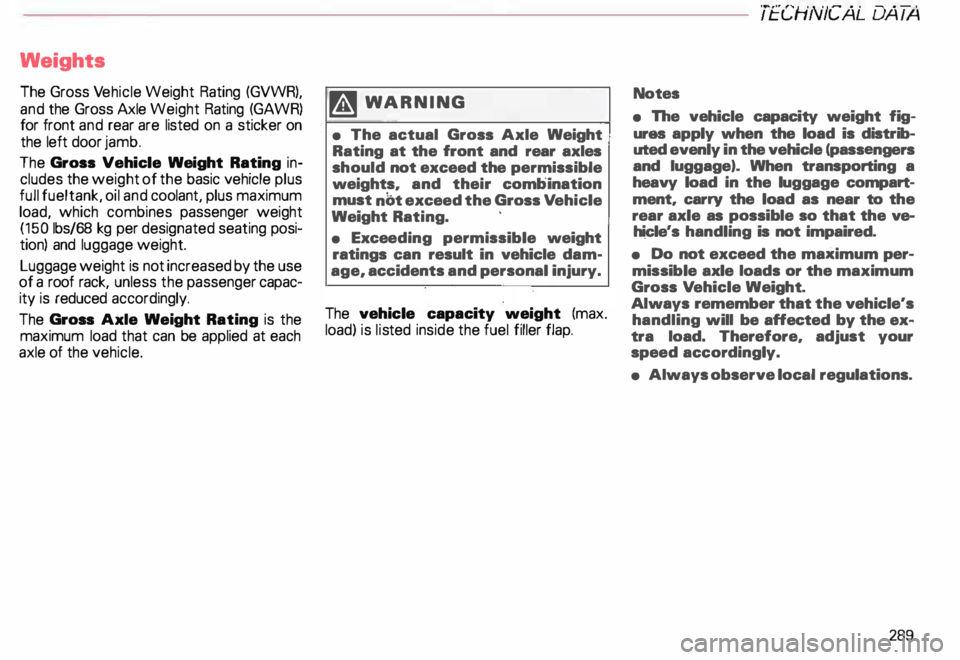
The Gross Vehicle Weight Rating (GVWR),
and the Gross Axle Weight Rating (GAWR)
for front and rear are listed on a sticker on
the left door jamb.
The Gross Vehicle Weight Rating in
cludes the weight of the basic vehicle plus
full fuel tank, oil and coolant, plus maximum
load, which combines passenger weight
(150 lbs/68 kg per designated seating posi
tion) and luggage weight.
Luggage weight is not increased by the use
of a roof rack, unless the passenger capac
ity is reduced accordingly.
The Gross Axle Weight Rating is the
maximum load that can be applied at each
axle of the vehicle. �W
ARNIN G
• The actual Gross Axle Weight
Rating at the front and rear axles
should not exceed the permissible
weights, and their combination
must nbt exceed the Gross Vehicle
Weight Rating.
• Exceeding permissible weight
ratings can result in vehicle dam
age, accidents and personal injury.
The vehicle capacity weight (max.
load) is listed inside the fuel filler flap. TECHNICAL
DATA
Notes
• The vehicle capacity weight fig
ures apply when the load is distrib
uted evenly in the vehicle (passengers
and luggage). When transporting a
heavy load in the luggage compart·
ment, carry the load as near to the
rear axle as possible so that the ve
hicle's handling is not impaired.
• Do not exceed the maximum per
missible axle loads or the maximum
Gross Vehicle Weight.
Always remember that the vehicle's
handling will be affected by the ex
tra load. Therefore, adjust your
speed accordingly.
• Always observe local regulations.
289
Page 297 of 306
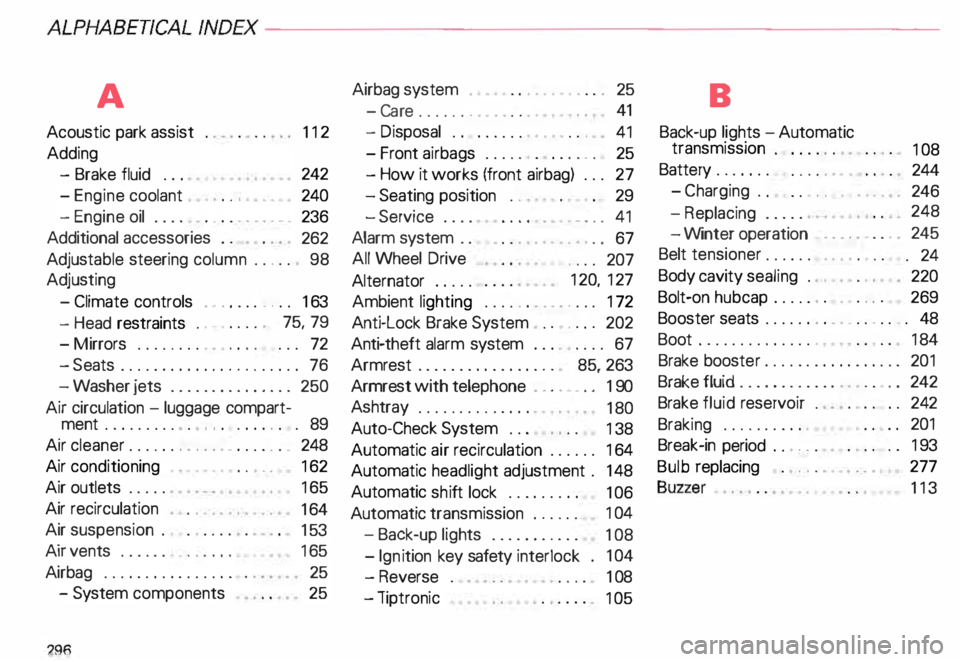
ALP
HABEnCAL INDEX----------------------------------------------
A
Acoustic park assist
Adding - Brake fluid ...
- Engine coolant
. . . . . • • •
- Engine oil . . . . .
... •.• .. __ 11
2
242
240
236
Additional accessories ..
262
Adjusta ble steering column . . . . . 98
Adjusting
- Climate controls . . . . . . . . . . 163
- Head restraints . • . . . . . 75, 79
-M irrors . . . . . . . . . • • . . . . . . . 72
-S eats .... ... ............ ... 76
- Washer jets . . . . . . . . . . . . . . . 250
Air circulation -luggage compart-
ment ........ .. ... .... .. . 89
Air cleaner ...... .. ... . _ .... . .. 248
Air conditioning . . . . . . . , . .
162
Air outlets . . . . . 165
Air recirculation
... ••• , • • . .
164
Air suspension .
153
Air vents . . . . . . • . . . . . . 165
Airbag . . . . . . . . . . . . . . . .
25
- System components
25
?00 Airbag
system . • . . . . • • • . . . . 25
-C are....... .. .. .. .. 41
- Disposal . . . . . . . . . • • . • . . .
41
- Front airbags . . . . . . . . . . . .
25
- How it works (front airbag) . . . 27
-S eating position . .
29
-S ervice .. .. .. .. ... _ ... 41
Alarm system . .
• . . . . • • • • . . . . 67
All Wheel Drive
. . . . 207
Alternator . . . . . 120, 127
Ambient lighting . . . . . . . _ . . . . . 172
Anti-Lock Brake System ..•.... 202
Anti-theft alarm system . . . . ...
67
Armrest . . . . . . . . . . . . . . . . . 85, 263
Armrest with telephone ..... _ . . 19 0
Ashtray . . . . . . . . . . . . . .
180
Auto-Check System . . .
1 38
Automatic air recirculation . . . . . . 164
Automatic headlight adjustment . 14 8
Automatic shift lock . . . . . . . . .
106
Automatic transmission . . . . . . 1 04
- Back-up lights . . . . . . . . . . .
1 08
- Ign ition key safety interlock 1
04
- Reverse 1
08
- Tiptronic
105 B
Back-up lights- Automatic
transmission .
1 08
Battery . . . . . . .
. . . . . • • • 244
-C harging . .
. . • . . • .... . 246
- Replacing . . . . . 248
- Winter operation .
. . . . . . . . . 245
Belt tensioner . . . . . . • • • . • . .
. 24
Body cavity sealing .
220
Bolt-on hubcap . . . . . . . . . • . . 269
Booster seats ....... .. .. ... .. _ . 48
Boo t.............. .
184
Brake booster. . . . . . . . . . . . . . . . . 201
Brake fluid . . . . . . . . . . . . . • • . . • . . 242
Brake fluid reservoir . . . 242
Braking . . . . . . . . . . . 201
Break-in period . . • . . . . . 193
Bulb replacing . • . . . • • • • . . • 277
Buzzer 113
Page 298 of 306
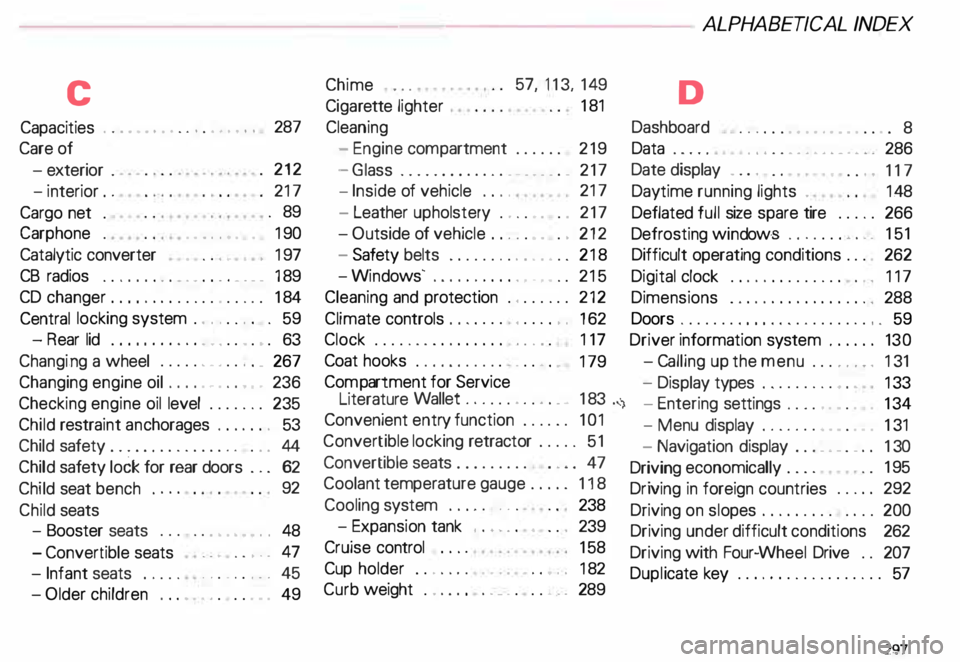
c
Capacities ...• ••.•. .......• o o 287
Care of
-e xterior . 212
-i nterior . . 217
Cargo net . .
89
earphone . . •
• . . • • 190
Catalytic converter •
. . . • • o 197
CB radios . . . . . . . . . . . . . . . . • . . . 189
CD changer . . . . . . . . . . . . . . . . . . . 184
Central locking system .. ... . 0 • • 59
- Rear lid . . . . . . . . . . . . • . . . • . • . 63
Changing a wheel . . . . . . . .. o • • 267
Changing engine oil . . . . . . . . • 236
Checking engine oil level . . . . . . . 235
Child restra int anc horages . . . . . . . 53
Child safety ... ........... .. ... 44
Child safety lock for rear doors . . . 62
Child seat bench . . . . 92
Child seats
- Booster seats . . . . . . • • • • • . . 48
-C onvertible seats .. • .. o •• 47
- Infant seats . . . . .
. .. ... .. . 45
-O lder children . . . • . . . . . . . . 49 Chime
...
Ciga rette lighter
Cleaning 57,
113, 14 9
18 1
- Engine compartment ..... . 219
217
-
Glass ............. ... .. . .
- Inside of vehicle . . . . 217
- Leather upholstery . . . . . . . 217
-O utside of vehicle .... . • .. 212
- Safety belts . . . . . . . . . . . . . . . 218
-W indows· . . . . . . . . . . . • . . . . 215
Cleaning and protection . . . . . . . . 212
Clima te controls . . . . . . . . .... o • 16 2
Clock .. .. . .. .. . .. .. .. .. .. .
117
Coat hooks . . . . . . . . . . . . . . • . •
179
Com partment for Service
Literature Wallet ......... .... 18 3 .,)
Convenient entry function . . . . . . 1 01
Convertible locking retractor .... . 51
Convertible seats......... . ... 47
Coolant temperature gauge . . . . . 118
Cooling system . . . . . . . .
238
- Expansion tank 0 • • • • • • • • • 239
Cruise control . . . . 15
8
Cup holder . . . . . . . . . • . • . . • . . 182
Curb weight . . . . . . . . _. . . . ... 289 ALP
HABETICAL INDEX
D
Dashboard ...... •••• .••.• .... 8
Data . . . . . . . o • • • • • • • • • • • • • 286
Date display . . . . . .
• .. 0 • 117
Daytime running lights .
148
Deflated full size spare tire ..... 266
Defrosting windows . . . . . . . • . . . 151
Difficult operating conditions . . . . 262
Digital clock . . . . . . . . . . . . . . . . . 117
Dimensions . . . . . . . . . . . . . . . . . . 288
Doors ....................... 0. 59
Driver information system . . . . . . 130
-C alling up the menu ....... . 131
- Display types . . . . . . . . . • . • 133
- Entering settings . . . . • . • . . . 134
- Menu display . . . . . . . • • • . . . 131
- Navigation display ..... _ . . . . 130
Driving economically . . . . 19
5
Dri ving in foreign countries . . . . . 292
Driving on slopes . . . . . . . . . . . . . 200
Driving under difficult conditions
262
Driving with Four-Wheel Drive . . 207
Dupl icate key ....... .... ....... 57
297