airbag off AUDI ALLROAD 2000 Owners Manual
[x] Cancel search | Manufacturer: AUDI, Model Year: 2000, Model line: ALLROAD, Model: AUDI ALLROAD 2000Pages: 306, PDF Size: 9.95 MB
Page 17 of 306
SA
FETY FIRST
Don't rely on airbags alone for protection.
Even when they deploy, airbags provide
only supplemental protection. Airbags are
not supposed to deploy in all kinds of acci
dents. Although your Audi is equipped with
airbags for the driver and front seat passen
ger, all vehicle occupants, including the
driver, still have to wear safety belts- re
gardless of whether their seating position
has an airbag.
Remember too, that airbags will deploy only
once and that your safety belts are always
there to offer protection in those accidents
in which airbags are not supposed to deploy
or when they have already deployed.
Unbelted occupants can also be thrown out
of the car where even more severe or fatal
injuries can occur.
16 Unbelted
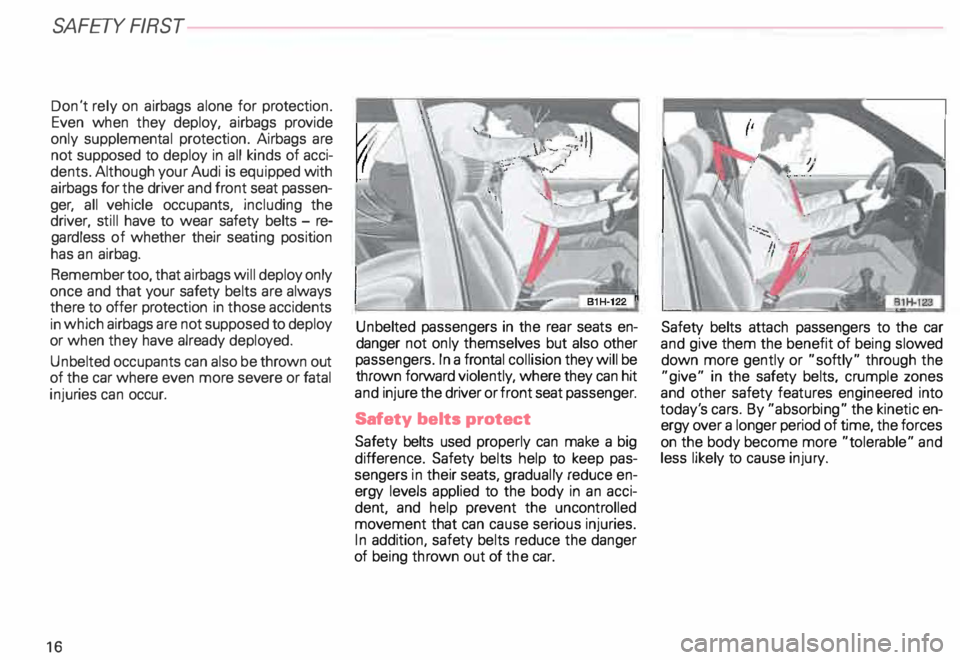
passengers in the rear seats en
danger not only themselves but also other
passengers. In a frontal collision they will be
thrown forward violently, where they can hit
and injure the driver or front seat passenger.
Safety belts protect
Safety belts used properly can make a big
difference. Safety belts help to keep pas
sengers in their seats, gradually reduce en
ergy levels applied to the body in an acci
dent, and help prevent the uncontrolled
movement that can cause serious injuries.
In addition, safety belts reduce the danger
of being thrown out of the car. Safety
belts attach passengers to the car
and give them the benefit of being slowed
down more gently or "softly" through the
"give" in the safety belts, crumple zones
and other safety features engineered into
today's cars. By "absorbing" the kinetic en
ergy over a longer period of time, the forces
on the body become more "tolerable" and
less likely to cause injury.
Page 27 of 306
SA
FETY FIRST
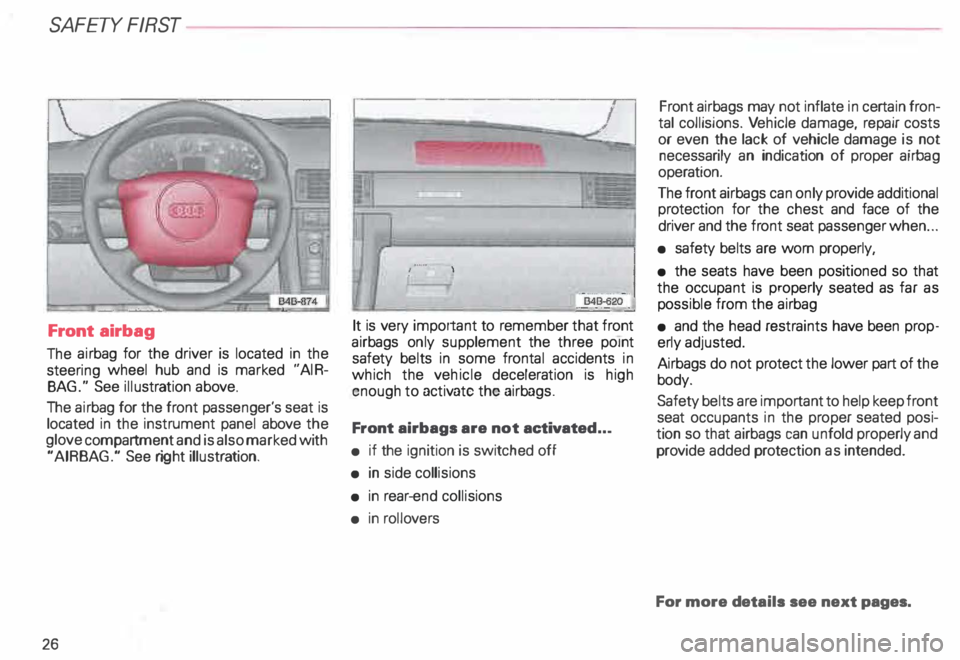
Front airbag
The airbag for the driver is located in the
steering wheel hub and is marked "AIR
BAG." See illustration above.
The airbag for the front passenger's seat is
located in the instrument panel above the
glove compartment and is also marked with
"AIRBAG." See right illustration.
26 It
is very important to remember that front
airbags only supplement the three point
safety belts in some frontal accidents in
which the vehicle deceleration is high
enough to activate the airbags.
Front airbags are not activated ...
• if the ignition is switched off
• in side collisions
• in rear-end collisions
• in roiJovers Front
airbags may not inflate in certain fron
tal collisions. Vehicle damage, repair costs
or even the lack of vehicle damage is not
necessarily an indication of proper airbag
operation.
The front airbags can only provide additional
protection for the chest and face of the
driver and the front seat passenger when ...
• safety belts are worn properly,
• the seats have been positioned so that
the occupant is properly seated as far as
possible from the airbag
• and the head restraints have been prop
erly adjusted.
Airbags do not protect the lower part of the
body.
Safety belts are important to help keep front
seat occupants in the proper seated posi
tion so that airbags can unfold properly and
provide added protection as intended.
For more details see next pages.
Page 28 of 306
--------------------------------------------------SAFETYRRST
�W ARNING
• To reduce the risk of injury
when the front airbags inflate, the
driver and passenger should al
ways sit in an upright position and
must never lean against or place
any part of your body too close to
the area where the front alrbags
are located.
• See "Imp ortance of proper seat
ing position" in this section at
pages 29 and 37 and heed all
WA RNINGS.
G Occupants who are unbelted,
out of position or too close to the
airbag can be seriously injured by
an airbag as it unfolds with great
force in the blink of an eye. For
seat adjustment, see page 76. Remember
too, airbags will deploy only
once and only in certain kinds of accidents
- your safety belts are a�ways t� ere t? off �r
protection in those acc1dents m wh1ch air
bags are not supposed to deploy or when
they have already deployed.
An airbag is not a substitute �or the safety
belt. It is part of the overall veh1cle safety sy
stem. The airbag system works most effec
tively when used with the safety belts.
Therefore, always wear your safety belts.
See pages 14 to 24.
It is important to remember that 'JI:'hile the
supplemental airbag system . IS d� s�g �ed to
reduce the likelihood of senous lnJUnes, 1t
can cause swelling, bruising, and minor
abrasions. How
the front airbag system works
The airbag system is designed so that in a
severe frontal collision the driver and
front passenger airbags are triggered. Th�
front airbags will not inflate in frontal colli
sions in which vehicle deceleration is not
high enough, or in side or rear collisions, or
in rollovers.
It is not possible to define an airbag trig�er
ing range that will cover every poss1ble
angle of impact, since the circumstances
will vary considerably between one acci
dent and another.
Important factors include, for example, the
nature ( hard or soft) of the object which the
car hits, the angle of impact, vehicle speed,
and etc.
27
Page 36 of 306

-----------------------------------------------------SAFETYRRST
The supplemental side airbags inflate only
in severe side collisions occuring on
the impact side of the vehicle.
The supplemental side airbags will
not inflate ...
• if the ignition is switched off
• in frontal collisions
• in side collisions in which vehicle
deceleration is not high enough
• in rear collisions
• in rollovers.
Under some accident conditions, both front
and side airbags may inflate.
Remember too, airbags will deploy only
once and only in certain kinds of accidents
- your safety belts are always there to offer
protection in those accidents in which air
bags are not supposed to deploy or when
they have already deployed. A
side airbag is not a substitute for the
safety belt. It is part of the overall vehicle
safety system. The airbag system works
most effectively when used with the safety
belts. Therefore, always wear your safety
belts. See pages 14 to 24.
It is important to remember that while the
supplemental side airbag system is de
signed to reduce the likelihood of serious in·
juries, it can cause swelling, bruising, and
minor abrasions.
How the supplemental side airbag
system works
In a side collision the supplemental side air
bags can help to reduce the risk of injury to
the upper part of the body on the side of the
car that is struck in a side collision.
In order to assure this additional protection,
the side airbag must inflate within the blink
of an eye during a collision. It
is )'lOt possible to define an airbag trigger
ing range that will cover every possible
angle of impact, since the circumstances
will vary considerably between one acci
dent and another.
Important factors include, for example, the
nature ( hard or soft ) of the object which the
car hits, the angle of impact, vehicle speed,
and etc.
The triggering of the airbag system de
pends on the vehicle deceleration rate
caused by the collision and registered by
the control unit. If this rate is below the ref
erence value programmed into the control
unit, the. airbags will not be triggered, even
though the car may be badly damaged as a
result of the accident.
35
Page 40 of 306

Head airbags (SIDEGUARD)
The head airbags (inflatable curtain head
airbags) are located on the left and right
sides above the doors underne ath the head
lin er. These locations are marked with the
word "AIRBAG".
The head airbags are inflated together with
the supplemental side airbags only in se
vere side collisions occuring on the impact
side of the vehicle. The
head airbags will not inflate ...
• if the ignition is switched off
• in frontal collisions
• in side collisions in which vehicle
deceleration is not high enough
• in rear collisions
• in roll-overs.
Under some accident conditions, front and
side and head airbags may inflate.
Remember too, airbags will deploy only
once and only in certain kinds of accidents
-y our safety belts are always there to offer
protection in those accidents in which air
bags are not supposed to deploy or when
they have already deployed.
A head airbag is not a substitute for the
safety belt It is part of the overa ll vehicle
safety system. The airbag system works
most effectively when used with the safety
belts. Therefore, always wear your safety
belts. See pages 14 to 24. SA
FETY FIRST
How the head airbag system works
In the event of a side-impact collision, the
head airbag deploys to reduce the risk that
persons sitting next to the doors will be in
jured if their heads strike the windows or
door columns. In addition, the head airbag
protects occupants from objects hurtled
into the vehicle from the outside, such as
broken glass.
In order to provide optimal protection for ve
hicle occupants, the airbag system is de
signed so that the head and side airbags on
the accident side are always triggered to
gether.
Therefore, the conditions under which the
head airbags are deployed are identical to
those for the side airbags. See page 35.
39
Page 47 of 306

SA
FETY FI
RST------------------------
�W ARNING
If, in exceptio nal circumstances
you have no alternative but to
install a rear facing child seat or in
fant canier an the front passenger
seat, deactivate the front passen
ger airbag prior to installing the
child restra int.
Please note, that the side airbag
for the front passenger seat will
remain functional even if the front
passenger alrbag is switched off.
Make sure the child restraint has
been designed and certified by its
manufacturer for use on a front
seat with a side airbag.
Always move the passenger seat
into its raarmost position, as far
away from the airbag as possible
before installing the child re
straint. The backrest must be ad
justed to an upright position.
46
Babies and older children must
never ride in a vehicle sitting on
the lap of an adult. Holding a child
in your arms is never a substitute
for a child restraint system. The
strongest adult could not hold
onto the child under the forces ex
erted in an accident. 1ft
WARNING continued
The child would strike the interior
of the vehicle and could also be
struck by the adult's body moving
forwa rd. The child and the adult
could injure each another.
In a frontal accident at a speed of 20-35 mph
(30-56 km/h) the forces acting on a
13 -pound (6 kg) infant would be more than
20timestheweightofthe child. This means
the weight of the child would suddenly be
more than 260 pounds (120 kg). Under
these conditions, only an appropriate child
restr aint properly used can reduce the risk
of serious injury.
Page 50 of 306
-------------------------------------------------SAFETY ARST
In a collision, airbags must inflate within a
blink of an eye and with considerable force.
In order to do its job, the airbag needs room
to inflate so that it will be there to protect
the occupant as the occupant moves for
ward into the airbag.
A vehicle occupant who is out of position
and to close to the airbag gets in the way of
on infloting nirbag. When an occupant is too close he or she will be stru ck violently and
will r� ceive serious or possibly even fatal in
jury.
In order for the airbag to offer protection, it
is important that all vehicle occupants, es
pecially children who must ride on the front
seat in excep tional situations, be properly
restra ined and as far away from the airbag
as possible. By keeping room between your
body and the front of the passenger
compartment, the airbag can inflate fully
and completely and provide supplemental
pro tection in certain frontal collisions. �W
ARNING
Never let a child stand or kneel on
any seat, particularly the front
seat. Never let a child ride in the
cargo area of your car. If a child is
leaning forward, sitting sideways
or out of position in any way, the
child is more likely to be injured in
a crash and will receive serious or
fatal injuries if the child comes
into contact with an airbag as it in
flates.
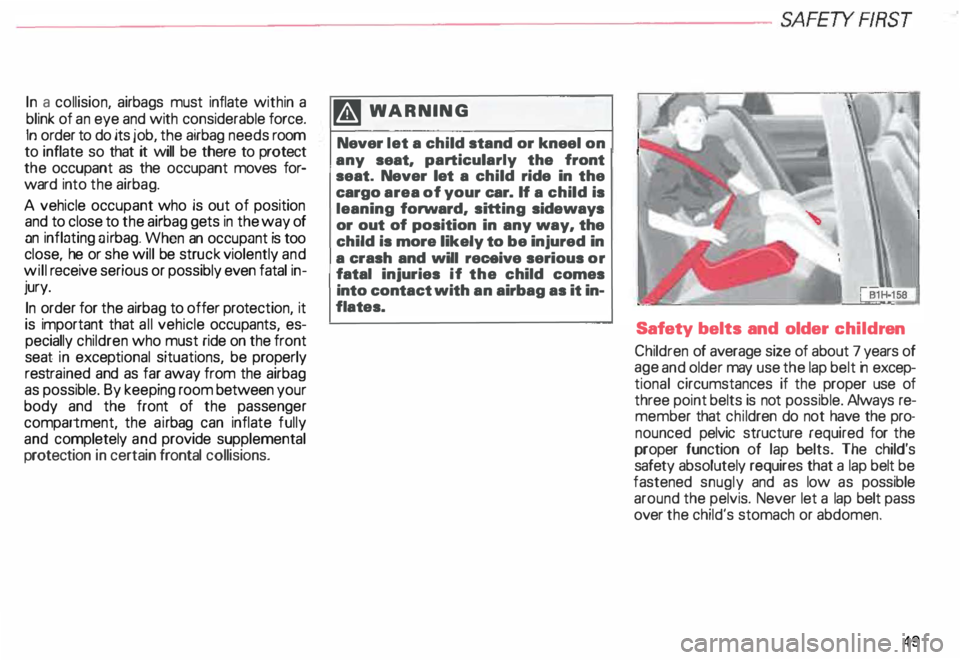
Safety belts and older children
Children of average size of about 7 years of
age and older may use the lap belt in excep
tional circumstances if the proper use of
three point belts is not possible. Always re
member that children do not have the pro
nounced pelvic structure required for the
proper function of lap belts. The child's
safety absolutely requires that a lap belt be
fastened snugly and as low as possible
around the pelvis. Never let a lap belt pass
over the child's stomach or abdomen.
49
Page 55 of 306
SAFETYRRST----------------------------------------------------
These LATCH anchorage points are only in
tended for the installation and attachment
of child restra ints specially certified for use
with LATCH anchorages. Child restraints
that are not equipped with the LATC H an
chorages can still be installed using the ve
hicle seat belts.
Some child restra ints are certified for instal
lation either with LATCH ancho rages or the
vehicle safety belt. It is recommended that
such child restraints be used with the
LATCH anchorages because this system
will provide the easiest and more secure
installation.
LA TCH anchor ages are designed to be used
only with child restraints adapted for them.
Always refer to the child restra int manufac
turer's instructions for proper installation of
the child restra int using the vehicle LATCH
lower anchorage or safety belts. Never use
the LATC H lower ancho rages to attach safe
ty belts or other kinds of occupant re
straints.
54 �W
ARNING
• Do not drive the vehicle without
the head restraints provided. Head
restraints are designed to help re
duce injuries.
• The child restraint anchorages
are only to be used to hold a child
restra int system in its place.
• Child restraint anchorages are
designed to withstand only those
loads imposed by correctly fitted
child restraints. Under no circum
stances are they to be used for
adult seat balta or harnesses.
• Do not mount two child re
straint seats on one anchor point.
• Always follow the instructions
provided by the manufacturer of
the child restraint which you
intend to install in your Audi. Side
airbags and child safety
Yo ur Audi comes equipped with 2 front air
bags (driver and front passenger) and 4 side
airbags (in the front and rear*) which offer
the occu pants increased protection in the
event of a lateral collision.
In or�er t� assure this additional protection,
the s1de a1rbag must inflate within milli-sec
onds during a collision. When the airbag is
a ?tivated, it breaks through a seam on the
s1de of the seatback identified by the AIR
BAG label, and inflates between the pas
senger and side trim panel at very high
speed.
The side airbag inflates with such a high
f ? rce, that it could injure a child seriously if
h1s I her seating position is not proper up
nght, or 1f 1tems are positioned in the area
where the airbag inflates.
Page 56 of 306
�W
ARNING
• To prevent serious injuries, chil
dren must always be secured in a
vehicle by a child restraint system
appropriate for their age and size.
• A child must never rest his I her
head against the side trim panel in
the area where the side airbag in
flates.
An inflati ng alrbag can cause seri
ous or fatal injury!
• Never place items in the area
where the side airbag inflates. This
could cause serious injury!
Note If special situations in your family require,
your authorized Audi Dealer can disconnect
the rear side airbags upon your request. NEVER
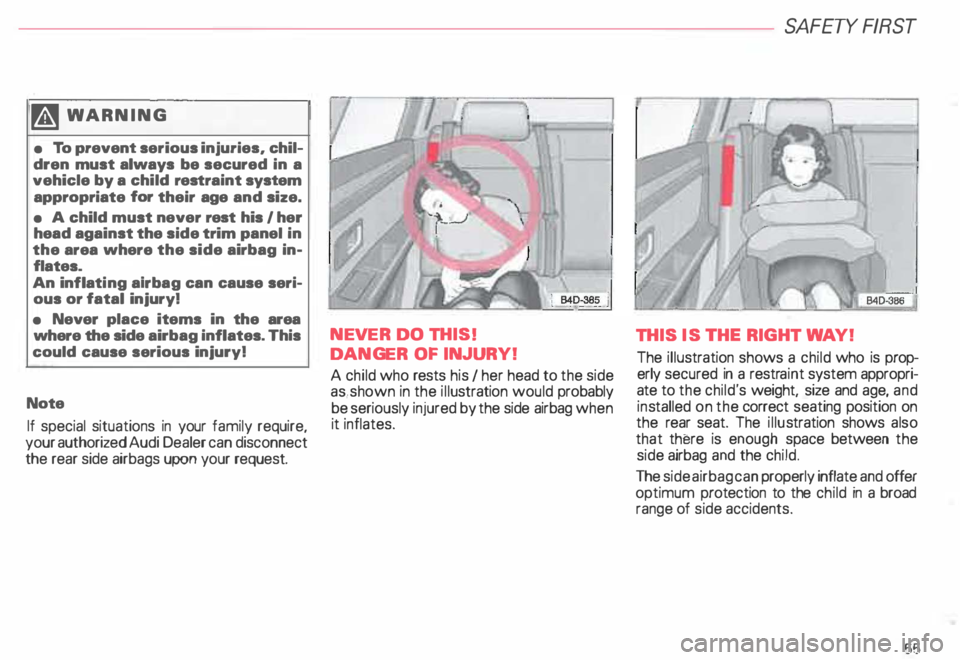
DO THIS I
DANGER OF INJ URY !
A child who rests his I her head to the side
as, shown in the illustration would probably
be seriously injured by the side airbag when
it inflates. SA
FETY FIRST
THIS IS THE RIGHT WAY !
The illustration shows a child who is prop
erly secured in a restr aint system appropri
ate to the child' s weight, size and age, and
ins talled on the correct seating position on
the rear seat. The illustration shows also
that there is enough space between the
side airbag and the child.
The side airbag can properly inflate and offer
optimum protection to the child in a broad
range of side accidents.
55
Page 67 of 306
CONT
ROLS AND EQUIPMENT---------------------
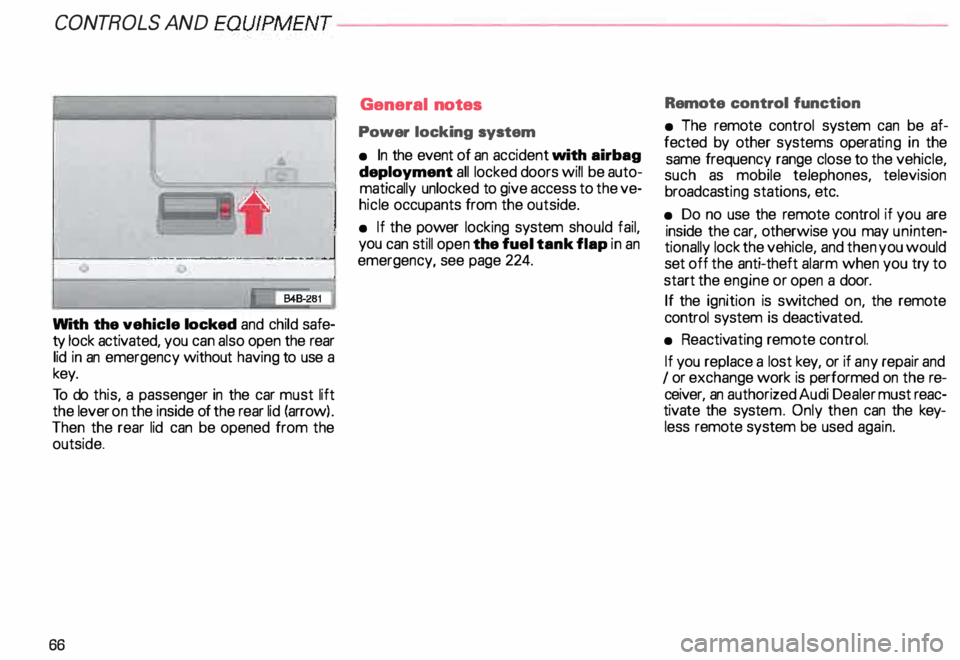
With the vehicle locked and child safe
ty lock activated, you can also open the rear
lid in an emergency without having to use a
key.
To do this, a passenger in the car must lift
the lever on the inside of the rear lid (arrow) .
Then the rear lid can be opened from the
outside.
66 General
notes
Power locking system
• In the event of an accident with airbag
deployment all locked doors will be auto
matically unlocked to give access to the ve
hicle occupants from the outside.
• If the power locking system should fail,
you can still open the fuel tank flap in an
emergency, see page 224. Remote
control function
• The remote control system can be af
fected by other systems operating in the
same frequency range close to the vehicle,
such as mobile telephones, television
broadcas ting stations, etc.
• Do no use the remote control if you are
inside the car, otherwise you may uninten
tionally lock the vehicle, and then you would
set off the anti-theft alarm when you try to
start the engine or open a door.
If the ignition is switched on, the remote
control system is deactiv ated.
• Reactiv ating remote control.
If you replace a lost key, or if any repair and
I or exchange work is performed on the re
ceiver, an authorized Audi Dealer must reac
tivate the syste m. Only then can the key
less remote system be used again.