steering AUDI ALLROAD 2000 Owners Manual
[x] Cancel search | Manufacturer: AUDI, Model Year: 2000, Model line: ALLROAD, Model: AUDI ALLROAD 2000Pages: 306, PDF Size: 9.95 MB
Page 6 of 306
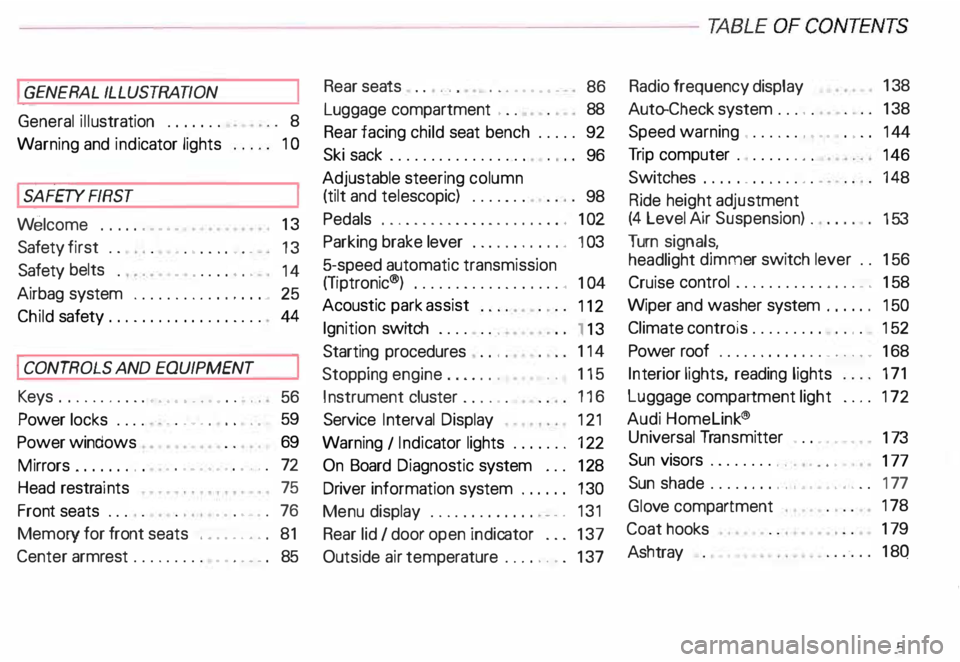
----------------------------------------------TABLE OFCONT ENTS
I GENERAL ILLUSTRATION
General illustration 0 0 0. • • • 8
Warning and indicator lights 10
I SAFETY
FIRST
W elcome ... 0 0 0 •• •• 13
Safety first 0 0
• 0 • 0 0 0 0 • 0 •
13
Safety belts
• . . 0 0 0 • 0 0
14
Airbag system 0 ••••••• 0 0 • • • • • • • 25
Child safety ........ 0 • 0 0 0 0 0 0 0 0 0 44
I CONTROLS AND EQUIPMENT
Keys 0 0 0 0 0 0 0 0 0 0 0 •••• ••••• 0 0 • • 0
56
Power locks 0 0 0 0
Power windows
Mirrors 0 •• 0 0 0 •••
Head restraints
Front seats 0 0 0 •
0.- . 0 0 0 • • 59
69
• •• - •••• 0 ••• 0 72
75
•• 0 •• 0 76
Memory for front seats , .... 0 •• 0 81
Center armrest 0 0 0 0 0 0 0 0 0 •••••• 0 85 Rear
seats 0 0 •• 0 •• 0 • • • • • •
86
Luggage compartment , 0 0 88
Rear facing child seat bench 0 0 0 0 0 92
Ski sack 0 0 0 0 0 0 0 0 0 0 0 0 0 0 0 0.
96
Adjustable steering column
(tilt and telescopic) 0 0 0 0 • 0 0
98
Pedals 0 0 • 0 0 0 0 0 0 0 0 0 0 0 0 0 0 0 0 0 0 0 , 1 02
Parking brake lever 0 • 0 0 0 0 0 0 0 •• 0 1 03
5-speed automatic transmission
(Trptronic ®) 0 0 0 0 0 0 0 0 0 0 • 0 0 0 0 0. 0 • 104
Acoustic park assist
112
Ignition switch 0 0 0 0 0 0 0
1 13
Starting procedures . 0 • • 114
Stopping engine 0 0 0 0 0 0 • • • 115
Instrument cluster 0 0 0 0 0 0 116
Service Interval Display
121
Warning I Indic ator lights 0 0 0 0 0 0 • 122
On Board Diagnostic system 0 0 0 128
Driver information system 0 • 0 • • • 130
Menu display 0 0 0 0 0 0 0 0 0 0 0 0 0
0 131
Rear lid I door open indicator 0 0 0 137
Outside air temp erature 0 • 0 0 0 0 0 0 137 Radio
frequency display 13
8
Auto-Check system 0 0 0 o 0 138
Speed warning . 0 0 0 • 0 0 • • • • 0 • 0 0 144
Tr ip computer 0 0 0 0 0 0 •• 0
146
Switches 0 • 0 •• 0 0 0 0 • 0 0 0 0 148
Ride height adjustment
(4 Level Air Suspension) 0
153
Turn signals,
headlight dimmer switch lever 0 0 156
Cruise control 0 0 0 0 0 0 0 0 0 0 0 0 0 0 0 • • 158
Wiper and washer system 0 ••• 0 0 150
Climate controls 0 0 0 0 0 0 0 0 0 0 0 • 0 152
Power roof 0 0 0 0 0 0 0 • 0 0 0 0 0 • • • • • • 168
Int erior lights, reading lights 171
Luggage compartment light 0 0 0 0 172
Audi Homelink ®
Uni versal Transmitter . 0 0 • • • •
173
Sun visors 00 00 00 00 ... • .. •
177
Sun shade 0 0 0 0 0 0 0 0 •• , • • • ••• 0 0 177
Glo ve compartment
Coat hooks
Ashtray 178
179
180
5
Page 7 of 306

TABLE OF CO
NTENTS----------------------------------------------
Cigar ette lighter I Socket ....... 181
Storage compartments
Steering wheel with
Audio controls .......••.... 0
Steering wheel with
radio and telephone equipment
in the steering wheel .
Mobile telephones and
CB radios ..
earphone ..•
Roof rack ... ..
I VEHICLE
OPERATION
The first 1,000 miles (1 500 km)-182
18 5
186
189 19 0
191
and afterwa rds ....... ....... .. 193
Operate your vehicle safely . . . . . 194
Operate your vehicle economically
and minimize pollution . . 195
Driving on rough roads or
rugged terrain . . . . . . . . . . 199
Braking . . . . . . . . . . . . . . . . . 201
Ele ctronic differential lock
(EDL) 204
6 Electronic
Stability Program
(ESP) .. .. .. .. .. .. .. .. .. 205
Driving with your quattro® . . . . . . 207
Trailer towing . . . . . . . . _ ... _ . . 208
I VEHICLE
CARE
Cleaning and protection 212
Fuel tank . . . . . . . .
222
Fuel supply . _ .... .. _ . . . . . . . . . . 225
Maintenance ..• •. .
Engine hood .
. . .
Engine compartment
Engine oil ..... ..... .
Engine cooling system
o •• •••
Power steering
Brake fluid ..
Battery ...
Air cleaner
Spark plugs
Belts . . . . .
. __ ..• .. ...
Windshield I
headlight washer container ..... 228
231
232
234
238
241
242
244 248
249
249
250 Wiper
blades
lires I Wheels
Difficult operating
conditions ...... . .
Additional accessories, Modifications and
Parts replacement ...... . .
I DO-IT-YOURSELF
SERVICE
First aid kit ....•.
Emergency
warning triangle . . . . . . . . .
Jack and tools ... .• . _ .. ..• .. ..
Spare wheel .. .. . .. ... . ..
Changing a wheel . . . • . . . . .
Fuses ........ .. . . . .. .. _ .. ..
Replacing bulbs
Installing I
replacing a radio
Emergency starting
Emergency towing with
commercial tow truck
Lifting vehicle .... . 251
252
262
262
263
263
264
266
267 274
277
277
278
281
283
Page 10 of 306
1
2
3
4 5
6
7
8
9
10
11 12
13 14
15
16
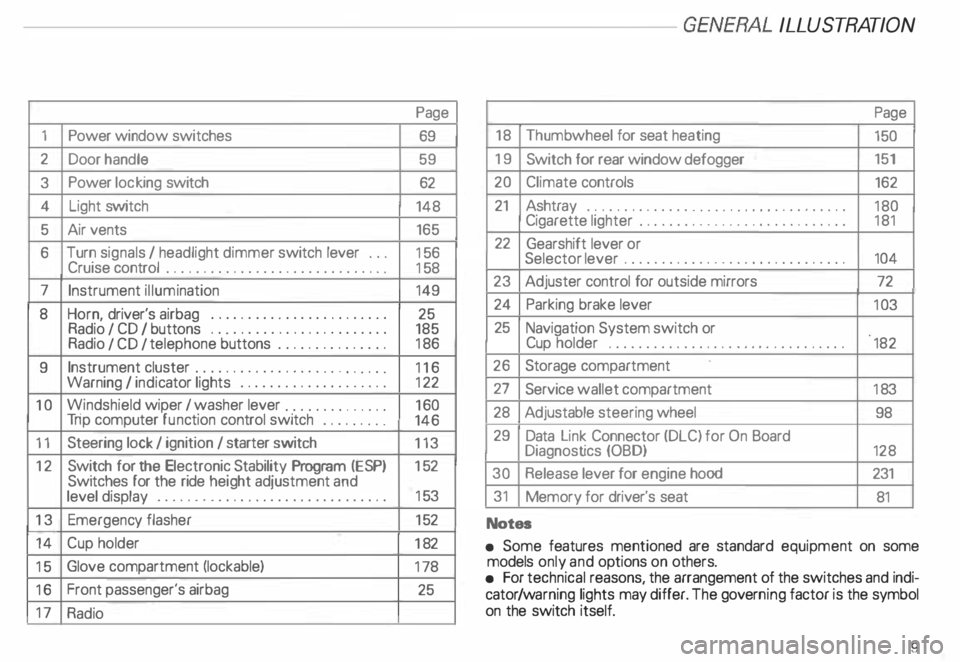
17 Power
window switches
Door handle
Power locking switch
Light switch
Air vents
Turn signals I headlight dimmer switch lever ...
Cruise control ................. .............
Instrument illumination
Horn, driver's airbag •••••
0 •• 0 •• 0 0 •• 0 ••• 0 ••• 0
Radio I CD I buttons ................
........
Radio I CD I telephone buttons ...............
Instrument cluster ....... ... ... ... ... .. .....
Warning I indi cator lights ••••••••
0 0
••••••••••
Windshield wiper I washer lever ..............
Tri p computer function control switch .........
Steering lock I ignition I starter switch
Switch for the Electronic Stability Program (i::SP)
Switches for the ride heigh t adjustment and
level display •••••••••••••••
0 •• 0 •• 0 0 •• 0 0 ••••
Emergenc y flasher
Cup holder
Glove compartment (lockable)
Front passenger's airbag
Radio Page
69
59 62
148 165
15 6
15 8
149
25
185
18 6
11 6
12 2
16 0
146
113
15 2
15 3
15 2
18 2
17 8
25 -------GE NERA L ILLUST
RATION
Page
18 Thumb wheel for seat heating
150
19 Switch for rear window defogger 151
20 Climate controls
162
21 Ashtray ...................................
180
Cigarette lighter ............................ 181
22 Gearshift lever or
Selector lever ..............................
104
23 Adjuster control for outside mirrors
72
24 Parking brake lever
103
25 Navigation System switch or
Cup holder
•••••••••••••••• 0 •••• 0 •••• 0 •••••
182
26 Storage compartment
27 Service wallet compartment
183
28 Adjustable steering wheel
98
29 Data Link Connector (DLC) for On Board
Diagnostics (OBD)
128
30 Release lever for engine hood 231
31 Memory for driver's seat
81
Notes
• Some features mentioned are standard equipment on some
models only and options on others.
• For technical reasons, the arrangement of the switches and indi
cator /warning lights may differ. The govern ing factor is the symbol
on the switch itself.
9
Page 14 of 306
--------------------------------------------------SAFETYRRST
Welcome Dear Audi Owner,
This chapter contains important informa
tion, tips and suggestions on occupant safe
ty.
We've prepared this chapter in order to
summarize what you need to know about
such topics as safety belts, airbags, child
safety, seats for children and infants.
Please make certain that you follow
the suggestions and warnings given
- it's in your own interest and in the
interest of all your passengers.
However, please note, that impor
tant safety information regarding
your vehicle and its operation will
also be found in all other chapters of
this Owner's Manual.
Remember -safety first! Safety
first
Yo ur safety and the safety of your passen
gers shouldn't be left to chance. Advances
in technology have made a variety of fea
tures available to help reduce the risk of in
jur y in an accident. The following is a listing
of just a few of the safety features in your
Audi:
sophisticated safety belts with tension
ers
optimized safety belt geometry through
safety belt ancho rages on front seats,
safety belt height adjustors front seats,
lateral belt adjustment on outer rear
seats,
safety belt guide for the center rear seat
- front airbags
side airbags in the front and rear* seats
- head airbags left and right above the
doors
special seat pan structure
- adjustable steering column
padded kneebar integrated into the dash
board. These
individual safety features, can work
together as a system to help protect you
and your passengers in a wide range of acci
dents. These features can't work as a sys
tem if they are not always properly adjusted
and properly used!
The following sections provide important in
formation about why these features are im
portant, how they work to help protect you
and your passengers and how they must be
adjusted and used to get the greatest bene
fit and reduce the likelihood of injury.
The sections also contain important
WA RNINGS which you and your passen
gers must always heed in order to reduce
the risk of personal injury.
Safety is everybody's responsibil
ity!
1'> ....
Page 16 of 306
The
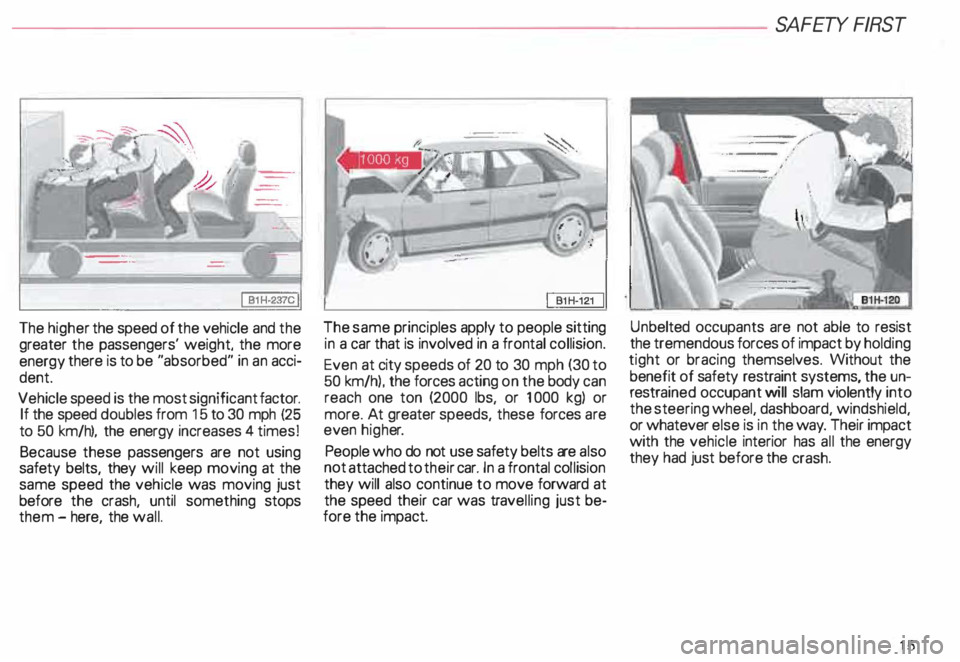
higher the speed of the vehicle and the
greater the passengers' weight, the more
energy there is to be "absorbed" in an acci
dent.
Vehicle speed is the most significant factor.
If the speed doubles from 15 to 30 mph (25
to 50 km/hl. the energy increases 4 times!
Because these passengers are not using
safety belts, they will keep moving at the
same speed the vehicle was moving just
before the crash, until something stops
them -here, the wall. The same
principles apply to people sitting
in a car that is involved in a frontal collision.
Even at city speeds of 20 to 30 mph (30 to
50 km/h), the forces acting on the body can
reach one ton (2000 lbs, or 1 000 kg) or
more. At greater speeds, these forces are
even higher.
People who do not use safety belts are also
not attached to their car. In a frontal collision
they will also continue to move forward at
the speed their car was travelling just be
fore the impact. SA
FETY FIRST
Un belted occupants are not able to resist
the tremendous forces of impact by holding
tight or bracing themselves. Without the
benefit of safety restraint systems, the un
restra ined occupant will slam violently into
the steering wheel, dashboard, windshield,
or whatever else is in the way. Their impact
with the vehicle interior has all the energy
they had just before the crash.
15
Page 26 of 306

---------------------------------------------------SAFETY RRST
Airbag system
Your vehicle has two front and four
side airbags, one front and one side air
bag for each front seat occupant, one side
airbag" for each rear seat occupant sitting
on the left and right rear seat.
In addition, your vehicle is equipped with
head airbags* on the left and right sides to
protect occupants seated next to the front
and rear doors. System
components
The airbag system consists of the following:
• electronic control module,
• an inflatable airbag with gas generator in
side the steering wheel,
• an inflatable airbag with gas generator in
side the instrument panel tor the front pas
senger,
• supplemental side airbags in the back
rest padding of the front and rear seats*,
• an inflatable curtain head airbag above
the doors on each side,
• an AIRB AG indicator light in the
instrument cluster ( see "Warning I Indica
tor lights" page 125).
The indicator light in the instrument cluster
(readiness light) will light up for a few sec
onds each time the ignition is switched on.
The light monitors the electronic control
module, sensor circuits, and system wiring. The
system must be inspected
if the indicator light:
• does not come on when the ignition is
switched on,
• does not go out after a few seconds after
the ignition is switched on, or
• comes on while driving.
In the event of a system malfunction, the in
dicator light will stay on continuously to
serve as a constant reminder to have the
system repaired.
�W ARNING
If any of these conditions occur,
have the alrbag system inspected
immediately by your Audi Dealer.
Otherwise, the airbags in your ve
hicle may not work properly in
case of a frontal collision or a side
impact.
25
Page 27 of 306
SA
FETY FIRST
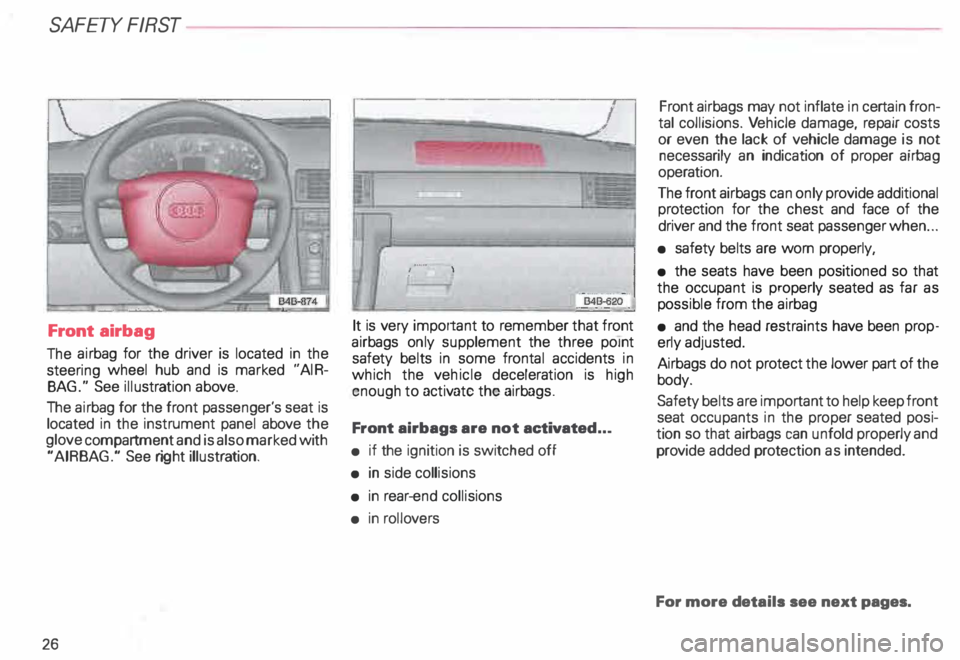
Front airbag
The airbag for the driver is located in the
steering wheel hub and is marked "AIR
BAG." See illustration above.
The airbag for the front passenger's seat is
located in the instrument panel above the
glove compartment and is also marked with
"AIRBAG." See right illustration.
26 It
is very important to remember that front
airbags only supplement the three point
safety belts in some frontal accidents in
which the vehicle deceleration is high
enough to activate the airbags.
Front airbags are not activated ...
• if the ignition is switched off
• in side collisions
• in rear-end collisions
• in roiJovers Front
airbags may not inflate in certain fron
tal collisions. Vehicle damage, repair costs
or even the lack of vehicle damage is not
necessarily an indication of proper airbag
operation.
The front airbags can only provide additional
protection for the chest and face of the
driver and the front seat passenger when ...
• safety belts are worn properly,
• the seats have been positioned so that
the occupant is properly seated as far as
possible from the airbag
• and the head restraints have been prop
erly adjusted.
Airbags do not protect the lower part of the
body.
Safety belts are important to help keep front
seat occupants in the proper seated posi
tion so that airbags can unfold properly and
provide added protection as intended.
For more details see next pages.
Page 29 of 306

SAFETYRRST---------------------------------------------------
The triggering of the airbag system de
pends on the vehicle deceleration rate
caused by the collision and registered by
the control unit. If this rate is below the ref
erence value programmed into the control
unit, the airbags will not be triggered, even
though the car may be badly damaged as a
result of the accident.
When the system is activated, the airbags
fill with a propellant gas, break open the
padded covers, and inflate between the
steering wheel and the driver and between
the instrument panel and the front passen
ger.
All this takes place within the blink of an
eye, so fast that many people don't even
realize that the airbags have deployed. The
airbags also inflate with a great deal or force
and nothing should be in their way when
they deploy.
28 Fully
inflated airbags in combination with
properly worn safety belts slow down and
limit the occupant's forward movement and
help to reduce the risk of injury to the head
and upper torso.
The airbags will deflate immediately after
the deployment so that the front occupants
can see through the windshield again.
When the system is activated, fine dust is
released. This is normal and is not caused
by a fire in the vehicle. It could irritate skin. �W
ARNING
• The fine dust created when air
bags deploy can cause breathing
problems for people with a history
of asthma or other breathing con
ditions.
• To reduce the risk of brea thing
problems, those with asthma or
other respiratory conditions
should get fresh air right away by
getting out of the car or opening
windows or doors.
• If you are in an accident in
which airbags deploy, wash your
hands and face with mild soap and
water before eating.
• Be careful not to get the dust
into your eyes or into any cuts or
scratches.
• If the residue should get into
your eyes, flush them with water.
Page 31 of 306
SAFETY FIRST--------------------------
�
WARNING continued
- Always sit upright with your
back against the backrest of
your seat.
. 30 Never
place your feet on the in
strument panel or on the seat.
Always keep both feet on the
floor in front of the seat to help
prevent serious injuries to the
legs and hips if the airbag in
flates. BBN-163
There is a lot that you and your passengers
can do to help the individual safety features
installed in your Audi work together as a
system. Adjusting
the driver's seat
For detailed steps for adjusting the driver's
seat please see "Front Seats" on page 76.
We recommend that you adjust the driver's
seat as follows:
- adjust the seat in fore and aft direction so
that you can easily push the pedals all the
way while keeping your knee slightly
bent.
- adjust the seatback so that when you sit
with your back against the seatback, you
can still grasp the top of the steering
wheel.
adjust the steering wheel -see chapter
"Adjustable steering column" page 98.
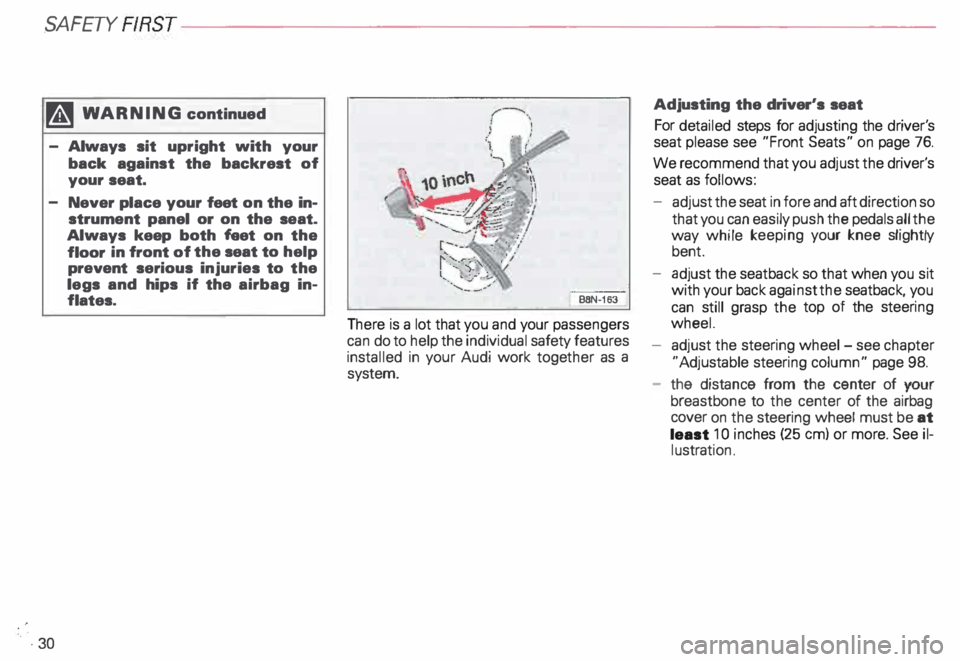
- the distance from the center of your
breastbone to the center of the airbag
cover on the steering wheel must be at
least 1 0 inches (25 em) or more. See il
lustration .
Page 32 of 306
-----------------------------------------------------SAFETY RRST
�W ARNING
• Never sit closer than 10 inches
(25 em) to the stee ring wheel.
• If you cannot sit more than
10 inches (25 em) from the steer
ing wheel, we recommend that
you investigate whether adaptive
equipment may be available to
help you reach the pedals and in
crease your seating distance from
the steering wheel.
Adjusting the steering wheel
For detailed steps for adjusting the steering
wheel please see "Adjustable steering col
umn" page 98.
Adjust the steering wheel so that the steer
ing wheel and airbag cover points at your
chest and not at your face. The steer ing
wheel should be adjusted so that you can
hold the outer rim of the steering wheel
comfortably with your hands at the 3 o'clock
and 9 o'clock positions. �W
ARNING
• Pointing the steering wheel to
ward your face decreases the abil
ity of the supplementa l driver's air
bag to protect you in an accident.
• Holding the steering wheel the
wrong way can cause serious inju
ries to the hands, arms and head if
the driver's airbag inflates.
• Never hold the steering wheel at
the 12 o'clock position or with
your hands at other positions in
side the steering wheel rim or on
the steering wheel hub.
Adjusting the passenger's seat
For detailed steps for adjusting the pas
senger's seat please see "Front Seats" on
page 76.
We recommend that you adjust the passen
ger's seat as follows:
- backrest upright (never reclined)
place your feet on the floor in front of the
passenger's seat adjust
the passenger's seat as far as pos
sible to the rear of the fore and aft adjust-
1)1ent range.
�W ARNING
• Always keep both feet on the
floor in front of the seat.
• Never place your feet on the in
strument panel or on the seat. If
the airbag inflates and your feet
are on the instrument panel or on
the seat, your could receive seri
ous personal injuries.
Some other important points to
know
Because airbags inflate in the blink of an eye
with great force, things you have on your lap
or have placed on the seat could become
dangerous projectiles and be pushed into
you if the airbag inflates.
Always head all WARNINGS
on next page.
31