child lock AUDI E-TRON 2019 User Guide
[x] Cancel search | Manufacturer: AUDI, Model Year: 2019, Model line: E-TRON, Model: AUDI E-TRON 2019Pages: 310, PDF Size: 81.91 MB
Page 73 of 310
4KE012721BB
Sitting correctly and safely
front seats. Always transport children in suitable
child safety seats secured on the rear seats.
In exceptional circumstances: transporting
children in the front passenger's seat
If exceptional circumstances require the child
safety seat to be placed on the front passenger's
seat, then the front passenger's airbag must be
deactivated. Please note the important informa-
tion for this > page 67, Advanced airbag system.
If you must secure a forward-facing child safety
seat, move the front passenger's seat as far back
as possible so that it is as far as possible from the
front passenger's airbag. While doing this, make
sure the seat can be adjusted all the way.
Only switch to a larger child safety seat when
absolutely necessary
Switch to a larger child safety seat only when ab-
solutely necessary. Secure your child using a safe-
ty belt without a child safety seat only if all of the
following statements are true:
—The child is large enough to sit upright in the
seat
— The child is able to sit with his or her back rest-
ing completely on the seat backrest
—The child is able to sit with his or her knees
bent over the edge of the seat surface
—The child is able to sit with both of his or her
feet completely touching the floor in the foot-
well
—The lap portion of the safety belt lies flat and
securely over the hip area and never over the
stomach
— The shoulder portion of the safety belt lies flat
and securely over the center of the shoulder
and
the chest, and never under the arm, behind
the back, or over the neck or face.
—The child is able to maintain this seating posi-
tion throughout the entire trip
Read and follow the important information and
warnings regarding the correct use of safety belts
=> page 60.
@ Tips
— Child safety seats can also be secured to
seats with side airbags. In the event of an
accident, children can also be protected by
the side airbags if the child is correctly se-
cured in a suitable child safety seat that is
attached correctly.
— The lower LATCH anchors as well as the
safety belt may be required to correctly in-
stall some child safety seats. Using both at
the same time is permitted, provided that
the fastening systems or safety belts do not
impair those in an adjacent seating position.
—All child safety seats are constructed so that
they can be secured using the lap safety belt
in the vehicle.
— Child safety seats with a support base can
only be secured to the outer rear seats and
to the front passenger's seat.
Securing child safety seats to the lower
LATCH anchors
a r ee pablo
»
ATM A
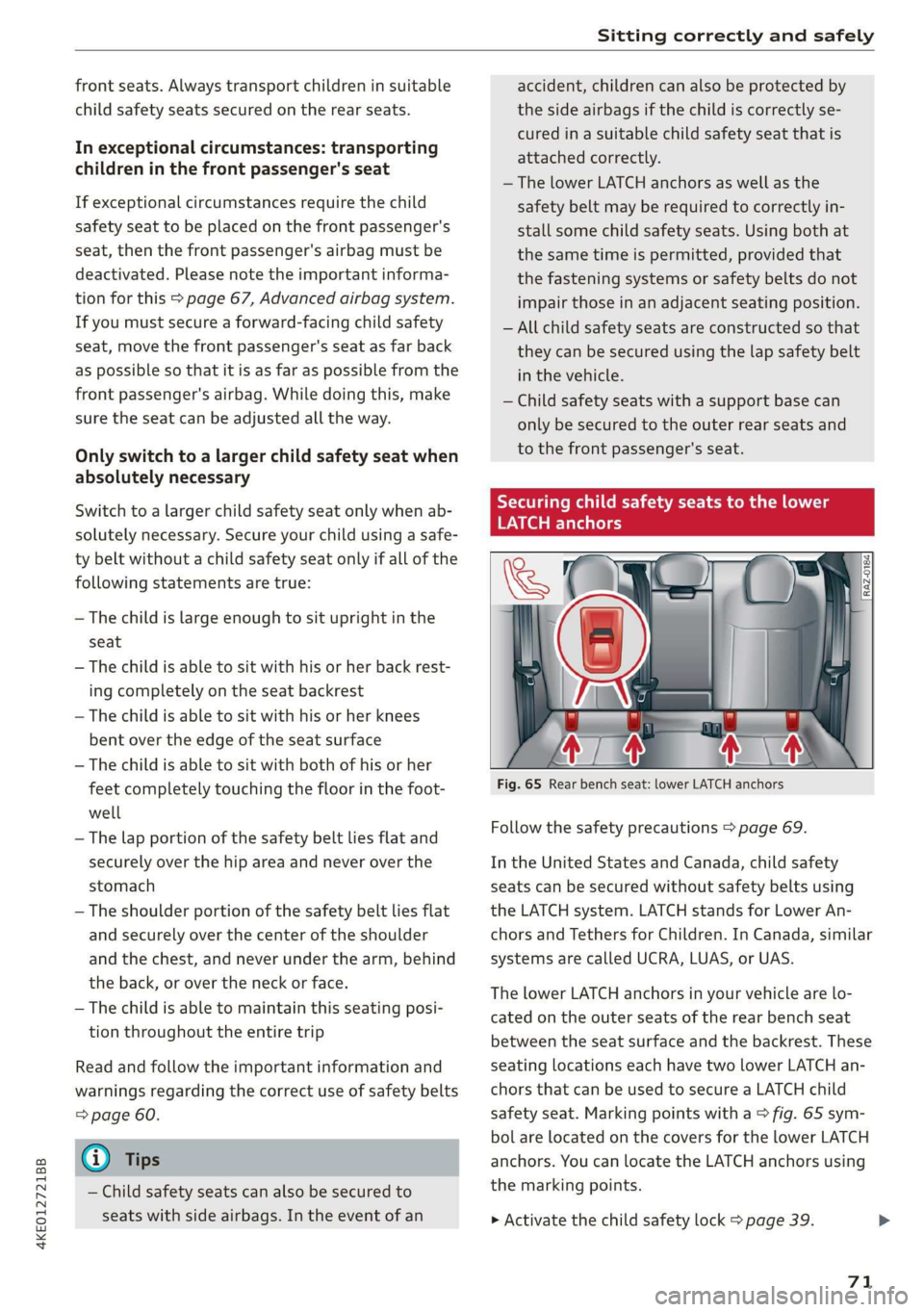
Fig. 65 Rear bench seat: lower LATCH anchors
Follow the safety precautions > page 69.
In the United States and Canada, child safety
seats can be secured without safety belts using
the LATCH system. LATCH stands for Lower An-
chors and Tethers for Children. In Canada, similar
systems are called UCRA, LUAS, or UAS.
The lower LATCH anchors in your vehicle are lo-
cated on the outer seats of the rear bench seat
between the seat surface and the backrest. These
seating locations each have two lower LATCH an-
chors that can be used to secure a LATCH child
safety seat. Marking points with a > fig. 65 sym-
bol are located on the covers for the lower LATCH
anchors. You can locate the LATCH anchors using
the marking points.
> Activate the child safety lock > page 39.
71
>
Page 75 of 310
4KE012721BB
Sitting correctly and safely
safety seat to be placed on the front passenger's
seat, then the front passenger's airbag must be
deactivated. Please note the important informa-
tion for this > page 70, Correct positioning for
children and > page 67, Advanced airbag sys-
tem.
Securing child safety seats
> Activate the child safety lock > page 39.
> If you secure a child safety seat to the rear seat,
secure any unused safety belts that are within
reach of the child > A\, > page 73.
> If you secure a child safety seat to the front
passenger's seat, adjust the front passenger's
seat to the highest position.
> Secure the child safety seat according to the
child safety seat manufacturer instructions.
> If necessary, activate the belt retractor lock
=> page 73, Activating the belt retractor lock.
> If the child safety seat is secured on the front
passenger's seat, adjust the front passenger's
seat backrest until it rests flat against the child
safety seat. Also make sure that the upper safe-
ty belt fixture is behind the child safety seat.
> If you secure a child safety seat on the rear
seat, also secure it to the correct top tether an-
chor if possible > page 72.
Activating the belt retractor lock
If you secure a child safety seat using the vehicle
safety belt, you must activate the belt retractor
lock. Follow the child safety seat manufacturer
instructions.
The belt retractor lock prevents the safety belt
from becoming loose while driving, which could
result in the child safety seat no longer being ad-
equately secured.
> Secure the child safety seat according to the
child safety seat manufacturer instructions.
While doing so, pull out the safety belt. Insert
the safety belt in the belt latch belonging to
the seat until it audibly engages.
> Pull the upper belt out completely and then al-
low it to retract. You will hear a clicking sound
while the belt is retracting. It will not be possi-
ble to pull the safety belt out any farther.
> Push the child safety seat into the seat and al-
low the belt to retract more.
> Make sure that the child safety seat cannot
move more than 1 inch (2.5 cm).
Deactivating the belt retractor lock
> Unbuckle the safety belt from the belt latch.
» Remove the child safety seat according to the
manufacturer instructions.
> Allow the safety belt to retract completely. The
belt retractor lock is deactivated.
Z\ WARNING
— A safety belt that is not locked by the belt
retractor lock or a locking device cannot se-
cure a child safety seat while driving or in
the event of an accident, which increases the
risk of fatal injury. Always make sure the
belt retractor lock on the safety belt is acti-
vated if the child safety seat manufacturer
instructions require it.
— Due to the risk of fatal injury, never place a
rear-facing child safety seat on the front
passenger's seat when the front passenger's
airbag is switched on.
— For the child safety seat to offer the maxi-
mum protection, it is especially important
to route the vehicle safety belt correctly. Al-
ways follow the instructions from the child
safety seat manufacturer for routing the
safety belt correctly. Incorrectly fastened
safety belts can cause injuries, even during
minor accidents.
Yate eM eRe 11am Lhe Te
TT 14
C9)
;
5 —
7 = Lf
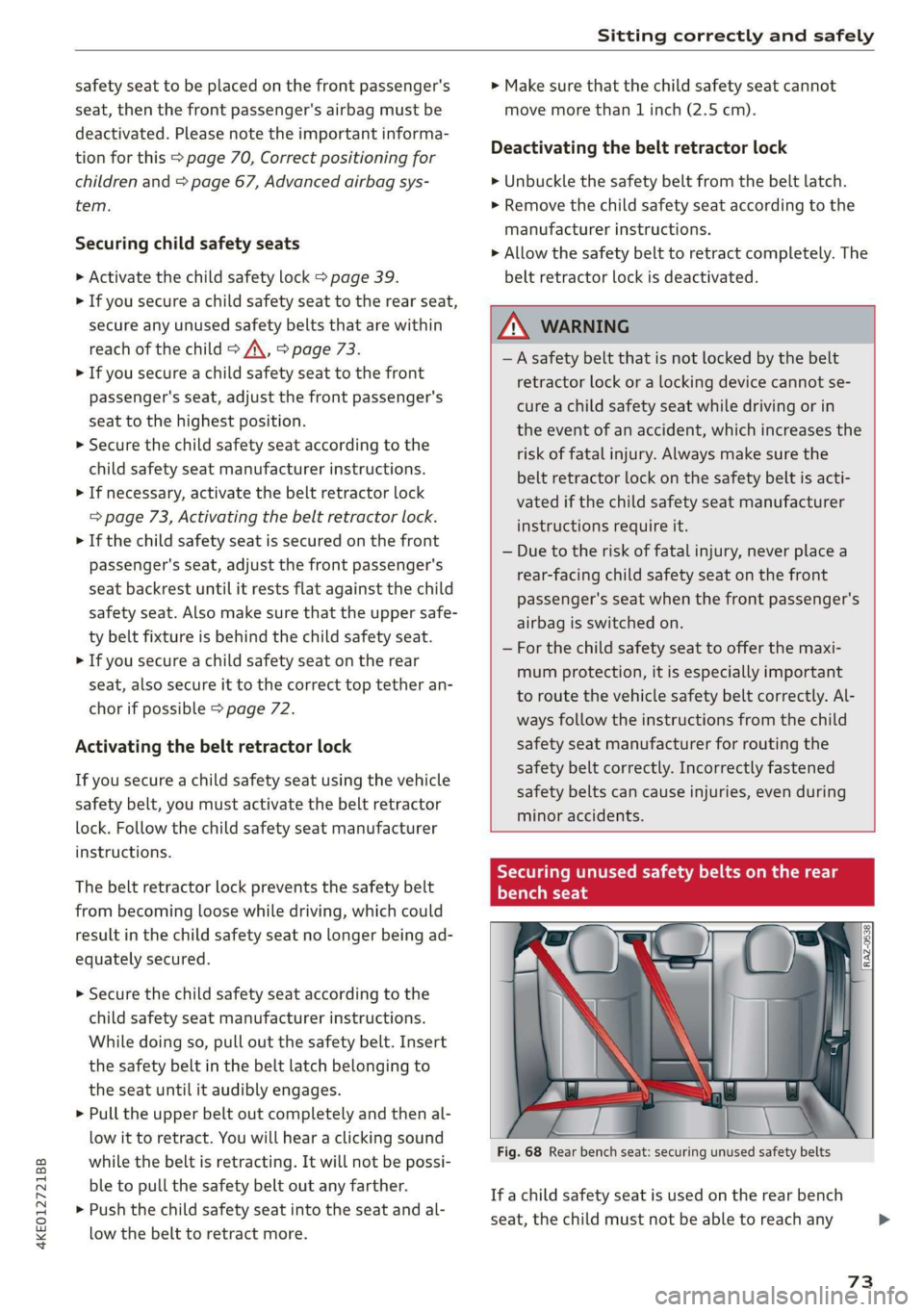
Fig. 68 Rear bench seat: securing unused safety belts
If a child safety seat is used on the rear bench
seat, the child must not be able to reach any
73
>
Page 76 of 310
Sitting correctly and safely
safety belts that are not being used. Secure safe-
ty belts that are within reach of the child.
> If you secure a child safety seat to the LATCH
anchors, fasten the safety belt on the seat
where the child safety seat is installed using
the seat's safety belt latch.
> If you secure a child safety seat to one of the
outer seats, fasten the safety belt for the cen-
ter seat in its latch.
> Activate the belt retractor lock on the fastened
safety belts. To do this, pull the upper belt out
completely and then allow it to retract. You will
hear a clicking sound while the belt is retract-
ing. It will not be possible to pull the safety
belt out any farther.
> Make sure the fastened safety belt does not
block access to the LATCH anchors. Otherwise,
it may not be possible to secure the child safety
seat to the LATCH anchors correctly.
ZA WARNING
A child in a child safety seat could play with
the unused safety belts and then become en-
tangled in them, which increases the risk of
fatal injury. Always secure unused safety belts
so that they are not within reach of children in
child safety seats.
74
Page 80 of 310
Stowing and using
— Never secure a child safety seat to the tie-
downs.
— Never leave your vehicle unattended, espe-
cially if the luggage compartment lid is
open. Children could enter the luggage com-
partment and close the luggage compart-
ment lid from the inside. This creates the
risk of fatal injury, since the children would
be locked in and may not be able to escape
by themselves.
— Do not allow children to play in or on the ve-
hicle. Close and lock the luggage compart-
ment lid as well as all other doors when you
leave the vehicle.
— Never transport passengers in the luggage
compartment. Every passenger must be cor-
rectly secured with the safety belts in the
vehicle > page 60.
— Be careful when releasing the backrest and
folding
it forward. To reduce the risk of be-
ing pinched, pay attention and check when
folding backrests forward.
— The backrest must be securely latched so
objects cannot slide forward out of the lug-
gage compartment during sudden braking.
— The backrest must be latched securely to en-
sure that the safety belt is protecting the
center seating position.
— Always pull forward on the backrest to make
sure it is check if it is correctly locked in
place.
@ Note
—To reduce the risk of damage, move the rear
head restraints down > page 60 before fold-
ing the rear backrests forward.
— When folding the backrest forward, make
sure the outer safety belts are in the belt
guide recess so that they do not get pinched
in the backrest lock and damaged. Other ob-
jects
should be removed from the rear
bench seat to protect the backrest from
damage.
— If you move the front seat back when the
rear seat backrest is folded forward, you
could damage the head restraints on the
rear seat.
78
— Make sure that the heating grid strips for
the rear window defogger are not damaged
by abrasive objects.
— Let the luggage compartment cover roll up
slowly to reduce the risk of damage.
— Let the partition net roll up slowly to pre-
vent damage.
@) Tips
— The tire pressure must be adapted to the
load > page 253.
— You can purchase straps at specialty stores.
Luggage compartment cover
Applies to: vehicles with luggage compartment cover
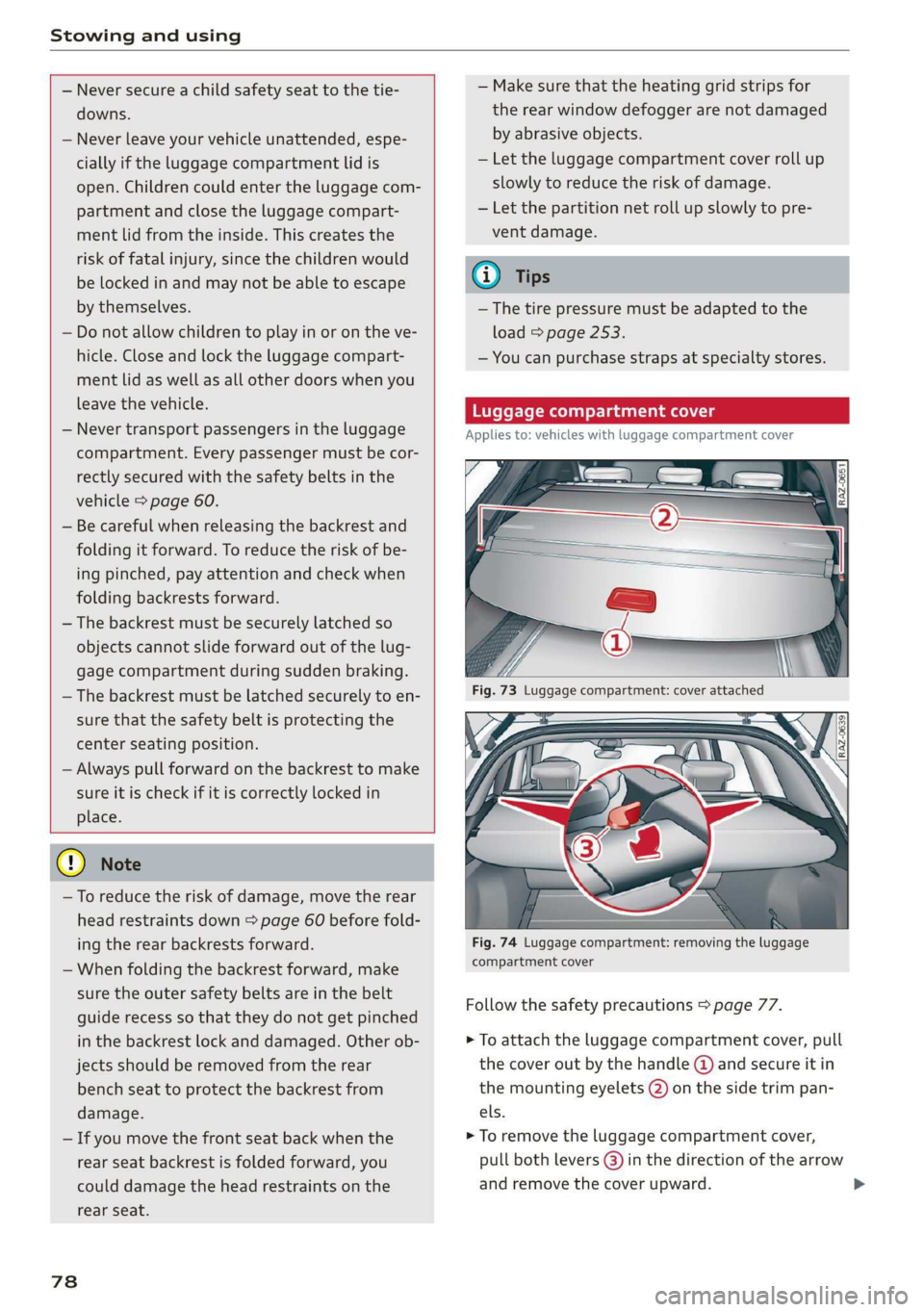
Fig. 74 Luggage compartment: removing the luggage
compartment cover
Follow the safety precautions > page 77.
> To attach the luggage compartment cover, pull
the cover out by the handle @ and secure it in
the mounting eyelets (2) on the side trim pan-
els.
> To remove the luggage compartment cover,
pull both levers (3) in the direction of the arrow
and remove the cover upward.
Page 85 of 310
4KE012721BB
Warm and cold
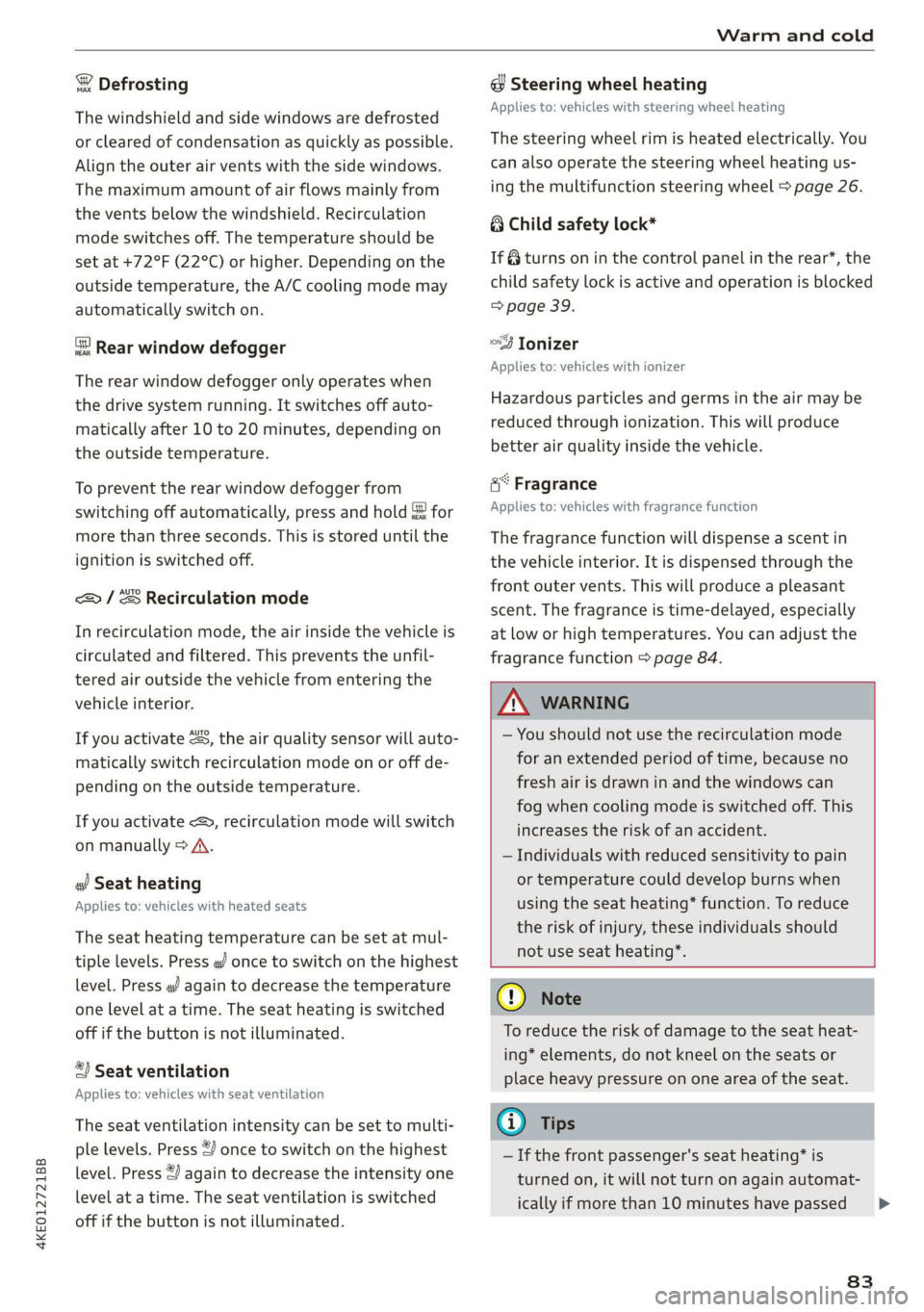
® Defrosting
The windshield and side windows are defrosted
or cleared of condensation as quickly as possible.
Align the outer air vents with the side windows.
The maximum amount of air flows mainly from
the vents below the windshield. Recirculation
mode switches off. The temperature should be
set at +72°F (22°C) or higher. Depending on the
outside temperature, the A/C cooling mode may
automatically switch on.
& Rear window defogger
The rear window defogger only operates when
the drive system running. It switches off auto-
matically after 10 to 20 minutes, depending on
the outside temperature.
To prevent the rear window defogger from
switching off automatically, press and hold & for
more than three seconds. This is stored until the
ignition is switched off.
AUTO
/& Recirculation mode
In recirculation mode, the air inside the vehicle is
circulated and filtered. This prevents the unfil-
tered air outside the vehicle from entering the
vehicle interior.
If you activate 3S, the air quality sensor will auto-
matically switch recirculation mode on or off de-
pending on the outside temperature.
If you activate &, recirculation mode will switch
on manually > A\.
«@ Seat heating
Applies
to: vehicles with heated seats
The seat heating temperature can be set at mul-
tiple levels. Press w once to switch on the highest
level. Press ) again to decrease the temperature
one level at a time. The seat heating is switched
off if the button is not illuminated.
2) Seat ventilation
Applies to: vehicles with seat ventilation
The seat ventilation intensity can be set to multi-
ple levels. Press ©) once to switch on the highest
level. Press 2) again to decrease the intensity one
level at a time. The seat ventilation is switched
off if the button is not illuminated.
@ Steering wheel heating
Applies to: vehicles with steering wheel heating
The steering wheel rim is heated electrically. You
can also operate the steering wheel heating us-
ing
the multifunction steering wheel > page 26.
& Child safety lock*
If 8 turns on in the control panel in the rear*, the
child safety lock is active and operation is blocked
> page 39.
»(% Ionizer
Applies to: vehicles with ionizer
Hazardous particles and germs in the air may be
reduced through ionization. This will produce
better air quality inside the vehicle.
&* Fragrance
Applies to: vehicles with fragrance function
The fragrance function will dispense a scent in
the vehicle interior. It is dispensed through the
front outer vents. This will produce a pleasant
scent. The fragrance is time-delayed, especially
at low or high temperatures. You can adjust the
fragrance function > page 84.
ZA WARNING
— You should not use the recirculation mode
for an extended period of time, because no
fresh air is drawn in and the windows can
fog when cooling mode is switched off. This
increases the risk of an accident.
— Individuals with reduced sensitivity to pain
or temperature could develop burns when
using the seat heating* function. To reduce
the risk of injury, these individuals should
not use seat heating*.
() Note
To reduce the risk of damage to the seat heat-
ing* elements, do not kneel on the seats or
place heavy pressure on one area of the seat.
@ Tips
— If the front passenger's seat heating” is
turned on, it will not turn on again automat-
ically if more than 10 minutes have passed
83
Page 88 of 310
Driving
Driving
Starting the vehicle
Description
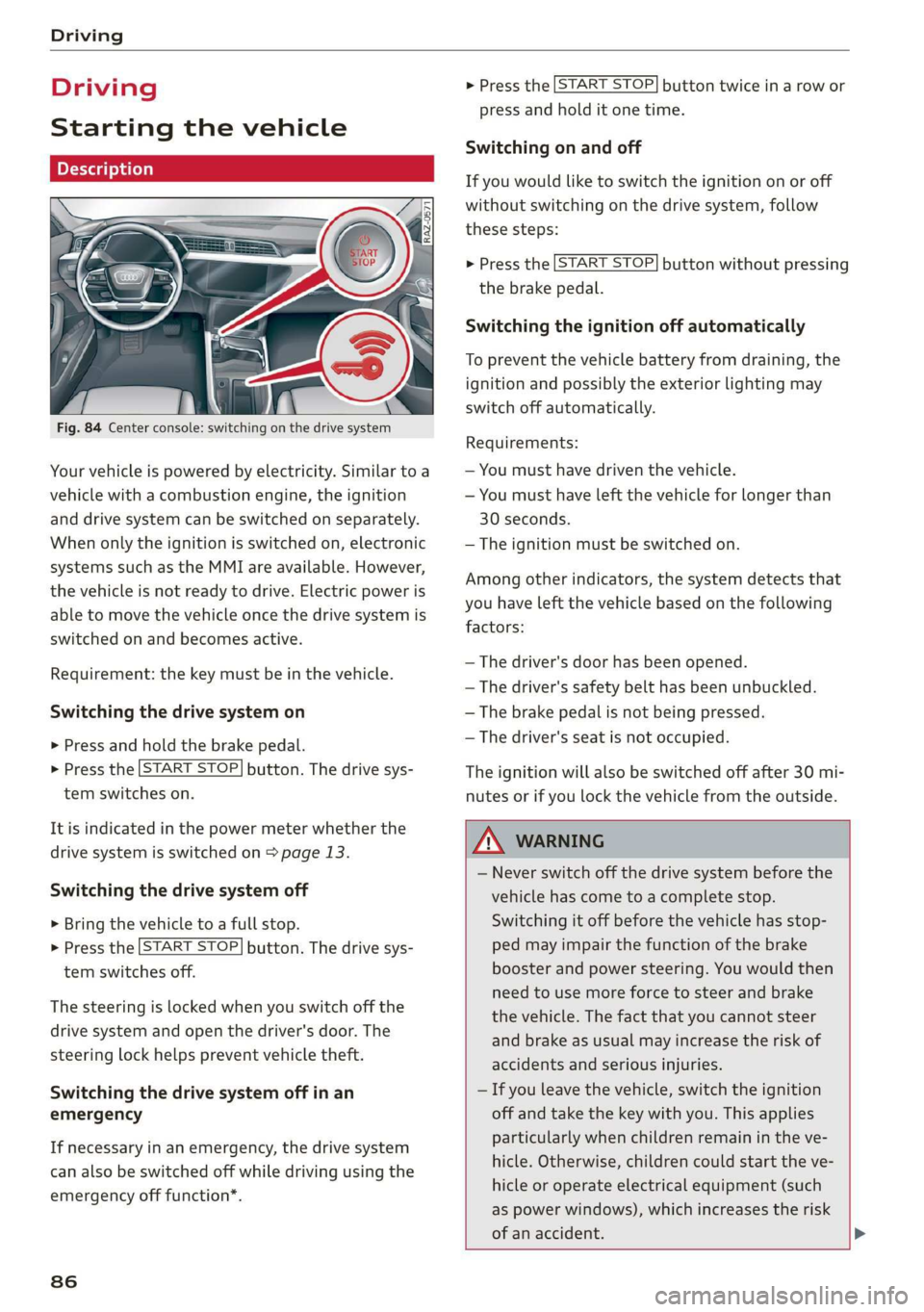
Fig. 84 Center console: switching on the drive system
Your vehicle is powered by electricity. Similar to a
vehicle with a combustion engine, the ignition
and drive system can be switched on separately.
When only the ignition is switched on, electronic
systems such as the MMI are available. However,
the vehicle is not ready to drive. Electric power is
able to move the vehicle once the drive system is
switched on and becomes active.
Requirement: the key must be in the vehicle.
Switching the drive system on
> Press and hold the brake pedal.
> Press the [START STOP] button. The drive sys-
tem switches on.
It is indicated in the power meter whether the
drive system is switched on > page 13.
Switching the drive system off
> Bring the vehicle to a full stop.
> Press the [START STOP] button. The drive sys-
tem switches off.
The steering is locked when you switch off the
drive
system and open the driver's door. The
steering lock helps prevent vehicle theft.
Switching the drive system off in an
emergency
If necessary in an emergency, the drive system
can also be switched off while driving using the
emergency off function”.
86
> Press the [START STOP] button twice in a row or
press and hold it one time.
Switching on and off
If you would like to switch the ignition on or off
without switching on the drive system, follow
these steps:
> Press the [START STOP] button without pressing
the brake pedal.
Switching the ignition off automatically
To prevent the vehicle battery from draining, the
ignition and possibly the exterior lighting may
switch off automatically.
Requirements:
— You must have driven the vehicle.
— You must have left the vehicle for longer than
30 seconds.
— The ignition must be switched on.
Among other indicators, the system detects that
you have left the vehicle based on the following
factors:
— The driver's door has been opened.
— The driver's safety belt has been unbuckled.
— The brake pedal is not being pressed.
— The driver's seat is not occupied.
The ignition will also be switched off after 30 mi-
nutes or if you lock the vehicle from the outside.
ZA WARNING
— Never switch off the drive system before the
vehicle has come to a complete stop.
Switching it off before the vehicle has stop-
ped may impair the function of the brake
booster and power steering. You would then
need to use more force to steer and brake
the vehicle. The fact that you cannot steer
and brake as usual may increase the risk of
accidents and serious injuries.
— If you leave the vehicle, switch the ignition
off and take the key with you. This applies
particularly when children remain in the ve-
hicle. Otherwise, children could start the ve-
hicle or operate electrical equipment (such
as power windows), which increases the risk
of an accident.
Page 108 of 310
High-voltage system
Charging at household and industrial sockets
or at public charging stations with
alternating current (AC)
The vehicle's high-voltage battery can be charged
with alternating current (AC) via the charging
port (5). Depending on the vehicle equipment,
there may be a second charging port ©) on the
opposite side of the vehicle. Both charging ports
have the same charging power. You can use
whichever charging port is more convenient for
your charging setup. When using one charging
port, the opposite charging port is locked.
Quick charging at public direct current (DC)
charging stations
The vehicle’s high-voltage battery can be charged
at a direct current (DC) charging station via the
charging port on the driver's side (). There is a
significant decrease in charging time. The charg-
ing cable being used may be a maximum of 30 m.
Charging time
The duration of the charging process may vary
based on the following factors:
— Sockets being used (household or industrial
sockets)
— Country-specific system voltage, current
strength and number of available phases
— Household connection
— The value set for the charging power level on
the Audi charging system control unit
— Fluctuations in the system voltage
— The temperature outside the vehicle
— The temperature of the high-voltage battery
and the Audi charging system control unit.
— Settings for the climate control inside the vehi-
cle
— Current capacity of the charging connector
— Whether the ignition is on or off
ec e laa eed
ZA\ WARNING
Short circuiting, electric shock, explosions,
fire and severe burns can result from not
charging the battery correctly (for example,
disregarding general safety precautions, using
unsuitable or damaged sockets and charging
cables, and charging at an unsuitable electri-
cal equipment) and can lead to serious and fa-
tal injuries.
— Only charge at sockets that are installed cor-
rectly, that are tested and that are not dam-
aged, or at electrical equipment that is func-
tioning correctly.
— Never use damaged and/or dirty charging
equipment. Check the charging equipment
for damage before every use.
— Never modify or repair any electrical compo-
nents, especially the high-voltage system.
— Never charge in areas at risk for explosions.
The components in the charging equipment
can trigger sparks, which can cause flamma-
ble or explosive fumes to ignite. To reduce
the risk of explosions, especially in garages,
make sure the Audi e-tron charging system
control unit is at least 19 inches (50 cm)
above the floor when charging.
— Never use the charging equipment with an
extension cord, a cable reel, a power strip,
or an adapter, for example, a travel adapter
or timer.
— Do not touch the contacts on the vehicle
charging port or charging equipment.
— Do not insert any objects in the vehicle
charging port or in the charging equipment.
— Always protect the sockets and connections
from water, moisture and other fluids.
— Never charge with both vehicle charging
ports at the same time.
— Only use the charging equipment provided
by the factory or the charging station cable.
Z\ WARNING
Applies to: Audi charging systems
Sockets that are installed incorrectly can
cause electric shock or fire when charging the
high-voltage battery using the vehicle charg-
ing connection.
— Read all information and safety precautions
for Audi charging systems before using
them.
— Monitor the Audi charging system if it is be-
ing used near children.
106
Page 296 of 310
Index
Blinds
refer to Sunshade (roof) ............00-5 40
Block
route................ 00 cece eee 202
BLOWER. « sees su comers a enmeane wa nents a = swine = 82
Bluetooth
Audio player........... 0.00 e eee eee 218
Connecting a mobile device............ 170
Deleting
ardevice wii s 2 isnsins ov sucrose « sence 233
Device overVieW...... 6c eee ee eee eee 232
Disconnecting a device................ 233
Displaying profiles.................... 233
Searching fora device...............-. 233
Selecting adevice.............2eeeeee 233
Specifying a favorite.................. 233
BOOStTUNCTION owas x cee 2 sneer 2 eo ces ¢ 89
Brake fluid
Checking the brake fluid level........... 239
Brak Sicnes 2 x sree: vo cmv ow orien ow soe © o ooEKS 92
Brakerassist. scsmrs « acess» oi soz 4 0 omens « 102
Brake fluid. .................0..0000. 239
Emergency braking function............. 95
New brake pads..............---00000- 92
Break-in security feature................. 32
Breaking in
New brake pads............0.20200000- 92
NGW TIRES: « « noms 2 s saros & 9 cate gs eam a 250
Browser
refer to Mediacenter................4. 222
Bulb replacement.............--22+-05- 282
Business: address). «i ijei as jana a scan a va 202
Cc
California Proposition 65 Warning........ 235
Batteryspecific... =. eccs s sive s ween as: 241
GALLLISt « wea ¢ 2 aeee xs meee oe eee s Bee ee 174
Capacities
Fuebtanike, « secs 2 a oasan oo ssamon o wana oo ove 291
Washer fluid reservoir................- 291
Cangowmatc © « conse ws aussins 6 0 secs a a amass We ae 80
Cargoinets: « s soma 2s memew + wauim a 3 mam 6 @ oarae 80
Car key « s eeu oy ews y oeE 6 2 ween 6 Ewes 33
Car phone
Serialinumber(IMED) « wsscsce ao soteane ao sanaia 181
Switching on... ....... eee eee eee 181
Using the car phone function........... 169
Car WASH: = sass 5 x eee 5 feats sb eG EE 263
294
Cell phone
refer to Telephone...........-0e eee eae 169
Cell phone compartment
refer to Audi phone box............... 171
Central
locking ...... 0. cece eee eee eee 29
AUTO LOCK: » geese + sunems 2 seene & 3 donee & = Be 29
Convenience key « sscsu © cvenesie © erase wo vnscem 34
Convenience opening and closing......... 40
Luggage compartment lid............... 36
Mechanically unlocking and locking....... 32
Messages... 1.6... ce eee cece eee eee 31
Remote control keys: ss esas ss eves os ees 34
SettN's 6 e wanes a a saws «wo ones vo meen + 8 o8TH 30
Vehicle key... 6... ccc ee eee eee eee 34
Central locking switch.............000005 31
Centificat onto» a sess + x aneans ao somes o 6 mmm 289
Changing lightibulbs'. « ccs ss sew s 6 sesso 282
Charging
refer to Power sourceS............00 000s 75
Charging clip
refer to Wall mount clip............... 119
Charging display................---0000- 109
Charging the battery (mobile devices). 171, 220
Charging times. « sass. se savin s 2 wees © 2 sree 106
Child safety lock
Climate control system controls in the rear. 39
POWER WINK OWS inc ¢ & cme 5 ores 5 v eee 39
Rear doorsten « swe so mim 2 women n= ame wD 39
Child
safety seats........ 0... ce eee ee eee 69
Securing to the top tether anchor........ 72
Securing with a safety belt.............. 72
Securing with LATCH. ss sses ss eee se eee 71
Gl@aNiNG ¢ sere « s ewes 5 o eee se eee ce ees 263
Cleaning Alcantara.............-..0000. 266
Cleaning artificial leather............... 266
Cleaning carbon components........ 265, 266
Cleaning controls..............00 eee eee 266
Cleaning decorative parts/trim........... 265
Cleaning plastic parts.................. 265
Cleaning textiles: s ws + wees v ween oe eee 266
Climate control system ..............004. 81
Climate control system controls in the rear
Child safetylotk.o icvc os soci © sean © wows 39
Closing
Automatic luggage compartment lid...... 36
Convenience closing................045 40
Page 297 of 310
4KE012721BB
Index
HOO « cnsvecs 2 v citvace ow eneaene oo somes ve soto ¥ 236
Luggage compartment lid............... 36
Luggage compartment lid with foot motion . 37
Panoramic glass roofs. «esc se eevee eae 40
Sunshade (roof)... 2.2.0.6. eee eee 40
WINdOWS : soce = ¢ xews 2 y cee xs eee 5 oes 39
Closing aid (power closing doors).......... 29
Cockpit dimming...............002-000 48
Cockpit (overview) ....... 0.000 c cece ee eee 6
Collapsible spare tire
Inflating....... 2... eee eee eee ee eee 275
Collapsible tire
refer to Collapsible spare tire........... 2715
GOlGr MUMBEN: ¢ sees 5 xy ream sy eee 5 e eR « 291
Comfort auxiliary climate control.......... 85
Coming home/Leaving home
refer to Entry/exit lighting.............. 46
Compartments: < s ceau ze ee@s so eRe eb eS 76
Compass inthe mirror................00- 53
Compliance ........ 6.0... cece eee eee ee 289
Configuration wizard.................00. 17
CONME Cie. va nce & mene a moms @ a ee @ sue 184
Data plans... .... 2. ee eee eee eee 189
Data Privatyiee = « news ¢ x eng s eae a 5 eee 285
Emmengeneyseall ssc «a ssi 6 svensewe + syacene 191,
Infotainment...............-.-0 eee eee 185
Infotainment services............00005 185
Online roadside assistance............. 192
Vehicle control services................ 186
Connected devices
Device overvieW.... 0... cece e ee ee eee 232
Connections
referto Media............--.+++- 217,221
Consumer information.................- 286
Consumption
Reducing « svar es senw e waen @ o wee ey wee 91
Consumption (energy) ...............0005 14
Contacts
Add destinations ssw: « x cima © 2 aves @ 2 sone 203
Importing and exporting.............. 181
Memory capacity............000e eae 181
Opening (business card)............... 175
Updatinginthe MMI.................. 181
Convenience key............00 020 e sees 29
Convenience closing. ..........0eeee eee 40
also refer to Vehicle key..............-- 33
Convenience opening and closing
Windows or panoramic glass roof........ 40
Cooling mode..... 0.2... eee eee eee 82
Cooling system
Coolant... ... eee ee eee 237
Coolant l6VEl sence 2 5 seen s cage 2 eevee ga 238
Cornering
light: =» sees ¢ 2 eese 2» ewan ss es 44
Cross traffic assist (intersection assistant)... 157
Cruise control system
refer to Speed control systems.......... 134
Cup Holdets es « « sven ¢ ¢ een se eee x e sees 75
Current consumption.................... 14
D
Data plans... 0... eee eee eee 189
Data Privacy....... 0... cece eee eee 285
Date... eee 14
Daytime running lights.................. 44
Declaration of compliance............... 289
DEF (instrument cluster) ..............004 11
Demo mode
refer to Presentation mode............. 207
Destination on the map..............0.. 198
Detailsts os sscmve o vam 2 2 amore ao ansome oy ave 197
Determining correct load limit........... 256
Digital: cOMpaSs sew: : 2 sees c= reas ve een se 53
Dimensions ...........-..0 0c e eee eee ee 291
Dimming the exterior mirrors............. 49
Dimming the rearview mirror............. 49
Directory
Settings........... 002.2 eee eee eee 181
also refer to ContactS..............00. 175
Display
Gleanings « « exes = > eavane « esecnie ow ears owe 266
Disposalicne is « scsswa se suns « @ mnenes oe mae ow 286
DiStaNCC rss « ¢ eames = o sage s ¥ eeupe & 2 Hee x 14
DIStanGe WARNING, ames 3 « says se gems «eR 147
Doors
Childisatety lock eric. ss cio so ween a ewes « 39
Door contact switch................200. 47
Mechanically unlocking and locking....... 32
Power closing/closing aid............... 29
Driver information system................ 12
Drives
refer toMed idles « «wees sv eww 6 owen 217,221
295
Page 300 of 310
Index
Immobilizer
refer to Electronic immobilizer........... 33
Indicator lights........ 2.0.0... cee eee eee 7
Inspection interval...............00200. 242
Instrumenticluster's « «cscs « esac vo stone vos 11.
Adjusting the layout................... 12
Cleaning’: ¢ = em. ¢ » awe s 2 ees es PER Ge Be 266
Enginewodes. < oss: os wens oe ewe 6 8 wae 233
On-board computer.............000000 14
Opebating’s = see « » asmm = 2 seme © 5 eam 2 ee 12
Personal profile ....... 0000 se ceee ee veee 11.
Service interval display................ 242
Software information...............-- 233
Switching tabs: « sci se sec eo mace a 2 cee 12
Switching the Views... veces ceune ee enue we 12
Vehicle functions...................00. 13
Version information..............0005 233
Instrument illumination..............00- 48
Integrated assistance................0-. 17
Integrated Toll Module................. 133
Intelligent search
NSViGatlOlios « = gene « ¢ anes = neem se BoE 194
Titerior UIGHtING s « cams sv vows 4 peas 0s we 47,48
Intermittent mode (windshield wipers) ..... 50
Internet
refertoconnect..........eeeeeee 184,185
Internet radio
refer
to Online radio.................. 213
Intersection assistant...............44. 157
IGWIZEM's « @ oops ¢ x cares 5 eee FE ws @ eee a 83
iPhone
refer to Audi music interface........... 220
J
JUMPp Starting aes « s cees < ees 5 x ween w + oes 276
K
K@Y = cassis + « eewis « © ees s # eg o He a se 29,33
Convenience opening and closing......... 40
Key replacement..............0000000. 33
Mechanical:key sss s 2 sews + a ewe x s oes x 33
Notirecognized « cscs oe cars a x sewn ow enews x 87
PANIC key... ccc eee eee eee eee eee 33
Replacing the battery................2. 35
Unlocking and locking.................. 34
Vehicle code... 1.0... cece eee ee eee 33
298
KeyUSC? sis ss snnaue vw amass occas @ eueimin o o eeee 28
KicksdOwn: « «esses 2 scees 4 a sourees & o onenion @ @ ae 89
L
Lane assist
refer to Lane departure warning......... 147
refer to Lane guidance................ 147
Lane departure warning................. 147
Cleaning the camera area.............. 264
Lane guidance sc ss sees ss tees s eevee sees 142
Laserscanner........... 000.0 e eee eee 124
Cleaning
EQUNCINGONEG Laas « 5 was.s 2 Saeea & ¢ ease Gs Ha 89
Leather care and cleaning............... 266
Legal information
License subscriptions................. 233
Software information................. 233
Software licenses...............000005 233
Version information.................. 233
License plate bracket................... 288
Lifting points (vehicle jack).............. 273
Light/rain sensor
Headlights: swe = sases 2 3 Hoam 5 x nee 5 E ge 44
Intermittent mode (windshield wipers).... 50
Lighting
Exterior
Interior
Lights... eect eee
Lights on the charging port
refer to Charging display............... 109
Listening to music
Fefer to M@diajeo. « x caves 5 s wees so we 217; 221
[Gad + seg « = secu © t seus 2s Hew ¢ 9 eee os 292
Locking and unlocking
By remote’control.. « s sses vs sews se cows vs 34
Using the lock cylinder................. 32
With the convenience key............... 34
Low beam headlights.................... 44
Luggage compartment.................. 77
COVET aise & & cain x s BGR 3 ¢ Rae FB Wee = 9 78
Increasing the size.............-.00 eee 79
also refer to Luggage compartment...... 77
Luggage compartment lid
Closing button.................0000005 36
General information................005 35