engine AUDI Q3 2015 Repair Manual
[x] Cancel search | Manufacturer: AUDI, Model Year: 2015, Model line: Q3, Model: AUDI Q3 2015Pages: 258, PDF Size: 64.9 MB
Page 187 of 258
and adve rsely affect you r New Vehicle
Wa rrant y.
@) For the sake of the environment
-Un der no ci rc u mstances can the o il come
in contact with the sewage network or
the soil.
- Observe and follow lega l regu lations
when disposing of empty oil containers .
Changing the engine oil
We recommend that have your oil changed by
an authorized Audi dealer or a qualified serv
ice station.
Before you check anything in the engine com
par tment,
a lways rea d and he ed all WARN
INGS ~&. in Working in the engine compart
ment on page 179.
The engine oil must be changed according to
the intervals specified in your Warranty
&
Maintenance book let. This is very important
because the lubricating properties of oil di
minish gradua lly during normal vehicle use.
Under some circumstances the engine oi l
should be changed more frequently. Change
oil more often if you drive most ly short dis
tances, operate the vehicle in dusty areas or under predominantly stop-and-go traff ic con
d itions, or have your veh icle where tempera
tures remain below freezing for extended pe
riods.
Detergent additives in the o il w ill make fresh
oil look dark after the engine has been run n ing for a short time. This is normal and is not
a reason to change the oil more often than recommended.
Because of the problem of proper disposa l,
along w ith the special tools and necessary ex
pertise required, we strongly recommend that
you have you r oi l changed by an authorized
~ Au di de ale r o r a qual ified servi ce station.
M N
0 ::i co ,...., \!) 1.1'1 ,...., 1.1'1 ,....,
If you choo se t o c ha ng e y our o il your self ,
please note the followi ng important informa
tion :
Checkin g and fillin g 185
A WARNING
To reduce the risk of personal injury if you
must change the eng ine oil in your vehicle
yourself:
- Wear eye protect ion.
- To reduce the risk of burns from hot en- gine oil, let the engine cool down to the
touch.
- When removing the o il dra in p lug with
your fingers, stay as far away as possible. Always keep your forearm parallel to the
ground to help p revent hot oil from run
ning down you r arm.
- Dra in the oil into a container designed
for this purpose, one la rge enough to
hold at least the tota l amount of oi l in
your eng ine .
- Engine oil is poisonous. Keep it well out
of the reach of children.
- Continuous contact wit h used eng ine o il
is harmful to your s kin. A lways protect
your skin by washing oil off tho ro ughly
with soap and water.
@ Note
Neve r mix oil additives with your engine
oil. These additives can damage your en
g ine and adversely affec t you r Au di L imit
ed New Vehicle Warranty.
@ For the sake of the environment
- Before changing your oil, first make su re
you know where you c an properly dispose
o f the used oil.
- Always dispose of used eng ine oi l proper
ly. Do not dump it on garden soil, wood
ed areas, into open streams or down
sewage drains .
- Recycle used engine oil by taking it to a
used engine oil collect ion facility in your
area, or contact a service station.
•
•
Page 188 of 258
186 Checking and filling
Engine cooling system
Coolant
The engine coolant performs two functions: it
keeps the engine from overheating and it pro
tects the engine from freezing in the winter .
The cooling system is sealed and generally re
qu ires little attention .
The cooling system has been filled at the fac
tory with a permanent coo lant which does not
need to be changed. The coolant consists of a
mixture of spec ially conditioned water and the
manufacturer's glycol-basedcoolant addi-
tive G13 antifreeze with ant icorros ion addi
tives (50% for USA models; 60% for Ca nada
models) . This mixture both assures the neces
sary frost protection and protects metal com
ponents in the engine's cooling system from
corrosion and scaling.
It a lso raises the boil
ing point of the coo lant.
Do not reduce the concentration o f the coo l
ant in the summer by adding plain water .
The
proportion of coolant additive must be at
least 50% but not more than 60%
to main
tain antifree ze protection and cooling efficien
cy. If the coolant frost protect ion is too low,
the coolant could freeze and damage the veh i
cle heating and engine cooling system .
For year-round driving, antifree ze is added at
the factory for temperatures down to:
- -31°F(-35°C)USA
- - 40 °F ( -40 °C) Canada.
I f you must add coo lant, use a mixture of wa
ter and coolant addit ive. Mixing the coolant
additive with distilled water is recommended.
_& WARNING
Before yo u check anything in the engine
compartment, always read and heed all
WARNINGS
~ &. in Working in the engine
compartment on page 179.
(D Note
- Before winter sets in, have the coolant
checked to see if the coolant additive in
-
your vehicle is sufficient to meet the cli mate conditions . This is especia lly impor
tant if you live in a reg ion where the win
ter is extreme ly cold. If necessary, in
crease the proportion of coolant add itive
to 60% .
- When adding coolant additive to your
cooling system, remember:
- We recommend using only coolant ad
ditive G12++ or G13 for your vehicle.
This coolant additive is available at au
thorized Audi dealers. Other types of
antifreeze can significantly reduce cor rosion protection. The resulting corro
sion can cause a loss of coolant and se
rious engine damage .
- Do not add any type of rad iator leak seal
ant to your vehicle's engine coolant.
Adding radiator repair flu id may adverse
ly affect the function and performance of
your cooling system and could result in
damage not covered by your New Vehicle
Limited Warranty.
Checking the engine coolant level
The engine coolant level can be checked with
a quick glance.
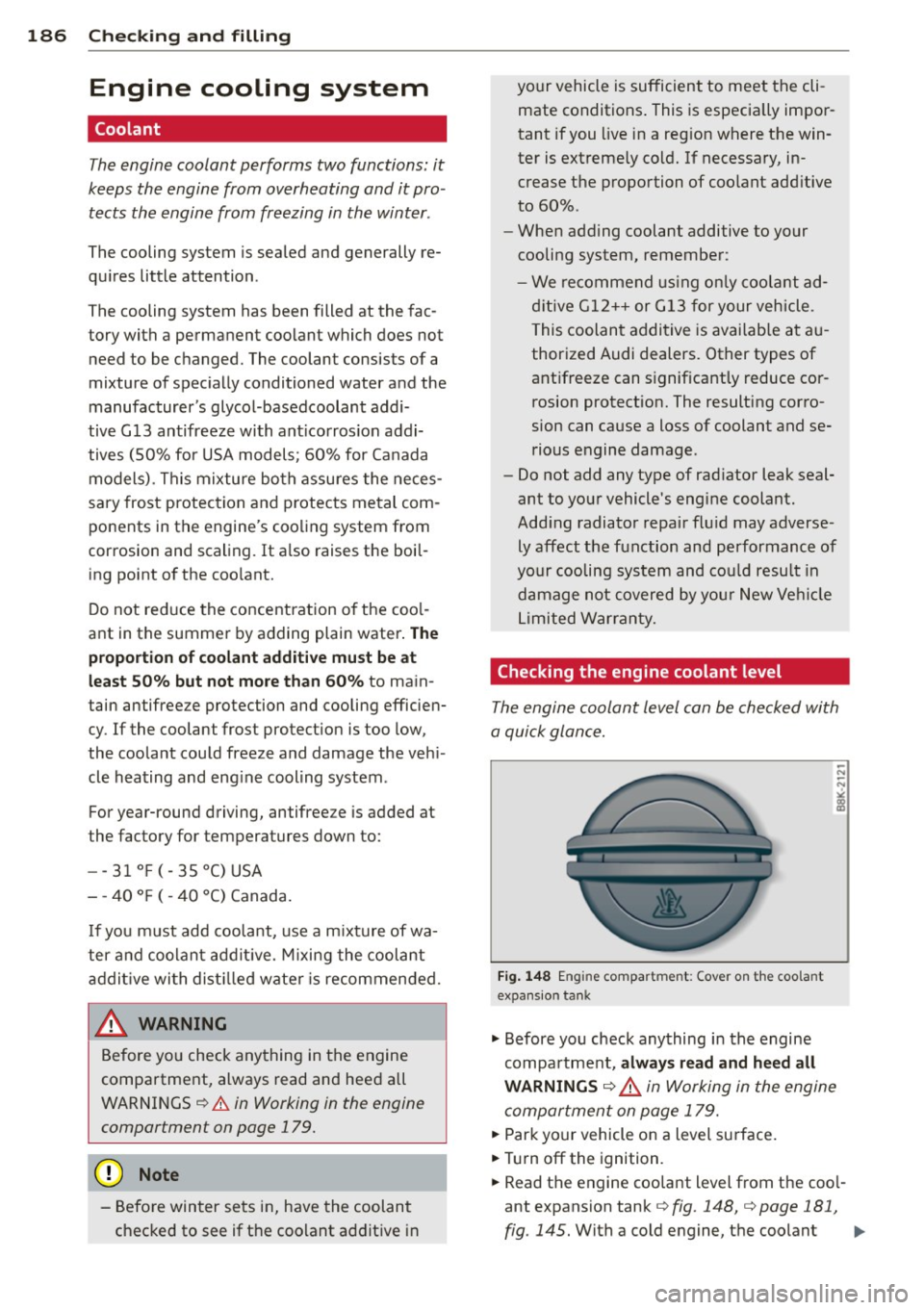
Fig. 148 E n gin e compart men t: Cover on the coo la n t
expans io n tank
.,. Before you check anything in the engine
compa rtment,
always read and heed all
WARNINGS ~ ,& in Working in the engine
compartment on page 179.
.,. Park your vehicle on a level surface .
.,. Tur n off the ignition.
.,. Read the engine coolant level from the coo l
ant expansion tank
c:> fig . 148, c:> page 181,
fig. 145.
With a cold engine, the coolant Iii>-
Page 189 of 258
M N
M N
0 ::i co ,...., \!) ..,.,
,...., ..,., ,....,
level should be between the "MIN" and
"MAX" markings. When the engine is warm,
the level may be slightly above the "MAX"
marking .
The location of the coolant expansion tank
can be seen in the engine compartment illus
tration
<=> page 181.
To obtain an accurate reading , the engine
must be switched
off.
The expansion tank in your vehicle is equipped
with an electric coolant level sensor.
When the coolant level is too low, the warning
light in the Auto-Check System <=>
page 14 will
blink until you add coolant and the level has
been restored to normal. Even though there is
an electric coolant level sensor, we still rec
ommend you check the coolant level from
time to time.
Coolant loss
Coolant loss may indicate a leak in the cooling
system. In the event of coolant loss, the cool
ing system should be inspected immediately
by your authorized Audi dealer.
It is not
enough merely to add coolant.
In a
sealed system, losses can occur only if
the boiling point of the coolant is exceeded as
a result of overheating.
A WARNING
The cooling system is under pressure and
can get very hot. Reduce the risk of scald
ing from hot coolant by following these
steps.
- Turn
off the engine and allow it to cool
down.
- Protect your face, hands and arms from escaping fluid and steam by covering the
cap with a large, thick rag .
- Turn the cap slowly and very carefully in
a counter-clockwise direction while ap
plying light, downward pressure on the
top of the cap .
- To avoid being burned, do not spill anti
freeze or coolant on the exhaust system
Checking and filling 187
or hot engine parts. Under certain condi
tions, the ethylene glycol in engine cool
ant can catch fire.
([) Note
Do not add any type of radiator leak seal
ant to your vehicle's engine coolant. Add- ing radiator repair fluid may adversely af
fect the function and performance of your
cooling system and could result in damage
not covered by your New Vehicle limited
Warranty .
Adding coolant
Be very careful when adding engine coolant.
Before you check anything in the engine com
partment ,
always read and heed all WARN
INGS <=>
A in Working in the engine compart
ment on page 179 .
Requirement: There must be a residual
amount of coolant in the expansion tank
<=> (D.
.,. Turn off the engine.
.,. Let the engine cool down.
.,. Place a thick rag over the coolant expansion
tank
<=> page 186, fig . 148 and carefully turn
the cap counter-clockwise
<=> .&_ .
.,. Add coolant mixed in the correct ratio
<=> page 186, Coolant up to the MAX mark
ing.
.,. Make sure that the fluid level remains sta-
ble. Add more coolant if necessary.
.,. Twist the cap on again
tightly.
Replacement engine coolant must conform to
exact specifications
<=> page 186, Coolant.
We recommend using only coolant additive
G12 ++, G13 or in an emergency G12 +. Do
not
use a different additive. In an emergency use
plain water until you can get the correct addi
tive and can restore the correct ratio. This
should be done as soon as possible.
If you have lost a considerable amount of
coolant , then you should add cold antifreeze
and cold water only when the engine is cold.
Always use
new engine coolant when refilling . .,.
•
•
Page 190 of 258
188 Checking and filling
Do not fill coolant above the "MAX" mark. Ex
cess coolant will be forced out through the pressure re lief valve in the cap when the en
g ine becomes hot.
A WARNING
- The coo ling system is under pressure and
can get very hot. Reduce the risk of
scalding from hot coolant by following
these steps.
- Turn
off the eng ine and a llow it to cool
down.
- Protect your face, hands and arms from
escaping fluid and steam by covering
the cap with a large, thick rag.
- Turn the cap slowly and very ca refully
i n a co unte r-clockwise d irection while
apply ing light, downward press ure on
the top of the cap.
- To avoid being burned, do not spi ll an
tifreeze or coolant on the exhaust sys
tem or hot engine parts. Under certa in
conditions, the ethylene glyco l in en
g ine coolant can ca tch f ire.
- Antifreeze is poisonous. Always store an
t ifreeze in its original container and we ll
o ut of the reac h of children.
- If you drain the coolant, it must be
caught and safely stored in a p roper con
ta iner clear ly ma rked "poison".
(D Note
- Do not add coolant if the expansion tan k
i s empty. A ir could enter the cooling sys
tem and damage the eng ine. If this is
the case, do not continue driving. Seek
professional assistance.
- Coolant po llutes the e nv ironment and
could cause an engine fire. Excess coo l
ant will be forced ou t through the pres
su re re lief v alve in the ca p when the en
gine becomes hot .
- If, in an emergen cy, only water can be
added, the corre ct ratio be twee n wa te r
and antifr eeze¢
page 186 must be re
stored as soon as possib le .
{® For the sake of the environment
D rained coo lant should not be reused . A l
ways d ispose of used coolant whi le observ
i ng a ll environmental regulations.
Radiator fan
The radiator fan switches on automatically by
itself
T he rad iator fan is driven by the engine v ia the
V-belt. The viscous clutch regulates the spee d
of the fan acco rding to the temperature of the
coolant.
An a uxiliary electric radiator fan* sw itches on
and
off depending on coolant temperature
and othe r vehicle ope rat ing condit ions .
A ft er yo u sw itc h t he eng ine
off, the aux iliary
f an can continue running for up to 10 m inutes
- even wit h the ignition
off. It can even switc h
on again later by itself¢.&. , if
- t he tempe rature of the engine coo lant rises
due to the heat build -up from the engine in
the engine compa rtment, or
- the engine compa rtment heats up because
the vehicle is parked in i ntense sunlig ht.
A WARNING ~
- To reduce the risk of perso na l inj ury nev -
er touch the radiator fan.
- The a uxiliary electric fan is tempe rat ure
contro lled and can sw itch on sud denly
even when the engine is not running.
- The a uxiliary radiator fan sw itches on a u
tomatically when the engine coo lant
reac hes a certa in temperature and will
continue to ru n until the coolant temper
ature drops.
Page 191 of 258
M N M N
0 ::i co
rl I.O
"' rl
"' rl
Brake fluid
Checking brake fluid level
The brake fluid level can be checked with a
quick glance.
N
N
;:;;
" 03
"'
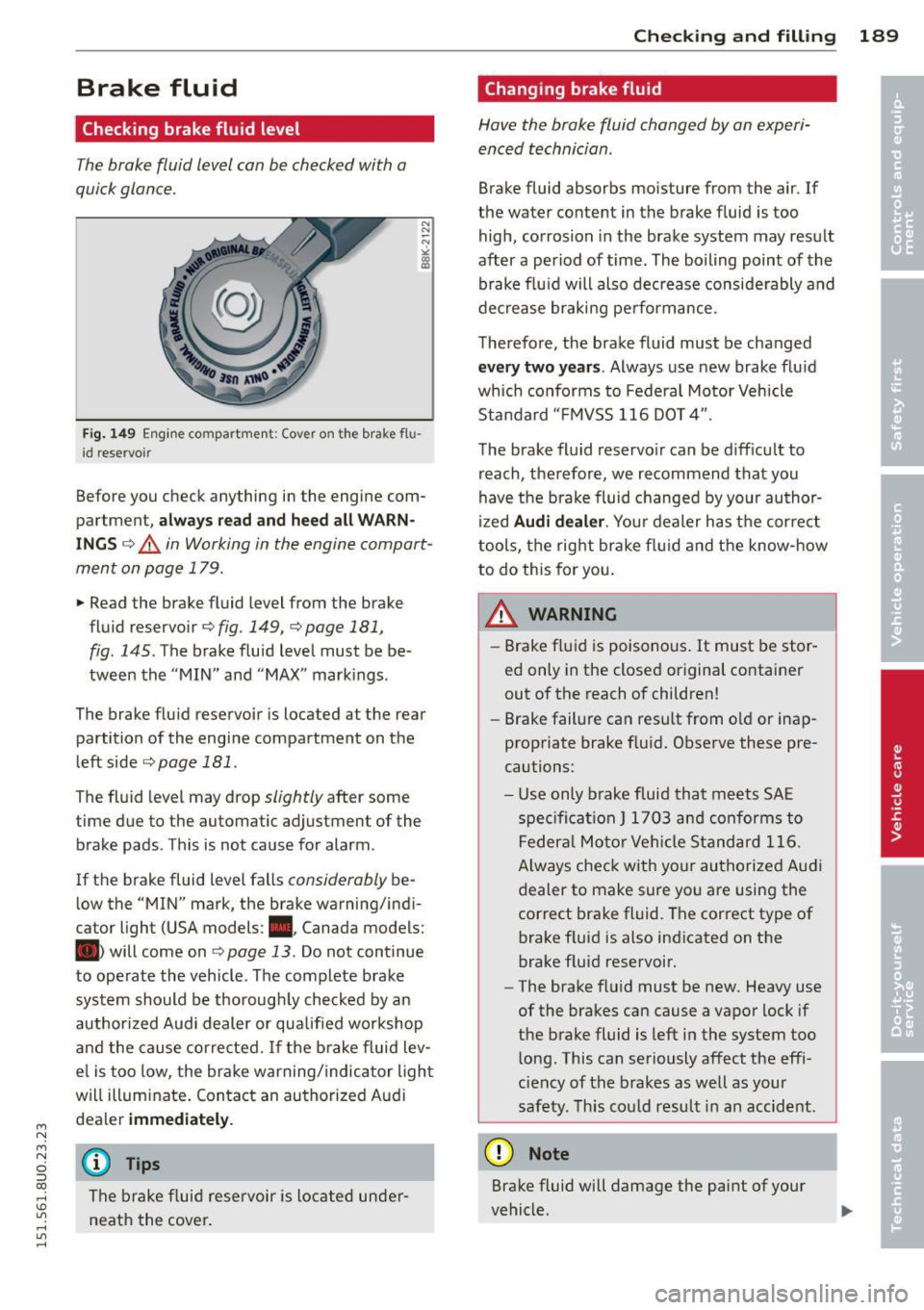
Fi g. 149 Eng ine compartment: Cover on the brake flu
id reservoir
Before you check anything in the engine com
partment,
a lwa ys read and heed all WARN
ING S c:> .&.. in Working in the engine compart
ment on page 179 .
~ Read the brake fluid level from the brake
fluid reservoir
c:> fig. 149, <=> page 181,
fig . 145.
The brake flu id level must be be
tween the "MIN" and "MAX" markings.
The brake fluid reservoir is located at the rear
partition of the engine compartment on the
left side <::;>
page 181 .
The fluid level may drop slightly after some
time due to the automatic adjustment of the
brake pads . This is not cause for alarm .
If the brake fluid level falls
considerably be
low the "MIN" mark, the brake warning/indi
cator light (USA models: ., Canada models:
• will come on
<::;> page 13. Do not continue
to operate the vehicle . The complete brake
system should be thorough ly checked by an
author ized Audi dealer or qua lified workshop
and the cause corrected.
If the brake fluid lev
e l is too low, the brake warning/indicator ligh t
will illuminate . Contact an authorized A ud i
dealer
immediately.
@ Tips
The brake f luid reservoir is located under
neath the cover .
Checking and fillin g 189
Changing brake fluid
Have the brake fluid changed by on experi
enced technician.
Brake fluid absorbs moisture from the air. If
the water content in the brake fluid is too
high, corrosion in the brake system may result
after a period of time . The boiling point of the
brake flu id will also dec rease considerably and
decrease braking pe rformance.
Therefore, the brake fluid must be changed
ev ery two years. Always use new brake flu id
which conforms to Federal Motor Vehicle
Standard "F MVSS 116 DOT 4".
The brake fluid reservo ir can be d iff icult to
reach, the refore, we recommend that you
have the brake fluid changed by your author
i zed
Audi d ealer. Your dealer has t he correct
tools, the right brake fl uid and t he know-how
to do this for you .
A WARNING -.
-Brake fluid is poisonous . It must be stor
ed only in the closed original container
out of the reach of children!
- Brake failure can resu lt from o ld or inap
propriate brake f luid. Observe these pre
cautions:
- Use only brake fluid that meets SAE
spe cificat ion
J 1 7 03 and conforms to
Federa l Moto r Ve hicl e Standard 116.
Always check with yo ur authorized Audi
dealer to make sure yo u are using the
correct bra ke fluid. The correct type of
brake f luid is also indicated on the
brake f luid reservoir.
- The brake fluid must be new. Heavy use
of the brakes can cause a vapor lock if
the brake fluid is left in the system too
l ong . This can seriously affect the effi
c iency of the brakes as well as your
safety. This cou ld resu lt in an accident.
(D Note
Brake fluid will damage the paint of your
vehicle .
Page 192 of 258
190 Checking and filling
@ For the sake of the environment
Because of the problem of proper disposa l
of brake flu id as we ll as the special tools
req uired and the necessary expert ise, we
recommend that you have the b rake fluid
changed by your author ized Audi dealer.
Battery
General information
Unde r normal operating conditions, the bat
tery in your A udi does not need any mainte
nance. With
high outside temperatures or
long daily dr ives we recommend that you have
the elect ro lyte level checked by an authorized
Aud i dea ler o r qualified workshop . The elec
trolyte leve l sho uld a lso be c hecked each t ime
the battery is c harged
c::> page 192.
H ave the battery checked when you take your
ve hicle in for service . Yo u are well adv ised to
replace a bat tery that is older tha n 5 yea rs .
W ith certa in types of a irbag deployment, t he
battery is d isconnected from the vehicle elec
tr ica l system fo r safety reasons
c::> & in Re
pair, core and disposal of the airbags on
page 126.
Disconnecting the battery terminals
Some veh icle functions (power w indow regu
lato rs, for example) are lost if the battery ter
m inals a re discon nected. These functions have
to be re lea rned after the batte ry terminals a re
c onnec ted agai n. T o prevent this, the battery
should o nly be di sconnec ted from the vehicle
e lec trica l syste m when absolu tely necess ary
for repairs.
Vehicles not driven for long periods
I f yo u do not dr ive you r vehicle over a pe riod
of severa l days or weeks, elec trical co m po
n en ts are gr adually cu t back o r swi tched off .
T his reduces energy cons ump tion and main
tains sta rting capab ility over a lon ger perio d
c::> page 159 .
Some o f the conven ien ce f unct ions m ay no t
ope rate, su ch as the in ter ior lights o r the power seat adjus
tment . The convenience
funct ions wi ll be available again when yo u
tu rn on the ign ition and sta rt t he engine .
Winter operation
During the w inte r mon th s, batt ery c apac ity
tends to dec rease as tempera tures drop . This
is beca use more power is a lso consumed w hile
starting, and the headlights, rear win dow de
f ogger, etc., are used more often.
Avoid unnecessa ry powe r consumpt ion, pa r
ticu lar ly in ci ty traffic o r when traveling only
sho rt distances . Let yo ur autho rized A udi
dealer check the capacity of the vehicle bat
tery before w inter sets in
<=:> page 192. A well
charged battery will not on ly prevent starting
problems when the weather is cold, but w ill
also last longer .
@ Tips
If your vehicle is left standing for seve ral
w eeks at extremely low temperatures, the
vehicle battery s hou ld be removed and
s tored w her e it w ill not freeze. This will
preve nt i t fr om be ing d amaged and having
t o be repla ced .
Working on the battery
Be especially careful when working on or near
the battery.
T he battery is loc ated in the luggage compar t
ment under the floo r. B efo re you che ck any
t hi ng in the luggage co mpartmen t,
read and
heed all WARNINGS
c::> .&_ .
Always heed t he safety warnings , when work
i ng on the veh icle ba tte ry or the vehicle e le c
t ric al sys tem to p reven t inju ry.
The following WARNINGS are very
important when working on the battery:
Always heed the following WARNING SYM ·
BOLS and safety precautions when working
on the battery .
®
Always wear eye protection .
Page 194 of 258
192 Checking and filling
(D Note
- Do not disconnect the vehicle battery
when the ignition is switched on or when
the engine is running, otherwise, you will
damage e lectronic components i n the
electrical system.
- If your vehicle is going to stand for a
long period of time without being driven,
protect t he battery from "freezing", oth
e rwise it w ill be damaged and w ill then
have t o be repla ced.
Battery charging
Starting the engine requires a well charged
battery.
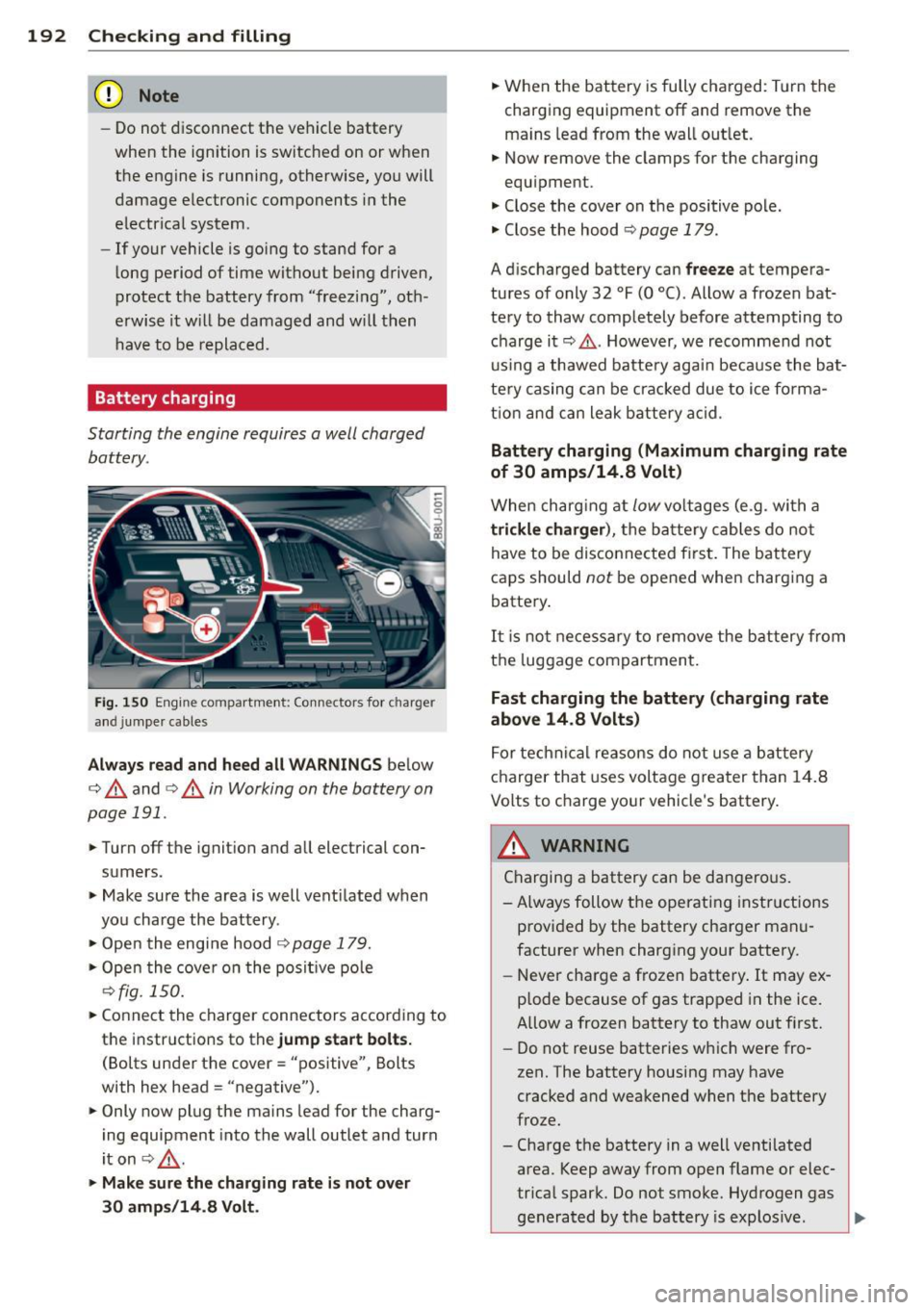
Fig. 150 Eng ine compartment: Connectors for charger
a nd jumper cables
Always read and heed all WARNINGS be low
c::> & and c::> & in Working on the battery on
page 191 .
•Turnoff th e ignit ion and all electrical con
sumers.
• Make sure the area is well vent ilated when
yo u cha rge the battery .
• Ope n the engi ne hood
c::> page 179.
• Open the cove r o n the pos it ive pole
c::> fig. 150.
• Connect the charger connectors according to
the instructions to the
jump start bolts.
(Bo lts under the cover = "positive", Bolts
with hex head= "negative").
• Only now plug the mains lead for the charg
i ng equipment into the wall outlet and turn
i t on
c::> .&,. .
• Make sure the charging rate is not over
30 amps /14.8 Volt .
• When the battery is fully charged: Turn the
charging equipment off and remove the
mains lead from the wall out let.
• Now remove the clamps for the charging
equ ipment.
.,. Close the cover on the positive pole .
.,. Close the hood
c::> page 179 .
A discharged battery can freeze at tempera
tures of only 32 °F (0 °C). Allow a frozen bat
tery to thaw comp letely before attempting to
charge i t
c::> .&.. However, we recommend not
u sing a thawed batte ry aga in because the ba t
te ry casing can be c racked due to i ce fo rm a
t io n an d can leak battery a cid.
Battery charging (Maximum charging rate
of
30 amps/14.8 Volt)
When charg ing at low vo lta ges (e.g. wi th a
trickle charger ), the ba tte ry cables do not
have to be disconnected f irs t. T he bat tery
caps should
not be opened when charg ing a
battery .
It is no t necessa ry to remove the b attery from
the luggage compartmen t.
Fast charging the battery (charging rate
above 14 .8 Volts)
F or te chnica l re asons do not use a batt ery
ch arger that uses voltage greater than
14 .8
Volts to c harge yo ur vehicle's battery.
A WARNING
.------
C harging a battery can be dangero us.
-A lways follow the operati ng instr uctions
p rovi ded by the battery charger manu
facturer when charg ing your battery.
- Never charge a frozen batte ry . It may ex
p lode because of gas trapped in the ice.
Allow a frozen battery to thaw out f irst.
- Do not reuse batteries w hich were fro
zen. The battery housing may have
cracked and weakened w hen the battery
froze .
- Charge the battery in a we ll ventilated
area. Keep away from open flame or elec
tr ica l spark. Do not s moke. Hydrogen gas
genera ted by t he battery is explos ive .
Page 195 of 258
M N
M N
0 ::i co ,...., \!) 1.1'1 ,...., 1.1'1 ,....,
-To r educe the danger of explosion, never
connect or disconnect charger cables
while the charger is operating.
- Fast charg ing a battery is dangerous and
should only be attempted by a compe
tent technician w ith the proper equip
ment .
- Battery acid that may spill during charg
ing should be washed
off with a solution
of warm water and baking soda to neu
t ralize the acid .
Never use a fast charger as a booster to
start the engine . This will seriously dam
age sensitive elect ronic components, such
as control units, relays, radio, etc. , as we ll
as t he battery charger.
Battery replacement
The new battery must have the same specifi
cations and dimensions as the original equip
ment battery.
Intell igent energy management in your veh i
cle is respons ible for d istr ibuting the e lectr i
cal energy throughout you r vehicle
¢ page 159. The inte lligen t en ergy ma nage
men t system w ill keep the engine b attery
charged be tter then vehicles w ithout this sys
tem . To make sure t he additional e lectrica l e n
ergy is available once again after you have
changed t he battery, we recommend that you
install ba tteries of the same type and man u
facture only (the same as t hose installed at
the t ime your vehicle was delivered) . Specifi
cations a re listed on the battery hous ing . You r
author ized Audi dealer must code the bat tery
in the energy management system to enable
you to use the energy management functions
correctly after rep lac ing the battery .
I f it is not poss ible to use a battery of this
type, the new bat tery mus t have the s ame ca
pacity, vo ltage ( 12-volts), ampe rage, con
struction and pl ug sea ling.
Checkin g and fillin g 193
When installing the battery, make su re the ig
nition and a ll electrical consume rs a re turned
off.
Q) Note
M ake sure the ven tilat ion hose on the side
of the batte ry is connecte d, otherwise
fumes o r batte ry acid can leak out .
@ For the sake of the environment
Because o f the p rob lem of proper disposal
of a battery, we recommen d your author
i zed A udi dealer change the battery for
you. Batteries contain sulfur ic acid and
l ead and must always be disposed of prop
erly in comp liance with a ll environmental
r egula tions . Dispos ing of vehicle batter ies
i mprope rly is v ery dange rous to th e envi
r o nmen t.
Windshield washer
container
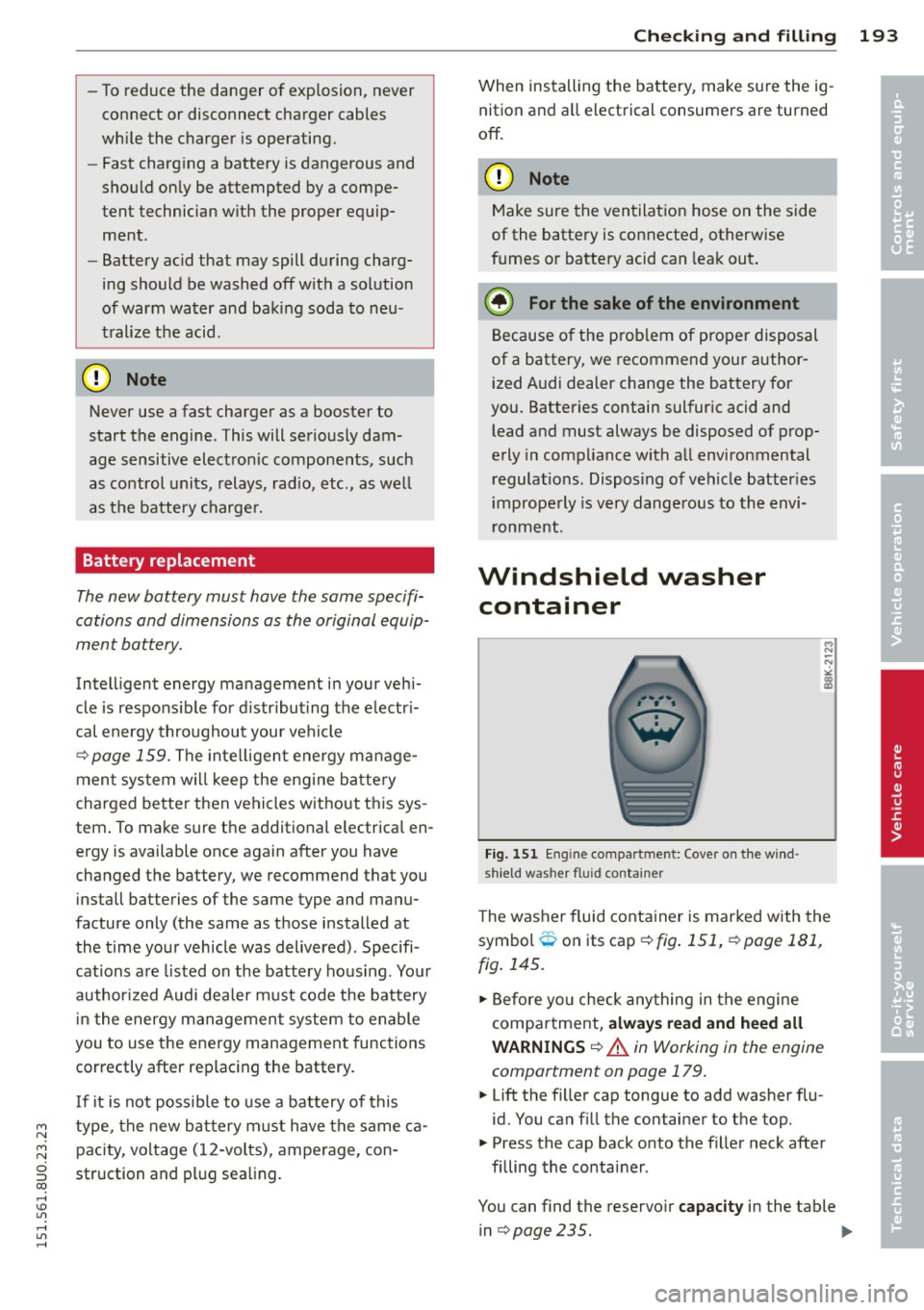
Fi g. 151 En gin e co mpa rtm en t: Cove r o n th e wind
s hi eld was her fluid conta in e r
The washer fluid conta iner is mar ked w ith the
symbol
O on its cap ¢ fig . 151, ¢page 181,
fig . 145.
.. Before yo u check any thing in t he engine
compa rtment,
alwa ys re ad and heed all
WARNINGS ¢ & in Working in the engine
compartment on page 179 .
.. Lift the fi ller cap tongue to add washer flu
id. You can f ill the container to t he top.
.. Press the cap back o nto the fi lle r neck after
filling the co nta iner .
You can find the reservo ir
capacity in the table
in
¢ page 235. 111>
•
•
Page 196 of 258
194 Checking and filling
Clean water sho uld be used when filling up. If
possible, use soft water to prevent scaling on
the washer jets. Always add a glass cleaner
solut ion (w ith frost protection in the w inter) .
Do not mix engine coolant antifreeze or
any other additives to fill up the wind
shie ld washer reservoir.
Page 202 of 258
200 Tires and wheels
you have stored. The system does not recog
nize the load condition of your vehicle.
The effectiveness of the tire pressure monito r
ing system* will be impaired if you store nor
mal load pressures but then operate the vehi
cle at its maximum load¢.&. .
See the illustration¢
fig. 152 for the location
of the label on driver's side 8-pillar (color of
the actua l label and exact location on the ve
hicle wi ll vary slightly).
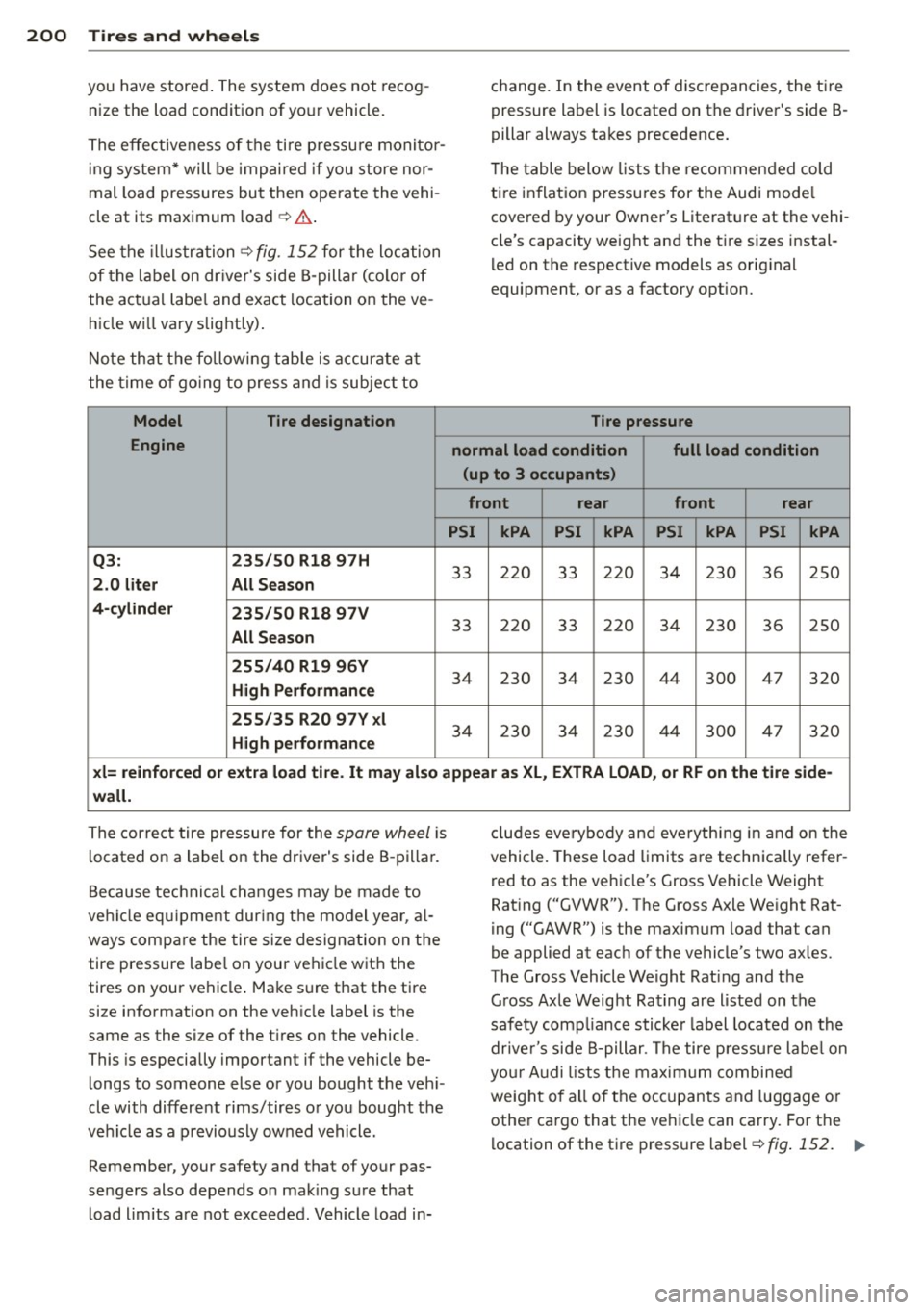
Note that the following table is accurate at
the time of going to press and is subject to
Model Tire designation
Engine
Q3: 235/50
Rl8 97H
2.0 liter All Season
4 -cylinder
235/50 Rl8 97V
All Season
255/40 Rl9 96Y
High Performan ce
255/35 R20 97Y xl
High performance
change. In the event of discrepancies, the tir e
pressure label is located on the driver's side 8-
pillar always takes precedence.
T he table below lists the recommended cold
ti re inflation pressures for the Audi mode l
covered by your Owner's Literature at the vehi
cle's capacity weight and the t ire sizes instal
l ed on the respective models as original
equipment, or as a factory option.
Tire pressure
normal load condition full load condition (up to 3 occupants)
front rear front rear
PSI kPA PSI kPA PSI kPA PSI kPA
33 220 33 220 34 230 36 250
33 220 33 220 34 230 36 250
34 230 34
230 44
300 47
320
34 230 34 230 44 300 47 320
xl= reinforced or extra load tire. It may also appear as XL, EXTRA LOAD, or RF on the tire side-
wall.
The correct tire pressure for the spare wheel is
located on a label on the driver's side 8 -pillar.
Because technical changes may be made to
vehi cle equipment dur ing the model year, al
ways compare the tire size designation on the
tire pressure labe l on your vehicle with the
tires on your vehicle . Make sure that the tire
size information on the veh icle label is the
same as the size of the t ires on the vehicle.
This is especially important if the vehicle be
longs to someone else or you bought the vehi
cle with different rims/tires or you bought the
vehicle as a previously owned vehicle.
Remember, your safety and that of your pas
sengers also depends on mak ing sure that
load limits are not exceeded . Vehicle load in- eludes
everybody and everything in and on the
vehicle. These load limits are technically refer
red to as the vehicle's Gross Vehicle Weight
Rat ing ("GVWR"). The Gross Axle We ight Rat
ing ("GAWR") is the maximum load that can
be applied at each of the vehicle's two axles.
The Gross Vehicle Weight Rating and the
Gross Axle Weight Rating are listed on the
safety compliance sticker label located on the
dr ive r's side 8-pillar. The tire pressure labe l on
you r Audi lists the max imum combined
weight of all of the occupants and luggage or
other cargo that the ve hicle can carry. For the
location of the tire pressure label
~fig . 152. .,..