battery capacity AUDI Q3 2015 Owners Manual
[x] Cancel search | Manufacturer: AUDI, Model Year: 2015, Model line: Q3, Model: AUDI Q3 2015Pages: 258, PDF Size: 64.9 MB
Page 161 of 258
with all-wheel drive¢ page 211, Snow
chains .
Replacing wheels /tire s
Vehicles w ith all-wheel drive mus t always
h ave tires o f the same size. Also avoid t ires
with different tread depths. For details see
page
c::> page 206, New tires and replacing
tires and wheels.
A WARNING
Always adjust your driving to road and traf
fic condit ions. Do not let the extra safety
afforded by all-wheel drive tempt you into
taking extra risks.
- Although the all-wheel dr ive is very ef
fective, always remember that braking capacity is limited by t ire traction . You
should therefore not dr ive at excess ive
speeds on icy or slippery road surfaces.
- On wet road surfaces, be careful not to
dr ive too fast because the front wheels
c ou ld beg in to s lide on top of the water
(aquaplaning). If this sho uld oc cur, you
will have no warning from a sudden in crease in engine speed as with a front
wheel drive vehicle. A lways drive at
speeds which are suited to the road con
ditions -risk of crash.
Energy management
Starting ability is optimized
Energy management controls the distribution
of electrical energy and thus optimizes the
availability of electrical energy for starting
the engine .
If a vehicle with a conventional energy system
is not driven for a long period of time , the bat
tery is discharged by idling cu rrent consumers
(e.g. immobilizer). In ce rtain c ircumstances it
can result in there being insufficient energy
M avai lab le to start the engine . N
M N
0 ::i co ,...., \!) 1.1'1 ,...., 1.1'1 ,....,
Intelligent energy management in your veh i
cle handles the d istribution of elec trical ener
gy . Starting abi lity is markedly improved and
the life of the battery is extended .
Intellig ent technolog y 159
Basica lly, energy management consists of
b att ery diag nosis , id lin g cur rent man age
ment
and dyn amic en ergy m anag ement.
Batte ry diagnosis
Battery diagnosis continuously determines
the state of the battery . Sensors determine
battery voltage, battery current and battery
temperature . This determines the current
state of charge and the power of the batte ry .
Idlin g current manag ement
Id ling current management reduces energy
consumption while the vehicle is standing.
With the ig nition switched off, it controls the
energy supply to the various electrical compo nents. Data from battery diagnosis is cons id
ered.
Depending on the battery's state of charge ,
individual consumers are gradually turned off
to prevent excessive discharge of the batte ry
and thus maintain starting capability .
Dynamic energy manag ement
While the vehicle is being driven, dynamic en
ergy management distributes the energy gen
erated according to the needs of the individ u
al components . It regulates consumption, so
that more electrical energy is not being used
than is being generated and ensures an opti
mal state of charge for the battery .
(D Tips
-But even energy management cannot
negate the limits of physics. Consider
that the power and life of a battery are
limited.
- If start ing ability is threatened, the indi
cator light (•) ;ippears
c::> page 15.
What you should know
The highest priority is given to maintaining
starting capability .
The battery is severe ly taxed in short-distance
driving , in ci ty traff ic and during the cold time
of year . Abundant electrical energy is .,.
•
•
Page 192 of 258
190 Checking and filling
@ For the sake of the environment
Because of the problem of proper disposa l
of brake flu id as we ll as the special tools
req uired and the necessary expert ise, we
recommend that you have the b rake fluid
changed by your author ized Audi dealer.
Battery
General information
Unde r normal operating conditions, the bat
tery in your A udi does not need any mainte
nance. With
high outside temperatures or
long daily dr ives we recommend that you have
the elect ro lyte level checked by an authorized
Aud i dea ler o r qualified workshop . The elec
trolyte leve l sho uld a lso be c hecked each t ime
the battery is c harged
c::> page 192.
H ave the battery checked when you take your
ve hicle in for service . Yo u are well adv ised to
replace a bat tery that is older tha n 5 yea rs .
W ith certa in types of a irbag deployment, t he
battery is d isconnected from the vehicle elec
tr ica l system fo r safety reasons
c::> & in Re
pair, core and disposal of the airbags on
page 126.
Disconnecting the battery terminals
Some veh icle functions (power w indow regu
lato rs, for example) are lost if the battery ter
m inals a re discon nected. These functions have
to be re lea rned after the batte ry terminals a re
c onnec ted agai n. T o prevent this, the battery
should o nly be di sconnec ted from the vehicle
e lec trica l syste m when absolu tely necess ary
for repairs.
Vehicles not driven for long periods
I f yo u do not dr ive you r vehicle over a pe riod
of severa l days or weeks, elec trical co m po
n en ts are gr adually cu t back o r swi tched off .
T his reduces energy cons ump tion and main
tains sta rting capab ility over a lon ger perio d
c::> page 159 .
Some o f the conven ien ce f unct ions m ay no t
ope rate, su ch as the in ter ior lights o r the power seat adjus
tment . The convenience
funct ions wi ll be available again when yo u
tu rn on the ign ition and sta rt t he engine .
Winter operation
During the w inte r mon th s, batt ery c apac ity
tends to dec rease as tempera tures drop . This
is beca use more power is a lso consumed w hile
starting, and the headlights, rear win dow de
f ogger, etc., are used more often.
Avoid unnecessa ry powe r consumpt ion, pa r
ticu lar ly in ci ty traffic o r when traveling only
sho rt distances . Let yo ur autho rized A udi
dealer check the capacity of the vehicle bat
tery before w inter sets in
<=:> page 192. A well
charged battery will not on ly prevent starting
problems when the weather is cold, but w ill
also last longer .
@ Tips
If your vehicle is left standing for seve ral
w eeks at extremely low temperatures, the
vehicle battery s hou ld be removed and
s tored w her e it w ill not freeze. This will
preve nt i t fr om be ing d amaged and having
t o be repla ced .
Working on the battery
Be especially careful when working on or near
the battery.
T he battery is loc ated in the luggage compar t
ment under the floo r. B efo re you che ck any
t hi ng in the luggage co mpartmen t,
read and
heed all WARNINGS
c::> .&_ .
Always heed t he safety warnings , when work
i ng on the veh icle ba tte ry or the vehicle e le c
t ric al sys tem to p reven t inju ry.
The following WARNINGS are very
important when working on the battery:
Always heed the following WARNING SYM ·
BOLS and safety precautions when working
on the battery .
®
Always wear eye protection .
Page 195 of 258
M N
M N
0 ::i co ,...., \!) 1.1'1 ,...., 1.1'1 ,....,
-To r educe the danger of explosion, never
connect or disconnect charger cables
while the charger is operating.
- Fast charg ing a battery is dangerous and
should only be attempted by a compe
tent technician w ith the proper equip
ment .
- Battery acid that may spill during charg
ing should be washed
off with a solution
of warm water and baking soda to neu
t ralize the acid .
Never use a fast charger as a booster to
start the engine . This will seriously dam
age sensitive elect ronic components, such
as control units, relays, radio, etc. , as we ll
as t he battery charger.
Battery replacement
The new battery must have the same specifi
cations and dimensions as the original equip
ment battery.
Intell igent energy management in your veh i
cle is respons ible for d istr ibuting the e lectr i
cal energy throughout you r vehicle
¢ page 159. The inte lligen t en ergy ma nage
men t system w ill keep the engine b attery
charged be tter then vehicles w ithout this sys
tem . To make sure t he additional e lectrica l e n
ergy is available once again after you have
changed t he battery, we recommend that you
install ba tteries of the same type and man u
facture only (the same as t hose installed at
the t ime your vehicle was delivered) . Specifi
cations a re listed on the battery hous ing . You r
author ized Audi dealer must code the bat tery
in the energy management system to enable
you to use the energy management functions
correctly after rep lac ing the battery .
I f it is not poss ible to use a battery of this
type, the new bat tery mus t have the s ame ca
pacity, vo ltage ( 12-volts), ampe rage, con
struction and pl ug sea ling.
Checkin g and fillin g 193
When installing the battery, make su re the ig
nition and a ll electrical consume rs a re turned
off.
Q) Note
M ake sure the ven tilat ion hose on the side
of the batte ry is connecte d, otherwise
fumes o r batte ry acid can leak out .
@ For the sake of the environment
Because o f the p rob lem of proper disposal
of a battery, we recommen d your author
i zed A udi dealer change the battery for
you. Batteries contain sulfur ic acid and
l ead and must always be disposed of prop
erly in comp liance with a ll environmental
r egula tions . Dispos ing of vehicle batter ies
i mprope rly is v ery dange rous to th e envi
r o nmen t.
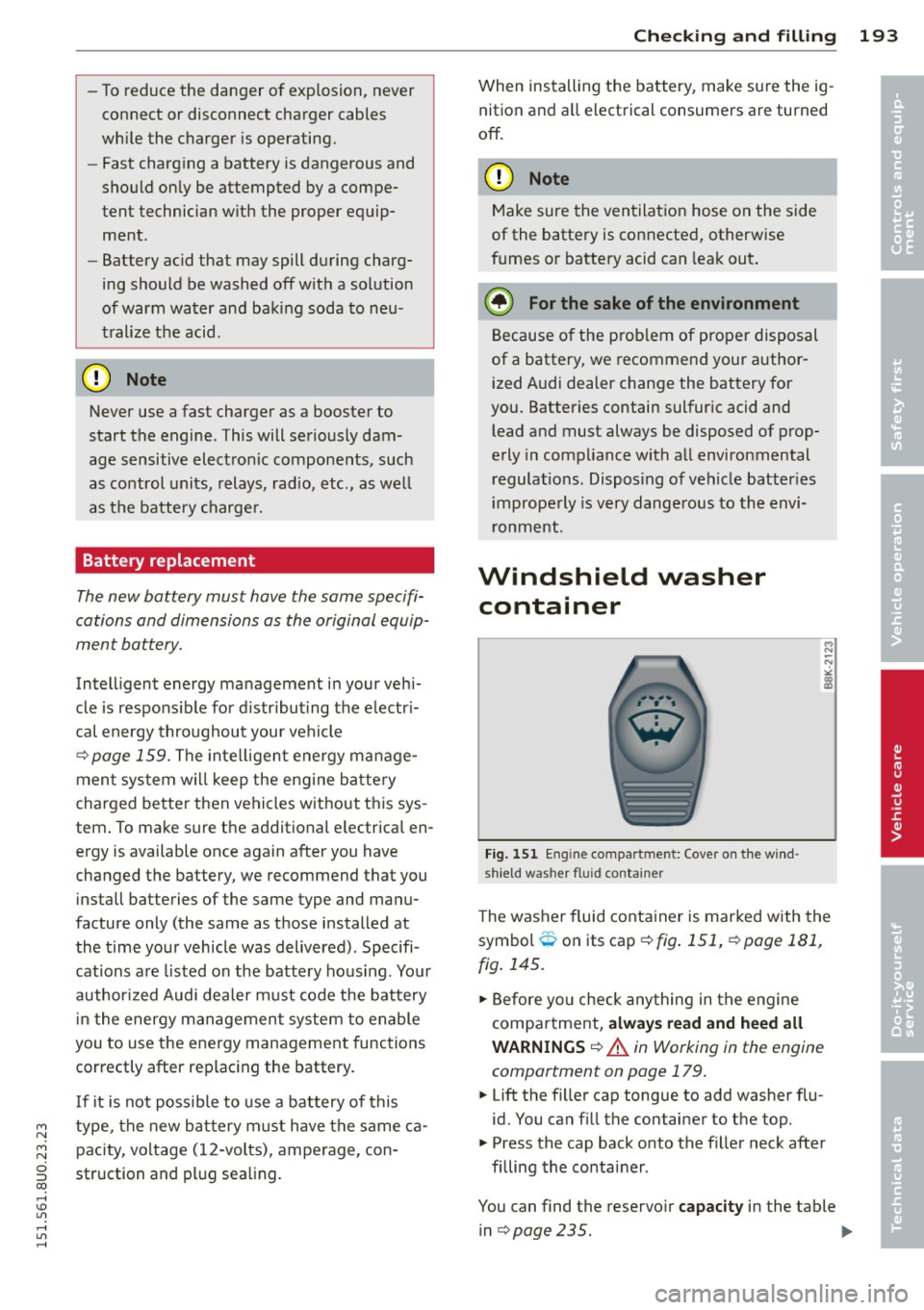
Windshield washer
container
Fi g. 151 En gin e co mpa rtm en t: Cove r o n th e wind
s hi eld was her fluid conta in e r
The washer fluid conta iner is mar ked w ith the
symbol
O on its cap ¢ fig . 151, ¢page 181,
fig . 145.
.. Before yo u check any thing in t he engine
compa rtment,
alwa ys re ad and heed all
WARNINGS ¢ & in Working in the engine
compartment on page 179 .
.. Lift the fi ller cap tongue to add washer flu
id. You can f ill the container to t he top.
.. Press the cap back o nto the fi lle r neck after
filling the co nta iner .
You can find the reservo ir
capacity in the table
in
¢ page 235. 111>
•
•
Page 199 of 258
M N
M N
0 ::i co ,...., \!) 1.1"1 ,...., 1.1"1 ,....,
Tires and wheels 197
Gross Vehicle Weight Rating ("GVWR") Ply
means the maximum total loaded weight of
the vehicle .
Groove
means the space between two adjacent tread
ri bs.
Load rating (code)
means the maximum load that a tire is rated
to carry for a given inflat ion pressure . You
may not find this informat ion on all tires be
cause it is not requ ired by law.
Maximum load rating
means the load rating for a t ire at the max i
mum permissible inflation pressure for that
tire .
Maximum loaded vehicle weight
means the sum of:
(a) Curb weight
(b) Accesso ry weight
(c) Vehicle capacity weight, and
(d) Production opt ions we ight
Maximum (permissible) inflation pressure
means the maximum co ld inf lation pressure
to which a tire may be inflated . Also called
"maximum inflation pressure."
Normal occupant weight
means 150 lbs . (68 kilograms) times the
number of occupants seated in the vehicle up
to the tota l seating capacity of your vehicle.
Occupant distribution
means distribution of occupants in a veh icle.
Outer diameter
means the overall diameter of an inflated new
tire .
Overall width
means the linear distance between the exteri
ors of the sidewalls of an inflated tire, includ
ing e levations due to labeling, decorations, or
protective bands or ribs. means a layer of
rubber-coated parallel cords.
Production options weight
means the combined weight of those installed
regular production opt ions we ighing over 5
lbs. (2.3 kg) in excess of those standa rd items
which they replace, not previously considered
in curb weight or accessory weight, including
heavy duty brakes, ride levelers, roof rack,
heavy duty battery, and spec ial trim.
Radial ply tire
means a pneumatic tire in which the ply cords
that extend to the beads are laid at substan
tially 90 degrees to the centerline of the
tread.
Recommended inflation pressure
see r::!;> page 196, Cold tire inflation pressure .
Reinforced tire
means a tire design to operate at higher loads
and at higher inflation pressures than the cor
responding standard tire. Reinforced tires
may be identified as "XL", "xl", "EXTRA LOAD",
or "RF" on the sidewal l.
Rim
means a metal support for a tire or a t ire and
tube assembly upo n which the tire beads are
seated .
Rim diamete r
means nominal diameter of the bead seat. If
you change your wheel s ize, you wi ll have to
purchase new tires to match the new r im di
ameter .
Rim size designation
means rim diameter and width.
Rim width
means nominal distance between rim flanges.
Sidewall
means that portion of a t ire between the
tread and bead .
•
•
Page 230 of 258
228 Emergency situations
Emergency situations
General
This chapter is intended for trained emer
gency crews and working personnel who
have the necessary tools and equipment to
perform these ope rations.
Starting by pushing or
towing
Q;) Note
Vehicles with an automati c transmission
cannot be started by pushing or towing .
Starting with jumper
cables
If necessary, the engine can be started by
connecting it to the battery of another vehi
cle.
If the engine should fail to start because of a
discharged or weak battery, the battery can be
connected to the battery of
another veh icle,
using a
pair of jumper cables to start the en
g ine .
Jumper cables
Use only jumper cables of sufficiently large
cross section to carry the starter current safe
ly. Refer to the manufacturer's specifications.
Use only jumper cables with
insulated termi
na l clamps which are distinctly marked:
plus(+) cable in most cases colored red
minu s(-) cable
in most cases colored black .
A WARNING
Batteries contain electricity, ac id, and gas .
Any of these can cause very serious or fatal
inju ry. Follow the instructions below for
safe handling of your veh icle's battery.
- Always shield you r eyes and avoid lean
ing over the battery whenever possible.
- A discharged battery can freeze at tem
peratures just be low 32 °F (0 °C). Before connecting a
jumper cable, you must
thaw the frozen battery complete ly, oth
erwise it could explode.
- Do not allow battery acid to contact eyes
or skin . Flush any contacted area with
water immediately .
- Improper use of a booster battery to start a vehicle may cause an explosion.
- Vehicle batteries generate explosive gas
es. Keep sparks, flame and lighted ciga
rettes away from batteries.
- Do not try to jump start any vehicle with a low ac id level in the battery.
- The vo ltage of the booster battery must
also have a 12-Volt rating . The capacity
(Ah) of the booster battery should not be
lower than that of the discharged bat
tery . Use of batteries of d ifferent voltage
or substantially different "Ah" rating
may cause an exp losion and personal in
jury.
- Never charge a frozen batte ry. Gas trap
ped in the ice may cause an explosion.
- Never charge or use a battery that has
been frozen. The battery case may have
be weakened.
- Use of batter ies of different voltage or
substantially different capacity (Ah) rat
ing may cause an exp losion and injury.
The capacity (Ah) of the booster battery
should not be lower than that of the dis
charged battery.
- Before you check anything in the engine
compartment, always read and heed a ll
WARNINGS ¢
page 179.
(D Note
-App lying a higher voltage booster bat
tery will cause expensive damage to sen
sitive electronic components, such as
control units, relays, radio, etc .
- Th ere must be no electrical contact be
tween the vehicles as otherwise current cou ld already start to f low as soon as the
positive(+) terminals are connected. .,.
Page 248 of 258
246 Index
Checking the engine coolant leve l .... . 186
Radiator fan . . . . . . . . . . . . . . . . . . . . . . 188
E ng ine coolant temperature
Temperature gauge ..... .. .. .. .. .. .. 10
Eng ine hood
Closing .... .......... ...... ... .. . 179
H ow to release the hood . . . . . . . . . . . . 179
E ngine oi l ..... ........... .... .... . 181
Adding .. .. ............. .. .. .. ... 184
Addi tives . . . . . . . . . . . . . . . . . . . . . . . . . 184
Changing .. ................ ... .. . 185
Check oil level ............ ... .. .. . 184
Consumpt ion . ........... .. .. .... . 184
I ndicator light . . . . . . . . . . . . . . . . . 17, 18
O il consumption .......... .... .... . 183
Oil dipstick ............... ... .... . 184
Oil grades . ................. ..... . 181
Pressure malfunction ....... .... ... .. 15
Sensor defective . . . . . . . . . . . . . . . . . . . . 18
Specification and viscosity .. .. .. .. .. . 181
Engine speed limitation ......... .... . . 17
Environment Break-in period ... ..... ... .. .. .. .. . 161
Cata lytic converter ............ ..... 161
Disposing of your vehicle battery .. .. . 193
Driving at high speeds ......... .. .. . 163
Driving to minimize pollution and noise 162
Fuel ... .... ................ ..... . 177
Fue l economy .............. .. .... . 162
Leaks under your vehicle ... .. .. .... . 179
Le tting the vehicle stand and warm up . 163
Proper disposal of dra ined brake fluid . 189
Proper disposal of dra ined engine cool-
ant . .. .... ... .......... .. .. .. .. . 187
Proper disposal of dra ined engine
oil . . . . . . . . . . . . . . . . . . . . . . . . . 184, 185
Recycling used engine oil ......... .. . 184
Roof rack . . . . . . . . . . . . . . . . . . . . . . . . . 58
Unleaded fuel ..................... 175
What should I do with an old battery? 193
EPC
refer to Electronic power control . . . . . . 17
Event Data Recorder (EDR) . ........ .. . 152
Exhaust tail pipes Cleaning . ............... ........ . 171
Expansion tank ............ .. .. .. .. . 186
Exterior lighting ............ ... .. ... . 40 Exterior
mirrors
Adjusting ..... .. .. .............. .. 44
Dimm ing . ... .. .. .. .............. .. 45
Heating ... .... .. ............. .... . 44
F
Fan
Radiator
Fastening Booster seats .... ................ .
Convertib le child safety seats ..... .. .
Infant seats ..... ............. ... .
Flat tire 188
141
140
139
Changing . .... .. ............. .... 218
Floor .. .. .. .. .. .. .. ...... .... ..... . 62
Floor mats . . . . . . . . . . . . . . . . . . . . . . . . . . 99
Fog lights/rear fog lights ...... ... .. .. . 40
Folding chocks .. .. ... .......... .... 217
Folding the rear seat forward ... .. .. .. . 60
Foot pedals ..... .. .......... ...... .. 99
For the sake of the environment Gasoline fumes and the environment .. 177
Le tting the engine warm up . . . . . .
66, 68
Refueling . . . . . . . . . . . . . . . . . . . . . . . . 177
Sav ing fuel by early upshifting ........ 11
Front airbags Description . . . . . . . . . . . . . . . . . . . . . . . 116
How they work . .. ............. .... 121
Frontal collis ions and the laws of physics 105
Front passenger's door emergency lock ing 33
Front seats . . . . . . . . . . . . . . . . . . . . . . . . . 50
Adjusting . .... .. ............. .... . 96
Child restraints in the front seat .. .. .. 114
Fuel Additives . ..... .. ................ . 175
B lended gasoline ................. . 175
Consumption .. ... ................ . 22
Filler neck . .... .. ............. .... 176
Fuel gauge . . . . . . . . . . . . . . . . . . . . . . . . 11
Gasoline .. ... ... ................ . 175
Gasoline additives ................ . 176
Low fuel level symbol . . . . . . . . . . . . . . . 18
Octane rating .. .. ............. .... 175
Recommendation ... ........... .. .. 175
Refueling . . . . . . . . . . . . . . . . . . . . . . . . 177
Reserve ........................... 11
Tank capacity .. .. ... .......... .... 235