fuel cap AUDI Q3 2015 Owners Manual
[x] Cancel search | Manufacturer: AUDI, Model Year: 2015, Model line: Q3, Model: AUDI Q3 2015Pages: 258, PDF Size: 64.9 MB
Page 13 of 258
Instrument s and warnin g/indic ator ligh ts 11
M N
M N
0 ::i co ,...., \!) ..,.,
& WARNING
-Always observe the wa rning in
¢
page 179, before opening the hood
and checking the engine coolant level.
- Never open the engine hood if you see or
hear steam, or if you see engine coolant
dripping from the engine compartment.
You could burn yourself. Let the engine cool off first so that you cannot hear or
see any steam or engine coolant.
(D Note
- Mounting additional lights or accessories
in front of the air inlets reduces the cool
i ng effect of the rad iator. At h igh outside
temperatures or high eng ine load, the
engine could overheat.
- The front spo iler has been designed to
proper ly distr ib ute the cooling air when
the veh icle is moving.
If the spoiler is
damaged, this cou ld redu ce the cooling
effect and the engine co uld then over
heat. Ask yo ur autho rized Aud i de aler f or
assistance.
Tachometer (engine rev counter)
The tachometer indicates the engine RPM
(revolutions per minutes).
If engine R PM drops be low 1,500, you should
downshift to the next lower gear. The red area
at the e nd of the sca le ind icates maximum
permissible engine RPM after the break- in pe
riod. Before reaching this area, move these
l ector lever to position D/S or ease your foot
off the accelerator peda l.
(D Note
The tachometer needle@¢ page 10,
fig. 3 sho uld only briefly be in the red
zone: you could damage your engine! The
beg inning of the red zone varies depend
ing on the engine.
@) For the sake of the environment
Upshift ing early saves fue l and reduces en-
~ gine noise. ,....,
Fuel gauge
T he fuel gauge wo rks only when the ignition is
o n.
When the needle reaches the red a rea, the
warning light
Ii] in the instrume nt cluster
will illuminate
¢ page 18. Time to refuel!
The tota l tank capacity of your ve hicle is listed
i n
¢ page 235.
(1) Note
Never run the ta nk completely dry! An ir
regular supply of f uel can cause engine
misfiring and fuel could enter into the ex
haust system . The catalytic converter
could t hen ove rheat and be damaged.
Warning/indicator
Lights
Description
T he ind icator lights in the instrument cluster
blink or tur n on. They indica te funct io ns or
malfu nctions ¢
.&,..
Messages may appea r with some indicato r
lights. A warning signal may sound at the
same time. The indicato r lights and messages
in the disp lay can be replaced by othe r d is
plays. In the dr iver informa tion system, you
can display the messages aga in
¢ page 21 .
Some indica tors lig hts in the d isplay can turn
on i n severa l colors.
& WARNING ~
- Failure to heed warning ligh ts and other
important vehicle information may res ult
in ser ious personal inj ury or vehicle dam
age.
- Whenever stalled or stoppe d for repair,
move the vehicle a safe d istance off the
road, stop the engine, and turn on the
emergency flasher ¢
page 43.
-The engine compartment o f any motor
ve hicle is a potentially hazardous area.
Before you check anything in the engine
Page 17 of 258
M N
M N
0 ::i co ,...., \!) 1.1'1 ,...., 1.1'1 ,....,
Instrument s and warnin g/indic ator ligh ts 15
If the indicator light turns on and the mes
sage appears , let the engine run at idle for a
few minutes to cool down .
A WARNING
-If your veh icle should break down for
mechanical or other reasons, park at a
safe distance from moving traffic, turn
off the engine and turn on the hazard
warning lights¢
page 43, Emergency
flashers.
-
- Never open the hood if you see or hea r
steam o r coolant escap ing from the en
gine compartment - you risk being s cald
ed . Wa it until you can no longe r see or
hear s team or coo lant escaping .
- T he e ngine compartment of any veh icle
is a dangerous a rea. Before you perform
any work in the engine compartment,
tu rn of the engine and allow it to cool.
Follow the warning stickers¢
page 179.
(D Note
Do not contin ue driving if the . symbo l
illuminates. There is a ma lf u nct ion in the
engine cooling system -you co uld damage
your eng ine.
requires immediate service or repair . Driving
with a low-oil -pressure indication is likely to
inflict severe damage to the engine.
• Turn off engine! Oil pressu re i s too low.
Tu rn off the eng ine and do no t continue dr iv
ing . Chec k the engine oil leve l¢
page 184.
- If the engine oil level is too low, add engine
o il ¢
page 184 . Only continue dr iv ing if the
indica tor l igh t turns off.
- If the engine oil leve l is correct and the indi
c ator lig ht st ill turns on, tur n the eng ine off
and do not contin ue d riving. See yo ur a u
tho rized Aud i dea le r or q uali fied repa ir fa
c ili ty.
(D Tips
- The engine oil pressure symbol. is
not an indicator for a low engine o il lev
el. Do not rely on it . Instead, check the
o il level in yo ur engine at regular inter
vals, preferably each time you refuel ,
and alway s before going on a long trip .
- The yellow oil lev el warn ing indication
l!I requires oil refill or workshop serv
ice without delay . Do not wait until th e
red oil pressure warning. start s to
fla sh before you respond to the low oil
level warning
m. By then, your engine
may alread y have suffered serious dam
age.
D Battery
The .warn ing/ indicator light i llum inates
when you switch on the ignition and must go
out after the eng ine has started.
• Alternator fault : Battery is not being
charged.
If the indicator light turns on and the mes
sage appears, there is a malfunction in the generator or vehicle electrical system .
Drive to your authori zed A udi dealer or quali
fied wor kshop immed iate ly . Because the ve hi
cle battery is discharging, turn off all unnec
essary e lectrical equipment such as the radio.
Seek professiona l assistance if the battery
charge level is too low.
(•) low battery cha rge: B atter y will be
charged while driving .
If the indica to r ligh t turns on and the mes
sage appears, there may be limited sta rting
ability .
If this message turns off afte r a little while,
the battery c ha rged enough while drivi ng.
If the message does not turn off, have you r
autho rized Aud i dea le r or qualified wor kshop
cor re ct t he malfu nction.
Page 19 of 258
Instrument s and warnin g/indic ator ligh ts 17
M N
M N
0 ::i co ,...., \!) ..,.,
not illuminate when you switch the ignition
on, this also means there is a malfunction .
A WARNING
If you have a malfunction in the safety sys
tems, contact your author ized Audi dealer
immediately. Otherw ise the safety sys
tems may not work properly in an acci
dent .
(0 ) Worn brake pads
Ill Brake pad s!
If the warn ing light illum inates, immediately
contact your authorized Audi dealer or quali
fied workshop to have all brake pads inspect
ed. On USA models the warning light
Ill
comes on together with the warn ing light •.
Both sets of b rake pads on an axle must al
ways be rep laced at the same time.
A WARNING
Dr iv ing with bad brakes can cause a coll i
sion and serious personal injury.
- If the wa rning light Ill and the warning
light
. ll with the message Brake pad s!
comes on in the instrument cluste r dis
play, immediately contact your author
i z ed Audi dealer or qualified workshop to
have all brake pads checked or replaced if
necessary .
EPC Electronic power control
This warning/indicator light monitors the
elec tronic power control .
The [31 warning/indicator light (E lectronic
Power Control) i lluminates when you switch
the ignition on as a function check .
-
If t his warning/indicator light ill uminates
while you are driving, then there is a ma lfunc
tion in the engine electron ics. Have the mal
function corrected as soon as possible by your
,....,
~ 1 ) . : USA models only
authorized Aud i dea le r or a qualified repair fa
cility.
· o Malfunction Indicator Lamp (MIL)
The Ma lfunction Indicator Lamp (MIL) is part
of the On-Board Diagnostic (OBD II) system.
The symbol
('4 lights up when the ignition is
switched on and will turn off after the eng ine
has started and has settled at a constant idle
speed . This i ndicates that the M IL is work ing
properly.
The warning light illuminates when there is a
malfu nction in the e ngine electron ic system .
Co ntact you r aut ho rized Aud i dea le r and have
t h e malfunc tion corrected.
An improperly closed fuel fille r cap may a lso
cause the MIL light to illuminate
q page 177 .
For more information q page 26.
!?; Engine speed limitation
App lies to vehicles: wi th engine speed limi tati on
(fl Do not e xce ed ma x. engin e speed of
XX.XX rpm
The Ill symbol illuminate s when there is an
engine contro l ma lf unct ion. The
(31 indicator
light in the instrument cluster also illumi
nates . The engi ne speed is limited to the
speed displayed in the d river info rmat ion sys
tem. Keep in mind that the engine speed w ill
not exceed the val ue d isplayed in the dr iver in
f ormat ion system, for example when down
shifting .
D rive to your authori zed A udi dealer immed i
ate ly to have the ma lfunction corrected .
!:( .. Engine oil level
1!1;111 Check oil level.
If the indicator light and the message appear,
add engi ne oil immediately
<=> page 181.
Page 28 of 258
26 Drive r in form ation d ispl ay
(D Note
-Only reset the oi l change display when
you have completed an o il change .
- If you d isconnect the battery term inals,
no calculatio ns can be made for the serv
ice interval display during this time and
no service rem inder will appear . Remem
ber that observing the proper service in
tervals is vitally important to extending
the life of you r vehicle, particularly the
engine, and maintaining its value. Even if
the mileage dr iven is low, the max imum
period of one year from one serv ice to
the next must not be exceeded.
On-Board Diagnostic
system (OBD)
Malfunction Indicator Lamp (MIL)
The Malfunction Ind icator Lamp (MIL) ¢'4 i n
the instrument cluster is part of the On-Board
Diagnostic (OBD II) system.
The warning/indicator light illuminates when
the ign ition is switched on and goes o ut after
the engine starts and the idle has stabilized.
Th is indicates that the MIL is working proper
l y.
If the light doe s not go out after the eng ine
is started, or illuminates wh ile you are driv
ing, a ma lfunction may exist in the engine sys
tem . If the light illuminates, the catalytic con
verter cou ld be damaged.
Continue driving
w ith reduced pow er (avoid
ing sustained high speeds and/or rapid accel
erations) and have the condition corrected.
Contact your authorized Audi dealer .
If the light ill uminates, the electronic speed
limiter may also be ma lfunctioning . For more
information
¢ page 2 7, Electronic speed
limiter.
An imp roperly clo sed fuel filler c ap m ay als o
c a u se th e M IL l ight to illuminate
¢ page 177.
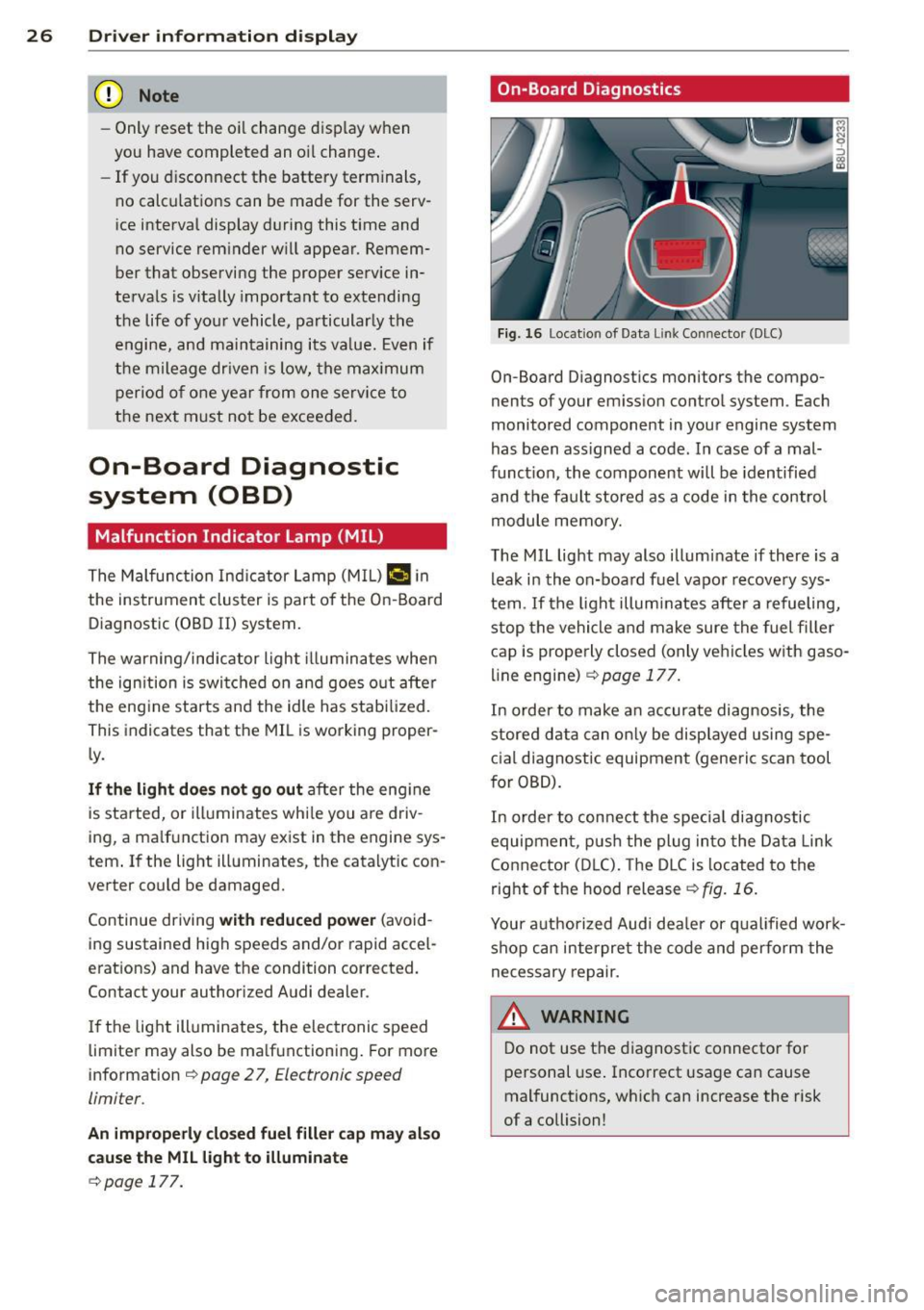
On-Board Diagnostics
Fig. 16 Locat io n of Data Li nk Conn ector (DLC)
On-Board D iagnostics monitors the compo
nents of your em ission contro l system . Each
monitored component in your engine system
has been ass igned a code . In case of a mal
funct ion, the component will be identified
and the fault stored as a code in the control
module memo ry.
The MIL light may also illuminate if there is a lea k in the on-board fuel vapor recove ry sys
tem . If the ligh t illuminates after a refueling,
stop the vehicle and make sure the fuel fille r
cap is prope rly closed (only vehicles w ith gaso
line engine) ¢
page 177.
In order to make a n accurate diagnosis, the
stored data can on ly be displayed using spe
c ial d iagnostic equipment (generic scan tool
for OBD).
In order to con nect t he special diagnostic
equipment, push the plug in to the Data Link
Connector (D LC). The D LC is located to the
right o f the hood release
<::!;> fig. 16.
Your a uthorized Audi dea le r or qua lified wor k
shop can interpret the code and perform the
necessary repair.
,&_ WARNING ~ -
Do not use t he diagnost ic connecto r fo r
personal use . Incorrect usage can cause
mal functions, wh ich can increase the risk
of a collision!
Page 178 of 258
176 Fuel suppl y and fillin g your fu el tank
Many gaso line grades are blended to perform
especially we ll for winter or summer driving.
During seasonal change-over, we suggest that
you fill up at busy gas stations where the sea sonal adjustment is more likely to be made in
time.
@ Note
- Methanol fuels which do not meet these
requirements may cause corrosion and
damage to plastic and rubber compo
nents in the fuel system.
- Do not use fuels that fail to meet the
spec ified criter ia in this chapter .
- If you are unable to determine whether
or not a particular fuel blend meets the
spec ificat ions, ask your service station o r
i ts fuel supplier .
- Do not use fuel for wh ich the contents
cannot be identified .
- Fuel system damage and performance
problems resulting from the use of fuels
different from those specified are not
the respons ibility of Audi and are not
covered under the New Ve hicle or the
Emission Control System Warranties.
- If you experience a loss of fue l economy
or driveabil ity and performance prob
l ems due to the use o f one of these fuel
blends, we recommend that you switch
to unblended fuel.
Gasoline additives
A major concern among many auto manufac
turers is carbon deposit build-up caused by
the type of gasoline you use .
A lthough gasoline grades diffe r from one
manufac turer to another, they have certa in
things in common. All gasoline grades contain
substances that can cause depos its to collect
on vital engine parts, such as fuel injectors
and intake valves . Although most gasoline
b rands include additives to keep eng ine and
fuel systems clean , they are not eq ua lly effec
tive. Audi recommends using
TOP TIER Detergent
Gasoline . For more information on TOP TIER
Detergent Gasoline, please go to the official
website (www.toptiergas .com) .
After an extended period o f using inadeq uate
fuels, built-up carbon deposits can rob your engine of peak performance.
(D Note
- Damage or malfunction due to poor fuel
quality is not covered by the Audi New
Vehicle Limited Warranty .
- Do not add afte rmarket fuel additive
produc ts to your f uel tank .
Fuel tank
Fuel filler neck
The fuel filler neck is located on the right rear
s ide panel behind the fuel filler flap.
If the power locking system should fail, you
can still open the flap manually -for detailed
instruct ions see o page 178.
You can find the fuel tank capacity of your ve
hicle in
o page 235 .
The label on the inside of the f uel fi ller flap
te lls you the correct fue l for your vehicle. For
more information about fue l specifications,
see
c:;, poge 175.
Your vehicle fue l tank has an on -board refuel
ing vapor recovery system . This feature helps
to prevent fuel vapors from escaping from the
tank and pollut ing the environment while you
refuel your vehicle. In order to fill the tank
properly while protecting the environment,
please follow this refueling procedure careful
ly.
.&_ WARNING
Under normal operating cond itions, never
carry addit ional fue l conta iners in your car .
Gas canisters and other conta iners used to
transport f uel can be dangero us. Such con-
tainers, fu ll or empty, may leak and could ..,.
Page 179 of 258

M N M N
0 :::i co
rl I.O
"' rl
"' rl
cause a fire in a co llision. If you must
transport fue l to use for yo ur lawn mowe r,
snow blower, etc., be very careful and al
ways observe local and state laws regard
ing the use, transportat ion and storage of
such fuel containers . Make certain the con
t ainer meets industry standards (ANSI/
AS TM F 852 -86).
(D Note
Never drive yo ur vehicle unt il the fuel tank
is completely empty . The irregular supp ly
of fuel can cause misfi ring. Gasoline could
enter the exhaust system and damage the
catalyt ic converte r.
Refueling
Fig. 140 Rig ht rea r veh icle s ide: Opening t he fuel f iller
fl ap
Fi g. 14 1 Fu el filler fla p with attach ed fu el c ap
When activating the central locking, the fuel
f ill er flap is automatically unlocked or locked .
Refue l the vehicle with the ignition turned
off.
Tak ing th e fuel cap off
• Press the left side of the fue l filler flap to
open it ¢
fig . 140 -arrow- .
• Unscrew fuel cap counter-clockwise and
hang it on the fuel f iller flap ¢
fig. 141.
Fuel suppl y and filling your fuel t ank 17 7
Refueling procedure
• Insert the fuel nozzle from the gasoline
pump into the fuel fi ller neck as far as it wi ll
go .
• Select a medium refueling rate so that the
no zz le switches off automatically when the
tank i s full .
Putting th e fuel cap bac k on
• After filling your tank, twist the fuel cap
clockw ise as far as it will go .
• Close the fue l filler flap.
T o avoid fuel spill ing or evaporating from the
fuel tank always close fuel cap properly and
completely . An improper ly closed fuel filler
cap may also cause the MIL lamp ¢
page 26
to come on.
A WARNING
Improper refue ling or handling of fuel can
cause fire, explosion and severe burns.
- Fuel is highly flammable and can cause
severe burns and other injur ies .
- Failure to shut the engine off while refu
eling and/or to insert the pump nozzle
fully into the fuel filler neck could cause
fue l to spray out of filler neck or to over
flow. Fue l spray and overflowing fuel can
cause a fire .
- Never use a ce llu lar telephone while re
fue ling. The electromagnet ic rad iation
can cause sparks that can ignite f uel va
pors and cause a fire.
- Never get back into yo ur vehicle while re
fuel ing.
If in excep tional circumstances
you must get back in your vehicle while refueling, make certain that you close
the door and touch metal to discharge static electricity before touching the fill
er nozzle again . Static electr icity can
cause sparks that can ignite fuel vapors
released during refueling.
- Never smoke or have an open f lame any
where in or near your veh icle when refu
eling or filling a portab le fuel conta iner .
- For your safety, we strongly recommend
that you do not t ravel with a portable
Page 180 of 258
1 78 Fuel supply and filling your fuel tank
fuel container in your vehicle. The con
tainer, full or empty may leak and could
cause a fire, especially in a crash.
- If, under exceptional circumstances, you
must transport a portable fuel container,
please observe the following:
- Never fill a portable fuel container
while it is anywhere in or on the vehicle
(for example, in the luggage compart
ment, or on the trunk). Static electrici
ty can build up while filling and can ig nite fuel vapors causing a fire .
- Always place a portable fuel container
on the ground before filling.
- Always keep the filler nozzle complete
ly inside the portable container before
and during filling.
- If filling a portable container made of
metal, the filler nozzle must always be in contact with the container. This will
help prevent static electricity from dis
charging and cause a fire.
- Never spill fuel inside the vehicle or
luggage compartment. Fuel vapors are
highly flammable.
- Always observe local and state/provin
cial laws regarding the use, storage
and transportation of fuel containers .
- Make certain the fuel container meets
industry standards (ANSI/ ASTM
F8S2 -86) .
d) Note
If any fuel has spilled onto the car, it
should be removed immediately to prevent
damage to the paint .
@ For the sake of the environment
As soon as the correctly operated nozzle
switches off automatically for the first
time, the tank is full. Do not try to add more fuel because fuel may spill out. In
addition, the expansion space in the fuel
tank will be filled -causing the fuel to
overflow when it becomes warm and pol
lute the environment.
(D Tips
- Running your engine while refueling may
cause vapors to escape or even cause
fuel to spill out of the tank. This would
then shut off the fuel nozzle before the
tank is full .
- Do not refuel your vehicle with the igni
tion turned on. The fuel gauge may oth erwise not indicate the correct fuel level
after refueling .
- The fuel filler flap of your vehicle is not
locked when you lock the vehicle from
the inside .
Unlocking the fuel filler flap
by hand
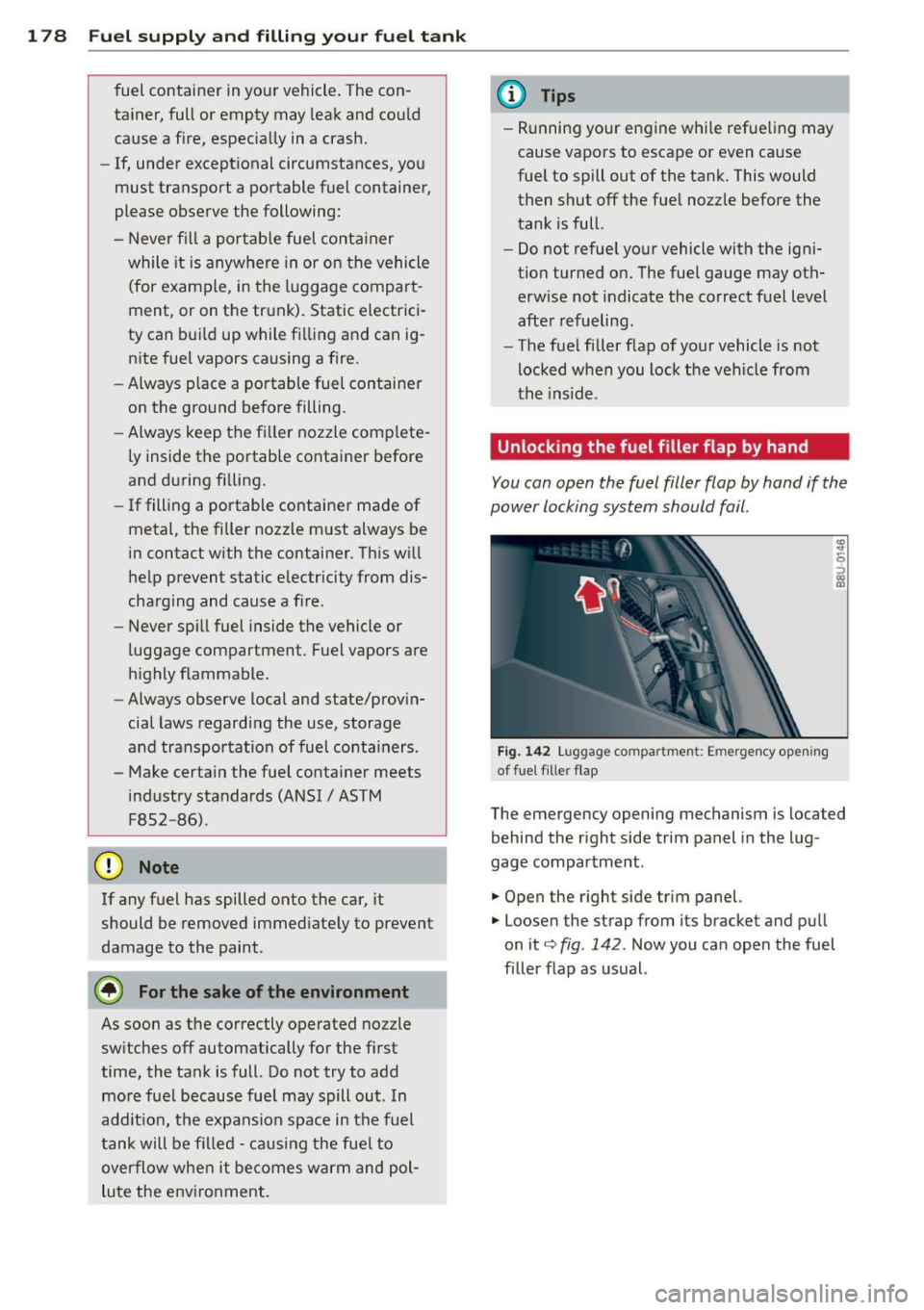
You can open the fuel filler flap by hand if the
power locking system should fail.
Fig. 142 L uggage compart men t: E mergency opening
o f fuel fille r flap
The emergency opening mechanism is located
behind the right side trim panel in the lug
gage compartment .
.,. Open the right side trim panel.
.,. Loosen the strap from its bracket and pull
on it
r::';> fig. 142 . Now you can open the fuel
filler flap as usual.
Page 182 of 258
180 Checking and filling
coolant can be seen or heard before
carefully opening the hood.
- Keep children away from the engine com
partment.
- Never spill fluids on hot engine compo
nents. They can cause a fire.
- Never touch the radiator fan. The auxili ary electric fan is temperature controlled
and can switch on suddenly.
- Never open the coolant reservoir cap
when the engine is still warm. The cool
ant system is pressurized and hot cool
ant could spray out .
- Protect your face, hands and arm from
steam or hot engine coolant by placing a
thick rag over the cap when you open the
coolant reservoir .
- Do not remove the engine cover under
any circumstances. This increases the
risk of burns.
- If work on the fuel system or the electri
cal system is necessary:
- Always disconnect the battery .
- Never smoke or work near heaters or
open flames. Fluids in the engine com
partment could start a fire.
- Keep an approved fire extinguisher im
mediately available.
- To avoid electrical shock and personal in
jury while the engine is running or being
started, never touch:
- Ignition cables
- Other components of the high voltage
electronic ignition system.
- If you must perform a check or repair
with the engine running:
- First, fully apply the parking brake,
move selector lever of automatic trans
mission to "P" (Park) .
-Always use extreme caution to prevent
clothing, jewelry, or long hair from get- ting caught in the
radiator fan, V-belts
or other moving parts, or from contact
ing hot parts. Tie back hair before
starting, and do not wear clothing that
will hang or droop into the engine .
- Minimize exposure to emission and
chemical hazards
c> A .
A WARNING
-California Proposition 65 Warning:
- Engine exhaust, some of its constituents,
and certain vehicle components contain
or emit chemicals known to the State of
California to cause cancer and birth de
fects and reproductive harm. In addition,
certain fluids contained in vehicles and
certain products of component wear con
tain or emit chemicals known to the
State of California to cause cancer and
birth defects or other reproductive harm.
- Battery posts, terminals and related ac
cessories contain lead and lead com
pounds, chemicals known to the State of
California to cause cancer and reproduc
tive harms. Wash hands after handling.
(D Note
When adding fluids, always make sure that
they are poured into the proper container
or filler opening, otherwise serious dam
age to vehicle systems will occur.
@ For the sake of the environment
To detect leaks in time, inspect the vehicle
floor pan from underneath regularly. If
you see spots from oil or other vehicle flu
ids, have your vehicle inspected by an au
thorized Audi dealer.
Page 198 of 258
196 Tire s and wheel s
-Never mount used tires on yo ur vehicle if
yo u are not sure of their "previous histo
ry." Old used tires may have been dam
aged even though the damage cannot be
seen that can lead to sudden t ire failure
and loss of vehicle control.
- If you notice unusual vibration or if the
vehicle pulls to one side when driving, al
ways stop as soon as it is safe to do so
and check the wheels and tires for dam
age.
(D Note
- Please note that summer and winter
tires are designed for the cond itions that
a re typ ica l in those seasons. Aud i recom-
Glossary of tire and loading terminology
Accessory weight
means t he comb ined we ight (in excess of
those sta ndard items wh ich may be rep lace d)
of automa tic transmission, power s teering ,
power brakes, power wi ndows, power seats,
radio, and heater, to the extent that thes e
items are availab le as factory-installed equip
ment (whether ins talled or not) .
Aspect ratio
means the ratio o f the height to the width of
the tire in percent. Numbers of 55 or lower in
d icate a low sidewall for improved steer ing re
sponse and better overall handling on dry
pavement.
Bead
means t he pa rt of the tire that is made of
steel wires, wrapped or reinforced by ply cords
and that is shaped to fit the rim .
Bead separat ion
means a b reakdown of the bond between
components in the bead.
Cord
means the strands forming the plies in the
tire. mends using winter tires during the w
in
ter months. Low temperatures signifi
cantly decrease the elastic ity o f summe r
tires, which affects traction and braking ability . If summer tires are used in very
co ld temperatures, cracks ca n form o n
the tread bars, resu lting in permanent
tire damage that can cause lo ud driving
noise and unbalanced tires. Aud i is no t
responsib le for this type of d amage .
- Burn ished , polished or chromed rims
must not be used in winter road condi
tions. The s urface of the rims does not
have s uff ic ient corrosion protection for
this and could be permanently damaged
by road sa lt o r similar substances .
Cold tire inflation pressure
means the t ire p ress ure recommended by the
vehicle m anufacture r fo r a tire o f a des ign ated
s ize that has not been d riven for more than a
coup le of miles (ki lometers) at low speeds in
the three hour period before the tire p ress ure
is measured or adjusted .
Curb weight
means the we ight of a motor ve hicl e w ith
standard equipment including the maximum
capac ity of fuel, oi l, and coolant, air condi
tion ing and additional weig ht o f optiona l
equipment.
E x tra load tire
means a t ire design to operate at higher loads
and at higher inflation pressures than the cor
responding standa rd tire . Extra load tires may
be identified as "XL", "x l" , "E X TRA LOAD", or
"RF" on the sidewall.
Gross Axle Weight Rating ("GAWR ")
means the load-carrying capa city of a s ingle
axle system, measured at the tire-ground in-
terfaces.
liJJ>
Page 213 of 258
M N
M N
0 ::i co ,...., \!) ..,.,
,...., ..,., ,....,
was manufactured. Please see ¢ page 207,
Speed rating (letter code) for a listing of the
speed rat ing letter codes and the maximum
speed at which the tires can be driven .
The speed rating letter code(¢
page 198) is
on the side wall of the tire
c::> page 206.
A WARNING
Winter tires have maximum speed limits
that may be lower than your vehicle's max
imum speed. Always know the maximum
speed before driving off . Never drive faster
than the speed permitted for your specific
w inte r tires . This will cause damage to the
tires leading to an ac cident and serious
pe rsonal inj ury to you and yo ur passen
gers .
A WARNING
Driving faster than the maximum speed
for which the winter tires on your vehicle
were designed can ca use tire fai lure in
cluding a blowout and sudden deflat ion,
loss of control, crashes and serious per
sonal injuries . Have worn or damaged tires
rep laced immed iate ly.
- Winter tires have maximum speed rat ing
that may be lower than your veh icle's
maximum speed .
- Never drive faster than the speed for
w hich the winter or other tires installed
on your veh icle are rated .
A WARNING
Always adjust your d rivi ng to the road and
traffic conditions. Neve r let the good ac
c eleration of the w inte r ti res and all whee l
drive temp t you in to taking extra r is k s . A l
ways remember:
- When bra king, an a ll whee l dr ive vehicle
hand les in the s ame way as a front drive
vehicle.
- Drive carefu lly and reduce your speed on
icy and slippery roads, even winter tires
cannot he lp under blac k ice conditions.
Tire s an d wheel s 211
'
@) For the sake of the environment
Use summer tires when weather condi
tions permit. They are qu ieter, do not wear
as quickly and reduce fuel consumpt ion.
Snow chains
Snow cha ins may be fitted only to the front
wheels, and o nly to certain tire sizes . Ask your
autho rized Aud i deale r on which tire sizes
snow cha ins can be used .
The snow chains must have low-prof ile links
and must not be th icker than 0.53 inch
(13.5 mm) , includ ing the lock .
Remove wheel center covers and trim discs
before putt ing snow cha ins on your vehicle
c::> Q) . For safety reasons cover caps must then
be fitted over the wheel bolts. These are ava il
able from autho rized Aud i dealers.
A WARNING
Using the wrong snow chai ns for your vehi
cle o r insta lling them incorrect ly can in
crease the risk of loss of cont ro l leading to
serious personal injury.
- Snow chains are available in different
sizes. A lways make sure to follow the in
structions p rov ided by the snow chain
manufacturer.
- When driving with snow chains never
drive faster than the speed permitted for
your specif ic snow chains.
- Always observe local regulations .
(D Note
-Remove snow chains before dr iv ing o n
roads not covered with snow to avoid
damaging tires and wea ring the snow
chains down unnecessarily.
- Snow chains, which come into direct con
tact with the whee l rim , can scratch or
damage it . Therefore, make sure that the
snow chains are suitably covered. Check
the pos ition of the snow chains after
•
•