Fluid AUDI Q3 2016 User Guide
[x] Cancel search | Manufacturer: AUDI, Model Year: 2016, Model line: Q3, Model: AUDI Q3 2016Pages: 252, PDF Size: 62.81 MB
Page 180 of 252
Checking and Filling
-Keep children away from the engine com
partment.
- Never spill fluids on hot engine compo
nents. They can cause a fire.
- Never touch the radiator fan. The auxiliary
electric fan is temperature controlled and
can switch on suddenly.
- Never open the coolant reservoir cap when
the engine is still warm. The coolant system
is pressurized and hot coolant could spray
out.
- Protect your face, hands and arm from steam or hot engine coolant by placing a
thick rag over the cap when you open the
coolant reservoir .
- Do not remove the engine cover under any
circumstances. This increases the risk of
burns .
- If work on the fuel system or the electrical
system is necessary:
-Always disconnect the battery.
- Never smoke or work near heaters or open
flames. Fluids in the engine compartment
could start a fire.
- Keep an approved fire extinguisher imme
diately available.
- To avoid electrical shock and personal injury
while the engine is running or being started,
never touch:
- Ignition cables
- Other components of the high voltage
electronic ignition system.
- If you must perform a check or repair with
the engine running:
- First, fully apply the parking brake, move
selector lever of automatic transmission
to "P" (Park).
- Always use extreme caution to prevent
clothing, jewelry, or long hair from get-
178
ting caught in the radiator fan, V-belts or
other moving parts, or from contacting
hot parts. Tie back hair before starting,
and do not wear clothing that will hang or
droop into the engine.
- Minimize exposure to emission and chemi
cal hazards
c::> & .
A WARNING
California Proposition 65 Warning:
- Engine exhaust, some of its constituents,
and certain vehicle components contain or
emit chemicals known to the State of Cali
fornia to cause cancer and birth defects and
reproductive harm. In addition, certain flu
ids contained in vehicles and certain prod
ucts of component wear contain or emit
chemicals known to the State of California
to cause cancer and birth defects or other
reproductive harm .
- Battery posts, terminals and related acces
sories contain lead and lead compounds,
chemicals known to the State of California
to cause cancer and reproductive harms.
Wash hands after handling.
([) Note
When adding fluids, always make sure that
they are poured into the proper container or
filler opening, otherwise serious damage to
vehicle systems will occur.
@ For the sake of the environment
To detect leaks in time, inspect the vehicle
floor pan from underneath regularly. If you
see spots from oil or other vehicle fluids, have
your vehicle inspected by an authorized Audi dealer .
Page 181 of 252
.... N
c:i ::J CX)
.... I.Cl U"I
N I.Cl ......
Checking and Filling
Engine compartment
Engine compartment overview
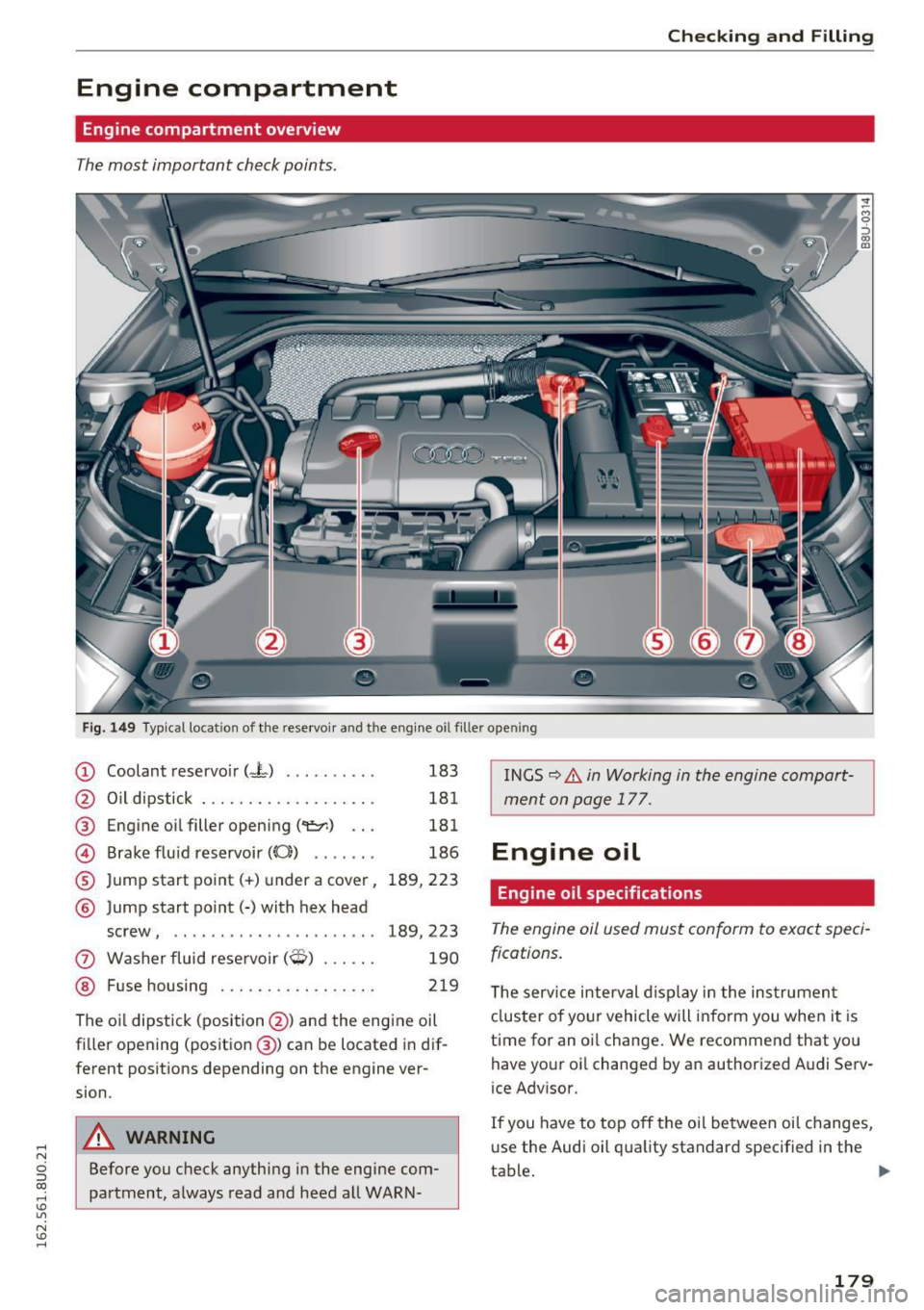
The most important check points.
Fig. 149 Typical location of the reservoir a nd the engine o il fil ler ope ning
(D Coolant reservoir (-L) . . . . . . . . . . 183
@ Oil dipstick . . . . . . . . . . . . . . . . . . . 181
@ Engine oil filler opening ('1!::r.) . . . 181
@ Brake fluid reservoir (0) . . . . . . . 186
® Jump start point(+) under a cover, 189, 223
® Jump start point(-) with hex head
screw, . . . . . . . . . . . . . . . . . . . . . .
189, 223
0 Washer fluid reservoir($) . . . . . . 190
@ Fuse housing . . . . . . . . . . . . . . . . . 219
The oil dipstick (position @) and the engine oil
filler opening (position @) can be located in dif
ferent positions depending on the engine ver
sion.
A WARNING
Before you check anything in the engine com
partment, always read and heed all WARN- INGS
9 .&. in Working in the engine
compart
ment on page 177.
Engine oil
Engine oil specifications
The engine oil used must conform to exact speci
fications.
T he serv ice interval d isplay in the instrument
cluster of your vehicle will inform you when it is
time for an oil change . We recommend that you
have your oil changed by an authorized Audi Serv
ice Advisor.
If you have to top off the oil between oil changes,
us e the Audi oil quality standard specified in the
tab~ .
~
179
Page 185 of 252
Cooling system
Coolant
The engine coolant performs two functions: it
keeps the engine from overheating and it pro
tects the engine from freezing in the winter .
The cooling system is sealed and generally re
quires little attention.
T he cooling system has been filled at the factory
with a permanent coolant which does not need to
be changed . The coolant consists of a mixture of
specially condit ioned water and the manufactur
er's glycol-basedcoolant add itive G 13 antifreeze
with anticorrosion additives (SO% for USA mod
e ls; 60% for Canada models) . This mixt ure bot h
assures the necessary frost protec tion and pro
tects meta l components in the engine's cooling
system from corrosion and scaling . It also raises
the boiling point of the coolant.
D o not red uce the concent ration of the coolant in
the summer by add ing p la in water.
The propor
tion of coolant addit ive mu st be at least 50 %
but not more than 60 %
to mainta in antifreeze
protection and cooling efficiency. If the coolant
frost protection is too low, the coolant could
freeze and damage the vehicle heating and en
g ine cooling system .
For year-round driving, antifree ze is added at the
factory for temperatures down to :
- -31° F(- 3S°C)USA
- -4 0 ° F ( - 40 °C) Can ada.
If you must add coolant, use a m ixture of water
and coolant addit ive. M ixing the coolant additive
with d istilled water is recommended .
_& WARNING
Before you check anythi ng i n t he engine com
partment, a lways read and heed a ll WARN
INGS
¢ .&. in Working in the engine compart
ment on page 177 .
(D Note
-Befo re winter se ts in, have the coo lant
checked to see if the coolant additive in you r
vehicle is sufficient to meet the cl imate con -
Check ing and Filling
ditions. This is especially important if you
live in a region where the winter is extreme
ly cold. If necessary, increase the proportion
of coolant additive to 60%.
- When adding coolant additive to your cool
ing system, remember :
- We recommend us ing only coolant add i
tive G12+ + or G13 fo r yo ur vehicle. This
coolant addit ive is avai lab le a t aut horized
A udi dealers . O ther types of antifree ze can
significantly reduce corrosion pro tect ion .
The resulting corrosion can cause a loss of
coolant and serious engine damage.
- Do not add any type of radiator leak sealant
to your vehicle's engine coolant. Adding ra
diator repair fluid may adversely affect the
function and performance of your cooling system and cou ld resu lt in damage not cov
ered by your New Veh icle Limited Warra nty .
Checking the engine coolant level
The engine coolant level can be checked with a
quick glance.
Fi g. 1 52 Engin e compar tmen t: Cover o n the coo la n t ex
pans ion tank
.. Before you check anything in the eng ine com
partment,
always r ead and h eed all WARN
INGS ¢ ,A in Working in the engine compart
ment on page 177 .
.. Par k your veh icle on a leve l sur face.
.. Tur n off t he ignit io n .
.. Read the eng ine coolan t leve l from the coo lant
expansion tank
¢ fig . 15 2, ¢ page 179,
fig. 149 .
With a cold engine, the coo lant level
should be b etween the "MIN" and "MAX" mark
ings. When the eng ine is warm, the level may
be slightly above the "MAX" marking. .,..
183
Page 186 of 252
Check ing and F illing
The location of the coolant expansion tank can be
seen in the engine compartment illustration
c::> page 179.
To obtain an accura te reading, the eng ine must
be switched off .
The expans io n tank in your vehicle is equipped
with a n elec tric coolant level sensor.
When the coolant level is too low, the war ning
lig ht in the Auto-Check System
c::> page 14 will
blin k until you add coo la nt and the level has bee n
restored to normal. Even t hou gh the re is an e lec
tr ic coolant level sensor, we still re commend you
check the coo lant level from time to time .
Coolant loss
Coolant loss may indicate a leak in the cooling
system. I n the event of coolant loss, the cooling
system should be inspected immediately by your
author ized Audi dealer. It is not enough me rely
to add coolant.
I n a
se aled system, losses can occur only if the
boi ling point of the coo lant is ex ceeded as a re
sul t of over heat ing.
A WARNING
T he cooling system is unde r pressure and can
get very hot . Red uce the risk of scalding from
hot coolant by following these steps.
- Turn off the eng ine and a llow it to cool
down .
- Protect your face, hands and arms from es
caping fluid and steam by cove ring the ca p
with a la rge, thick rag.
- Turn the cap s lowly and very ca refu lly in a
counter-clockwise direction w hile ap ply ing
light, downwa rd pressure o n the top of the
cap.
- To avo id being burned, do not sp ill anti
freeze or coolant on the exha ust system or
hot eng ine parts. Under certain conditions,
the ethy lene g lycol in e ngine coolant can
catch fire.
(D Note
Do not add any type of radiato r leak sealant
to your veh icle's engine coolant. Adding radia-
184
tor repair fluid may a dverse ly affect the func
tion and performance of your coo ling system
and could result in damage not covered by
your New Vehicle Limited Warranty.
Adding coolant
Be very careful when adding engine coolant.
Befo re yo u check any thing in the engine compart
ment,
always read and heed all WARNINGS
c::>
A in Working in the engine compartment on
page 177.
Requireme nt: The re mus t be a res idual amo unt
of coolant in the expans ion tank
c::> (D .
""Tur n off t he engine .
"" Let the eng ine cool down.
"" Pla ce a thick rag over the coolan t ex pan sio n
tank
c::> page 183, fig. 152 and carefull y turn
the cap counter-clockwise
c::> ,&. .
""Add coolant m ixed in the cor rect rat io
c::>page 183, Coolant up to the MAX ma rking.
"" Make sure that the fluid level remains stab le.
Add more coolant if necessa ry .
"" Twis t the cap o n aga in
tightly.
Replacement eng ine coolant must conform to ex
act specifications
c::> page 183, Coolant.
We recommend using only coo lant ad ditive G 12+
+ , G13 or in an emergency G12+. Do
not use a
different additive. In an emergency use plain wa
te r unt il you can get the cor rect addit ive and ca n
r esto re the cor rect rat io. Thi s should be done as
soon as possib le.
If you have lost a considerable amount of coo l
an t, then you s hou ld add co ld a ntifreeze and cold
water only whe n the engine is co ld.
A lways use
new engine coo lant when ref illing.
Do no t fill c oolant above the "MAX" mark . Excess
coolant will be forced out th rough the pressure
r elief valve in the cap when the engine becomes
hot.
~
Page 187 of 252
A WARNING ,~
- The cooling system is under pressure and
can get very hot. Reduce the risk of scald ing
from hot coolant by following these steps.
- Turn
off the engine and allow it to coo l
down.
- Protect you r face, hands and arms from
escaping fluid and steam by cover ing the
cap with a large, thick rag.
- Turn the cap slowly and very carefully in a
counter-clockwise d irection while applying
light, downward p ressure on the top of
the cap.
- To avoid being burned, do not spill anti
freeze or coolant on the exhaust system or
hot engine parts. Under certa in cond i
tions, the ethylene glycol in eng ine cool
ant can catch fire.
- Antifreeze is poisonous. Always store anti
freeze in its orig inal container and well out
of the reach of children.
- If you dra in the coolant, it must be caught
and safely stored in a proper conta iner
clearly marked "poison".
- Do not add coolant if the expansion tank is
empty. Air cou ld enter the cooling system
and damage the eng ine. If this is the case,
do not continue driving . Seek professional
ass istance.
- Coolant pollutes the env ironment and could
cause an eng ine fire. Excess coolant will be
fo rced o ut through the pressure relief valve
i n the cap when the e ng ine be comes hot.
- If, in an emergency, only wate r can be add
ed, the co rrect r atio betwee n wate r and an
tifree ze
Q page 183 must be res to red as
soon as possib le.
{® For the sake of the environment
Dra ined coolant sho uld not be reused. Always
disp ose of used coolant while obse rving all
....
"' environment al regulat ions. ci ::, co ....
Ch eck ing and Filling
Rad iator fan
The radiator fan switches on automatically by it
self .
The radiator fan is driven by the engine via the V
belt. The viscous clutch regulates th e speed of
the fan accord ing to the temperature of the cool
ant .
An auxiliary e lectr ic radiator fan* switches on and
off depending on coo lant temperature and other
vehicle operating conditions.
After you switch the engine
off, the auxiliary fan
can continue running for up to 10 m inutes -even
with the ignition
off. It can even switch on aga in
later by itself
Q .& , if
- the temperature of the engine coolant rises due
to the heat build-up from the engine in the en
gine compartment, or
- the engine compartment heats up beca use the
veh icle is parked in intense sunlight.
A WARNING
- To reduce the r isk of persona l injury neve r
touch the radia to r fan .
- The auxiliary e lectr ic fan is temperature
controlled and can switch on s uddenly even
when the engine is not ru nning .
- The a uxiliary radiator fan sw itches on auto
mat ically when the eng ine coolant reaches a
certa in temperature a nd will continue to run
until the coolant temperature d rops.
185
Page 188 of 252
Checking and Filling
Brake fluid
Checking brake fluid level
The brake fluid level can be checked with a quick
glance.
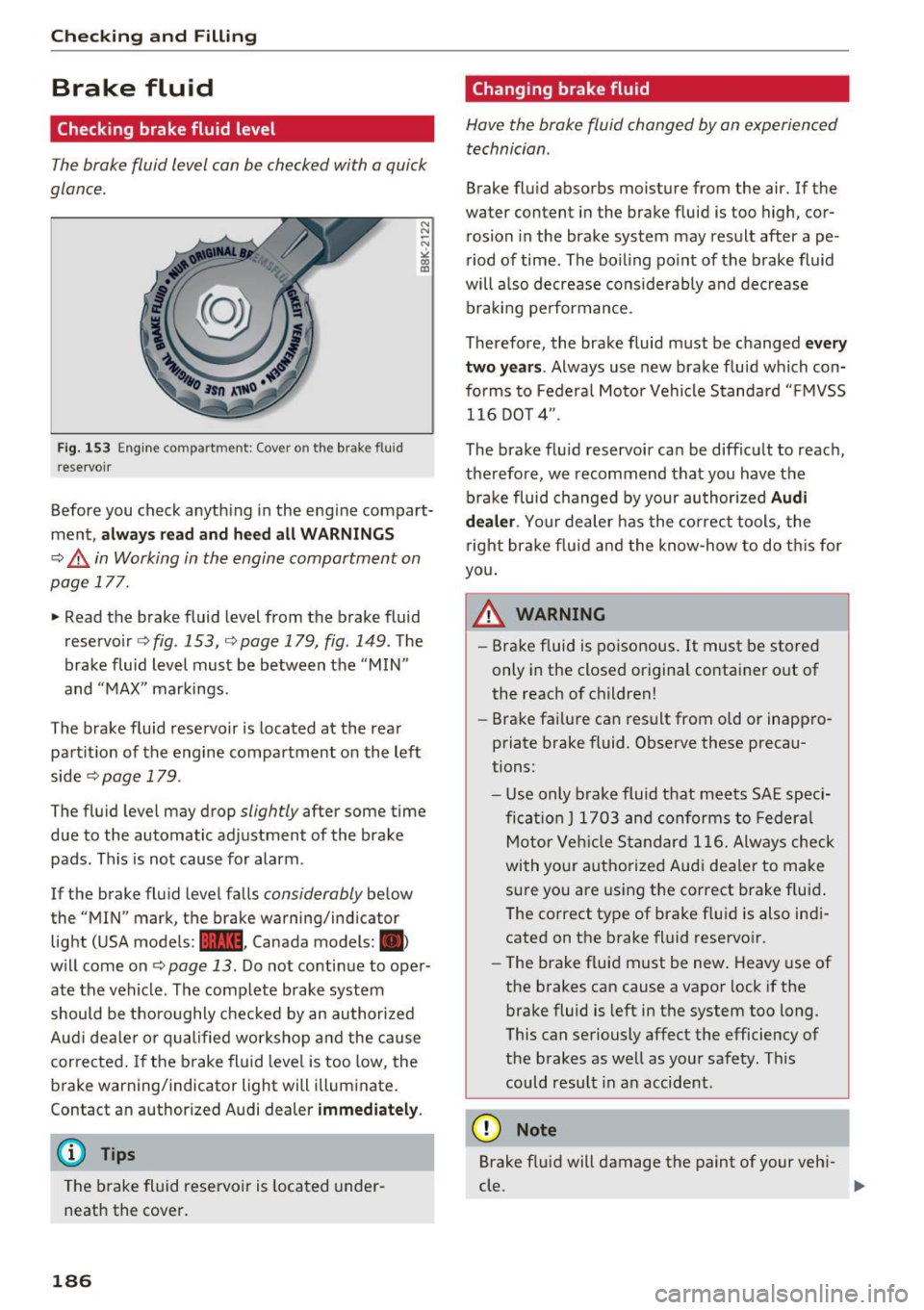
Fig. 153 Eng ine compartment: Cover on the brake fluid
r eservoir
Before you check anything in the engine compart
ment,
always read and heed all WARNINGS
¢ A in Working in the engine compartment on
page 177.
., Read the brake fluid level from the brake fluid
reservoir
<=> fig . 153, ¢page 179, fig . 149 . The
brake fluid level must be between the
" MIN"
and "MAX " markings.
The brake fluid reservoir is located at the rear
partition of the engine compartment on the left
side ¢
page 179 .
The fluid level may drop slightly after some time
due to the automatic adjustment of the brake
pads . This is not cause for alarm .
If the brake fluid level falls
considerably below
the ' 'MIN" mark, the brake warning/indicator
light (USA models:
1111 , Canada models:. )
will come on¢
page 13 . Do not continue to oper
ate the vehicle . The complete brake system
should be thoroughly checked by an authorized
Aud i dealer or qualified workshop and the cause
corrected. If the brake fluid level is too low, the
brake warning/indicator light w ill illuminate.
Contact an author ized Audi dealer
immediately.
(D} Tips
The brake fluid reservoir is located under
neath the cover.
186
Changing brake fluid
Have the brake fluid changed by an experienced
technician .
Brake fluid absorbs moisture from the air. If the
water content in the brake fluid is too high, cor
rosion in the brake system may result after ape
riod of time . The boiling po int of the brake fluid
will a lso decrease considerably and decrease
braking performance.
Therefore , the brake fluid must be changed
every
two years .
Always use new brake fluid which con
forms to Feder-al Motor Vehicle Standard "FMVSS
116 DOT 4 ".
The brake fluid reservoir can be difficult to reach ,
therefore, we recommend that you have the
brake fluid changed by your author ized
Audi
dealer .
Your dealer has the correct tools, the
right brake fluid and the know-how to do this for
you.
A WARNING
- Brake fluid is poisonous. It must be stored
only in the closed original container out of
the reach of children!
- Brake fai lure can result from o ld or inappro
priate brake fluid. Observe these precau
tions:
- Use only brake fluid that meets SAE speci
fi cation
J 1703 and conforms to Federal
Motor Veh icle Standard 116. Always check
with your authorized Audi dealer to make
sure you are using the correct brake fluid .
The correct type of brake f luid is also indi
cated on the brake fluid reservoir.
- The brake fluid must be new . Heavy use of
the brakes can cause a vapor lock if the
brake fluid is left in the system too long .
This can seriously affect the efficiency of
the brakes as well as your safety. This
could result in an accident.
(D Note
Brake fluid will damage the paint of your vehi-
cle .
lilJJ,
Page 189 of 252
@ For the sake of the environment
Because of the problem of proper disposal of
brake fluid as we ll as the special toots re
quired and the necessary expertise, we rec
ommend that you have the brake fluid
changed by your authorized Audi dealer .
Battery
General information
Under normal operating conditions, the battery
in your Audi does not need any maintenance.
With
high outside temperatures or long daily
drives we recommend that you have the electro
lyte level checked by an authorized Audi dealer or
qualified workshop. The electrolyte level should
also be checked each time the battery is charged
c> page 189.
Have the battery checked when you take your ve
hicle in for serv ice. You are well advised to re
place a battery t hat is older than 5 years.
With certain types of airbag deployment, the battery is disconnected from the vehicle electri
cal system for safety reasons
c> & in Repair, care
and disposal of the airbags on page 125 .
Disconnecting the battery terminals
Some vehicle functions (power window regula
tors, for example) are lost if the battery termi nals are disconnected. These functions have to be
relearned after the battery terminals are con
nected again. To prevent th is, the battery should
only be disconnected from the vehicle e lectr ica l
system when abso lutely necessary for repairs.
Vehicles not driven for long periods
If you do not drive your vehicle over a period of
several days or weeks, electrical components are
gradually cut back or sw itched off. This reduces
energy consumption and maintains starting ca
pability over a longer pe riod
c> page 157.
Some of the conven ience functions may not oper
ate, such as the interior lights or the power seat
adjustment. The convenience functions will be
available again when you turn on the ignition and
start the engine.
Checking and Filling
Winter operation
During the winter months, battery capacity tends
to decrease as temperatures drop . This is be
cause more power is also consumed while start
ing, and the headlights, rear window defogger,
etc., are used more often.
Avo id unnecessary power consumption, particu
larly in city traffic or when traveling only short
distances . Let your authorized Audi dealer check
the capacity of the vehicle battery before winter
sets in
c> page 189. A well charged battery will
not only prevent starting problems when the
weather is cold, but will also last longer .
(D Tips
If your vehicle is left standing for several
weeks at extremely low temperatures, the ve
hicle battery should be removed and stored
where it w ill not freeze. This will prevent it
from be ing damaged and having to be re
placed.
Working on the battery
Be especially careful when working on or near
the battery.
The battery is located in the engine compart
ment . Before you check anything in the engine
compartment ,
read and heed all WARNINGS
c>,& ,
Always heed the safety warnings, when working
on the vehicle battery or the veh icle electrical
system to prevent injury.
The following WARNINGS are very important
when working on the battery:
Always heed the following WARNING SYM·
BOLS and safety precautions when working on
the battery.
®
Always wear eye protection.
A
Battery acid contains sulfuric acid. Al-
ways wear gloves and eye protection .
187
Page 192 of 252
Check ing and F illing
CJ) Note
Never use a fast charger as a booster to start
the engine . This will serious ly damage sensi
tive electronic components, such as control
units, relays, radio, etc., as well as the battery
charger.
Battery replacement
The new battery must have the same specifica
tions and dimensions as the original equipment
battery .
Intelligent energy management in your vehicle is
responsible for distributing the electrical energy
throughout your vehicle
¢ page 157. The intelli
gent energy management system wi ll keep the
engine battery charged better then veh icles w ith
out this system. To make sure the addit ional
e lectrica l energy is available once again after you
have changed the battery, we recommend that
you install batteries of the same type and manu
facture only (the same as those installed at the
time your veh icle was delivered). Specifications
are listed on the battery housing. Your author
ized Audi dealer must code the battery in the en
ergy management system to enable you to use
the energy manageme nt functions correctly after
replacing the battery.
If it is not possible to use a battery of this type,
the new battery must have the same capacity,
voltage (12-volts), amperage, construction and p lug sealing.
When installing the battery, make sure the igni
tion and all electrical consumers are turned off.
@ Note
Make sure the ventilation hose on the side of
the battery is connected, otherw ise fumes or
battery acid can leak out.
@ For the sake of the environment
Because of the problem of proper disposal of
a battery, we recommend your authorized
Audi dea ler change the battery for you. Bat
teries contain sulfuric ac id and lead and must
always be disposed of properly in compliance
190
with all environmenta l regulations. Disposing
of vehicle batteries improperly is very danger
ous to the environment.
Windshield washer system
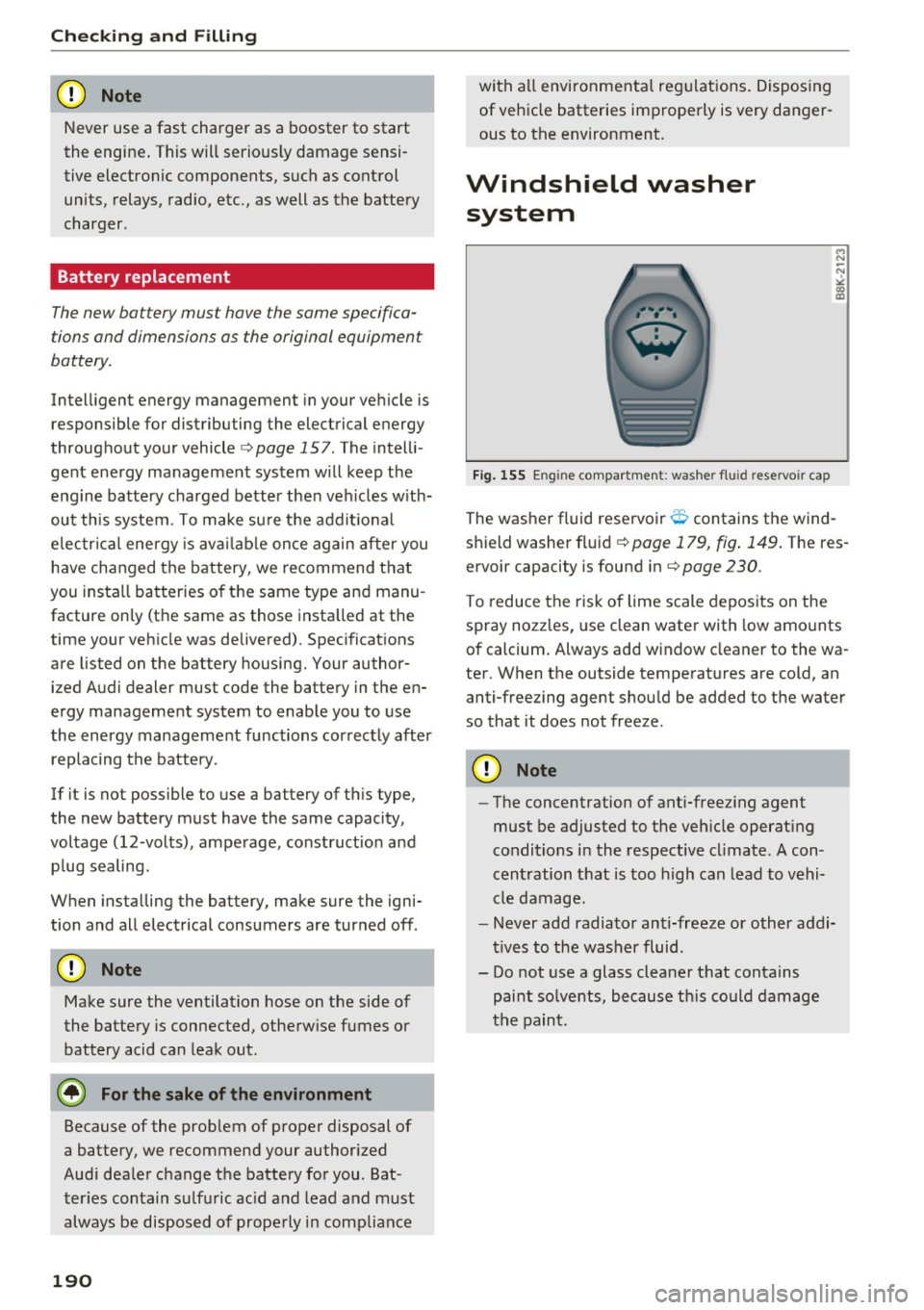
Fig. 155 Eng ine compartment: washe r fluid reservoir cap
M N
-N ,.:
"' m
The washer fluid reservoir O contains the wind
shield washer flui d¢
page 179, fig. 149. The res
ervoir capacity is found in
¢ page 230.
To reduce the risk of lime scale depos its on the
spray nozzles, use clean water with low amounts
of calcium . Always add window cleaner to the wa
ter. When the outside temperatures are cold, an
anti-freez ing agent shou ld be added to t he water
so that it does not freeze .
(D Note
-The concentration of anti-freezing agent
must be adjusted to the vehicle operating
conditions in the respective climate. A con
centration that is too high can lead to vehi
cle damage.
- Never add radiator anti-freeze or other addi
t ives to the washer fluid.
- Do not use a glass cleaner that contains
paint solvents, because th is could damage
the paint.
Page 205 of 252
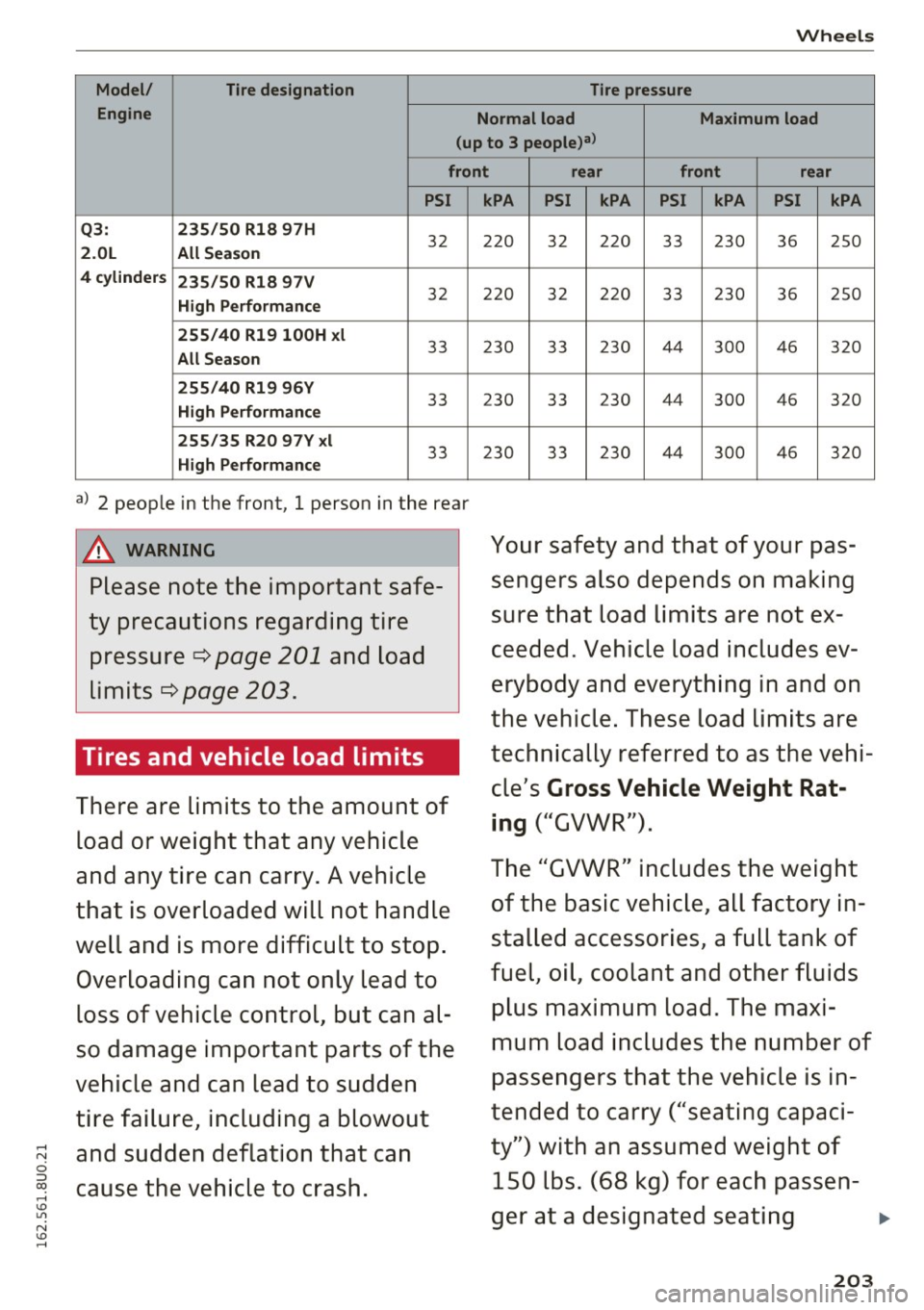
Wheels
Model/ Tire designation Tire pressure
Engine Normal load Maximum load
(up to 3 people)a>
front rear front rear
PSI
Q3: 235/50 Rl8 97H
2.0L All Season
32
4 cylinders
235/50 Rl8 97V
High Performance
32
255/40 Rl9 l00H xl
All Season
33
255/40 Rl9 96Y
High Performance
33
255/35 R20 97Y xl
High Performance
33
a) 2 people in the front , 1 person in the re ar
A WARNING
-
Please note the important safe-
ty precautions regarding tire
pressure
c=> page 201 and load
limits ¢
page 203.
Tires and vehicle load limits
There are limits to the amount of
load or weight that any vehicle
and any tire can carry. A vehicle
that is overloaded will not handle
well and is more difficult to stop.
Overloading can not only lead to
loss of vehicle control, but can al
so damage important parts of the
vehicle and can lead to sudden
tire failure, including a blowout
and sudden deflation that can
cause the vehicle to crash.
kPA PSI kPA PSI kPA PSI kPA
220 32 220 3 3 23 0 36 2 50
220 32 220 33 230 36 250
230 33 230 44 300 46 320
2 30 33 230 44
300 46
320
230 33 230 44 300 46 320
Your safety and that of your pas
sengers also depends on making
sure that load limits are not ex
ceeded. Vehicle load includes ev
erybody and everything in and on
the vehicle. These load limits are
technically referred to as the vehi
cle's
Gross Vehicle Weight Rat
ing
("GVWR").
The "GVWR" includes the weight
of the basic vehicle, all factory in
stalled accessories, a full tank of
fuel, oil, coolant and other fluids
plus maximum load. The maxi
mum load includes the number of
passengers that the vehicle is in
tended to carry ("seating capaci
ty") with an assumed weight of
150 lbs. (68 kg) for each passen-
ger at a designated seating
11--
203
Page 223 of 252
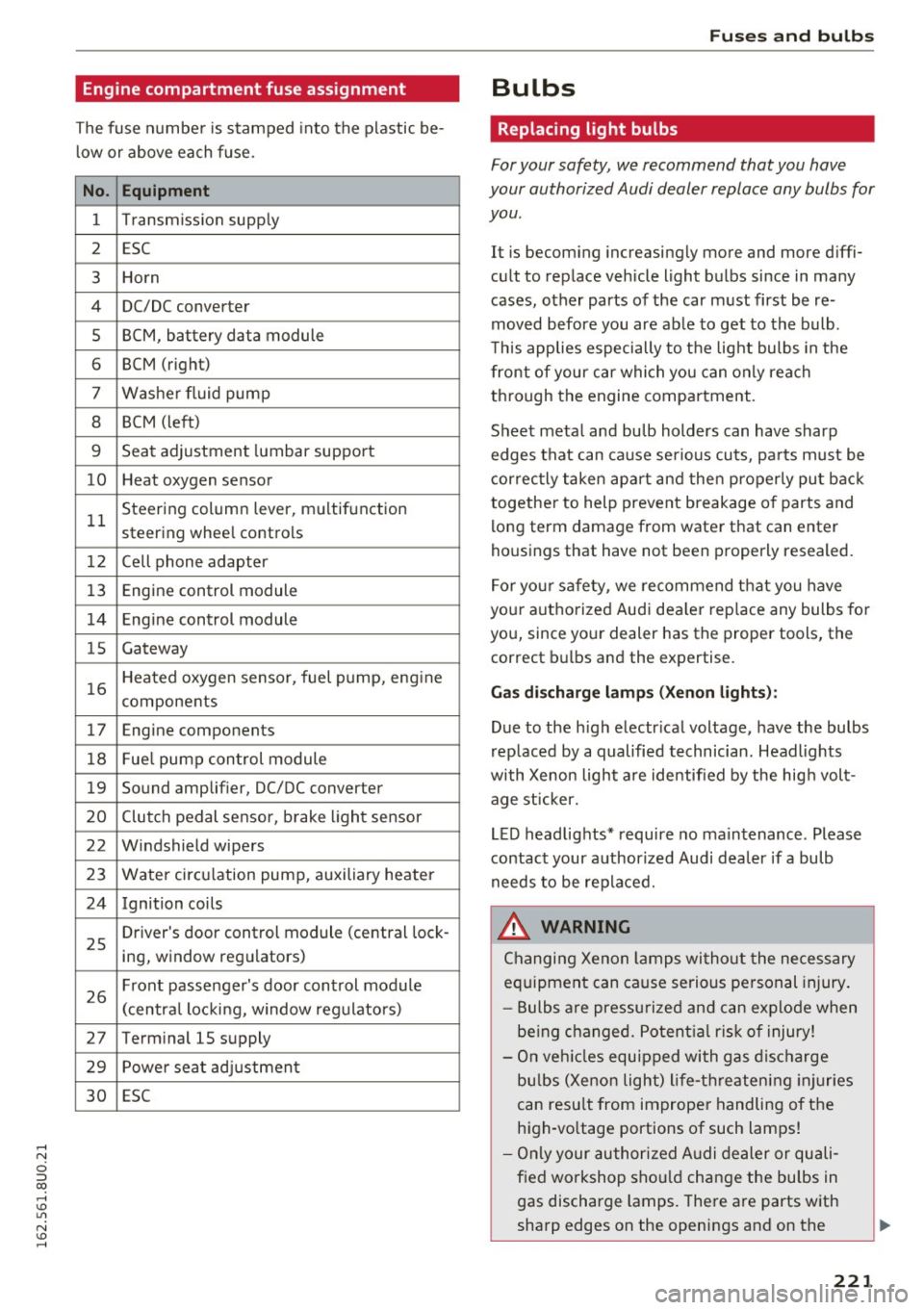
Engine compartment fuse assignment
The fuse number is stamped into the plastic be
low or above each fuse.
No. Equipment
1 Transmiss ion supply
2 ESC
3 Horn
4 DC/DC
converter
5 BCM, battery data module
6 BCM (right)
7 Washer fluid pump
8 BCM (left)
9 Seat adjustment lumbar support
10 Heat oxygen sensor
11 Steering
column lever, multifunction
steering wheel contro ls
1 2 Cell phone adapter
13 Engine control
module
14 Engine control module
15 Gateway
16 Heated oxygen sensor, fuel pump,
engine
components
17 Engine components
18 Fue l pump control module
19 Sound
amplifier, DC/DC converter
20 Clutch pedal sensor, brake light sensor
22 Windshield wipers
23 Water circu
lation pump, auxiliary heater
24 Ignition coils
25 Driver's door
control module (central lock-
ing, window regu lators)
26 Front
passenger's door control module
(centra l locki ng, window reg ulators)
27 Terminal 15 supply
29 Powe r seat adjustment
30 ESC
Fuses an d bulb s
Bulbs
Replacing light bulbs
For your safety, we recommend that you have
your authorized Audi dealer replace any bulbs for
you .
It is becoming increasingly more and more diffi
cult to replace vehicle light bulbs since in many
cases, other parts of the car m ust first be re
moved before you are able to get to the bulb .
T his applies especially to the light bulbs in the
front of your car which you can only reach
through the engine compartment .
Sheet metal and bu lb holders can have sharp
edges that can cause serious cuts, pa rts must be
correctly taken apart and then properly put back
together to help prevent breakage o f parts and
long term damage from water that can enter
housings that have not been properly resealed.
For your safety, we recommend t hat you have
your authorized Aud i dea le r rep lace any bulbs fo r
you, since your dealer has the proper tools, the
correct bulbs and the expertise.
Gas di schar ge la mps (Xe no n light s):
Due to the high electr ical voltage, have the bulbs
rep laced by a qualified technician. Headlights
with Xenon light are identified by the hig h volt
age st icker.
LED headlights* require no maintenance . Please
contact your authorized Audi dea ler if a bulb
needs to be replaced.
_&. WARNING
Changing Xenon lamps wi thout the necessary
equipment can cause serious personal injury .
- Bulbs are pressu rized and can explode when
be ing changed. Potent ial ris k of injury!
- On veh icles equipped with gas disc harge
bu lbs (Xenon light) life-threatening injuries
can resu lt from improper handling of the
high-vo ltage portions of such lamps!
- Only your authorized A udi dealer or quali
fied workshop sho uld change the bulbs in
gas discharge lamps. There are parts with
sharp edges on the openings and on the
221