check engine AUDI Q3 2016 User Guide
[x] Cancel search | Manufacturer: AUDI, Model Year: 2016, Model line: Q3, Model: AUDI Q3 2016Pages: 252, PDF Size: 62.81 MB
Page 86 of 252
Automatic transmissio n
Stopp ing temporarily
.,. Press the b rake peda l to stop the vehicle, fo r
example at a traffic light. Do not press the ac
ce lerator peda l when doing this.
... To prevent the vehicle from rolling when you
start driving, set the parking brake when stop
ping on steep inclines ¢
,&..
.,. The park ing brake w il l release automatically
and the vehicle will start moving once you press
the accelerator pedal.
Stopp ing /park ing
If the selector lever is not in the P posit ion when
you open the driver's door, the vehicle could roll.
The message
S hift to P and turn off ign it ion ,
otherwi se vehicle can roll awa y
appears.
.,. Press and hold the brake pedal
c> ,&. .
.,. Set the parking brake.
.,. To engage the P selector lever posit ion, press
the button on the selector lever and sh ift into
the P position
i:> page 82.
Stopp ing on an incline
.,. Always press the brake peda l to hold the vehi
cle in place and prevent it from "rolling back"
c> ,&. . Do not try to prevent the vehicle from
"ro lling back" when a gear is engaged by in
c reasing the eng ine speed
i:> 0.
Starting on a hill
.,. Set the parking brake.
.,. Se lect the D posit ion .
.,. Press t he accelerator pedal carefully . If you r
safety belt is fastened, the pa rking brake is au
tomat ica lly released a nd your ve hicle beg ins to
move .
Unde r ce rtain c ircumstances, such as driv ing in
the mountains, it may be usef ul to sw itch tempo
rarily to the manua l shift program in o rde r to ad
just the gea rs to the d riving conditions by hand
i:>page 85 .
On inclines, act ivate the park ing brake first and
then move the se lector lever to the P pos it ion
c>page 72. This prevents the lo cking mechanism
from being loaded too heav ily and w ill make i t
easier to move the se lec tor lever out of the P po
sition.
84
A WARNING
- The vehicle can also ro ll when the eng ine is
stopped.
- Unintended vehicle movement can cause se
rious injury.
- Never leave your veh icle with the engine
running while in gear. If you must leave
your veh icle w hen the engine is r unning, ac
tivate t he pa rking brake a nd move the selec
tor lever to P .
- Power is still transmitted to the wheels
when the engine is running at idle . To p re
vent the vehicle from "creeping", yo u m ust
keep your foo t on t he b rake when the en
g in e is ru nning and the selector lever is in D/
Sor R or "tiptronic" mode is se lected .
- Do not press the a cce le ra to r peda l when
changing the se lec to r l ever posi tion while
the vehicle is s ta tionary and the engine is
r u nning .
- Never sh ift into R or P whi le driving.
- Before d riving down a s teep sl ope, redu ce
your spee d and sh ift into a lower gea r w ith
"t i ptronic" .
- Do not ride the brakes or press the bra ke
pedal too of ten o r too long when dr iv ing
down a hi ll. Constant braking ca uses the
brakes to ove rheat and substantially re
duces brak ing performance, increases b rak
ing d istance or causes comp lete failure of
the brake system.
- To prevent the veh icle from rol ling back
when stopp ing on inclines, always hold it in
place with the brake peda l or park ing brake .
- Never hold the vehicle on an incline with a
slipping clutch. The clutch opens automati
cally when it becomes too hot from the
overload. An ind icator lam p. illumina tes
and a dr iver message appears¢
page 86
w hen t he clu tch is overloade d.
- If the e ngine must rema in running, never
have a ny driving posi tion engaged when
checking unde r th e hood. Make s ure these
lec to r l ever has secu rely eng aged an d is
loc ked in P with the parking b rake set
Page 156 of 252
Intelligent Technology
When the hill descent assist is on, the current
driving speed, when your vehicle entered the in
cline is maintained. It is only possible to switch
on the assist when driving slower than 37 mph (60 km/h). The assist works between approxi
mately 2 and 19 mph (4 and 30 km/h). The driver
can increase or decrease the vehicle speed within
these limits by depressing the accelerator or brake pedal.
There must be however sufficient ground adhe
sion . The hill descent assist
cannot do its job if
the incline is icy or if the incline ground is loose
¢ ,&.
Active assistance at a specific speed up to about 19 mph (30 km/h) is shown in the instrument
cluster through a blinking indicator light •. The
indicator light shines continuously when in the
ready mode.
The system does not work at speeds between 19
and 37 mph (30 and 60 km/h) . The system is
then in the ready-mode. This is shown through
the LED turned on in the button . The system au
tomatically switched off when you drive faster
than 37 mph (60 km/h). The LED will also go out
in this scenario.
Hill descent assist is automatically activated un
der the following conditions:
- The LED in the button turns on ,
- the vehicle speed is lower than 19 mph (30 km/
h) ,
-the incline angle is at least around 10% .
A WARNING
-Always adapt your speed to the weather ,
road and traffic conditions . Do not let the
increased safety provided tempt you into
taking risks, because this increases the risk
of an accident.
- The hill descent assist system cannot over
come the laws of physics. Your driving style
must always be adapted to the current road
and traffic conditions.
- The hill descent assist may not be able to
hold your vehicle at a constant speed under
all conditions while driving on an incline (for
154
example if ground under the vehicle is
loose).
Brakes
New brake pads
New brake pads do not achieve their full braking
effect during the first
250 mi (400 km). They
must be "broken in" first¢& . However, you can
compensate for the slightly reduced braking
force by pressing firmly on the brake pedal. Avoid heavy braking during the break-in period.
Operating conditions and driving habits
The brakes on today's automobiles are still sub
ject to wear, depending largely on operating con
ditions and driving habits¢,& . On vehicles that
are either driven mostly in stop-and-go city traf
fic or are driven hard, the brake pads should be checked by your authorized Audi dealer more of
ten than specified in the
Warranty & Mainte
nance booklet.
Failure to have your brake pads
inspected can result in reduced brake perform
ance.
On steep slopes, you should use the braking ef
fect of the engine. This way, you prevent unnec
essary wear on the brake system. If you must use
your brakes, do not hold the brakes down contin
uously. Pump the brakes at intervals.
Operating noise
Noises may occur when braking depending on the
speed, braking force and outside conditions such
as temperature and humidity.
Effect of water or road salt
In certain situations, for example after driving
through water, in heavy rain, after overnight con densation or after washing your car , the braking
effect can be reduced by moisture or ice on the
brake rotors and brake pads. The brakes must be
"dried" first with a few careful brake applica
tions.
At higher speeds and with the windshield wipers
turned on, the brake pads press against the brake
rotors for a short amount of time. This action
which is not felt by the driver happens at regular .,.
Page 167 of 252
Operating instructions
6" r-2
~·~
1/2"
1·1/2"
ill
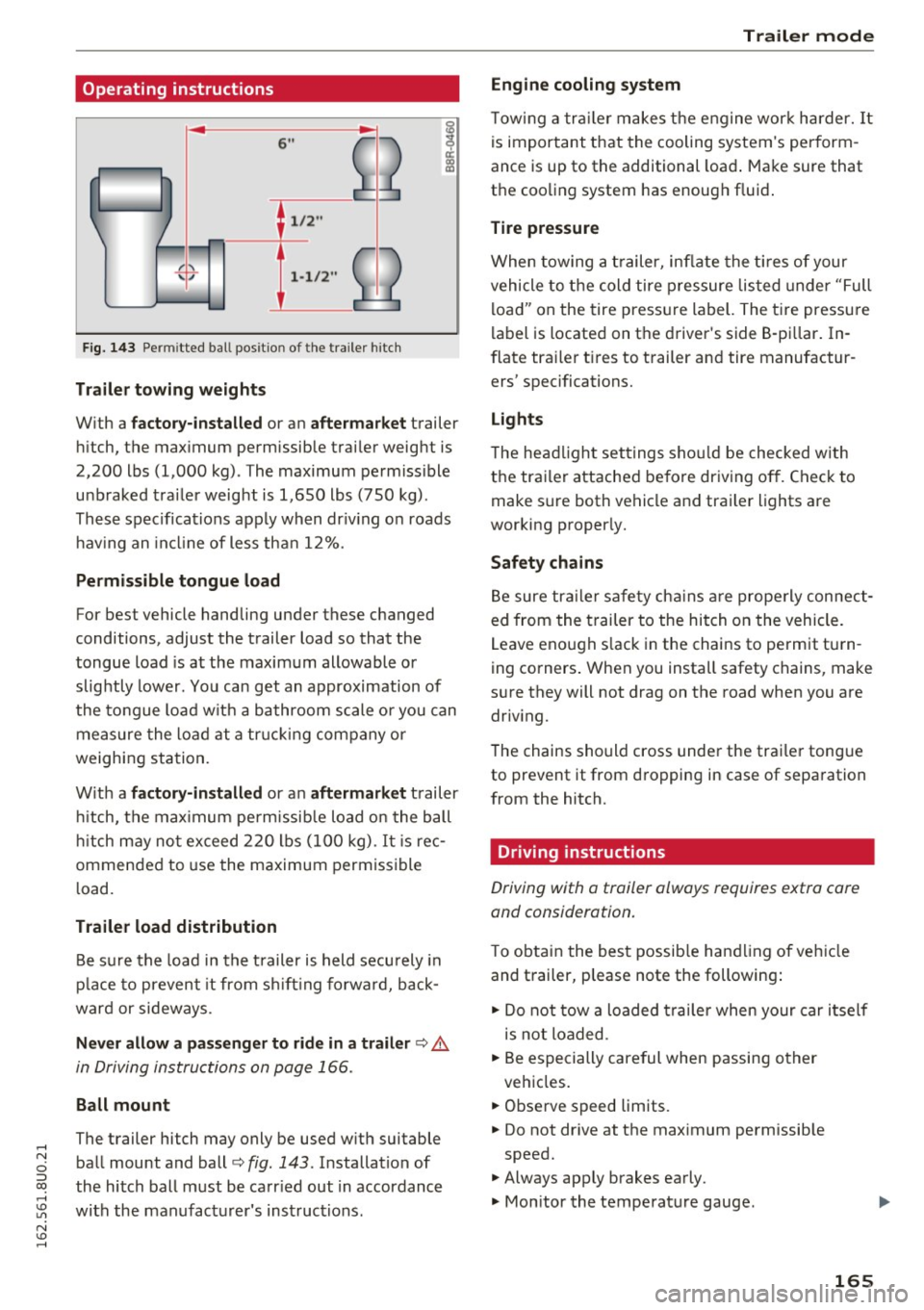
Fig. 143 Permitted ball pos ition of the trailer hitch
Trailer towing weights
With a
factory-installed or an aftermarket trailer
hitch, the maximum permissib le trailer weight is
2,200 lbs (1,000 kg). The maximum permiss ible
unbraked trailer weight is 1,650 lbs (750 kg).
These specifications apply when dr iv ing on roads
h av ing an incl ine of less than 12%.
Permissible tongue load
For best vehicle handling under these changed
conditions, adjust the trailer load so that the
tongue load is at the maximum allowable or
slightly lower. You can get an approximation of
the tongue load w ith a bathroom scale o r you can
measure the load at a trucking company or
weighing station.
With a
factory-installed or an aftermarket trailer
hit ch, the maximum permissib le load on the ball
hitch may not exceed 220 lbs (100 kg).
It is rec
ommended to use the maximum permissible
l oad.
Trailer load distribution Be sure the load in the trailer is held securely in
place to prevent it from s hiftin g forward, back
ward or sideways.
Never allow a passenger to ride in a trailer ¢.&.
in Driving instructions on page 166.
Ball mount
The trailer hitch may only be used w ith suitable
ball mount and ball¢
fig. 143. Installation of
the hitch ball must be carr ied out in accordance
with the manufacturer's instructions.
Trailer mode
Engine cooling system
To wing a trailer makes the engine work harder. It
is important that the cooling system's perform
ance is up to the additional load . Make sure that
the cooling system has enough fluid .
Tire pressure
When towing a trailer, inflate the tires of your
vehicle to th e cold tire pressure lis ted under "Full
load" on the tire pressure label. The tire pressu re
label is located on the driver's side B-pi llar . In
flate trailer t ires to trailer and tire manufactur
ers' specifications.
Lights
T he headlight settings shou ld be checked with
the trai ler attached before driving off. Check to
make s ure both vehicle and trailer lights are
working properly.
Safety chains
Be sure trailer safety chains are properly connect
ed from the trailer to the hitch on the vehicle.
Leave enough s lack in the chains to permit turn
ing corners . When you install safety chains, make
sure they will not drag on the road when you are
driv ing.
The chains should cross under the trai ler tongue
to prevent it from dropping in case of separation
from the hitch.
Driving instructions
Driving with o trailer always requires extra core
and consideration .
To obtain the best possib le handling of vehicle
and trailer, p lease note the following:
.. Do not tow a loaded trailer when your car itself
is not loaded.
.. Be especially care ful when passing other
vehicles .
.. Observe speed limits.
.. Do not drive at the maximum permissib le
speed.
.. Always apply brakes early.
.. Mon itor the temperature gauge .
165
Page 179 of 252
.... N
c:i ::J CX)
.... I.Cl U"I
N I.Cl ......
Checking and Filling Hood
Opening the hood
The hood is released from the interior.
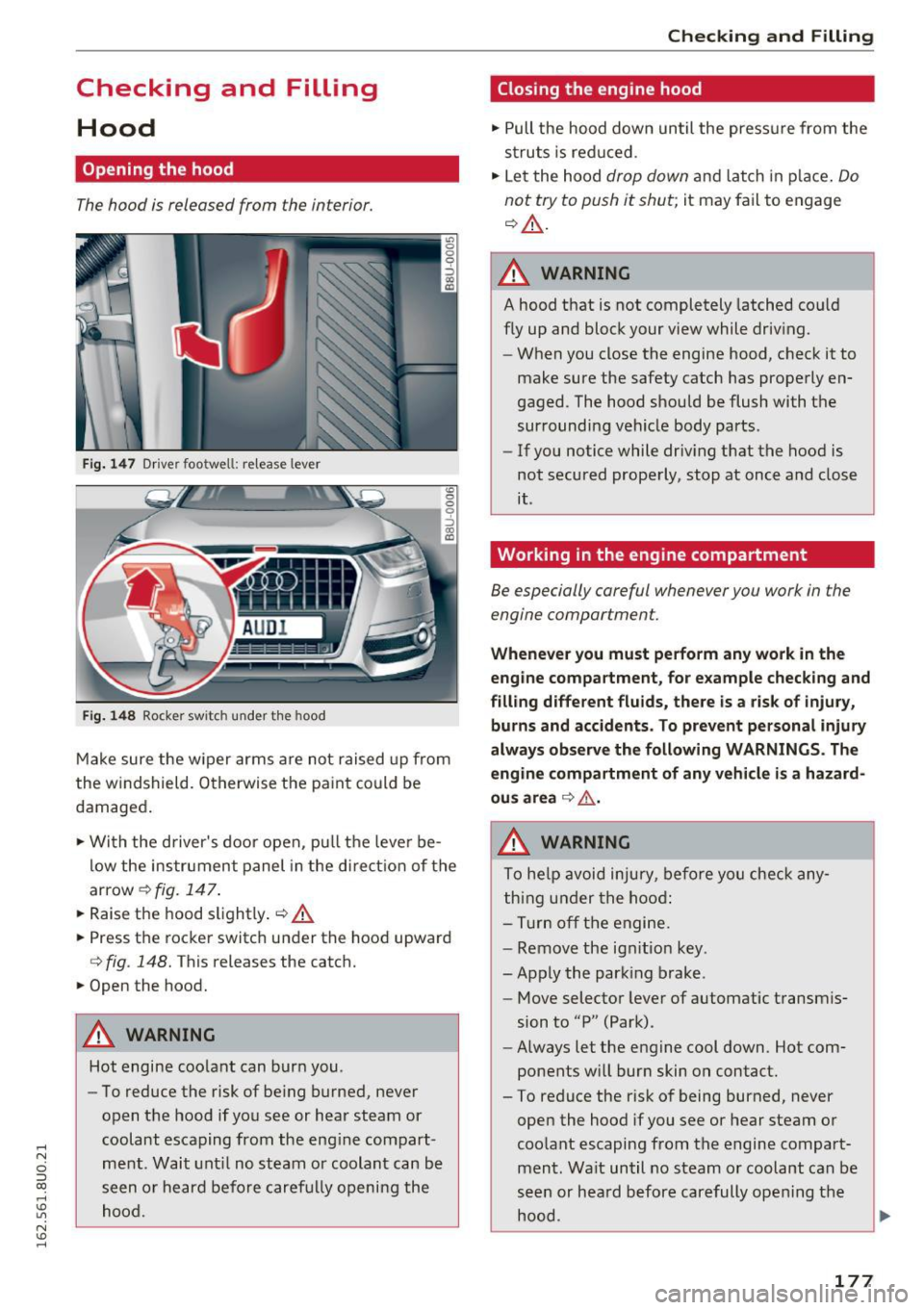
Fig. 147 Driver footwell: release lever
Fig. 14 8 Rocke r switch under t he hood
<0 0 0
0
::,
"' CD
Make sure the w iper arms are not raised up from
the w indshield. O therwise the paint coul d be
damaged .
.,. Wi th the d river's doo r open, p ull th e leve r be
l ow the ins trument panel in the direct io n of the
arrow¢
fig. 1 47.
.,. Raise the hood s lightly . q &.
.,. Press t he roc ker switc h under the hood upward
Q fig. 148. This releases the catch.
.,. Open the hood.
A WARNING
Hot engine coolant can burn you.
- To reduce the risk of be ing burned, never
open t he hood if you see or hear steam or
coolant escaping from the eng ine compart
me nt. Wait unt il no steam or coolant can be
seen o r he ard before caref ully opening the
hood.
Checking and Filling
Closing the engine hood
., Pull the hood down until the press ure from the
s tr uts is red uced .
.,. Le t the hood
drop down and lat ch in p lace . Do
not try to push it shut;
it may fail to engage
q &_ .
A WARNING
A hood that is not completely latched co uld
fly up and block your view while driv ing.
- When you close the engine hood, check it to
make sure the safety catch has prope rly en
gaged. The hood should be flush with th e
sur rounding veh icle body parts.
- If you notice while driv ing that the hood is
not secured prope rly, stop at once and close
it .
Working in the engine compartment
Be especially careful whenever you work in the
engine compartment.
-
Whenever you must pe rform any work in the
eng ine compartment , for e xample check ing and
filling diff erent fluids, there is a ris k of injury,
burns and accidents. To prevent personal injury
always ob serv e the following WARNINGS . Th e
engine compartment of any veh icle is a hazard
ou s area
q .&. .
A WARNING
To he lp avoid injury, before yo u check any
t hing under the hoo d:
- Turn off the engi ne .
- Remove the ign ition key.
- Apply the park ing brake .
- Move selector lever of automatic transmis-
sion to "P" (Park).
- Always let the engine cool down. Hot com
ponents w ill bur n skin on contact.
-
-To reduce the risk of being burned, never
open the hood if you see or hear steam or
coo lant escaping from the engine compart
ment. Wa it until no steam o r coolant can be
seen or hea rd before carefully opening the
hood.
177
Page 180 of 252
Checking and Filling
-Keep children away from the engine com
partment.
- Never spill fluids on hot engine compo
nents. They can cause a fire.
- Never touch the radiator fan. The auxiliary
electric fan is temperature controlled and
can switch on suddenly.
- Never open the coolant reservoir cap when
the engine is still warm. The coolant system
is pressurized and hot coolant could spray
out.
- Protect your face, hands and arm from steam or hot engine coolant by placing a
thick rag over the cap when you open the
coolant reservoir .
- Do not remove the engine cover under any
circumstances. This increases the risk of
burns .
- If work on the fuel system or the electrical
system is necessary:
-Always disconnect the battery.
- Never smoke or work near heaters or open
flames. Fluids in the engine compartment
could start a fire.
- Keep an approved fire extinguisher imme
diately available.
- To avoid electrical shock and personal injury
while the engine is running or being started,
never touch:
- Ignition cables
- Other components of the high voltage
electronic ignition system.
- If you must perform a check or repair with
the engine running:
- First, fully apply the parking brake, move
selector lever of automatic transmission
to "P" (Park).
- Always use extreme caution to prevent
clothing, jewelry, or long hair from get-
178
ting caught in the radiator fan, V-belts or
other moving parts, or from contacting
hot parts. Tie back hair before starting,
and do not wear clothing that will hang or
droop into the engine.
- Minimize exposure to emission and chemi
cal hazards
c::> & .
A WARNING
California Proposition 65 Warning:
- Engine exhaust, some of its constituents,
and certain vehicle components contain or
emit chemicals known to the State of Cali
fornia to cause cancer and birth defects and
reproductive harm. In addition, certain flu
ids contained in vehicles and certain prod
ucts of component wear contain or emit
chemicals known to the State of California
to cause cancer and birth defects or other
reproductive harm .
- Battery posts, terminals and related acces
sories contain lead and lead compounds,
chemicals known to the State of California
to cause cancer and reproductive harms.
Wash hands after handling.
([) Note
When adding fluids, always make sure that
they are poured into the proper container or
filler opening, otherwise serious damage to
vehicle systems will occur.
@ For the sake of the environment
To detect leaks in time, inspect the vehicle
floor pan from underneath regularly. If you
see spots from oil or other vehicle fluids, have
your vehicle inspected by an authorized Audi dealer .
Page 181 of 252
.... N
c:i ::J CX)
.... I.Cl U"I
N I.Cl ......
Checking and Filling
Engine compartment
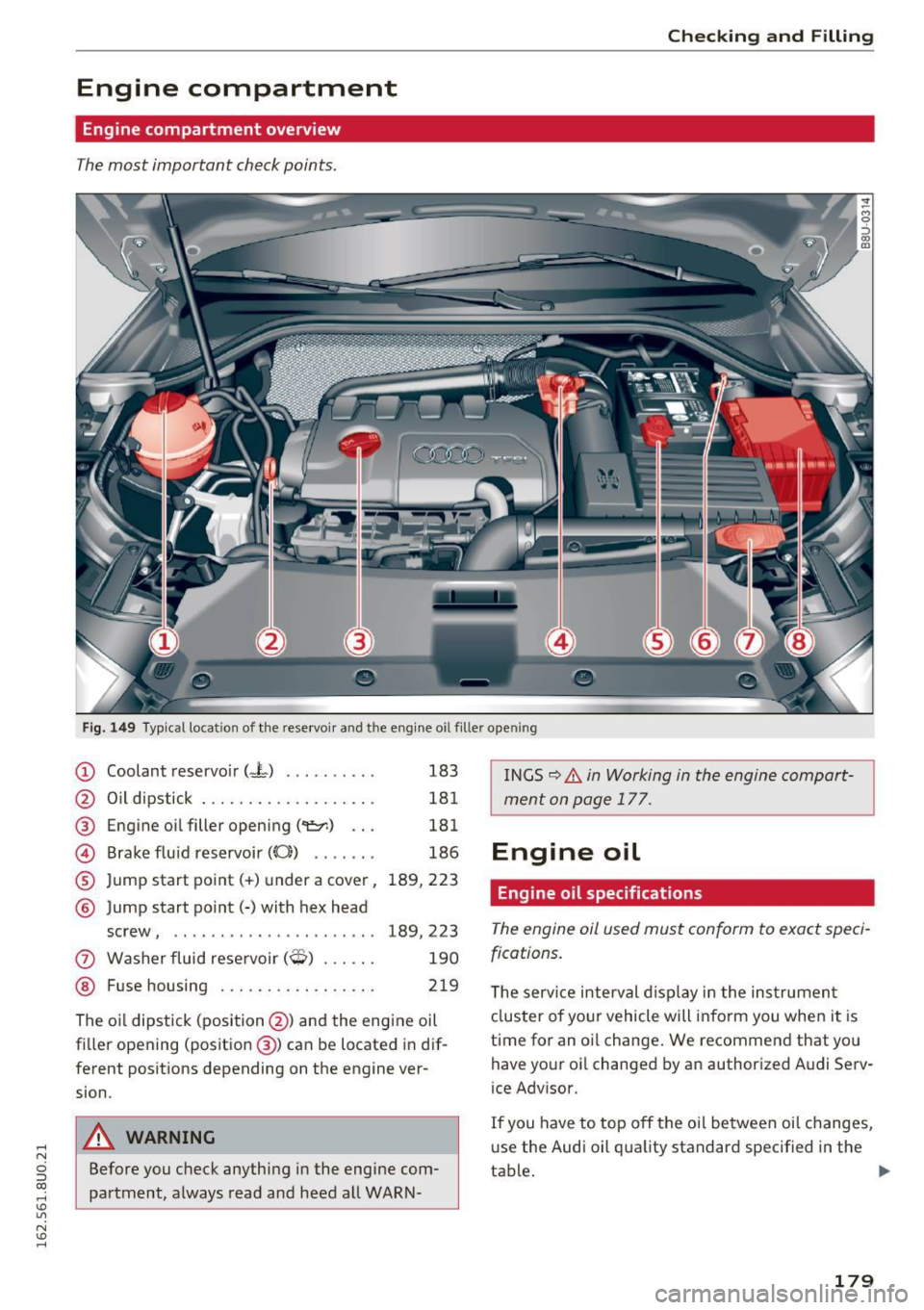
Engine compartment overview
The most important check points.
Fig. 149 Typical location of the reservoir a nd the engine o il fil ler ope ning
(D Coolant reservoir (-L) . . . . . . . . . . 183
@ Oil dipstick . . . . . . . . . . . . . . . . . . . 181
@ Engine oil filler opening ('1!::r.) . . . 181
@ Brake fluid reservoir (0) . . . . . . . 186
® Jump start point(+) under a cover, 189, 223
® Jump start point(-) with hex head
screw, . . . . . . . . . . . . . . . . . . . . . .
189, 223
0 Washer fluid reservoir($) . . . . . . 190
@ Fuse housing . . . . . . . . . . . . . . . . . 219
The oil dipstick (position @) and the engine oil
filler opening (position @) can be located in dif
ferent positions depending on the engine ver
sion.
A WARNING
Before you check anything in the engine com
partment, always read and heed all WARN- INGS
9 .&. in Working in the engine
compart
ment on page 177.
Engine oil
Engine oil specifications
The engine oil used must conform to exact speci
fications.
T he serv ice interval d isplay in the instrument
cluster of your vehicle will inform you when it is
time for an oil change . We recommend that you
have your oil changed by an authorized Audi Serv
ice Advisor.
If you have to top off the oil between oil changes,
us e the Audi oil quality standard specified in the
tab~ .
~
179
Page 182 of 252
Check ing and F illing
Audi oil quality standard
Gas olin e
VW 502 00 or
engi ne vw 50400
Using the proper engine oil is important for the
functionality and service life of the engine. Your
engine was factory-filled with a high-quality oil
which can usually be used throughout the entire
year .
Q) Note
Your Limited New Vehicle Warranty does not
cover damage or malfunctions due to failure
to follow recommended maintenance and use
requirements as set fo rth in the Audi Owner's
Manual and Wa rranty
& Maintenance booklet.
- Use only a high qua lity eng ine oi l th at ex-
pressly complies with the Audi oil qua lity
stan dard specified for your vehi cle's engine.
Using any o ther oil can cause serious engine
damage .
- Do not mix any lubricants o r other addit ives
i nto the engine oil. Doing so can cause en
gine damage.
(D Tips
I f you nee d to add oi l and there is none availa
ble that meets the Audi o il qu ality st andard
your engine requires, you may ad d a total of
no more than 0 .5 quart/liter of a high-quality
"synthet ic"oil that meets the following speci
fications.
- ACEA A3 o r API SM with a viscosity g rade of
SAE OW-30, SAE 5W-30 or SAE 5W-40.
- For more information about engine oi l that
has been approved for your vehicle, please
contact either your authorized Audi dea ler
or Audi Custome r Relat ions at
1 (800) 822-2834 or visit our web site at
www.audiusa.com or www .aud icanada .ca.
Engine oil consumption
The engine in your vehicle depends on an ade
quate amount of oil to lubricate and cool all of
its moving parts .
In order to provide effective lubrication and cool
ing of internal engine components, all internal
180
combust ion engines consume a certa in amo unt
of oil. Oil consumption varies from engine to en
gine and may change significantly over the life of
the engine. Typically, engines w ith a specified
break-in period (see
c:::;, page 159) consume more
o il dur ing the break-in per iod than they consume
af ter o il consumption has stab ilized .
Under normal conditions, the rate of oil con
sumption depends on the quality and viscos ity of
the oil, the RPM (revo lutions per m inute) at
wh ich the engine is operated, the amb ient tem
perature and road condit ions. Further factors a re
the amount of o il di lution from wate r co ndensa
tion or fue l resid ue an d the oxidation level of the
o il. As any engine is sub ject to wear as mileage
builds up, the oi l cons umption may increase over
time unt il replacement of worn components may
become necessary.
With a ll these variab les coming into p lay, no
standard rate of oil consumption can be estab
li shed or specified. The re is no alternative to reg
u lar and frequent checking of the oi l level, see
Note.
If the yellow engine oil level warning symbo l Ell
in the instrument cluster lights up, you sho uld
check the oil level as soon as possible
c:::;, page 181. Top off the oil at your earliest con
venience
c:::;,page 181.
A WARNING
Before you check anyth ing in the e ng ine com
partment, always read and heed all WARN
I NGS
c:::;, .&. in Working in the engin e compart
ment on page 177.
(D Note
Driving w ith an insuffic ient oil level is likely to
cause severe damage to the eng ine.
(D Tips
- The oil pressure warn ing d isplay. is not
an indicator of the oil level. Do not rely on
it. Instead, check the oil level in your en
g ine at regular int ervals , pr eferably each
time you refuel, and alway s before going
on a long trip .
Page 183 of 252
.... N
c:i ::J CX)
.... I.Cl U"I
N I.Cl ......
-If yo u have the impression your engine con
sumes excessive amounts of oil, we recom
mend that you consu lt an autho rized Aud i
dealer to have the cause of your concern
properly d iagnosed . Keep in mind that the
accurate measurement of oil consumption
r equ ires great care and may take some
time . An authorized Audi dea ler has instruc
tions about how to measure oil consump
tion a ccura tely .
Checking the engine oil level
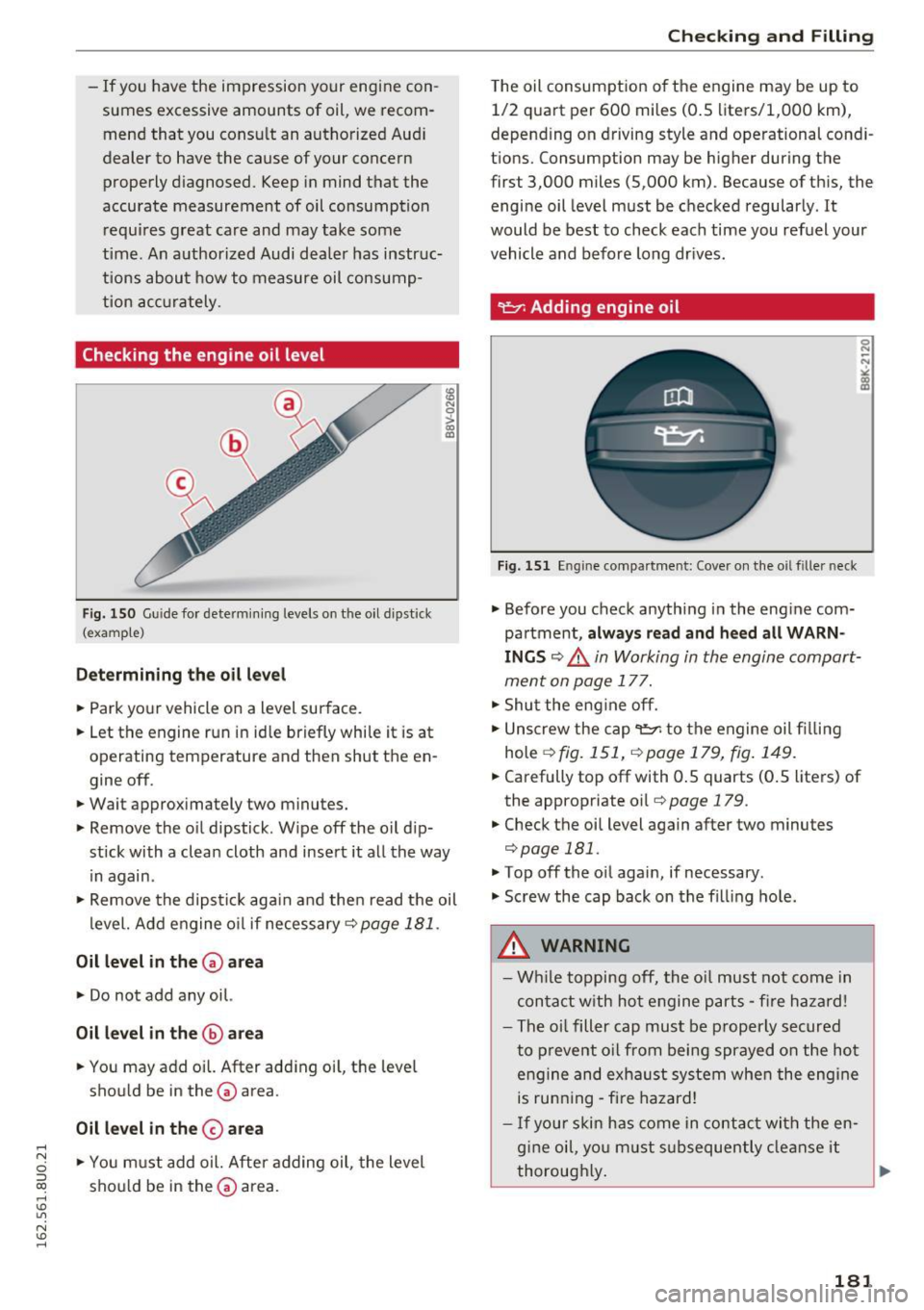
Fig . 1 50 G uide fo r d ete rm ini ng le v e ls on t he o il d ips tic k
(exam ple)
Det ermining the oil level
.,. Park yo ur veh icle on a level su rface .
.. Let the engine run in id le briefly while it is at
operating t emperature and then shut the en
gine off .
.. Wait approx imately two minutes.
.. Remove the o il dipstick . W ipe off the oil d ip
stick with a clean cloth and insert it all the way
in again .
.,. Remove the dipstic k aga in a nd then read the oil
level. Add e ngine o il if necessary
r=;, page 181.
Oil level in the~ area
.. Do not add any oil.
Oil level in the @ area
.. You may add o il. After add ing oi l, the leve l
sho uld be in the
G) area.
Oil l evel in the@ area
.,. Yo u m ust add o il. After adding oil , the level
should be in the
G) area.
Checking and Filling
T he oil consumpt ion of the engine may be up to
1/2 quart per 600 miles (0 .5 liters/1,000 km),
depending on driving style and ope rational cond i
tions. Consumption may be higher during the
first 3,000 miles (5,000 km) . Because of th is, the
engine oil level must be checked regularly . It
would be best to check each time you refuel your
vehicle and before long dr ives.
~ Adding engine oil
Fi g. 15 1 En g in e co mpa rtm ent: Cove r on the oil f iller nec k
.. Before you check anything in the eng ine com
partment,
always read and heed all WARN
INGS ¢ &. in Working in the engine compart
ment on page 177 .
.,. Shu t the eng ine off .
.,. Unscrew the cap~ to the engine oil fi lling
hole
r=;, fig. 151, r=;,page 179, fig . 149 .
.. Carefully top off with 0 . 5 quarts (0 .5 liters) of
the appropriate oil¢
page 179 .
.. Check the oi l level again after two minutes
¢page 181.
.. Top off the o il aga in, if necessary .
.,. Screw the cap back on the fi lling ho le .
_& WARNING
- W hile topping off, the o il must not come in
con ta ct with hot e ngine parts - fi re hazard!
- The oi l filler cap must be p rop erly secured
to p revent o il from being sprayed on the hot
engine and exha ust system whe n the eng ine
is ru nning -fi re haz ard!
- If you r skin has come in contac t wit h the en
g in e oil, yo u m ust s ubsequently clea nse i t
thoroug hly.
~
181
Page 184 of 252
Check ing and F illing
CJ) Note
- Check the oil level us ing the radio or MMI*.
If the message Please reduce oil l evel a p
pears, contact your authorized Audi dealer
or qual ified workshop to have excess oil ex
tracted if necessary.
- Audi does not recommend the use o f oil
add itives. Th ey may dam age the eng ine
and ad ve rse ly aff ect your N ew Vehicl e
Warranty .
@ For the sake of the environment
-Under no circumstances can the o il come in
contact with the sewage network or the soil.
- Observe and follow legal regulations when
dispos ing of empty oil containers .
Changing the engine oil
We recommend that have your oil changed by an
authorized Audi dealer or a qualified service sta tion .
Before you check anyth ing in the eng ine compart
ment,
a lways r ead and heed all WARNINGS ¢&.
in Working in the engine compartment on
page 177 .
The engine oil must be changed accord ing to the
intervals specif ied in your Warranty
& Mainte
nance booklet. This is very important because the
lubricat ing propert ies of oil d iminish gradually
du ring normal vehicle use.
Under some circumstances the eng ine o il should
be changed more frequently . Change oil more of
ten if you drive mostly short distances, ope rate
the vehicle in dusty areas or under predominantly
stop-and-go traffic cond it ions, o r have your vehi
cle where temperatu res remain below freezing
for extended periods.
Detergent additives in the oil will make fresh oil
look dark afte r the engine has been ru nning fo r a
short t ime. This is no rmal and is not a reason to
change the oil more often than recommended.
Because of the prob lem of proper disposa l, along
with the special tools and necessa ry expe rt ise re
qu ired, we s trong ly recommend that you have
182
you r oi l changed by an authorized Audi d ealer or
a qua lified service station.
If you choo se to chang e your oil your self, please
note the follow ing important information:
& WARNING
To reduce the risk of persona l injury if you
must change the eng ine oil in yo ur vehicle
yourself:
- Wear eye protection .
-
-To reduce the r isk of b urns from hot engine
oil, let the engine cool down to the touch.
- When removing the oil d rain plug with yo ur
fingers, stay as far away as possible. Always
keep your forearm parallel to the gro und to
he lp prevent hot oil from running down your
arm.
- Drain the oil into a container designed for
this purpose, one la rge enough to hold at
least the tota l amount of oil in your engine.
- Engine oil is poisonous. Keep it well out of
the reach of children.
- Continuous contact with used engine o il is
harmf ul to your skin. Always protect your
skin by washing oil off thoroughly with soap
and water .
(D Note
Never mix oil additives with your engine oil.
These additives can damage your engine and adverse ly affect your Audi Limited New Vehi
cle Warranty.
@I For the sake of the environment
- Before chang ing you r oi l, first make sure
you know where you can properly dispose of
the used oil.
- Always dispose of used engine o il properly.
Do not dump it on garden soi l, wooded
areas, into open streams or down sewage
drains.
- Recycle used engine o il by tak ing it to a used
eng ine oil collect ion fac ility in your area, or
contact a service station .
Page 185 of 252
Cooling system
Coolant
The engine coolant performs two functions: it
keeps the engine from overheating and it pro
tects the engine from freezing in the winter .
The cooling system is sealed and generally re
quires little attention.
T he cooling system has been filled at the factory
with a permanent coolant which does not need to
be changed . The coolant consists of a mixture of
specially condit ioned water and the manufactur
er's glycol-basedcoolant add itive G 13 antifreeze
with anticorrosion additives (SO% for USA mod
e ls; 60% for Canada models) . This mixt ure bot h
assures the necessary frost protec tion and pro
tects meta l components in the engine's cooling
system from corrosion and scaling . It also raises
the boiling point of the coolant.
D o not red uce the concent ration of the coolant in
the summer by add ing p la in water.
The propor
tion of coolant addit ive mu st be at least 50 %
but not more than 60 %
to mainta in antifreeze
protection and cooling efficiency. If the coolant
frost protection is too low, the coolant could
freeze and damage the vehicle heating and en
g ine cooling system .
For year-round driving, antifree ze is added at the
factory for temperatures down to :
- -31° F(- 3S°C)USA
- -4 0 ° F ( - 40 °C) Can ada.
If you must add coolant, use a m ixture of water
and coolant addit ive. M ixing the coolant additive
with d istilled water is recommended .
_& WARNING
Before you check anythi ng i n t he engine com
partment, a lways read and heed a ll WARN
INGS
¢ .&. in Working in the engine compart
ment on page 177 .
(D Note
-Befo re winter se ts in, have the coo lant
checked to see if the coolant additive in you r
vehicle is sufficient to meet the cl imate con -
Check ing and Filling
ditions. This is especially important if you
live in a region where the winter is extreme
ly cold. If necessary, increase the proportion
of coolant additive to 60%.
- When adding coolant additive to your cool
ing system, remember :
- We recommend us ing only coolant add i
tive G12+ + or G13 fo r yo ur vehicle. This
coolant addit ive is avai lab le a t aut horized
A udi dealers . O ther types of antifree ze can
significantly reduce corrosion pro tect ion .
The resulting corrosion can cause a loss of
coolant and serious engine damage.
- Do not add any type of radiator leak sealant
to your vehicle's engine coolant. Adding ra
diator repair fluid may adversely affect the
function and performance of your cooling system and cou ld resu lt in damage not cov
ered by your New Veh icle Limited Warra nty .
Checking the engine coolant level
The engine coolant level can be checked with a
quick glance.
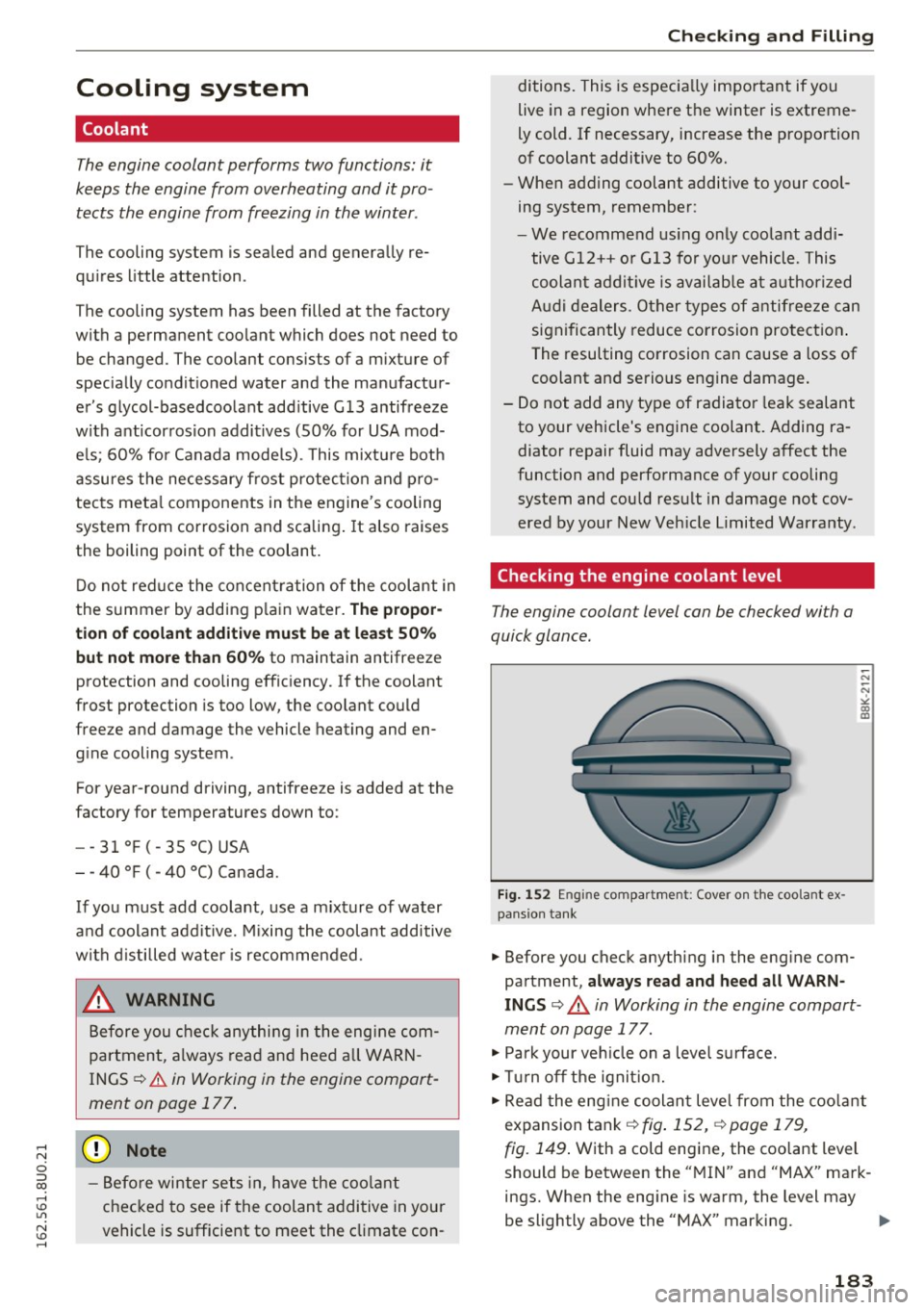
Fi g. 1 52 Engin e compar tmen t: Cover o n the coo la n t ex
pans ion tank
.. Before you check anything in the eng ine com
partment,
always r ead and h eed all WARN
INGS ¢ ,A in Working in the engine compart
ment on page 177 .
.. Par k your veh icle on a leve l sur face.
.. Tur n off t he ignit io n .
.. Read the eng ine coolan t leve l from the coo lant
expansion tank
¢ fig . 15 2, ¢ page 179,
fig. 149 .
With a cold engine, the coo lant level
should be b etween the "MIN" and "MAX" mark
ings. When the eng ine is warm, the level may
be slightly above the "MAX" marking. .,..
183