steering wheel AUDI Q3 2016 Owner's Manual
[x] Cancel search | Manufacturer: AUDI, Model Year: 2016, Model line: Q3, Model: AUDI Q3 2016Pages: 252, PDF Size: 62.81 MB
Page 119 of 252
Advanced front airbag system
Your vehicle is equipped with a front Advanced
Airbag System in compliance with Un ited States
F edera l Motor Vehicle Safety Standard 208, as
well as Canada Motor Vehicle Safety Standard
(CMVSS) 208 as applicable at the time your vehi
cle was manufactured .
The front Advanced Airbag System supp lements
the safety belts to provide additional protection
for the driver's and front passenger's heads and upper bodies in frontal crashes . The airbags in
f late only in frontal impacts when the veh icle de
celeration is high enough.
The front Advanced Airbag System for the front
seat occupants is not a substitute for your safety be lts . Rather, it is part of the overall occupant re
stra int system in your vehicle. Always remember
that the airbag system can on ly help to protect
you, if you are sitting upr ight, wear ing your safe
ty belt and wear ing it prope rly. This is why you
and your passengers must always be prope rly re
stra ined, not just beca use the law req uires yo u to
be .
The Advanced Airbag System in your veh icle has
been ce rtified to meet the "low r is k" requi re
ments fo r 3 and 6 ye ar-old children o n the pas
senger side and very sma ll adults on the drive r
side . The low risk dep loyment criteria are intend
ed to help reduce the risk of injury through inter
action with the front a irbag that can occur, for
examp le, by being too close to the steering wheel
and instrument panel when the airbag inflates .
In addition, the system has been certified to
comp ly with the "suppression" requirements of
the Safety Standard, to turn off the front a irbag
for i nfants 12 months old and younger who are
restrained on the front passenger seat in child re
stra ints that are listed in the Standa rd
¢ page 134, Child restraints and Advanced Air
bags.
"Suppress ion" requ ires the front a irbag on the
passenger side to be turned off if:
- a ch ild up to about one year of age is restra ined
on the front passenger seat in one of the rear
facing or forward-fac ing infant restra ints listed
Airb ag sys tem
in Federal Motor Veh icle Safety Standard 208
with which the Advanced Airbag System in your
veh icle was certif ied. For a List ing of the child
restraints that were used to certify your vehi
cle's compliance with the US Safety Standard
¢page 134,
-weight less than a threshold level stored in the
control un it is detected on the front passenger
seat .
When a person is detected on the front passen ger seat, weighing more than the total weight of
a chi ld that is about
1 year old restra ined in one
of the rear-facing or forward-fac ing infant re
straints (listed in Federal Motor Veh icle Safety
Standard 208 with w hich the Advanced A irbag
System in your veh icle was certified), the front
airbag on the passenge r side may o r may not de
ploy .
T he
PAS SENGER AIR BAG OFF lig ht comes o n
whe n the elect ronic control uni t detects a tota l
weight on the fron t passenger sea t th at req uires
the front airbag to be turned off . If the
PASSEN
GER AIR BAG OFF
light does not come on, the
front airbag on the passenger side has not been
turned off by the control unit and can dep loy if
the control unit senses an impact that meets the
condit ions stored in its memory .
If the total weight on the front passenger seat is
more than that of a typica l 1 year-old, but less
than the weight of a small adult, the front airbag
o n the passenger s ide may deploy (the
PAS SEN
GER AIR BAG OFF
light does not come on) .
For example , the ai rb ag may deploy if :
- a small chi ld that is heav ier than a typ ica l 1
yea r-o ld child is on the front passenger seat
(regard less of whether the child is in one of the
child safety seats listed
¢ page 134),
- a child who has outgrown c hild restraints is on
the front passenger seat.
If the front passenge r a irbag is t urned off, the
PASSENGER AIR BAG OFF light in the center of
the instrument pane l wi ll come on and stay on .
T he front airbag on the passenger side m ay
not
deploy (the PASSENGER AIR BAG OFF light does
not illuminate and stay lit) if: ..,.
117
Page 121 of 252
greater detail below. Because the front passen
ger seat contains important parts of the Ad
vanced A irbag System, you must take care to pre
vent it from being damaged. Damage to the seat may prevent the Advanced Airbag for the front
passenger seat from doing its job in a crash .
The front Ad vanced Airb ag S ystem con sis ts
of the follo wing :
-Crash sensors in the front of the vehicle that
measure vehicle acceleration/decelerat io n to
provide information to the Advanced Airbag
System about the severity of the crash .
- An electronic control unit, with integrated crash sensors for front and side impacts . The
contro l unit "decides" whethe r to fire the front
airbags based on the information received from
the crash sensors. The control unit also "de
cides" whether the safety be lt pretensioners
shou ld be activated.
- An Advanced Airbag with gas generator and
contro l valve for the driver inside the steering
whee l hub .
- An Advanced Airbag with gas generator and
contro l valve inside the instrument pane l for
the front passenger.
- A weight -sensing mat under the upho lstery
padding of the front passenger seat cushion
that measures the total weight on the seat . The
information registered is sent continuously to
the e lectron ic control unit to regulate dep loy
ment of the front Adva need A irbag on the pas
senger side.
- An airbag monitoring system and indicator
light i n the instrument cluster
¢ page 122.
-A sensor in each front seat registers the dis
tance between the respective seat and the
steering wheel or instrument panel. The infor
mation reg istered is sent cont inuous ly to the
electronic control unit to regulate deployment
of the fro nt Adv a need A irbags.
- T he
PASS EN GE R AIR BAG OFF light comes on
and stays on in the center of the instrument
pane l¢
page 122, fig . 124 and tells you when
the front Advanced Airbag on the passenge r
side has been turned off.
- A sensor below the safety belt latch fo r the
front seat passenger to meas ure the tension on
Airb ag sys tem
the sa fety belt. The tension on the safety belt
and the weight registered by the weight-sens
ing mat help the contro l unit "decide" whether
the front airbag for the front passenger seat should be turned off or not¢
page 113, Child
restraints on the front seat -some important
things to know.
- A sensor in the safety belt latch for the driver
and for the front seat passenger that senses
whether that safety belt is latched or not and
transmits this information to t he electronic
cont rol un it.
_& WARNING
Damage to the front passenge r seat can pre
vent the front airbag from working properly.
- Imp roper repair or disassembly of the front
passenger and driver seat will p revent the
Advanced Airbag System from f unctioning
p roperly.
- Repairs to the front passenger seat must be
performed by qualified and properly trained
workshop personne l.
- Never remove the front passenger or driver
seat from the vehicle.
- Never remove the upholstery from the front
passenger seat.
- Never d isassemble o r remove par ts from the
seat o r disconnect w ires from it.
- Never carry sh arp objects in your pocke ts or
p lace them on the seat. If the weight-sens
ing mat in the passenger seat is punctu red
it cannot work proper ly.
- Never carry things on your lap or carry ob
jects on the passenger seat. S uch items can
increase the weight reg istered by the
weight-sensing mat and send the wrong in
formation to the a irbag control unit.
- Never store items under the front passenger
seat. Parts of the Advanced Airbag System
under the passenger seat could be dam
aged, p reventing them and the airbag sys
tem from working p roper ly.
- Never p lace seat covers or replacement up
holstery that have not been specifically ap
p roved by A udi on the front seats.
- Seat covers can prevent the Advanced A ir
bag System from recognizing chi ld
119
Page 124 of 252
Airbag syste m
-Never place or attach accessories or other
objects (such as cupholders, telephone
brackets, large, heavy or bulky objects) on
the doors, over or near the area marked "AIRBAG" on the steering wheel, instru
ment panel, seat backrests or between
those areas and yourself. These objects
could cause injury in a crash, especially
when the airbags inflate.
- Never recline the front passenger's seat to
transport objec ts. Items can also move into
the area of the side airbag or the front a ir
bag dur ing braking or in a sudden maneu
ver. Objects near the airbags can become projectiles and cause injury, particularly
when the seat is reclined.
A WARNING
The f ine dust created when airbags deploy can
cause breath ing problems for people w ith a
history of asthma or other breathing condi
t ions.
- To reduce the risk of breathing problems,
those w ith asthma or other respiratory con
ditions should get fresh air right away by
gett ing out of the vehicle o r opening w in
dows or doors.
- If you are in a collision in which airbags de
ploy, wash your hands and fa ce with mild
soap and water befo re eat ing.
- Be careful not to get the dust into your eyes,
o r into any cu ts or sc ratches.
- If the resid ue should get into yo ur eyes,
flush them with water.
Monitoring the
Advanced Airbag System
!f Airbag monitoring indicator light
Two separate indicators monitor the function of
the Advanced Airbag System: the airbag moni
toring indicator light and the
PA SSENGER AIR
BAG OFF
light.
The Advanced Airbag System as well as the side airbags and side curtain airbags with eject ion
mit igat ion features ( including the electronic con
trol unit, sensors and system wiring) are all
122
monitored continuous ly to make sure that they
are functioning properly whenever the ignition is
on . Each time you turn on the ignit ion, the airbag
monitoring indicator light
m will come on for a
few seconds (se lf diagnostics) .
The system mu st be inspected wh en th e
indicat or light
E,I:
- does not come on when the ignition is switched
on,
- does not go out a few seconds after you have
switched on the ignit ion, or
- comes on while driving.
If an airbag system malfunc tion is detec ted, the
indicator light will first start flashing to catch the
driver's attention and then stay on continuously
to serve as a constant rem inder to have the sys
tem inspected immediately.
If a malfunction occurs that turns the front air
bag on the passenger side off, the
PASSENGER
AIR BAG O FF
light will come on and stay on
whenever the ignition is on.
A WARNING
An airbag system that is not functioning prop
erly cannot provide supplemental protect ion
in a frontal crash .
- If the airbag ind icator light
q page 16
comes when the veh icle is being used, have
the system inspected immediately by your
author ized Audi dealer. It is possib le that
the airbag will i nfla te when i t is no t sup
posed to, or wi ll not inf late when it sho uld.
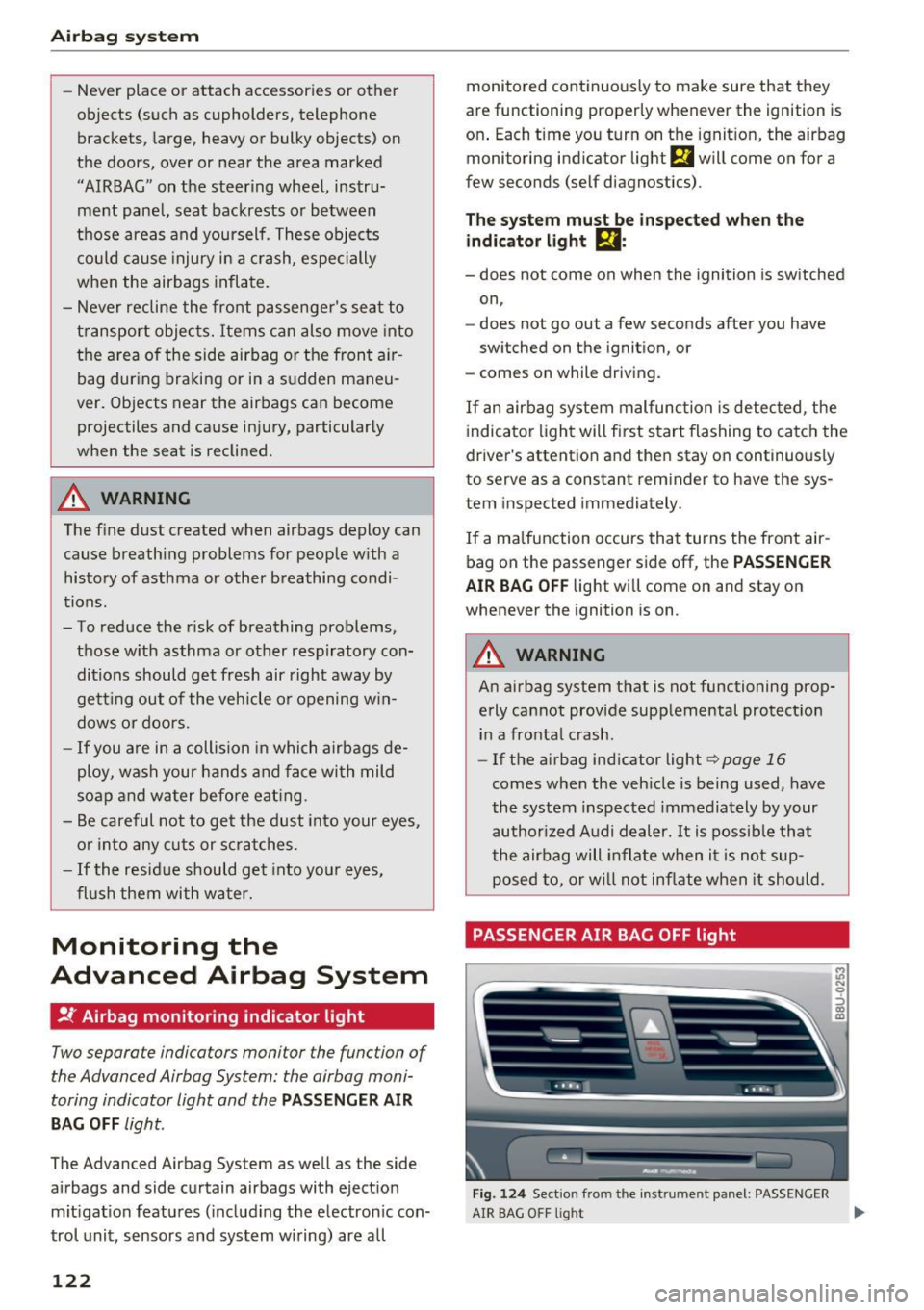
PASSENGER AIR BAG OFF light
Fig. 12 4 Section from the inst rument panel: PASSENGER
&l N 9 ::::, CD m
AIR BAG OFF l ight ...
Page 135 of 252
exceptional circumstances and the
PASS ENGER AIR BAG OFF light does not
come on and stay on, immed iately install
the rear-fac ing ch ild safety seat in a rear
seating pos it ion and have the airbag system
inspected immediately by your Audi dealer .
A WARNING
If, in exceptio nal circumstances, you must in
stall a forward-facing chi ld restraint on the
front passenger's seat:
- Always make sure the forward-fac ing seat
has been designed and ce rtified by its man
ufact urer fo r use on a front seat with a pas
senger front and side airbag .
- Always follow the manufact urer's instruc
tions prov ided with the ch ild safety seat or
carrier.
- Always move the passenger seat into its
rearmost position in the seat's fore and aft
adjustment range, as far away from the air
bag as possib le before installing the child
restraint. The backrest must be adjusted to
an upr ight position.
- Always make sure that the
PA SSENGER AIR
BAG OFF
light comes on and stays on all the
t ime whenever the ignition is switched on.
{D) Tips
Always replace chi ld restraints that were in
stalled in a vehicle dur ing a crash . Damage to
a child restraint that is not visible could cause
it to fail in another collision situation.
Advanced front airbag system and children
Your veh icle is equipped with a front "Advanced
Airbag System " in compliance w ith United States
F edera l Moto r Vehicle Safety Standard (FMVSS)
208, as well as Canada Motor Ve hicle Safe ty
Stand ard (CMVSS) 208 as appli cable at the t ime
your vehicle was manufactured .
The Advanced Airbag system in your ve hicle has
been ce rtified to meet the "low-risk " requ ire
ments for 3 -and 6-year old children on the pas
senger side and small adults on the driver side .
The low risk deployment criteria are intended to
Ch ild safety
reduce the risk of injury through interaction with
the airbag that can occur, for example, by being
too close to the steering wheel and instr ument
panel when the airbag inflates. In addition, the
system has been cert ified to comply with the
"suppression" requirements of the Safety Stand
ard, to turn off the front airbag for infants up to
12 months who are restrained on the front pas
senger seat in ch ild rest raints that are lis ted in
the S tanda rd .
Even thoug h your veh icle is equipped with an Ad
vanced Airbag system, all ch ildren, especially
those 12 yea rs and younger, sho uld a lways ride
i n the back seat properly restra ined for their age
and size . The airbag on the passenger side makes
the front seat a potentia lly dangerous p lace for a
child to ride. The front seat is not the safest place
for a ch ild in a forward-fac ing ch ild safety seat. It
can be a very dangerous place for an infant or a
larger ch ild in a rearward-facing seat .
Advanced Airbags and the weight -sensing
mat in the front seat
T he Advanced A irbag System in you r vehicle de
tects the presence of a n in fan t or child in a ch ild
restra int on the front passenger seat using the
weight-sensing mat in the seat cushion and the sensor below the safety belt latch on the front
passenger seat that measures the tension on the
safety belt.
The weight-sensing mat measures total weight
of the child and the chi ld safety seat and a child
blanket on the front passenger seat. The weight
on the front passenger seat is related to the de
s ign of the child restra int and its "footprint" , the
s ize and shape of the bottom of the c hild re
straint as it s its on the seat. The weight of a chi ld
r estra int and its "footprint " va ry for different
k inds of child restra ints and for the different
models of the same kind of ch ild rest raint of
fered by child restraint manufacturers.
T he weight ranges for the individ ual types,
makes and mode ls of chi ld restrain ts that the
N HT SA has spec ified in the Safety Standard to
gether with the weight ranges o f typical infants
and typical 1 year-old chi ld have been stored in .,.
133
Page 153 of 252
shared, please see your contract with the
wireless telecommunications provider and the
"About Aud i connect" tab in your vehicle's
MMI:
! MENUI button> Audi connect > About
Audi conn ect.
Electronic Stabilization
Control (ESC)
Description
ESC helps to improve road ho ld ing and vehicle
dynamics to help reduce the probability of skid
d ing and loss of vehicle control. It works only
when the engine is runn ing . E SC detects certain
d ifficult dr iving sit uat ions, including when t he
ve hicl e is begin ning to spin (yaw) out of contro l
and helps you to ge t the veh icle back under con
tro l by se lective ly braking the wheels, and/or re
ducing engine powe r and provid ing steering as
sistance to help hold the vehicle on the dr iver's
intended course. The indicator light
GJ in the in
strument cluster blinks when ESC is taking action
to help you co ntrol the vehicle.
ESC has limitations. It is important to remember
that ESC cannot overcome the laws of physics. It
will not a lways be able to help out under all con
d itions you may come up aga inst. For example,
ESC may not always be able to help you master
situations where there is a sudden change in the
coeff icient of friction of the road surface. When
there is a section of dry road that is sudde nly cov
e red with water, slush o r snow, ESC cannot pe r
form the same way it wo uld on the dry s urface . If
the vehicle hydrop lanes (rides on a cushion of wa
ter i nstead of the road su rface), ESC wi ll not be
ab le to he lp you steer the veh icle because contact
with the pavement has been interrupted and the
ve hicle cannot be braked or steered. Dur ing fast
cornering, pa rticula rly on w inding roads, ESC
cannot always deal as effect ively w it h difficult
d riving si tuations tha n at lowe r speeds. When
tow ing a t raile r, ESC is not able to help you re
ga in con trol as it would if you we re not towing a
tra iler .
A lways adjust yo ur speed and driving sty le to
road, traffic and weathe r cond itions. ESC cannot
override the vehicle's physical lim its, increase the
Intellig ent Technology
available t ract ion, or keep a vehicle on the road if
road departure is a resu lt of driver inattention .
Instead, ESC improves the possib ility o f keeping
the vehicle under contro l and on the road d uring
extreme maneuvers by us ing the driver's steer ing
i nputs to help keep the veh icle go ing in the in
tended direction.
If you are traveling at a speed
that causes you to run off the road before ESC c an p rovide any assistance, you may not exper i
en ce the benefi ts of ESC.
ESC is switched o n all the time . In certa in s itua
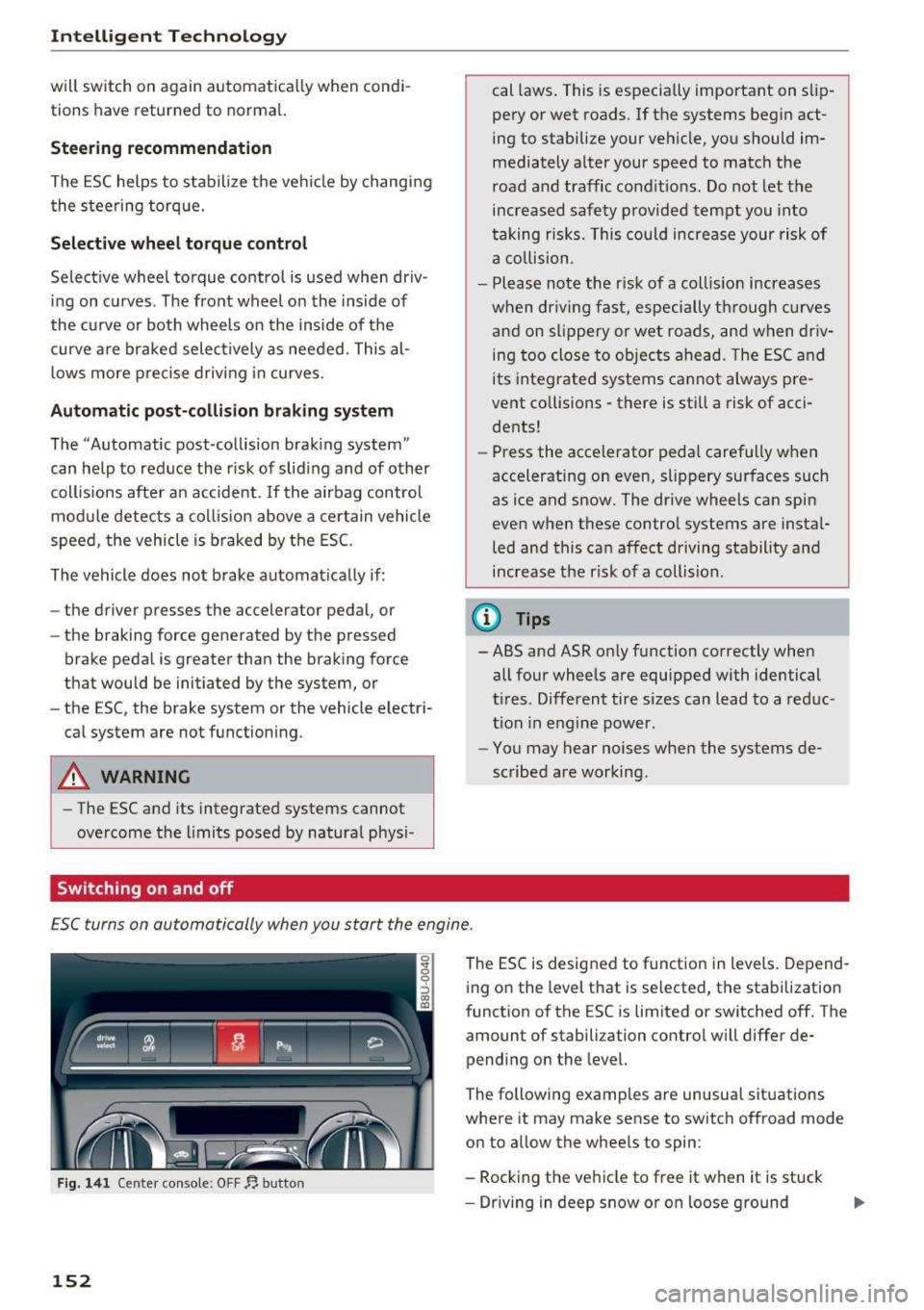
t ions when you need less tract ion, you can sw itch
off AS R by press ing the button
[fil c:> page 152,
fig. 141. B e sure to switc h ASR on again whe n
you no longer need less tract ion .
T he following systems are integrated in the ESC:
Anti-lock brak ing system (ABS )
ABS prevents the wheels from locking when brak ing . The vehicle can still be steered even dur ing
hard braking. Apply steady pressure to the brake
pedal. Do not pump the pedal. A pulsing in the
brake pedal ind icates that the system is acting to
stab ilize the ve hicle.
Brake assist system
The brake assist system can decrease braking dis
tance. It increases braking powe r when the dr iver
presses the brake peda l quickly in emergency sit
uat io ns. You must press a nd ho ld the bra ke pedal
u nt il the dange rous situation is over.
Anti-slip regulation (ASR)
ASR reduces engine power whe n the dr ive wheels
begin spin ning and adapts the force to the road
co ndit ions. This makes it eas ier to s tart, acce ler
ate and d rive up incl ines.
Electronic differential lock (EDL)
The EDL brakes wheels that are spinning and
transfers the drive power to the other dr ive
wheel or wheels if the vehicle is equ ipped with all
whee l drive*) . This function is not available a t
highe r speeds .
In extreme cases, EDL automat ica lly switches off
to keep t he brake o n the braked wheel from over
hea ting . T he veh icle is still working co rrectly. EDL.,.
151
Page 154 of 252
Intelligent Technology
will switch on again automat ically when condi
tions have returned to normal.
Steering recommendation
The ESC helps to stabilize the veh icle by changing
the steering torque.
Selective wheel torque control
Selective wheel torque control is used when driv
i n g on curves . The front wheel on the inside of
the c urve or both wheels on the inside of the
curve are braked selectively as needed. This al
lows more precise driving in curves.
Automatic post-collision braking system
The "Automatic post-collision brak ing system"
can help to reduce the r isk of slid ing and of other
coll is ions after an accident . If the airbag control
module detects a collision above a certain vehicle
speed, the vehicle is braked by the ESC.
The vehicle does not brake automatically if :
- the driver presses the accelerator pedal, or
- the braking force generated by the pressed
brake pedal is greater than the braking force
that would be initiated by the system, or
- the ESC, the brake system or the vehicle electri
cal system are not functioning.
A WARNING
- The ESC and its integrated systems cannot
overcome the limits posed by natural physi-
Switching on and off
cal laws. This is especially important on slip
pery or wet roads. If the systems beg in act
ing to stabilize your vehicle, you should im
mediately alter your speed to match the
road and traffic conditions. Do not let the
increased safety provided tempt you into
taking risks. This could increase your risk of
a collision.
- Please note the risk of a collision increases
when dr iv in g fast, especially through curves
and on slippery or wet roads, and when dr iv
ing too close to objects ahead. The ESC and
its integrated systems cannot always pre
vent collisions -there is still a risk of acci
dents!
- Press the accelerator peda l carefully when
accelerating on even, slippery surfaces such
as ice and snow. The drive wheels can spin
even when these control systems are instal
led and this can affect driving stability and
increase the risk of a collision .
@ Tips
-ABS and ASR only function correctly when
all four wheels are equipped with identical
tires. Different tire sizes can lead to a reduc
tion in engine power.
- You may hear noises when the systems de
scribed are working.
£SC turns on automatically when you start the engine .
Fig. 141 Center console: OFF rJ. button
152
The ESC is designed to function in levels. Depend
i ng on the level that is selected, the stabilization
function of the ESC is limited or switched off. The amount of stabilization control will differ de
pending on the level.
The following examples are unusual situations
where it may make sense to switch offroad mode
on to allow the wheels to spin:
- Rocking the vehicle to free it when it is stuck
- Dr iving in deep snow or on loose ground
Page 158 of 252
Intelligent Technology
Electromechanical
steering
The electromechanical steering sup ports the
driver's steering movements .
Power steering adapts electronically based on
the vehicle speed .
Indicator lights and mess ages
• Steering fault! Do not drive veh icle!
If thi s ind ic a tor light t urns o n and stays o n and
this message appears, the power steering may
have fa iled.
S top the veh icle in a safe lo cat io n as soo n as pos
sib le. Do
not c on tinue driving. See an author ized
Aud i dea ler o r authorized Aud i Serv ice Facility fo r
assistance.
If the ind icator lig ht t urns on, the steer ing wheel
may be mo re diff icu lt to move o r more sensitive
than usual. The stee ring wheel may also be at a n
angle when dr iving straight .
Dr ive s low ly to your author ized A udi dealer or au
thor ized Audi Se rvice Facility to have the ma l
f u nction co rrected.
E£-ij St eering lock: System fault! Plea se contact
deal er.
There is a malfunction in the electronic steering
lock.
D rive to an a uthorized Audi dea le r or a uthorized
Audi Service Facility immediately to have the
malfunct ion corrected.
@ Tips
If the . or Erj indicato r light on ly stays on
for a short time, you may continue driv ing.
All wheel drive (quattro)
Applies to vehicles: with all wheel drive
In oil wheel drive, oil four wheels ore powered .
General information
In a ll w heel d rive, the d rivi ng power is divided be
tween a ll four wheels . This happens au tomatical-
156
ly depending on yo ur driv ing behavior as we ll as
the cur rent road conditions . Refer to
Q page 151.
The all whee l dr ive concep t is designed fo r high
engine power. Yo ur vehicle is except ion ally pow
erf ul and has excellent drivin g charac teristics
both un der normal driving conditions and on
snow and ice . Always read and follow safety pre
cautions
c:> .&, .
Winter tires
By using all whee l dr ive, your ve hicle has goo d
f orward motion wi th standard tires in w inte r con
ditions . However, in winte r we recommend using
winter or all-season tires on all four wheels, be
cause this will improve the brak ing effect
c:> page 206, Winter tires .
Snow chains
If there are snow chain laws, snow chains m ust
also be used o n veh icles with all wheel drive
c:> page 206, Snow chains.
Replacing tires
Fo r vehicles with all wheel drive, on ly wheels with
t h e same ro lli ng circ umfe rence sho uld be used .
Avoid whee ls with different t read depths
Q page 198 , New tires or wheels .
A WARNING
-Also, in vehicles with all wheel drive, adapt
your driving sty le to the current road and
traffic conditions. Do not let t he increased
safety prov ided tempt you in to taking r isks,
because this inc reases t he risk of an acc i
dent.
- The braking ab ility o f your vehicle is limited
t o th e trac tion of th e wh eels. I n this way, it
is no t differe nt from a two wheel drive vehi
cle. Do no t be tempte d to accelerate to a
hi gh speed when the ro ad is slip pery this in
creases the risk of an accident .
- N ote tha t on wet s tree ts, the front wheels
can " hydrop lane" i f driv ing at spee ds tha t
are too high. Unlike front wheel drive
veh icles, t he engine does not
rev higher sud
de nly when t he vehicle begins hydroplan ing.
For this reason, pay attention to the road
Page 202 of 252
Wheels
-Have an authorized Audi dealer or authorized Audi Service Facili
ty check the wheel alignment if
there is unusual wear .
-Have the wheels rebalanced if an
imbalance is causing noticeable
vibration in the steering wheel. If you do not, the tires and other
vehicle components could wear more quickly.
Tread wear indicator
The original tires on your vehicle
have 1/16 inch (1.6 mm) high
wear indicators
c:::> fig. 157 run
ning across the tread. Marks on
the tire sidewall (for example
"TWI" or other symbols) indicate
the positions of the tread wear in
dicators.
The tires have reached the mini mum tread depth
l) when they
have worn down to the tread wear
indicators. Replace the tires with
new ones
c:::>,1i..
Wheel rotation
Rotating the wheels regularly is
recommended to ensure the tires
wear evenly . To rotate wheels, in
stall the wheels from the rear
1> Obey any applicable regulations in your
country.
200
axle on the front axle and vice
versa. This will allow the tires to
have approximately the same
length of service life.
For unidirectional tires, make
sure the tires are installed accord
ing to the running direction indi
cated on the tire sidewall
c:::> page 218.
Hidden damage
Damage to tires and rims can of
ten occur in locations that are
hidden. Unusual vibrations in the
vehicle or pulling to one side may indicate that there is tire damage .
Reduce your speed immediately .
Check the tires for damage. If no
damage is visible from the out
side, drive slowly and carefully to
the nearest authorized Audi deal
er or authorized Audi Service Fa
cility to have the vehicle inspect
ed.
WARNING
Tread that has worn too low or
different tread depths on the
tires can reduce driving safety.
This can especially have a nega-
tive effect on handling, on the ,..
Page 212 of 252
Wheels
Chec k/co rrec t the p ress ures o f all four tires and
sto re the pressure a gain in the Infotainment sys
tem
¢ page 210.
mm (Ti re Pressure Moni to ring System) Tire
pressure: S ystem malfunction !.
Ifm:im appears
after switc hing the ignition on or whi le driving
and the
RI] i ndicator light in the instrument cl us
ter blinks for approximate ly one minute and then
stays on, there is system malfunction. Try to
store the correct tire pressures¢
page 210 . If
the ind icator light does tur n off or turns on again
after a short period of t ime, dr ive to you r auth or
ized A udi dealer o r autho riz ed Aud i Service Faci li
ty immedia tely to have the malfunct ion corre ct
ed .
A WARNING
- If the ti re pressu re indicator appears in the
display, reduce your speed immediate ly and
avoid any hard steering or braking maneu
vers. Stop as soon as possib le and check the
t ires and t heir pressu re.
- The driver is responsib le for maintaining the
correct tire pressure. You must check the
t ire pressure regu larly .
- Under certain conditions (such as a sporty
dr iv ing style, winter cond itions o r unpaved
roads), the tire pressure mo nitoring system
indicator may be delayed.
- Do not use r un-flat tires on your vehicle. Us
ing them when not permitted can lead to
vehicle damage or accidents.
(D Tips
- The t ire pressure monitoring system can al
so stop work ing when there is an ESC mal
funct io n.
- Using snow chains may result in a system
malfunction.
- The t ires with the identification "AO" or
"RO" ¢
page 198 have been matched with
your Audi tire pressure monitoring system .
W e recommend that you use these t ires.
210
· Storing tire pressures
Applies to vehicles: with tire pressure mo nitoring system
If the tire pressure changes or a tire is replaced,
it must be confirmed in the Infotainment sys
tem .
.,. Make sure before stor ing that the t ire pressures
of all four tires mee t the specified values and
are adap ted to the load ¢
page 201 .
.,. Sw itch the ignit io n on .
.,. Sele ct: the
I CARI f u nct ion bu tton > (Car) sys
tems *
control b utt on > Servicing & c heck s >
Tire pressure monitoring .
(D Tips
Do not s to re t he tire pressures if snow ch ains
a re ins talled .
Page 223 of 252
Engine compartment fuse assignment
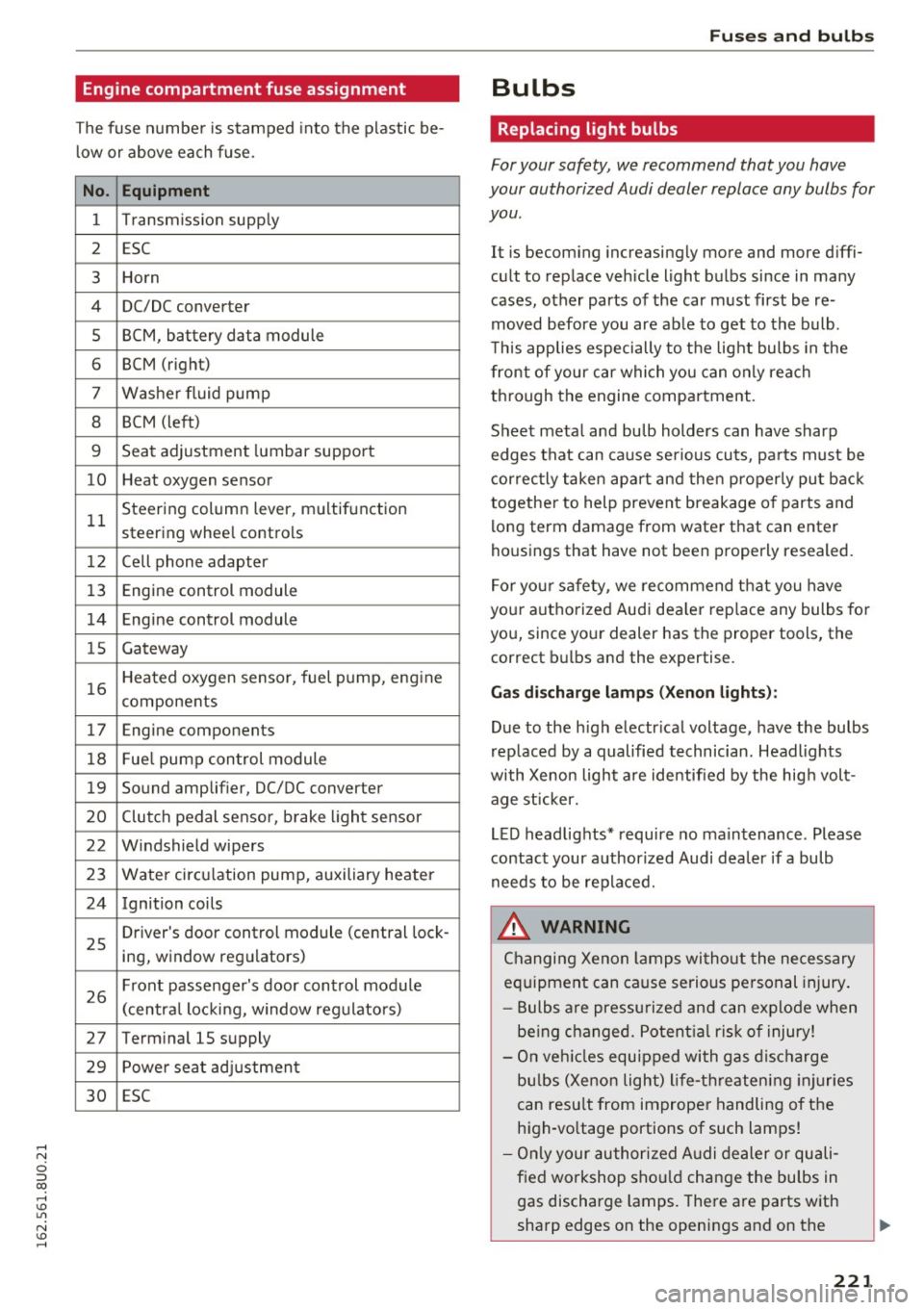
The fuse number is stamped into the plastic be
low or above each fuse.
No. Equipment
1 Transmiss ion supply
2 ESC
3 Horn
4 DC/DC
converter
5 BCM, battery data module
6 BCM (right)
7 Washer fluid pump
8 BCM (left)
9 Seat adjustment lumbar support
10 Heat oxygen sensor
11 Steering
column lever, multifunction
steering wheel contro ls
1 2 Cell phone adapter
13 Engine control
module
14 Engine control module
15 Gateway
16 Heated oxygen sensor, fuel pump,
engine
components
17 Engine components
18 Fue l pump control module
19 Sound
amplifier, DC/DC converter
20 Clutch pedal sensor, brake light sensor
22 Windshield wipers
23 Water circu
lation pump, auxiliary heater
24 Ignition coils
25 Driver's door
control module (central lock-
ing, window regu lators)
26 Front
passenger's door control module
(centra l locki ng, window reg ulators)
27 Terminal 15 supply
29 Powe r seat adjustment
30 ESC
Fuses an d bulb s
Bulbs
Replacing light bulbs
For your safety, we recommend that you have
your authorized Audi dealer replace any bulbs for
you .
It is becoming increasingly more and more diffi
cult to replace vehicle light bulbs since in many
cases, other parts of the car m ust first be re
moved before you are able to get to the bulb .
T his applies especially to the light bulbs in the
front of your car which you can only reach
through the engine compartment .
Sheet metal and bu lb holders can have sharp
edges that can cause serious cuts, pa rts must be
correctly taken apart and then properly put back
together to help prevent breakage o f parts and
long term damage from water that can enter
housings that have not been properly resealed.
For your safety, we recommend t hat you have
your authorized Aud i dea le r rep lace any bulbs fo r
you, since your dealer has the proper tools, the
correct bulbs and the expertise.
Gas di schar ge la mps (Xe no n light s):
Due to the high electr ical voltage, have the bulbs
rep laced by a qualified technician. Headlights
with Xenon light are identified by the hig h volt
age st icker.
LED headlights* require no maintenance . Please
contact your authorized Audi dea ler if a bulb
needs to be replaced.
_&. WARNING
Changing Xenon lamps wi thout the necessary
equipment can cause serious personal injury .
- Bulbs are pressu rized and can explode when
be ing changed. Potent ial ris k of injury!
- On veh icles equipped with gas disc harge
bu lbs (Xenon light) life-threatening injuries
can resu lt from improper handling of the
high-vo ltage portions of such lamps!
- Only your authorized A udi dealer or quali
fied workshop sho uld change the bulbs in
gas discharge lamps. There are parts with
sharp edges on the openings and on the
221