engine AUDI Q3 2016 Manual PDF
[x] Cancel search | Manufacturer: AUDI, Model Year: 2016, Model line: Q3, Model: AUDI Q3 2016Pages: 252, PDF Size: 62.81 MB
Page 222 of 252
Fuses and bulbs
(D Tips
- The following table does not list fuse loca
tions that are not used.
- Some of the equipment listed in the follow
ing tables applies only to certain model ver
sions or certain optional equipment.
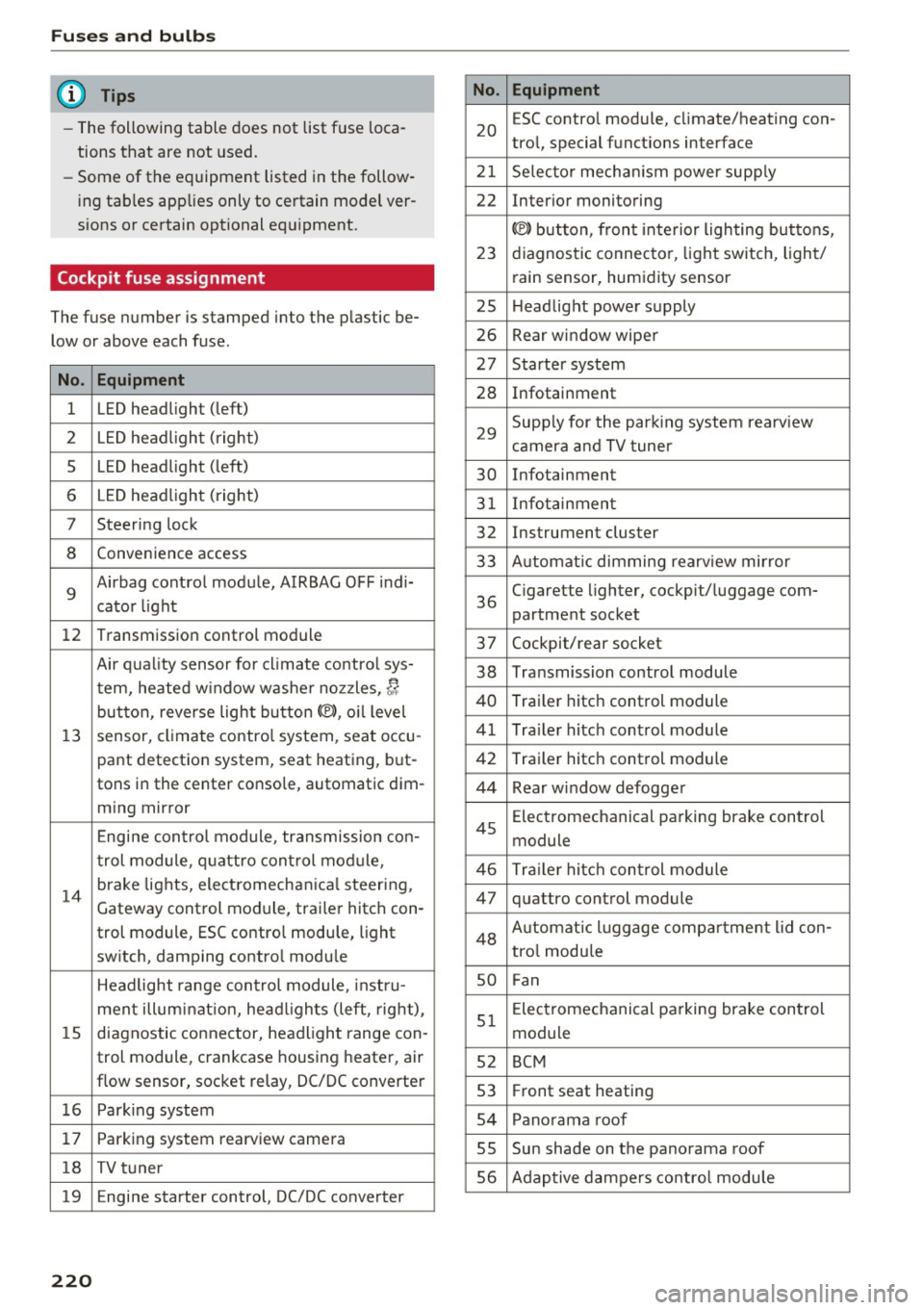
Cockpit fuse assignment
The fuse number is stamped into the plastic be
low or above each fuse.
No. Equipment
1 LED headlight (left)
2 LED headlight ( right)
5 LED headlight (left)
6 LED headlight (right)
7 Steering lock
8 Convenience access
9
Airbag control module, AIRBAG OFF indi-
cator light
12 Transmission control module
Air quality sensor for climate contro l sys-
tern, heated w indow washer nozzles,~
button, reverse light button<®>, oil level
13 sensor, climate control system, seat occu-
pant detection system, seat heating , but-
tons in the center console, automatic dim-
ming mirror
Engine control module, transmission con-
trol module, quattro control module,
14
brake lights, electromechanica l steering,
Gateway cont rol module, trailer hitch con-
trol module, ESC contro l module, light
switch, damping control module
Headlight range control module, instru-
ment illuminat ion, headl ights (left, right),
15 diagnostic connector, headlight range con-
trol module, crankcase housing heater, air
flow sensor, socket relay, DC/DC converter
16 Park ing system
17 Parking system rearview camera
18 TV tuner
19 E ngine starter control, DC/DC converter
220
No . Equipment
20
ESC contro l module, climate/heating con-
tro l, special functions interface
21 Selecto r mechanism power supply
22 Interior monitoring
© button, front interior lighting buttons,
23 diagnostic connector, light switch, light/
rain sensor, humidity sensor
25 Headlight power supply
26 Rear window wiper
27 Starter system
28 Infotainment
29
Supply for the park ing system rearv iew
camera and TV tuner
30 Infotainment
31 Infotainment
32 Instrument cluster
33 A utomat ic dimming rearview mirror
36
Cigarette lighter, cockpit/ luggage com-
partment socket
37 Cockpit/rear socket
38 Transmission control module
40 Trailer hitch control module
41 Trailer hitch control module
42 Trailer hitch control module
44 Rear window defogger
45
Electromechanical parking brake control
module
46 Trailer hitch control module
47 quattro control module
48 Aut omat ic lu ggage compartment lid con-
tro l module
so Fan
51
Electromechanical parking brake control
module
52 BCM
53 Fr ont seat heating
54 Panorama roof
55 Sun shade on the panorama roof
56 Adaptive dampers control module
Page 223 of 252
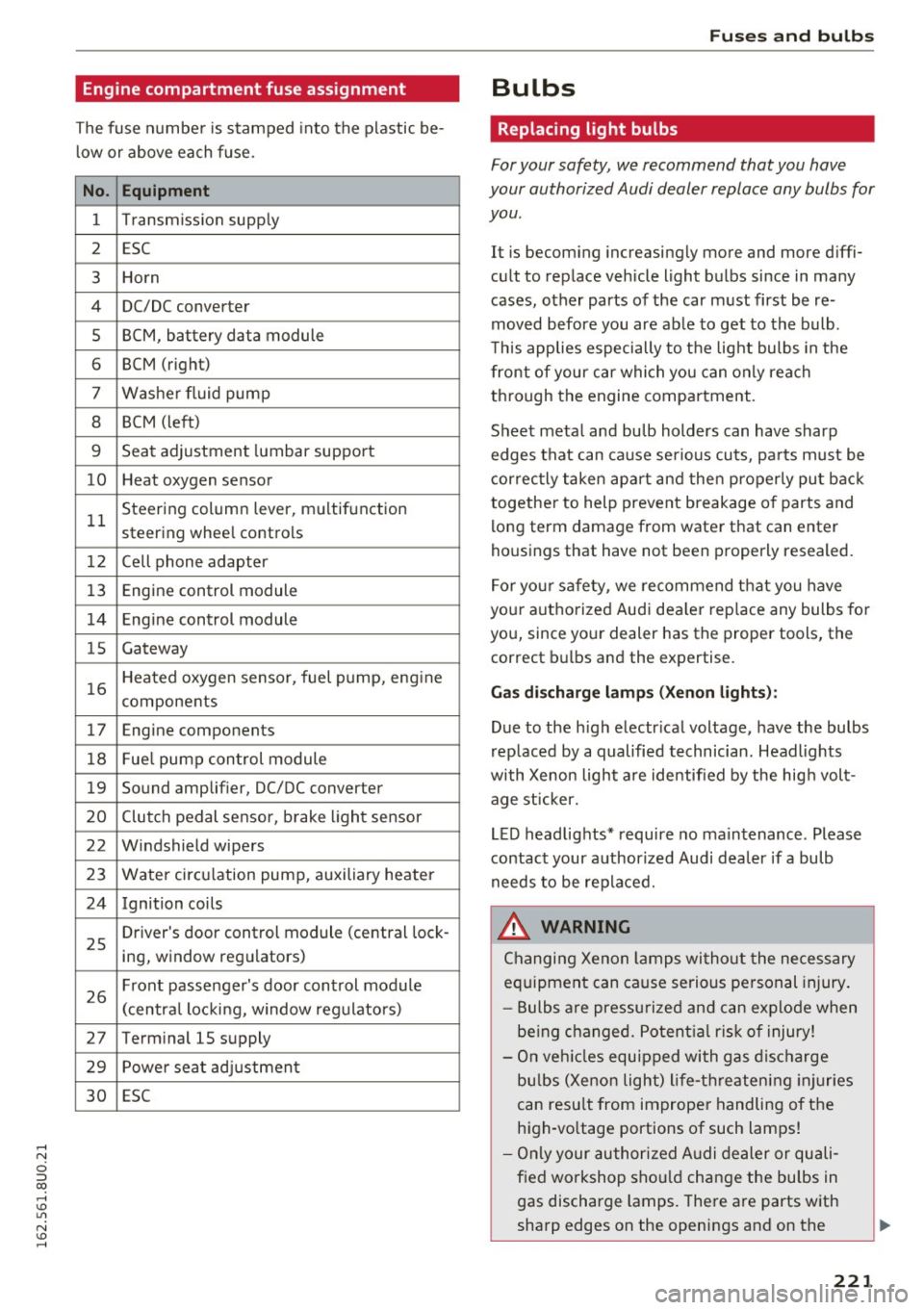
Engine compartment fuse assignment
The fuse number is stamped into the plastic be
low or above each fuse.
No. Equipment
1 Transmiss ion supply
2 ESC
3 Horn
4 DC/DC
converter
5 BCM, battery data module
6 BCM (right)
7 Washer fluid pump
8 BCM (left)
9 Seat adjustment lumbar support
10 Heat oxygen sensor
11 Steering
column lever, multifunction
steering wheel contro ls
1 2 Cell phone adapter
13 Engine control
module
14 Engine control module
15 Gateway
16 Heated oxygen sensor, fuel pump,
engine
components
17 Engine components
18 Fue l pump control module
19 Sound
amplifier, DC/DC converter
20 Clutch pedal sensor, brake light sensor
22 Windshield wipers
23 Water circu
lation pump, auxiliary heater
24 Ignition coils
25 Driver's door
control module (central lock-
ing, window regu lators)
26 Front
passenger's door control module
(centra l locki ng, window reg ulators)
27 Terminal 15 supply
29 Powe r seat adjustment
30 ESC
Fuses an d bulb s
Bulbs
Replacing light bulbs
For your safety, we recommend that you have
your authorized Audi dealer replace any bulbs for
you .
It is becoming increasingly more and more diffi
cult to replace vehicle light bulbs since in many
cases, other parts of the car m ust first be re
moved before you are able to get to the bulb .
T his applies especially to the light bulbs in the
front of your car which you can only reach
through the engine compartment .
Sheet metal and bu lb holders can have sharp
edges that can cause serious cuts, pa rts must be
correctly taken apart and then properly put back
together to help prevent breakage o f parts and
long term damage from water that can enter
housings that have not been properly resealed.
For your safety, we recommend t hat you have
your authorized Aud i dea le r rep lace any bulbs fo r
you, since your dealer has the proper tools, the
correct bulbs and the expertise.
Gas di schar ge la mps (Xe no n light s):
Due to the high electr ical voltage, have the bulbs
rep laced by a qualified technician. Headlights
with Xenon light are identified by the hig h volt
age st icker.
LED headlights* require no maintenance . Please
contact your authorized Audi dea ler if a bulb
needs to be replaced.
_&. WARNING
Changing Xenon lamps wi thout the necessary
equipment can cause serious personal injury .
- Bulbs are pressu rized and can explode when
be ing changed. Potent ial ris k of injury!
- On veh icles equipped with gas disc harge
bu lbs (Xenon light) life-threatening injuries
can resu lt from improper handling of the
high-vo ltage portions of such lamps!
- Only your authorized A udi dealer or quali
fied workshop sho uld change the bulbs in
gas discharge lamps. There are parts with
sharp edges on the openings and on the
221
Page 224 of 252
Fuses and bulbs
bulb holders that can ca use serio us cuts . If
yo u are uncertain about what to do, have
the work performed by an authorized Audi dealer or qualif ied workshop . Serious per
sonal in ju ry may resu lt from imprope rly per·
formed work .
@ Tips
-If you still prefer to rep lace the light bulbs
yourself, be aware that the engine compart ment is a haza rdous a rea to work
in Q page 177 ~&. .
- It is best to ask your authorized A udi dealer
whenever yo u want to change a b ulb.
222
Page 225 of 252
Emergency situations
General
This chapter is intended for trained emergency
crews and working personnel who have the nec
essary tools and equipment to perform these
operations.
Starting by pushing or
towing
(D Note
Vehicles with an automatic transmission
cannot be started by pushing or towing.
Starting with jumper
cables
If necessary, the engine can be started by con
necting it to the battery of another vehicle .
If the engine should fail to start because of a dis
charged or weak battery, the battery can be con
nected to the battery of
another vehicle, using a
pair of jumper cables to start the engine.
Jumper cables
Use only jumper cables of sufficiently large cross
section
to carry the starter current safely. Refer
to the manufacturer's specifications.
Use only jumper cables with
insulated terminal
clamps which are distinctly marked :
plus(+) cable in most cases colored red
minus(·) cable
in most cases colored black.
A WARNING
Batteries contain electricity, acid, and gas.
Any of these can cause very serious or fatal in
jury. Follow the instructions below for safe
handling of your vehicle's battery.
-Always shield your eyes and avoid leaning
over the battery whenever possible.
-A discharged battery can freeze at tempera
tures just below 32 °F (0 °C). Before con
necting a jumper cable, you must thaw the
Emergency situations
frozen battery completely, otherwise it
could explode .
- Do not allow battery acid to contact eyes or
skin. Flush any contacted area with water immediately.
- Improper use of a booster battery to start a
vehicle may cause an explosion.
- Vehicle batteries generate explosive gases.
Keep sparks, flame and lighted cigarettes
away from batteries.
- Do not try to jump start any vehicle with a
low acid level in the battery .
- The voltage of the booster battery must also
have a 12-Volt rating. The capacity (Ah) of
the booster battery should not be lower
than that of the discharged battery. Use of
batteries of different voltage or substantial
ly different "Ah" rating may cause an explo
sion and personal injury .
- Never charge a frozen battery. Gas trapped
in the ice may cause an explosion.
- Never charge or use a battery that has been
frozen . The battery case may have be weak
ened .
- Use of batteries of different voltage or sub
stantially different capacity (Ah) rating may
cause an explosion and injury. The capacity
(Ah) of the booster battery should not be
lower than that of the discharged battery.
- Before you check anything in the engine
compartment, always read and heed all
WARNINGS
r::!)page 177.
(D Note
-Applying a higher voltage booster battery
will cause expensive damage to sensitive
electronic components, such as control
units, relays, radio, etc.
- There must be no electrical contact between
the vehicles as otherwise current could al
ready start to flow as soon as the positive
(+) terminals are connected.
(D Tips
- The discharged battery must be properly
connected to the vehicle's electrical system. ..,.
223
Page 226 of 252
Emergency situations
When jump starting or charging the bat
tery, never connect the negative ground ca
ble to the battery negative post because the
battery manager system must be able to de
tect the battery's state of charge. Always
connect the negative ground cable to the
negative ground post of the battery manag
er contro l unit.
Use of jumper cables
Make sure to connect the jumper cable clamps in
exactly the order described below!
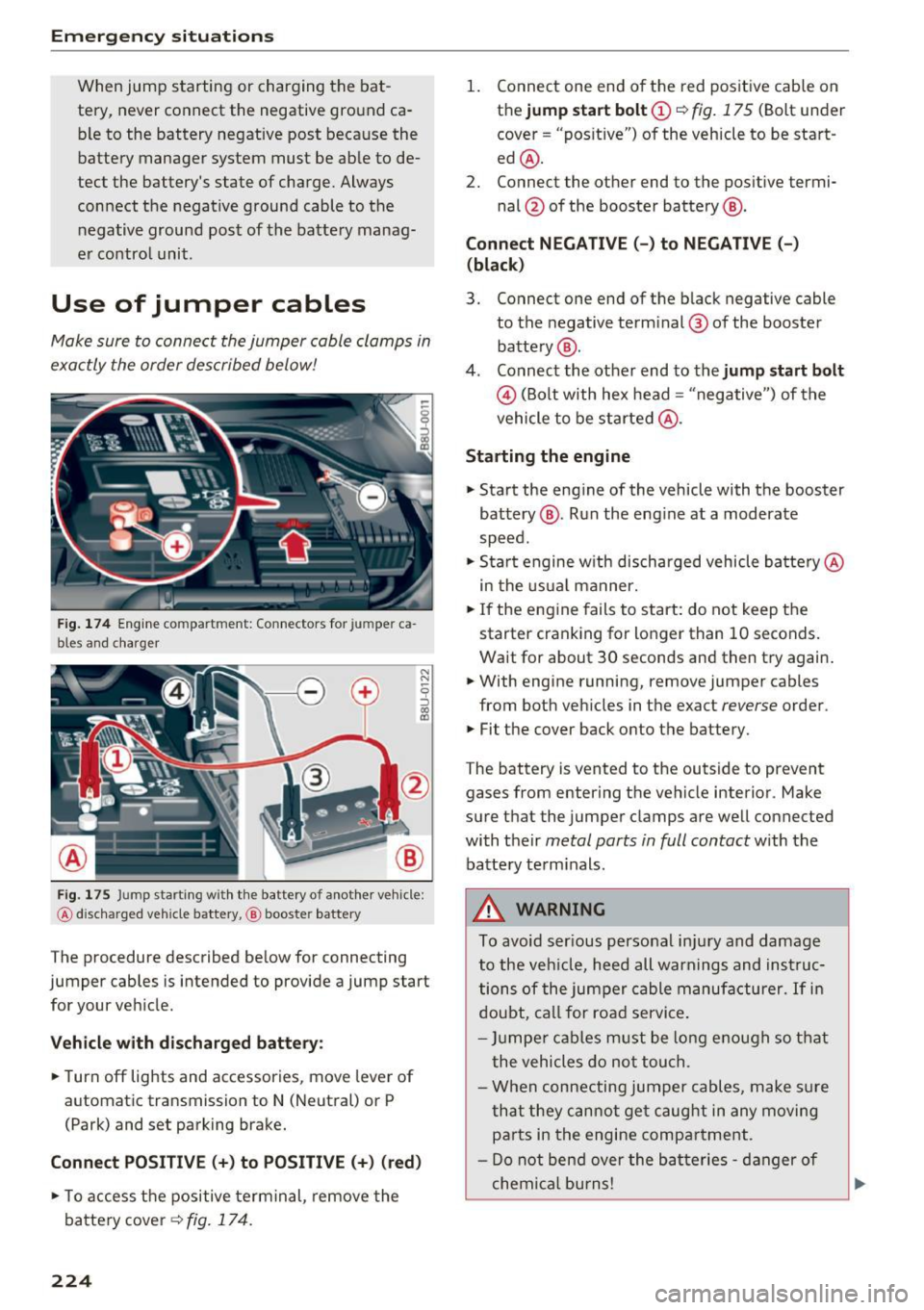
F ig . 1 74 Engine compar tment: Connectors for jumper ca
bles and charger
N N ~ 9 ::, 00 CXl
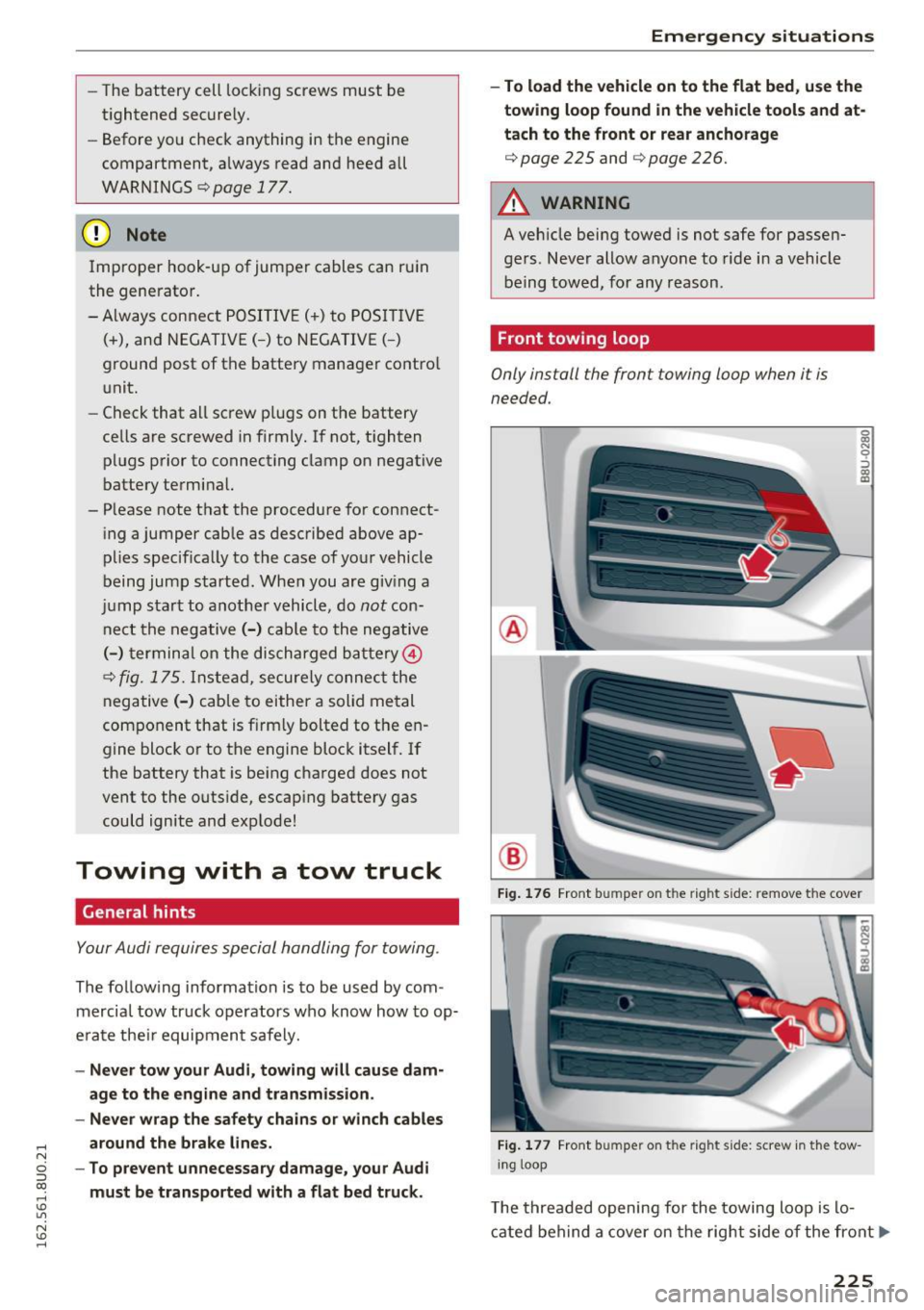
F ig. 175 Jump starti ng wit h the battery of another veh icle:
@ discharged vehicle battery,@booster battery
The procedure described below for connecting
jumper cables is intended to provide a jump start for your vehicle.
Vehicle with discharged battery:
• Turn off lights and accessories, move lever of
automatic transmission to N (Neutral) or P
(Park) and set parking brake.
Connect POSITIVE (+) to POSITIVE (+) (red)
• To access the positive terminal, remove the
battery cover
c::> fig. 17 4.
224
1. Connect one end of the red pos itive cable on
the
jump start bolt (D c::> fig. 175 (Bolt under
cover= "positive") of the vehicle to be start
ed @.
2. Connect the other end to the positive termi-
nal @ of the booster battery @.
Connect NEGATIVE (- ) to NEGATIVE (-)
(black)
3. Connect one end of the black negative cable
to the negative term inal @ of the booster
battery @.
4. Connect the other end to the
jump start bolt
@ (Bolt with hex head = "negative") of the
vehicle to be started @.
Starting the engine
• Start the eng ine of the vehicle with the booster
battery @. Run the eng ine at a moderate
speed.
• Sta rt engine w ith discharged vehicle ba ttery @
in the usual manner.
• If the engine fails to start: do not keep the
starter cranking for longer than 10 seconds.
Wait for about 30 seconds and then try again.
• With engine running, remove jumper cables
from both vehicles in the exact
reverse order.
• Fit the cover back onto the battery.
The battery is vented to the outside to prevent
gases from entering the vehicle interior . Make
sure that the jumper clamps are well connected
with their
metal parts in full contact with the
battery terminals.
&_ WARNING
To avoid ser ious personal injury and damage
to the vehicle, heed all warnings and instruc
tions of the jumper cable manufacturer. If in
doubt, call for road service.
- Jumper cables must be long enough so that
the vehicles do not touch .
- When connecting jumper cables, make sure
that they cannot get caug ht in any moving
parts in the engine compartment.
- Do not bend over the batteries - danger of
chemical burns!
Page 227 of 252
.... N
c:i ::J CX)
.... I.Cl U"I
N I.Cl ......
-The battery cell lock ing screws must be
t ightened secure ly.
- Befo re yo u check anything in the en gine
compartment, a lways read and heed a ll
WARNINGS
¢ page 177.
(D Note
Imp ro per hook -u p of jum pe r cables can r uin
the gene rato r.
-Always con nect POSIT NE
(+ ) to POSITI VE
(+ ), and NEGATIVE( -) to NEGATIVE( -)
ground post of the battery manager contro l
u nit .
- Check that all sc rew p lugs on the batter y
ce lls are screwed in firmly . If not, t ighten
pl ugs prior to connecting clamp on negative
batte ry te rminal.
- Please note t hat the procedure fo r con nect
i ng a jumper cab le as desc ribed above ap
p lies specif ica lly to the case of yo ur vehicle
being jump start ed. Wh en you are giv ing a
ju mp sta rt to anothe r vehicle, do
not con
n ec t t he neg ative (-) ca b le to the negative
( -) t ermina l on the disch arged b attery @
¢
fig. 175. In ste ad , secure ly connec t the
negative( -) ca b le to either a solid me tal
com ponent th at is f irm ly bolted to the e n
gine block o r to t he engine block i tsel f. If
the battery that is be ing c ha rged does not
vent to the outs ide, escap ing batte ry ga s
could ignite and exp lode!
Towing with a tow truck
General hints
Your Audi requires s pecial handling for towing .
The following informa tion is to be used by com
mercia l tow tr uck operators who know how to op
e ra te the ir equip men t safely.
- Ne ver tow your Audi, towing will cause dam
age to the engine and transmission .
- Never wrap the safety chains or winch cables
around the brake lines.
- To prevent unnecessary damage, your Audi
must be transported with a flat bed truck .
Emergency situations
-To load the vehicle on to the flat bed , use the
towing loop found in the vehicle tools and at
tach to the front or rear anchorage
¢ page 225 and ¢ page 226.
A WARNING
A veh icle being towed is not safe for passen
ge rs. Neve r allow a nyo ne to ride in a vehicle
b eing towed, for any reason .
Front towing loop
Only ins tall the front towing loop when i t is
needed .
®
®
-
0 0) N 9 ::>
gi
Fig. 176 Front bum pe r o n th e rig "h t side : remove t he co ver
Fi g. 177 Fron t bum per o n th e right sid e: screw in t he tow
in g loop
The threaded opening for the towing loop i s lo
cate d be hind a cove r on t he rig ht side of the front .,.
225
Page 229 of 252
.... N
c:i ::J CX)
.... I.Cl U"I
N I.Cl ......
Front hook up
• Align the vehicle w ith the centerline of the car
earner ramp .
• Attach the winch hook to the front towline eye
previously installed.
Rear hook up
• Al ign the vehicle w ith the centerline of the car
carr ier ramp .
• Attach the winch hook to the rear towline eye
previously installed.
@ Tips
Check carefully to make sure the hook-up is
secure befo re moving the car up the flatbed
truck ramp.
Raising the vehicle
Lifting with workshop hoist and with floor
jack
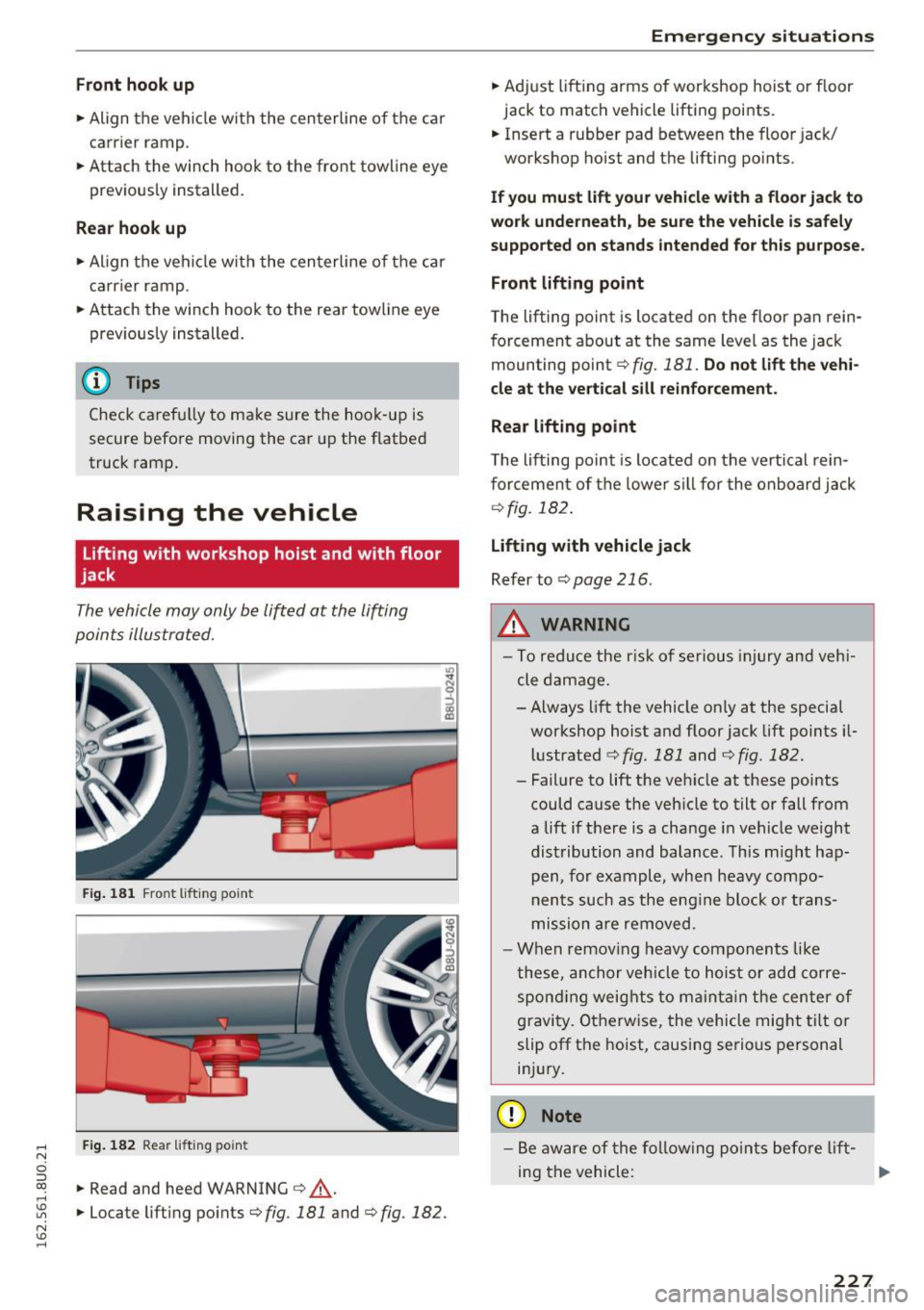
The vehicle may only be lifted at the lifting
points illustrated.
Fig. 181 Front lifting point
F ig . 182 Rear lifting point
• Read and heed WARNING¢,&..
I
• Locate lifting points ¢fig.181 and ¢ fig. 182.
Emergency situations
• Adjust lifting arms of workshop hoist or floor
jack to match vehicle lifting points .
• Insert a rubber pad between the floor jack/
workshop hoist and the lifting points .
If you must lift your vehicle with a floor jack to
work underneath, be sure the vehicle is safely
supported on stands intended for this purpose .
Front lifting point
T he lifting point is located on the floor pan rein
forcement about at the same level as the jack
mounting point ¢
fig. 181. Do not lift the vehi
cle at the vertical sill reinforcement .
Rear lifting point
The lifting point is located on the vertical rein
forcement of the lower sill for the on board jack
¢fig . 182.
Lifting with vehicle jack
Refer to¢ page 216.
&_ WARNING
- To reduce the risk of se rious injury and vehi
cle damage.
- Always lift the vehicle on ly at the special
workshop hoist and floor jack lift points il
lustrated ¢
fig. 181 and ¢ fig. 182.
- Failure to lift the vehicle at these points
could cause the vehicle to tilt or fall from
a lift if there is a change in vehicle weight
distribution and balance . This might hap
pen, for example, when heavy compo
nents such as the engine block or trans
mission are removed.
- When remov ing heavy components like
these, anchor vehicle to hoist or add corre
sponding weights to maintain the center of
gravity. Otherw ise, the vehicle might tilt or
slip off the hoist, causing serious personal
injury .
([) Note
-Be aware of the following points before lift-
ing the vehicle: ..,_
227
Page 230 of 252
Emergency situations
-The vehicle should never be lifted or
jacked up from underneath the engine oil
pan, the transmission housing, the front
or rear axle or the body side members.
This could lead to serious damage.
- To avoid damage to the underbody or
chassis frame, a rubber pad must be in
serted between the floor jack and the lift
points .
- Before driving over a workshop hoist,
check that the vehicle weight does not
exceed the permissible lifting capacity of
the hoist .
- Before driving over a workshop hoist, en
sure that there is sufficient clearance be
tween the hoist and low parts of the ve hicle.
228
Page 231 of 252
.... N
c:i ::J CX)
.... I.Cl U"I
N I.Cl ....
Technical data
Vehicle identification
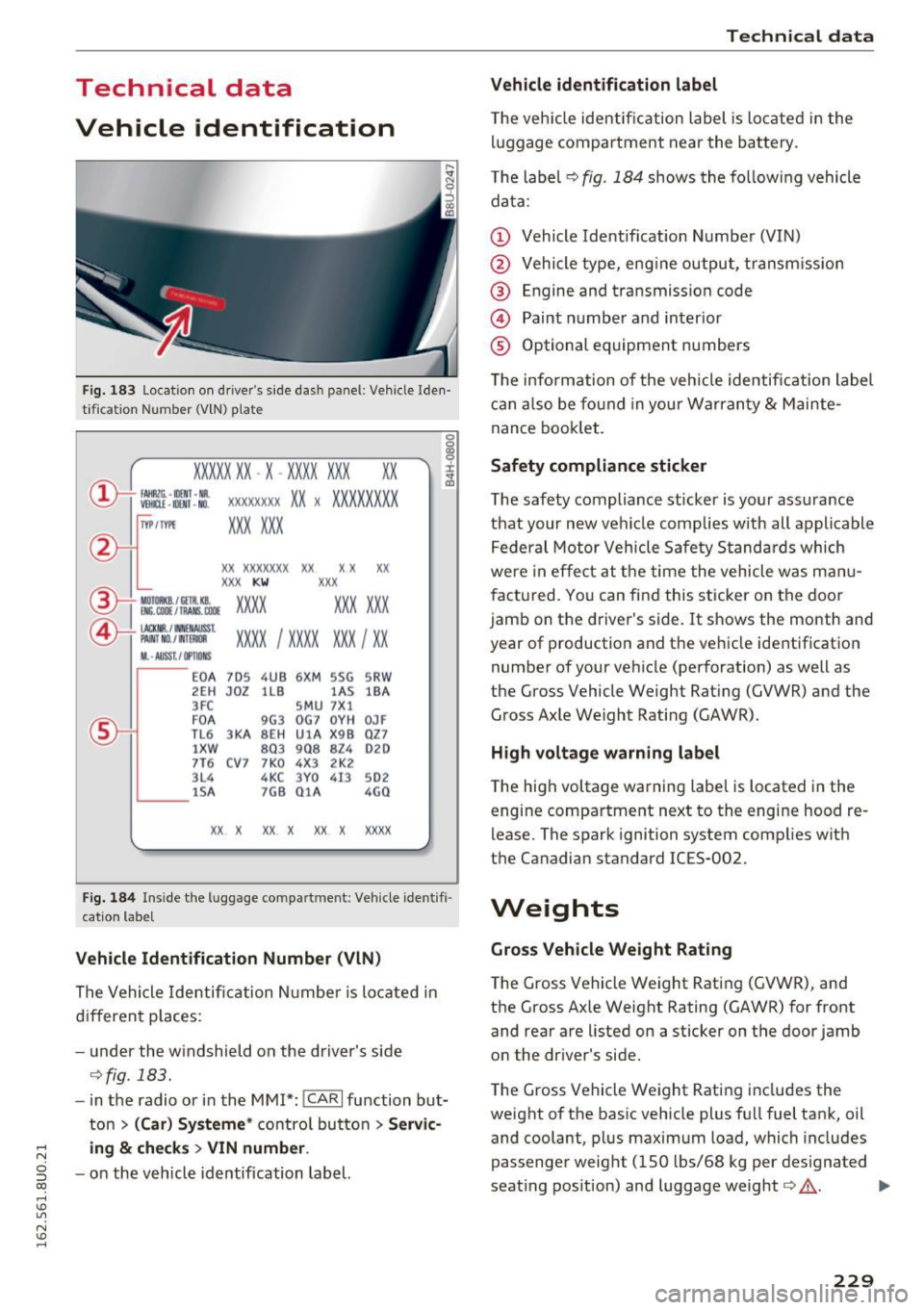
F ig. 183 Location on d river 's side dash panel: Vehicle Iden·
ti fic ation Number (VlN) p late
XXXXX XX -X -XXXX XXX XX
CD+ ~t :1:: xxxxxxxx xx x xxxxxxxx
TVP/fffl XXX XXX
XX XXXXXXX XX X X xx
XXX KW XXX
®i ~:J·f lfils~~ XXXX XXX XXX
®-+ ~N:a=i~l xxxx ; xxxx xxx ; xx
II. · AUSS, I OPTIONS
,__ __
EO A 7D5
2EH J0Z
3FC
FOA
TL6 3KA
lXW
7T6 CV7
3L4
lSA
4UB 6XM 5SG
llB l AS
SMU 7Xl
9G3 0G7 0YH
8EH
Ul A X 98
803 908 824
7K0 4X3 2K2
4KC 3Y0 413
7GB 01A
5RW
18 A
0JF
Q Z7
020
502
4G0
XX . X XX X XX X XXXX
Fig. 184 Inside the luggage compartment: Vehicle identifi
cat ion labe l
Veh icle Identification Number (VlN )
The Vehicle Identification Number is located in
different p laces :
- under the windshield on the driver's side
¢ fig . 183.
-in the radio or in the MMI*: !CARI function but
ton
> ( Car ) Systeme * control button > Servic
ing
& checks > VIN number .
-on the vehicle identification label.
Technical data
Vehicle identification label
The veh icle identification label is located in the
luggage compartment near the battery.
T he label¢
fig. 184 shows the following vehicle
data:
(D Vehicle Identification Number (VIN)
@ Vehicle type, eng ine output, transm ission
@ Engine and transmission code
@ Paint number and interior
® Optional equipment numbers
T he information of the veh icle identification label
can also be found in your Warranty
& Mainte
nance booklet.
Safety compliance sticker
The safety compliance sticker is your assurance
that your new vehicle complies w ith all applicable
Federal Motor Vehicle Safety Standards which
were in effect at the time the vehicle was manu
factured. You can find this sticker on the door
jamb on the driver 's side. It shows the month and
year of production and the vehicle identification number of your vehicle (perforation) as well as
the Gross Vehicle Weight Rat ing (GVWR) and the
Gross Axle Weight Rating (GAWR).
H igh voltage warning label
The high voltage warning label is located in the
engine compartment next to the engine hood re
lease. The spark ignition system complies with
the Canadian standard ICES-002.
Weights
Gross Vehicle Weight Rating
The Gross Vehicle Weight Rating (GVWR), and
the Gross Axle Weight Rating (GAWR) for front
and rear are listed on a sticker on the door jamb
on the driver 's side.
The Gross Vehicle Weight Rating includes the
weight of the basic vehicle plus full fuel tank, oil
and coolant, plus maximum load, which includes
passenger weight (150 lbs/68 kg per des ignated
seating position) and luggage weight
c:> .&, . .,.
229
Page 233 of 252
Gasoline engines
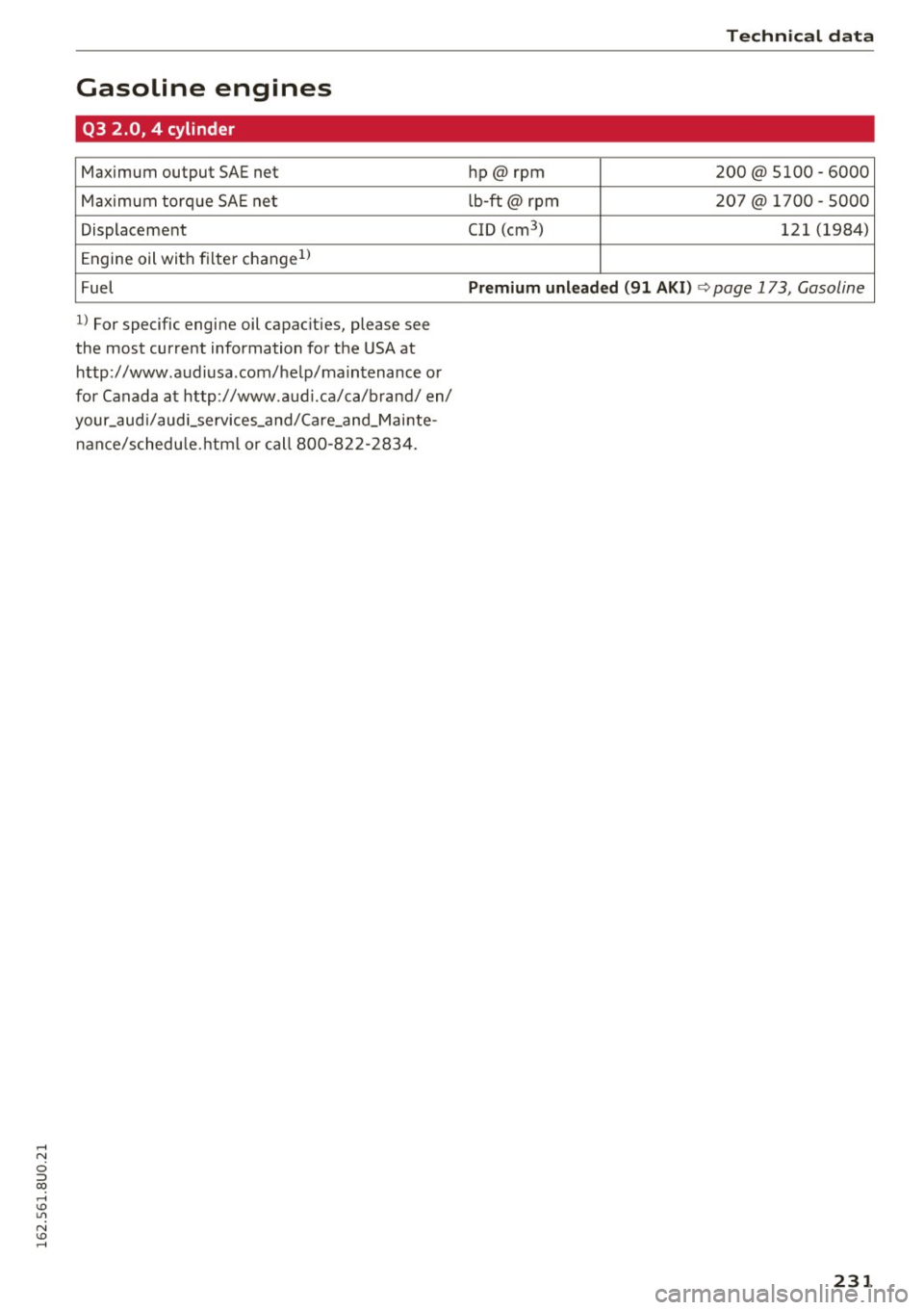
Q3 2.0, 4 cylinder
Maximum output SAE net
Max imum torq ue SAE net
Displacement
E ngine oil wi th f ilter change
1>
Fuel
ll For specific engine oil capacities, please see
the most current information for the USA at
http:/ /www .aud iusa .com/ help/ma intenance or
for Canada a t http:/ /www .audi.ca/ca/b rand/ en/
your _aud i/ aud i_services_a nd/Care_and_M a i n te
n a nce/ schedu le. htm l or call 800 -82 2-2834.
Techn ical data
hp@ rpm 200@ 5100 -6000
l b -ft@ rpm 207 @ 1700 -5000
CID (cm
3 ) 121 (1984)
Premium unleaded (91 AKI) c::> page 173, Gasoline
231