warning AUDI Q3 2017 Owner´s Manual
[x] Cancel search | Manufacturer: AUDI, Model Year: 2017, Model line: Q3, Model: AUDI Q3 2017Pages: 236, PDF Size: 58.93 MB
Page 170 of 236
Checking and Filling
Brake fluid
N
N
~ N ,l: a, CXl
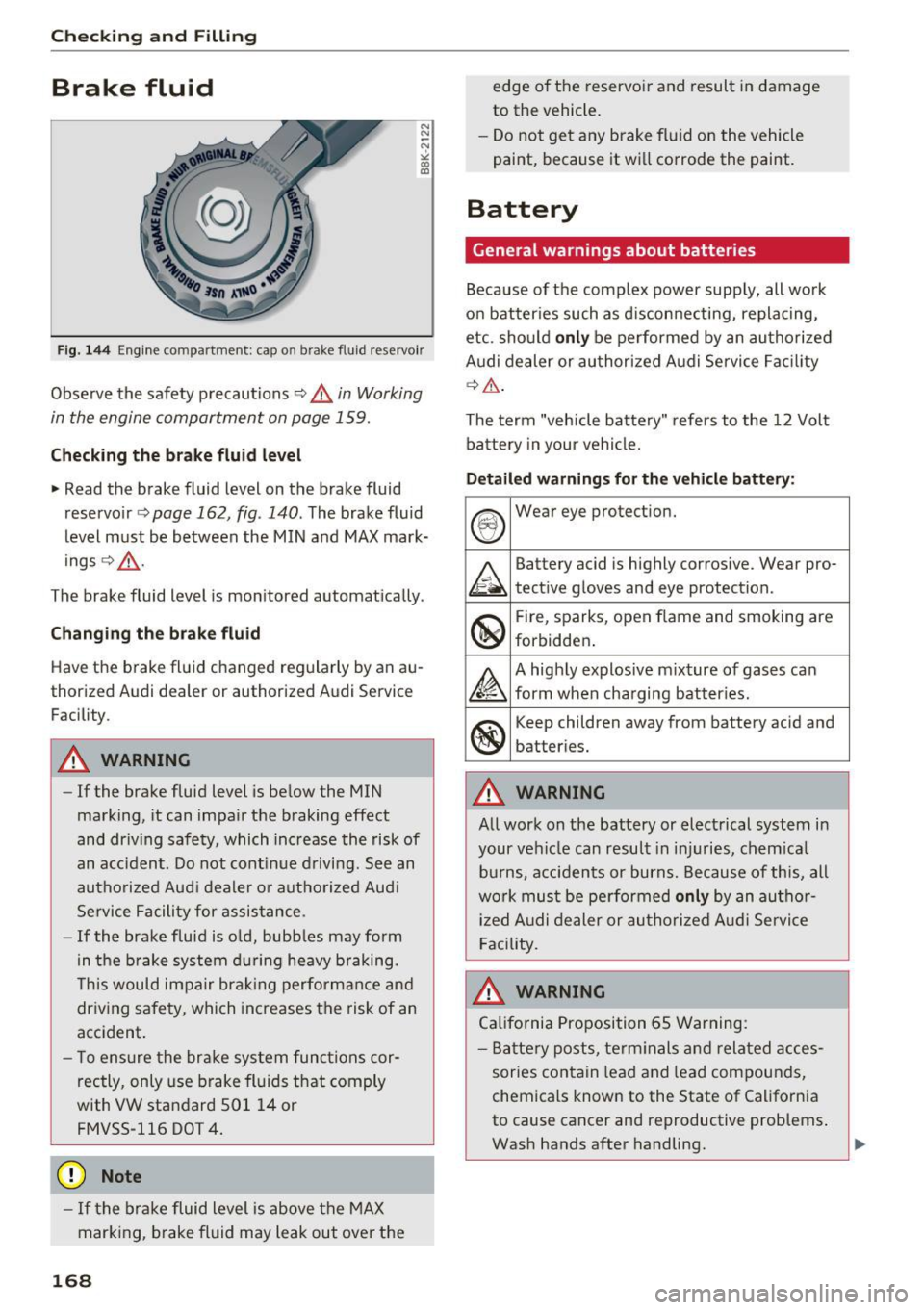
Fig. 14 4 Engine compartment: cap on brake fluid reservoir
Observe the safety precautions c:::> .&. in Working
in the engine compartment on page 159.
Checking th e br ake fluid l evel
.- Read the brake fluid level on the brake fluid
reservoir
c:::> page 162, fig . 140 . The brake fluid
level must be between the MIN and MAX mark
ings
c:::> ,&. .
The brake fluid level is monitored automatically .
Chang in g the b ra ke flu id
Have the brake fluid changed regularly by an au
thorized Audi dealer or authorized Audi Service
Facility .
A WARNING
-If the brake fluid level is below the MIN
marking, it can impair the braking effect
and dr iving safety, which increase the risk of
an accident. Do not cont inue driving . See an
authorized Aud i dealer or autho rized Audi
Service Facility for assistance.
- If the brake fluid is o ld, bubbles may form
in the b rake system du ring heavy b raking.
This would impair brak ing performance and
driving safety, which increases the risk of an
accident.
- T o ensure the brake system functions cor
rectly, only use brake fluids t hat comply
with VW standard 501 14 or
FMVSS-116 DOT 4.
(D Note
-If the brake fluid level is above the MAX
mark ing, brake fluid may leak out over the
168
edge of the reservoir and result in damage
to the vehicle.
- Do not get any brake fluid on the vehicle
paint, because it will corrode the paint.
Battery
General warnings about batteries
Because of the comp lex power supp ly, all wo rk
on batter ies such as d isconnecting, replacing,
etc. should
only be performed by an authorized
Audi dealer or authorized A udi Service Fac ility
c:::> &. .
The term "veh icle battery" refers to the 12 Volt
ba tte ry in your vehicle.
D etail ed warning s for th e vehicle batte ry:
®
Wear eye protection.
A
Battery acid is highly corrosive. Wear pro-
tect ive gloves and eye protection.
@
Fire, sparks, open flame and smoking are
forbidden .
&
A highly explosive m ixture of gases can
form when charging batter ies.
@
Keep children away from battery acid and
batteries.
A WARNING
All work on the battery or electrical system in
your vehicle can result in injuries, chem ica l
bu rns, acciden ts or burns. Because of this, all
wo rk mus t be performed
only by an autho r
i zed A udi dealer or authorized Aud i Service
Facility.
A WARNING
Ca lifornia Proposition 65 Warning:
- Batte ry posts, te rm inals and related acces
sories contain lead and lead compounds,
chemicals known to the State of California
to cause cancer and reproductive problems.
Wash hands after handling.
-
Page 171 of 236
a:,
a:,
...... N r--. N .... 0 0 ::, a:,
(D Note
Protect the vehicle battery against freezing if
the vehicle will be parked for long periods of time so that it is not destroyed by "freezing"
c;,page 169. Make sure that the vehicle bat
tery is charged.
@) For the sake of the environment
¥ Batteries contain polluting substances such
as sulfuric acid and lead. Contact an author
ized Audi dealer or authorized Audi Service
Facility for more information .
Charging the vehicle battery
Applies to: Q3
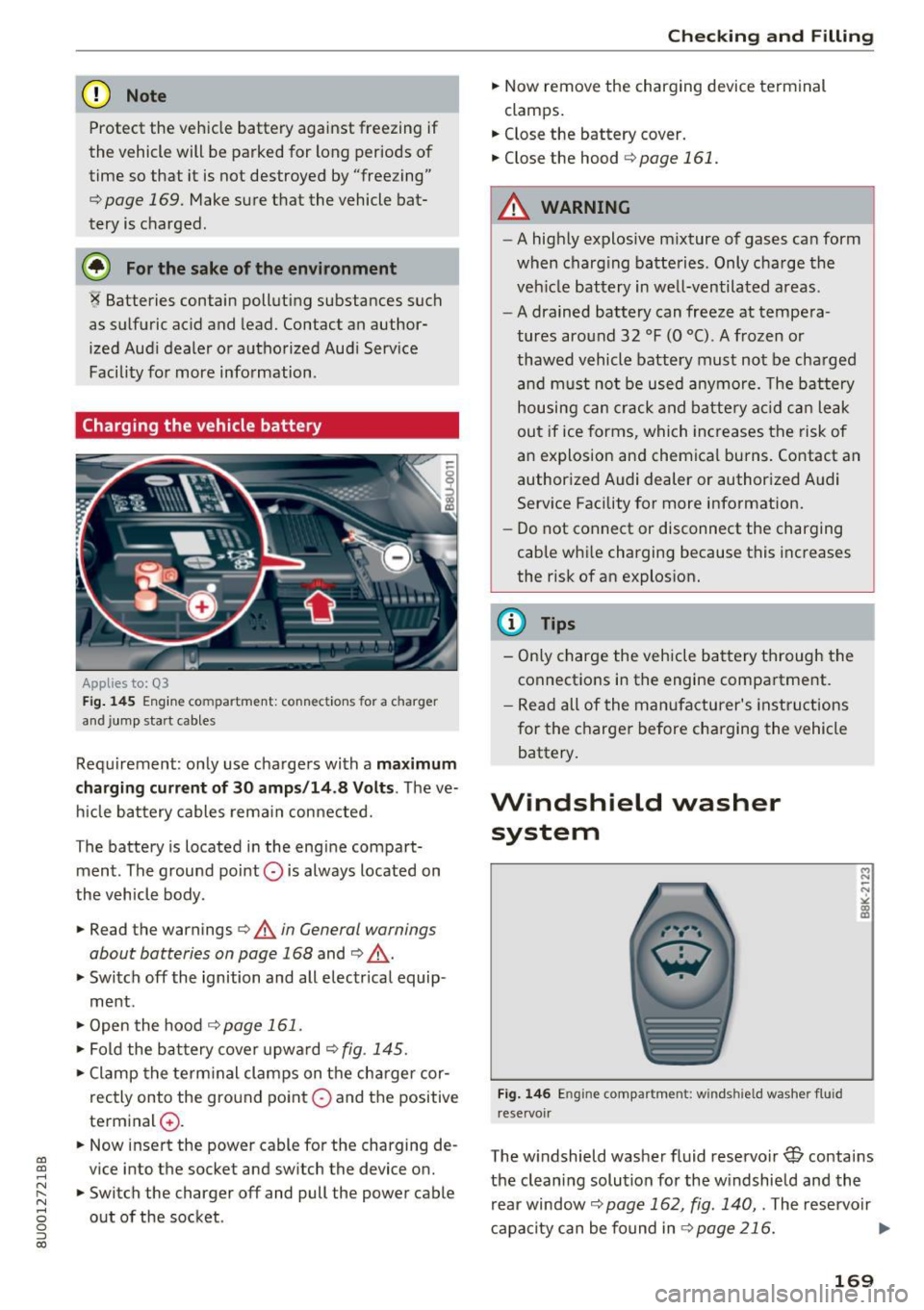
Fig. 145 Engine compartment: connections for a charg er
and jump start cables
Requirement : only use chargers with a maximum
charging current of 30 amps/14.8 Volts .
The ve
hicle battery cables remain connected.
The battery is located in the engine compart
ment. The ground point
0 is always located on
the vehicle body .
.,. Read the warnings
c;, .&. in General warnings
about batteries on page 168
and c;, .&, .
.,. Switch off the ignition and all electrical equip-
ment .
.,. Open the hood
c;, page 161 .
.,. Fold the battery cover upward c;, fig. 145 .
.,. Clamp the terminal clamps on the charger cor
rectly onto the ground point
0 and the positive
terminal
0 .
.,. Now insert the power cable for the charging de
vice into the socket and switch the device on.
.,. Switch the charger off and pull the power cable
out of the socket .
Checking and Filling
.,. Now remove the charging device terminal
clamps.
.,. Close the battery cover.
.,. Close the hood
c;, page 161.
A WARNING
-- A highly explosive mixture of gases can form
when charging batteries. Only charge the
veh icle battery in well-ventilated areas.
- A drained battery can freeze at tempera
tures around 32 °F (0 °C) . A frozen or
thawed vehicle battery must not be charged
and must not be used anymore . The battery
housing can crack and battery acid can leak
out if ice forms, which increases the risk of
an explosion and chemical burns. Contact an
authorized Audi dealer or authorized Audi
Service Facility for more information.
- Do not connect or disconnect the charging
cable while charging because this increases
the risk of an explosion.
@ Tips
- Only charge the vehicle battery through the
connections in the engine compartment.
- Read all of the manufacturer's instructions
for the charger before charging the vehicle
battery.
Windshield washer system
Fig. 146 Engine compar tmen t: win ds hiel d washer flu id
re servoir
M N
-N ~ (D a,
The windshield washer fluid reservoir W contains
the cleaning solution for the windshield and the rear window
c;, page 162, fig . 140, . The reservoir
capacity can be found in
c;,page 216. .,.
169
Page 178 of 236
Wheels
"XL" "xl" "EXTRA LOAD" or "RF" I I I
on the sidewall.
Rim
means a metal support for a tire
or a tire and tube assembly upon
which the tire beads are seated.
Rim diameter
means nominal diameter of the
bead seat . If you change your
wheel size, you w ill have to p ur
chase new tires to match the new rim diameter .
Rim size designation
means rim diameter and width.
Rim width
means nomina l distance between
rim flanges.
S idewall
means that portion of a tire be
tween the tread and bead .
Speed rating (letter code)
means the speed at which a tire is
designed to be driven for extend
ed periods of time. The rat ings
range from 93 mph (150 km/h)
to 186 mph (298 km/h)
¢ table
on page 172.
You may not find
this information on all tires be
cause it is not requ ired by law.
1 76
The speed rating letter code,
where applicable, is molded on
the tire sidewall and ind icates the
maximum permissible road
speeds
¢ .&. in Winter tires on
page 186.
Tire pressure monitoring system*
means a system that detects
when one or mo re of a vehicle's
tires are underinflated and illum i
na tes a low tire pressure warning
telltale .
Tread
means that portion of a tire that
comes into contact w ith the road .
Tread separation
means pulling away o f the tread
from the t ire carcass .
Treadwear indicators (TWI)
means the projections within the
principal grooves designed to give
a visua l indication of the deg rees
of wear of the tread. Se e
¢ page 180, Treadwear indicator
for more information on measur-
ing tire wear. .,.
Page 181 of 236
a)
a)
.... N r-N .... 0
0
::, a)
For this reason, in case of emer
gency, only use a spare tire that
has the same circumference as
the regular tires.
& WARNING -
-Only use tire/rim combina
tions and suitable wheel bolts
that have been approved by
Audi. Otherwise, damage to
the vehicle and an accident
could result.
-For technical reasons, it is not possible to use tires from oth
er vehicles - in some cases,
you cannot even use tires from
the same vehicle model.
-Make sure that the tires you select have enough clearance
to the vehicle . Replacement
tires should not be chosen
simply based on the nominal
size, because tires with a dif
ferent construction can differ greatly even if they are the
same size. If there is not
enough clearance, the tires or
the vehicle can be damaged
and this can reduce driving
safety and increase the risk of
an accident.
-Only use tires that are more
than six years old when abso-
Wheels
lutely necessary and drive
carefully when doing so.
-Do not use run-flat tires on
your vehicle . Using them when
not permitted can lead to ve
hicle damage or accidents.
-If you install wheel covers on
the vehicle, make sure they al low enough air circulation to
cool the brake system. If they
do not, this could increase the
risk of an accident.
Tire wear/damage
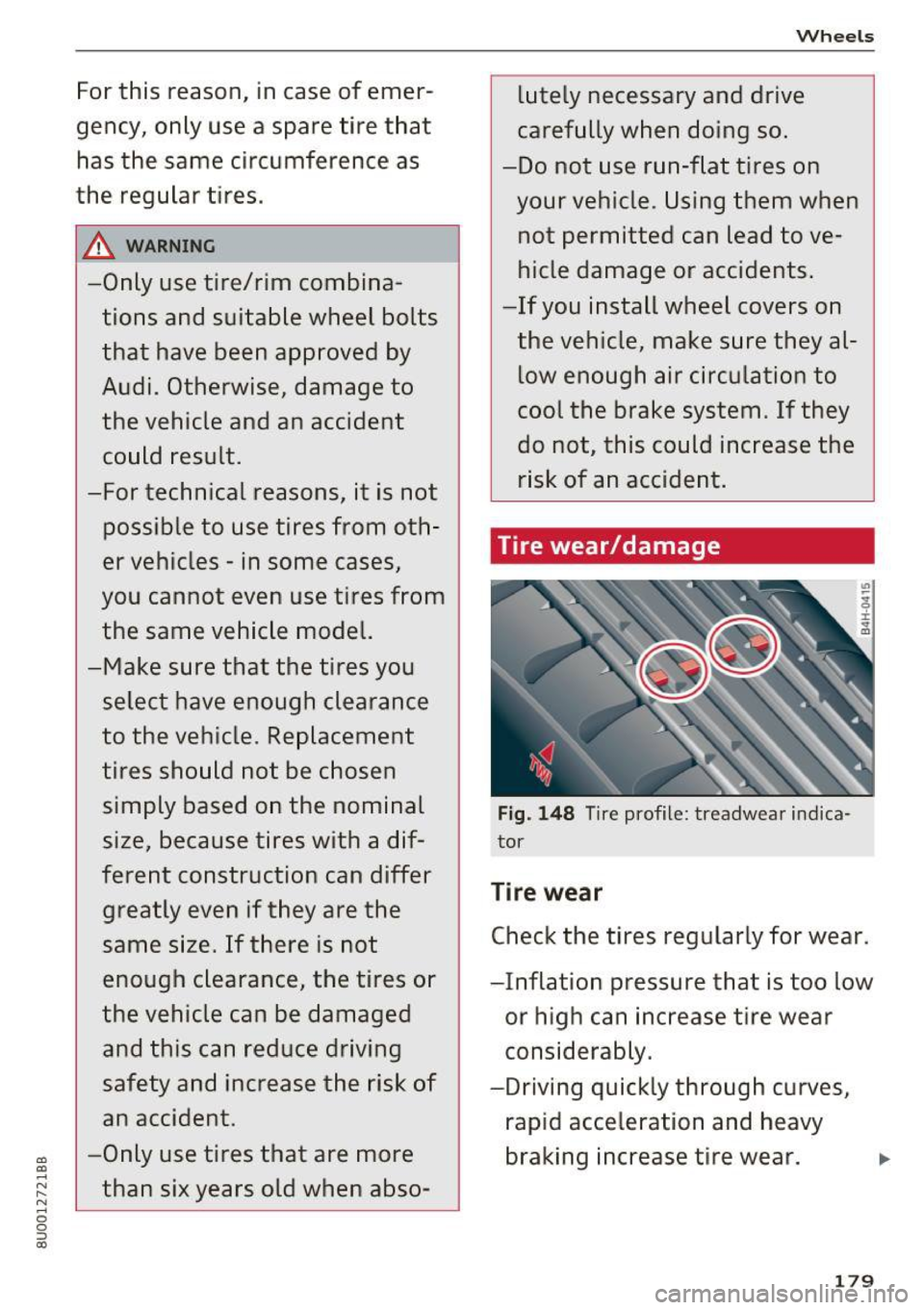
Fig. 148 Tire profile: treadwear indica
tor
Tire wear
Check the tires regularly for wear.
-Inflation pressure that is too low or high can increase tire wear
considerably.
-Driving quickly through curves, rapid acceleration and heavy
braking increase tire wear.
179
Page 182 of 236
Wheels
-Have an authorized Audi dealer or authorized Audi Service Facili
ty check the wheel alignment if
there is unusual wear .
-Have the wheels rebalanced if an
imbalance is causing noticeable
vibration in the steering wheel. If you do not, the tires and other
vehicle components could wear more quickly.
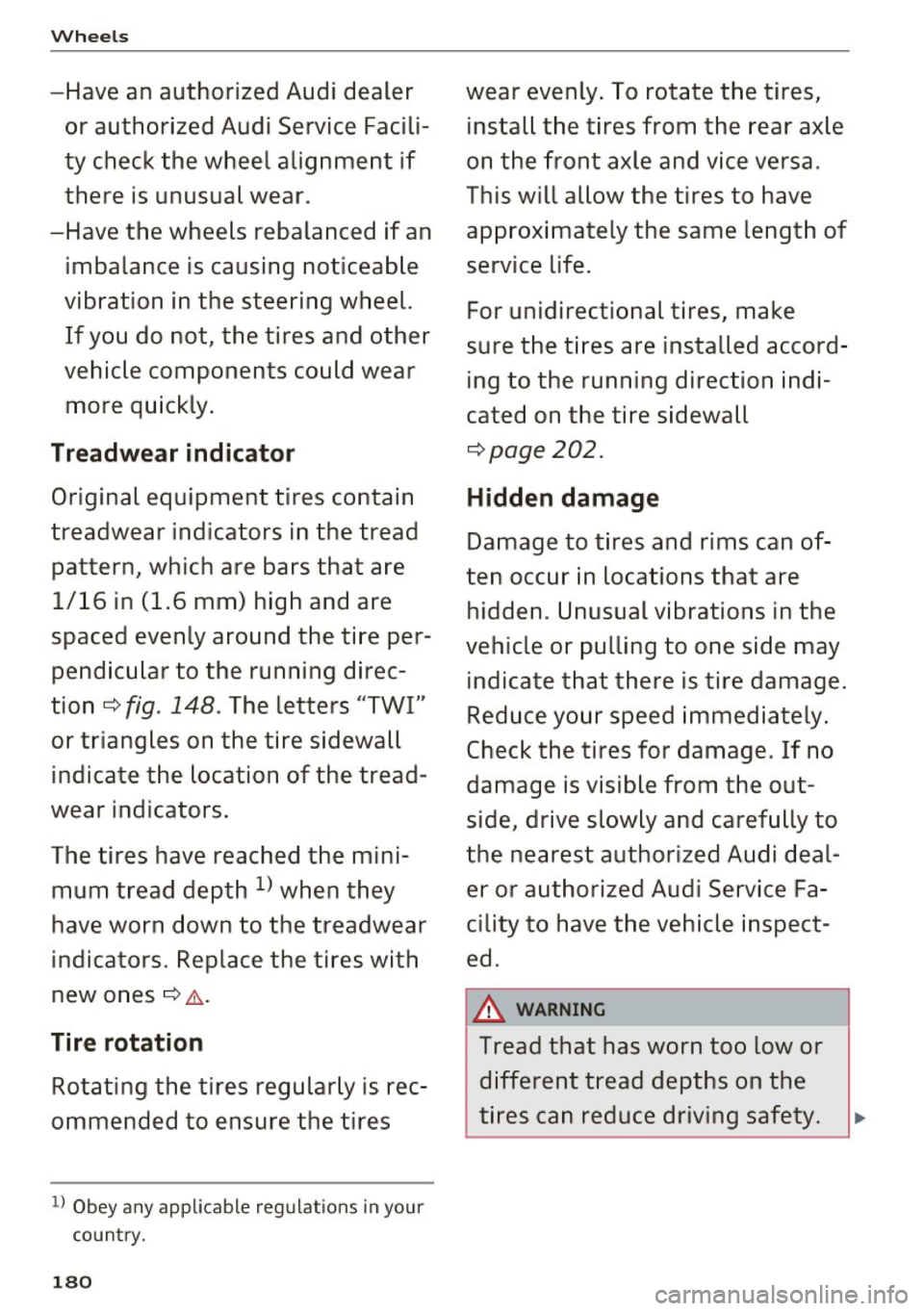
Treadwear indicator
Original equipment tires contain
treadwear indicators in the tread
pattern, which are bars that are 1/16 in (1.6 mm) high and are
spaced evenly around the tire per pendicular to the running direc
tion
¢ fig . 148 . The letters "TWI"
or triangles on the tire sidewall indicate the location of the tread
wear indicators .
The tires have reached the mini mum tread depth
l) when they
have worn down to the treadwear
indicators. Replace the tires with
new ones
¢ ..&. .
Tire rotation
Rotating the tires regularly is rec
ommended to ensure the tires
1> Obey any applicable regulations in your
country.
180
wear evenly. To rotate the tires,
install the tires from the rear axle
on the front axle and vice versa .
This will allow the tires to have
approximately the same length of
service life.
For unidirectional tires, make
sure the tires are installed accord
ing to the running direction indi
cated on the tire sidewall
¢page 202.
Hidden damage
Damage to tires and rims can of
ten occur in locations that are hidden . Unusual vibrations in the
vehicle or pulling to one side may indicate that there is tire damage.
Reduce your speed immediately.
Check the tires for damage . If no
damage is visible from the out
side, drive slowly and carefully to
the nearest authorized Audi deal
er or authorized Audi Service Fa
cility to have the vehicle inspect
ed .
.&_ WARNING
Tread that has worn too low or
different tread depths on the
tires can reduce driving safety. ,..
Page 184 of 236
Wheels
A WARNING
Always adapt the tire pressure
to your driving style and vehicle load.
-Overloading can lead to loss of vehicle control and increase
the risk of an accident. Read and follow the important safe
ty precautions in¢
page 183,
Tires and vehicle load limits.
-The tire must flex more if the
tire pressure is too low or if
the vehicle speed or load are
too high. This heats the tire up
too much. This increases the
risk of an accident because it
can cause the tire to burst and
result in loss of vehicle con
trol.
-Incorrect tire pressure in creases tire wear and has a
Tire pressure table
Please note that the information
contained in the following table
was correct at the time of print ing, and the information is sub
ject to change . If there are differ
ences between this information
and the tire pressures specified
on the label on the driver's side 8- pillar, always follow the specifica-
182
negative effect on driving and
braking behavior, which in
creases the risk of an accident.
(D Note
Replace lost valve caps to re
duce the risk of damage to the
tire valves.
@ For the sake of the environment
Tire pressure that is too low in
creases fuel consumption.
(D Tips
Audi recommends using the
tire pressure specified for a normal load ¢
table on
page 183
or for a full load
when the vehicle is partially
loaded.
tion on the 8-pillar label
¢ page 181, fig. 149.
Make sure that the tire designa
tion on your tire matches the des ignation on the tire pressure label
and the tire pressure table.
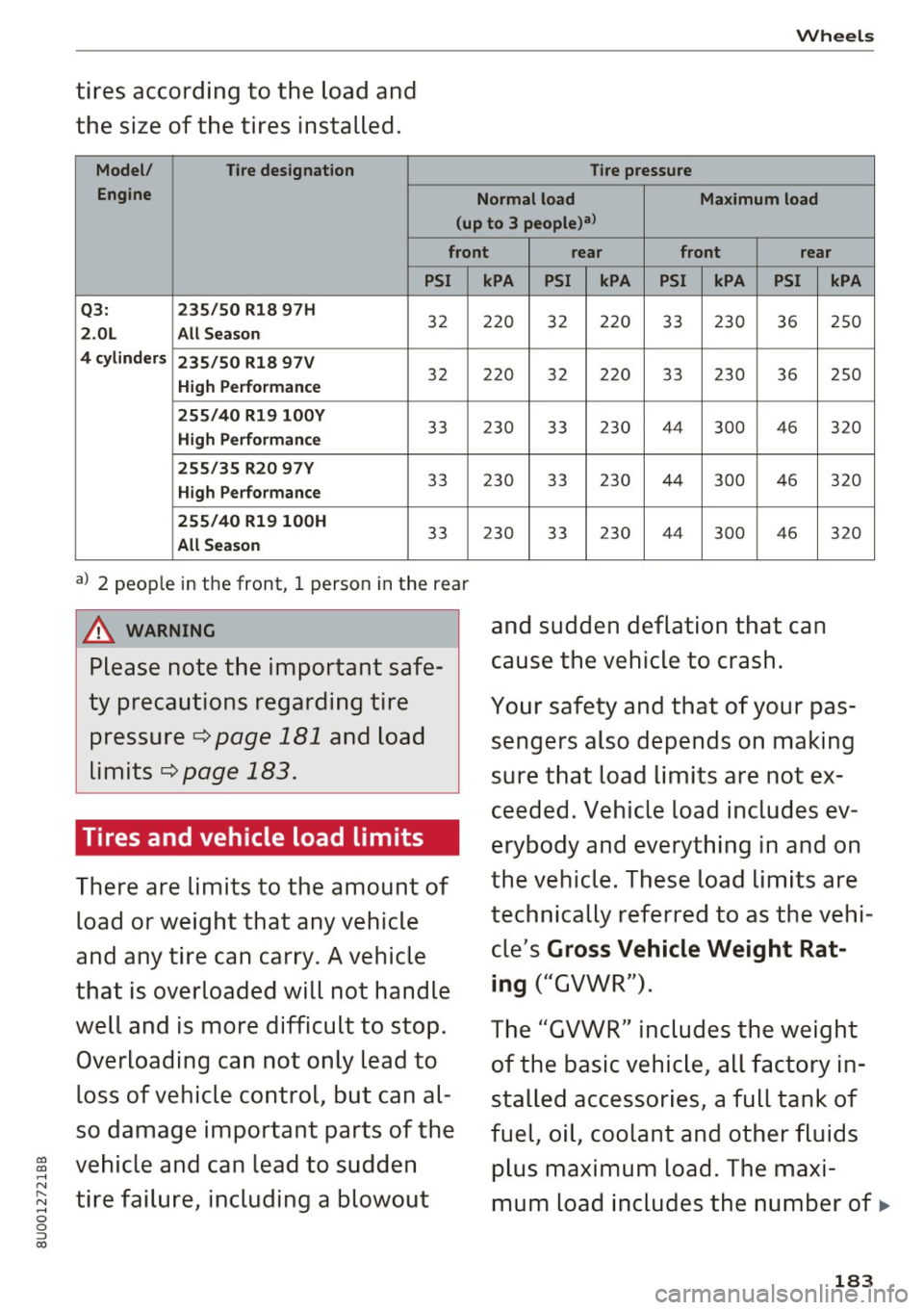
The following table lists recom- mended tire pressures in cold ..
Page 185 of 236
00
00
......
"' ,....
"' ...... 0 0 :::,
00
tires according to the load and
the size of the tires installed .
Model/
Tire designation
Engine
Wheels
Tire pressure
Normal load Maximum load
(up to 3 people)a>
front rear front rear
PSI
Q3: 235/50 Rl8 97H
32 2.0L All Season
4 cylinders 235/50 Rl8 97V
High Performance
32
255/40 Rl9 l00Y
33 High Performance
255/35 R20 97Y
33 High Performance
255/40 Rl9 l00H
33 All Season
a) 2 people in the front, 1 person in the rear
A WARNING
Please note the important safe
ty precautions regarding tire pressure
c:::> page 181 and load
limits
c:::> page 183.
Tires and vehicle load limits
There are limits to the amount of
load or weight that any vehicle
and any tire can carry. A vehicle
that is overloaded will not handle
well and is more difficult to stop.
Overloading can not only lead to
loss of vehicle control, but can al
so damage important parts of the
vehicle and can lead to sudden
tire failure, including a blowout
kPA PSI kPA PSI kPA PSI
220 32 220 33 230 36
220 32 220 33 230 36
23 0 33 230 44
300 4
6
230 33 230 44 300 46
23 0
33 230
44 3
00 4
6
and sudden deflation that can
cause the vehicle to crash.
kPA
250
250
320
320
3 20
Your safety and that of your pas
sengers also depends on making
sure that load limits are not ex
ceeded. Vehicle load includes ev
erybody and everything in and on
the vehicle . These load limits are
technically referred to as the vehi
cle's
Gross Vehicle Weight Rat
ing
("GVWR").
The "GVWR" includes the weight
of the basic vehicle, all factory in
stalled accessories, a full tank of
fuel, oil, coolant and other fluids
plus maximum load. The maxi
mum load includes the number of.,.
183
Page 186 of 236
Wheels
passengers that the vehicle is in
tended to carry ("seating capaci
ty") with an assumed weight of 1 SO lbs. (68 kg) for each passen
ger at a designated seating posi
tion and the total weight of any
luggage in the vehicle. If you tow
a trailer, the weight of the trailer hitch and the tongue weight of
the loaded trailer must be includ
ed as part of the vehicle load.
The
Gross Axle Weight Rating
("GAWR") is the maximum load
that can be applied at each of the
vehicle's two axles.
The fact that there is an upper limit to your vehicle's Gross Vehi
cle Weight Rating means that the
total weight of whatever is being
carried in the vehicle (including
the weight of a trailer hitch and
the tongue weight of the loaded
trailer) is limited. The more pas
sengers in the vehicle or passen
gers who are heavier than the
standard weights assumed mean
that less weight can be carried as luggage.
The Gross Vehicle Weight Rating
and the Gross Axle Weight Rating
are listed on the safety compli
ance sticker label located on the
184
driver's side B-pillar ¢ page 181,
fig. 149.
~ WARNING
Overloading a vehicle can cause
loss of vehicle control, a crash
or other accident, serious per
sonal injury, and even death.
-Carrying more weight than your vehicle was designed to carry will prevent the vehicle
from handling properly and
increase the risk of the loss of
vehicle control.
-The brakes on a vehicle that has been overloaded may not
be able to stop the vehicle
within a safe distance.
-Tires on a vehicle that has been overloaded can fail sud
denly, including a blowout and
sudden deflation, causing loss
of control and a crash.
-Always make sure that the to tal load being transported -including the weight of a trail
er hitch and the tongue
weight of a loaded trailer -
does not make the vehicle
heavier than the vehicle's
Gross Vehicle Weight Rating.
Page 188 of 236

Wheels
and a special procedure. You must not repair or
disassemble them¢&. .
A WARNING
Wheel bolts that are tightened or repaired in
correctly can become loose and result in loss
of vehicle control, which increases the risk of
an accident. For the correct t ightening specifi
cation, see ¢
page 199, After changing a
wheel .
- Always keep the wheel bolts and the
threads in the wheel hub clean and free of grease.
- Only use wheel bolts that fit the rim .
- Always have damaged rims repaired by an
authorized Audi dealer or authorized Audi
Service Facility . Never repair or disassemble
rims yourself, because this increases the risk
of an accident.
Winter tires
Winter tires significantly improve the vehicle's
handling when driving in winter conditions . Be
cause of their construction (width, compound,
tread pattern), summer tires provide l ess trac
tion on ice and snow.
.,. Use winter tires on all four wheels.
.,. Only use winter tires that are approved for your
vehicle.
.,. Please note that the maximum permitted
speed may be lower with winter tires
q .&,. . An
authori zed Audi dealer or authori zed Audi Serv
ice Facility can inform you about the maximum
permitted speed for your tires .
.,. Check the tire pressure after install ing wheels
q page 181.
The effectiveness of winter tires is reduced great
ly when the tread is worn down to a depth of
0 .157 in (4 mm). The characteristics of winter
tires also decrease greatly as the tire ages, re
gardless of the remaining tread.
A WARNING
- Never drive faster than the maximum per
mitted speed for your tires. This could cause
the tires to heat up too much. This increases
186
-
the risk of an accident because it can cause
the tire to burst.
- Always adapt your driving to the road and
traffic conditions . Drive carefully and reduce
your speed on icy or slippery roads . Even
winter tires can lose traction on black ice .
@ For the sake of the environment
Reinstall summer tires at the appropriate
time, because they provide better handling
when roads are free of snow and ice. Summer
tires cause less road noise, tire wear and fuel
consumption .
(D Tips
You can also use all season tires instead of
winter tires. Please note that in some coun
tries where winter tires are required, only
winter tires with the~ symbol may be per
mitted.
Snow chains
Snow chains not only improve the driving in win
ter road conditions, but also the braking.
.,. Only install snow chains on the front wheels .
This applies also to vehicles with a ll wheel
drive* .
.,. Check and correct the seating of the snow
chains after driving a few feet, if necessary. Fol
low the instructions from the manufacturer.
.,. Note the maximum permitted speed when driv
ing with snow chains. Do not exceed 30 mph
(SO km/h) .
Use
fine-mesh snow chains. They must not add
more than 0.53 inch (13 .5 mm) in height, includ
ing the chain lock.
You must remove the snow chains on roads with
out snow. Otherwise , you could impair driving
ability and damage the tires .
Use of snow chains is only permitted with certain
rim/tire combinations due to technical reasons.
Check with an authorized Audi dealer or author i z ed Audi Service Facility to see if you may use
snow chains.
Page 189 of 236
00
00
......
"' ,....
"' ...... 0 0 :::,
00
& WARNING
Using incorrect snow chains or insta lling snow
chains incorrectly can result in loss of vehicle
control, which increases the risk of an acc i
dent.
(D Note
Snow chains can damage the rims/wheel cov
ers * if the chains come into direct contact
wit h them . Remove the wheel covers * first .
Use coated snow chains.
Low aspect ratio tires
Your Aud i is factory-equipped with low aspect ra
tio tires . These t ires have been thoroughly tested
and been se lected specifica lly for you r model for
the ir supe rb performance, road feel and handling
u nder a va riety of d riving conditions. As k yo ur au
thor ized Audi dealer for mo re de tails.
The low aspect ratio of these t ires is indicated by
a numera l of
55 or l ess in the tire's size desig na
tion . The numera l rep resents t he rat io of the
tire's sidewall he ight in rela tion t o its tread w idth
expressed in percen tage. Conventional t ires have
a height/w idth ratio of 60 or more .
The performan ce of low -aspect-r atio tire s is par
ticularly sen sitiv e to impr oper infla tion pre s
s ure . It is therefore important that low a spect
ratio tires are infl ated to the specified pressure
and that the inflation pre ssure is regularl y
checked and ma inta ined . Tire pre ssure s should
be checked at least once a month and alwa ys
before a long trip
c> page 181.
What you can do to avoid tire and rim damage
Low aspect rat io tires can be damaged more easi
ly by impact with potholes, curbs, gul lies or
ridges on the road, pa rticularly if the tire is un
de rinflated .
In order to minimize the occurrence of impact
damage to the t ires of your ve hicle, we recom
mend that you observe the follow ing precau
tions:
Wh eel s
-Always maintain recommended inflat ion pres
sures . Check your tire pressure every 2,000
m iles (3,000 km) and add air if necessary .
- Drive carefully on roads wit h potholes, deep
gu llies or ridges . T he impact from dr iving
through or over such obstacles can damage
your tires. Impact with a curb may a lso cause
damage to your tires.
-After any impact, immed iate ly inspect your
tires or have them inspected by the nearest au
thorized Audi dealer . Replace a damaged tire as
soon as possible .
- Inspect your tires every 2,000 m iles (3,000 km)
for damage and wear. Damage is not a lways
easy to see . Damage can lead to loss of a ir and
unde rinflat ion, wh ic h could eventually cause
t ire fa ilu re . If yo u be lieve th at a t ire may have
been damaged, repla ce the tire as soon as pos
sible.
- These tires may we ar mo re quickly tha n others.
- Please also remember that, while these tires
de live r responsive ha nd ling, they may ride less
comfort ably and make more noise t han other
choices .
Reduced performance in winter/cold season
conditions
All t ires are des igned for certai n pu rposes. The
l ow aspect ratio, ultra h igh performance tires
origina lly installed on your vehicle are intended
for maximum dry and wet road performance and handling. They are not suitable for co ld, snowy or
icy weather conditions. If you drive under those
c ircumstances, you should equip your vehicle
with all-season or winter tires, which offer better
t ract ion under those conditions . We suggest you
u se the recommended s now or a ll-season tires
spe cified for your veh icle, o r the ir equiva lent.
Refer to
c> page 186 for more detailed informa
t ion regard ing winter tires.
Uniform tire quality grad ing
- Tread wear
- Traction AA ABC
- Temperature ABC
187