ECU AUDI Q3 2017 Owner´s Manual
[x] Cancel search | Manufacturer: AUDI, Model Year: 2017, Model line: Q3, Model: AUDI Q3 2017Pages: 236, PDF Size: 58.93 MB
Page 154 of 236
Child safety
LATCH lower anchorage so that the connectors
lock into place
¢ fig. 131 .
.. Pull on the connector attachments to make
sure they are properly attached to the LATCH
lower anchorage .
.. Pull straps t ight following the child restra int
manufacturer's instructions.
R eleasing
.. Loosen the tension on the straps following the
ch ild restraint manufacturer's instruct ions .
.. Depress the spring catches to release the an
chorage hooks from the lower anchorages.
Remember: Use tether straps to help keep the
child restraint firmly in place.
A WARNING
Improper use of the LATCH system can in
crease the risk of serious personal injury and
death in an acc ident.
- These anchors were developed only for child
safety seats us ing the "LATCH" system.
- Never attach other child safety seats, belts
or other objects to these anchors.
- Always make sure that you hear a click when
latch ing the seat in place. If you do not hear
a click the seat is not secure and could fly
forward and h it the inte rior of the vehicle,
o r be ejected from the vehicle.
A WARNING
Improper ins tallation of ch ild rest raints will
increase the r isk of injury in an acc ident.
- Always follow the child restra int system
manufactu rer's instruct io ns for proper in
st al lation of the child res tra int system and
proper use of tether straps as well as the
lower anchorages or safety be lts in your ve
hicle .
- Always read and heed the important infor
mation and WARNINGS about child safety
and the installation of child restraint sys
tems
¢page 137, Child safety.
152
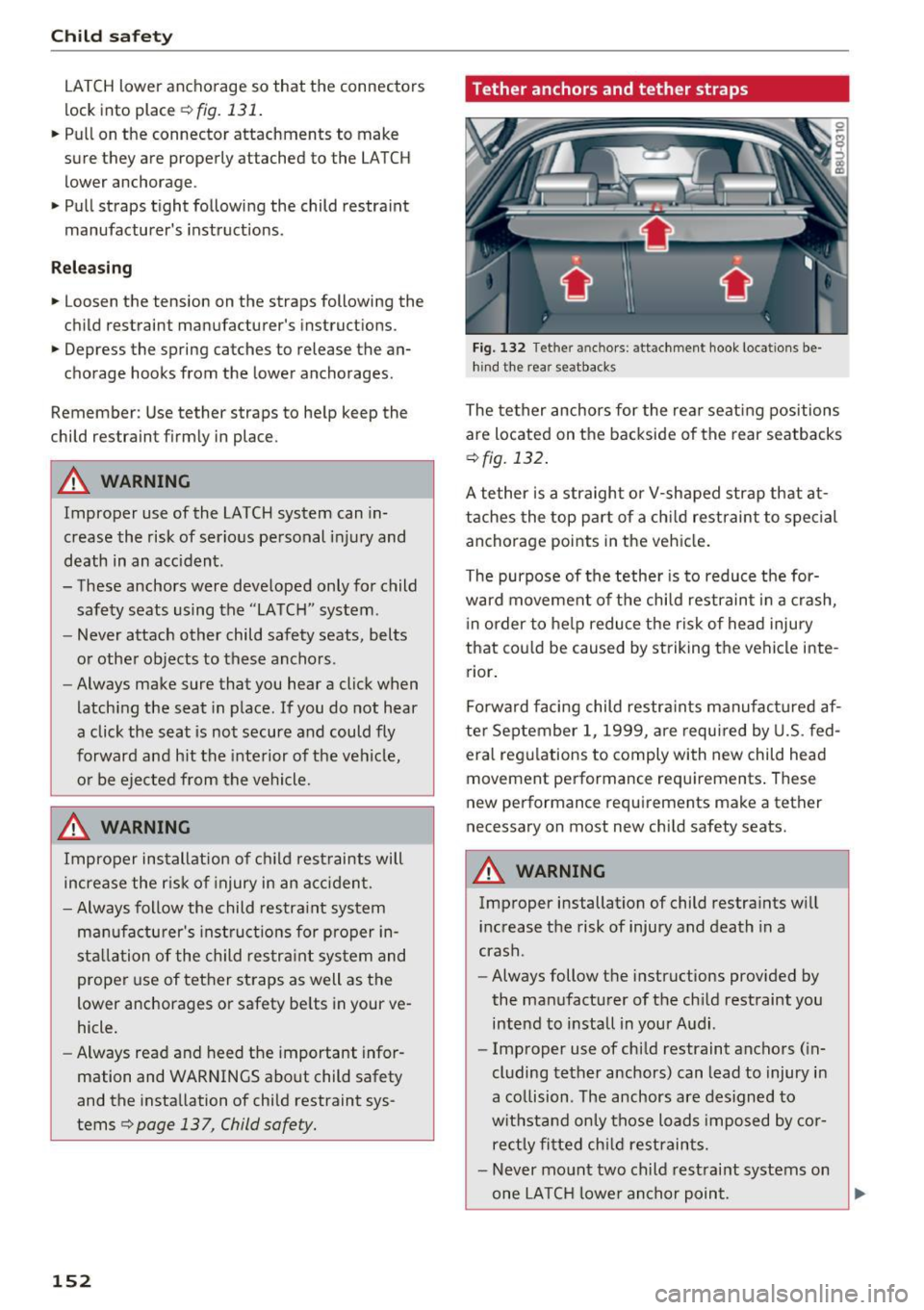
Tether anchors and tether straps
Fig. 132 Tether anchors: attachment hook locations be
hi nd the rear seatbac ks
The tether anchors for the rear seat ing positions
are located on the backside of the rear seatbacks
¢ fig. 132.
A tether is a straight or V-shaped strap that at
taches the top par t of a ch ild restrain t to special
anchorage points in the vehicle .
The purpose of the tether is to reduce the for
ward movement of the child restrain t in a crash,
i n order to help reduce the risk of head injury
that cou ld be caused by striking the vehicle inte
rior.
Forward facing child restra ints manufac tured af
te r September 1, 1999, are requi red by U.S . fed
era l reg ulations to comply with new child head
movement performance req uirements . These
new performance requ irements make a tether
necessary on most new child safety seats.
A WARNING
Improper installation of child restra ints w ill
increase the risk of injury and death in a
crash .
- Always follow t he i nstructions provided by
the manufacturer of the ch ild restraint you
intend to i nstall in your Audi.
- Improper use of chi ld restraint anchors ( in
cluding tether anchors) can lead to injury in
a co llision . The anchors are designed to
w it h stand on ly those loads imposed by cor
re ctly fi tted ch ild restraints.
- Never mo unt two ch ild rest raint systems on
one LA TC H l owe r anchor point.
Ill-
Page 155 of 236
a:,
a:,
...... N r--. N
'"' 0 0 ::, a:,
-Never attach two child restraint systems to
one tether strap or tether anchorage.
- Never attach a tether strap to a tie-down
hook in the luggage compartment.
- Never use child restraint tether anchorages
to secure safety belts or other kinds of occu
pant restraints.
- Never secure or attach any luggage or other
items to the LA TCH lower anchorages or to
the tether anchors.
- If a tether or other strap is used to attach a
child restraint to the front passenger seat,
make sure that it is not so tight, that it
causes the weight-sens ing mat to measure
more weight than is actually on the seat .
- The heavier weight registered can make the
Advanced Airbag System work as though an
adult were on the seat and dep loy the Ad
vanced Airbag when it must be supp ressed
ca using se rious o r even fatal injur y to the
c hild.
- If you must install a re arward fac ing ch ild
safety seat on the front passenger seat be
cause of except io na l circumstances and the
PASSENGER AIR BAG O FF light does not
come on and stay on, immediate ly install
the rear-fac ing child safety seat in a rear
seating position and have the airbag system
inspected by your Audi dealer.
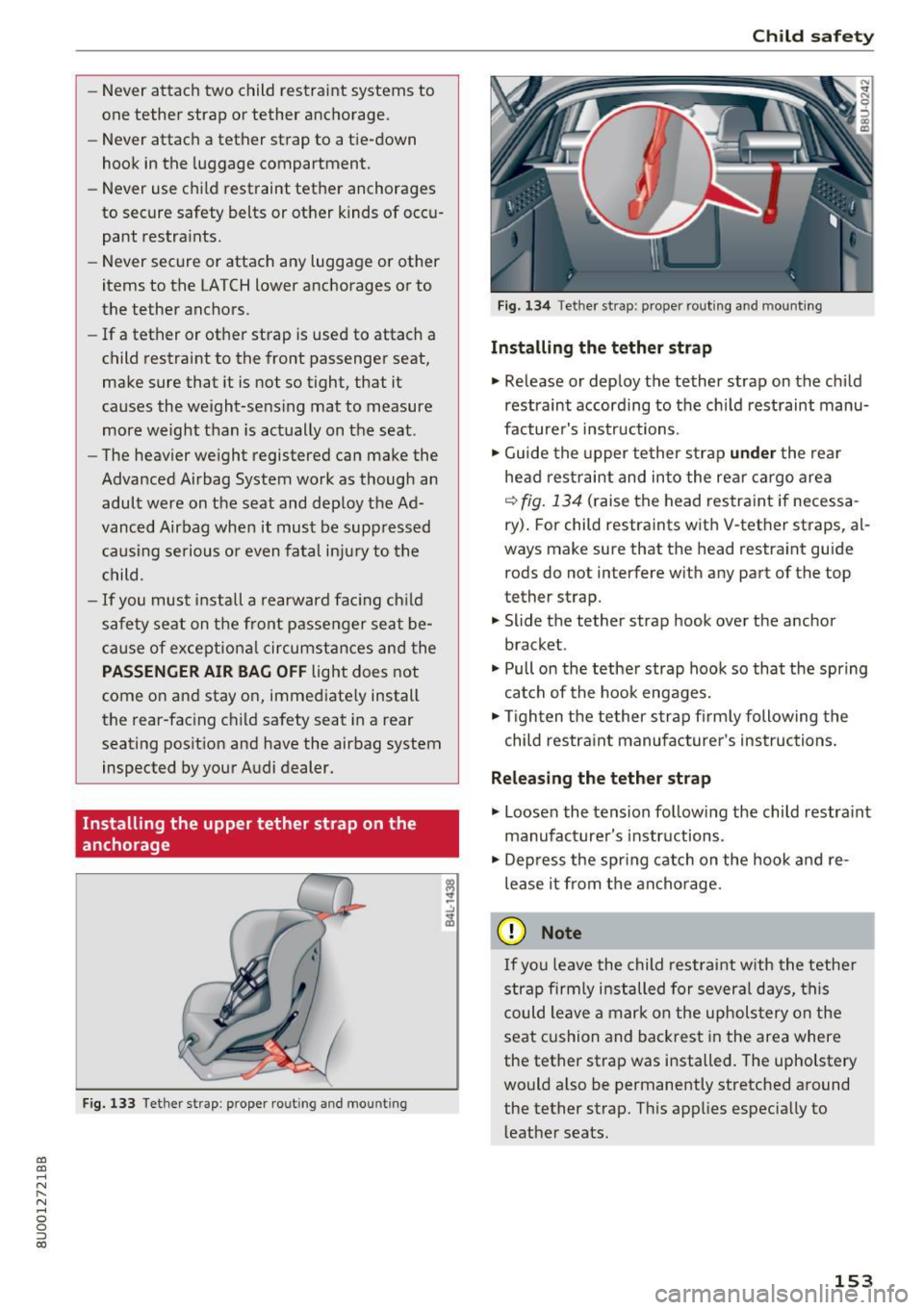
Installing the upper tether strap on the
anchorage
F ig. 133 Tether str ap : pro pe r ro uting an d mountin g
Ch ild sa fety
Fig. 134 Tet her st rap : p ro p er r out ing an d mount ing
Installing the tether st rap
• Release or deploy the tether strap on the ch ild
restraint according to the ch ild restraint manu
facture r's instructions .
• Guide the upper tether strap
under the re a r
head restraint and in to the rear ca rgo area
~ fig. 134 (raise the head restraint if necessa
ry) . For child restraints w ith V-teth er straps, al
ways make sur e that th e head restraint guide
r ods do not interfere w ith any part of the top
tether strap.
• Slide the tether strap hook over the anchor
bracket .
• Pull on the tethe r strap hook so that the spring
catch of the hook engages.
• Tighten the tether s trap firm ly following the
child restra int manufacture r's instruc tions.
Releasing the tether strap
• Loose n the tension fo llow ing the child restra int
manufac turer's instr uctions .
• Dep ress the spr ing catch on the hook and re
le ase it from the anchorage.
(D Note
If yo u leave the child restrai nt w ith the tethe r
strap firmly i nstalled for several days, th is
could leave a mark on the uphols tery on the
seat cushion and backrest i n the area where
the tether strap was installed. The upholstery
would a lso be permanently stretched around
the tether strap. This app lies espec ia lly to
l eather seats.
153
Page 163 of 236

a:,
a:,
,....,
N r--. N
'"' 0 0 ::, a:,
Opening/closing the hood
The hood is released from inside the vehicle.
Fig. 1 38 D river footwell: release lever
Fi g. 1 39 Roc ke r switch under the hood
"' 0 0
0
=i
~
Make sure the w iper arms a re not raised up from
the windshield. Otherwise the pa int could be
damaged .
Opening the hood
.. Wi th the driver's doo r open, pu ll the leve r be
low the instrument panel in the d irect io n of the
arrow¢fig.138 .
Checking and Filling
.. Raise the hood slightly¢,& .
.. Press the rocker switch under the hood upward
¢fig . 139. This releases the catch .
.. Open the hood.
Closing the hood
.. Push the hood down until yo u over ride the
force of t he str ut .
.. Let the hood fall lightly into the latch.
Do not
press it in.
c> ,&.
A WARNING
-
-Never open the hood when there is steam or
coolant escaping from the engine compart
ment, because there is a risk that you could
be burned. Wait unt il no steam or coolan t is
escaping.
- If the hood is not latched completely, it
could fly up w hile you are dr iving and ob
s truc t your v isio n.
- For safety reasons, the hood must always be
closed secu rely while dr iv ing. Because of
this, always che ck t he hood afte r closing i t
t o make sure it is latched correct ly. The
hood is latched if the front corners cannot
be lifted.
- If you notice th at the hood is not latched
while you are d riving, stop immediately and
close it, because driving when the hoo d is
not latched increases the risk of an accident .
161
Page 169 of 236
00
00
......
"' ,....
"' ...... 0 0 :::,
00
~ Add coolant mixed in the correct ratio
¢ page 166 up to the upper marking.
~ Make sure that the fluid level rema ins stable.
Add more coolant if necessary.
~ Close the cap securely.
Coolant loss usually indicates there is a leak. Im
mediately drive your vehicle to an authorized
Audi dealer or authori zed Audi Service Facility
and have the cooling system inspected. If the
cooling system is not leaking, a loss can come
from the coolant boiling through overheating
and be ing pushed out of the cooling system.
.&, WARNING
The cool ing system is pressu rized and can be
come very hot. To reduce the r is k of burns
from hot coolant :
- Do not open the coo lant expansion tank cap
when the engine is hot. This increases the risk of burns.
- Stop the engine and allow it to cool.
- Protect your face, hands and arms from es -
caping coolant and steam by covering the
coolant tank cap with a large, thick cloth .
- T urn the coo lant tank cap co unterclo ckwise
slowly and keep light pressu re on the cap .
- T o reduce the risk of burns , do not allow any
antifreeze o r coolant to drip onto the ex
haust system or hot engine components.
T he ethylene glycol in engine coolant can
catch fire under certain circumstances .
- T he coo lant add itive and the coolant can be
dangerous to your health . For this reason,
keep the coolant in the original container
and away from children. There is a risk of
poisoning.
- When working in the engine compartment,
remember that the radiator fan can switch
on even if the ignition is switched off, which
increases the risk of injury .
Do not add coolant if the expansion tank is
empty. Air could enter the cooling system and
damage the engine. If this is the case, do not
cont inue driv ing . See an authorized Audi deal -
Check ing and Filling
er or authorized Aud i Service Facility for assis
tance .
- Before the start of winter, have your author
ized Aud i dea ler or a uthorized Audi Serv ice
Facility check if the coolant additive in your
vehicle matches the percentage appropriate
for the climate. This is especially important
when driving in colder climates.
- If the appropr iate coo lant add itive is not
availab le in an emergency, do not add any
other additive . You could damage the en
gine. If this happens, only use water and re
store the correct m ixtu re ratio with the
specified coolant add it ive as soo n as poss i
ble .
- Only refill w ith new coolant.
- Radiator sealant must not be mixed with
the coolant .
Radiator fan
T he radiator fan switches on automatically by it
self.
An auxiliary e lectr ic radiator fan switches on and
off depend ing on coolant temperature and other
vehicle operating conditions.
After you switch the engine off, the auxiliary fan c a n continue running for up to 10 m inutes - even
with the ignition off . It can even switch on aga in
later by itself ¢.& , if
- the temperature of the engine coolant rises due
to the heat build-up from the engine in the en
gine compartment, or
- the engine compartment heats up bec ause the
veh icle is parked in in tense sunlight.
.&, WARNING
--
- To reduce the r isk of personal injury never
touch the radiator fan .
- The auxiliary e lectr ic fan is temperature
controlled and can switch on s uddenly even
when the engine is not runn ing .
- The auxiliary radiator fan sw itches on auto
mat ica lly when the eng ine coolant reaches a
certa in temperature and will continue to run
until the coolant temperature d rops .
167
Page 199 of 236
a:,
a:,
...... N r--. N .-< 0 0 ::, a:,
Emergency assistance
General information
.. Park the vehicle as far as poss ible from moving
traffic in the event of a breakdown. In the event
of a flat tire, park the vehicle on a leve l surface .
It you are on a steep h ill, be especially careful.
.. Set the parking brake .
.. Switch the emergency flashe rs on .
.. Put on a reflective vest .
.. Set up the warn ing triang le, if available .
.. Have the passengers exi t the veh icle. They
sho uld move to a safe place, for example be
hind a guard rail.
_& WARNING
Follow the steps given above. This is for your
protection and the for the safety of other d riv
ers.
_& WARNING
Improper use of the vehicle jack can cause se
rious personal injuries .
- Never use the screw driver hex head to
t ighten whee l bolts, since the bolts cannot
attain the necessary tighten ing torque if you
use the hex head, potentially causing an ac
c ident .
- The factory-supplied jack is intended only
for your vehicle model. Under no circum
stances should it be used to lift heavy
vehicles o r other loads; yo u ris k inju ring
yo urself.
- Never start the engine when the vehicle is
ra ised, which could cause a n accident.
- Support the veh icle secure ly with app ropr i
a te s tan ds if wor k is to be performed under
neath t he vehicle; otherwise, the re is a po
tent ial ris k for i njur y.
- Never use the jack s upplied with yo ur Audi
on another vehicle, pa rtic ularly o n a heav ie r
one. The jack is only suitable for u se on the
vehicle it came wit h.
Emergen cy a ssis tanc e
Equipment
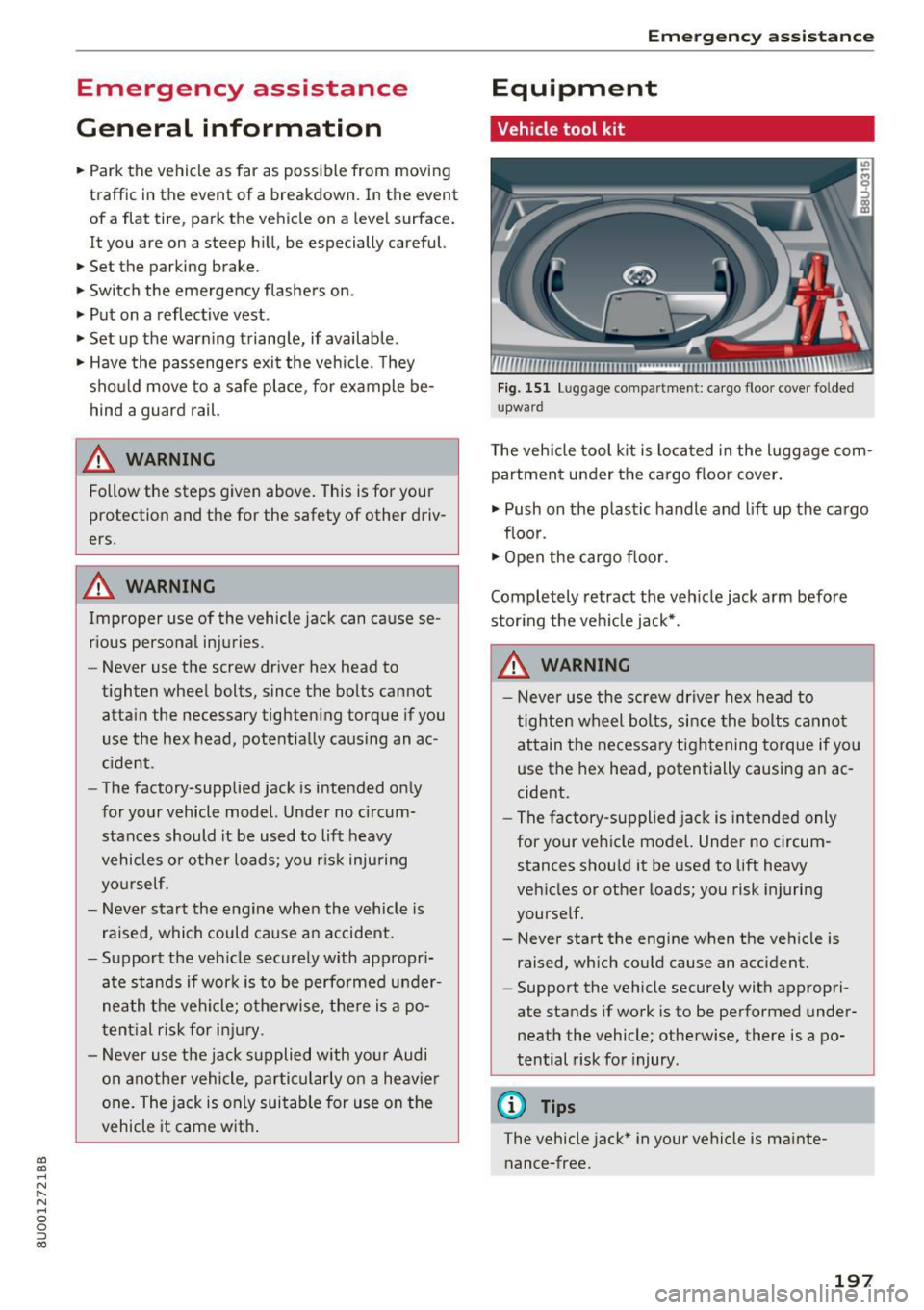
Vehicle tool kit
Fig. 151 Lu gg age compartmen t: cargo floo r cove r fo lded
u pwa rd
T he veh icle tool k it is located in the luggage com
partment under the cargo floor cover.
.. Push on the p lastic handle and lift up the cargo
floor .
.. Open the cargo floor.
Completely retract the veh icle jack a rm before
stor ing the ve hicle jack*.
_& WARNING
- Never use the screw driver hex head to
tighten wheel bo lts, since the bolts cannot
attain the necessary tightening torque if yo u
use the hex head, potentially causing an ac
cident.
- The factory-supp lied jack is intended only
for your ve hicle model. Under no circum
stances shou ld it be used to lift heavy
veh icles or other loads; you risk injuring
yourse lf.
- Never start the engine when the ve hicle is
raised, which could cause an accident.
- Support the vehicle securely with appropri
ate stands if wo rk is to be performed under
neath the vehicle; otherwise, there is a po
tential risk fo r injury .
@ Tips
The vehicle jack * in your vehicle is mainte
nance-free.
197
Page 200 of 236
Emerg ency assis ta nce
Folding chocks
Applies to: ve hicles w ith fol ding chocks
The folding chocks* are part of the vehicle tool
kit.
-- -,,,.
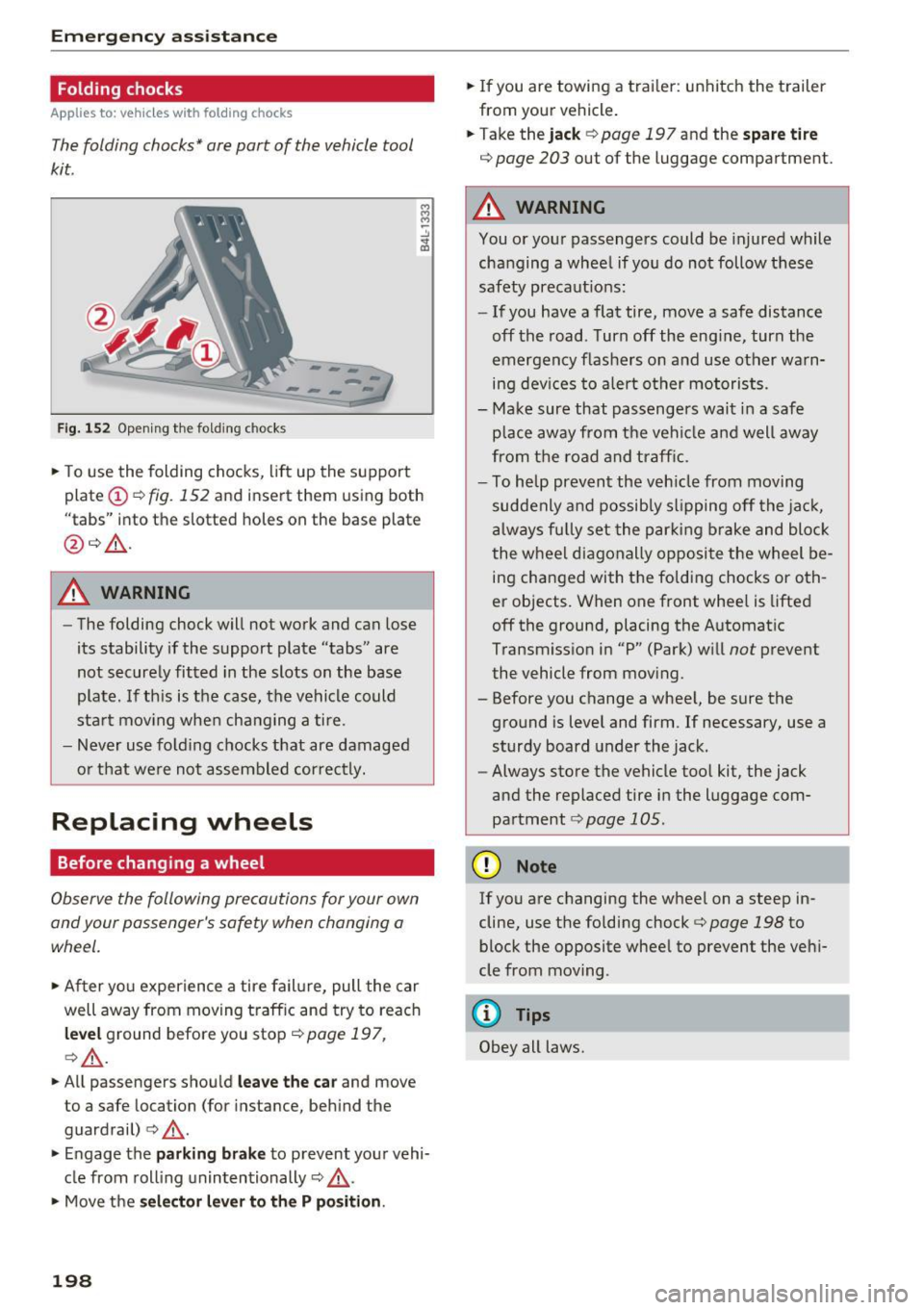
F ig. 152 Opening the fo lding chocks
• To use the folding chocks, lift up the support
plate (!)¢
fig. 152 and insert them using both
"tabs" into the slotted holes on the base plate
@ ¢_& .
A WARNING
-The folding chock will not work and can lose
its stability if the support plate "tabs" are
not securely fitted in the slots on the base
plate. If th is is the case, the vehicle could
start mov ing when changing a tire.
- Never use fo ld ing chocks that are damaged
o r that were not assembled cor rectly.
Replacing wheels
Before changing a wheel
Observe the following precautions for your own
and your passenger's safety when changing a
wheel.
• After you experience a tire failure, pull the car
well away from moving t raffic and try to reach
l ev el ground before you stop¢
page 197,
¢_& .
• All passengers shou ld leav e th e car and move
to a safe location (for instance, beh ind the
guardrail)
¢ _& .
• Engage the park in g br ake to prevent your vehi
cle from roll ing unintentionally ¢_& .
• Move the selec to r l eve r to the P po sition.
198
• If you are towing a trai ler : unhitch the t railer
from your veh icle.
• Take the jac k
¢page 197 and the sp are tire
¢
page 203 out of the luggage compartment.
A WARNING
You or your passengers could be injured while
changing a wheel if you do not follow these
safety precaut ions:
- If you have a flat tire, move a safe distance
off the road . Turn off the eng ine, turn the
emergency f lashers on and use other warn
ing dev ices to alert other motorists.
- Make sure that passengers wait in a safe
place away from the vehicle a nd well away
from the road and traff ic.
- To he lp prevent the veh icle from moving
suddenly and possib ly sl ipping off the jac k,
always fu lly set the par king b rake and block
the whee l diagonally opposite the wheel be
ing changed with the folding chocks or oth
er objects. When one front whee l is lifted
off the ground, placing the Automat ic
Transmission in "P" (Park) w ill
not prevent
the vehicle from moving.
- Before you change a whee l, be sure the
ground is level and firm . If necessary, use a
sturdy board under the jack.
- Always store the vehicle too l kit, the jack
and the replaced tire in the luggage com
partment
¢ page 105.
(D Note
If you are changing the wheel on a steep in
cline, use the folding chock¢
page 198 to
block the opposite whee l to prevent the vehi
cle from moving.
@ Tips
Obey all laws.
Page 203 of 236
a:,
a:,
...... N r-,. N
"" 0 0 ::, a:,
.. Install the rod on the vehicle jack: Insert the
rod into the opening on the handwheel. Turn
the rod left or r ight to secure it.
.. Cont inue raising the jack with the rod until the
wheel lifts off the ground slightly.
Position the vehicle jack
onl y under the designat
ed lifting points on the sill
c:::> fig. 156. There is ex
actly
one location for each wheel. The jack must
not be pos itioned at any other location
c:::> .&.,
c:::> CD.
Soft grou nd under the jack can cause the vehicle
to slip off the jack. Always place the jack on firm
ground . Use a flat, stable support if necessary.
Use a non-slip surface such as a rubber mat on a
s lipper y surfa ce such as tile .
_& WARNING
-
-Yo u or your passengers could be injured
wh ile chang ing a whee l if yo u do not follow
these safety precau tions:
- Position the veh icle jack only at the desig
nated lifting points and align the jack.
Otherw ise, the vehicle jack cou ld slip and
cause an injury if it does not have suffi
cient hold on the vehicle.
- Use on ly the jack* supplied with your vehi
cle to raise the vehicle.
If yo u use a jack
from a d ifferent vehicle, your veh icle may
slip off the jack -ris k of injury!
- Do not use the jack* supp lied with your ve
h icle to ra ise other veh icles, as these may
slip off the jack -ris k of injury!
- A soft or unstable s urface under the jack
may cause the vehicle to s lip off the jac k.
Always p rovide a firm base fo r the jack on
the ground . If necessary, use a sturdy
board underthejack .
- On hard, sl ippery surfa ce (such as tiles)
use a rubbe r mat or similar to prevent the
jack from slipp ing.
- T o help prevent injury to you rself and yo ur
passenge rs:
- Do not ra ise the vehicle unt il you are sure
the jack is securely engaged .
- Passengers must not remain in the vehicle
when it is jacked up.
Em ergen cy a ssis tanc e
-Make sure that passengers wait in a safe
place away from the vehicle and well away
from the road and traffic .
- Make sure jack position is correct, adjust
as necessary and then continue to raise
the jack.
- If work has to be done under the veh icle,
ensure that it is safely supported on suita
ble stands -risk of injury!
- Never start the engine when the vehicle is
on the jack -risk of acc ident!
(D Note
Do not lift the ve hicle by the s ill. Pos ition the
vehicle jack only at the des ignated lifting
po ints on the sill. Otherw ise, your veh icle will
be damaged.
Taking the wheel off/installing the spare
tire
Follow these instructions step-by-step for chang
ing the wheel.
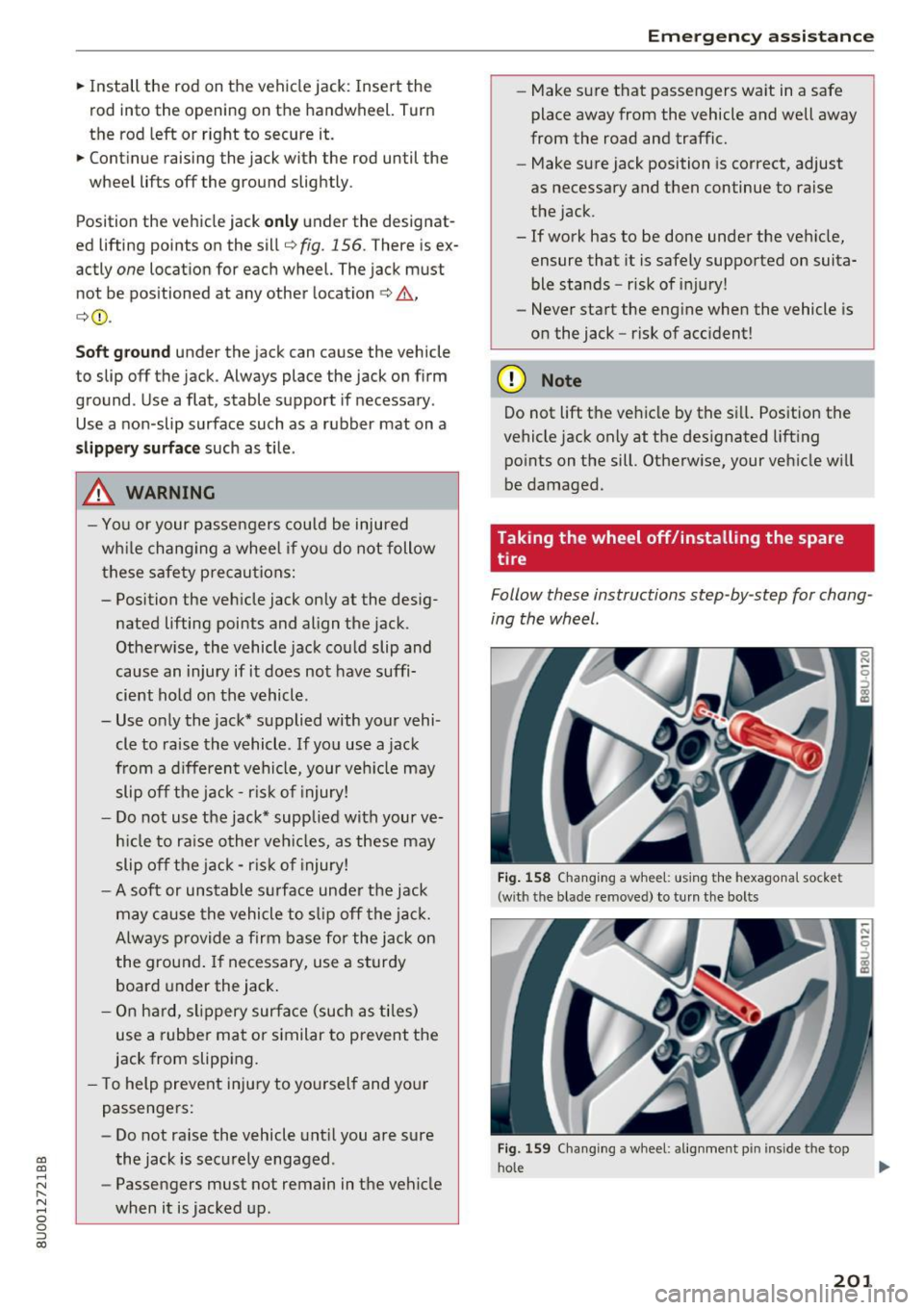
F ig . 1 58 Chang ing a w hee l: us ing the hexagona l socket
(with the blade removed) to turn the bolts
Fig. 159 Changi ng a whee l: alig nment p in i nside the top
h ole
201
Page 205 of 236
a:,
a:,
.... N r--. N .... 0 0 ::, a:,
-Ha ve the wheel b olt tightening torque
ch ecked wit h a to rque wr ench a s soon a s po s
s ible b y your auth orized Audi dealer or qu ali·
fied works hop.
- With steel and allo y wheel rims , the wheel
bolts a re correctl y tight ened at a to rque of
105
ft lbs (140 Nm ).
- If you n oti ce th at the wheel bolts are cor roded
a nd d iff icult to tu rn w hile c hang ing a t ire ,
they should be replaced be fore you check th e
t ighte nin g torqu e.
- Repla ce the flat t ire with a new one and h ave
i t insta lled on you r veh icle as so on a s possi
ble . Remo unt the whee l co ver .
Until then, d riv e with extra ca re and at redu ced
spee ds.
A WARNING
- If you are going to equ ip your vehicle w ith
t ir es or rims which differ from those which
were factory installed, then be sure to read
the informat io n
¢ page 178, N ew tires or
wheels.
- Always make sure the damaged wheel or
even a flat tire and the jack and tool kit a re
properly secured in the luggage compart
ment and are not loose in the passenger
compartmen t.
- In an accident o r sudden maneuver they
cou ld fly forward, injuring anyone in the ve
hicle.
- Always store damaged whee l, ja ck a nd too ls
sec urely in the luggage compartment . Oth
erwise, in an accident or sudden maneuver
they could fly forward, ca using injury to pas
sengers in the vehicle .
(D Note
Do not use commercia lly available tire seal
ants . Otherwise, the electrical components of
the t ire pressure monitoring system* will no
longer work properly and the sensor for the
tire pressure mon itor ing system" will have to
be replaced by qualified workshop.
.
Em ergen cy a ssis tanc e
Spare tire
Space-saving spare tire (compact spare
tire)
Applies to: veh icles with spare tir e/space-saving spare tire
(compact spare tire)
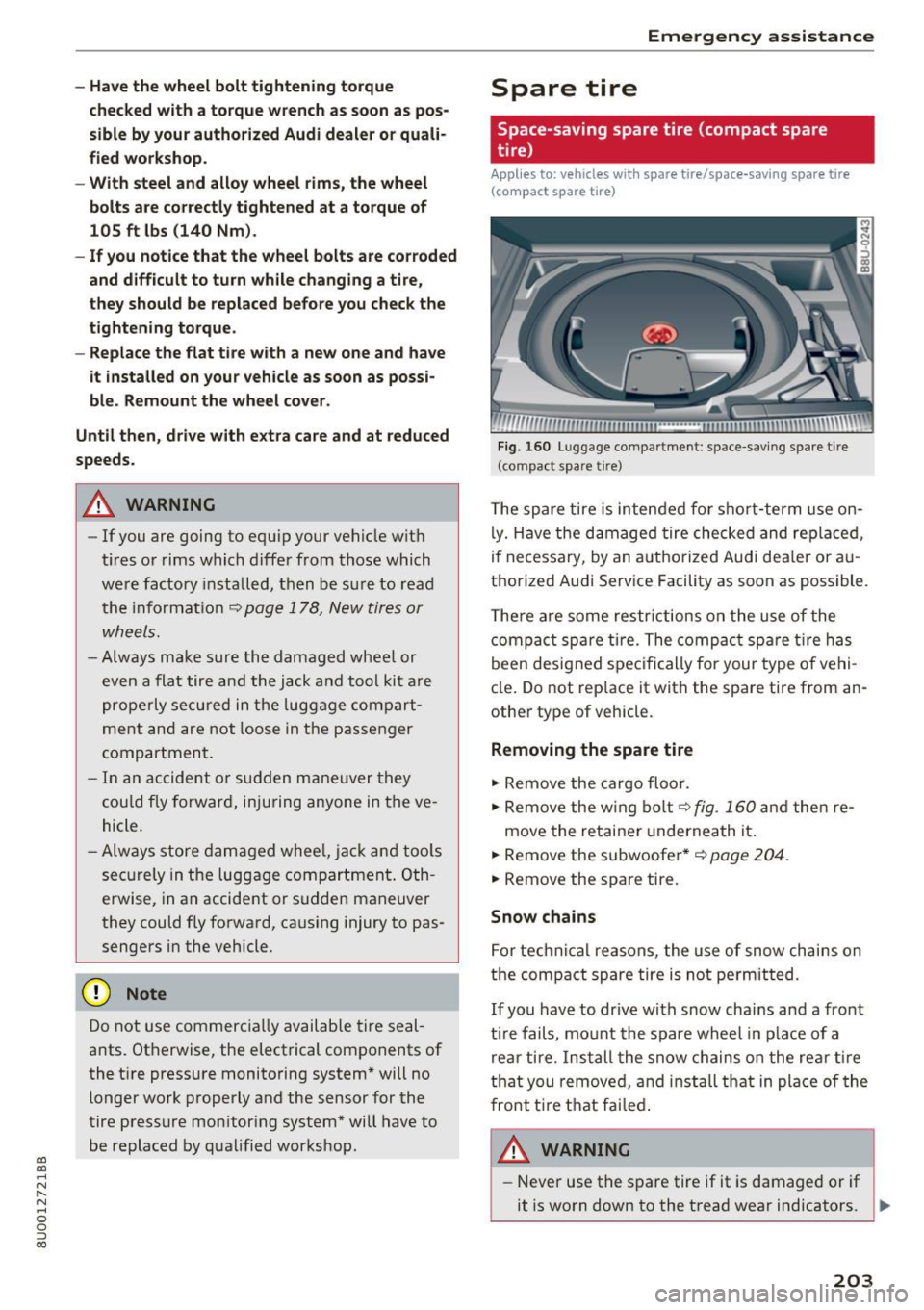
F ig. 160 Lugg age compar tme nt: space -s a ving s pare tire
( c ompact spa re
tir e)
The spare tire is intended fo r sh ort -term use on
ly. Have the damaged tire checked and replaced ,
i f necessary, by an authorized Aud i dea ler or au
thorized Aud i Service Facility as soon as possible.
T here are some restr ictions on the use of the
compact spare tire . The compac t spa re t ire has
been designed specifically for your type of vehi
cle . Do not rep lac e it with the spare tire from an
other type of vehicle .
Removing the spare tire
.,. Remove the cargo floo r.
.,. Remove the w ing bo lt
¢ fig. 160 an d then re-
move the retaine r underneath it .
.,. Remov e the subwoofer*
¢ page 204.
.,. Remov e the spar e tir e.
Snow chains
For technical reasons, the use of snow chains on
the compact spare tire is not pe rmitted .
If you have to drive with snow chains and a front
tire fails , mo unt the spare wheel in place of a
rear tire. Install the snow chains o n the rear t ire
that you removed, and install that in place of the
front t ire that fai led .
A WARNING
-Never use the spare tire if it is damaged or if
it is worn down to the tread wear indicators . .,.
203
Page 206 of 236
Emerg ency assis ta nce
- If the spare tire is more than 6 years old,
use it only in an emergency and with ex
treme caution and careful driving.
- The spare tire is intended only for tempora
ry and short-term use .
It should be replaced
as soon as possible with the normal wheel
and t ire .
- After mounting the compact spare tire, the
tire pressure must be checked as soon as
poss ible. The tire pressure of the compact
spare tire must be
4.2 bar; otherwise, you
risk having an accident.
- Do not drive faster than SO mph
(80 km/h).
Yo u risk having an accident.
- Avoid full-throttle accelerat ion, heavy brak
ing, and fast cornering . You risk having an
acc ident.
- Never dr ive using more than one spare
wheel and tire . You risk having an accident .
- Normal summer or winter tires must not be mounted on the compact spare wheel rim.
- For technical reasons, the use of tire chains
on the spare tire is not perm itted. If it is
necessary to drive with t ire chains, the spare
wheel m ust be mounted on the front axle in
the event of a flat in a rear tire. The new ly
available front wheel m ust then be insta lled
in place of the rear wheel with the flat tire.
Installing the tire chain before mounting
the wheel and t ire is recommended.
- Loose items in the passenger compartment
can cause serious perso nal injury during
hard braking or in an accident. Never store
the spare tire or jack and too ls in the pas
senger compartment.
204
Removing the subwoofer
App lies to : vehicles wit h subwoofer
The subwoofer must be removed before the
spare tire*ltemporary spare tire* can be re moved.
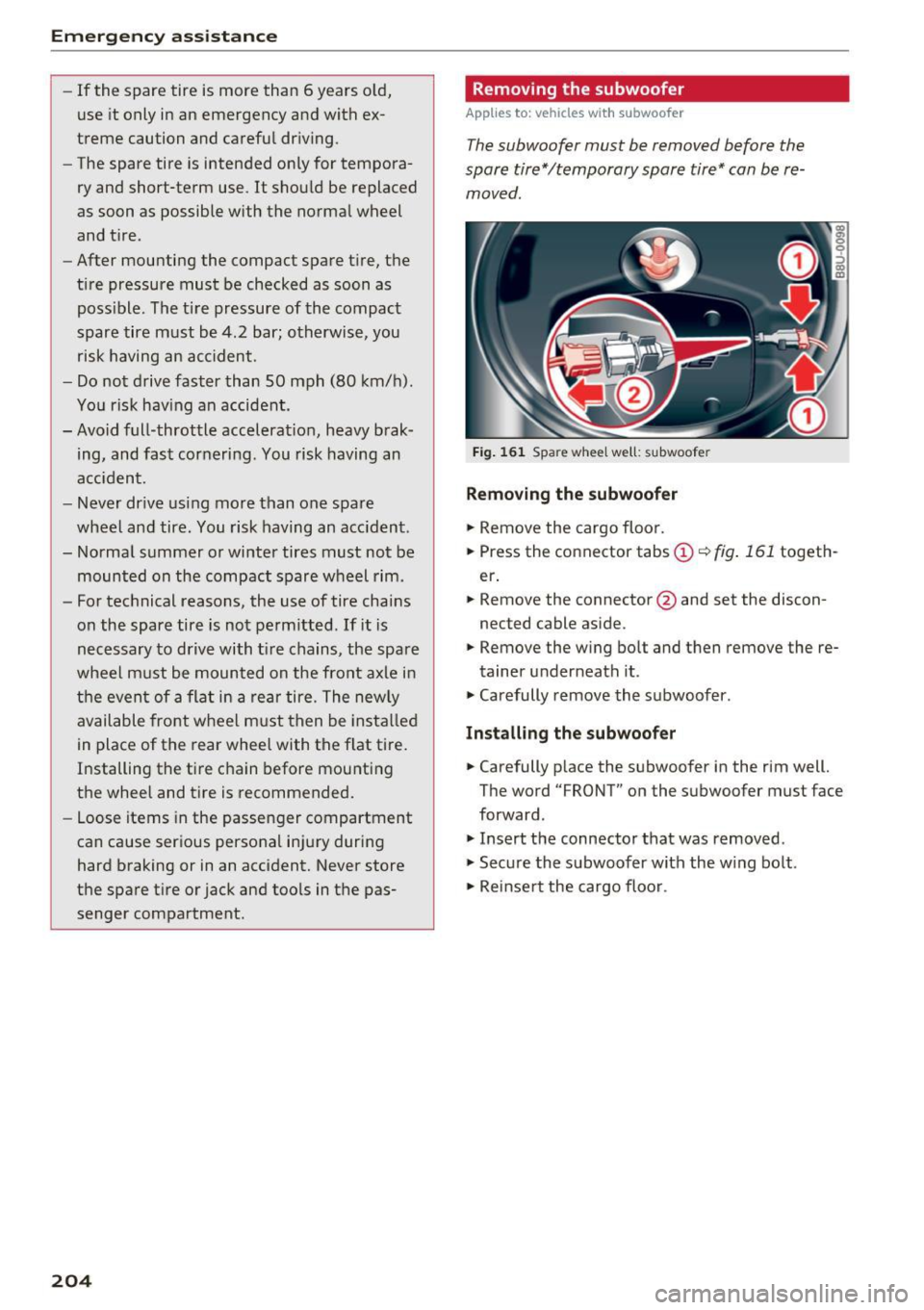
Fig . 161 Spare whee l we ll: subwoofe r
Removing th e subwoo fer
.. Remove the cargo floor .
.. Press the connector
tabs @¢fig . 161 togeth
er .
.. Remove the connector @and set the discon
nected cable aside.
.. Remove the wing bo lt and then remove the re-
tainer underneath it .
.,. Carefully remove the s ubwoofer .
Insta llin g the sub woofer
.. Carefully place the subwoofer in the rim well.
The word "FRONT" on the subwoofer must face
forward.
.. Insert the connector that was removed .
.,. Secure the subwoofer with the w ing bo lt.
.. Reinse rt the cargo floor .
Page 213 of 236
-Do not b end over the batteries -danger of
chemical burns!
- The battery cell locking screws must be
tightened securely.
- Before you check anyth ing in the engine
compartment, a lways read and heed all
WARNINGS
¢ page 159.
(D Note
Improper hook-up of jumper cables can ruin
the generator.
- Always connect POSITIVE(+) to POSITIVE
( + ), and NEGATIVE(-) to NEGATIVE(-)
ground post of the battery manager contro l
unit.
- Check that all screw p lugs on the battery
cells are screwed in firmly . If not, tighten
plugs prior to connecting clamp on negative
battery terminal.
- Please note that the procedure for connect
ing a jumper cable as described above ap
plies specif ically to the case of your vehicle
being jump started. When you are giv ing a
jump start to another vehicle, do
not con
nect the negative( -) cab le to the negative
(-) terminal on the discharged battery@
¢ fig. 165. Instead, securely connect the
negative (-) cable to either a solid metal
component that is firm ly bolted to the en
gine block or to the engine block itself. If
the battery that is being charged does not
vent to the outs ide, escaping battery gas
could ignite and explode!
Towing with a tow truck
General hints
Your Audi requires special handling for towing .
The follow ing information is to be used by com
mercial tow tr uck operators who know how to op
erate their equipment safely .
-Never tow your Audi, towing will cause dam-
age to the engine and transmission .
a:, ~ -Never wrap the safety chains or winch cables
~ around the brake lines. N
"" 0 0 ::, a:,
Emergency situations
-To prevent unnecessary damage , your Audi
must be transported with a flat bed truck.
- To load the vehicle on to the flat bed, use the
towing loop found in the vehicle tools and at·
tach to the front or rear anchorage
¢ page 211 and ¢ page 212.
A WARNING ~ -
A veh icle being towed is not safe for passen
gers . Never allow anyone to ride in a vehicle
being towed, for any reason .
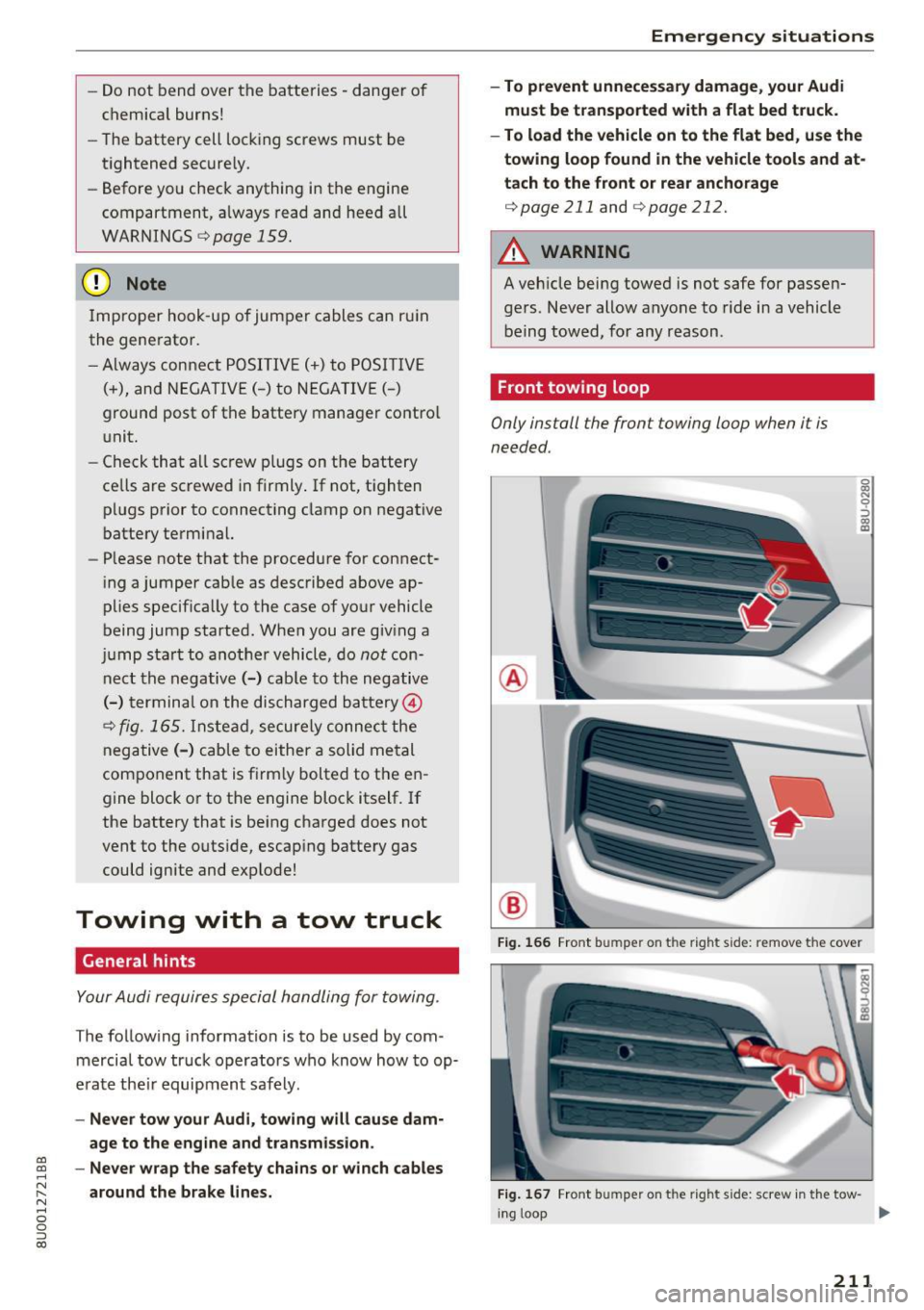
Front towing loop
Only install the front towing loop when it i s
needed.
®
®
0 0:, N 9 ::> 0:, a)
Fig. 166 Front bumpe r o n the right s ide: re move t he co ver
Fig. 167 Front bum pe r o n th e righ t side : screw in the tow-
in g loop ...
211