brake AUDI Q3 2017 Owner´s Manual
[x] Cancel search | Manufacturer: AUDI, Model Year: 2017, Model line: Q3, Model: AUDI Q3 2017Pages: 236, PDF Size: 58.93 MB
Page 98 of 236
Intelligent Technology
gear or lower driving range. Do not ride the
brakes or hold the pedal down too long or
too often. This could cause the brakes to get hot and diminish braking efficiency .
- Do not "ride the brakes" by resting your foot
on the pedal when you do not intend to
brake. This may cause the brakes to over
heat, premature wear and increased stop
ping distance.
- Under certain climatic and operating condi
tions such as passing through water, driving in heavy rain or after washing the vehicle ,
the effectiveness of the brakes can be re
duced . In winter, ice can accumulate on the
brake pads, linings, discs and drums . Care
fully apply brakes for a test. Brakes will dry and ice coatings will be cleaned off after a
few careful brake applications.
- Driving for an extended period of time on
salt-covered roads without using your
brakes can also affect braking efficiency .
Clean off accumulated salt coating from
brake discs and pads with a few careful
brake applications .
- If you damage the front spoiler, or if you in
stall a different spoiler, be sure the air flow
to the front brakes is not obstructed. Other
wise the brake system could overheat reduc
ing the effectiveness of the entire brake sys
tem.
- Failure of one brake circuit will impair the
braking capability resulting in an increased
stopping distance. Avoid driving the vehicle
and have it towed to the nearest authorized
Audi dealer or qualified workshop.
- Never let the vehicle roll to a stop with the
engine shut off.
- If the brake booster is not working, the
brake pedal must be pressed considerably
harder to make up for the lack of booster
assistance.
96
Electromechanical
steering
The electromechanical steering supports the
driver's steering movements .
Power steering adapts electronically based on
the vehicle speed .
Indicator lights and messages
• Steering fault! Do not drive vehicle!
If this indicator light turns on and stays on and
this message appears, the power steering may
have failed.
Do
not continue driving . See an authorized Audi
dealer or authorized Audi Service Facility for as
sistance.
If the indicator light turns on, the steering wheel
may be more difficult to move or more sensitive
than usual. The steering wheel may also be at an
angle when driving straight.
Drive slowly to an authorized Audi dealer or au
thorized Audi Service Facility to have the mal
function corrected .
(;r, lj Steering lock: System fault! Please contact
dealer.
There is a malfunction in the electronic steering
lock.
Drive to an authorized Audi dealer or authorized
Audi Service Facility immediately to have the malfunction corrected.
A WARNING
Have the system malfunction corrected as
soon as possible by an authorized Audi dealer
or authorized Audi Service Facility, as this in
creases the risk of an accident .
{!) Tips
If the . or 'T j indicator light only stays on
for a short time, you may continue driving.
-
Page 101 of 236
00
00
......
"' ,....
"' ...... 0 0 :::,
00
is designed to record data re lated to vehicle dy
namics and safety systems for a short period of
time, typically 30 seconds or less . The EDR in this
vehicle is designed to record such data as :
- How various systems in you r vehicle were oper
ating;
- Whether or not the driver and passenger safety
belts were buckled/fastened;
- How fa r (if at all) the dr iver w as depressing the
acce lerator and/or brake peda l; and,
- How fast the ve hicle was travel ing.
These data can help prov ide a better understand
ing of the c ircumstances in which c rashes and in
juries occur. NO TE: E DR data are reco rded by your
ve hicl e only if a non -triv ia l crash si tuation occurs;
no data are recorded by the EDR under norma l
driving conditions and no pe rsonal data (e.g.,
name, gender , age, and crash location) are re
corded. However, other parties, such as law en
forcement, could combine the EDR data w ith the
type of personally identifying data routine ly ac
qu ired during a crash invest igation.
To read data recorded by an EDR, specia l equip
ment is required, and access to the ve hicle or the
EDR is needed. In addit ion to the vehicle manu
facturer, other parties, such as law enforcement,
that have the special equ ipment, can read the in
formation if they have access to the vehi cle or the
E DR.
Some state laws restrict the retr ieval or down
loadi ng of data stored by ED Rs installed i n a vehi
cle for the express purpose of retrieving data af
ter a n accident o r crash event wi tho ut t he own
e r' s consent.
Aud i will not access the EDR and/or s imilar data
or give it to othe rs -
- unless the vehicle owner (or lessee if the vehi
cle has been leased) agrees; or
- upon the off icia l request by the police; o r
- upon the order of a court of law or a govern-
ment agency; o r
- for the defense of a laws uit throug h the judicial
discovery process.
- Audi may also use the data for research about
vehicle operation and safety performance or
Intellig ent Technology
prov ide the data to a third pa rty for research
purposes witho ut identifying the specific vehi
cle or informat ion about the ident ity o f its own
er or lessee and only after the recorded veh icle
data has been accessed.
Vehicle control m odules
You r vehicle is also eq uipped with a number of
electronic control modules for various vehicle
systems, such as engine management, emiss ion
contro l, airbags, and safety be lts.
These electronic contro l modu les record data
during norma l vehicle operation that may be
needed by trained techn ic ians for diagnostic and
repa ir purposes. The recording capab ility of these
modules is lim ited to data (no sound is record
ed) . Only a small amount of data is actua lly re
corded over a very limited period of time, or stor
ed when a system fault is detected by a contro l
module . Some of the da ta stored may relate to
vehicle speed, direction, or b raking, as well as re
strain t system use and per formance in the eve nt
of a crash . Stored data can also on ly be read and
down loade d with specia l equipment that is di
rectly connected to the vehicle.
(D Tips
Your vehicle may be equipped wit h Au di con
nect. Your use of certai n Audi connect fea
tures requires wire less serv ices that are pro
v ided by a third party wireless telecommuni
cations provide r. For details regarding how in
formation obtained throug h Aud i connect is
collected, p rocessed, transmitted, used, and
s hared, please see you r contra ct w ith the
wireless tele co m mun ications pr ovi der and the
"Abou t A udi con nect" t ab in yo ur vehicle's
M MI:
I MENU ! button > Audi connect > About
Audi connect .
99
Page 106 of 236
Driving sa fe ty
-Always drive with the head restraints i n
place and properly adjusted.
- Every person in the vehicle must have a
properly adjusted head restra int.
- Always make sure each person in the vehicle
properly adjusts their head restraint. Adjust
the head restra ints so the upper edge is as
even as possib le w ith the top of your head.
If that is not possib le, try to adjust the head
restra int so that it is as close to th is position
as possib le.
- Never attempt to adjust head restraint wh ile driving.
If you have dr iven off and
must adjust the driver headrest for any rea
son, fi rst stop the vehicle safely before at
tempting to ad just the head restr aint.
- Children must always be p roperly restrained
in a chi ld restrain t th at is appropria te fo r
their age and si ze
~page 137.
Examples of improper seating positions
The occupant restraint system can only reduce
the risk of injury if vehicle occupants are properly
seated.
I mp roper seating positions can cause se rious in
ju ry or deat h. Safety belts can only wo rk when
they are p roperly posi tioned o n the body . Im
p roper seating posi tions reduce t he effe ct iveness
of sa fety belts and w ill even increase the r isk o f
in jury and death by moving the safety be lt to crit
ical areas of the body . Improper seating posit ions
also increase the risk of ser ious injury and death
when an airbag deploys and strikes an occupant
who is not in the prope r seat ing position. A driver
is respo nsible for the safety of all vehicle occu
pants and especially fo r children. Therefo re:
~ Never allow anyone to assume an incorrect
seat ing pos ition w hen the veh icle is being used
~ .&. -
The follow ing bulletins list only some sample po
sitions that will inc rease the risk of serious inju ry
and death. Ou r hope is that these examples will
make you more aware of seat ing pos it io ns that
a re dangero us.
104
Therefore , whenever the vehicle is moving :
-neve r stand up in the vehicle
- neve r sta nd on the seats
- neve r kneel on the seats
- never ride w ith the seatback recl ined
- neve r lie down on the rear seat
- neve r lean up against the instrument panel
- never s it on the edge of the seat
- neve r sit sideways
- neve r lean out t he window
- neve r put your feet o ut the window
- never put your feet on the instrument panel
- neve r rest your feet on the seat cushion or back
of the seat
- never ride in the footwell
- never ride in the cargo area
'
A WARNING
Imp roper seating positions inc rease the risk
of ser ious personal injury and death whenever
a veh icle is being used.
- Always make sure that all veh icle occupants
stay in a proper seating posit ion and are
properly restrained whenever the vehicle is be ing used .
Pedal area
Pedals
The pedals must alway s be free to move and
must never be interfered with by a floor mat or
any o ther object.
Mak e su re t hat all pedals move free ly w ithout in
te rfe rence and t hat nothing prevents them from
r etur ning to their orig inal positions.
Only use floor mats that leave the pedal a rea free
and can be secured wi th floor ma t faste ne rs.
If a brake circuit fails, i ncreased brake pedal trav
el is requ ired to bring the vehicle to a fu ll stop.
A WARNING
Pedals that ca nnot move freely ca n cause loss
of vehicle contro l and increase the r is k of seri
ous injury.
Page 107 of 236
a:,
a:,
...... N r--. N .... 0 0 ::, a:,
-Never place any objects in the driver's foot
well. An object could get into the pedal area and interfere w ith pedal function. In case of
sudden braking or an accident, you would not be able to brake or accelerate!
- Always make sure that nothi ng can fall or
move into the dr iver's footwell.
Floor mats on the driver side
Always use floor mots that con be securely at
tached to the floor mot fasteners and do not in
terfere with the free movement of the pedals .
.. Make sure that the floor mats are properly se
cured and cannot move and interfere with the
pedals
q .&, .
Use only floor mats that leave the pedal area un
obstructed and that are firmly secured so that
they cannot slip out of position. You can obtain
suitable floor mats from your authorized Audi
dealer .
F loor mat fasteners are installed in your Audi.
Fl oor mats used in your vehicle must be attached
to these fasteners. Proper ly securing the floor
mats will prevent them from sliding into posi
tions that could interfere with the pedals or im pair safe operation of your vehicle in other ways.
A WARNING
Peda ls that cannot move free ly can result i n a
loss of vehicle control and increase the risk of
ser ious personal injury .
-Always make sure that floor mats are prop erly secured.
- Never place or install floor mats or other
floo r coverings in the veh icle that ca nnot be
prope rly secured in place to prevent them
from slipp ing and in terfering with the ped
als or the abili ty to contro l the vehicle.
- Never place or insta ll floor mats or o ther
floo r coverings on top of already insta lled
floo r ma ts. Addit ional floor mats and othe r
coverings w ill reduce the size of the peda l
area and interfere with the pedals .
- Always properly reinstall and secu re floor
mats that have been taken o ut for cleaning .
Driving safety
-Always make sure that objects cannot fall
into the driver footwell while the vehicle is
mov ing. Objects can become trapped under
the brake pedal and accelerator pedal caus ing a loss of vehicle control.
Storing cargo correctly
Loading the luggage compartment
All luggage and other objects must be properly stowed and secured in the luggage compart
ment.
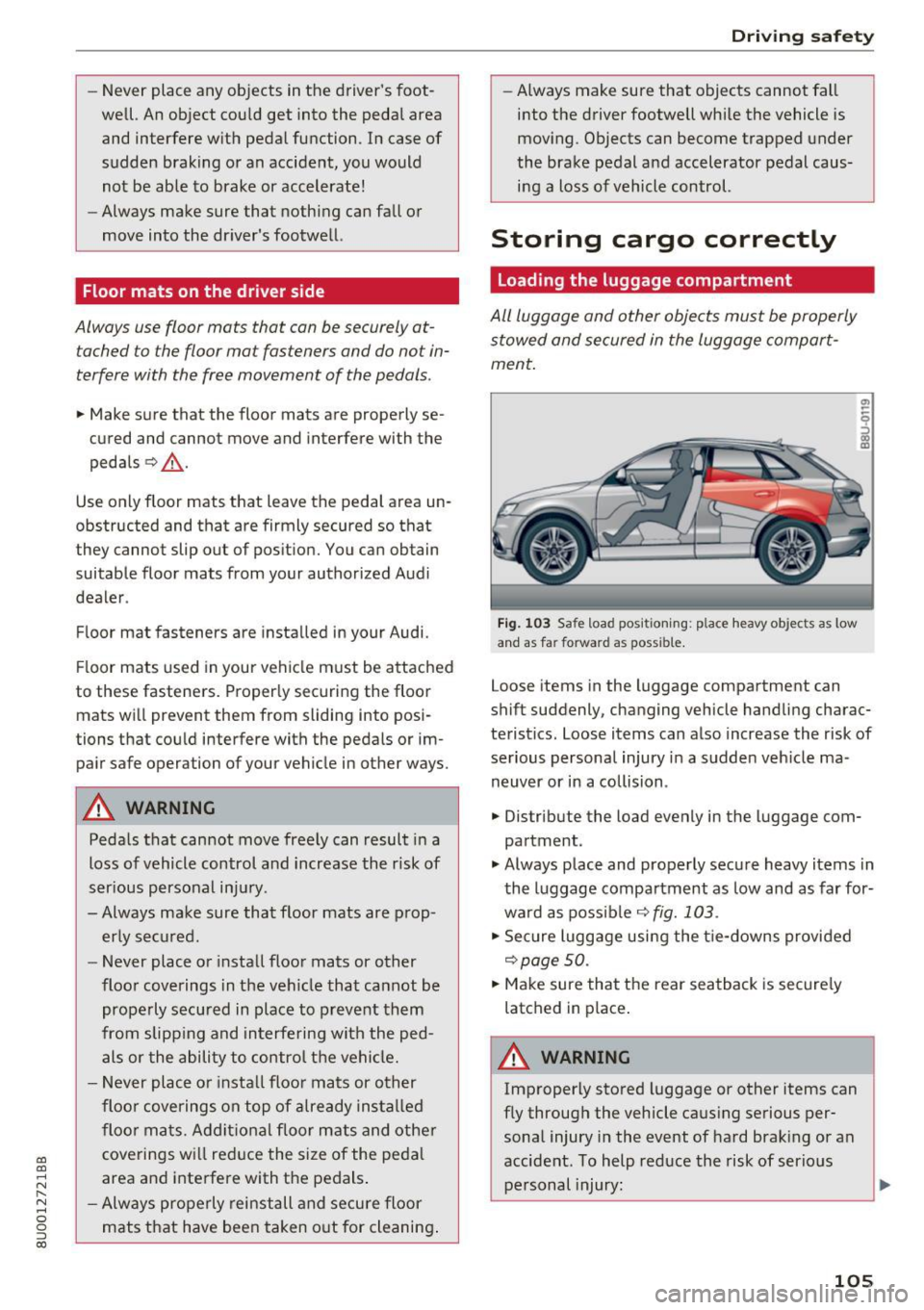
Fi g. 103 Safe load pos ition ing: place heavy objects as low
and as fa r forward as poss ible.
Loose items in the luggage compartment can
shift suddenly, changing vehicle handling charac
teristics. Loose items can also increase the risk of
serious personal injury in a sudden veh icle ma
neuver or in a collision .
.. Distribute the load evenly in the luggage com
partment.
.,. Always place and properly secure heavy items in
the luggage compartment as low and as far for
ward as possib le
q fig. 103 .
.. Sec ure luggage usi ng the t ie-downs provided
q pogeSO.
.. Make sure that the rear seatback is secure ly
latched in place .
A WARNING
Improperly stored luggage or other items can
fly through the vehicle caus ing serious per
sona l injury i n the event of hard brak ing or an
accident. To help reduce the risk of serio us
personal injury :
~
105
Page 161 of 236
00
00
......
"' ,....
"' ...... 0 0 :::,
00
pollutants in the exhaust gas before they are re
leased into the atmosphere.
The exclusive use of unleaded fue l is critically im
portant for the life of the catalytic converter and
proper functioning of the engine .
~ WARNING
-The temperature of the exhaust system is
high, both when driving and after stopping
the engine.
- Never touch the exha ust ta il pipes once they
have become hot. This could result in burns.
- Do not park or operate the vehicle in areas
where the hot exhaust system may come in
contact with dry grass, brush, fuel spill or
other mater ial which can cause a fire.
- Do not apply additional undercoating or
rustproof ing on or near the exhaust mani
fold, exhaust pipes, catalytic converter or
heat shields. During dr iv ing, the substance
used for undercoating could overheat and
cause a fire.
(D Note
- Be aware that just o ne tank filling with
lead ed fue l will already ser iously degrade
the pe rformance of the catalytic co nverter .
- Do not exceed the correct eng ine o il level
c::;, page 164.
- Do not drive until the fuel tank becomes
completely empty. The engine could mis
fire. Unburned fuel could also get into the
exhaust system and th is cou ld cause the
c ata lytic converter to overheat.
- Do not turn off the ignition whi le the vehicle
i s mov ing.
- Do not continue to operate your veh icle un
der these cond it ions, as otherwise fue l can
r each the cataly tic conve rte r. This cou ld re
s ul t in ove rheating of the converter, req uir
i ng its re placement.
- To assure efficient operation of the Em is
s ion Control System:
- Have your vehicle maintained properly and
in accordance with the service recommen
dations in your Warranty
& Maintenance
booklet.
-
Ch eck ing and Filling
-Lack of proper ma intenance as well as im
p roper use of the vehicle w ill impair the
f u nct ion o f the emission control system
and could lead to damage.
® For the sake of the environment
Even when the Emiss ion Control System is op
erating properly, the exhaust gas can have a
su lfur -like exhaust gas sme ll under some op
erating states. This depends on the sulfur
content of the fuel being used. Us ing a d iffer
ent brand of fuel may help, or f illing the tank
wi th lead-free supe r g rade gasoline.
Engine compartment
Working in the engine compartment
Special care is required if you are working in the
engine comportment
For work in th e engine compartm ent su ch as
che cking and filling fluids, there i s a ri sk of in
jury, scalding , accident s, and burn s. For thi s
reason , follow all the warnings and gene ral
s afety p re caution s prov ided in the following in·
formatio n. The engine compartment is a dan
gerous area on the vehicle.
c::;, .&. .
A WARNING
-- T urn the engine off.
- Sw itch the ignition off.
- Set the parking brake .
- Move the selector lever into t he P position .
- Neve r open the hood whe n there is steam o r
coo lant escaping from the engine compart
ment, because there is a risk that you could
be burned. Wait unt il no steam or coolant is
escaping.
- Let the eng ine cool down.
- Keep children away from the eng ine com -
partment.
- Never sp ill fluids on a ho t engine. These flu
ids (such as the anti -freezing agent con
tained in the coolant) can ignite .
- Avoid short c ircui ts in the elect rical sys tem.
- W hen working in the engi ne comp artme nt,
remember that the radiator fan can swi tch
159
Page 162 of 236
Checking and Filling
on even if the ignition is switched off, which
increases the risk of personal injury.
- Never open the cap on the coolant expan
sion tank when the engine is warm. The
cooling system is under pressure.
- To protect your face, hands, and arms from
hot steam or coolant, cover the cap with a
large cloth when opening.
- Do not remove the engine cover under any
circumstances . This increases the risk of
burns.
- If tests need to be performed with the en gine running, there is additional danger due
to moving components (such as the ribbed
belt, alternator and radiator fan) and from
the high-voltage ignition system .
- Do not under any circumstances activate the throttle inadvertently (for example, by hand
from the engine compartment) if the vehi
cle is stationary but the engine is running
and a gear is engaged. Otherwise, the vehi
cle will start to move immediately and this
could result in an accident.
- Pay attention to the following warnings list
ed when work on the fuel system or on the
electrical equipment is required.
- Do not smoke .
- Never work near open flames.
- Always have a working fire extinguisher
nearby
- To reduce the risk of electric shock and in
jury, never touch the following components when the engine is running or is being start
ed:
- Ignition cable - Other components in the electronic high-
voltage ignition system
- If you must check or perform work on the
engine while it is running:
- Set the parking brake and place the selec
tor lever in the P (park) position first .
- Always proceed with extreme caution so that clothing, jewelry or long hair do not
become caught in the radiator fan, fan
belt or other moving components or do
not come into contact with hot compo
nents . Tie back long hair before beginning
160
work and do not wear clothing that can
hang down into the engine .
- Limit your exposure to exhaust and chemi
cals to as short a time as possible
c:> ,& .
-All work on the battery or electrical system
in your vehicle can result in injuries, chemi
cal burns, accidents or burns. Because of
this, all work must be performed
only by an
authorized Audi dealer or authorized Audi
Service Facility .
A WARNING
California Proposition 6S Warning:
- Engine exhaust , some of its constituents,
and certain vehicle components contain or
emit chemicals known to the State of Cali
fornia to cause cancer and birth defects and
reproductive harm . In addition, certain flu
ids contained in vehicles and certain prod
ucts of component wear contain or emit
chemicals known to the State of California
to cause cancer and birth defects or other reproductive harm .
- Battery posts, terminals and related acces ·
sories contain lead and lead compounds,
chemicals known to the State of California
to cause cancer and reproductive harms. Wash hands after handling.
(D Note
When filling fluids, be sure not to mix the fluids up. Otherwise severe malfunctions and en
gine damage will occur .
@I For the sake of the environment
You should regularly check the ground under
your vehicle in order to detect leaks quickly. If
there are visible spots from oil or other fluids, bring your vehicle to an authorized Audi deal
er or authorized Audi Service Facility to be
checked .
Page 164 of 236
Checking and Filling
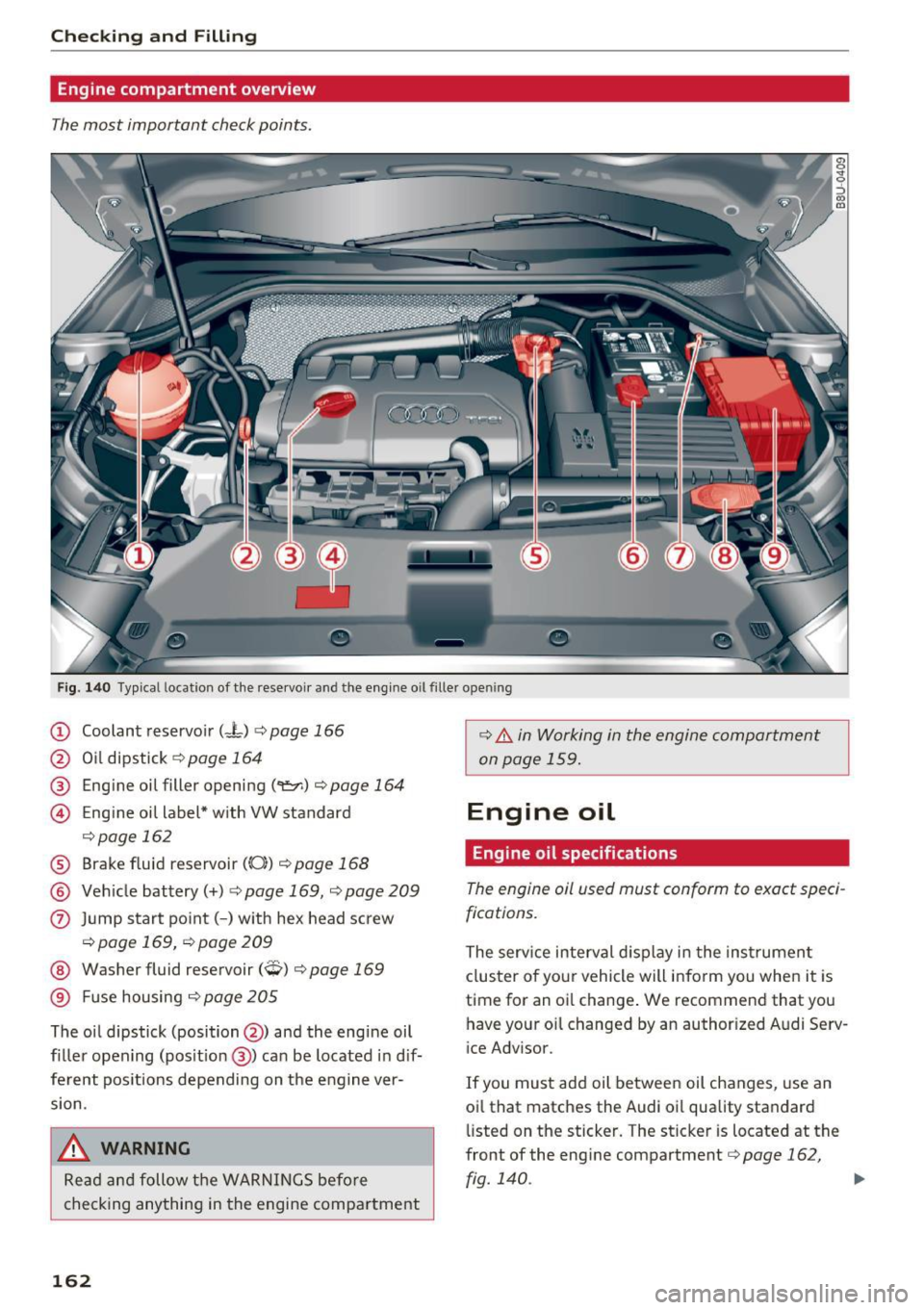
Engine compartment overview
The most important check points.
Fig. 140 Typical location of the rese rvoir and the engine o il fil le r open ing
(D Coolant reservoir (- L) ¢ page 166
@ Oil dipstick ¢ page 164
® Engine oil filler opening ('t:::r.) ¢page 164
© Eng ine oil label* w ith VW standard
¢page 162
® Brake fluid reservoir ((0)) ¢ page 168
® Vehicle battery(+) ¢ page 169, ¢page 209
(?) Jump start point( -) w ith hex head screw
¢page 169, ¢page 209
@ Washer fluid reservoir (O) ¢ page 169
® Fuse housing c:::> page 205
The oil dipstick (position @) and the engine oil
filler open ing (pos it ion @) can be located in dif
fe rent positions depending on the engine ver
sion .
_8. WARNING
Read and follow the WARNINGS befo re
checking anything in the engine compartment
162
¢ &. in Working in the engine compartment
on page 159.
Engine oil
Engine oil specifications
The engine oil used must conform to exact speci
fications.
The serv ice interval display i n the inst rumen t
cluster o f your vehicle will inform you when it is
time for an oi l change . We recommend that you
have your o il changed by an author ized A udi Serv
ice Adv isor.
If you must add oil between oil changes, use an oi l that matches the Aud i oi l quality standard
li sted on the sticker. The sticker is located at the
front of the eng ine compartment ¢
page 162,
fig. 140 .
Page 170 of 236
Checking and Filling
Brake fluid
N
N
~ N ,l: a, CXl
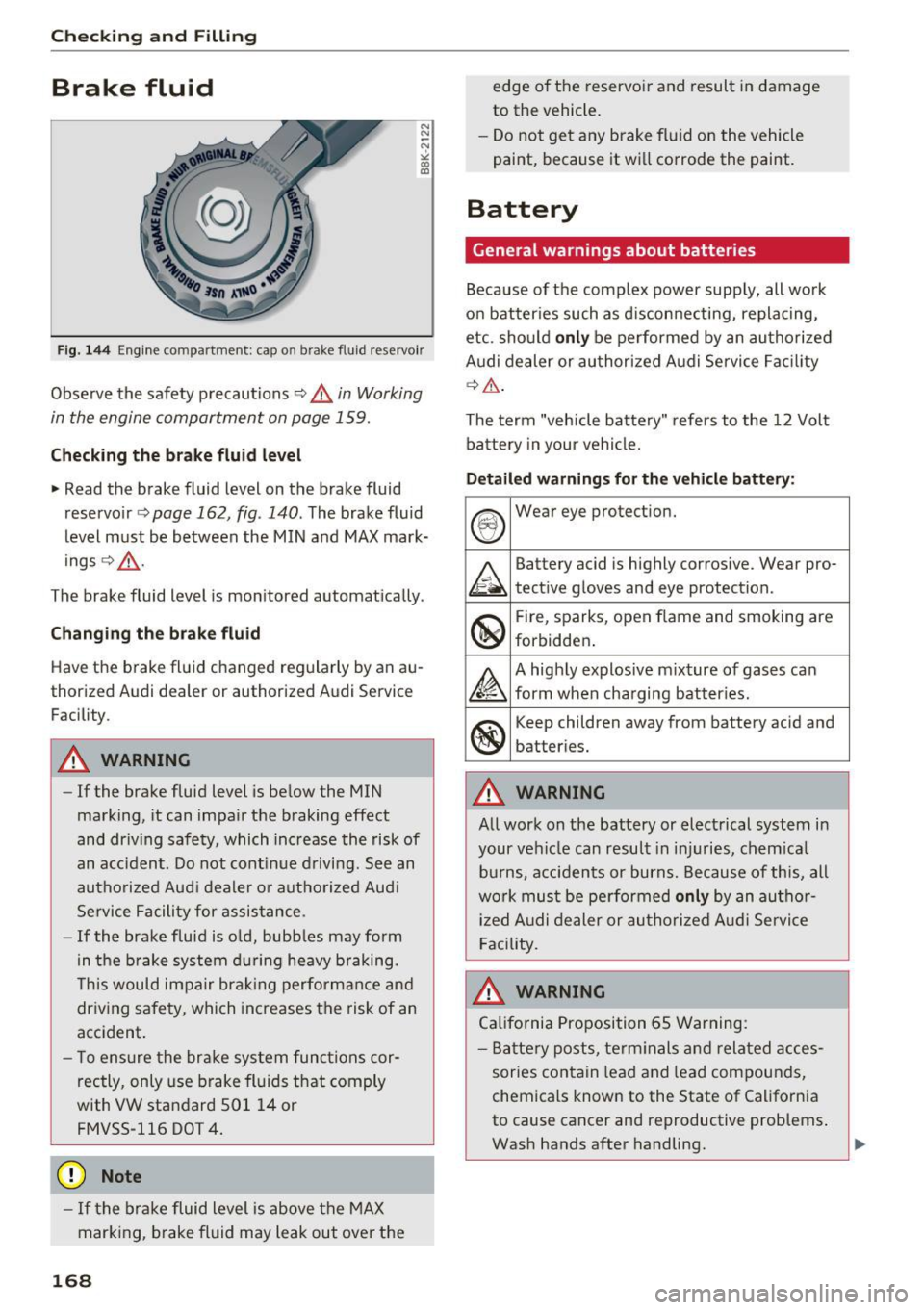
Fig. 14 4 Engine compartment: cap on brake fluid reservoir
Observe the safety precautions c:::> .&. in Working
in the engine compartment on page 159.
Checking th e br ake fluid l evel
.- Read the brake fluid level on the brake fluid
reservoir
c:::> page 162, fig . 140 . The brake fluid
level must be between the MIN and MAX mark
ings
c:::> ,&. .
The brake fluid level is monitored automatically .
Chang in g the b ra ke flu id
Have the brake fluid changed regularly by an au
thorized Audi dealer or authorized Audi Service
Facility .
A WARNING
-If the brake fluid level is below the MIN
marking, it can impair the braking effect
and dr iving safety, which increase the risk of
an accident. Do not cont inue driving . See an
authorized Aud i dealer or autho rized Audi
Service Facility for assistance.
- If the brake fluid is o ld, bubbles may form
in the b rake system du ring heavy b raking.
This would impair brak ing performance and
driving safety, which increases the risk of an
accident.
- T o ensure the brake system functions cor
rectly, only use brake fluids t hat comply
with VW standard 501 14 or
FMVSS-116 DOT 4.
(D Note
-If the brake fluid level is above the MAX
mark ing, brake fluid may leak out over the
168
edge of the reservoir and result in damage
to the vehicle.
- Do not get any brake fluid on the vehicle
paint, because it will corrode the paint.
Battery
General warnings about batteries
Because of the comp lex power supp ly, all wo rk
on batter ies such as d isconnecting, replacing,
etc. should
only be performed by an authorized
Audi dealer or authorized A udi Service Fac ility
c:::> &. .
The term "veh icle battery" refers to the 12 Volt
ba tte ry in your vehicle.
D etail ed warning s for th e vehicle batte ry:
®
Wear eye protection.
A
Battery acid is highly corrosive. Wear pro-
tect ive gloves and eye protection.
@
Fire, sparks, open flame and smoking are
forbidden .
&
A highly explosive m ixture of gases can
form when charging batter ies.
@
Keep children away from battery acid and
batteries.
A WARNING
All work on the battery or electrical system in
your vehicle can result in injuries, chem ica l
bu rns, acciden ts or burns. Because of this, all
wo rk mus t be performed
only by an autho r
i zed A udi dealer or authorized Aud i Service
Facility.
A WARNING
Ca lifornia Proposition 65 Warning:
- Batte ry posts, te rm inals and related acces
sories contain lead and lead compounds,
chemicals known to the State of California
to cause cancer and reproductive problems.
Wash hands after handling.
-
Page 175 of 236
"' "' -N
" N
-0
0
::, a)
® Mud and snow capability
"M/5" or "M+S" indicates the tire
has properties making it suitable
to drive in mud or snow.~ indi
cates a winter tire .
@ Composition of the tire cord
and materials
The number of plies indicates the
number of rubber ized fabric lay
ers in the t ire. In general : the
more layers, the more weight a
tire can carry . Tire manufacturers
must also specify the materials
used in the tire . These incl ude
stee l, nylon, polyester and other
materials .
@Maximum permitted load
This number indicates the maxi
mum load in kilograms and
pounds that the tire can carry.
@ Uniform tire quality grade
standards for treadwear,
traction and temperature resistance
T read wear, trac tion and temper
ature ranges
¢ page 187.
@ Running direction
The arrows indicate the running
direction of un idirectional t ires.
You must always follow the speci- fied running direction
¢
page 202.
€3) Maximum permitted
inflation pressure
Wheels
T his number ind icates the max i
mum pressure to which a tire can
be inflated unde r normal operat
ing conditions.
Glossary of tire and loading
terminology
Accessory weight
means the combined we igh t (in
excess of those standard items
wh ich may be replaced) of auto
matic transmission, power steer
ing, power brakes, power win
dows, power seats, radio, and
heater, to the extent that these
items are available as factory-in
stalled equipment (whether in
stalled or not).
Aspect ratio
means the ratio of the height to
the w idth of the tire in percent .
Numbers of 55 or lower indicate a
low s idewall for improved steer
ing response and better overall
handling on dry pavement .
173
Page 177 of 236
"' "' -N
" N
-0
0
::, a)
(a) Curb weight
(b) Accessory weight
(c) Vehicle capacity weight, and
(d) Production options we ight
Ma ximum (permissible)
inflation pressure
means the maximum cold infla
tion pressure to which a t ire may
be inflated. Also called "maxi
mum inflation pressure."
Normal occupant weight
means 150 lbs. (68 kilograms)
times the number of occupants
seated in the veh icle up to the to
tal seating capacity of your vehi c le.
Occupant distribution
means distribution of occupants
in a vehicle.
Outer diameter
means the overall diameter of an
inflated new tire.
Overall width
means the linear distance be
tween the exteriors of the side
walls of an inflated tire, including
elevations due to labeling, deco
rations, or protective bands or
ribs .
Wheels
Ply
means a layer of rubber-coated
parallel cords .
Production options weight
means the combined weight of
those installed regular production
options weighing over 5 lbs.
(2.3 kg) in excess of those stand
ard items which they replace, not
previously considered in curb
weight or accessory weight, in
cluding heavy duty brakes, ride levelers, roof rack, heavy duty
battery, and special trim.
Radial ply tire
means a pneumatic tire in which
the ply cords that extend to the beads are laid at substantially
90 degrees to the centerline of
the tread.
Recommended inflation
p ressure
see ~ page 174, Cold tire infla
tion pressure .
Reinforced tire
means a tire designed to operate
at higher loads and at higher in
flation pressures than the corre sponding standard tire. Rein
forced tires may be identified as .,.
175