warning light AUDI Q3 2017 Owner´s Manual
[x] Cancel search | Manufacturer: AUDI, Model Year: 2017, Model line: Q3, Model: AUDI Q3 2017Pages: 236, PDF Size: 58.93 MB
Page 147 of 236
a:,
a:,
...... N r--. N
'"' 0 0 ::, a:,
restraint in place c!;> page 46. Install the
head restraint again immediately once the
child seat is removed. Driving without head
restraints or with head restraints that are
not properly adjusted increases the risk of
serious or fatal neck injury dramatically .
- Always read and heed all WARNINGS when
ever using a child restrained in a vehicle is
being used¢
page 109, Safety belts,
¢ page 117, Airbag system and
¢page 137, Important information.
_& WARNING
If exceptional circumstances require the use
of a forward-facing child restraint on the
front passenger's seat, the child's safety and
well-being require that the following special
precautions be taken:
- Make sure the forward-facing seat has been
designed and certified by its manufacturer
for use on a front seat with a passenger
front and side airbag .
- Always follow the manufacturer's instruc
tions provided with the child safety seat or
infant carrier.
- Always move the front passenger seat to
the highest position in the up and down ad
justment range and move it back to the
rearmost position in the seat's fore and aft
adjustment range, as far away from the air
bag as possible, before installing the for
ward-facing child restraint.
- Always make sure that the safety belt upper
anchorage is behind the child restraint and
not next to or in front of the child restraint
so that the safety belt will be properly posi
tioned.
- Always make sure that nothing prevents the
front passenger's seat from being moved to
the rearmost position in its fore and aft ad
justment range.
- Always make sure the backrest is in an up
right position.
- Make sure that the
PASSENGER AIR BAG
OFF
light comes on and stays on all the time
whenever the ignition is switched on.
Child safety
- If the light does not stay on, perform the
checks¢
page 12 7, Monitoring the Ad
vanced Airbag System.
-T ake the child restraint off the front passen
ger seat and install it properly at one of the rear seat positions if the
PASSENGER AIR
BAG OFF
light does not stay on whenever
the ignition is switched on.
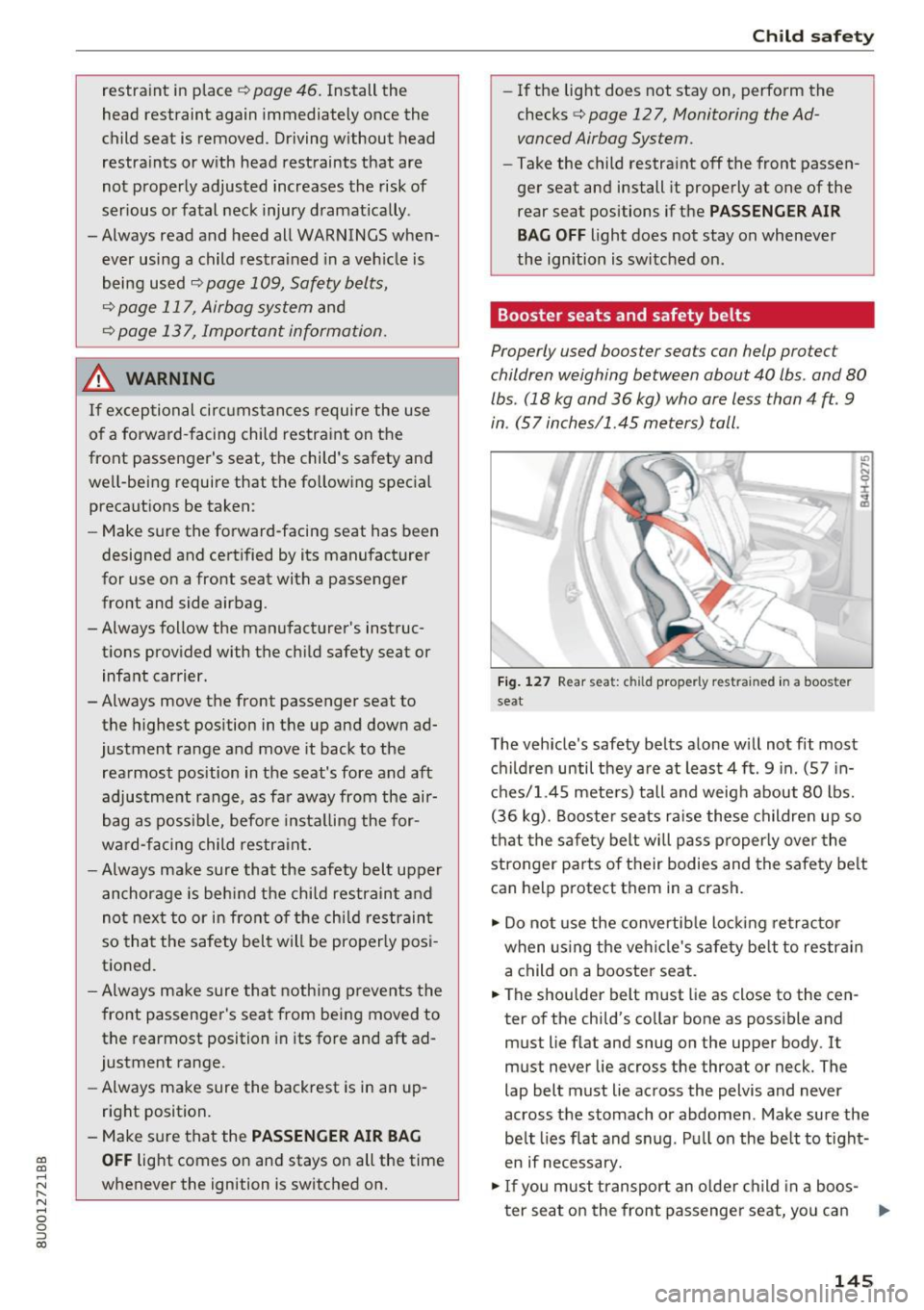
Booster seats and safety belts
Properly used booster seats can help protect
children weighing between about 40 lbs . and 80
lbs . (18 kg and 36 kg) who are less than 4 ~-9
in . (57 inches/1 .45 meters) tall.
Fig. 127 Rear seat: child properly restrained in a boos ter
seat
The vehicle's safety belts alone will not fit most
children until they are at least 4 ft . 9 in . (57 in
ches/1.45 meters) tall and weigh about 80 lbs.
(36 kg). Booster seats raise these children up so
that the safety belt will pass properly over the
stronger parts of their bodies and the safety belt
can help protect them in a crash.
"' Do not use the convertible locking retractor
when using the vehicle's safety belt to restrain
a child on a booster seat.
"'Th e shoulder belt must lie as close to the cen
ter of the child's collar bone as possible and
must lie flat and snug on the upper body. It
must never lie across the throat or neck. The
lap belt must lie across the pelvis and never
across the stomach or abdomen . Make sure the
belt lies flat and snug . Pull on the belt to tight
en if necessary.
"'If you must transport an older child in a boos-
ter seat on the front passenger seat, you can
IIJJ,
145
Page 149 of 236
00
00
......
"' ,....
"' ...... 0 0 :::,
00
- Never let a child stand or kneel on any seat,
for example the front seat.
- Never let a child ride in the cargo area of
your vehicle.
- Always remember that a child leaning for
ward, sitting sideways or out of position in
any way during an accident can be struck by
a deploying airbag. This will result in serious
personal injury or death.
- If you must install a booster seat on the
front passenger seat because of exceptional
circumstances the
P A SS ENGER AIR BAG
OFF
light must come on and stay on, when
ever the ignition is switched on.
- If the
PASSENGER A IR BAG OFF light does
not come on and stay on, perform the
checks descr ibed
c:> page 12 7, Monitoring
the Advanced Airbag System.
- Take the ch ild restraint off the front passen
ger seat and install it p roperly at one of the
rear seat positions if the
PA SSENGER A IR
BA G OFF
light does not stay on whenever
the ignition is switched on.
- Always read and heed all WARN INGS when
ever using a child restrained in a vehicle is
being used
r=;, page 109, Safety belts,
c:> page 117, Airbag system
and
c:> page 13 7, Important information.
Securing child seats
Securing a child safety seat using a safety
belt
Safety belts for the rear seats and the front pas
senger can be locked with the convertible locking retractor to properly secure child safety seats .
The safety belts emergency locking retractors for
the rear seats safety belts and for the front pas
senger's seat safety belt have a convertib le lock
ing retractor for child restraints. The safety belt
must be locked so that belt webbing cannot un
reel. The retractor can be activated to lock the
safety belt and prevent the safety belt webbing
from loosening up during normal driving. A child
safety seat can only be properly installed when
the safety belt is locked so that the child and
child safety seat w ill stay in place .
Child safety
Always remember : Even though your vehicle is
equipped with an Advanced Airbag system, all
children, especially those 12 years and younger,
should always ride in the back seat properly re
strained for their age and size.
A WARNING
=
Improperly installed child safety seats in
crease the risk of serious personal injury and
death in a collision .
-
-Always make sure that the safety belt re
tractor is locked when installing a child
safety seat. An un locked safety be lt retrac
tor cannot hold the ch ild safety seat in place
du ring normal driving or in a c rash.
- Always buckle the child safety seat fi rm ly in
p lace even if a ch ild is not sitt ing in it. A
loose child safety seat can fly around during
a sudden stop or in a co llision.
- Always make sure that the rear seat back
rest to which the center rear safety belt is
attached is securely latched whenever the
rear center safety belt is being used to se
cure a child restraint.
- If the backrest is not securely latched, the
child and the child restraint will be thrown
forward together with the backrest and w ill
strike parts of the veh icle inter ior. The child
can be seriously injured or killed .
- Never install rear-facing child safety seats
or infant carriers on the front passenger
seat . A child w ill be seriously injured and
can be killed when the passenger a irbag in
flates.
- The inflating airbag will h it the ch ild safety
seat or infant ca rr ier with great force and
will smash the child safety seat and child aga inst the backrest, cente r armrest, door
or roof .
- Always install rear-fac ing child safety seats
or infant car riers on the rear seat.
- Forward-facing child safety seats o r infant
carriers installed on the front passenger's
seat may interfere with the deployment of
the airbag and cause serio us injury to the
child .
- It is sa fer to install a forward -facing child
safety seat on the rear seat.
147
Page 150 of 236
Child safety
-Always read and heed all WARNINGS when
ever using a child restrained in a vehicle is
being used ¢
page 13 7. Special precautions
apply when installing a child safety seat on
the front passenger seat¢
page 118, Child
restraints on the front seat -some impor
tant things to know.
_& WARNING
Always take special precautions if you must
install a forward or rearward-facing child re
straint on the front passenger's seat in excep
tional situations:
- Whenever a forward or rearward-facing
child restraint is installed on the front pas
senger seat, the
PASSENGER AIR BAG OFF
light must come on and stay on whenever
the ignition is switched on.
- If the
PASSENGER AIR BAG OFF light does
not come on and stay on, perform the
checks described
¢ page 127, Monitoring
the Advanced Airbag System.
- Take the child restraint off the front passen
ger seat and install it properly at one of the
rear seat positions if the
PASSENGER AIR
BAG OFF
light does not stay on whenever
the ignition is switched on .
- Improper installation of child restraints can
reduce their effectiveness or even prevent
them from providing any protection .
-An improperly installed child restraint can interfere with the airbag as it deploys and
seriously injure or even kill the child.
-Always carefully follow the manufacturer's
instructions provided with the child safety
seat or carrier.
- Never place additional items on the seat
that can increase the total weight registered by the weight-sensing mat and can cause in
jury in a crash.
_& WARNING
Forward-facing child restraints:
- Always make sure the forward-facing seat
has been designed and certified by its man
ufacturer for use on a front seat with a pas
senger front and side airbag.
148
-
- Never put the forward-facing child restraint
up, against or very near the instrument pan
el.
- Always move the front passenger seat to
the highest position in the up and down ad
justment range and move it back to the rearmost position in the seat's fore and aft
adjustment range, as far away from the air
bag as possible, before installing the for
ward-facing child restraint.
-Always make sure that the safety belt upper
anchorage is behind the child restraint and
not next to or in front of the child restraint
so that the safety belt will be properly posi
tioned.
- Make sure that the
PASSENGER AIR BAG
OFF
light comes on and stays on all the time
whenever the ignition is switched on.
_& WARNING
Rearward-facing child restraints:
-A child in a rearward-facing child safety seat
installed on the front passenger seat will be
seriously injured and can be killed if the
front airbag inflates -even with an Ad
vanced Airbag System.
- The inflating airbag will hit the child safety
seat or infant carrier with great force and
will smash the child safety seat and child
against the backrest, center armrest, door
or roof.
- Always be especially careful if you must in
stall a rearward facing child safety seat on
the front passenger seat in exceptional cir
cumstances .
- A tight tether strap on a rearward-facing child restraint attached to the front passen
ger seat can put too much pressure on the
weight-mat in the seat and register a heavi
er weight in the Advanced Airbag System.
The heavier weight registered can make the
system work as though an adult were on the
seat and deploy the Advanced Airbag when
it must be suppressed causing serious or
even fatal injury to the child.
Page 151 of 236
00
00
......
"' ,-...
"' ...... 0 0 :::,
00
- Make sure that the PA SSENGER AIR B AG
OFF
light comes on and stays on all the time
whenever the ignition is switched on.
- If the PAS SEN GER AIR BAG OFF light does
not come on and stay on, immediately in
stall the rear-fac ing ch ild safety seat in a
rear seat ing pos ition and have the airbag
system inspected by your Aud i dealer.
Activating the convertible locking retractor
Use the convertible locking retractor to secure a
child restraint.
Always heed the child safety seat manufacturer's
instructions when installing a ch ild restraint in
your veh icle. To act ivate the convertible locking
retractor:
.. Place the child restraint on a seat, preferab ly
on the rear seat.
.,. Slowly pull the be lt
all th e way out .
.. Route it around or through the c hild restraint
belt path ¢
.&_.
.,. Push the child safety seat down with your fu ll
weight to get the safety be lt rea lly t ight.
.,. Inse rt the bel t tongue into the buckle fo r that
seating position .
.,. Guide the safety be lt back into the retractor un
til the belt lies flat and snug on the child safety
seat.
.. You should hear a "clicking" noise as the belt
winds back into the inertia reel. Test the con
vertible locking retractor by pulling on the belt .
You should no longer be able to pull the belt
out of the ret ractor. The conve rtible locking re
tractor is now ac tivated .
.,. Make s ure that the red release button is fac ing
away from the child restraint so that it can be
unbuckled quick ly.
.. Pull on the be lt to make sure the safety belt is
properly tight and fastened so that the seat
cannot move forward or sideways more than
one inch (2 .5 cm).
A WARNING
Using the wrong child restra int or an improp
erly installed ch ild rest raint can cause ser ious
personal in jury o r death in a crash.
Ch ild safety
-Always make sure that the safety be lt re
tractor is locked when installing a child
safety seat. An unlocked safety be lt retrac
tor cannot hold the ch ild safety seat in place
during normal driving or in a crash .
- Always buckle the child safety seat firmly in
place even if a ch ild is not sitt ing in it . A
loose child safety seat can fly a round dur ing
a sudden s top or in a c rash.
- Always make sure the seat backrest to which
the child restraint is installed is in an up
right position and securely latched into
p lace and cannot fo ld forward. Othe rw ise,
the seatback with the child safety seat at
tached to it could fly forward in the event of
an accident or other emergency situation.
- Always read and heed all WARNINGS when
ever using a child restrained in a vehicle is
being used¢
page 137 . Special precautions
apply when install ing a child safety seat on
the front passenger seat ¢
page 118, Child
restraints on the front seat -some impor
tant things to know .
Deactivating the convertible locking
retractor
The convertible locking retractor for child re
straints will be deactivated automatically when
the belt is wound all the way back into the re
tractor .
.. Press the red button on the safety belt buckle.
The belt tongue will pop out of the buck le.
.,. Guide the safety belt all the way back into its
s towed posit io n .
Always let the safety belt retract completely into
its stowed posit ion. The safety be lt can now be
u sed as an ord inary safety belt wit hout the con
vertib le locking ret ractor fo r ch ild rest raints .
If the convertible locking retractor should be ac
t ivated inadverte ntly, the safety belt must be un
fastened and guided comp lete ly back into its
stowed pos ition to deactivate th is feature. If the
convertible locking retractor is not deactivated,
the safety belt will gradua lly become tighter and
uncomfortab le to wear. ..,.
149
Page 163 of 236

a:,
a:,
,....,
N r--. N
'"' 0 0 ::, a:,
Opening/closing the hood
The hood is released from inside the vehicle.
Fig. 1 38 D river footwell: release lever
Fi g. 1 39 Roc ke r switch under the hood
"' 0 0
0
=i
~
Make sure the w iper arms a re not raised up from
the windshield. Otherwise the pa int could be
damaged .
Opening the hood
.. Wi th the driver's doo r open, pu ll the leve r be
low the instrument panel in the d irect io n of the
arrow¢fig.138 .
Checking and Filling
.. Raise the hood slightly¢,& .
.. Press the rocker switch under the hood upward
¢fig . 139. This releases the catch .
.. Open the hood.
Closing the hood
.. Push the hood down until yo u over ride the
force of t he str ut .
.. Let the hood fall lightly into the latch.
Do not
press it in.
c> ,&.
A WARNING
-
-Never open the hood when there is steam or
coolant escaping from the engine compart
ment, because there is a risk that you could
be burned. Wait unt il no steam or coolan t is
escaping.
- If the hood is not latched completely, it
could fly up w hile you are dr iving and ob
s truc t your v isio n.
- For safety reasons, the hood must always be
closed secu rely while dr iv ing. Because of
this, always che ck t he hood afte r closing i t
t o make sure it is latched correct ly. The
hood is latched if the front corners cannot
be lifted.
- If you notice th at the hood is not latched
while you are d riving, stop immediately and
close it, because driving when the hoo d is
not latched increases the risk of an accident .
161
Page 165 of 236

00
00
......
"' ,....
"' ...... 0 0 :::,
00
A udi rec ommend s
@;Cilstrot /Jgjgf ~ f'r,w.~7dr,,'1AJ.
A ud i re commends Longlife high p erform ance
e ngi ne oil from A udi Gen uin e P art s
Using the proper engine oil is important for the
functionality and service life of the engine. Your
engine was factory-filled with a high-quality oil
which can usually be used throughout the entire
year .
Note
Your Limited New Vehicle Warranty does not
cover damage or malfunctions due to failure
to follow recommended maintenance and use
requirements as set fo rth in the Aud i Owner's
Manual a nd Warranty & Mai ntenan ce booklet.
- Use only a high quality eng ine oil that ex-
pressly complies with the Aud i oil q ual ity
standard specified for your vehicle's engine. Using any other oil can cause serious engine
damage .
- Do not mix any l ubricants or othe r addi tives
into the engine oil. Doing so can cause en
gine damage.
(D Tips
If you need to add oil and there is none availa
ble that meets the Audi oil quality standard
your engine requires, you may add a total of
no more than 0 .5 quart/liter of a high-quality
"synthet ic"oil that meets the following speci
fications.
- ACEA A3 or API SM with a viscosity grade of
SAE OW-30, SAE SW-30 or SAE SW-40.
- For more information about engine oi l that
has been approved for your vehicle, please
contact e ither your authorized Audi dea ler
or Audi Customer Relat ions at
1 (800) 822-2834 or vis it our web site at
www.audiusa.com or www.aud icanada .ca.
Ch eck ing and Filling
Engine oil consumption
The engine in your vehicle depends on on ade
quate amount of oil to lubricate and
cool oil of
its moving ports.
In order to provide effect ive lubrication and cool
ing of internal engine components, all internal
combust ion eng ines consume a certa in amount
of oil. Oil consumption varies from eng ine to en
gine and may change s ign ificantly over the life of
the engine. Typ ica lly, engines w ith a specified
break-in period (see
q page 58) consume more
oi l during the break -in period than they consume
after oil consumption has stabilized.
Under normal cond itions, the rate of oil con
sumption depends on the q uality and viscosity o f
the oil, the RPM (revol utions per minute) at
which the engine is operated, the ambient tem perature and road condit ions. Further factors are
the amount of oil dilution from water condensa
tion or fuel residue and the oxidation level of the o il. As any engine is subject to wear as mileage
builds up, the oil consumption may increase over
time unt il replacement of worn components may
become necessary.
With all these variables coming into play, no standard rate of o il consumption can be estab
li shed or spec ified . T he re is no alte rnative to reg
u la r and frequent checking of the oi l level , see
Note .
If the yellow engine o il leve l warning symbo l !I
in the instrument cluster lights up, you sho uld
check the o il level as soon as possible
q page 164. Top off the o il at your earlies t con
venience.
A WARNING ~
Before you check anything in the engine com-
partment, always read and heed all WARN
INGS
q .&. in Working in the engine comport
ment on page 159.
(D Note
Driving with an insufficient oil level is likely to
cause severe damage to the eng ine. ..,.
163
Page 169 of 236
00
00
......
"' ,....
"' ...... 0 0 :::,
00
~ Add coolant mixed in the correct ratio
¢ page 166 up to the upper marking.
~ Make sure that the fluid level rema ins stable.
Add more coolant if necessary.
~ Close the cap securely.
Coolant loss usually indicates there is a leak. Im
mediately drive your vehicle to an authorized
Audi dealer or authori zed Audi Service Facility
and have the cooling system inspected. If the
cooling system is not leaking, a loss can come
from the coolant boiling through overheating
and be ing pushed out of the cooling system.
.&, WARNING
The cool ing system is pressu rized and can be
come very hot. To reduce the r is k of burns
from hot coolant :
- Do not open the coo lant expansion tank cap
when the engine is hot. This increases the risk of burns.
- Stop the engine and allow it to cool.
- Protect your face, hands and arms from es -
caping coolant and steam by covering the
coolant tank cap with a large, thick cloth .
- T urn the coo lant tank cap co unterclo ckwise
slowly and keep light pressu re on the cap .
- T o reduce the risk of burns , do not allow any
antifreeze o r coolant to drip onto the ex
haust system or hot engine components.
T he ethylene glycol in engine coolant can
catch fire under certain circumstances .
- T he coo lant add itive and the coolant can be
dangerous to your health . For this reason,
keep the coolant in the original container
and away from children. There is a risk of
poisoning.
- When working in the engine compartment,
remember that the radiator fan can switch
on even if the ignition is switched off, which
increases the risk of injury .
Do not add coolant if the expansion tank is
empty. Air could enter the cooling system and
damage the engine. If this is the case, do not
cont inue driv ing . See an authorized Audi deal -
Check ing and Filling
er or authorized Aud i Service Facility for assis
tance .
- Before the start of winter, have your author
ized Aud i dea ler or a uthorized Audi Serv ice
Facility check if the coolant additive in your
vehicle matches the percentage appropriate
for the climate. This is especially important
when driving in colder climates.
- If the appropr iate coo lant add itive is not
availab le in an emergency, do not add any
other additive . You could damage the en
gine. If this happens, only use water and re
store the correct m ixtu re ratio with the
specified coolant add it ive as soo n as poss i
ble .
- Only refill w ith new coolant.
- Radiator sealant must not be mixed with
the coolant .
Radiator fan
T he radiator fan switches on automatically by it
self.
An auxiliary e lectr ic radiator fan switches on and
off depend ing on coolant temperature and other
vehicle operating conditions.
After you switch the engine off, the auxiliary fan c a n continue running for up to 10 m inutes - even
with the ignition off . It can even switch on aga in
later by itself ¢.& , if
- the temperature of the engine coolant rises due
to the heat build-up from the engine in the en
gine compartment, or
- the engine compartment heats up bec ause the
veh icle is parked in in tense sunlight.
.&, WARNING
--
- To reduce the r isk of personal injury never
touch the radiator fan .
- The auxiliary e lectr ic fan is temperature
controlled and can switch on s uddenly even
when the engine is not runn ing .
- The auxiliary radiator fan sw itches on auto
mat ica lly when the eng ine coolant reaches a
certa in temperature and will continue to run
until the coolant temperature d rops .
167
Page 191 of 236
00
00
......
"' ,....
"' ...... 0 0 :::,
00
also reduces fuel e fficiency and tire tread life,
and may affect the vehicle's handling and stop p ing ability .
Pl ease no te that the TPMS is not a substi tute for
p roper tire maintenance, and it is the drive r's re
sponsib ility to maintain cor rect tire pressure,
even if under-inflation has not reached the leve l
to tr igger illum inat ion of the TPMS low tire pres
sure telltale.
Your vehicle has also been eq uipped with a TPMS
mal funct ion indicator to indicate when the sys
tem is not operating properly. The TPMS mal
function indicator is combined w ith the low tire
pressure tellta le. Whe n the system detects a
malfunct ion, the telltale will flash for approx i
mately one min ute and then remai n cont inuo usly
i llum inated. This sequence will continue upon
s ubseq uen t ve hicl e start- ups as long as the m al
f u nction ex ists.
When the malfunct io n in dicator is ill uminated,
the system may not be ab le to detect or signa l
l ow tire press ure as intended . TPM S malfu nctions
may oc cur for a var iety of reasons, incl uding the
installation of replacement or alternate ti res o r
wheels on the vehicle that prevent the TPMS
from functioning properly . Always check the
TPMS malfunction telltale after rep lacing one or
more t ires or whee ls on your ve hicle to ensure
that the replacement or alternate tires and
wheels allow the TPMS to cont inue to funct ion
p roperly.
If the Tire Pressure Monitoring System
ind icator appears
A ppl ies to: ve hicles with Tir e Pressure Moni toring System in
di cato r
The tire pressure indicator in the instrument
cluster informs you if the tire pressure is too low
or if th ere is a system malfunction .
Using the ABS sensors, the tire p ressure mo nitor
i ng system compa res the tire tread circumfer
e n ce and vib ra tion characteristics of the individ u
a l tir es .
If the pressure c hanges in o ne or more
wheels , th is is indica ted in the instrument clus ter
d is p la y with a n
[I] indica to r li ght and a message.
Wh eel s
If only one tire is affected, the location of tha t
t ir e will be indicated.
T he tire press ures mus t be store d in the Infot ain
ment system again each t ime the pressures
c h ange (switching between partia l and full load
pressure) or after changing or replacing a tire on
yo ur vehicle
r::!;> page 190 . The tire pressure mon i
toring system on ly monitors the tire pressure you
have stored . Refer to the t ire pressure label for
the recommended t ire press ure fo r yo ur vehicle
r::!;>page 181, fig . 150 .
Tire tread c ircumfe rence and vibration cha racter
istics can change and cause a tire pressu re warn
i ng if :
- the t ire pressure in one or more tires is too low.
- the t ire has str uctural damage .
- t he t ire w as rep lace d or the t ire pressu re was
changed and it was no t store d
r::!;> page 190.
- t he spare tire* is i nstalled.
Indicator lights
[I] -Loss of pressu re in at leas t one tire r::!;> & .
Check the tires and replace or repair if necessary .
Check/correct the pressures of all fou r tires and
store the pressu re again in the menu disp lay
r::!;>page 190.
ffim (T ire Pressure Moni tor ing Sys tem) Tire
pre ssure: Syst em malfunction!. Ifm appears
after sw itching the ignition on or while d riv in g
and the
[I] i ndic ator ligh t in the i nstru men t clus
te r blinks for approx imately one minute and then
stays on, the re is system ma lf u nction . Try to
store the co rrect tire pressures
r::!;> page 190 . If
the indicator light does turn off or turns on again
after a short period of time, drive to an author
ized Audi dealer or author ized Audi Se rvice Facili
ty immediate ly to have the ma lfunction correct
ed.
_&. WARNING
- I f the tire p ressure in dicator appears in the
d isp lay, redu ce you r speed immedi ately and
a void any h ard stee ring or bra king m aneu
vers . S to p as soon as poss ible and check the
tires an d their pressure .
~
189
Page 193 of 236
00
00
......
"' ,....
"' ...... 0 0 :::,
00
Care and cleaning
General information
Regular, proper care helps to maintain your vehi
cle's value. It can a lso be a requirement when
submitting warranty claims for corrosion damage
and paint defects on the body.
The necessary care products can be obtained
from an authorized Audi dealer or authorized
Audi Service Facility . Read and follow the instruc
tions for use on the packaging.
A WARNING
- Us ing clean ing and care products incorrectly
can be dangerous to your health.
- Always store clean ing and care products out
of reach of children to reduce the r isk of po i
son ing .
@ For the sake of the environment
- Preferably purchase env ironmenta lly-friend
l y cleaning products.
- Do not d ispose of leftover cleaning and care
products with household trash.
Car washes
T he longer that deposits remain on the vehicle,
the more the surface may be damaged. High
temperatures such as those caused by sunlight increase the damag ing effect.
Befor e washing, rinse
off heavy depos its with
p lenty of water.
S tubborn depos its such as bird droppings or tree
sap are best removed with plenty of water and a
microfiber cloth.
A lso, wash t he un derside of yo ur vehicle once
road sa lt stops being used for the season .
Pressure washers
When washing your ve hicle w ith a pressure wash
e r, a lways fo llow the operating instructions pro
vided wi th the p ressure washer. This is especially
i mportant in rega rd to the pressure and sp raying
d istance . Do not aim the spray directly at seals on
side windows, doors, the hood, the luggage com-
Ca re and cleaning
partment lid or the panorama glass roof* or at
tires, rubber hoses, insulating material, sensors *
o r camera lenses* . Keep a distance of at least 16
in
(40 cm).
Do not remove snow and ice with a pressure
washer.
Never use cone nozz les o r high press ure nozzles .
T he water temperatu re must not be above
140 °F
(60 °().
Automatic car washes
Spray off the vehicle before washing.
Make s ure that the windows and roo f* are closed
and the windshie ld wipers are
off . Follow instruc
tions from the car wash ope rator, especially if
there are accessories attached to your vehicle.
If possible, use car washes that do not have
brushes .
Washing by hand
Clean the ve hicl e starting from the top and wor k
i ng down using a soft sponge o r cleaning br ush.
U se solven t-free cleaning produ cts.
Washing vehicles with matte finish paint by
hand
T o avo id damag ing the pa int w hen washi ng, fi rst
remove dust and large pa rticl es from you r vehi
cle . Insects, grease spots and fingerprints are
best removed w ith a special cleaner for matte
finish paint.
Apply t he product using a microf iber cloth . To
avoid damaging the paint surface, do not use too
much pressure.
Rinse the ve hicl e thoroug hly w ith wate r. Then
cl ean usi ng a neutral shampoo and a soft micro
fiber cloth .
Rinse the ve hicl e thorough ly aga in and let it air
dry. Remove any wate r residue using a chamois.
WARNING
-On ly wash the vehicle when the ign ition is
off and follow the instr uctions from the car
191
Page 196 of 236
Care and cleaning
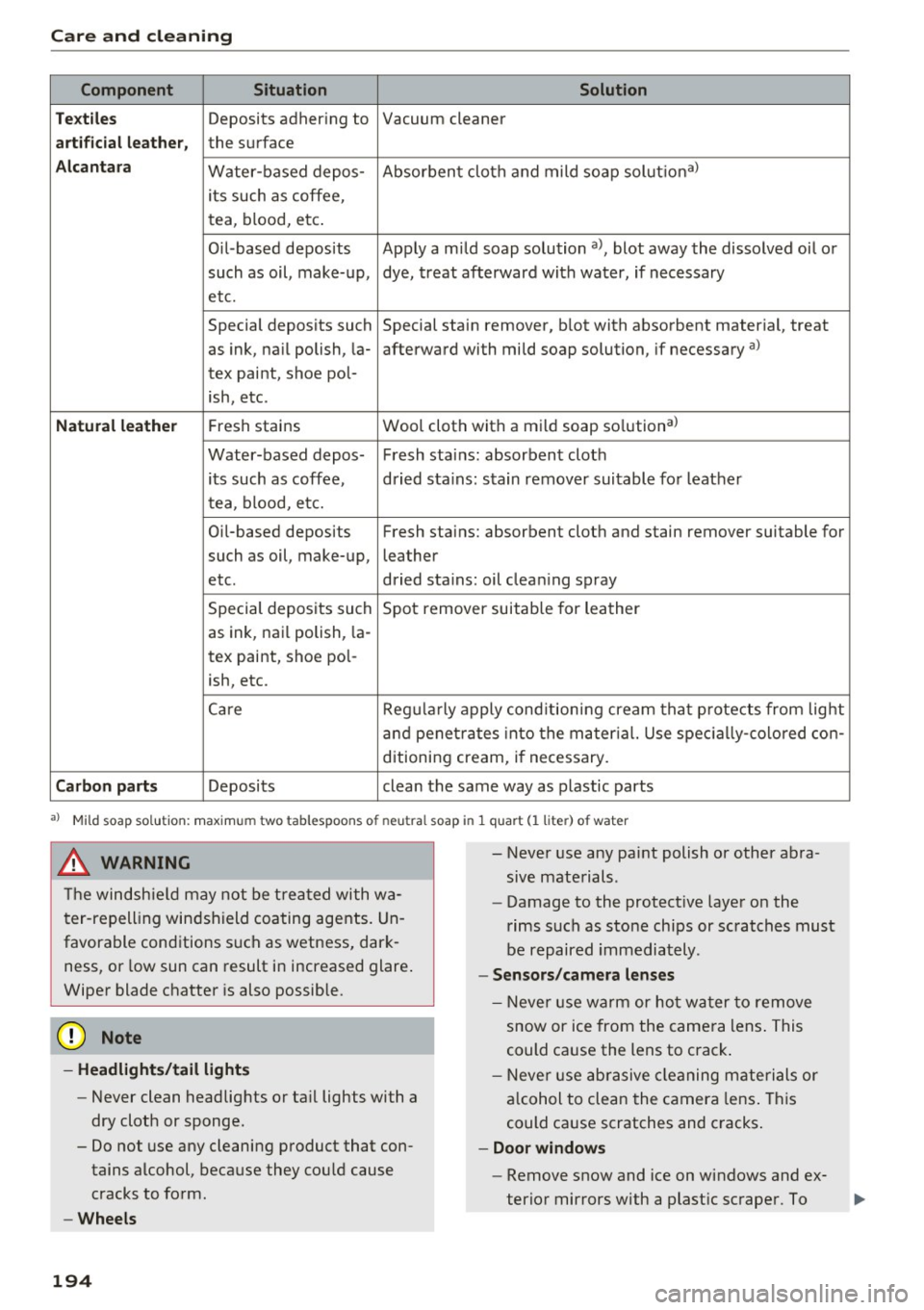
Component Situation Solution
Te xtil es
Deposits adhering to Vacuum cleaner
artifi cial le ather , the surface
Alcan tara Water-based depos- Absorbent cloth and mild soap
solutional
its such as coffee,
tea, blood, etc.
O il-based deposits Apply a mild soap solution a), blot away the dissolved oil o r
such as oil, make-up, dye, treat afterward with water, if necessary
etc.
Special deposits such Special sta ,in remover, blot with absorbent material, treat
as ink, na il polish, la- afterward with mild soap solution, if necessary al
tex paint, shoe pol-
ish, etc.
Natural leather Fresh stains Wool cloth with a m
ild soap solutional
Water-based depos- Fresh stains: absorbent cloth its such as coffee, dried sta ins: stain remover suitable fo r leather
tea, blood, etc.
Oil-based deposits Fresh stains: absorbent cloth and stain remover suitable for
such as oil, make-up, leather
etc. dried sta
ins: oil clean ing sp ray
Special deposits such Spot remover suitable for leather
as ink, nai l polish, la -
tex paint, shoe pol-
ish, etc.
Ca re Regularly apply cond itioning cream tha t protects from light
a nd penetr ates into the ma ter ial. Use spec ia lly-co lored con -
ditioning cream, i f necessary.
Carbon parts Deposits clean the same way as plastic parts
a) Mild soap sol ution: maxim um two tablesp oons of neutral soap in 1 quart (l liter) of water
_& WARNING
The windshie ld may not be trea ted with w a
ter-repelling windshield coating agents. Un
favorable conditions s uch as wetness, dark
ness, or low sun can result in increased glare .
Wiper blade chatter is also possib le.
(D Note
- Headlights/tail light s
-Never clean headlights or ta il lights with a
dry cloth or sponge.
- Do not use any cleaning p roduct that con
tains alcohol, because they cou ld cause
cracks to form.
- Wheels
194
-
- Never use any paint polish or other abra
sive materials.
- Damage to the protect ive layer on the
rims such as stone chips or scratches must
be repaired immediately.
- Sensors /camera lenses
- N ever use wa rm or ho t wa ter to remove
snow or ice from the camera lens . This
could ca use the lens to crack .
- N eve r use abrasive cleaning m aterials or
a lcohol to clea n the camera lens . This
could cause scratches and c racks .
-Door windows
- Remove snow and ice on windows and ex-
terior mirrors with a plast ic scraper. To