light AUDI Q3 2018 Owners Manual
[x] Cancel search | Manufacturer: AUDI, Model Year: 2018, Model line: Q3, Model: AUDI Q3 2018Pages: 230, PDF Size: 57.03 MB
Page 164 of 230
Check ing and F illing
Cooling system
Coolant
The engine coo ling system is filled with a mixture
of pur ified wate r and coolan t addit ive at the fa c
t ory . T his coo la nt must not be not changed .
The coolant leve l is monito red throug h the . in
d icator light
¢ page 12. Howeve r, we do recom
mend occasionally chec king the coo la nt level
manually.
If you must add coolant, use a m ixt ure of wa ter
a nd coo lant add it ive. Mixing the coolant additive
with d istilled water is recommended.
Coolant additive
The coolant additive is made of ant i-freezing and
corros ion protection agents. Only use the fo llow
ing coolant add it ives. These addit ives may be
m ixed w it h each other.
Coolant additive Specification
G13
TL 774 J
G12++ TL 774 G
The amount of coo lant add itive that needs to be
mixed wit h water depends on the climate where
the vehicle will be operated . If the coolant addi
tive percentage is too low, the coolant can free ze
and damage the engine.
Coolant Freeze protec-
additive tion
Warm min . 40% m in. -13 °F
reg ions max . 45% (
- 25 °C)
Co ld min. 50% max. -40 °F
reg ions max. 55% (-40 °C)
CJ) Note
- Befo re the start of winter, have an author
i zed Audi dealer or authorized A udi Service
Fac ility check if the coolant additive in yo ur
vehicle matc hes the percentage approp riate
for the climate . Th is is especially important
whe n driving in co lde r clima tes.
- If the approp riate coolant additive is not
available in an emergency, do no t add any
other addi tive . You cou ld damage the en-
162
gine . If this h appens, on ly use wa ter and re
store the correct m ixt ure ratio with t he
specified coo lant ad ditive as soon as poss i
ble.
- Only refill w ith new coolant .
- Radiator sealant mus t not be mixed wi th
the coolant .
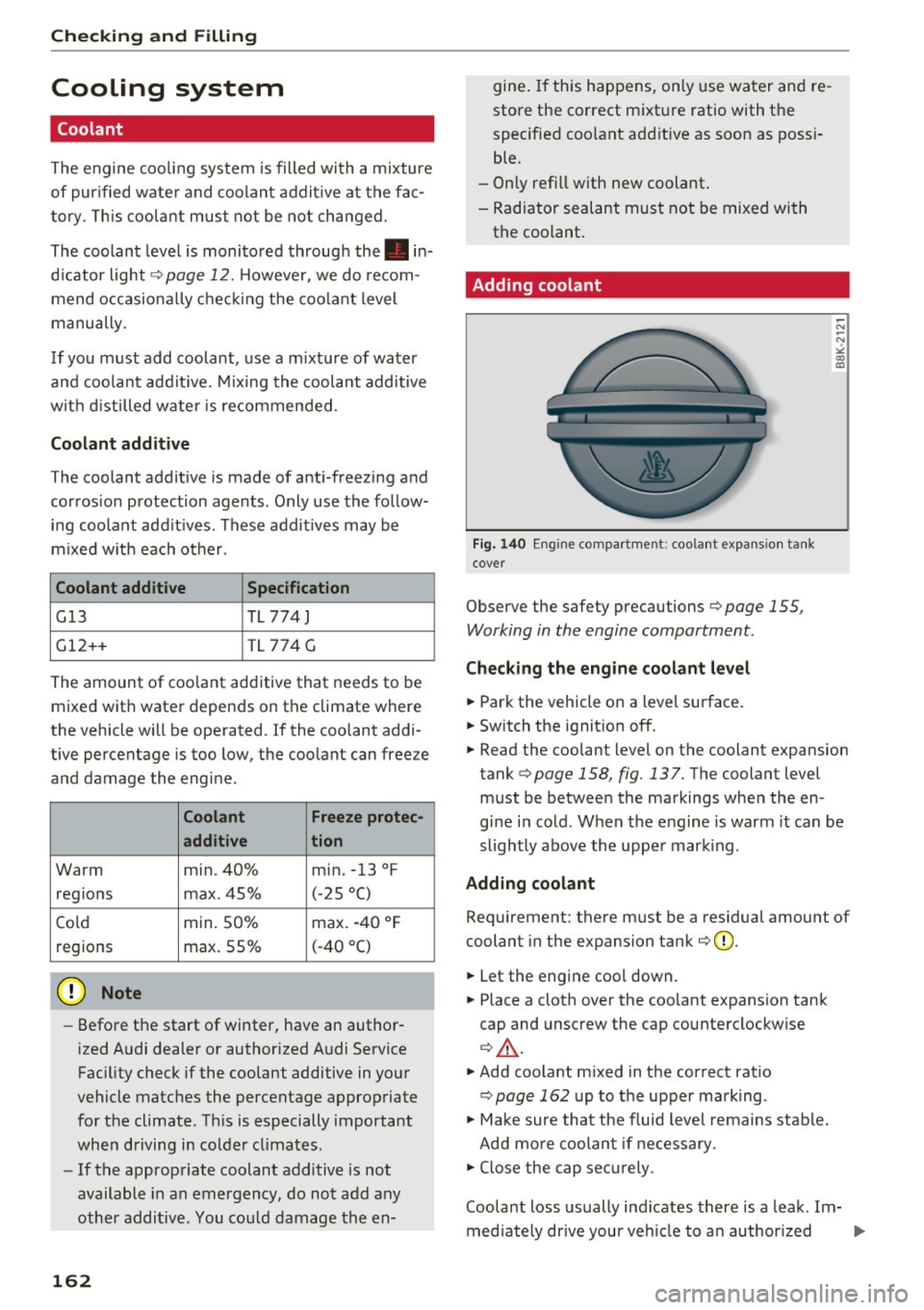
Adding coolant
Fig. 140 En gine co mpar tm ent: coo la nt expans io n ta nk
cove r
Observe the safety precautions¢ page 155,
Working in the engine compartment .
Checking the eng ine c oolant level
.,. Park the vehicle on a level surface .
.,. Sw itch the ignit ion off.
-"' -"' •
"" co a,
.,. Read the coolant level on the coolant expansion
tank ¢
page 158 , fig. 137. T he coolant leve l
must be betwee n the markings when the en
gi ne i n cold . When t he e ng ine is warm it can be
slightly above the uppe r mar king .
Adding coolant
Requirement: there must be a residual amount of
coolant in the expansion ta nk
¢ (D .
.,. Let the engine coo l down.
.,. Place a clot h over the coolant expansion tan k
cap and unscrew the cap counterclockw ise
¢ .&._ .
.,. Add coo lant m ixed in the cor rect rat io
c;, page 162 up to t he up per ma rk ing .
.,. Make sure that the fluid level remains stab le.
Add mo re coolan t if necess ary.
.,. Close the cap sec urely .
Coo lant loss usually ind icates there is a lea k. Im-
med iate ly dr ive you r ve hicl e to a n author ized .,.
Page 168 of 230
Wheels
Wheels
Wheels and Tires
General information
1>-(heck your tires regularly for
damage (punctures , cuts, cracks
and bulges). Remove foreign ob
jects from the tire tread.
.,. If driving over curbs or similar
obstacles, drive slowly and ap proach the curb at an angle.
1>-Have faulty tires or rims re
placed immediately.
1>-Protect your tires from oil,
grease and fuel.
.,. Mark tires before removing
them so that the same running
direction can be maintained if
they are reinstalled.
1>-Lay tires flat when storing and
store them in a cool , dry location
with as little exposure to light as possible.
_&. WARNING -
-Never drive faster than the
maximum permitted speed
for your tires . This could cause
the tires to heat up too much.
This increases the risk of an
accident because it can cause
the tire to burst .
-Always adapt your driving to the road and traffic condi-
166
tions. Dr ive carefully and re
duce your speed on icy or slip
pery roads. Even winter tires
can lose traction on black ice .
(D Note
-Please note that summer and
winter tires are designed for
the conditions that are typical
in those seasons. Audi recom
mends using winter tires dur
ing the winter months . Low
temperatures significantly de
crease the elasticity of summ
er tires, which affects traction
and braking ability. If summer
tires are used in very cold
temperatures, cracks can form
on the tread bars, resulting in
permanent tire damage that
can cause loud driving noise
and unbalanced tires.
-Burnished, polished or chromed rims must not be used in winter driving condi
tions. The surface of the rims
does not have sufficient corro
sion protection for this and
could be permanently dam
aged by road salt or similar
substances.
Page 185 of 230
0 co ......
"' ,....
"' ...... 0 0 :::,
00
A WARNING 1 = -
The traction grade ass igned to this tire is
based on straight-ahead braking traction
tests, and does not include acceleration, cor nering, hydroplaning or peak tract ion charac
teristics.
A WARNING
The temperature grade for this t ire is estab
lished for a t ire that is properly inflated and
no t overloaded. Excess ive speed, underinfla
tion, or excessive loading, either separately or
in combination, can cause heat buildup and
possible tire failure.
A WARNING
Temperature grades apply to tires that are properly inflated and not over or underinflat
ed.
Tire pressure monitoring system
(!) General notes
Applies to: veh icles with tire pressure monitoring system
-
Each tire, including the spare (if provided),
should be checked monthly when co ld and inflat
ed to the inflation pressure recommended by the
vehicle manufacturer on the vehicle placa rd or
tire i nflat ion pressure label. (If your vehicle has
tires of a different s ize tha n the s ize indicated on
the veh icle placard or tire inflation pressure la
be l, yo u sh ou ld de termine the prope r tire infla
tion pressure for those tires).
As an added safety feature, your veh icle has been
eq uipped w ith a tire pressu re monito ring sys tem
(TPMS) that ill uminates a low tire p ress ure te ll
tale when one or more of your tires is significan t
l y under-inflated. Accordingly, when the low tire
p ressure tellta le illuminates, you should stop and
check yo ur tires as soon as possible, and inflate
them to the proper pressure. Driving on a s ignifi
cantly under-i nflated tire causes the tire to over
h eat and can lead to t ire failure . Unde r-inflation
a lso reduces fuel efficiency and t ire t read life,
Wh eel s
and may affect the vehicle 's handling an d stop
ping ability.
Please note tha t the TPM S is not a s ubstitute fo r
prope r ti re maintenance, a nd it is the dr iver's re
spons ibility to maintain co rrect t ire pressure,
even if under-inflatio n has not reached the level
to t rigge r ill umination of the TPMS low t ire pres
s ur e te lltale .
Yo ur vehicle has also been equipped with a TPMS
malfunction indicator to indicate when the sys
tem is not ope rating properly. The TP MS ma l
funct ion indicator is combined with the low t ire
pressure telltale. When the system detects a
malfu nction, the telltale w ill flash for app roxi
mately one m inute and t hen rema in continuously
illuminated . Thi s seque nce w ill cont inue upon
s u bsequent vehicle star t-ups as long as the mal
funct ion exists.
When the malfunction indicator is illum inated,
the system may not be able to detect o r signal
l ow tire p ressure as intended. TPMS malfunct ions
may occur fo r a v arie ty of reaso ns, including the
insta llation o f replacement or al ternate tires or
whee ls on the vehicle that p revent the TPMS
from functioning proper ly . Always check the
TPMS ma lf u nction te lltale after replac ing one or
more tires or wheels on yo ur vehicle to ensure
that the rep lacement or a lt ernate tires and
wheels allow the TPMS to continue to function prope rly.
' If the Tire Pressure Monitoring System
indicator appears
Applies to: vehicles wi th Tire Pressur e Mon ito ring System in·
dicator
The tire pressure indicator in the ins trument
cluster informs you if the tire pressure is too low
or if there is a system malfunction .
Using the ABS sensors, the tire pressure monitor
ing system compares the tire tread c ircumfer
ence and v ibration characterist ics of the ind ividu
al tires. If the pressure changes in one o r more
whee ls, this is indicated in the inst rument cl uste r
display with t he
[IJ indica to r light and a mes
sage . If only one tire is affec ted, the locat ion of
that tire w ill be indicated. .,,.
183
Page 186 of 230
Wheels
The tire pressures must be stored in the Infotain
ment system again each time the pressures
change (switch ing between partial and full load
pressure) or after changing or replacing a tire on
your vehicle
c:::> page 184. The tire pressure moni
toring system only monitors the tire pressure you have stored . Refer to the tire pressure label for
the recommended tire pressure for your vehicle
c:::> page 176, fig. 147.
Tire tread circumference and vibration character istics can change and cause a t ire pressure warn
ing if:
- the tire pressure in one or more tires is too low
- the tire has structural damage
- the tire was replaced or the tire pressure was
changed and it was not stored
c:::> page 184
- the spare tire* is installed
Indicator lights
ti] -Loss of pressure in at least one tire c:::> & .
Check the tires and replace or repair if necessary.
Check/correct the p ressures of all four tires and
store the pressure again in the menu display
c:::> page 184.
@m (Ti re Pressure Monitoring System) Tire
pressure : System malfunction!. If@m
appears
after switching the ignit ion on or whi le driving
and the
ti] indicator light in the instrument clus
ter blinks for approximately one minute and then
stays on, there is system malfunction. Try to
store the correct tire pressures
c:::> page 184. If
the indicator light does turn off or turns on again
after a short period of time, dr ive to an author
ized Audi dealer or authorized Aud i Service Facili
ty immediately to have th e malfunct ion correct
ed.
_& WARNING
- If the tire pressure indicator appea rs in the
display, reduce your speed immediate ly and
avoid any hard steering or braking maneu
vers. Stop as soon as possib le and check the
t ir es and their pressure.
- The driver is responsible for maintaining the
correct tire pressure. You must check the
tire pressure regularly.
184
'
-Under certain conditions (such as a sporty
driving style, w inter conditions or unpaved
roads), the tire pressure monitoring system
ind icator may be delayed .
- Do not use run-flat tires on your vehicle. Us
ing them when not permitted can lead to
veh icle damage or accidents.
(D Tips
- The tire pressure monitor ing system can al
so stop working when there is an ESC mal
function.
- Using snow chains may result in a system
malfunction.
- The tire pressure monitor ing system in your
Audi was calibrated with "Audi Or iginal
Tires"
c:::> page 173. Using these tires is rec
ommended.
Storing tire pressures
App lies to: vehicles wit h Tire Pressure Monito rin g Syste m in
dic ator
.. Make sure before storing that the tire pressures
of all four tires meet the specified values and
are adapted to the load <=:>page
175 .
.. Switch the ignition on.
.. Select: the
I CARI funct ion button > (Car) Sys
tems *
control button > Servicing & checks >
Tire pressure monitoring > Store tire pressures
> Yes, store now.
(D Tips
Do not store the tire pressures if snow chains
are installed.
Page 187 of 230

0 co ......
"' ,....
"' ...... 0 0 :::,
00
Care and cleaning
General information
Regular, proper care helps to maintain your vehi
cle's value. It can a lso be a requirement when
submitting warranty claims for corrosion damage
and paint defects on the body.
The necessary care products can be obtained
from an authorized Audi dealer or authorized
Audi Service Facility . Read and follow the instruc
tions for use on the packaging.
A WARNING
- Us ing clean ing and care products incorrectly
can be dangerous to your health.
- Always store clean ing and care products out
of reach of children to reduce the r isk of po i
son ing .
@ For the sake of the environment
- Preferably purchase env ironmenta lly-friend
l y cleaning products.
- Do not d ispose of leftover cleaning and care
products with household trash.
Car washes
T he longer that deposits remain on the vehicle,
the more the surface may be damaged. High
temperatures such as those caused by sunlight increase the damag ing effect.
Befor e washing, rinse
off heavy depos its with
p lenty of water.
S tubborn depos its such as bird droppings or tree
sap are best removed with plenty of water and a
microfiber cloth.
A lso, wash t he un derside of yo ur vehicle once
road sa lt stops being used for the season .
Pressure washers
When washing your ve hicle w ith a pressure wash
e r, a lways fo llow the operating instructions pro
vided wi th the p ressure washer. This is especially
i mportant in rega rd to the pressure and sp raying
d istance . Do not aim the spray directly at seals on
side windows, doors, the hood, the luggage com-
Ca re and cleaning
partment lid or the panorama glass roof* or at
tires, rubber hoses, insulating material, sensors *
o r camera lenses* . Keep a distance of at least 16
in
(40 cm).
Do not remove snow and ice with a pressure
washer.
Never use cone nozz les o r high press ure nozzles .
T he water temperatu re must not be above
140 °F
(60 °().
Automatic car washes
Spray off the vehicle before washing.
Make s ure that the windows and roo f* are closed
and the windshie ld wipers are
off . Follow instruc
tions from the car wash ope rator, especially if
there are accessories attached to your vehicle.
If possible, use car washes that do not have
brushes .
Washing by hand
Clean the ve hicl e starting from the top and wor k
i ng down using a soft sponge o r cleaning br ush.
U se solven t-free cleaning produ cts.
Washing vehicles with matte finish paint by
hand
T o avo id damag ing the pa int w hen washi ng, fi rst
remove dust and large pa rticl es from you r vehi
cle . Insects, grease spots and fingerprints are
best removed w ith a special cleaner for matte
finish paint.
Apply t he product using a microf iber cloth . To
avoid damaging the paint surface, do not use too
much pressure.
Rinse the ve hicl e thoroug hly w ith wate r. Then
cl ean usi ng a neutral shampoo and a soft micro
fiber cloth .
Rinse the ve hicl e thorough ly aga in and let it air
dry. Remove any wate r residue using a chamois.
WARNING
-On ly wash the vehicle when the ign ition is
off and follow the instr uctions from the car
185
Page 188 of 230

Care and cleaning
wash operator to reduce the risk of acci
dents.
- To reduce the risk of cuts, protect yourself
from sharp metal components when wash ing the underbody or the inside of the wheel
housings.
- After washing the vehicle, the braking effect
may be delayed due to moisture on the
brake rotors or ice in the winter. This in
creases the risk of an accident. The brakes
must be dried first with a few careful brake
applications.
(D Note
- If you wash the vehicle in an automatic car
wash, you must fold the exterior mirrors in
to reduce the risk of damage to the mirrors.
Power folding exterior mirrors* must only
be folded in and out using the power folding
function.
- To reduce the risk of paint damage, do not
wash the vehicle in direct sunlight. -
To reduce the risk of damage to the surface,
do not use insect removing sponges, kitchen
sponges or similar items.
- Matte finish painted vehicle components:
- To reduce the risk of damage to the sur-
face, do not use polishing agents or hard
wax.
- Never use protective wax. It can destroy
the matte finish effect.
- Do not place any stickers or magnetic
signs on vehicle parts painted with matte
finish paint. The paint could be damaged
when the stickers or magnets are re
moved.
@ For the sake of the environment
Only wash the veh icle in facilities spec ially de
signed for that purpose. This will reduce the
risk of dirty water contaminated with oil from
entering the sewer system.
Cleaning and care information
When clean ing and caring for individual vehicle
components, refer to the following tables. The
information contained there is simply recom
mendations. For quest ions or for components that are
not listed, consult an authorized Aud i
dealer or authorized Audi Service Facility. Also
follow the information found in¢&..
Exterior cleaning
Component Situation Solution
Windshield wiper
Deposits ¢ page 39, Cleaning the wiper blades
blades
Headlights/
Deposits Soft sponge with a mi ld soap solutiona >
Tail lights
Sensors/
Deposits Sensors: soft cloth with solvent-free cleaning solution
Camera lenses Camera lenses: soft cloth with alcohol-free cleaning solu-
tion
Snow/ice Hand brush/so
lvent-free de -icing spray
Wheels Road salt Water
Brake dust Acid-free special cleaning solution
Exhaust tail pipes Road salt Water, cleaning solution suitable for stainless steel, if
necessary
Decorative parts/ Deposits Mild soap solution al, a cleaning solution suitable for
Trim stainless steel, if necessary
186
Page 190 of 230
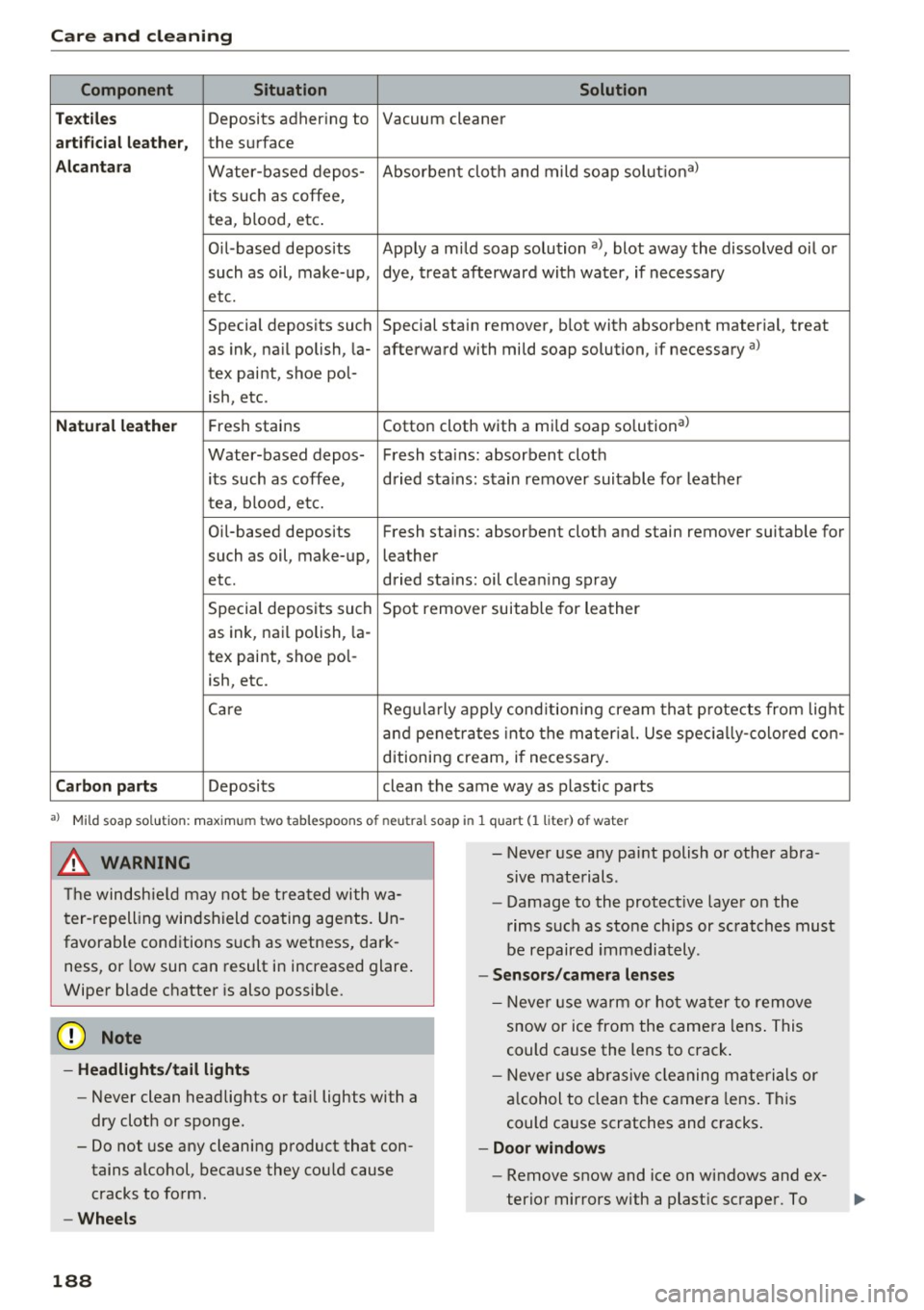
Care and cleaning
Component Situation Solution
Te xtil es
Deposits adhering to Vacuum cleaner
artifi cial le ather , the surface
Alcan tara Water-based depos- Absorbent cloth and mild soap
solutional
its such as coffee,
tea, blood, etc.
O il-based deposits Apply a mild soap solution a), blot away the dissolved oil o r
such as oil, make-up, dye, treat afterward with water, if necessary
etc.
Special deposits such Special sta ,in remover, blot with absorbent material, treat
as ink, na il polish, la- afterward with mild soap solution, if necessary al
tex paint, shoe pol-
ish, etc.
Natural leather Fresh stains Cotton cloth w
ith a mi ld soap solutional
Water-based depos- Fresh stains: absorbent cloth its such as coffee, dried sta ins: stain remover suitable fo r leather
tea, blood, etc.
Oil-based deposits Fresh stains: absorbent cloth and stain remover suitable for
such as oil, make-up, leather
etc. dried sta
ins: oil clea ning sp ray
Special deposits such Spot remover suitable for leather
as ink, nai l polish, la -
tex paint, shoe pol-
ish, etc.
Ca re Regularly apply cond itioning cream tha t protects from light
a nd penetr ates into the ma ter ial. Use spec ia lly-co lored con -
ditioning cream, i f necessary.
Carbon parts Deposits clean the same way as plastic parts
a) Mild soap sol ution: maxim um two tablesp oons of neutral soap in 1 quart (l liter) of water
_& WARNING
The windshie ld may not be trea ted with w a
ter-repelling windshield coating agents. Un
favorable conditions s uch as wetness, dark
ness, or low sun can result in increased glare .
Wipe r blade chatter is also possib le.
(D Note
- Headlights/tail light s
-Never clean headlights or ta il lights with a
dry cloth or sponge.
- Do not use any cleaning p roduct that con
tains alcohol, because they cou ld cause
cracks to form.
- Wheels
188 -
- Never use any paint polish or other abra
sive materials.
- Damage to the protect ive layer on the
rims such as stone chips or scratches must
be repaired immediately.
- Sensors /camera lenses
- N ever use wa rm or ho t wa ter to remove
snow or ice from the camera lens . This
could ca use the lens to crack .
- N eve r use abrasive cleaning m aterials or
a lcohol to clea n the camera lens . This
could cause scratches and c racks .
-Door windows
- Remove snow and ice on windows and ex-
terior mirrors with a plast ic scraper. To
Page 191 of 230
0 co ......
"' ,....
"' ...... 0 0 :::,
00
avoid scratches, move the scraper only in
one direction and not back and forth.
- Never remove snow or ice from door win
dows and mirrors using warm or hot water
because this could cause cracks to form.
- To avoid damage to the rear window de fogger, do not apply any stickers on the
heating wires on the inside of the window.
- Decorative part .s/trim
- Never use chrome care or cleaning prod-
ucts .
- Paint
- To reduce the risk of scratches, the vehicle
must be free of dirt and dust before pol
ishing or waxing.
- To prevent paint damage, do not polish or
wax the vehicle in direct sunlight .
- To reduce the risk of paint damage, do not
polish away rust spots .
- Remove cosmetics and sunscreen immedi
ately- these could damage the paint.
- Displays/instrument cluster
- The displays/instrument cluster and the
trim surrounding them must not be
cleaned with dry cleaning methods be
cause they could be scratched.
- Make sure that the instrument cluster is
switched off and has cooled off before
cleaning it.
- Make sure no fluids enter the spaces be
tween the instrument cluster and the
trim, because that could cause damage.
- Controls
- Make sure that no fluids enter the con-
trols, because this could cause damage.
- Safety belts
- Do not remove the safety belts to clean
them.
- Never clean safety belts or their compo
nents chemically or with corrosive fluids
or solvents and never allow sharp objects
to come into contact with the safety belts.
This could cause damage to the belt web bing.
- If there is damage to the webbing, the
connections, the retractors or the buckles,
Care and cleaning
have them replaced by an authorized Audi
dealer or authorized Audi Service Facility.
- Textiles/artificial leather/ Alcantara
- Never treat artificial leather/Alcantara
with leather care products, solvents, floor
polish, shoe polish, spot remove or similar
products.
- Have a specialist remove stubborn stains
to prevent damage.
- Never use steam cleaners, brushes, hard
sponges, etc . when cleaning.
- Do not turn on the seat heating* to dry the
seat .
- Objects with sharp edges, such as zippers
or rivets on clothing or belts, can cause
damage to the surface.
- Open hook and loop fasteners, for exam
ple on clothing, can damage seat covers .
Make sure hook and loop fasteners are
closed .
- Natural leather
- Never treat leather with solvents, floor
polish, shoe polish, spot remover or simi
lar products.
- Objects with sharp edges, such as zippers
or rivets on clothing or belts, can cause
damage to the surface.
- Never use steam cleaners, brushes, hard
sponges, etc. when cleaning.
- Do not turn on the seat heating* to dry the
seat.
- To help prevent the leather from fading,
do not leave the vehicle in direct sunlight
for long periods of time. If leaving the ve
hicle parked for long periods of time, you
should cover the leather to protect it from
direct sunlight.
(D Tips
- Insects are easier to remove from paint that
has been freshly waxed.
- Regular waxing can prevent rust spots from
forming.
189
Page 194 of 230

Emergency assistance
& WARNING
You or your passengers could be injured while changing a wheel if you do not follow these
safety precautions :
- If you have a flat ti re, move a safe d ista nee
off the road . Turn off the engine, turn the
emergency flashers on and use other warn·
ing devices to alert other motorists.
- Make sure that passengers wait in a safe
place away from the vehicle and well away
from the road and traffic.
- To help prevent the vehicle from moving
suddenly and possibly slipping off the jack,
always fully set the parking brake and block
the front and back of the wheel diagonally
opposite the wheel being changed with the
folding chocks or other objects. When one
front wheel is lifted off the ground, placing
the Automatic Transmission in "P" (Park)
will
not prevent the vehicle from moving.
- Before you change a wheel, be sure the
ground is level and firm. If necessary, use a
sturdy board under the jack .
- Always store the vehicle tool kit, the jack
and the replaced tire in the luggage com
partment
c:> page 102 .
(D Tips
Obey all laws.
Changing a wheel
When you change a wheel, follow the sequence
described below step-by-step and in exactly that
order.
1. Remove the decorative wheel cover* or the
wheel bolt caps*. For more details see also
<=:>page 193.
2. Loosen the wheel bolts c:> page 193.
3. Locate the proper mounting point for the
jack and align the jack below that point
<=:>page 194.
4. Lift the car with the jack c:> page 194 .
5. Remove the wheel with the flat tire and then
install the
spare tire <=:>page 195.
6. Tighten all wheel bolts lightly.
7.
Lower the vehicle with the jack.
192
8. Use the wheel bolt wrench and firmly tighten
all wheel bolts in a crisscross pattern
<=:>page 193.
9. Replace the decorative wheel cover* or the
wheel bolt caps*.
& WARNING
Always read and follow all WARNINGS and in
formation
c:> .&. in Raising the vehicle on
page 194
and <=:>page 196.
After changing a wheel
A wheel change is not complete without the do·
ing the following .
.,. Always store the vehicle tool kit, the jack* and
the replaced tire in the luggage compartment
c:>page 102.
.,. Check the tire pressure of the spare tire as soon
as possible .
.,. As soon as possible, have the
tightening tor·
ques
on all wheel bolts checked with a torque
wrench. The correct tightening torque is
10S ft lbs (140 Nm).
.,. Have the flat tire
replaced as soon as possible.
(D Tips
- If you notice that the wheel bolts are cor
roded and difficult to turn while changing a
tire, they should be replaced before you check the tightening torque.
- Drive at reduced speed until you have the
tightening torques checked .
Page 196 of 230
Emerg ency assis ta nce
Raising the vehicle
The vehicle must be li~ed with the jack first be
fore the wheel can be removed .
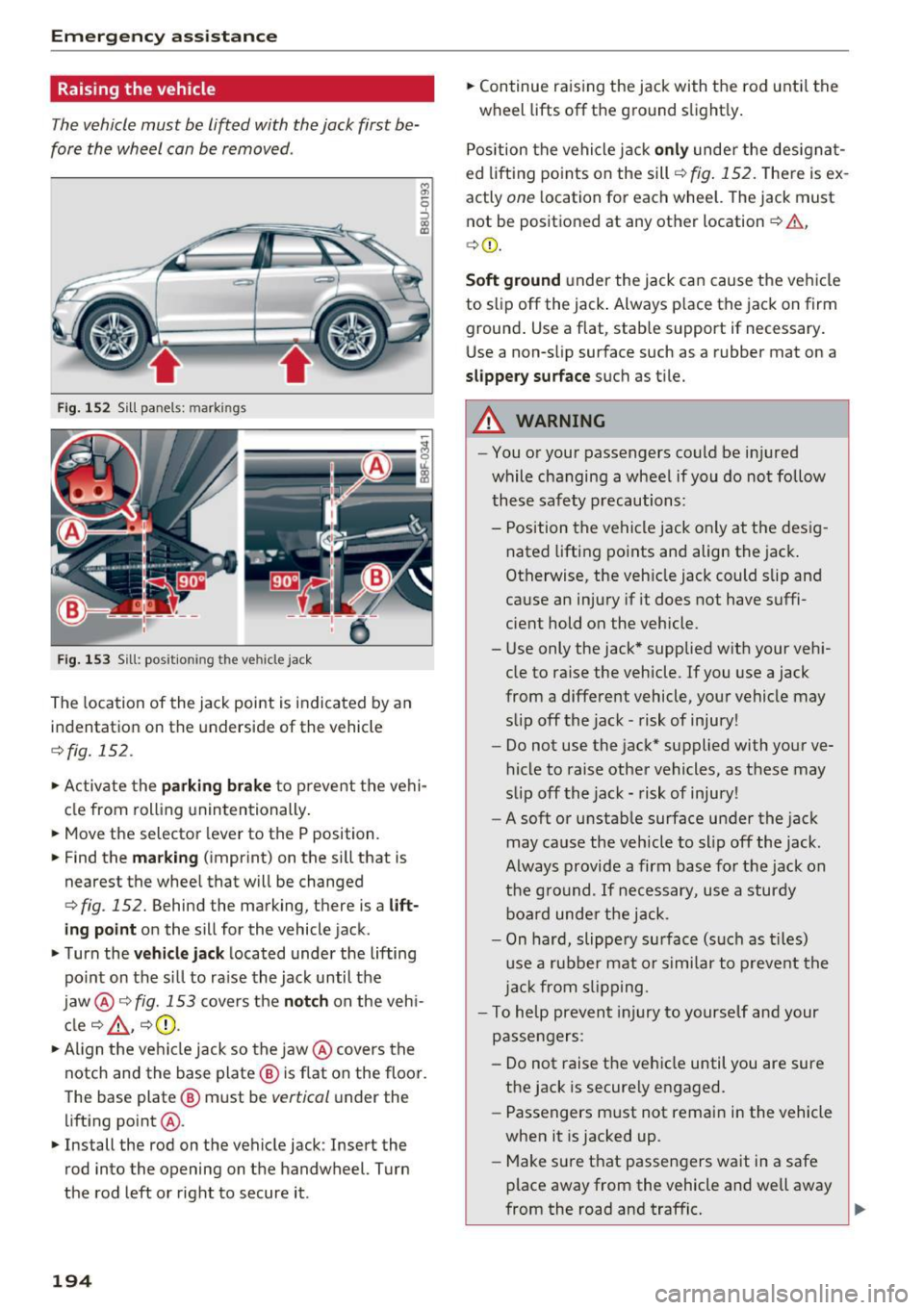
Fig. 152 Sill panels : mark in gs
Fig. 153 Sill : pos itio nin g th e ve hicle jack
The location of the jack point is indicated by an
indentation on the underside of the vehicle
¢ fig. 152 .
,.. Activate the pa rking brake to prevent the vehi
cle from rolling unintentionally .
,.. Move the selector lever to the P position.
,.. Find the
m arki ng (imprint) on the sill that is
nearest the wheel that will be changed
c> fig . 152. Behind the marking, there is a li ft
ing po int
on the sill for the vehicle jack.
• Turn the
veh icle jack located under the lifting
point on the s ill to ra ise the jack until the
jaw @¢
fig. 153 covers the notch on the veh i
cle ¢
.&_, ¢(D .
,.. Align the vehicle jack so the jaw @covers the
notch and the base plate @ is flat on the floor .
The base plate @ must be
vertical under the
lifting point @.
,.. Install the rod on the vehicle jack : Insert the
rod into the opening on the handwheel. Turn
the rod left or right to secure it .
194
• Continue raising the jack with the rod until the
wheel lifts off the ground slight ly.
Position the vehicle jack
only under the designat
ed lifting points on the sill
c> fig. 152. There is ex
actly
one l ocation fo r each wheel. The jack must
not be positioned at any other location
c> & ,
¢(I) .
So ft ground
under the jack can cause the vehicle
to slip off the jack . Always place the jack on firm
ground . Use a flat, stable support if necessary.
Use a non-slip surface such as a rubber mat on a
sl ippery su rf ace such as tile.
A WARNING
-
- You or your passengers could be injured
while changing a wheel if you do not follow
these safety precautions:
- Position the vehicle jack only at the desig
nated lifting points and align the jack .
Otherwise, the veh icle jack could slip and
cause an injury if it does not have suffi
cient hold on the vehicle.
- Use only the jack* supplied with your vehi cle to raise the vehicle. If you use a jack
from a different vehicle, your vehicle may
slip off the jack - risk of injury!
- Do not use the jack* supplied with your ve
hicle to raise other vehicles, as these may
slip off the jack - risk of injury!
- A soft or unstab le surface under the jack
may cause the vehicle to slip off the jack .
Always provide a firm base for the jack on
the gro und .
If necessary, use a sturdy
board unde r th e jack .
- On hard, slippe ry surface (such as t iles)
use a rubber mat or s imilar to prevent the
jac k from slipping.
- To he lp prevent injury to yourself and your
passengers:
- Do not raise the vehicle until you are sure
the jack is securely engaged.
- Passengers must not remain i n the vehicle
when it is jacked up .
- Make sure that passengers wait in a safe
place away from the vehicle and well away
from the road and traffic. .,,.