Fuel AUDI Q3 2018 User Guide
[x] Cancel search | Manufacturer: AUDI, Model Year: 2018, Model line: Q3, Model: AUDI Q3 2018Pages: 230, PDF Size: 57.03 MB
Page 69 of 230
a
co
...... N r--. N .-< 0 0 ::, co
When a moderate driving s tyle is used, the
transmission selects the most economical driving
mode. The transm iss ion upsh ifts at a lower RPM
and downshifts at a higher RPM to improve fuel
efficiency .
The transmission switches to a sporty mode after a kick-down or when the driver uses a
spo rt y
dri ving st yle
character iz ed by quick accelerator
pedal movements, heavy acceleration, frequent
changes in speed and traveling at the maximum
speed .
If desired , the driver can also select the gears
manually (tip tronic mode ) ¢ page 70, Manual
shifting (tiptronic mode) .
Power is transferred using a torque converter.
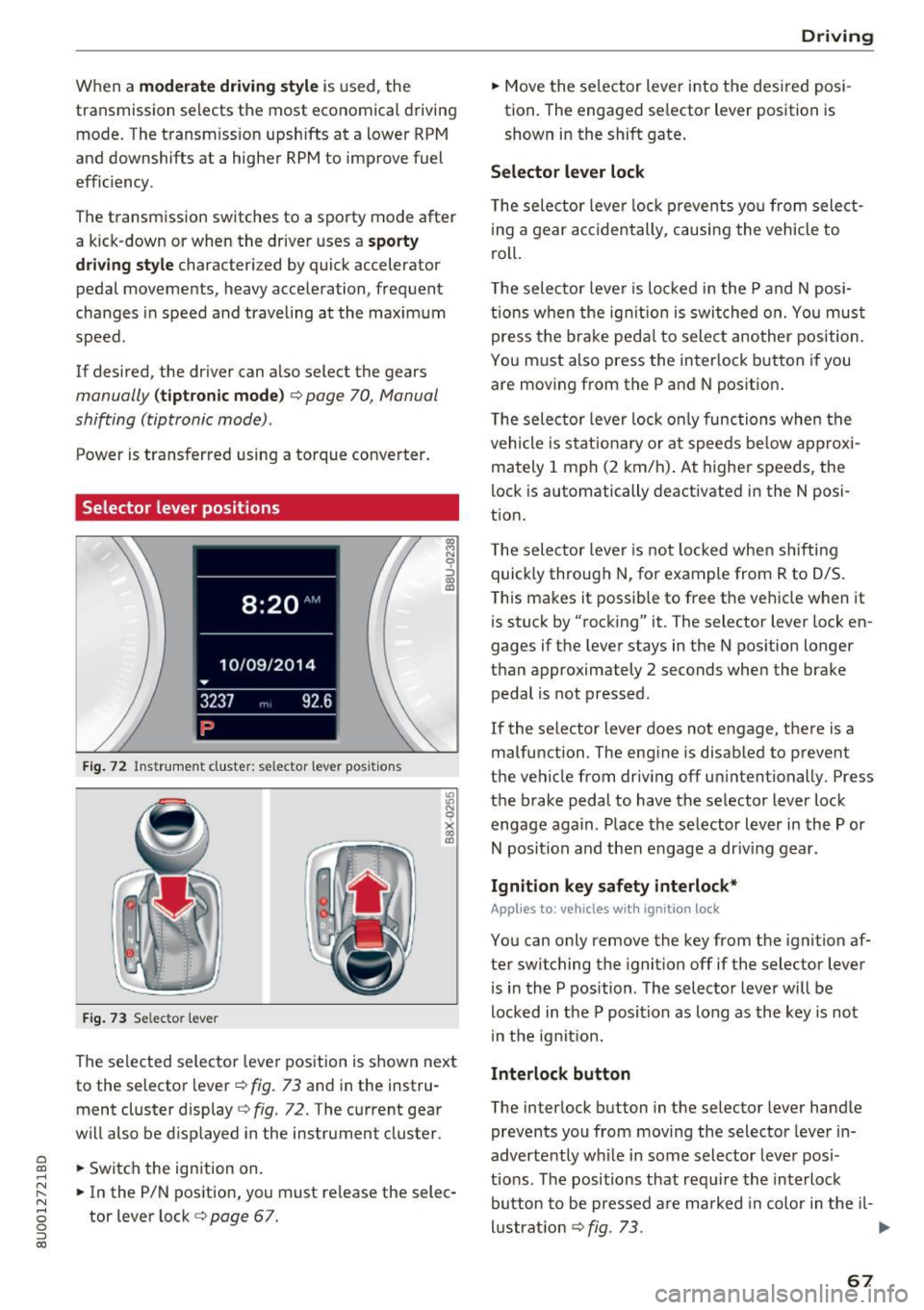
Selector lever positions
Fig. 72 Inst rument cluste r: selector leve r pos it ions
F ig. 7 3 Selec tor lever
The selected selector lever position is shown next
to the selector lever ¢
fig. 73 and in the instru
ment cluster display
¢ fig . 72. The current gear
will also be d isp layed in the instrument cluster.
.. Switch the ign ition on.
.. In the P/N position, you must release the selec
tor lever lock ¢
page 67.
Drivi ng
.. Move the selector lever into t he des ired posi
tion. The engaged se lector lever position is
shown in the shift gate .
Selector lever lock
The selec tor leve r lock p revents yo u from select
i ng a gear accidentally, causing the vehicle to
roll.
T he selector leve r is lo cked in the P and N posi
ti ons when the ig nit ion is switched on. You mus t
press the brake peda l to sele ct another position.
You must also press the interlock button if you are moving from the P and N position.
T he selec tor leve r lock o nly functions when the
vehicle is stat ionary or at speeds be low approxi
mately 1 mph (2 km/h) . At higher speeds, the
lock is automatically deactivated in the N posi
tion.
T he selec tor leve r is not locked whe n shifting
quick ly through N, for example from R to 0/S.
This makes it possib le to free the vehicle when it
is stuck by "rocking" it. The selector lever lock en
gages if the lever stays in the N pos ition longer
than approximately 2 seconds when the brake peda l is not pressed .
If the selector lever does not engage, there is a
malfunction . The engine is disabled to prevent
the vehicle from driv ing off un intent ionally. Press
the brake pedal to have the se lector lever lock
engage again . Place the selector lever in the P or
N position and then engage a dr iv ing gear.
Ignition key safety interlock*
Applies to: vehicles with ignition lock
You can only remove the key from the ignition af
ter switching the ignition off if the selector lever
is in the P position . The selector leve r will be
locked in the P position as long as the key is not
in the ignit ion.
Interlock button
The interlock button in the selector lever handle
prevents you from movi ng the selector lever in
advertently wh ile in some selector lever posi
tio ns. The positions that requ ire the interlock
button to be pressed a re marked in color in the il-
l u strat io n ¢
fig. 73. .,.
67
Page 75 of 230
0 co ......
"' ,-...
"' ...... 0 0 :::,
00
Trailer towing
Driving with a trailer
General information
Your vehicle is primarily intended for transport ing people and luggage . However, if you drive
with a trailer , follow the technical requirements,
the operation and driving tips, and the legal reg
ulations.
Driving with a trailer affects the vehicle's fuel
consumption, performance and wear.
It also re
quires higher concentration from the driver.
A WARNING
Do not transport any people in a trailer due to
the risk of fatal injury.
Technical requirements
Certain requirements must be met when towing
a trailer.
Trailer hitch
Only use a trailer hitch with a removable ball hitch mount and ball hitch. The trailer hitch must
be permitted for the vehicle , the trailer and the
permitted total weight of the trailer being
pulled. Above all, it must be securely and safely
attached to the vehicle trailer.
Never mount a trailer hitch on the bumper. The
trailer hitch must be mounted in a way that does
not impair the function of the bumper. Do not
make any changes to the exhaust system and the
brake system.
Check regularly if the trailer hitch is securely mounted. Always follow the instructions given by
the trailer hitch manufacturer.
Trailer brakes
If the trailer has its own brake system, then fol
low the manufacturer specifications. However,
the brake system on the trailer must never be
connected to the vehicle brake system.
Trailer towing
Engine cooling system
Driving with a trailer means a higher load on the
engine and the cooling system. The cooling sys
tem must be designed for additional load and
contain enough coolant
c::> (D .
A WARNING
-
-Never mount a "weight-distributing" or
"load-balancing" trailer coupler as the trail
er hitch . The vehicle was not designed for
these types of trailer hitches . The trailer
hitch can malfunction and the trailer can
break off from the vehicle.
- If the trailer is equipped with electronic
brakes, these brakes cannot be activated by
a factory-installed control system, which in
creases the risk of an accident.
- To reduce the risk of injury, always remove
the ball hitch mount if no trailer is mount
ed.
(D Note
Longer inclines cannot be driven without a
suitable cooling system, especially if the out
side temperatures are high. otherwise, this
increases the risk of engine damage.
' Operating instructions
Several things must be noted when towing a
trailer.
Towing capacity
The permitted towing capacity for trailers with
out brakes is 1,650 lbs (750 kg).
The permitted towing capacity for trailers with brakes is 2,200 lbs (1,000 kg) .
These values apply to roads with up to 12% in
cline.
Tongue weight
The maximum permitted tongue weight of the
trailer drawbar on the trailer hitch ball head may
not be exceeded. ..,.
73
Page 154 of 230
Check ing and F illing
Checking and Filling
Fuel
Gasoline grade
A pp lies to: ve hicles w ith gaso li ne engines
The correct gasoline grade is stated on the inside
of the fuel filler door .
The vehicle is equipped with a catalytic converter
and must only be driven w ith
unleaded ga soli ne.
Aud i recommends using TOP TIER Detergent Gas
oline. Additional information on TOP TIER Deter
gent Gaso line can be found on the offic ial web
site (www .toptiergas.com) .
The individua l gasoline grades are differentiated
by
octane ratings . This value is given with (R +M)/
2 equating to AK I or in RON.
The fo llow ing headings match the co rrespon ding
sticker in the fue l fi ller door .
UNLEADED FUEL ONLY MIN . (R+M) /2 87
Regular/ MIN. RON
91 Regular
Use regu lar gaso line with minim um 87 AKI/
9 1 RON ~@ .
The max imum engine power is only reached if
p rem ium gasol ine
91 A KI/ 95 RO N is used.
0 Note
- Fi lli ng the tank just one t ime with leaded
fuel or o ther meta llic additives will cause
p ermanent de ter iorat io n to the catalyt ic
conve rter func tion.
- Whe n gasoline with an octane rati ng that is
too low is used, high speeds o r heavy engi ne
l oad can lead to engine damage .
(D Tips
The vehicle may be fi lled wi th fu el tha t h as a
higher octane ra ting than wh at is required by
t he engine .
152 ·
Blended gasoline
Use of gasoline containing alcohol or MTBE
(methyl tertiary butyl ether)
Yo u may use unleaded gasoline b lended wi th al
cohol o r MTBE (commonly referred to as oxygen
ates) if the blended mixt ure meets the fo llowing
criteria :
Blend of ga soline methanol (wood alcohol or
meth yl alcohol)
- Anti-knock index must be 87 AK I or h igher.
- Blend must contain no more than 3% metha-
nol.
- Blend must contain more tha n 2% co -solvents.
Blend of gasoline and ethanol (grain alcohol or
ethyl alcohol )
-Anti -knock index must be 87 AK I or higher .
- Blend must not co ntai n mo re t han
15% etha-
nol.
Blend of ga soline and MTBE
- Anti-knock index must be 87 AKI or higher.
- Blend must contain not more than 15% MTBE.
Seasonally adjusted gasoline
Many gasoline grades a re blended to pe rform es
pec ially well for w in ter o r su mme r dr iv ing . D ur
i ng seasonal change-ove r, we s ugges t th at yo u
fill up at busy gas stat ions where the seasona l
adjustment is more likely to be made in time.
(D Note
- Meth ano l fuels which do not meet these re
q uirements may cause corrosion and dam
age to plastic and rubber com ponents in the
fuel system.
- Do not use fue ls that fa il to meet the speci
fied cr iteria in th is chapter .
-If you are una ble to dete rm ine whether or
not a part icu lar f uel blend meets the speci
fications, ask yo ur service station or its fue l
supplier.
- Do not use fue l for which the contents can
not be ident ified .
Page 155 of 230
a
co
...... N r--. N .-< 0 0 ::, co
-Fuel system damage and performance prob
l ems resulting from the use of fuels differ
ent from those specified are not the respon
sibility of Audi and are not covered under
the New Vehicle or the Emission Control
System Warranties.
- If you experience a loss of fuel economy or
driveability and performance problems due
to the use of one of these fuel blends, we
recommend that you switch to unblended
fuel.
Gasoline additives
A majo r concern among many auto manufactur
ers is carbon deposit build-up caused by the type
of gasoline you use.
Although gasoline grades d iffer from one manu
facturer to another, they have certain things in
common. All gasoline grades contain substances
that can cause deposits to collect on vital engine parts, such as fuel injectors and intake valves . Al
though most gasoline brands include additives to keep engine and fuel systems clean, they are not
equally effective.
Audi recommends using TOP TIER Detergent Gas
oline . For more information on TOP TIER Deter
gent Gasoline, please go to the official website
(www.toptiergas.com).
After an extended period of using inadequate
fuels, built-up carbon deposits can rob your en gine of peak performance.
(}) Note
-Damage or malfunction due to poor fuel
quality is not covered by the Audi New Vehi
cle Limited Warranty.
Checking and Filling
Refueling
Fueling procedure
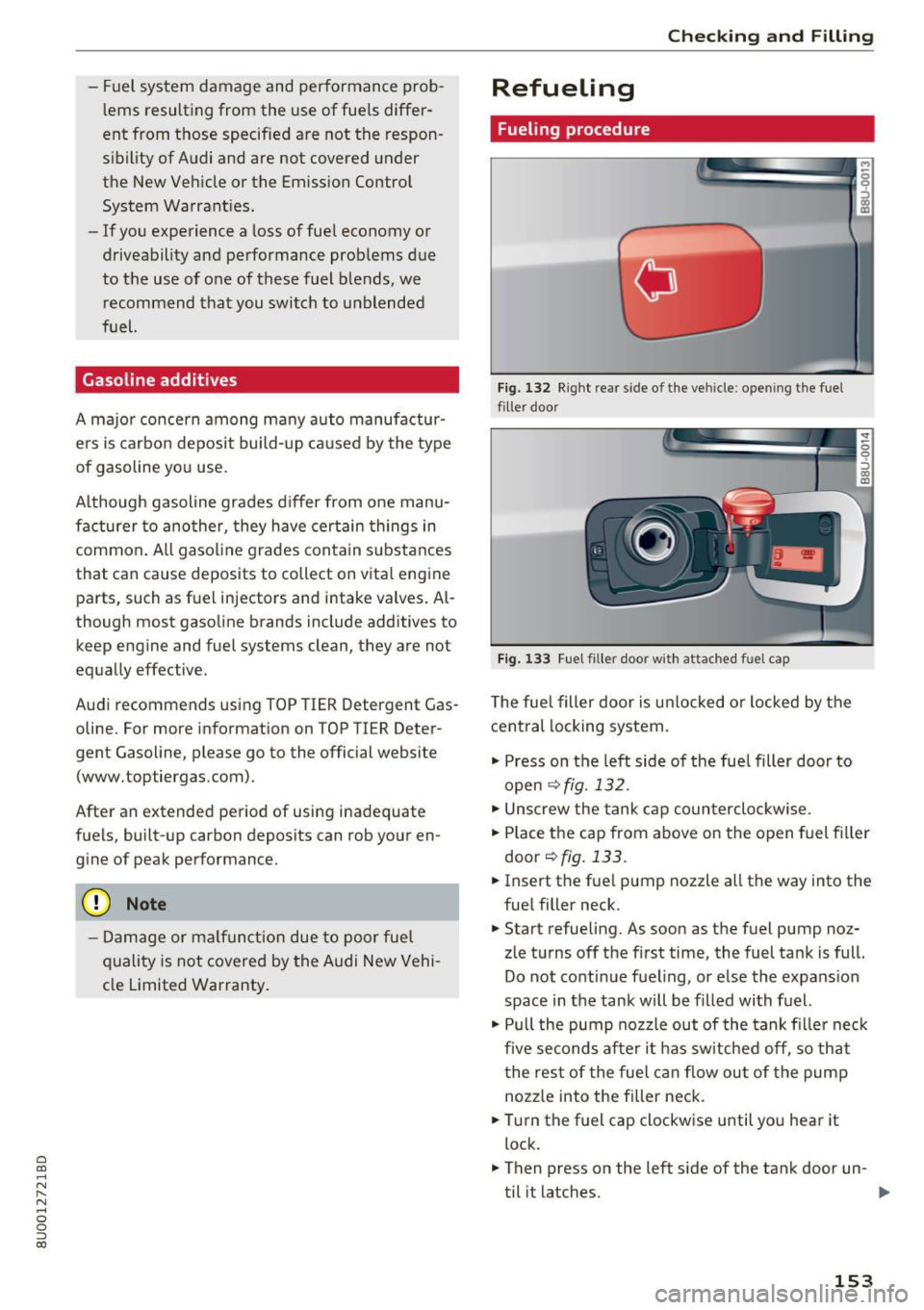
Fig. 132 Right rear s ide o f th e ve hicle : ope ning the fuel
filler door
Fig. 133 Fuel filler door with attached fue l cap
The fuel filler door is unlocked or locked by the
central locking system.
"' Press on the left side of the fuel filler door to
open
r=.> fig. 132 .
"'Unscrew the tank cap counterclockwise.
"' Place the cap from above on the open fuel filler
door
r=.> fig. 133.
"'Insert the fuel pump nozzle a ll the way into the
fuel filler neck.
"' Start refueling. As soon as the fuel pump noz
zle turns off the first time, the fuel tank is full.
Do not continue fueling, or else the expansion
space in the tank will be filled with fuel.
"' Pull the pump nozzle out of the tank filler neck
five seconds after it has switched off, so that
the rest of the fuel can flow out of the pump
nozzle into the filler neck.
"' Turn the fuel cap clockwise until you hear it
lock.
"' Then press on the left side of the tank door un-
til it latches.
Ill>
153
Page 156 of 230

Check ing and F illing
The correct fuel type for your vehicle can be
found on a label located on the inside of the fue l
f ill er door . For addit iona l information on fuel,
see
¢ page 152 .
For the tank capacity in yo ur vehicle, refer to the
Technical Data
¢ page 210.
To reduce the r isk of fuel leak ing out or vapo rs
escaping, make sure that the fuel tank is closed
correct ly. Otherwise th@
¢'41
) indicator light may
turn on.
If the central loc king system malf unc tions, the
f u e l filler door may emergency release
¢ page 155.
A WARNING
An improper fue ling procedure and improper
hand ling of fue l can lead to explosions, f ires,
severe bu rns and other injur ies.
- Do not smoke and keep away from open
flames.
- The ignition must be switched off when re
fueling .
- Cell phones, radio devices and other radio
equipment should always be switched
off
when refueling. Electromagnet ic rays cou ld
cause sparks and start a fire.
- If you do not insert t he fue l pump nozzle a ll
the way into the filler tube, then f ue l can
leak out. Spilled fuel can ignite and start a
fire .
- Never get into the vehicle when refueling. If
there is an exceptional situation where t he
vehicle must be entered, close the door and
touch a metal surface before touching the
fuel pump nozzle agai n. This will reduce the
r isk of e lectros tat ic discharge t hat can ca use
flying spar ks. Sparks can start a fire when
ref ue ling.
A WARNING
We recommend that you do not t ransport any
fuel containers in the vehicle . Fuel could leak
out of t he container and ignite, especially dur-
l) Market -s pecific
154 ing an accident. Th
is can ca use explos ions,
f ires and injuries.
- If you must transport fuel in a fue l contain
er, p lease note the following:
- Always place a fue l co nta iner on the
ground befo re fil ling . Neve r fill the fuel
contai ne r with fuel whi le i t is in o r o n the
vehicle. Elect rostatic charge can oc cu r
while refueling and the fuel vapo rs could
ignite.
- Fo r fuel con tai ners made o f me tal, the
fuel p ump nozzle must a lways maintai n
contact with the container to reduce the
risk of stat ic charge.
- Insert the fuel pump nozz le as far as pos
sible into the f iller opening wh ile refuel
ing .
- Fo llow lega l req uirements when using,
stor ing and transporting fuel conta iners .
- Make su re t hat the fuel container meets
the i nd ustry standards, for example ANSI
or ASTM F852-86.
(D Note
- Remove fue l tha t has overflowed onto any
vehicle components immediately to reduce
the risk of damage to the vehicle.
- Never drive unt il the fuel tan k is com plete ly
empty . The i rreg ular s upply of fue l that re
sults from that can cause eng ine misfires .
Uncombusted fuel will ente r the exhaust
system and increase the risk of damage to
the catalytic converter .
(® For the sake of the environment
Do not overfill the fuel tank, otherwise fuel
can leak out when the veh icle is warming up.
(D Tips
The fuel filler door o n your veh icle does not
l ock if you lock the veh icle from the inside us
i ng the centra l locking switch.
Page 157 of 230
a
co
...... N r--. N .... 0 0 ::, co
Fuel filler door emergency release
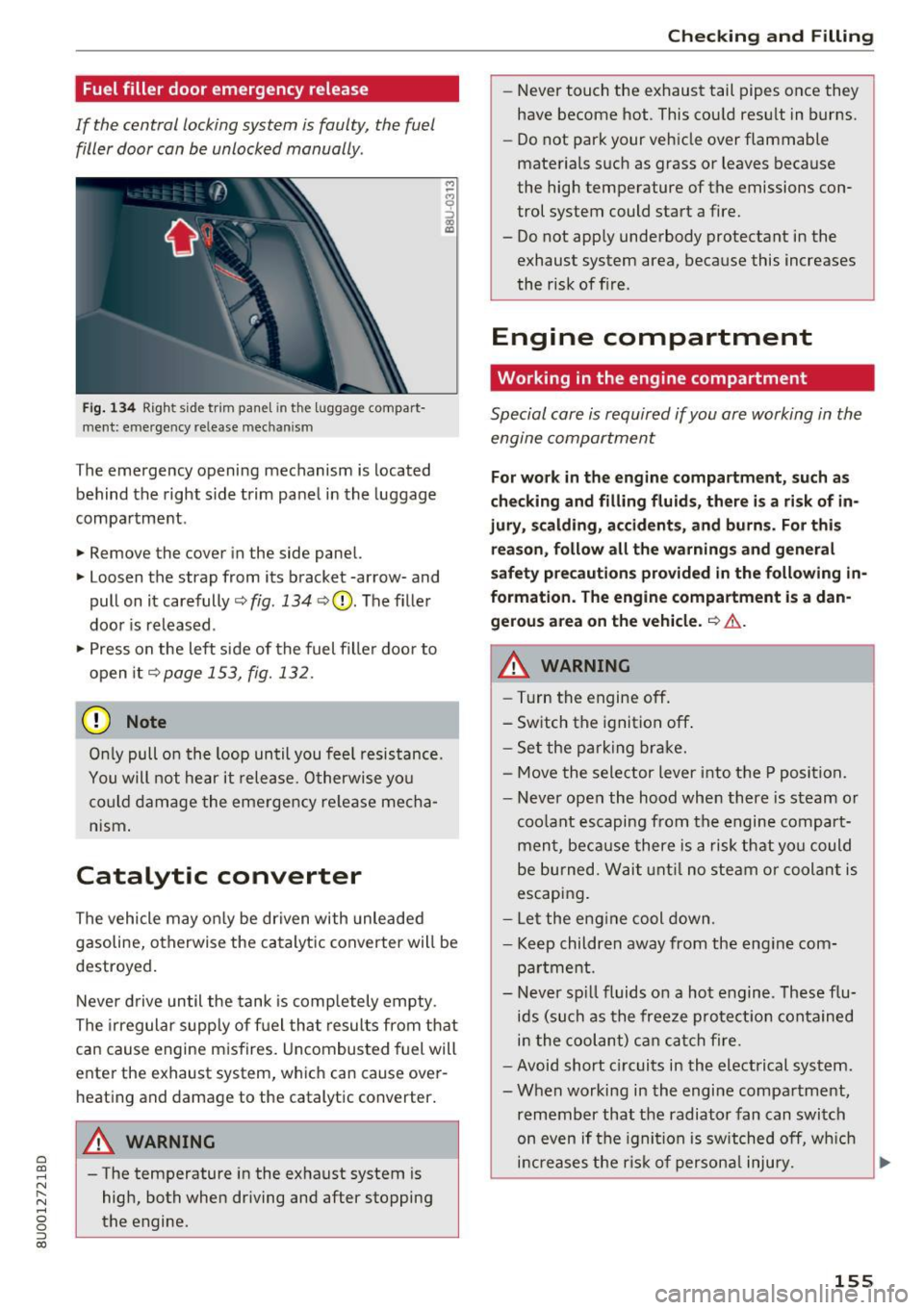
If the central locking system is faulty, the fuel filler door can be unlocked manually.
Fi g. 134 Right si de tr im j:>ane l in the luggage compart
ment: emergen cy release mechani sm
The emergency opening mechanism is located
behind the right side trim panel in the luggage
compa rtme nt.
• Remove the cover in the side panel.
• Loosen the strap from its bracket -arrow- and
pull on it carefully<=:>
fig. 134 c:>(D . The filler
doo r is released .
• Press on the lef t side of the fuel fille r doo r to
open it
<=:> page 153, fig. 132 .
(D Note
Onl y pull o n the loop until you feel resi stance.
You will not he ar it relea se. O therwise yo u
co uld d amage the eme rge ncy re lea se me ch a
nism .
Catalytic converter
The vehicle may o nly be dr iven with unleaded
gasoline, otherwise the catalyt ic converter will be
destroyed .
N ever d rive until the tank is comp letely e mpty .
The irregular supply of f uel th at resul ts from that
can cause engine m isfires. Uncombus ted f uel will
enter the exhaust system, wh ic h can cau se ove r
heat ing and damage to the catalyt ic converter .
A WARNING
-The temperature in the ex ha ust system is
high, both when dr iving and after stopping
the engine.
-
Checking and Filling
- Never touch the exhaust tail pipes o nce they
have become hot . This cou ld resu lt in burns.
- Do not par k your vehicle over flammable
mate ria ls s uch as grass or leaves because
the high temperature of the emissions con
trol system could start a fire.
- Do not app ly unde rbody protectant in the
exhaust system area, because this increases
the risk of fire.
Engine compartment
' Working in the engine compartment
Special care is required if you are working in the
engine compartmen t
For work in the engine compartment, such as
checking and fill ing fluids, there is a risk of in
jury, scalding, accident s, and burns . For thi s
reason, follow all the warnings and general
s afety pre caution s provided in the following in
formation. The engine compartment is a dan
gerous a rea on the vehicle .
<=:> .&.
A WARNING
-Turn the engine off .
- Sw itch th e ignition off .
- Se t the p arking brak e.
- M ove the selec tor lever i nto the P position.
- Never open the hood whe n th ere is steam o r
coo lant escaping from the engine comp art
men t, bec ause there is a risk that yo u could
be burned. Wai t until no s te a m o r coolan t is
escaping .
- Le t t he eng ine cool down.
- Keep children away from th e eng in e com-
p ar tme nt.
- N ever sp ill fluid s on a ho t engine . These flu
i d s (su ch as the free ze p ro te ct ion contained
in the coolant) c an catch fi re.
- Avoid short circui ts in th e electrical system.
- When working in the engine compartment,
remember that the radiator fan can swi tch
o n even if t he igni tion i s sw itched off, w hich
i n cre a ses the r is k of person al injury.
~
155
Page 158 of 230
Checking and Filling
-Never open the cap on the coolant expan
sion tank when the engine is warm. The
cooling system is under pressure.
- To protect your face, hands, and arms from
hot steam or coolant, cover the cap with a
large cloth when opening.
- Do not remove the engine cover under any circumstances. This increases the risk of
burns.
- If tests need to be performed with the en
gine running, there is additional danger due
to moving components (such as the ribbed belt, alternator and radiator fan) and from
the high-voltage ignition system.
- Do not under any circumstances give gas in
advertently (for example, by hand from the
engine compartment) if the vehicle is sta
tionary but the engine is running and a gear
is engaged. Otherwise, the vehicle will start
to move immediately and this could result
in an accident.
- Pay attention to the following warnings list
ed when work on the fuel system or on the
electrical equipment is required.
- Do not smoke .
- Never work near open flames.
- Always have a working fire extinguisher
nearby.
- All work on the battery or electrical system
in your vehicle can result in injuries, chemi
cal burns, accidents or burns. Because of
this, all work must be performed
only by an
authorized Audi dealer or authorized Audi
Service Facility.
- To reduce the risk of electric shock and in
jury, never touch the following components when the engine is running or is being start
ed:
- Ignition cable
- Other components in the electronic high-
voltage ignition system
- If you must check or perform work on the
engine while it is running:
- Set the parking brake and place the selec
tor lever in the P (park) position first .
- Always proceed with extreme caution so
that clothing, jewelry or long hair do not
156
become caught in the radiator fan, fan
belt or other moving components or do
not come into contact with hot compo
nents. Tie back long hair before beginning
work and do not wear clothing that can
hang down into the engine .
- Limit your exposure to exhaust and chemi cals to as short a time as possible
¢ &, .
A WARNING
California Proposition 65 Warning:
- Engi ne exhaust, some of its constituents,
and certain vehicle components contain or
emit chemicals known to the State of Cali
fornia to cause cancer and birth defects and
reproductive harm . In addition, certain flu
ids contained in vehicles and certain prod
ucts of component wear contain or emit
chemicals known to the State of California
to cause cancer and birth defects or other reproductive harm .
- Battery posts, terminals and related acces
sories contain lead and lead compounds,
chemicals known to the State of California
to cause cancer and reproductive harms.
Wash hands after handling.
@ Note
When filling fluids, be sure not to mix the flu
ids up. Otherwise severe malfunctions and en
gine damage will occur .
@ For the sake of the environment
You should regularly check the ground under
your vehicle in order to detect leaks quickly. If there are visible spots from oil or other fluids,
bring your vehicle to an authorized Audi deal
er or authorized Audi Service Facility to be
checked.
Page 161 of 230
0 co ......
"' ,....
"' ...... 0 0 :::,
00
Using the prope r engine oil is important for the
functionality and s ervice life of the engine. Your
engine was factory-filled with a high -quality oil
which can usually be used throughout the entire
year .
Note
Your Limited New Vehicle Warranty does not
cover damage or malfunctions due to failure
to follow recommended maintenance and use
requirements as set forth in the Audi Owner's Manual and Warranty & Maintenance booklet .
- Use only a high quality engine oil that ex-
pressly complies with the Aud i oil quality
standard specified for your vehicle's engine.
Using any o ther oil can cause serious engine
damage.
- Do not mix any lubricants o r other additives
into the engine oil. Doing so can cause en
gine damage.
@ Tips
If you need to add oil and there is none availa
ble that meets the Audi o il quality standard
your eng ine requ ires, you may add a total of
no more than 0 .5 quart/li ter of a h igh-quality
"synthet ic"oil that meets the following speci
fications.
- ACEA A3 or API SM with a v iscosity grade o f
SAE OW-30, SAE SW -30 or SAE SW-40.
- Fo r more information abou t engine o il t ha t
has been approved for your vehicle, please
contact either your authorized Audi dea ler
or Audi Custome r Relat ions at
1 (800) 822-2834 or visit our web site at
www .audiusa.com or www .aud icanada .ca.
Engine oil consumption
T he engine in your vehicle depends on an ade
qua te amoun t of oil to lubricate and cool all of
i t s moving par ts.
In order to provide effective lub rication and coo l
ing of in te rnal engine components, a ll internal
combustion engines consume a cer tain amount
of oil. Oil consumption varies from engine to en
g ine and may change sign ificantly over the life of
the eng ine . Typically, eng ines with a spec ified
Ch eck ing and Filling
break-in period (see ¢ page 57) consume more
oi l during th e break-in period than they consume
after oil consumption has stabilized.
Under normal cond itions, the rate of oil con
sumption depends on the q uality and viscos ity o f
the oil , the RPM (revolutions per minut e) at
which the engine is operated, the amb ient tem
perature and road condit ions. Further factors are
the amount of oil dilution from w ater condensa
tion or fuel resid ue and the oxidation level of the
o il. As any engine is subject to wear as mileage
builds up, the oi l consumption may increase ove r
t ime unt il repla cement of worn components may
become necessary.
With al l these variables coming into play, no
standard rate of o il consumption can be estab
l ished or spec ified . T he re is no alte rnative to reg
u la r and fre quent chec king of the o il level , see
Note .
If the yellow engine oil level warning symbo l II
in the instrument cluster lights up , you sho uld
check the o il level as soon as possible
¢ page 160. Top off the o il at your earliest con
venience.
A WARNING
Before you check anything in the engine com
partment, always read and heed all WARN
INGS¢ .&.
in Working in the engine compart
ment on page 155.
(D Note
D riving wit h an insufficient oil level is likely to
cause severe damage to the engine .
(D Tips
- The oil pressure warn ing display. i s not
an indicato r of the o il le vel. Do not rely on
it . Instead, check the oil level in your en
gine at regular intervals , pre fe rabl y each
time you refuel, and alw ays befo re go ing
on a long trip .
-If you have the impression your engine con
sumes excessive amounts of oi l, we recom
mend that you consult an author ized Audi
dea ler to have the cause of your concern
159
Page 163 of 230
0 co ......
"' ,....
"' ...... 0 0 :::,
00
@ Fo r the sa ke of the env ironment
- Engine oi l should never enter the sewer sys
tem or come into contact with the ground
under any circumstances.
- Pay attention to legal requirements when
disposing of empty oil containers.
The engine oil consumption may be up to 0.5 quart/600 m iles (0.5 liter/1,000 km), de
pending on driving style and operating condi
tions. Consumption may be higher during the
first 3,000 miles (5,000 km). The engine oil
level must be checked regularly . It would be
best to check each time you refuel your vehi
cle and before long dr ives.
Changing the engine oil
We recommend that have your oil changed by an
authorized Audi dealer or a qualified service sta
tion.
Before you check anyth ing in the eng ine compart
ment,
alw ays r ea d and heed all WARNINGS Q .&.
in Working in the engine compartment on
page 155.
The engine oil must be changed according to the
intervals specified in your Warranty
& Mainte
n ance booklet. This is very important because the
l ubri cat ing propert ies of o il diminish gradually
d ur ing normal vehicle use.
Under some c ircumstances the eng ine o il should
be changed more frequently . Change oil more of
ten if yo u drive mostly short distances, ope rate
the vehicle in d usty areas or under predominant ly
stop-and -go traffic conditions, or have your vehi
cle where temperatures remain below freezing
for extended periods.
Detergent additives in the oil will make fresh oil
l ook da rk after the engine has been running for a
short time. This is normal and is not a reason to
change the oil more often than recommended.
Because of the problem of p roper disposal, along
with the special tools and necessa ry expertise re
qu ired, we strong ly recommend that you have
Ch eck ing and Filling
your oi l changed by an authorized Audi dealer or
a qualified service station .
If yo u choo se to ch ange yo ur oil your self, please
note the follow ing important info rmation:
A WARNING
=
To reduce the risk of persona l injury if you
must change the engine oil in your vehicle
yourself:
- Wear eye protect ion .
-
-To redu ce the r is k of burns from hot eng ine
oil, let the engine cool down to the touch.
- W hen remov ing the oil d rain plug w ith your
fingers, stay as far away as possib le. Always
keep your forearm parallel to the ground to
he lp prevent hot oil from running down your
arm.
- Drain the oil into a container designed for
this purpose, one la rge enough to hold at
least the tota l amount of oil in your engine.
- Engine oil is poisonous. Keep it well out of
the reach of children.
- Continuous contact with used engine oil is
harmful to your skin. Always protect your
skin by washing oil off thoroughly with soap
and water.
(D Note
Never mix oil additives with your engine oil.
These additives can damage your engine and
adverse ly affect yo ur Audi Limited New Vehi
cle Warranty.
@ For the sa ke of the environment
- Before chang ing your oi l, first make sure
you know where you can properly d ispose of
the used oil.
- Always dispose of used engine o il properly.
Do not dump it on garden soil, wooded
areas, into open streams or down sewage
drains.
- Recycle used engine o il by tak ing it to a used
eng ine oil collection fac ility in your area, or
contact a service station .
161
Page 168 of 230
Wheels
Wheels
Wheels and Tires
General information
1>-(heck your tires regularly for
damage (punctures , cuts, cracks
and bulges). Remove foreign ob
jects from the tire tread.
.,. If driving over curbs or similar
obstacles, drive slowly and ap proach the curb at an angle.
1>-Have faulty tires or rims re
placed immediately.
1>-Protect your tires from oil,
grease and fuel.
.,. Mark tires before removing
them so that the same running
direction can be maintained if
they are reinstalled.
1>-Lay tires flat when storing and
store them in a cool , dry location
with as little exposure to light as possible.
_&. WARNING -
-Never drive faster than the
maximum permitted speed
for your tires . This could cause
the tires to heat up too much.
This increases the risk of an
accident because it can cause
the tire to burst .
-Always adapt your driving to the road and traffic condi-
166
tions. Dr ive carefully and re
duce your speed on icy or slip
pery roads. Even winter tires
can lose traction on black ice .
(D Note
-Please note that summer and
winter tires are designed for
the conditions that are typical
in those seasons. Audi recom
mends using winter tires dur
ing the winter months . Low
temperatures significantly de
crease the elasticity of summ
er tires, which affects traction
and braking ability. If summer
tires are used in very cold
temperatures, cracks can form
on the tread bars, resulting in
permanent tire damage that
can cause loud driving noise
and unbalanced tires.
-Burnished, polished or chromed rims must not be used in winter driving condi
tions. The surface of the rims
does not have sufficient corro
sion protection for this and
could be permanently dam
aged by road salt or similar
substances.