seat adjustment AUDI Q3 2018 User Guide
[x] Cancel search | Manufacturer: AUDI, Model Year: 2018, Model line: Q3, Model: AUDI Q3 2018Pages: 230, PDF Size: 57.03 MB
Page 140 of 230
Child safety
A WARNING
Not using a child safety seat, using the wrong
child safety seat or improperly installing a
child restraint increases the risk of serious
personal injury and death.
- All vehicle occupants and especially children
must be restrained properly whenever riding
in a vehicle. An unrestrained or improperly
restrained child could be injured by striking
the interior or by being ejected from the ve
hicle during a sudden maneuver or impact.
An unrestrained or improperly restrained
child is also at greater risk of injury or death
through contact with an inflating airbag.
- Commercially available child safety seats
are required to comply with U .S. Federal
Motor Vehicle Safety Standard (FMVSS) 213
(in Canada CMVSS 213).
- When buying a child restraint, select one
that fits your child and the vehicle.
- Only use child restraint systems that fully
contact the flat portion of the seat cush
ion. The child restraint must not tip or
lean to either side. Audi does not recom
mend using child safety seats that rest on
legs or tube-like frames. They do not pro
vide adequate contact with the seat.
-Always heed all legal requirements per
taining to the installation and use of child safety seats and carefully follow the in
structions provided by the manufacturer
of the seat you are using.
- Never allow children under 57 inches
(1.45 meters) to wear a normal safety belt.
They must always be restrained by a proper child restraint system. Otherwise, they
could sustain injuries to the abdomen and
neck areas during sudden braking maneu
vers or accidents .
- Never let more than one child occupy a child
safety seat .
- Never let babies or older children ride in a
vehicle while sitting on the lap of another passenger .
- Holding a child in your arms is never a sub
stitute for a child restraint system.
138
-The strongest person could not hold the
child with the forces that exist in an acci
dent. The child will strike the interior of
the vehicle and can also be struck by the
passenger.
- The child and the passenger can also in
jure each other in an accident.
- Never install rear-facing child safety seats
or infant carriers on the front passenger
seat . A child will be seriously injured and
can be killed when the passenger airbag in
flates -even with an Advanced Airbag Sys
tem.
- Make sure there is enough space in front of
the child in the child seat. If necessary, ad
just the angle and position of the seat in
front of the child seat.
- The inflating airbag will h it the child safety
seat or infant carrier with great force and
will smash the child safety seat and child
against the backrest, center armrest, door
or roof.
-Always install rear-facing child safety seats
or infant carriers on the rear seat.
- Forward-facing child safety seats installed
on the front passenger's seat can interfere
with the airbag when it inflates and cause serious injury to the child. Always install for
ward-facing child safety seats on the rear seat .
- If exceptional circumstances require the use
of a forward-facing child restraint on the
front passenger's seat, the child's safety
and well-being require that the following
special precautions be taken:
- Make sure the forward-facing seat has
been designed and certified by its manu
facturer for use on a front seat with a pas
senger front and side airbag.
- Always carefully follow the manufacturer's
instructions provided with the child safety
seat or carrier.
- Always move the front passenger seat to
the highest position in the up and down
adjustment range and move it back to the
rearmost position in the seat's fore and
aft adjustment range, as far away from
Page 141 of 230
a
co
...... N r--. N .-< 0 0 ::, co
the airbag as possible, before installing
the forward-facing child restraint.
- Always make sure that the safety belt up
per anchorage is behind the child restraint
and not next to or in front of the child re
straint so that the safety belt will be prop
erly positioned .
- Always make sure that nothing prevents
the front passenger's seat from being
moved to the rearmost position in its fore
and aft adjustment range .
- Always make sure that the backrest is in the upright position .
- Always buckle the child safety seat firmly in
place even if a child is not sitting in it. A
loose child safety seat can fly around during
a sudden stop or in a collision.
-Always read and heed all WARNINGS when
ever using a child restrained in a vehicle is
being used
¢ page 106, Safety belts,
¢p age 114, Airbag system
and
~ page 134, Child safety.
_& WARNING
To reduce the risk of serious injury, make sure
that the
PASSENGER AIR BAG OFF light
comes on and stays on whenever a child re
straint is installed on the front passenger seat
and the ignition is switched on.
- Take the child restraint off the front passen
ger seat and install it properly at one of the
rear seat positions if the
PASSENGER AIR
BAG OFF
light does not stay on.
- Have the airbag system inspected by your
authorized Audi dealer immediately.
Child safety
Secure unused safety belts on the rear seat
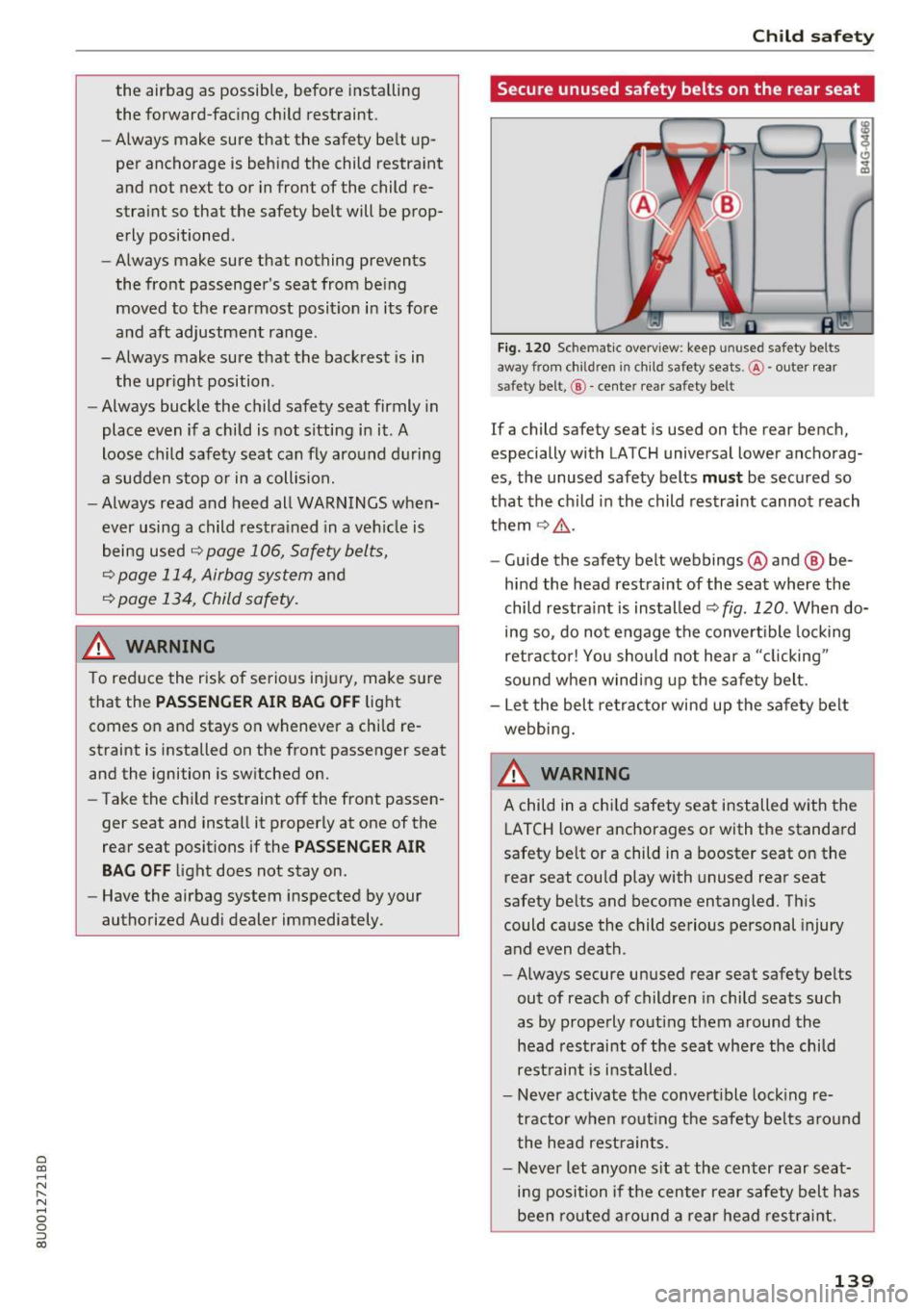
Fig. 120 Sc hema tic overv iew: keep unused safety belts
away from children in chil d safety seats. @-ou ter rear
safety belt,@ -center rear safety belt
If a child safety seat is used on the rear bench,
especially with LATCH universal lower anchorag
es, the unused safety belts
must be secured so
that the child in the child restraint cannot reach
them ~.&. -
- Guide the safety belt webbings @ and @ be
hind the head restraint of the seat where the
child restraint is installed
c::> fig. 120 . When do
ing so , do not engage the convertible locking
retractor! You should not hear a "clicking"
sound when winding up the safety belt.
- Let the belt retractor wind up the safety belt
webbing.
A WARNING
-
A child in a child safety seat installed with the LATCH lower anchorages or with the standard
safety belt or a child in a booster seat on the rear seat could play with unused rear seat
safety belts and become entangled. This
could cause the child serious personal injury
and even death.
- Always secure unused rear seat safety belts
out of reach of children in child seats such
as by properly routing them around the head restraint of the seat where the child
restraint is installed .
- Never activate the convertible locking re
tractor when routing the safety belts around
the head restraints.
- Never let anyone s it at the center rear seat
ing position if the center rear safety belt has
been routed around a rear head restraint .
139
Page 144 of 230
Child safety
restraint in place 9 page 44. Install the
head restraint again immediately once the
child seat is removed. Driving without head
restraints or with head restraints that are
not properly adjusted increases the risk of
serious or fatal neck injury dramatically .
- Always read and heed all WARNINGS when
ever using a child restrained in a vehicle is
being used
9 page 106, Safety belts,
9page 114, Airbag system
and
9 page 134, Important information.
_& WARNING
If exceptional circumstances require the use
of a forward-facing child restraint on the
front passenger's seat, the child's safety and
well-being require that the following special precautions be taken:
- Make sure the forward-facing seat has been
designed and certified by its manufacturer
for use on a front seat with a passenger
front and side airbag.
- Always follow the manufacturer's instruc
tions provided with the child safety seat or
infant carrier.
- Always move the front passenger seat to
the highest position in the up and down ad
justment range and move it back to the
rearmost position in the seat's fore and aft
adjustment range, as far away from the air
bag as possible, before installing the for
ward-facing child restraint.
- Always make sure that the safety belt upper
anchorage is behind the child restraint and
not next to or in front of the child restraint
so that the safety belt will be properly posi
tioned.
- Always make sure that nothing prevents the
front passenger's seat from being moved to
the rearmost position in its fore and aft ad
justment range.
- Always make sure the backrest is in an up
right position.
- Make sure that the
PASSENGER AIR BAG
OFF
light comes on and stays on all the time
whenever the ignition is switched on.
142
- If the light does not stay on, perform the
checks
¢ page 124, Monitoring the Ad
vanced Airbag System.
-T ake the child restraint off the front passen
ger seat and install it properly at one of the
rear seat positions if the
PASSENGER AIR
BAG OFF
light does not stay on whenever
the ignition is switched on.
Booster seats and safety belts
Properly used booster seats can help protect
children weighing between about 40 lbs . and 80
lbs. (18 kg and 36 kg) who are less than 4 ft.
9
in . (57 inches/1.45 meters) tall.
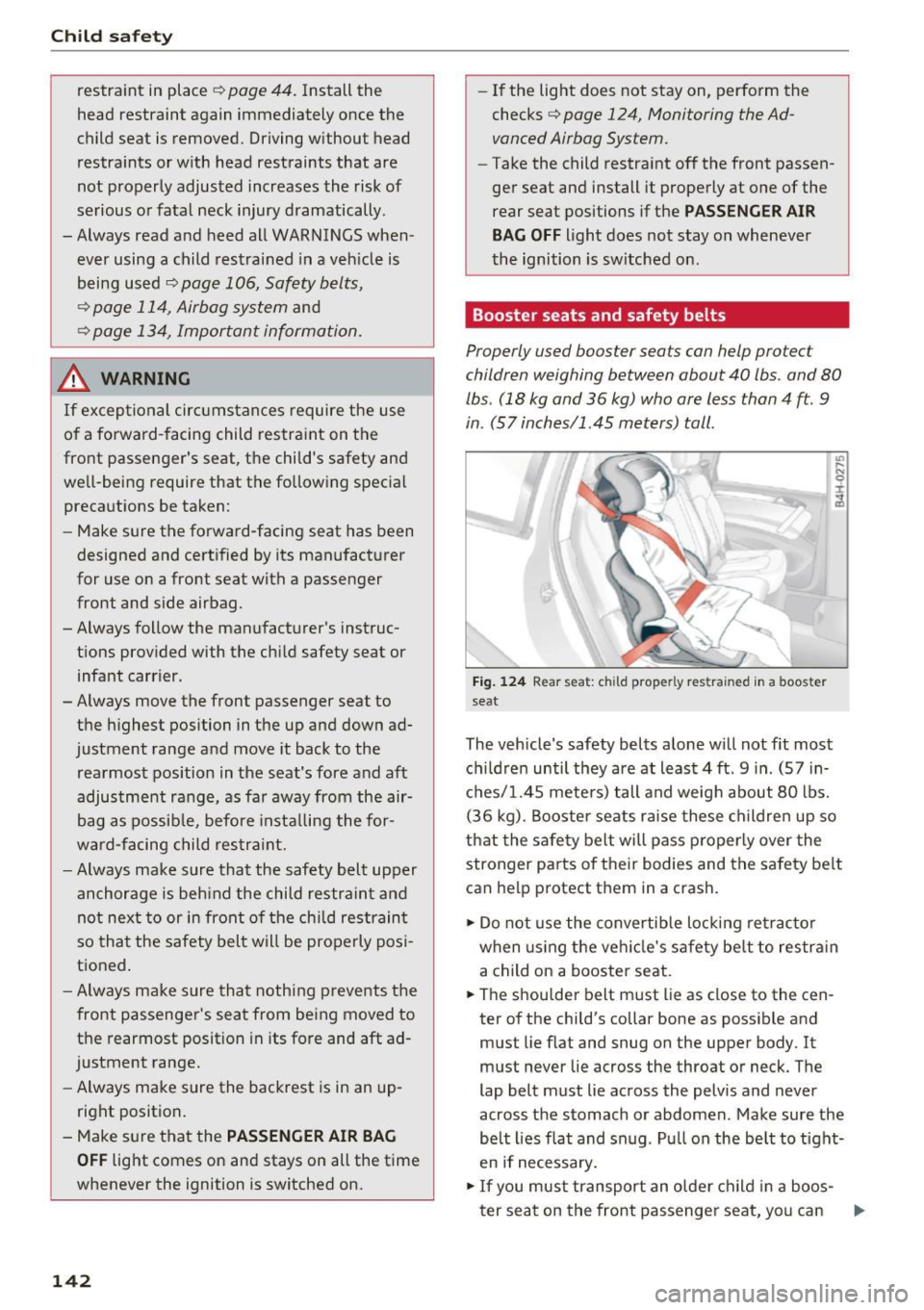
Fig. 124 Rear seat: child proper ly restrained in a booster
seat
The vehicle's safety belts alone will not fit most
children until they are at least 4 ft. 9 in. (57 in
ches/1.45 meters) tall and weigh about 80 lbs.
(36 kg). Booster seats raise these children up so
that the safety belt will pass properly over the
stronger parts of their bodies and the safety belt
can help protect them in a crash.
.,. Do not use the convertible locking retractor
when using the vehicle's safety belt to restrain
a child on a booster seat.
.,. The shoulder belt must lie as close to the cen
ter of the child 's collar bone as possible and
must lie flat and snug on the upper body.
It
must never lie across the throat or neck. The
lap belt must lie across the pelvis and never
across the stomach or abdomen . Make sure the
belt lies flat and snug . Pull on the belt to tight
en if necessary.
.,. If you must transport an older child in a boos-
ter seat on the front passenger seat, you can
Ill>-
Page 145 of 230
0 co ......
"' ,....
"' ...... 0 0 :::,
00
use the safety belt height adjustment to help
adjust the shoulder portion properly .
~ Secure unused safety belts on the rear seat
¢ page 139.
Children up to at least 8 years old (over 40 lbs. or
18 kg) are best protect ed in child safety s eats de
signed for their age and weight. Experts say that
the skeletal structure, particularly the pelvis, of
these children is not fully developed, and they
must not use the vehicle safety belts without a
suitable child restra int .
It is usually best to put these children in appro priate booster seats . Be sure the booster seat
meets all applicable safety standards .
Booster se ats raise the seating position of the
child and reposition both the lap and shoulder
parts of the safety belt so that they pass across
the child's body in the right places. The rout ing of
the belt over the child's body is very important
for the child's protection, whether or not a boos
ter seat is used. Chi ld ren age 12 and unde r must
a lways ride in the rear seat .
Ch ildren who are at least 4 ft . 9 in. (57 inches/
1.45 mete rs) tall ca n genera lly use the veh icle's
three po int lap and shoulder be lts. Neve r use the
l ap belt po rtion of the vehicle 's safety belt alone
to restrain any child, regardless of how big the
chi ld is. A lways remember that children do not
hav e the pronounced pelvic structure required for
the proper function of lap belt port ion of the ve
h icle 's three point lap and shoulder be lt s. The
chi ld 's safety absolutely requires that a lap belt
port ion of the safety belt be fastened snugly and
as low as possible around the pelvis . Never let
the lap belt portion of the safety belt pass over
the child's stomach or abdomen.
In a crash, a irbags must inflate within a blink of
an eye and wit h considerable force . In order to do
its job, the airbag needs room to inflate so that it
will be there to p rotect the occupant as the occu
pant moves forward into the a irbag.
A vehicle occupant who is out of position and too
close to the airbag gets in the way of an inflating
ai rbag. When an occ upant is too close, he o r she
will be struck v iolently and will receive ser ious or
possibly even fatal injury.
Ch ild safety
In order for the a irbag to offer protection, it is
important that a ll vehicle occupants, especially
any ch ildren, who m ust be in the front seat be
cause of exceptiona l circumstances, be properly
res tra ined and as far away from the airbag as
poss ible. By keeping room between the child 's
body and the front of the passenger compart
ment, the a irbag can inflate completely and pro
vide s upplementa l protec tion in certain frontal
collisions.
A WARNING
-
Not using a booster seat, using the booster
seat improperly, incorrect ly installing a boos
ter seat or using the vehicle safety belt im
properly increases the risk of serious personal
i njury and death in a collision or other emer
gency situation. To help reduce the risk of se rious personal injury and/or death:
- The shou lder belt must lie as close to the
center of the ch ild's collar bone as possible
and must lie flat and snug on the upper
body. It must never lie across the throat or
neck. The lap belt must lie ac ross the pelvis
and never across the stomach o r abdomen.
Make sure the bel t lies flat and sn ug. Pu ll on
the belt to tighten if necessary.
- Fail ure to properly route safety bel ts over a
child's body w ill cause severe injuries in an
accident or other emergency situation
¢ page 106.
- The rear side of the chi ld safety seat should
be positioned as close as possible to the
backrest on the vehicle seat. Adjust or re
move the rear seat head restraint if it is dif
f icult to insta ll the ch ild seat with the head
restraint in place¢
page 44 . Install the
head restraint again immed iately once the
child seat is removed . Driving without head
rest raints or with head restra ints that a re
not properly adj usted increases the r is k of
serio us or fatal ne ck in jury dramatically .
- Never let a chi ld put the shoulder belt under
the arm or behind the ba ck, because i t could
cause severe inj uries in a crash .
- Ch ild ren on the fron t seat of any car, even
with Advanced Airbags, can be seriously in-
jured or even ki lled when an airbag inflates .
Ill>
143
Page 203 of 230
0 co ......
"' ,....
"' ...... 0 0 :::,
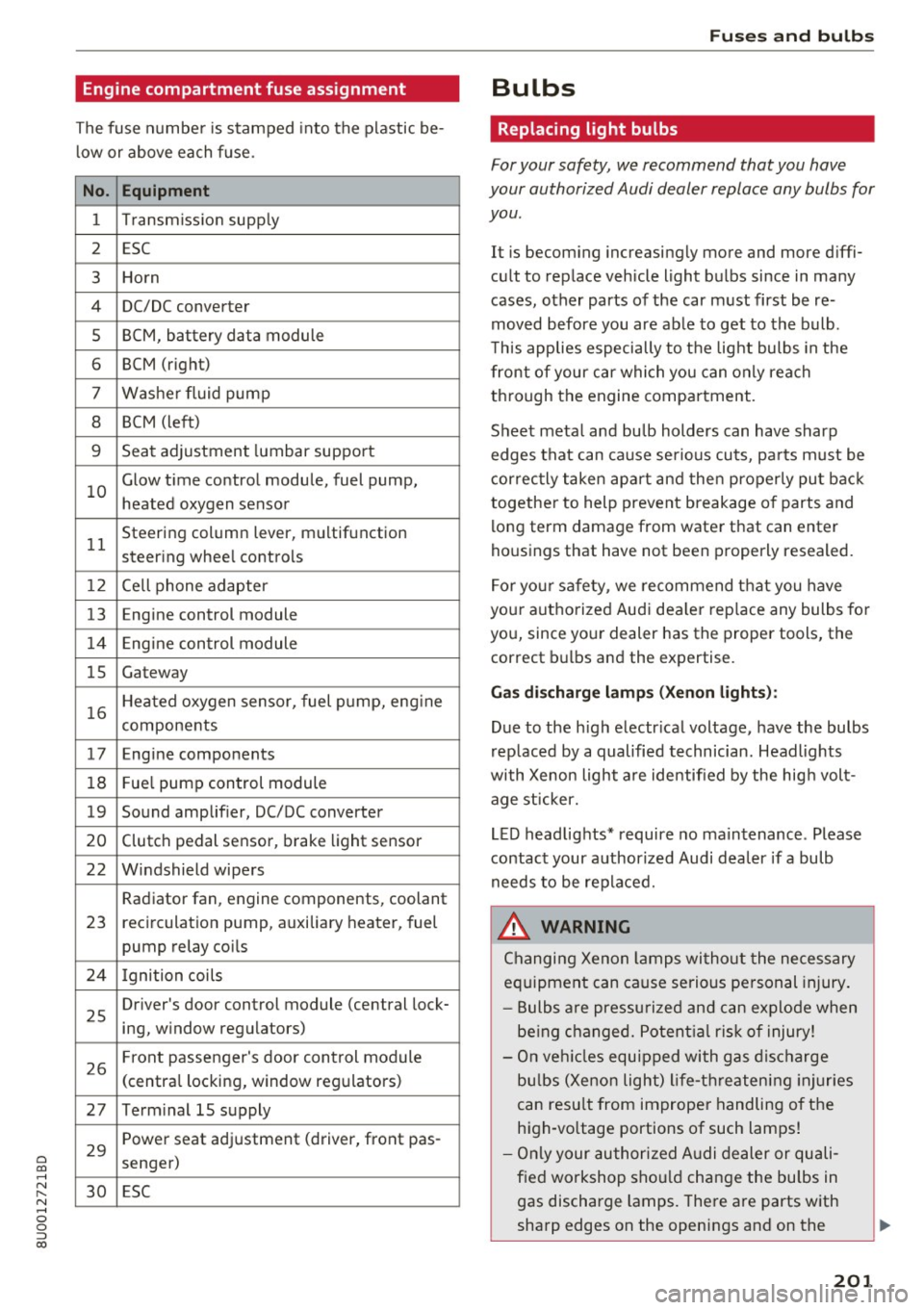
00
Engine compartment fuse assignment
The fuse number is stamped into the plastic be
low or above each fuse.
No. Equipment
1 Transmiss ion supply
2 ESC
3 Horn
4 DC/DC
converter
5 BCM, battery data module
6 BCM (right)
7 Washer fluid pump
8 BCM (left)
9 Seat adjustment lumbar support
10 Glow time
control module, fuel pump,
heated oxygen sensor
11 Steering
column lever, multifunction
steer ing whee l controls
1 2 Cell phone adapter
13 En
gine control module
14 Engine control module
15 Gateway
16 Heated oxygen sensor, fuel pump, eng
ine
components
17 Engine components
18 Fue
l pump control module
19 Sound amplifier, DC/DC converter
20 Clutch pedal sensor, brake light sensor
22 Windshield wipers Radiator fan, engine components, coolant
23 recirculation pump, auxiliary
heater, fuel
pump relay coils
24 Ignition coils
25 Driver's door
control module (central lock-
ing, window regulators)
26 Front passenger's door control module
(centra
l locking, window regulators)
27 Term inal 15 supply
29 Power seat adjustment (driver,
front pas-
senger)
30 ESC
Fu ses an d bulb s
Bulbs
Replacing light bulbs
For your safety, we recommend that you have
your authorized Audi dealer replace any bulbs for
you .
It is becoming increasingly more and more diffi
cult to replace vehicle light bulbs since in many
cases, other parts of the car must first be re
moved before you are able to get to the bulb .
T his applies especially to the light bulbs in the
front of your car which you can only reach
through the engine compartment .
Sheet metal and bu lb holders can have sharp
edges that can cause serious cuts, pa rts must be
correctly taken apart and then properly put back
together to help prevent breakage o f parts and
long term damage from water that can enter
housings that have not been properly resealed.
For your safety, we recommend that you have
your authorized Aud i dea ler rep lace any bulbs fo r
you, since your dealer has the proper tools, the
correct bulbs and the expertise.
Gas di schar ge la mps (Xe no n ligh ts):
Due to the high electr ical voltage, have the bulbs
rep laced by a qualified technician. Headlights
with Xenon light are identified by the hig h volt
age st icker.
LED headlights* require no maintenance . Please
contact your authorized Audi dea ler if a bulb
needs to be replaced.
_&. WARNING
Changing Xenon lamps wi thout the necessary
equipment can cause serious personal injury .
- Bulbs are pressu rized and can explode when
be ing changed. Potent ial ris k of injury!
- On veh icles equipped with gas disc harge
bu lbs (Xenon light) life-threatening injuries
can resu lt from improper handling of the
high-vo ltage portions of such lamps!
- Only your authorized A udi dealer or quali
f ied workshop sho uld change the bulbs in
gas discharge lamps. There are parts with
sharp edges on the openings and on the
201
Page 224 of 230
Index
Parking systems . . . . . . . . . . . . . . . . . . . . . . . 82
Adjusting the display/warning tone . . . . . . 87
Clean ing the rearv iew camera . . . . . . . . . . . 85
Cleaning the sensors/camera . . . . . . . . . . 186
Malfunction . . . . . . . . . . . . . . . . . . . . . . . . . 88
Rear parking system . . . . . . . . . . . . . . . . . . 83
Rearview camera . . . . . . . . . . . . . . . . . . . . . 84
Trailer hitch . . . . . . . . . . . . . . . . . . . . . . . . . 88
Parking (automatic transmission) . . . . . . . . . 69
Parts replacement . . . . . . . . . . . . . . . . . . . . 214
Pass-through . . . . . . . . . . . . . . . . . . . . . . . . . 48
PASSENGER AIR BAG OFF light . . . . . . . . . . 125
Pedals . . . . . . . . . . . . . . . . . . . . . . . . . . . . . . 101
Physical principles of a frontal collision . . . 107
Polishing . . . . . . . . . . . . . . . . . . . . . . . . . . . . 187
Pollen filter
refer to Pollutant filter . . . . . . . . . . . . . . . . 51
Pollutant filter . .... ........... .... .... 51
Power seat ad justment . . . . . . . . . . . . . . . . . 42
Power windows . . . . . . . . . . . . . . . . . . . . . . . . 30
Child safety lock . . . . . . . . . . . . . . . . . . . . . . 30
Malfunction . . . . . . . . . . . . . . . . . . . . . . . . . 31
Pregnant women Special considerations when wearing a safe-
ty belt . . . . . . . . . . . . . . . . . . . . . . . . . . . . . 111
Proper safety belt position . . . . . . . . . . . . . . 110
Proper seating posit ion
Fr ont passenger . . . . . . . . . . . . . . . . . . . . . . 99
Occupants. . . . . . . . . . . . . . . . . . . . . . . . . . . 98
Rear passengers . . . . . . . . . . . . . . . . . . . . . . 99
Protective liner . . . . . . . . . . . . . . . . . . . . . . . . 49
Q
quattro (all wheel drive) . . . . . . . . . . . . . . . . . 93
Question What happens to unbelted occupants? . . 107
R
Radio Standards Specification (RSS)
215
Rain/light sensor Headlights . . . . . . . . . . . . . . . . . . . . . . . . . . 33
I nterva l mode (windshield wipers) . . . . . . . 38
Ra ising the vehicle . . . . . . . . . . . . . . . . . . . . 207
Range (fuel level) . . . . . . . . . . . . . . . . . . . . . . 19
Reading lights . . . . . . . . . . . . . . . . . . . . . . . . . 35
222
Rear fog lights . . . . . . . . . . . . . . . . . . . . . . . . 33
Rearview camera
refer to Parking systems . . . . . . . . . . . . 83 , 84
Rear window defogger Automatic climate control system . . . . . . . 55
Manual climate control system . . . . . . . . . . 53
Rear window wiper Replacing wiper blades . . . . . . . . . . . . . 39, 40
Recirculation mode Automatic climate cont rol system . . . . . . . 55
Manua l climate control system . . . . . . . . . . 53
Refueling . . . . . . . . . . . . . . . . . . . . . . . . . . . . 153
Remote control
refer to Remote control key . . . . . . . . . . . . 23
Remote control key . . . . . . . . . . . . . . . . . . . . 23
LED . . . . . . . . . . . . . . . . . . . . . . . . . . . . . . . . 23
Personalization . . . . . . . . . . . . . . . . . . . . . . 23
Replacing the battery . . . . . . . . . . . . . . . . . 23
Synchronization . . . . . . . . . . . . . . . . . . . . . . 24
Unlocking/locking . . . . . . . . . . . . . . . . . . . . 24
Repair manuals . . . . . . . . . . . . . . . . . . . . . . . 212
Repairs Airbag system . . . . . . . . . . . . . . . . . . . . . . 127
Replacement key . . . . . . . . . . . . . . . . . . . . . .
23
Replacing
Light bulbs . . . . . . . . . . . . . . . . . . . . . . . . . 201
Replacing wiper blades . . . . . . . . . . . . . . 39 , 40
Reporting Safety Defects . . . . . . . . . . . . . . . 104
Reset button (trip odometer) . . . . . . . . . . . . . 9
Resett ing the trip odometer . . . . . . . . . . . . . . 9
Retractor . . . . . . . . . . . . . . . . . . . . . . . . . . . . 109
Rims ...... .. .. .. .. .. .. ........... .. 180
Roof load . . . . . . . . . . . . . . . . . . . . . . . . . . . . . 49
Roof rack . . . . . . . . . . . . . . . . . . . . . . . . . . . . . 49
s
Safe driving habits . . . . . . . . . . . . . . . . . . . . . 97
Safety Airbag system . . . . . . . . . . . . . . . . . . . . . . 114
Belts . . . . . . . . . . . . . . . . . . . . . . . . . . . . . . 106
Cargo . . . . . . . . . . . . . . . . . . . . . . . . . . . . . 102
Correct seat ing pos ition . . . . . . . . . . . . . . . 98
Pedal area . . . . . . . . . . . . . . . . . . . . . . . . . . 101
Safety belt position . . . . . . . . . . . . . . . . . . . 110
Safety be lt height adjustment . . . . . . . . . 111
Safety belts worn by pregnant women . . . 111
Page 225 of 230
Safety belt pretensioner Service and disposa l............ ..... . 113
Safety belts . . . . . . . . . . . . . . . . . . . . . . 106, 109
C leaning . . . . . . . . . . . . . . . . . . . . . . . . . . . 187
Danger to passengers who do not wear a
safety belt . . . . . . . . . . . . . . . . . . . . . . . . . 107
Fastening . . . . . . . . . . . . . . . . . . . . . . . . . . 109
H eight adjustment . . . . . . . . . . . . . . . . . . . 111
Improperly worn ............. .. ..... 112
Not worn . . . . . . . . . . . . . . . . . . . . . . . . . . 107
Safety belt position . . . . . . . . . . . . . . . . . . 110
Safety instructions . . . . . . . . . . . . . . . . . . . 108
Securing child safety seats . . . . . . . . . . . . 144
Special considerations for pregnant wom-
en . . . . . . . . . . . . . . . . . . . . . . . . . . . . . . . . 111
Unfastening . . . . . . . . . . . . . . . . . . . . . . . . 111
Warning/indicator light . . . . . . . . . . . . . . 106
Worn properly . . . . . . . . . . . . . . . . . . . . . . 108
Safety instructions
for side curta in a irbags . . . . . . . . . . . . . . . 133
for using ch ild safety seats . . . . . . . . . . . . 137
for using safety be lts . . . . . . . . . . . . . . . . . 108
Monitoring the Advanced Airbag System . 126
Safety systems . . . . . . . . . . . . . . . . . . . . . . . . 14
Seat Number of seats
Seat adjustment 106
Head restraints . . . . . . . . . . . . . . . . . . . . . 100
Seat belts
refer to Safety belts . . . . . . . . . . . . . . . . . . 106
Seat heating Automatic climate control system . . . . . . . 55
Manual climate control system . . . . . . . . . . 53
Seating capacity . . . . . . . . . . . . . . . . . . . . . . 106
Seating position Driver . . . . . . . . . . . . . . . . . . . . . . . . . . . . . . 98
Fr ont passenger . . . . . . . . . . . . . . . . . . . . . .
99
How to adjust the front seats . . . . . . . . . . . 99
Incorrect seat position . . . . . . . . . . . . . . . 100
Occupants . . . . . . . . . . . . . . . . . . . . . . . . . . . 98
Rear passengers . . . . . . . . . . . . . . . . . . . . . .
99
Seats
Adjusting . . . . . . . . . . . . . . . . . . . . . . . . . . . 42
Cleaning . . . . . . . . . . . . . . . . . . . . . . . . . . . 188
~ Correct seating position . . . . . . . . . . . . . . . 98 ......
~ Folding . . . . . . . . . . . . . . . . . . . . . . . . . . . . . 47
N
8 Selective whee l torque contro l . . . . . . . . . . . 89
0
:::,
00
Index
Se lector lever (automatic transmission)
Emergency operation . . . . . . . . . . . . . . . . . . 72
Pos ition . . . . . . . . . . . . . . . . . . . . . . . . . . . . 67
Service and disposal Safety belt pretensioner . . . . . . . . . . . . . . 113
Service interval display . . . . . . . . . . . . . . . . . 165
Service position
refer to Replacing wiper blades . . . . . . . . . 39
Setting the temperature
Automatic climate cont rol system . . . . . . . 54
Sh ift paddles (automatic transm iss ion) . . . . 70
Side airbags Description . . . . . . . . . . . . . . . . . . . . . . . . . 128
How they work . . . . . . . . . . . . . . . . . . . . . . 129
Side assist
refer to Audi side assist . . . . . . . . . . . . . . . . 78
S ide curta in airbags . . . . . . . . . . . . . . . . . . . 131
Description . . . . . . . . . . . . . . . . . . . . . . . . . 131
How they work . . . . . . . . . . . . . . . . . . . . . . 132
Safety instructions . . . . . . . . . . . . . . . . . . . 133
Ski bag. ........... .... ........... .... 48
Snow chains . . . . . . . . . . . . . . . . . . . . . . . . . 181
Sockets . . . . . . . . . . . . . . . . . . . . . . . . . . . . . . 44
Sources of information about child restraints
and their use . . . . . . . . . . . . . . . . . . . . . . . . . 151
Space-saving spare tire (compact spare tire)
. 197
Spare tire . . . . . . . . . . . . . . . . . . . . . . . . . . . 197
Speedometer . . . . . . . . . . . . . . . . . . . . . . . . . . 8
Speed warning system . . . . . . . . . . . . . . . . . . 76
Stab ilization control
refer to E lectronic stabi lization control . . . 89
START ENGINE STOP button . . . . . . . . . . . . . 61
Starting (engine) . . . . . . . . . . . . . . . . . . . 60, 61
Steering Electromechanical steering . . . . . . . . . . . . . 93
Locking (convenience key) . . . . . . . . . . . . . . 62
Locking (ignition lock) . . . . . . . . . . . . . . . . . 60
also refer to Electromechanical steering 93
Steering wheel Adjusting . . . . . . . . . . . . . . . . . . . . . . . . . . . 59
Shift paddles (automatic transmiss ion) . . . 70
Steps for determining correct load limit . . . 180
Stopping (engine) . . . . . . . . . . . . . . . . . . . 60, 62
Storage compartments . . . . . . . . . . . . . . . . . 45
Subwoofer. . . . . . . . . . . . . . . . . . . . . . . . . . . 198
223