tire pressure AUDI Q3 2018 User Guide
[x] Cancel search | Manufacturer: AUDI, Model Year: 2018, Model line: Q3, Model: AUDI Q3 2018Pages: 230, PDF Size: 57.03 MB
Page 177 of 230
0
"' .... N
" N .... 0 0 ::,
"'
not permitted can lead to ve
hicle damage or accidents.
-If you install wheel covers on the vehicle, make sure they allow enough air circulation to
cool the brake system. If they
do not, this could increase the risk of an accident.
Tire wear/damage
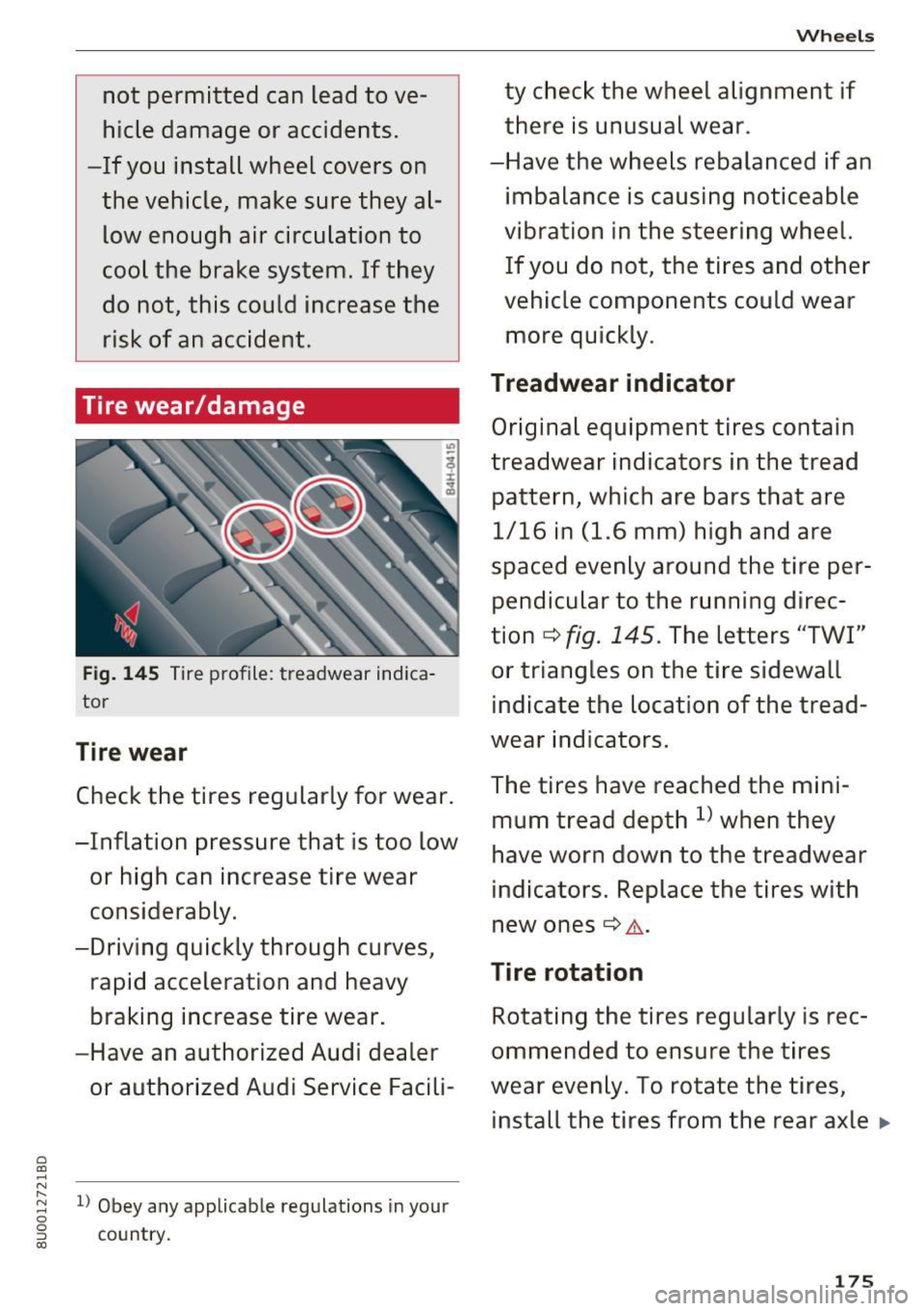
Fig. 145 Tire profile : treadwear indica
tor
Tire wear
Check the tires regularly for wear.
-Inflation pressure that is too low or high can increase tire wear
considerably.
-Driving quickly through curves, rapid acceleration and heavy
braking increase tire wear.
-Have an authorized Audi dea ler
or authorized Audi Service Facili-
l ) Obey any applicable regulations in your
country.
Wheels
ty check the wheel alignment if
there is unusual wear.
-Have the wheels rebalanced if an imbalance is causing noticeable
vibration in the steering wheel. If you do not, the tires and other
vehicle components could wear more quickly.
Treadwear indicator
Original equipment tires contain
treadwear indicators in the tread pattern, which are bars that are 1/16 in (1.6 mm) high and are
spaced evenly around the tire per pendicular to the running d irec
tion
i:::> fig. 145. The letters "TWI "
or triang les on the tire sidewall
indicate the location of the tread
wear indicators.
The tires have reached the mini mum tread depth
l ) when they
have worn down to the treadwear
indicators. Replace the tires with
new ones
i:::> .&..
Tire rotation
Rotating the tires regularly is rec
ommended to ensure the tires
wear evenly. To rotate the tires, install the tires from the rear axle ..,.
175
Page 178 of 230
Wheels
on the front axle and vice versa.
This will allow the tires to have approximately the same length of
service life.
For unidirectional tires, make
sure the tires are installed accord ing to the running direction indi
cated on the tire sidewall
¢ page 196.
Hidden damage
Damage to tires and rims can of
ten occur in locations that are hidden. Unusual vibrations in the
vehicle or pulling to one side may indicate that there is tire damage.
Reduce your speed immediately.
Check the tires for damage. If no
damage is visible from the out
s ide, drive slowly and carefully to
the nearest authorized Aud i deal
er or authorized Audi Service Fa
cility to have the vehicle inspect
ed.
A WARNING
Tread that has worn too low or
different tread depths on the
t ires can reduce driving safety.
This can increase the risk of an
accident because it has a nega
t ive effect on handling, driving
through curves, and braking, and because it increases the
176
risk of hydroplaning when driv
ing through deep puddles.
Tire pressure
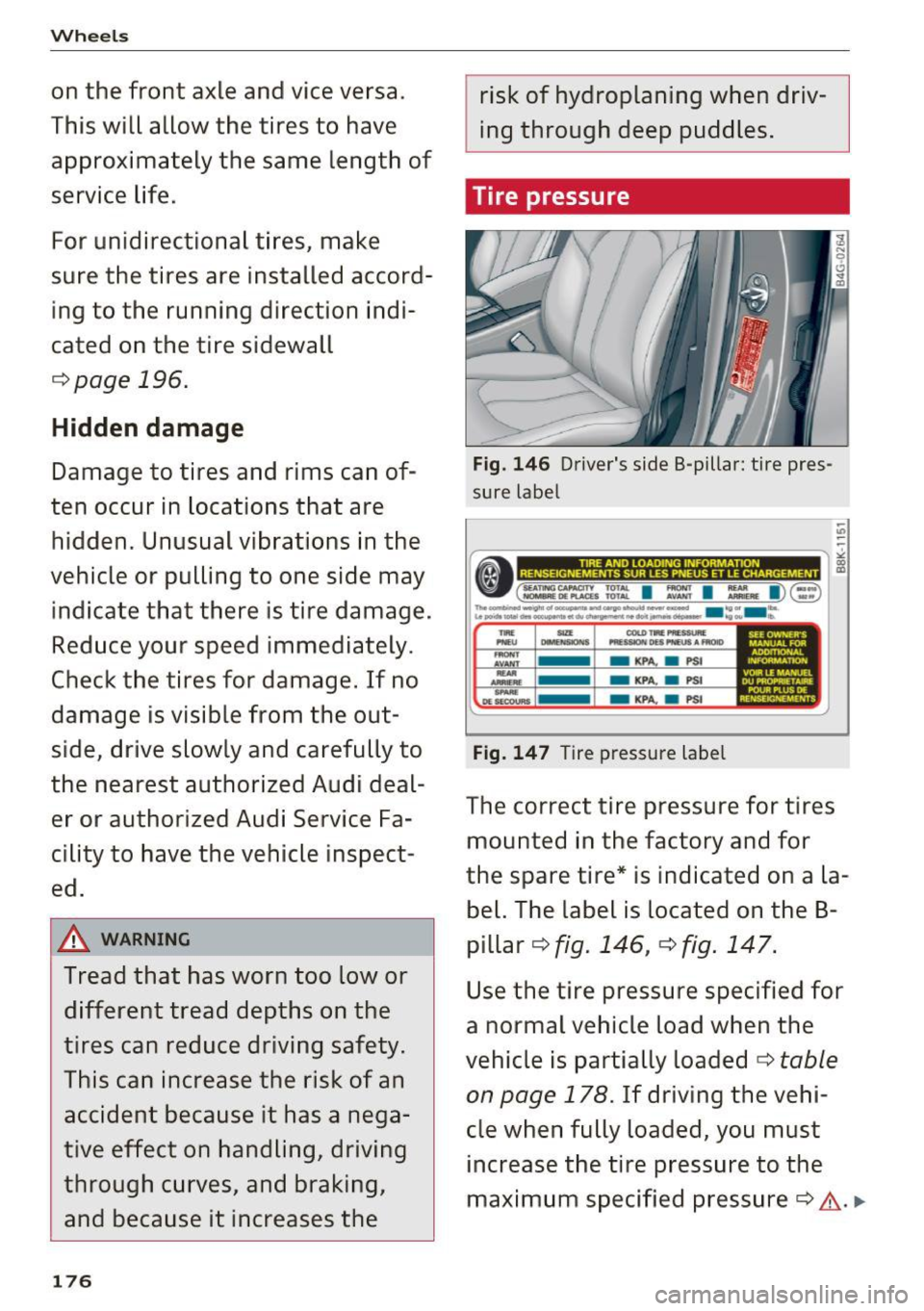
Fig. 146 Driver's side 8-pillar : tire pres
sure label
"'" '" AVANT
---
- KPA. a PSI
- KPA.
a PSI
- KPA.
a PSI
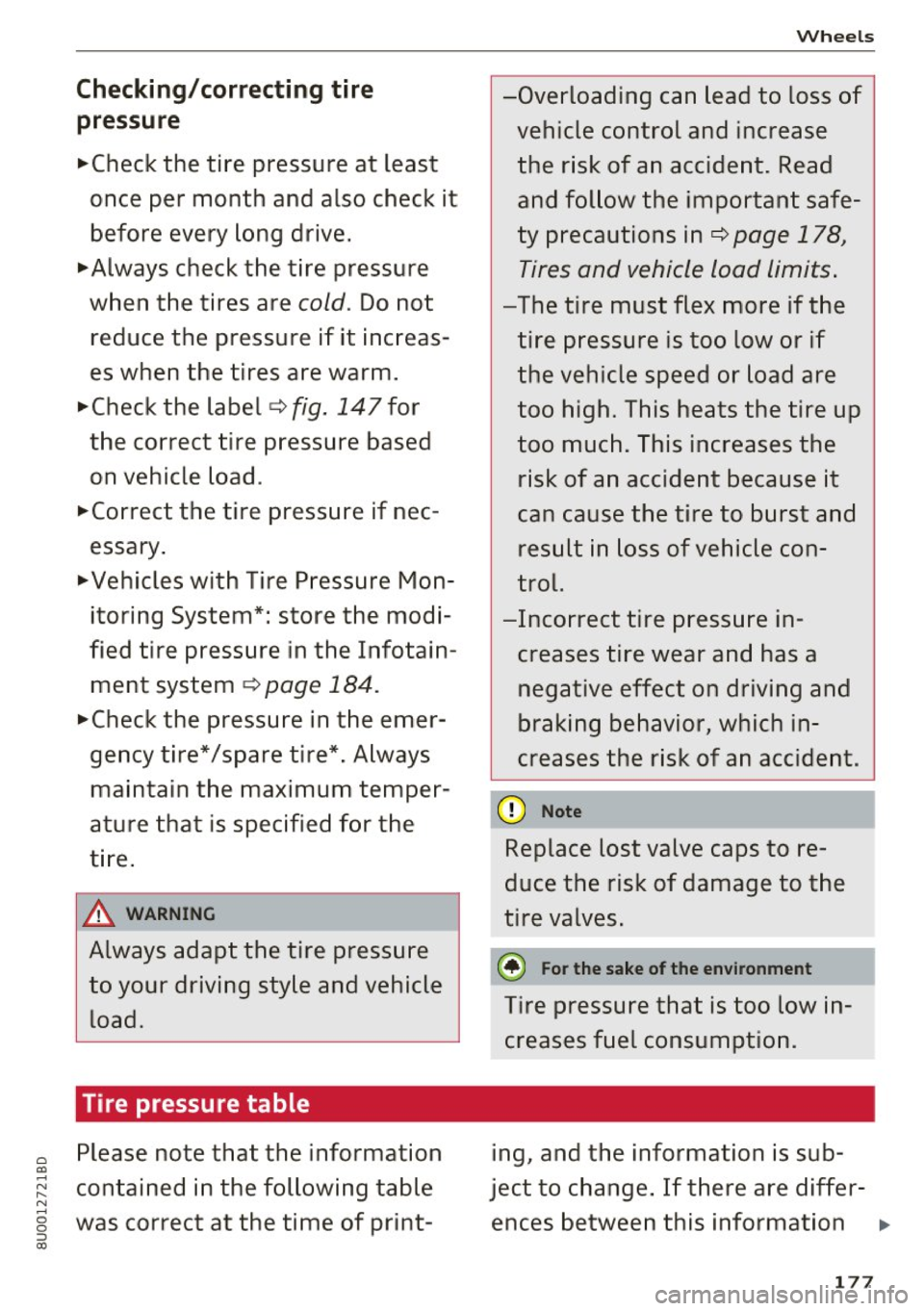
Fig. 147 Tire pressure label
The correct tire pressure for tires
mounted in the factory and for
the spare tire* is indicated on a la
bel. The label is located on the B
pillar ¢
fig. 146, ¢ fig. 147.
Use the tire pressure specified for
a normal vehicle load when the
vehicle is partially loaded¢
table
on page 178 .
If driving the vehi-
cle when fully loaded, you must
increase the tire pressure to the
maximum specified pressure¢.&. . .,.
Page 179 of 230
0 C0
-N
" N
-0
0
::, a)
Checking/correcting ti re pressure
.,,.Check the tire pressure at least
once per month and also check it
before every long drive.
.,,.A lways check the tire pressure
when the tires are
cold . Do not
reduce the pressure if it increas
es when the tires are warm .
.,,.Chec k the label ¢
fig. 147 for
the correct tire pressure based
on vehicle load .
.,,.Correct the tire pressure if nec
essary .
.,,.Ve hicles with Tire Pressure Mon
itoring System*: store the modi
fied tire pressure in the Infotain ment system ¢
page 184.
.,,.Check the pressure in the emer
gency tire*/spare tire*. Always
maintain the maximum temper
ature that is specified for the
tire.
.&_ WARNING
Always adapt the tire pressure
to your driving style and vehicle load.
Tire pressure table
Please note that the information
contained in the following table
was correct at the time of print-
Wheels
-Overload ing can lead to loss of
vehicle control and increase the risk of an accident. Read
and follow the important safe
ty precautions in ¢
page 178,
Tires and vehicle load limits.
-The tire must flex more if the
tire pressure is too low or if
the vehicle speed or load are
too high. This heats the tire up
too much. This increases the
risk of an accident because it
can cause the tire to burst and result in loss of vehicle con
trol.
-Incorrect tire pressure in
creases tire wear and has a
negative effect on driving and
braking behavior, which in
creases the risk of an accident.
(D Note
Replace lost valve caps to re
duce the risk of damage to the
tire valves.
@) For the sake of the environment
Tire pressure that is too low in
creases fuel consumption.
ing, and the information is sub
ject to change. If there are differ
ences between this information .,.
177
Page 180 of 230
Wheels
and the tire pressures specified
on the label on the driver's side B
pillar, always follow the specifica
tion on the B-pillar label
¢ page 176, fig. 146.
Make sure that the tire designa
tion on your tire matches the des-
Model/ Tire designation
Engine
ignation on the tire pressure label
and the tire pressure table.
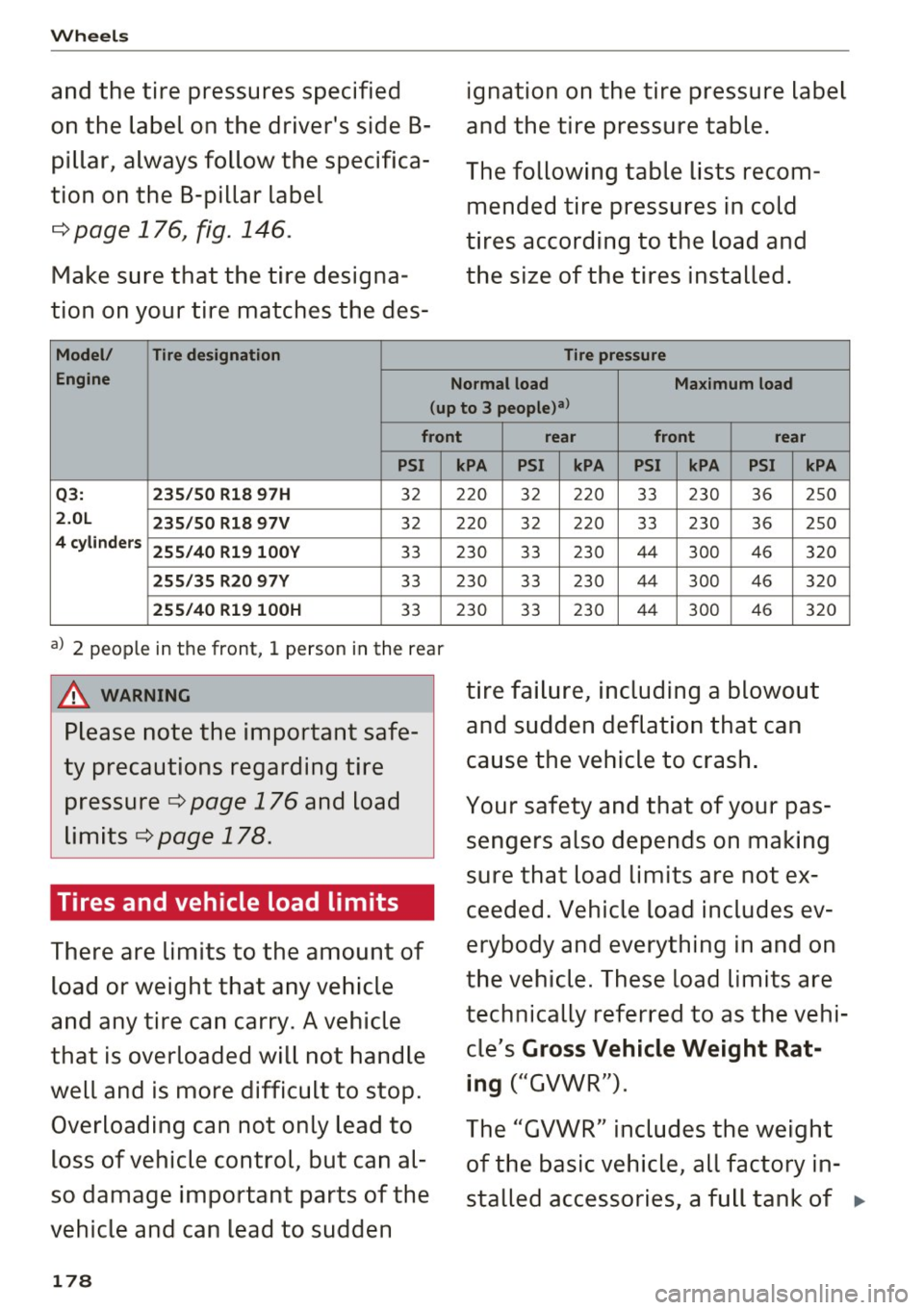
The following table lists recom mended tire pressures in cold
tires according to the load and
the size of the tires installed.
Tire pressure
Normal load Maximum load
(up to 3 people)a)
front rear front rear
PSI
Q3: 235/50 Rl8 97H 32
2.0L
235/50 Rl8 97V 32
4 cylinders 255/40 Rl9 l00Y 33
255/35 R20 97Y 33
255/40 Rl9 l00H 33
a) 2 peop le in the front ; 1 perso n in the rear
.8, WARNING
Please note the important safe
ty precautions regarding tire
pressure ¢
page 176 and load
limits ¢
page 178.
Tires and vehicle load limits
There are limits to the amount of
load or weight that any vehicle
and any tire can carry. A vehicle
that is overloaded will not handle
well and is more difficult to stop.
Overloading can not only lead to
loss of vehicle control, but can al
so damage important parts of the
vehicle and can lead to sudden
178
kPA PSI kPA PSI kPA PSI kPA
220 32 220 33 230 36 250
220 3 2 22 0
33 230
36 250
230 33 230 44
300 46 320
230 33 230 44 300 4
6 320
230 33 230 44 300 46 320
tire failure, including a blowout
and sudden deflation that can
cause the vehicle to crash.
Your safety and that of your pas
sengers also depends on making
sure that load limits are not ex
ceeded. Vehicle load includes ev
erybody and everything in and on
the vehicle. These load limits are
technically referred to as the vehi
cle's
Gross Vehicle Weight Rat
ing
("GVWR").
The "GVWR" includes the weight
of the basic vehicle, all factory in
stalled accessories, a full tank of
11>
Page 184 of 230
Wheels
with them. Remove the wheel covers" first.
Use coated snow chains.
Low-profile tires
App lies to: veh icles with low-profile tires
Your vehicle is equipped with low-profile tires* at
t he factory . Compared to other tire/rim combina
ti ons, low-profile tires offer a wider tread sur face
and a larger rim diameter with shorter tire side
walls . This results in an agile driving style . How
ever, it may reduce the level of comfort and in
crease road noise when dr iv ing on roads in poor
condition .
Low-profile tires can become damaged more
qu ickly than standard t ires when driving over
large b umps, potholes, manhole covers, speed
bumps and curbs. Therefore, it is part icu lar ly im
portant to maintain the cor rect tire pressure
¢page 176.
To reduce the r isk of damage to the tires and
rims, drive very carefully on poor roads.
Check your wheels regularly every 2,000 mi (3 ,000 km) for damage. For example , check for
bu lges/cracks on the tir es or deformations/
cracks on the r ims.
After a heavy impact or damage, have the tires
and rims inspected or replaced immediate ly by
an author ized Audi dealer or author ized A udi
Serv ice Facility .
Low-profile tires can wear out faster than stand
ard tires.
Summer tires are not suitable for cold weather,
snow or black ice . If you are driving in these con
d itions, use winter or all season t ires
¢ page 181.
Uniform tire quality grading
-Tread wear
- T raction AA A B C
- Temperature ABC
Qua lity grades can be found where applicab le on
the tire side wall between tre ad shoulder and
maximum section width
¢ page 16 7, fig . 144 .
182
For example: Tread wear 200 , Traction AA, Tem
perature
A .
All passenger car tir es must conform to Federal
Safety Requirements in addit ion to these grades .
Tread wear
The tread wear grade is a comparative rating
based on the wear rate of the tire when tested
under controlled conditions on a specified gov
ernment test course.
For example, a tire graded 150 would wear one
and one half (1 1/2) times as well on the govern
ment course as a tir e graded 100 .
T he relative performance of tires depends upon
the actual cond itions of their use, however, and
may depart sign ificantly from the norm due to
variations in driv ing habits, service practices and
differences in road characteristics and climate.
Traction
The traction grades , from highest to lowest, are
AA , A, Band
C. Those grades represent the tire's
ability to stop on wet pavement as measured un
der controlled conditions on specified govern
ment test surfaces of asphalt and concrete. A tire
marked C may have poor traction performance
¢_& .
Temperature
The temperature grades are A (the highest), B,
and C , representing the tire's resistance to the
generat ion of heat and its ability to dissipate
heat when tested under controlled conditions on
a spec ified indoor laboratory test wheel.
Sustained high temperature can cause the mate
rial of the tire to degenerate and reduce tire life ,
and excessive temperature can lead to sudden
tire failure ¢.& .
The grade C corresponds to a level of perform
ance which all passenger car tires must meet un
der the Federal Motor Vehicle Safety Standard
No. 109. Grades Band A represent higher levels
of performance on the laboratory test wheel than
the minimum required by law .
ll>
Page 185 of 230
0 co ......
"' ,....
"' ...... 0 0 :::,
00
A WARNING 1 = -
The traction grade ass igned to this tire is
based on straight-ahead braking traction
tests, and does not include acceleration, cor nering, hydroplaning or peak tract ion charac
teristics.
A WARNING
The temperature grade for this t ire is estab
lished for a t ire that is properly inflated and
no t overloaded. Excess ive speed, underinfla
tion, or excessive loading, either separately or
in combination, can cause heat buildup and
possible tire failure.
A WARNING
Temperature grades apply to tires that are properly inflated and not over or underinflat
ed.
Tire pressure monitoring system
(!) General notes
Applies to: veh icles with tire pressure monitoring system
-
Each tire, including the spare (if provided),
should be checked monthly when co ld and inflat
ed to the inflation pressure recommended by the
vehicle manufacturer on the vehicle placa rd or
tire i nflat ion pressure label. (If your vehicle has
tires of a different s ize tha n the s ize indicated on
the veh icle placard or tire inflation pressure la
be l, yo u sh ou ld de termine the prope r tire infla
tion pressure for those tires).
As an added safety feature, your veh icle has been
eq uipped w ith a tire pressu re monito ring sys tem
(TPMS) that ill uminates a low tire p ress ure te ll
tale when one or more of your tires is significan t
l y under-inflated. Accordingly, when the low tire
p ressure tellta le illuminates, you should stop and
check yo ur tires as soon as possible, and inflate
them to the proper pressure. Driving on a s ignifi
cantly under-i nflated tire causes the tire to over
h eat and can lead to t ire failure . Unde r-inflation
a lso reduces fuel efficiency and t ire t read life,
Wh eel s
and may affect the vehicle 's handling an d stop
ping ability.
Please note tha t the TPM S is not a s ubstitute fo r
prope r ti re maintenance, a nd it is the dr iver's re
spons ibility to maintain co rrect t ire pressure,
even if under-inflatio n has not reached the level
to t rigge r ill umination of the TPMS low t ire pres
s ur e te lltale .
Yo ur vehicle has also been equipped with a TPMS
malfunction indicator to indicate when the sys
tem is not ope rating properly. The TP MS ma l
funct ion indicator is combined with the low t ire
pressure telltale. When the system detects a
malfu nction, the telltale w ill flash for app roxi
mately one m inute and t hen rema in continuously
illuminated . Thi s seque nce w ill cont inue upon
s u bsequent vehicle star t-ups as long as the mal
funct ion exists.
When the malfunction indicator is illum inated,
the system may not be able to detect o r signal
l ow tire p ressure as intended. TPMS malfunct ions
may occur fo r a v arie ty of reaso ns, including the
insta llation o f replacement or al ternate tires or
whee ls on the vehicle that p revent the TPMS
from functioning proper ly . Always check the
TPMS ma lf u nction te lltale after replac ing one or
more tires or wheels on yo ur vehicle to ensure
that the rep lacement or a lt ernate tires and
wheels allow the TPMS to continue to function prope rly.
' If the Tire Pressure Monitoring System
indicator appears
Applies to: vehicles wi th Tire Pressur e Mon ito ring System in·
dicator
The tire pressure indicator in the ins trument
cluster informs you if the tire pressure is too low
or if there is a system malfunction .
Using the ABS sensors, the tire pressure monitor
ing system compares the tire tread c ircumfer
ence and v ibration characterist ics of the ind ividu
al tires. If the pressure changes in one o r more
whee ls, this is indicated in the inst rument cl uste r
display with t he
[IJ indica to r light and a mes
sage . If only one tire is affec ted, the locat ion of
that tire w ill be indicated. .,,.
183
Page 186 of 230
Wheels
The tire pressures must be stored in the Infotain
ment system again each time the pressures
change (switch ing between partial and full load
pressure) or after changing or replacing a tire on
your vehicle
c:::> page 184. The tire pressure moni
toring system only monitors the tire pressure you have stored . Refer to the tire pressure label for
the recommended tire pressure for your vehicle
c:::> page 176, fig. 147.
Tire tread circumference and vibration character istics can change and cause a t ire pressure warn
ing if:
- the tire pressure in one or more tires is too low
- the tire has structural damage
- the tire was replaced or the tire pressure was
changed and it was not stored
c:::> page 184
- the spare tire* is installed
Indicator lights
ti] -Loss of pressure in at least one tire c:::> & .
Check the tires and replace or repair if necessary.
Check/correct the p ressures of all four tires and
store the pressure again in the menu display
c:::> page 184.
@m (Ti re Pressure Monitoring System) Tire
pressure : System malfunction!. If@m
appears
after switching the ignit ion on or whi le driving
and the
ti] indicator light in the instrument clus
ter blinks for approximately one minute and then
stays on, there is system malfunction. Try to
store the correct tire pressures
c:::> page 184. If
the indicator light does turn off or turns on again
after a short period of time, dr ive to an author
ized Audi dealer or authorized Aud i Service Facili
ty immediately to have th e malfunct ion correct
ed.
_& WARNING
- If the tire pressure indicator appea rs in the
display, reduce your speed immediate ly and
avoid any hard steering or braking maneu
vers. Stop as soon as possib le and check the
t ir es and their pressure.
- The driver is responsible for maintaining the
correct tire pressure. You must check the
tire pressure regularly.
184
'
-Under certain conditions (such as a sporty
driving style, w inter conditions or unpaved
roads), the tire pressure monitoring system
ind icator may be delayed .
- Do not use run-flat tires on your vehicle. Us
ing them when not permitted can lead to
veh icle damage or accidents.
(D Tips
- The tire pressure monitor ing system can al
so stop working when there is an ESC mal
function.
- Using snow chains may result in a system
malfunction.
- The tire pressure monitor ing system in your
Audi was calibrated with "Audi Or iginal
Tires"
c:::> page 173. Using these tires is rec
ommended.
Storing tire pressures
App lies to: vehicles wit h Tire Pressure Monito rin g Syste m in
dic ator
.. Make sure before storing that the tire pressures
of all four tires meet the specified values and
are adapted to the load <=:>page
175 .
.. Switch the ignition on.
.. Select: the
I CARI funct ion button > (Car) Sys
tems *
control button > Servicing & checks >
Tire pressure monitoring > Store tire pressures
> Yes, store now.
(D Tips
Do not store the tire pressures if snow chains
are installed.
Page 187 of 230

0 co ......
"' ,....
"' ...... 0 0 :::,
00
Care and cleaning
General information
Regular, proper care helps to maintain your vehi
cle's value. It can a lso be a requirement when
submitting warranty claims for corrosion damage
and paint defects on the body.
The necessary care products can be obtained
from an authorized Audi dealer or authorized
Audi Service Facility . Read and follow the instruc
tions for use on the packaging.
A WARNING
- Us ing clean ing and care products incorrectly
can be dangerous to your health.
- Always store clean ing and care products out
of reach of children to reduce the r isk of po i
son ing .
@ For the sake of the environment
- Preferably purchase env ironmenta lly-friend
l y cleaning products.
- Do not d ispose of leftover cleaning and care
products with household trash.
Car washes
T he longer that deposits remain on the vehicle,
the more the surface may be damaged. High
temperatures such as those caused by sunlight increase the damag ing effect.
Befor e washing, rinse
off heavy depos its with
p lenty of water.
S tubborn depos its such as bird droppings or tree
sap are best removed with plenty of water and a
microfiber cloth.
A lso, wash t he un derside of yo ur vehicle once
road sa lt stops being used for the season .
Pressure washers
When washing your ve hicle w ith a pressure wash
e r, a lways fo llow the operating instructions pro
vided wi th the p ressure washer. This is especially
i mportant in rega rd to the pressure and sp raying
d istance . Do not aim the spray directly at seals on
side windows, doors, the hood, the luggage com-
Ca re and cleaning
partment lid or the panorama glass roof* or at
tires, rubber hoses, insulating material, sensors *
o r camera lenses* . Keep a distance of at least 16
in
(40 cm).
Do not remove snow and ice with a pressure
washer.
Never use cone nozz les o r high press ure nozzles .
T he water temperatu re must not be above
140 °F
(60 °().
Automatic car washes
Spray off the vehicle before washing.
Make s ure that the windows and roo f* are closed
and the windshie ld wipers are
off . Follow instruc
tions from the car wash ope rator, especially if
there are accessories attached to your vehicle.
If possible, use car washes that do not have
brushes .
Washing by hand
Clean the ve hicl e starting from the top and wor k
i ng down using a soft sponge o r cleaning br ush.
U se solven t-free cleaning produ cts.
Washing vehicles with matte finish paint by
hand
T o avo id damag ing the pa int w hen washi ng, fi rst
remove dust and large pa rticl es from you r vehi
cle . Insects, grease spots and fingerprints are
best removed w ith a special cleaner for matte
finish paint.
Apply t he product using a microf iber cloth . To
avoid damaging the paint surface, do not use too
much pressure.
Rinse the ve hicl e thoroug hly w ith wate r. Then
cl ean usi ng a neutral shampoo and a soft micro
fiber cloth .
Rinse the ve hicl e thorough ly aga in and let it air
dry. Remove any wate r residue using a chamois.
WARNING
-On ly wash the vehicle when the ign ition is
off and follow the instr uctions from the car
185
Page 194 of 230

Emergency assistance
& WARNING
You or your passengers could be injured while changing a wheel if you do not follow these
safety precautions :
- If you have a flat ti re, move a safe d ista nee
off the road . Turn off the engine, turn the
emergency flashers on and use other warn·
ing devices to alert other motorists.
- Make sure that passengers wait in a safe
place away from the vehicle and well away
from the road and traffic.
- To help prevent the vehicle from moving
suddenly and possibly slipping off the jack,
always fully set the parking brake and block
the front and back of the wheel diagonally
opposite the wheel being changed with the
folding chocks or other objects. When one
front wheel is lifted off the ground, placing
the Automatic Transmission in "P" (Park)
will
not prevent the vehicle from moving.
- Before you change a wheel, be sure the
ground is level and firm. If necessary, use a
sturdy board under the jack .
- Always store the vehicle tool kit, the jack
and the replaced tire in the luggage com
partment
c:> page 102 .
(D Tips
Obey all laws.
Changing a wheel
When you change a wheel, follow the sequence
described below step-by-step and in exactly that
order.
1. Remove the decorative wheel cover* or the
wheel bolt caps*. For more details see also
<=:>page 193.
2. Loosen the wheel bolts c:> page 193.
3. Locate the proper mounting point for the
jack and align the jack below that point
<=:>page 194.
4. Lift the car with the jack c:> page 194 .
5. Remove the wheel with the flat tire and then
install the
spare tire <=:>page 195.
6. Tighten all wheel bolts lightly.
7.
Lower the vehicle with the jack.
192
8. Use the wheel bolt wrench and firmly tighten
all wheel bolts in a crisscross pattern
<=:>page 193.
9. Replace the decorative wheel cover* or the
wheel bolt caps*.
& WARNING
Always read and follow all WARNINGS and in
formation
c:> .&. in Raising the vehicle on
page 194
and <=:>page 196.
After changing a wheel
A wheel change is not complete without the do·
ing the following .
.,. Always store the vehicle tool kit, the jack* and
the replaced tire in the luggage compartment
c:>page 102.
.,. Check the tire pressure of the spare tire as soon
as possible .
.,. As soon as possible, have the
tightening tor·
ques
on all wheel bolts checked with a torque
wrench. The correct tightening torque is
10S ft lbs (140 Nm).
.,. Have the flat tire
replaced as soon as possible.
(D Tips
- If you notice that the wheel bolts are cor
roded and difficult to turn while changing a
tire, they should be replaced before you check the tightening torque.
- Drive at reduced speed until you have the
tightening torques checked .
Page 198 of 230

Emergency assistance
- The wheel bolts should be clean and easy to
turn. Check for di rt and cor ros ion on the
mating s urfaces o f both the whee l an d the
h ub. Remove all dirt from t hese surfaces be
fo re remo unt ing t he wheel.
Tires with unidirectional tread design
Tires with unidirectional tread design must be
mounted with their tread pattern pointed in the
right direction.
Using a spare tire with a tread pattern intended for use in a specific direction
W hen us ing a spare ti re with a tread patte rn in
tended for use in a specific d irection, please note
the following:
- The direct ion o f rotat ion is marked by an
arrow
on the s ide of the t ire .
-If the spare tire has to be installed in the incor
rect d irection, use the spare tire only tempora
rily s ince the tire w ill not be ab le to achieve its
optimum pe rformance c haracter istics with re
gard to aq uaplaning, noise and wear .
- We recommend that you pay particular atten
tion to this fact during wet weathe r and that
yo u ad just yo ur speed to match road condi
t ions.
- Replace t he flat t ire with a new one and have it
i ns ta lled on yo ur vehicle as soon as possible to
r esto re t he handling advantages of a unidi re c
t ion al ti re.
Notes on wheel changing
Please read the info rm ation ¢ page 173, New
tires or wheels
i f you are goin g to use a s pare tire
which is d ifferent from the tires on yo ur vehicle.
Afte r you change a tire:
-Check the tire pressure on the spare immedi
ately after installation .
- Have the wheel bolt tightening torque
checked with a torque wrench as soon as pos
sible by your authorized Audi dealer or quali
fied workshop .
196
-With steel and alloy wheel rims, the wheel
bolts are cor rectly tightened at a torque of
105 ft lbs (140 Nm).
- If you notice that the wheel bolts are corroded
and difficult to turn while changing a tire,
they should be replaced before you check the
t ightening torque.
- Replace the flat tire with a new one and have
it installed on your vehicle as soon as poss i
ble. Remount the wheel cover.
Until then , drive with extra care and at reduced
speeds.
A WARNING
- If you are going to equip yo ur vehicle with
tires or r ims which diffe r from those which
we re facto ry insta lled, the n be su re to read
t he informa tion ¢
page 173, New tires or
wheels.
-Always make sure the damag ed wheel or
eve n a flat tire and t he jack and tool kit ar e
prope rly se cured in t he lu ggage comp art
me nt an d ar e no t loose in the passenge r
compa rtment.
- In an accide nt or sudde n maneuver they
co uld fly forw ard, i njuring an yon e in t he ve
h icle.
- Always s to re d amaged w hee l, jack a nd to ols
secure ly i n t he lug gage co m pa rtm ent. O th
erwise, in an a cci den t or sudden maneuve r
they cou ld fly forwar d, causing injury to pas
senge rs in the ve hicle.
(D Note
D o no t use co mm ercia lly availabl e tire se al
a nts . Ot herwise, t he e lectr ic al components of
the tire p ress ure monitor ing system * will no
l onge r wor k properly and t he sensor for t he
tire pressure monitoring system * w ill have to
be replaced by qualifie d wo rks hop.
-