ESP AUDI Q3 2018 Workshop Manual
[x] Cancel search | Manufacturer: AUDI, Model Year: 2018, Model line: Q3, Model: AUDI Q3 2018Pages: 230, PDF Size: 57.03 MB
Page 147 of 230
0 co ......
"' ,....
"' ...... 0 0 :::,
00
the airbag and cause serious injury to the
child.
- It is safer to install a forward-facing child
safety seat on the rear seat.
- Always read and heed all WARNINGS when
ever using a child restrained in a vehicle is
being used¢
page 134. Special precautions
apply when installing a child safety seat on
the front passenger seat ¢
page 115, Child
restraints on the front seat- some impor
tant things to know .
A WARNING
Always take special precaut ions if you must
install a forward or rearward-fac ing ch ild re
straint on the front passenger's seat in excep
tional situations:
- Whenever a forward or rearward-facing
child restraint is installed on the front pas
senger seat, the
PA SSENGER AIR BAG OFF
light must come on and stay on whenever
the ignition is switched on.
- If the PASSENGER AIR BAG OFF light does
not come on and stay on, perform the
checks described ¢
page 124, Monitoring
the Advanced Airbag System.
- Take the ch ild restraint off the front passen
ger seat and install it properly at one of the
rear seat positions if the
P AS SEN GER AIR
B AG OFF
light does not stay on whenever
the ignition is switched on .
- Improper installation of ch ild restraints can
reduce their effect iveness or even prevent
them from providing any protection .
- An improperly installed ch ild restraint can
interfere w ith the airbag as it deploys and
seriously injure or even kill the child .
- Always carefully follow the manufacturer's
instructions provided w ith the child safety
seat or carrier.
- Never place additional items on the seat
that can increase the total weight registered by the weight-sensing mat and can cause in
jury in a c rash.
A WARNING
Forward-fac ing child rest raints :
-
Child safety
-Always make sure the forward-facing seat
has been designed and certified by its man
ufacturer for use on a front seat with a pas
senger front and side airbag .
- Never put the forward-facing child restraint
up, against or very near the instrument pan
el.
- Always move the front passenger seat to
the highest posit ion in the up and down ad
justment range and move it back to the
rearmost posit ion in the seat's fore and aft
ad justment range, as far away from the air
bag as possible, before installing the for
ward-facing ch ild restraint.
- Always make sure that the safety be lt upper
anchorage is behind the ch ild rest raint and
not next to or in front of the child restraint
so that the safety be lt will be properly posi
tioned.
- Make sure that the
PASSENGER AIR BAG
OFF
li ght comes on and stays on all the time
wheneve r the ignit ion is switched on .
_& WARNING
-Rearward-facing ch ild restraints:
- A child in a rearward-facing child safety seat
installed on the front passenger seat will be
serious ly injured and can be killed if the
front airbag inflates -even with an Ad
vanced Airbag System.
- The inflating airbag will h it the ch ild safety
seat or infant carr ier with great force and
will smash the child safety seat and child aga inst the backrest, center armrest, door
or roof .
- Always be especia lly careful if you must in
stall a rearward facing child safety seat on
the front passenge r seat in except iona l cir
cumstances.
- A t igh t tether strap on a rearwa rd-facing
child restraint attached to the front passen
ge r seat can put too m uch p ressure on the
weight-m at in the seat and reg ister a heav i
er weight in the Advanced Airbag System .
The heavier weight reg istered can make the
system work as though an ad ult were on the
seat and deploy the Advanced A irbag when
Ill>
145
Page 153 of 230
0 co ......
"' ,....
"' ...... 0 0 :::,
00
~ Depress the spring catch on the hook and re
lease it from the anchorage.
@ Note
If you leave the ch ild restraint with the tether
strap firmly installed for several days, this
could leave a mark on the upholstery on the
seat cushion and backrest in the area where
the tether strap was installed. The upholstery
would also be permanently stretched around the tether strap . This applies especially to
leather seats .
Using tether straps on rearward-facing
child restraints
Current ly, few rear-facing chi ld restraint systems
come with a tether. Please read and heed the
child restraint system manufacturer's instruc
tions carefully to determine how to properly in
stall the tether.
A WARNING
A child in a rearward-facing child safety seat
installed on the front passenger seat w ill be
ser iously injured and can be killed if the front
airbag inflates -even w ith an Advanced Ai rbag
System.
- T he inflating airbag will hit the child safety
seat or infant carrier with great force and
will smash the child safety seat and child
against the backrest, center armrest, or
door.
- A tight tether or other strap on a rearward
f acing child restraint attached to the front
passenger seat can put too much pressure
on the weight-mat in the seat and register a
heavier weight in the Advanced Airbag Sys
tem. The heav ier weight registered can
make the system work as though an adult
were on the seat and deploy the Advanced
Airbag when it must be supp ressed causing
serious or even fatal injury to the child.
-If you must install a rearward facing ch ild
safety seat on the front passenger seat be
caus e of exceptiona l circumstances and the
PASSENGER AIR BAG OFF light does not
come on and stay on, immed iate ly install
Child safety
the rear-facing child safety seat in a rear
seating position and have the airbag system
inspected by your Audi dealer.
Additional information
Sources of information about child restraints and their use
There are a number of sources of additional in
formation about child restraint se lection, instal
lation and use :
NH TSA advises that the best child safety seat is
the one that fits your child and fits in your vehi
cle, and that you will use correctly and consis
tent ly.
Try before you buy!
U.S National Highway Traffic Safety Administra
tion
T el.: 1-888 -327-4236 ( TTY : 1-800-424-9153)
http:/ /www.nhtsa.gov
http:/ /www.safercar.gov
National SAFE KIDS Campaign
Tel.: (202) 662-0600
http:/ /www.sa fekids .org
Safety BeltSafe U.S .A
T el.: (800) 745-SAFE (E nglish)
Tel.: (800) 747-SANO (Spanish)
http:/ /www.carseat.org
Transport Canada Information Centre
T el.: 1-800 -333-0371 or call 1-613-998-8616 if
you are in the Ottawa area
http://www.tc.gc.ca/ eng/roadsafety/men u. htm
Audi Customer Relations
Tel.: (800) 822-2834
151
Page 154 of 230
Check ing and F illing
Checking and Filling
Fuel
Gasoline grade
A pp lies to: ve hicles w ith gaso li ne engines
The correct gasoline grade is stated on the inside
of the fuel filler door .
The vehicle is equipped with a catalytic converter
and must only be driven w ith
unleaded ga soli ne.
Aud i recommends using TOP TIER Detergent Gas
oline. Additional information on TOP TIER Deter
gent Gaso line can be found on the offic ial web
site (www .toptiergas.com) .
The individua l gasoline grades are differentiated
by
octane ratings . This value is given with (R +M)/
2 equating to AK I or in RON.
The fo llow ing headings match the co rrespon ding
sticker in the fue l fi ller door .
UNLEADED FUEL ONLY MIN . (R+M) /2 87
Regular/ MIN. RON
91 Regular
Use regu lar gaso line with minim um 87 AKI/
9 1 RON ~@ .
The max imum engine power is only reached if
p rem ium gasol ine
91 A KI/ 95 RO N is used.
0 Note
- Fi lli ng the tank just one t ime with leaded
fuel or o ther meta llic additives will cause
p ermanent de ter iorat io n to the catalyt ic
conve rter func tion.
- Whe n gasoline with an octane rati ng that is
too low is used, high speeds o r heavy engi ne
l oad can lead to engine damage .
(D Tips
The vehicle may be fi lled wi th fu el tha t h as a
higher octane ra ting than wh at is required by
t he engine .
152 ·
Blended gasoline
Use of gasoline containing alcohol or MTBE
(methyl tertiary butyl ether)
Yo u may use unleaded gasoline b lended wi th al
cohol o r MTBE (commonly referred to as oxygen
ates) if the blended mixt ure meets the fo llowing
criteria :
Blend of ga soline methanol (wood alcohol or
meth yl alcohol)
- Anti-knock index must be 87 AK I or h igher.
- Blend must contain no more than 3% metha-
nol.
- Blend must contain more tha n 2% co -solvents.
Blend of gasoline and ethanol (grain alcohol or
ethyl alcohol )
-Anti -knock index must be 87 AK I or higher .
- Blend must not co ntai n mo re t han
15% etha-
nol.
Blend of ga soline and MTBE
- Anti-knock index must be 87 AKI or higher.
- Blend must contain not more than 15% MTBE.
Seasonally adjusted gasoline
Many gasoline grades a re blended to pe rform es
pec ially well for w in ter o r su mme r dr iv ing . D ur
i ng seasonal change-ove r, we s ugges t th at yo u
fill up at busy gas stat ions where the seasona l
adjustment is more likely to be made in time.
(D Note
- Meth ano l fuels which do not meet these re
q uirements may cause corrosion and dam
age to plastic and rubber com ponents in the
fuel system.
- Do not use fue ls that fa il to meet the speci
fied cr iteria in th is chapter .
-If you are una ble to dete rm ine whether or
not a part icu lar f uel blend meets the speci
fications, ask yo ur service station or its fue l
supplier.
- Do not use fue l for which the contents can
not be ident ified .
Page 155 of 230
a
co
...... N r--. N .-< 0 0 ::, co
-Fuel system damage and performance prob
l ems resulting from the use of fuels differ
ent from those specified are not the respon
sibility of Audi and are not covered under
the New Vehicle or the Emission Control
System Warranties.
- If you experience a loss of fuel economy or
driveability and performance problems due
to the use of one of these fuel blends, we
recommend that you switch to unblended
fuel.
Gasoline additives
A majo r concern among many auto manufactur
ers is carbon deposit build-up caused by the type
of gasoline you use.
Although gasoline grades d iffer from one manu
facturer to another, they have certain things in
common. All gasoline grades contain substances
that can cause deposits to collect on vital engine parts, such as fuel injectors and intake valves . Al
though most gasoline brands include additives to keep engine and fuel systems clean, they are not
equally effective.
Audi recommends using TOP TIER Detergent Gas
oline . For more information on TOP TIER Deter
gent Gasoline, please go to the official website
(www.toptiergas.com).
After an extended period of using inadequate
fuels, built-up carbon deposits can rob your en gine of peak performance.
(}) Note
-Damage or malfunction due to poor fuel
quality is not covered by the Audi New Vehi
cle Limited Warranty.
Checking and Filling
Refueling
Fueling procedure
Fig. 132 Right rear s ide o f th e ve hicle : ope ning the fuel
filler door
Fig. 133 Fuel filler door with attached fue l cap
The fuel filler door is unlocked or locked by the
central locking system.
"' Press on the left side of the fuel filler door to
open
r=.> fig. 132 .
"'Unscrew the tank cap counterclockwise.
"' Place the cap from above on the open fuel filler
door
r=.> fig. 133.
"'Insert the fuel pump nozzle a ll the way into the
fuel filler neck.
"' Start refueling. As soon as the fuel pump noz
zle turns off the first time, the fuel tank is full.
Do not continue fueling, or else the expansion
space in the tank will be filled with fuel.
"' Pull the pump nozzle out of the tank filler neck
five seconds after it has switched off, so that
the rest of the fuel can flow out of the pump
nozzle into the filler neck.
"' Turn the fuel cap clockwise until you hear it
lock.
"' Then press on the left side of the tank door un-
til it latches.
Ill>
153
Page 156 of 230

Check ing and F illing
The correct fuel type for your vehicle can be
found on a label located on the inside of the fue l
f ill er door . For addit iona l information on fuel,
see
¢ page 152 .
For the tank capacity in yo ur vehicle, refer to the
Technical Data
¢ page 210.
To reduce the r isk of fuel leak ing out or vapo rs
escaping, make sure that the fuel tank is closed
correct ly. Otherwise th@
¢'41
) indicator light may
turn on.
If the central loc king system malf unc tions, the
f u e l filler door may emergency release
¢ page 155.
A WARNING
An improper fue ling procedure and improper
hand ling of fue l can lead to explosions, f ires,
severe bu rns and other injur ies.
- Do not smoke and keep away from open
flames.
- The ignition must be switched off when re
fueling .
- Cell phones, radio devices and other radio
equipment should always be switched
off
when refueling. Electromagnet ic rays cou ld
cause sparks and start a fire.
- If you do not insert t he fue l pump nozzle a ll
the way into the filler tube, then f ue l can
leak out. Spilled fuel can ignite and start a
fire .
- Never get into the vehicle when refueling. If
there is an exceptional situation where t he
vehicle must be entered, close the door and
touch a metal surface before touching the
fuel pump nozzle agai n. This will reduce the
r isk of e lectros tat ic discharge t hat can ca use
flying spar ks. Sparks can start a fire when
ref ue ling.
A WARNING
We recommend that you do not t ransport any
fuel containers in the vehicle . Fuel could leak
out of t he container and ignite, especially dur-
l) Market -s pecific
154 ing an accident. Th
is can ca use explos ions,
f ires and injuries.
- If you must transport fuel in a fue l contain
er, p lease note the following:
- Always place a fue l co nta iner on the
ground befo re fil ling . Neve r fill the fuel
contai ne r with fuel whi le i t is in o r o n the
vehicle. Elect rostatic charge can oc cu r
while refueling and the fuel vapo rs could
ignite.
- Fo r fuel con tai ners made o f me tal, the
fuel p ump nozzle must a lways maintai n
contact with the container to reduce the
risk of stat ic charge.
- Insert the fuel pump nozz le as far as pos
sible into the f iller opening wh ile refuel
ing .
- Fo llow lega l req uirements when using,
stor ing and transporting fuel conta iners .
- Make su re t hat the fuel container meets
the i nd ustry standards, for example ANSI
or ASTM F852-86.
(D Note
- Remove fue l tha t has overflowed onto any
vehicle components immediately to reduce
the risk of damage to the vehicle.
- Never drive unt il the fuel tan k is com plete ly
empty . The i rreg ular s upply of fue l that re
sults from that can cause eng ine misfires .
Uncombusted fuel will ente r the exhaust
system and increase the risk of damage to
the catalytic converter .
(® For the sake of the environment
Do not overfill the fuel tank, otherwise fuel
can leak out when the veh icle is warming up.
(D Tips
The fuel filler door o n your veh icle does not
l ock if you lock the veh icle from the inside us
i ng the centra l locking switch.
Page 164 of 230
Check ing and F illing
Cooling system
Coolant
The engine coo ling system is filled with a mixture
of pur ified wate r and coolan t addit ive at the fa c
t ory . T his coo la nt must not be not changed .
The coolant leve l is monito red throug h the . in
d icator light
¢ page 12. Howeve r, we do recom
mend occasionally chec king the coo la nt level
manually.
If you must add coolant, use a m ixt ure of wa ter
a nd coo lant add it ive. Mixing the coolant additive
with d istilled water is recommended.
Coolant additive
The coolant additive is made of ant i-freezing and
corros ion protection agents. Only use the fo llow
ing coolant add it ives. These addit ives may be
m ixed w it h each other.
Coolant additive Specification
G13
TL 774 J
G12++ TL 774 G
The amount of coo lant add itive that needs to be
mixed wit h water depends on the climate where
the vehicle will be operated . If the coolant addi
tive percentage is too low, the coolant can free ze
and damage the engine.
Coolant Freeze protec-
additive tion
Warm min . 40% m in. -13 °F
reg ions max . 45% (
- 25 °C)
Co ld min. 50% max. -40 °F
reg ions max. 55% (-40 °C)
CJ) Note
- Befo re the start of winter, have an author
i zed Audi dealer or authorized A udi Service
Fac ility check if the coolant additive in yo ur
vehicle matc hes the percentage approp riate
for the climate . Th is is especially important
whe n driving in co lde r clima tes.
- If the approp riate coolant additive is not
available in an emergency, do no t add any
other addi tive . You cou ld damage the en-
162
gine . If this h appens, on ly use wa ter and re
store the correct m ixt ure ratio with t he
specified coo lant ad ditive as soon as poss i
ble.
- Only refill w ith new coolant .
- Radiator sealant mus t not be mixed wi th
the coolant .
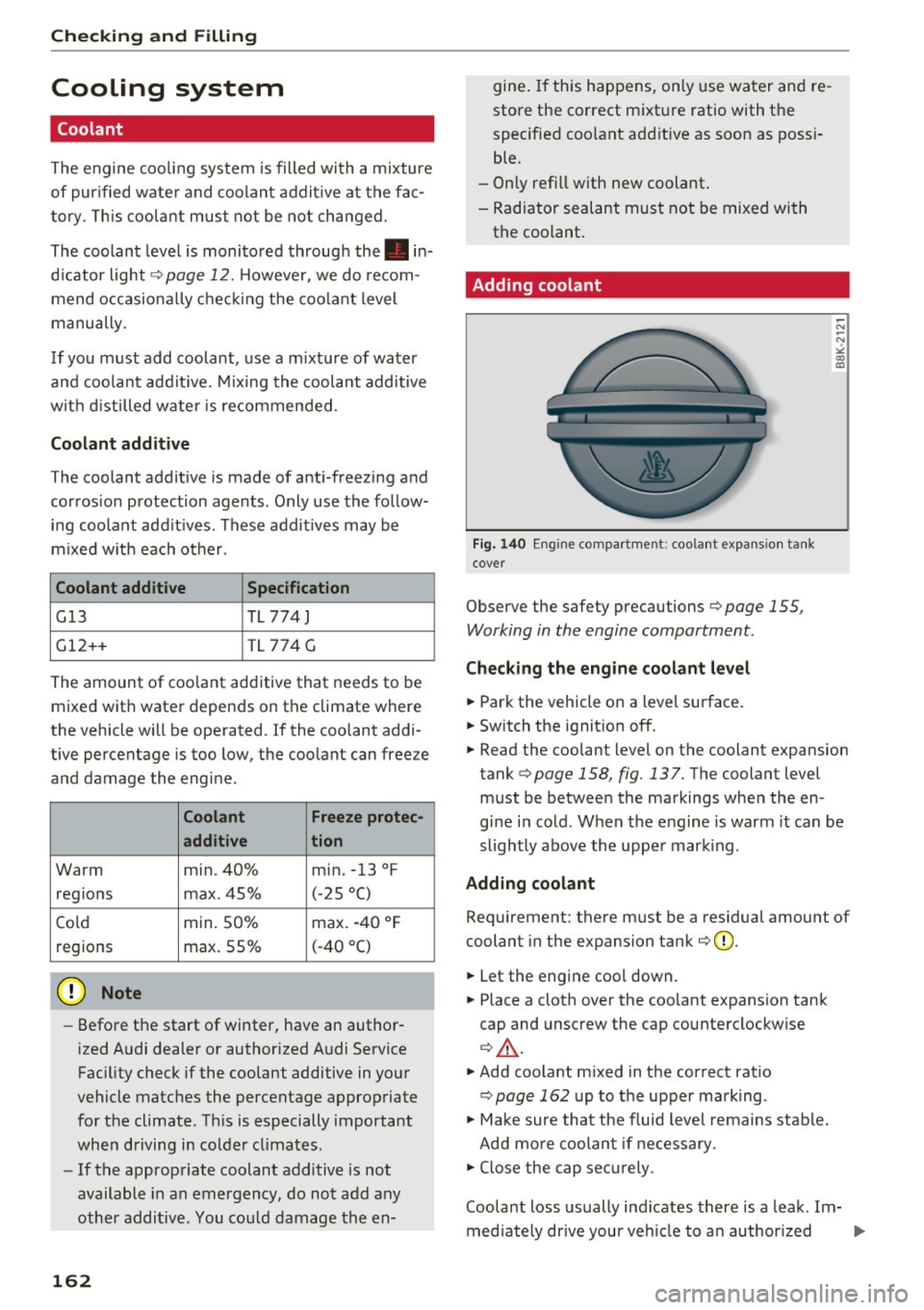
Adding coolant
Fig. 140 En gine co mpar tm ent: coo la nt expans io n ta nk
cove r
Observe the safety precautions¢ page 155,
Working in the engine compartment .
Checking the eng ine c oolant level
.,. Park the vehicle on a level surface .
.,. Sw itch the ignit ion off.
-"' -"' •
"" co a,
.,. Read the coolant level on the coolant expansion
tank ¢
page 158 , fig. 137. T he coolant leve l
must be betwee n the markings when the en
gi ne i n cold . When t he e ng ine is warm it can be
slightly above the uppe r mar king .
Adding coolant
Requirement: there must be a residual amount of
coolant in the expansion ta nk
¢ (D .
.,. Let the engine coo l down.
.,. Place a clot h over the coolant expansion tan k
cap and unscrew the cap counterclockw ise
¢ .&._ .
.,. Add coo lant m ixed in the cor rect rat io
c;, page 162 up to t he up per ma rk ing .
.,. Make sure that the fluid level remains stab le.
Add mo re coolan t if necess ary.
.,. Close the cap sec urely .
Coo lant loss usually ind icates there is a lea k. Im-
med iate ly dr ive you r ve hicl e to a n author ized .,.
Page 167 of 230
0 co ......
"' ,....
"' ...... 0 0 :::,
00
@ Tips
- Only charge the vehicle battery through the
connections in the engine compartment.
- Read all of the manufacturer's instructions
for the charger before charging the vehicle
battery.
Windshield washer system
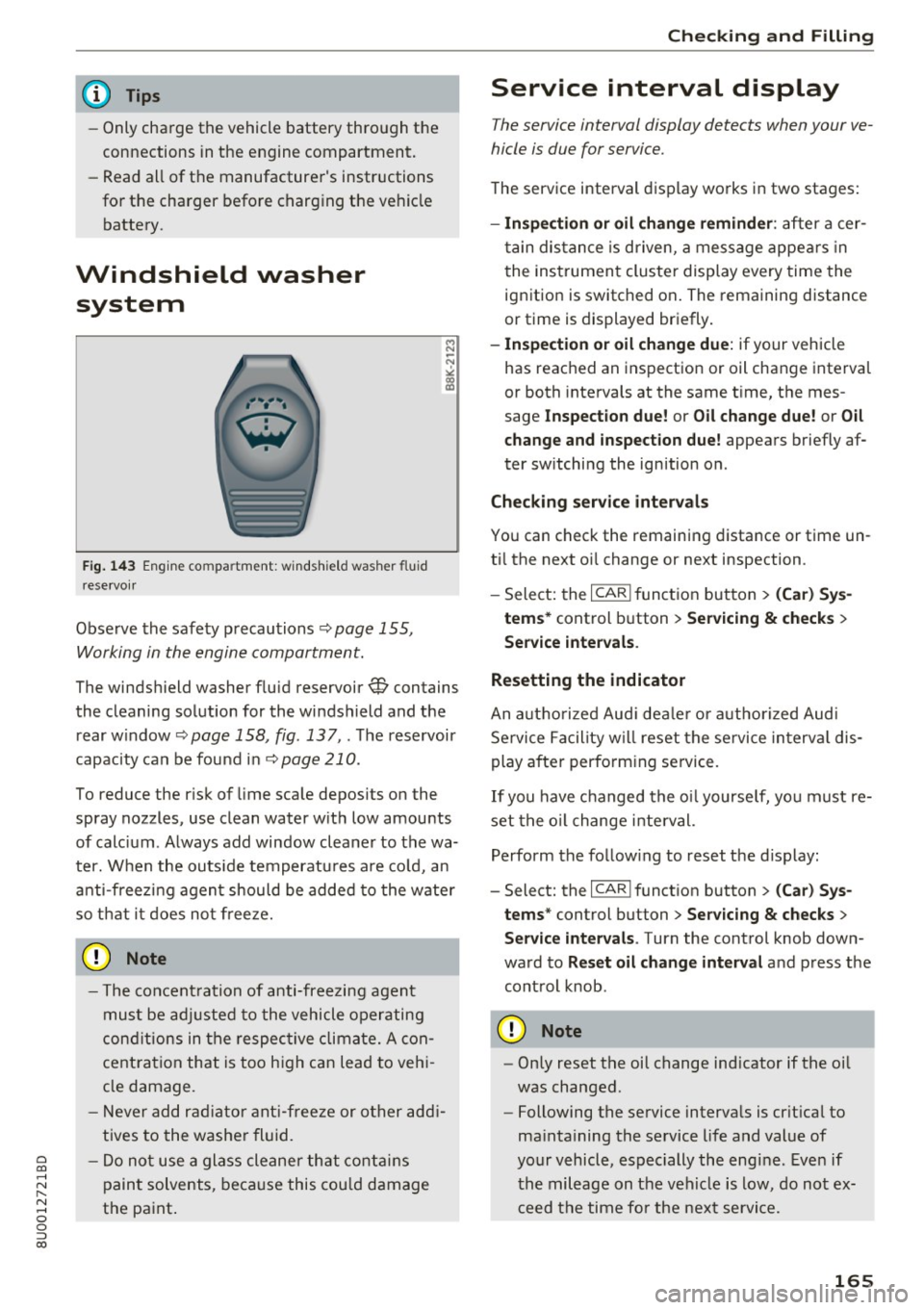
Fig. 143 Engine compartment: windshield washer fluid
reservoir
Observe the safety precautions q page 155,
Working in the engine compartment.
M N ~ N
"' a) ID
The windshield washer fluid reservoir W contains
the cleaning solution for the windshield and the rear w indow
q page 158, fig . 137,. The reservoir
capacity can be found in
qpage 210.
To reduce the risk of lime scale deposits on the
spray nozzles, use clean water with low amounts
of calc ium . Always add window cleaner to the wa
ter. When the outside temperatures a re cold, an
anti-freezing agent should be added to the water
so that it does not freeze.
- The concent ration of anti-freezing agent
must be adjusted to the vehicle operating
conditions in the respective climate. A con
cent ration that is too high can lead to vehi
cle damage.
- Never add radiator anti-freeze or other addi
tives to the washer fluid.
- Do not use a glass cleaner that contains
paint solvents, because this could damage
the paint .
Checking and Filling
Service interval display
The service interval display detects when your ve
hicle is due for service .
The service interval display works in two stages:
-Inspection or oil change reminder : after a cer-
tain distance is driven, a message appears in
t he instrument cluster display every time the
ignition is switched on. The remaining distance
or time is displayed br iefly.
- Inspection or oil change due: if your vehicle
has reached an inspection or oil change interval
or both intervals at the same time, the mes
sage
Inspection due! or Oil change due! or Oil
change and inspection due!
appears briefly af
ter sw itching the ignition on.
Checking service intervals
You can check the remaining distance or time un
ti l the next oi l change or next inspection .
- Select: the
I CARI function button > (Car) Sys
tems*
control button > Servicing & checks >
Service intervals .
Resetting the indicator
An autho rized Aud i dea ler or a uthorized Audi
Service Facility will reset the service in terva l dis
play after performing service .
If you have changed the o il yourself, you must re
set the oil change interval.
Perform the follow ing to reset the d isplay:
- Select: the
I CAR I function button > (Car) Sys
tems *
control button > Servicing & checks >
Service intervals . Turn the control knob down
ward to
Reset oil change interval and press the
control knob .
~ Note
-Only reset the oil change ind icator if the oil
was changed.
- Following the service intervals is crit ica l to
ma intaining the service life and value of
your vehicle, especially the engine . Even if
the mileage on the vehicle is low, do not ex
ceed the time for the next service.
165
Page 171 of 230
0 C0
-N
" N
-0 g a)
Glossary of tire and loading
terminology
Accessory weight
means the combined we ight (in
excess of those standard items
which may be replaced) of auto matic transmission, power steer
ing, power brakes, power win
dows, power seats, radio, and
heater, to the extent that these
items a re available as factory- in
stalled equipment (whether in
stalled or not) .
Aspect ratio
means the ratio of the height to
the width o f the tire in percent .
Numbers of 55 or lower indicate a
low s idewal l for improved steer
ing response and better overall
handling on dry pavement.
Bead
means the part of the t ire that is
made of steel wires, wrapped or
reinforced by ply cords and that is
shaped to fit the rim .
Bead separation
means a breakdown of the bond
between components in the bead .
Wheels
Cord
means the strands forming the
plies in the tire.
Cold tire inflation pressure
means the tir e pressure recom
mended by the vehicle manufac
tu rer for a tire of a designated
size that has not been driven for
more than a couple of m iles (k ilo
meters) at low speeds in the
three hour period before the t ire
pressure is measured or adjusted .
Curb weight
means the weight of a motor ve
hicle with standard equipment in
cluding the maximum capacity of
f u el, o il, and coolant, a ir cond i
tioning and additional weight of
optio nal eq uipment .
Extra load tire
means a tire designed to operate
at higher loads and at higher in
flat ion pressu res than the corre
sponding standard tire . Extra load
tires may be ident ified as "X L",
"xl", "EXTRA LOAD", or "RF" on
the sidewall. .,.
169
Page 175 of 230

0 C0
-N
" N
-0
0
::, a)
by the tire manufacturer. This in
formation is used to contact con
sumers if a tire defect requires a
recall.
Ve hicle capacity weight
means the rated cargo and lug
gage load plus 150 lbs. (68 k ilo
grams) times the vehicle's desig
nated seating capacity.
Vehicle ma ximum load on the
tire
means that load on an individual
tire that is determined by distrib
uting to each axle its share of the
maximum loaded vehicle weight
and dividing by two.
Vehicle normal load on the tire
means that load on an individual
tire that is determined by distrib
uting to each axle its share of the
curb weight, accessory weight,
and normal occupant weight (dis
tributed in accordance with¢
ta
ble on page
178) and dividing by
two.
Occupant loading and distr i
bution for vehicle normal load
for various design ated seating
capacities
Refer to the tire inflation pres
sure label¢
page 176, fig. 147
Wheels
for the number of seating posi
tions . Refer to the table ¢
table
on page
178 for the number of
people that correspond to the ve
hicle normal load.
New tires or wheels
Audi recommends having all work
on tires or wheels performed by an authorized Audi dealer or au
thorized Audi Service Facility.
These facilities have the proper
knowledge and are equipped with
the required tools and replace ment parts.
.,,. New tires do not yet have the
optimum gripp ing properties .
Drive carefully and at moderate
speeds for the first 350 miles (500 km) with new tires.
.,,. Only use tires with the same de
sign, size (rolling circumference)
and as close to the same tread
pattern as possible on all four
wheels.
.,,. Do not replace tires individually .
At least replace both tires on the
same axle at the same time.
.,,. Audi recommends that you use
Audi Original Tires . If you would
like to use different tires, please note that the tires may perform ...
173
Page 184 of 230
Wheels
with them. Remove the wheel covers" first.
Use coated snow chains.
Low-profile tires
App lies to: veh icles with low-profile tires
Your vehicle is equipped with low-profile tires* at
t he factory . Compared to other tire/rim combina
ti ons, low-profile tires offer a wider tread sur face
and a larger rim diameter with shorter tire side
walls . This results in an agile driving style . How
ever, it may reduce the level of comfort and in
crease road noise when dr iv ing on roads in poor
condition .
Low-profile tires can become damaged more
qu ickly than standard t ires when driving over
large b umps, potholes, manhole covers, speed
bumps and curbs. Therefore, it is part icu lar ly im
portant to maintain the cor rect tire pressure
¢page 176.
To reduce the r isk of damage to the tires and
rims, drive very carefully on poor roads.
Check your wheels regularly every 2,000 mi (3 ,000 km) for damage. For example , check for
bu lges/cracks on the tir es or deformations/
cracks on the r ims.
After a heavy impact or damage, have the tires
and rims inspected or replaced immediate ly by
an author ized Audi dealer or author ized A udi
Serv ice Facility .
Low-profile tires can wear out faster than stand
ard tires.
Summer tires are not suitable for cold weather,
snow or black ice . If you are driving in these con
d itions, use winter or all season t ires
¢ page 181.
Uniform tire quality grading
-Tread wear
- T raction AA A B C
- Temperature ABC
Qua lity grades can be found where applicab le on
the tire side wall between tre ad shoulder and
maximum section width
¢ page 16 7, fig . 144 .
182
For example: Tread wear 200 , Traction AA, Tem
perature
A .
All passenger car tir es must conform to Federal
Safety Requirements in addit ion to these grades .
Tread wear
The tread wear grade is a comparative rating
based on the wear rate of the tire when tested
under controlled conditions on a specified gov
ernment test course.
For example, a tire graded 150 would wear one
and one half (1 1/2) times as well on the govern
ment course as a tir e graded 100 .
T he relative performance of tires depends upon
the actual cond itions of their use, however, and
may depart sign ificantly from the norm due to
variations in driv ing habits, service practices and
differences in road characteristics and climate.
Traction
The traction grades , from highest to lowest, are
AA , A, Band
C. Those grades represent the tire's
ability to stop on wet pavement as measured un
der controlled conditions on specified govern
ment test surfaces of asphalt and concrete. A tire
marked C may have poor traction performance
¢_& .
Temperature
The temperature grades are A (the highest), B,
and C , representing the tire's resistance to the
generat ion of heat and its ability to dissipate
heat when tested under controlled conditions on
a spec ified indoor laboratory test wheel.
Sustained high temperature can cause the mate
rial of the tire to degenerate and reduce tire life ,
and excessive temperature can lead to sudden
tire failure ¢.& .
The grade C corresponds to a level of perform
ance which all passenger car tires must meet un
der the Federal Motor Vehicle Safety Standard
No. 109. Grades Band A represent higher levels
of performance on the laboratory test wheel than
the minimum required by law .
ll>