seat adjustment AUDI Q5 2013 User Guide
[x] Cancel search | Manufacturer: AUDI, Model Year: 2013, Model line: Q5, Model: AUDI Q5 2013Pages: 316, PDF Size: 78.89 MB
Page 181 of 316
-Always install rear-facing child safety
seats on the rear seat.
- If you must install a rearward facing
child safety seat on the front passenger
seat in exceptional circumstances and
the
PASSENGER AIR BAG OFF light does
not come on and stay on, immediately
install the rear-facing child safety seat in
a rear seating position and have the air
bag system inspected immediately by
your Audi dealer.
_& WARNING
If, in exceptional circumstances, you must
install a forward-facing child restraint on
the front passenger's seat:
- Always make sure the forward-facing
seat has been designed and certified by its manufacturer for use on a front seat
with a passenger front and side airbag.
- Always follow the manufacturer's in
structions provided with the child safety
seat or carrier.
- Always move the passenger seat into its
rearmost position in the seat's fore and
aft adjustment range, as far away from
the airbag as possible before installing
the child restraint. The backrest must be
adjusted to an upright position .
- Always make sure that the
PASSENGER
AIR BAG OFF
light comes on and stays
on all the time whenever the ignition is
switched on.
(D Tips
Always replace child restraints that were
installed in a vehicle during a crash. Dam
age to a child restraint that is not visible
could cause it to fail in another collision
situation.
Advanced front airbag system and children
Your vehicle is equipped with a front "Ad
vanced Airbag System" in compliance with United States Federal Motor Vehicle Safety
Child Safety 1 79
Standard (FMVSS) 208 as applicable at the
time your vehicle was manufactured.
The Advanced Airbag system in your vehicle
has been certified to meet the "low-risk" re
quirements for 3- and 6-year old children on
the passenger side and small adults on the driver side. The low risk deployment criteria
are intended to reduce the risk of injury
through interaction with the airbag that can
occur, for example, by being too close to the
steering wheel and instrument panel when
the airbag inflates . In addition, the system
has been certified to comply with the "sup
pression" requirements of the Safety Stand
ard, to turn off the front airbag for infants up
to 12 months who are restrained on the front
passenger seat in child restraints that are list
ed in the Standard.
Even though your vehicle is equipped with an
Advanced Airbag system, all children, espe cially those 12 years and younger, should al
ways ride in the back seat properly restrained
for their age and size. The airbag on the pas
senger side makes the front seat a potentially dangerous place for a child to ride . The front
seat is not the safest place for a child in a for
ward-facing child safety seat. It can be a very
dangerous place for an infant or a larger child
in a rearward-facing seat .
Advanced Airbags and the weight
sensing mat in the front seat
The Advanced Airbag System in your vehicle
detects the presence of an infant or child in a
child restraint on the front passenger seat us
ing the weight -sensing mat in the seat cush
ion and the sensor below the safety belt latch
on the front passenger seat that measures the
tension on the safety belt.
The weight -sensing mat measures total
weight of the child and the child safety seat
and a child blanket on the front passenger seat. The weight on the front passenger seat
is related to the design of the child restraint
and its "footprint", the size and shape of the
bottom of the child restraint as it sits on the ..,.
•
•
Page 184 of 316
182 Child Safety
&_ WARNING
Not using a child safety seat, using the
wrong child safety seat or improperly in
stalling a child restraint increases the risk
of serious personal injury and death .
-All vehicle occupants and especially chil
dren must always be restrained properly
whenever riding in a vehicle.
-
- An unrestrained or improperly restrain
ed child can be injured or killed by be
ing thrown against the inside of the ve
hicle or by being ejected from it during
a sudden maneuver or impact .
- An unrestrained or improperly restrain
ed child is at much greater risk of injury
or death by being struck by an inflating
airbag.
- Commercially available child safety seats
are required to comply with U.S. Federal
Motor Vehicle Safety Standard (FMVSS)
213 (in Canada CMVSS 213).
- When buying a child restraint, select
one that fits your child and the vehicle.
- Only use child restraint systems that
fully contact the flat portion of the
seat cushion. The child restraint must not tip or lean to either side. Audi does
not recommend using child safety
seats that rest on legs or tube -like
frames . They do not provide adequate
contact with the seat.
-Always heed all legal requirements per
taining to the installation and use of
child safety seats and carefully follow
the instructions provided by the manu
facturer of the seat you are using.
- Never allow children under 57 inches
(1.45 meters) to wear a normal safety
belt. They must always be restrained by a
proper child restraint system. Otherwise,
they could sustain injuries to the abdo
men and neck areas during sudden brak
ing maneuvers or accidents.
- Never let more than one child occupy a
child safety seat . -
Never let babies or older children ride in
a vehicle while sitting on the lap of an
other passenger .
- Holding a child in your arms is never a
substitute for a child restraint system.
- The strongest person could not hold
the child with the forces that exist in
an accident. The child will strike the in
terior of the vehicle and can also be
struck by the passenger.
- The child and the passenger can also
injure each other in an accident.
- Never install rear-facing child safety
seats or infant carriers on the front pas
senger seat. A child will be seriously in
jured and can be killed when the passen
ger airbag inflates -even with an Ad
vanced Airbag System .
- The inflating airbag will hit the child
safety seat or infant carrier with great
force and will smash the child safety seat
and child against the backrest, center
armrest, door or roof.
-Always install rear-facing child safety
seats or infant carriers on the rear seat .
- Forward-facing child safety seats instal
led on the front passenger's seat can in
terfere with the airbag when it inflates
and cause serious injury to the child. Al
ways install forward-facing child safety
seats on the rear seat.
- If exceptional circumstances require the
use of a forward-facing child restraint on
the front passenger's seat, the child's
safety and well-being require that the
following special precautions be taken :
- Make sure the forward-facing seat has
been designed and certified by its man
ufacturer for use on a front seat with a
passenger front and side airbag.
-Always carefully follow the manufac
turer's instructions provided with the child safety seat or carrier.
- Always move the front passenger seat
into the rearmost position of the pas
senger seat's fore and aft adjustment range, and as far away from the airbag
Page 185 of 316
as possible before installing the child
restraint.
- Always make sure that nothing pre
vents the front passenger's seat from
be ing moved to the rearmost position
in its fore and aft adjustment range.
- Always make sure that the backrest is
in the upr ight position.
- Always buck le the child safety seat firmly
in place even if a child is not sitting in it.
A loose ch ild safety seat can fly around
dur ing a sudden stop or in a col lision .
- Always read and heed all WARNINGS
whenever using a child restrained in ave
hicle is being used
c::> page 149, Safety
belts,
c::> page 157, Airbag system and
c::> page 178, Child Safety.
A WARNING
T o reduce t he ris k of serious injury, make
sure that the
PASSENGER AIR BAG OFF
light comes on and stays on whenever a
child rest raint is installed on the front pas
senger seat and the ignition is switc hed
on.
- Take the child restraint off t he fro nt pas
senger seat and install it properly at one
of the rear seat positions if the
PASSEN ·
GER AIR BAG OFF
light does not stay on.
- Have the airbag system inspected by
your authorized Aud i dealer immediate
ly.
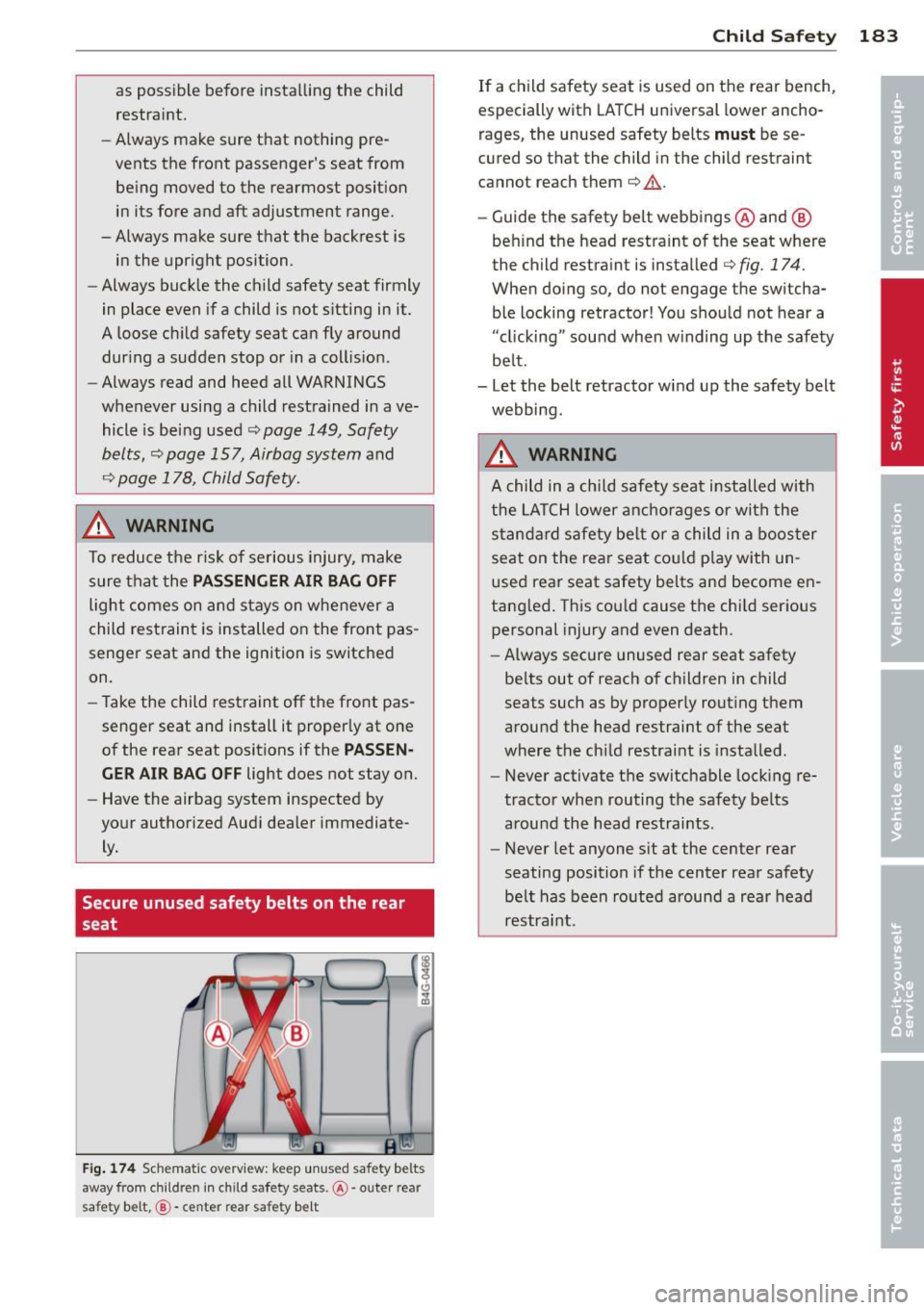
Secure unused safety belts on the rear
seat
F ig. 174 Schematic overv iew: keep un used safety belts
away from children in child safety seats.@-oute r rear
safety belt,
@ -center rear safety belt
Child S afety 183
If a child safety seat is used on the rea r bench,
especially with LATCH universal lower ancho
rages, the unused safety belts
must be se
cured so that the child in the child restraint
cannot reach them
c::> &.
-Guide the safety belt webbings @and @
beh ind the head restraint of the seat where
the child restra int is insta lled
c::> fig. 174.
When doing so, do not engage the switcha
ble locking retractor! You should not hear a
"cl icking" sound when w inding up the safety
be lt .
- Let the belt retractor wind up the safety belt
webbing.
A WARNING
A child in a chi ld safety seat i nstalled with
the LA TCH lower ancho rages or with the
standard s afety be lt or a child in a boos ter
seat on the rea r seat co uld p lay with un
use d rea r seat safety belts and become en
tang led . This could cause t he chi ld ser ious
personal injury and even death.
- Always secure unused rear seat safety
be lts out of reach of children in child
seats such as by proper ly rout ing them
around the head restrai nt of the seat
where the ch ild restraint is installed.
- Never activate t he switchable l ock ing re
tracto r when routing the safety be lts
around the head restraints.
- Never let anyone s it at the center rear
seating position if the center rea r safety
be lt has been routed around a rear head
restraint.
Page 188 of 316
186 Child Safety
to the backrest on the vehicle seat. Ad
just or remove the rear seat head restraint if it is difficult to install the
child seat with the head restraint in place
<=> page 65 . Install the head restraint
again immediately once the child seat is
removed. Driving without head restraints
or with head restraints that are not prop
erly adjusted increases the risk of serious
or fatal neck injury dramatically.
- Always read and heed all WARNINGS
whenever using a child restrained in ave
hicle is being used
<=> page 149, Safety
belts,¢ page 157, Airbag system
and
i=> page 178, Important things to know.
A WARNING
If exceptional circumstances require the
use of a forward-facing child restraint on
the front passenger's seat, the child's safe
ty and well-being require that the follow
ing special precautions be taken:
- Make sure the forward-facing seat has been designed and certified by its manu
facturer for use on a front seat with a passenger front and side airbag.
-Always follow the manufacturer's in
structions provided with the child safety
seat or infant carrier.
- Always move the front passenger seat in
to the rearmost position of the passen
ger seat's fore and aft adjustment range,
and as far away from the airbag as possi
ble before installing the child restraint.
- Always make sure that nothing prevents
the front passenger's seat from being
moved to the rearmost position in its
fore and aft adjustment range.
- Always make sure the backrest is in an
upright position.
- Make sure that the
PASSENGER AIR BAG
OFF
light comes on and stays on all the
time whenever the ignition is switched
on.
- If the light does not stay on, perform the
checks
¢ page 168, Monitoring the Ad
vanced Airbag System.
-
- Take the child restraint off the front pas
senger seat and install it properly at one
of the rear seat positions if the
PASSEN
GER AIR BAG OFF
light does not stay on
whenever the ignition is switched on.
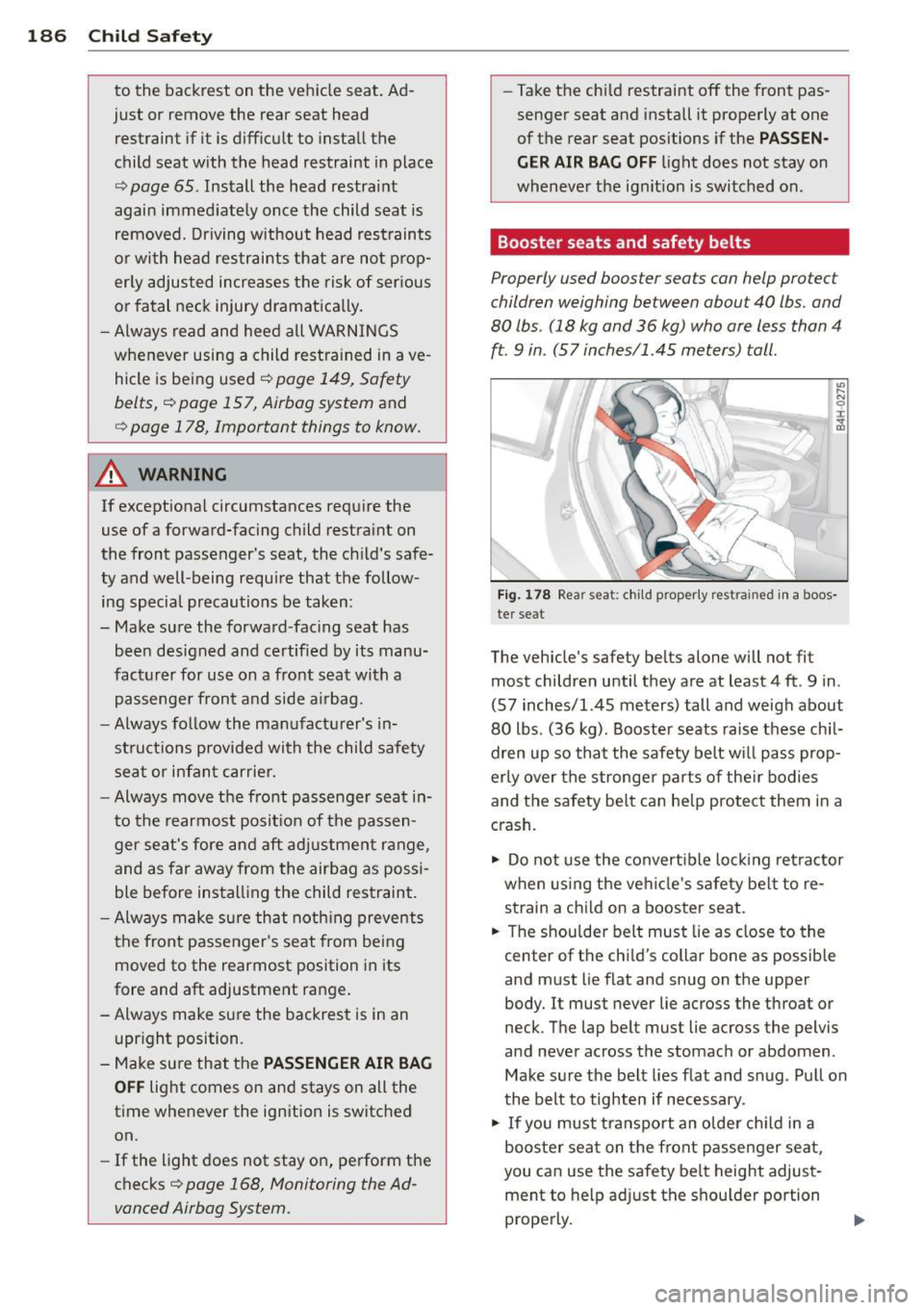
Booster seats and safety belts
Properly used booster seats can help protect
children weighing between about 40 lbs. and
80 lbs. (18 kg and 36 kg) who are less than 4
ft. 9 in . (57 inches/1 .45 meters) tall .
"' ....
"' 0 ±
o5
Fig. 178 Rear seat: ch ild properly rest rai ned in a boos
te r seat
The vehicle 's safety belts alone will not fit
most children until they are at least 4 ft . 9 in .
(57 inches/1.45 meters) tall and weigh about
80 lbs. (36 kg). Booster seats raise these chil
dren up so that the safety belt wil l pass prop
erly over the stronger parts of their bodies
and the safety belt can he lp protect them in a
crash.
"' Do not use the convertible locking retractor
when using the vehicle's safety belt to re
strain a child on a booster seat.
"' The shoulder belt must lie as close to the
center of the child's collar bone as possible
and must lie flat and snug on the upper
body. It must never lie across the throat or
neck . The lap belt must lie across the pelvis
and never across the stomach or abdomen .
Make sure the belt lies flat and snug . Pull on
the belt to tighten if necessary .
"' If you must transport an older child in a
booster seat on the front passenger seat,
you can use the safety belt height adjust
ment to help adjust the shoulder portion
properly.
Page 191 of 316
and child against the backrest, center
armrest, door or roof.
- Always install rear-facing child safety
seats or infant carriers on the rear seat.
- Forward-facing child safety seats or in
fant carriers installed on the front pas
senger's seat may interfere with the de
ployment of the airbag and cause serious
injury to the child.
- It is safer to install a forward-facing
child safety seat on the rear seat.
- Always read and heed all WARNINGS whenever using a child restrained in ave
hicle is being used¢
page 178. Special
precautions apply when installing a child
safety seat on the front passenger seat
¢ page 158, Child restraints on the front
seat -some important things to know.
A WARNING
Always take special precautions if you
must install a forward or rearward-facing
child restraint on the front passenger's
seat in exceptional situations:
-Whenever a forward or rearward-facing
child restraint is installed on the front
passenger seat, the
PASSENGER AIR
BAG OFF
light must come on and stay on
whenever the ignition is switched on.
- If the
PASSENGER AIR BAG OFF light
does not come on and stay on, perform
the checks described ¢
page 168, Moni
toring the Advanced Airbag System.
- Take the child restraint off the front pas
senger seat and install it properly at one
of the rear seat positions if the
PASSEN
GER AIR BAG OFF
light does not stay on
whenever the ignition is switched on.
- Improper installation of child restraints
can reduce their effectiveness or even
prevent them from providing any protec
tion.
- An improperly installed child restraint
can interfere with the airbag as it de
ploys and seriously injure or even kill the
child.
Child Safety 189
- Always carefully follow the manufactur
er's instructions provided with the child
safety seat or carrier.
- Never place additional items on the seat
that can increase the total weight regis
tered by the weight-sensing mat and can
cause injury in a crash.
A WARNING
Forward-facing child restraints:
- Always make sure the forward-facing
seat has been designed and certified by its manufacturer for use on a front seat
with a passenger front and side airbag.
- Never put the forward-facing child re straint up, against or very near the in
strument panel.
- Always move the passenger seat into its rearmost position in the seat's fore and
aft adjustment range, as far away from
the airbag as possible before installing
the forward-facing child restraint. The
backrest must be adjusted to an upright
position.
- Make sure that the PASSENGER AIR BAG
OFF
light comes on and stays on all the
time whenever the ignition is switched
on.
A WARNING
Rearward-facing child restraints:
- A child in a rearward-facing child safety
seat installed on the front passenger
seat will be seriously injured and can be killed if the front airbag inflates -even
with an Advanced Airbag System.
- The inflating airbag will hit the child
safety seat or infant carrier with great
force and will smash the child safety seat
and child against the backrest, center
armrest, door or roof.
-Always be especially careful if you must
install a rearward facing child safety seat
on the front passenger seat in exception-
al circumstances. .,.
•
•
Page 205 of 316
will have no warning from a sudden in
crease in engine speed as with a front
wheel drive vehicle. A lways drive at
speeds wh ic h are suited to the road con
ditions -risk of crash .
Energy management
Starting ability is optimized
Energy management controls the distribution
of electrical energy and thus optimizes the
availability of electrical energy for starting
the engine.
If a vehicle with a conventional energy system
i s not driven for a long pe riod o f time, the bat
tery is discharged by idling current consumers
(e .g. immobilizer) . In certain circumstances it
can result in there being insufficient energy
avai lab le to start the engine.
I ntelligen t energy management in your vehi
cle hand les the distribution of electrical ener
gy . Starting ability is marked ly improved and
the life of the battery is extended .
Basically, energy management consists o f
batter y diagno sis, idling cur rent man age
m ent
and dyn amic en e rg y m anagement.
Battery diagnosis
B attery d iagnosis continuously dete rmines
the state of the battery. Sensors determ ine
battery vo ltage, battery current and battery
temperature. This determines the current
state of charge and the power of the battery.
Idling curr ent management
Idling current management redu ces energy
consumption while the vehicle is stand ing.
With the ignition switched off, it contro ls the
energy supply to the various electrica l compo
nents . Data from battery diagnosis is consid
ered.
Depending on the battery's state of charge,
individual consumers are grad ually turned off
to prevent excessive discharge of the battery
and thus mainta in start ing capability.
Int ellig ent technolog y 203
Dynamic energy management
While the vehi cle is being driven, dynamic en
ergy management distrib utes the energy gen
erated according to the needs of the individ u
al components. It regulates consumption, so
that more e lectrical energy is not being used
than is being generated and ensures an opti
mal state of charge fo r the battery .
{!) Tips
- But even energy management cannot
negate the limits of physics. Consider
that the power and life of a battery are
limited .
- If start ing ability is threatened, the indi
cator light(•] appears ¢
page 34.
What you should know
The highest priority is given to maintaining
starting capability.
The battery is severe ly taxed in short -distance
driv ing, in city traff ic and during the cold time
of year. Abundant electrical energy is re
quired, but on ly a little is generated . It is also
c rit ical if the engine is not running and electri
ca l components are turned on . In this in
stance ene rgy is be ing consumed but none is
being genera ted .
It is in precisely these situations t hat you will
notice ene rgy management active ly regu lat
i ng the d istribu tion of ene rgy.
Vehicle stands for an extended period
If you do not drive your vehicle over a period
of several days or weeks, electr ical compo
nents are gradually cut back or switched off .
T h is reduces energy consumption and ma in
ta ins start ing capability over a longer pe riod .
Some of the convenience functions may not
operate, such as the interior ligh ts or the
power seat adjustment. The convenience
functions wi ll be available again when you
switch on the ignition and start the engine.
•
•
Page 246 of 316
244 Checking and filling
Vehicles not driven for long periods
If you do not drive you r vehicle over a pe riod
of severa l days or weeks, electrical compo
nents are gradually cut back or switched off.
This reduces energy consumption and main
tains starting capability over a longer period
¢page 203.
Take into consideration that when yo u un lock
your vehicle, some convenience functions, such as the interior lights or the power seat
adjustment, may not be available. The con
venience funct ions w ill be available again
when you turn on the ignition and start the
engine .
Winter operation
During the winter months, battery capacity
tends to decrease as temperatures drop . This
is because more power is also consumed while
start ing, and the headl ights, rear window de
fogger, etc., are used more often .
Avoid unnecessary power consumption, par
ticularly in city traffic or when traveling only
short distances . Let your authorized Audi
dealer check the capacity of the vehicle bat
tery before winter sets in¢
page 245. A well
cha rged battery w ill not only prevent starting
prob lems when the weather is cold , but will
a lso last longer .
Working on the battery
Be especially careful when working on or near
the battery.
The battery is located in the luggage compart
ment under the floor. Before you check any
thing in the luggage compartment,
read and
heed all WARNINGS
¢ _&..
Hybr id drive*: you can find impo rtant informa
tion about the high voltage battery under
¢page 97 .
Always heed the safety warnings , when work
ing on the vehicle battery or the vehicle elec
trical system to prevent injury.
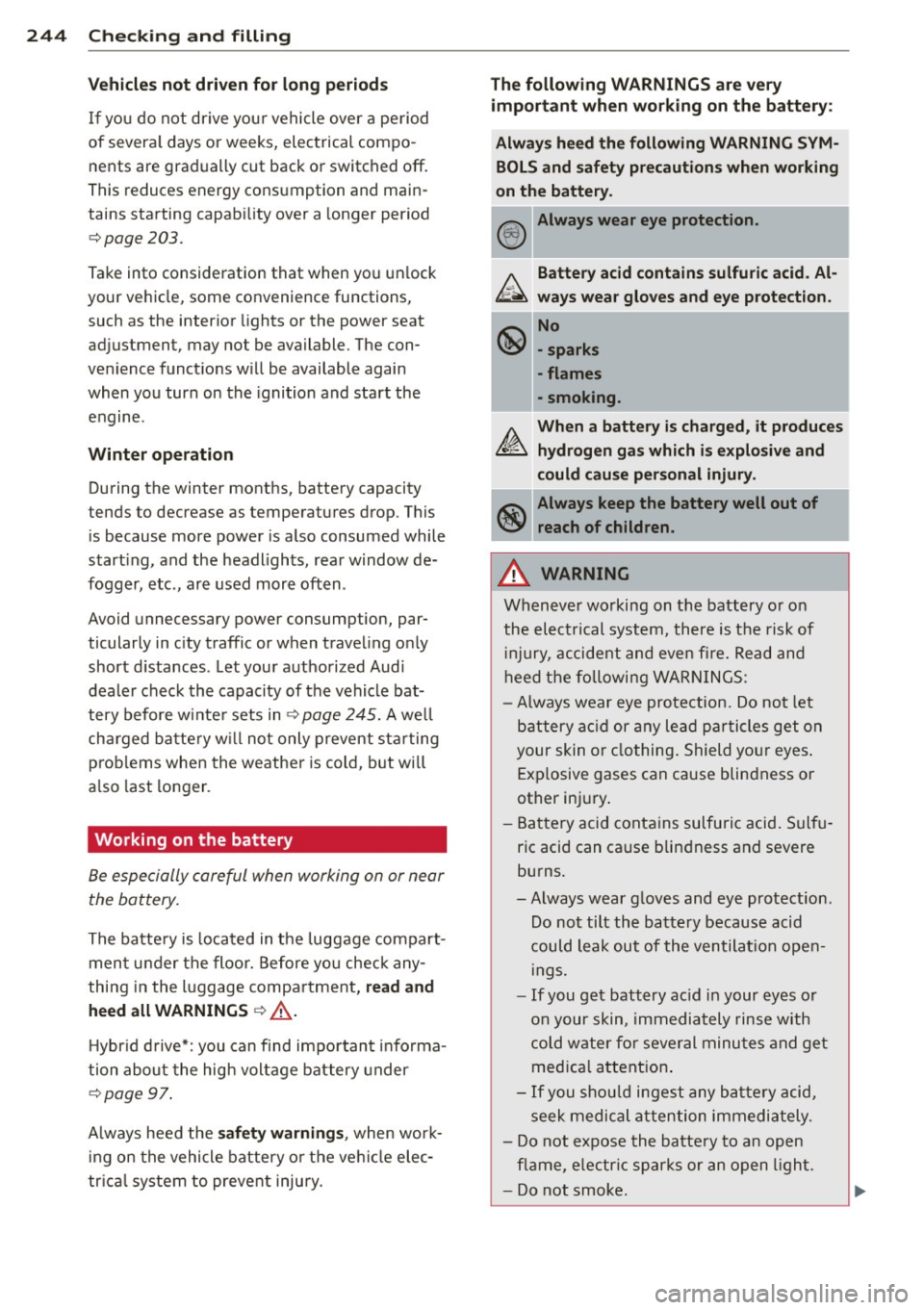
The following WARNINGS are very
important when working on the battery:
Always heed the following WARNING SYM BOLS and safety precaution s when working
on the battery.
@) Always wear eye protection .
I>. Battery acid contains sulfuric acid_-Al
~ ways wear gloves and eye protection.
~ No
\!=51 -sparks
-flames
-smoking.
A When a battery is charged, it produces
~ hydrogen gas which is explosive and
could cause personal injury.
/G Always keep the battery well out of
V!!JI reach of children.
A WARNING "--
Whenever working on the battery or on
the electrical system, there is the risk of
in jury, accident and even fi re. Read and
heed the following WARNINGS :
- Always wear eye protection. Do not let
battery ac id or any lead particles get on
your skin or clothing. Shield your eyes .
Exp losive gases can cause blindness or
other injury .
- Ba ttery acid contains sulfuric acid. Sulfu
ric acid can ca use blindness and severe
burns .
- Always wear gloves and eye protection .
Do not tilt the battery because acid
could leak out of the ventilat ion open
i ngs.
- If you get battery ac id in your eyes or
on your skin, immediately rinse with
cold water fo r several minutes and get
med ical attention .
-If you should ingest any battery acid,
seek medical attention immediately.
- Do not expose the battery to an open
flame, electr ic sparks or an open light.
- Do not smoke.
-
1
I
Page 305 of 316
Index 303
-----------------------------------.......
Cruise control
Changing speed .. ..... ... .. .. .. .... 95
Prese lect speed . . . . . . . . . . . . . . . . . . . . 96
Sw itching off ..... ....... .... .. .... 96
Sw itching on ............. .... .. .... 95
Warn ing/ indicator lights ........ .... . 17
Cruising range . . . . . . . . . . . . . . . . . . . . . . . 23
(upholde rs . . . . . . . . . . . . . . . . . . . . . 73, 74
H ea ted and cooled ........ .. .. .. .. .. 74
D
Data ....... ... ................ .... 292
Data recorde r ............. .... .. ... 197
D ate display . .... ......... .... .. .. .. 12
Daytime running lights ........... .... . SO
Declaration of compliance Adapt ive cr uise control .... .. .. .. .. . 298
Aud i side assist .......... .. .. .. .. . 298
Cell phone package ....... .. .. .. .. . 298
Conve nience key ............. .... .. 298
E lect ronic immobilize r ..... .. .. .. .. . 298
H omelink ® universal remote contro l .. 298
Remote control key ....... .. .. .. .. . 298
Defective light bulb warning . .. .. .. .. .. 33
D efrosting (w indows) .... ... .. .. .. .. .. 81
Determin ing cor rect load limit ... ... .. 257
Dig ita l clock . .. ........... .. .. .. .... 12
D ig it al compass ........... .. .. .. .. .. 59
Dig ita l speedometer ............ ... ... 21
Dimensions .. .. ... ..... ... .. .. .. ... 291
D immi ng the rearview mir ro r . . . . . . . . . . 58
Doors Chi ld safety locks .. ....... .. .. .. .. .. 46
Emergency locking ............. .... . 42
Driver information system . . . . . . . . . . . . . 20
Defective light bulb warning .. .. .. .. .. 33
Dig ita l speedometer ...... .. .. .. .. .. 21
Driver information messages . .. .. .. .. 27
Indicator lights . . . . . . . . . . . . . . . . . . . . 99
M essages .. .. ..... ...... .. .. .. .. .. 99
Open doo r o r r ear lid warning . . . . . . . . . 2 1
Outside tempera ture display .. .. .. .. .. 2 1
Sound system display . . . . . . . . . . . . . . . 20
Dr iver seat
refer to Seat ing pos ition ....... ... .. 14 0 Driver
's seat memory
Activating remote contro l key . . . . . . . . . 64
D rive select . .. .. .. ................. 120
Adaptive dampers .... ......... .. .. 1 20
D ynam ic steer ing . ............. .... 12 0
Setting the dr iv ing mode ..... ... .. .. 121
D rivi ng lights ..... .. ................ 49
Driving messages . . . . . . . . . . . . . . . . . . . . 27
Drivi ng offroad
D riving through wate r ....... ... .. .. 210
Driving tips . ..... .. . .. .. ..... ... .. 209
Ru les of behavior ... . .. ..... ... .. .. 209
Sand and mud . .. ................. 210
Snow-covered gro und . ............. 210
Un paved roads . .. ............. .. .. 210
D riving safely ..... ... .. .. ..... ... .. 139
Driving through wate r .............. . 210
Driving time .. .. .. ... ............ .. . 23
D uplicate key . .. .. ................. . 36
Dynam ic steering . . . . . . . . . . . . . . 120, 197
Ind icator light ... .. .......... .... . 201
E
E85 (Fuel) .. .. .. .. ... ... ...... ..... 229
Efficiency program .... .. .. ..... ... .. . 25
Fuel economy messages ..... ... .. .. . 25
Memory levels . . . . . . . . . . . . . . . . . . . . . 23
Other equipment . ................. . 25
El ectrical accessories
refer to Soc ket ... .. . ... ...... ... .. . 75
E lectrica l seat ad justment
refer to Seat adjustment ........ .. .. . 62
E lectromechanical parking brake
Emergency brak ing .. .. .... .... .. .. . 90
Malfunction ..... .. ..... ........... 91
Operation . . . . . . . . . . . . . . . . . . . . . . . . . 88
Pa rking ... .. .. .. .. .. ........... .. . 89
Re le as ing and closing .......... .. .. . 88
Star ting ass ist ... .. . .. ... .... ... .. . 90
Star ting from res t .. . ... ...... ... .. . 90
Starting off w ith a t railer ..... ... .. .. . 90
Warning/ind icator lights .......... .. . 18
El ec tromech anic al powe r as sis t .... .. .. 201
In dicator lig ht . .. ............. .. .. 201
E lectronic differential lock ( EDL) ...... . 197
Warning/ind icator lights .. .. ... ... .. . 17
•
•
Page 311 of 316
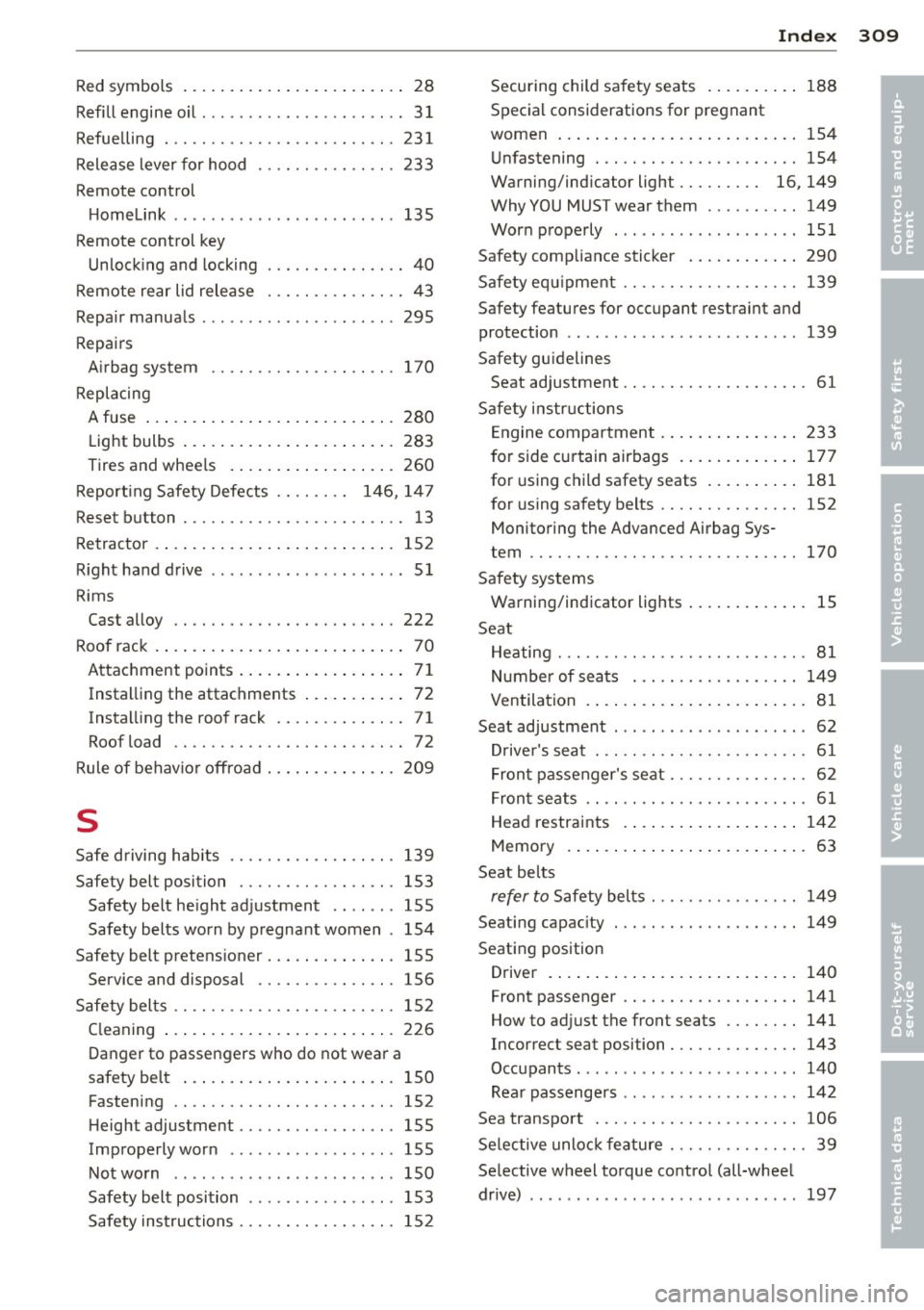
-----------------------------~I~ n~ d~ e~x 309
Red symbols . . . . . . . . . . . . . . . . . . . . . . . . 28
Refill engine oil ...................... 31
Refuelling . .. ............. .... .. .. . 231
Release lever for hood ............... 233
Remote control
H omelink ...................... .. 135
Remote control key
Unlock ing and locking ............... 40
Remote rear lid release ... .. .. .. .. .. 43
Repair manuals ................... .. 295
Repairs Airbag system
Replacing A fuse
... .. .. .... .. .... ... .. .. ...
Light bulbs ... ... ..... ... .. .. .. .. . 170
280
283
Tires and whee ls . ..... ... .. .. .. .. . 260
Report ing Safety Defects . . . . . . . . 146, 1 47
Reset button . ............. .... .. .... 13
Retractor
' . .. .... ...... ... .. .. .. .. .
Right hand d rive
Rims Cast alloy 1
5 2
5 1
222
Roof rack .... .... ...... ... .. .. .. .... 70
Attac hment points ..... ... .. .. .. .. .. 71
Instal ling the attachments ... .. .. .. .. 72
Instal ling the roof rack .............. 71
Roof load .. ............. .... .. .... 72
Rule of behavior offroad .. ... .. .. .. .. . 209
s
Safe d riving hab its .................. 139
Safety belt position . . . . . . . . . . . . . . . . . 153
Safety belt he ight adjustment ....... 155
Safety belts worn by pregnant women . 154
Safety belt pretensioner . . . . . . . . . . . . . . 155
Service and disposal ............... 156
Safety belts .. ............. .... .. .. . 152
C leaning ... .. .... .... ... .. .. .. ... 226
Danger to passengers who do not wear a
safety belt . . . . . . . . . . . . . . . . . . . . . . . 150
Fastening .. ............. .... .. ... 152
H eight adjustment .......... .. .. .. . 155
Improperly worn ... ..... ... .. .. .. . 155
Not wo rn ........................ 150
Safety belt position . . . . . . . . . . . . . . . . 153
S afety instructions ........ .. .. .. .. . 152 Securing child safety seats . . .
. . . . . . . 188
Specia l considerations for pregnant
women ... .. .. .. .. . .. ... .... ... .. 154
Unfastening . .. .. ................. 154
Warning/ind icator light . . . . . . . . . 16, 149
Why YOU MUST wear them .......... 149
Wor n properly ... .. . .. .. ..... ... .. 151
Safety compliance sticker ..... ... .. .. 290
Safety eq uipment ...... ............. 139
Safety features for occupant restraint and
protection ......................... 139
Safety gu idelines
Seat adjustment .. .................. 61
Safe ty i nstr uct ions
E ngine compartment . ... .... ... .. .. 233
f or side c urtain airbags . ..... ... .. .. 177
for using child safety seats ... ... .. .. 181
for using safety belts ............... 152
Monitoring the Advanced Airbag Sys-
tem ............................. 170
Safety sys tems
Warning/indicator lights ..... ... .. .. . 15
Seat Heating . .... .. .... ... .......... .. . 81
N umber of sea ts . ............. .... 1 49
Ventila tion .. .... .. . .. .. ..... ... .. . 81
Seat adjustment . . . . . . . . . . . . . . . . . . . . . 62
Drive r's seat . . . . . . . . . . . . . . . . . . . . . . . 61
Fron t passenger's seat . . . . . . . . . . . . . . . 62
F ron t seats .. .. .. .... ............. . 61
Head restraints .. .. . ... .... ... .. .. 142
Memory .. .. .... .. . .. .. ..... ... .. . 63
Seat be lts
refer to Safety belts . . . . . . . . . . . . . . . . 149
Seating capac ity .................... 149
Seati ng position
Driver
. . .. .. . ' .. .. . .. .. ..... ... . .
Front passenger .. .. ........... ... .
How to adj ust the front seats ....... .
Incorrect seat position ............. .
Occupants ....................... .
Rea r passengers .. .. . .. .. ..... ... . .
Sea transport 140
141
141
143
140
142
106
Se lective unlock feature . . . . . . . . . . . . . . . 39
Se lective wheel torque control (all-wheel
drive) ......... ... .. ............... 197
•
•