window AUDI Q5 2013 Owner's Manual
[x] Cancel search | Manufacturer: AUDI, Model Year: 2013, Model line: Q5, Model: AUDI Q5 2013Pages: 316, PDF Size: 78.89 MB
Page 154 of 316
152 Safety belts
Important safety instructions about
safety belts
Safety belts must always be correctly posi
tioned across the strongest bones of your
body.
,.. Always wear safety belts as illustrated and
described in this chapter.
,.. Make sure that your safety belts are always
ready for use and are not damaged.
A WARNING
Not wearing safety belts or wearing them
improperly increases the risk of serious
personal injury and death. Safety belts can
work only when used correctly .
- Always fasten your safety belts correctly
before driving off and make sure all pas
sengers are correctly restrained.
- For maximum protection, safety belts must always be positioned properly on
the body .
- Never strap more than one person , in
cluding small children, into any belt.
- Never place a safety belt over a child sit ting on your lap.
- Always keep feet in the footwell in front
of the seat while the vehicle is being driv
en .
- Never let any person ride with their feet on the instrument panel or sticking out
the window or on the seat.
- Never remove a safety belt while the ve
hicle is moving. Doing so will increase
your risk of be ing injured or killed.
- Never wear belts twisted.
- Never wear belts over rigid or breakable
objects in or on your clothing, such as
eye glasses, pens, keys, etc., as these
may cause injury.
- Never allow safety belts to become dam
aged by being caught in door or seat
hardware .
- Do not wear the shoulder pa rt of the belt
under your arm or otherwise out of pos i
tion . -
Several layers of heavy clothing may in
terfere with correct positioning of belts
and reduce the overall effectiveness of
the system .
- Always keep belt buckles free of anything
that may prevent the buckle from latch
ing securely .
- Never use comfort clips or devices that
create slack in the shoulder belt . Howev
er, special clips may be required for the
proper use of some child restraint sys
tems .
- Torn or frayed safety belts can tear, and
damaged belt hardware can break in an
accident. Inspect belts regularly .
If web
bing, bindings, buck les, or retractors are
damaged, have belts replaced by an au
thorized Audi dealer or qualified work
shop.
- Safety belts that have been worn and
loaded in an accident must be replaced
with the correct replacement safety belt
by an authorized Audi dealer . Replace
ment may be necessary even if damage
cannot be clearly seen . Anchorages that
were loaded must also be inspected.
- Never remove, modify, disassemble, or
try to repair the safety belts yourself.
- Always keep the belts clean. Dirty belts
may not work properly and can impair
the function of the inert ia reel
c:> page 226, Safety belts .
Safety belts
Fastening safety belts
Safety first -everybody buckle up!
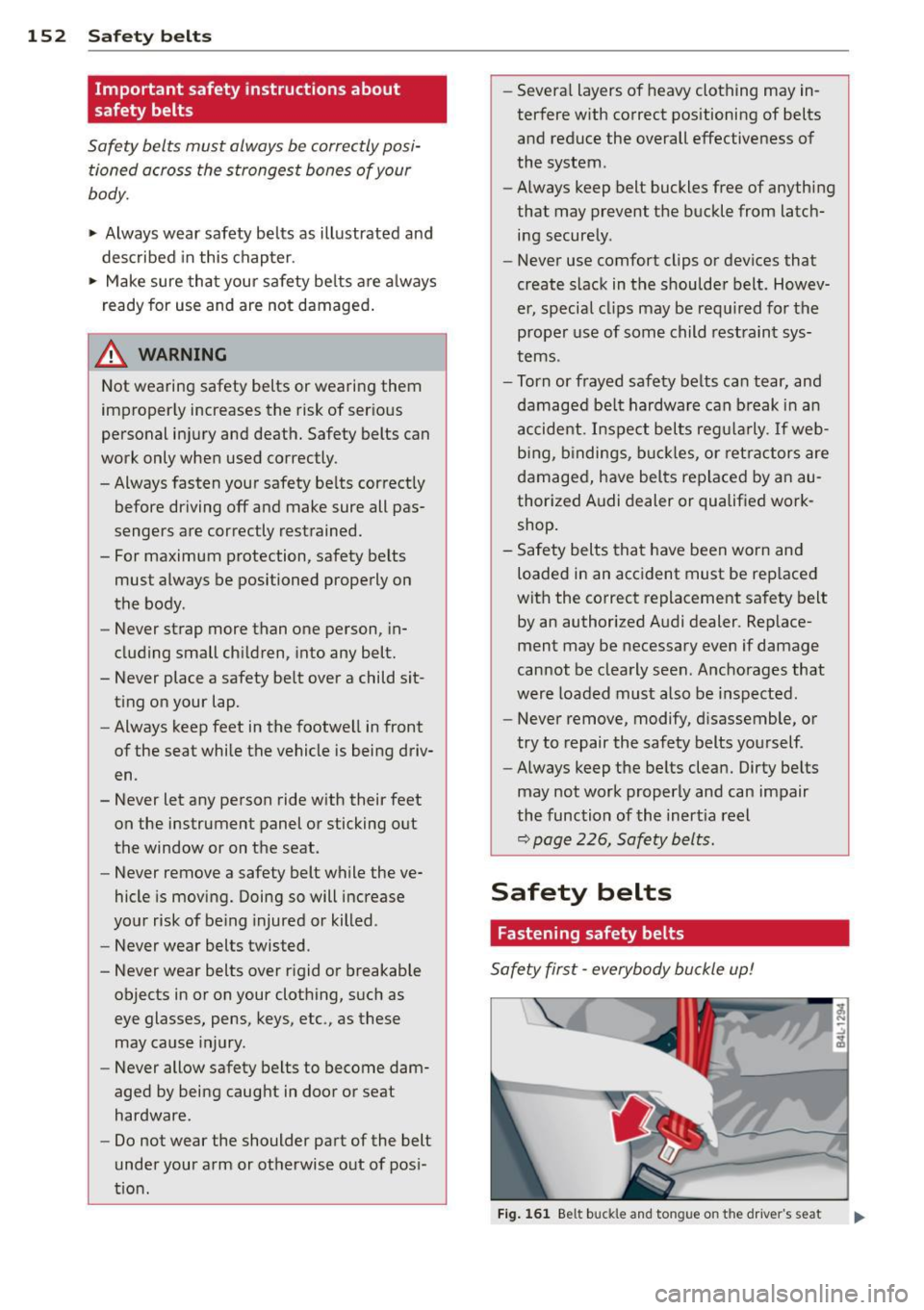
Fig. 161 B elt buck le and to ngue o n the drive r's sea t
Page 169 of 316
must always sit in an upright position,
must not lean against or place any part
of their body too close to the area where
the airbags are located .
- Occupants who are unbelted, out of posi
tion or too close to the airbag can be se riously injured by an airbag as it unfolds
with great force in the blink of an eye
~ page 158.
A WARNING
A child in a rearward-facing child safety
seat installed on the front passenger seat
will be seriously injured and can be killed if
the front airbag inflates -even with an Ad
vanced Airbag System.
- The inflating airbag will hit the child
safety seat or infant carrier with great
force and will smash the child safety seat
and child against the backrest, center
armrest, door or roof.
- Always install rear-facing child safety
seats on the rear seat.
- If you must install a rearward facing
child safety seat on the front passenger
seat because of exceptional circumstan
ces and the
PASSENGER AIR BAG OFF
light does not come on and stay on, im
mediately install the rear-facing child
safety seat in a rear seating position and
have the airbag system inspected by your
authorized Audi dealer .
A WARNING
Objects between you and the airbag will
increase the risk of injury in a crash by in
terfering with the way the airbag unfolds
or by being pushed into you as the airbag
inflates.
- Never hold things in your hands or on
your lap when the vehicle is in use.
- Never transport items on or in the area
of the front passenger seat. Objects
could move into the area of the front air
bags during braking or other sudden ma
neuver and become dangerous projec-
Airbag system 167
tiles that can cause serious personal in
jury if the airbags inflate.
- Never place or attach accessories or oth
er objects (such as cupholders, tele phone brackets, large, heavy or bulky ob
jects) on the doors, over or near the area marked "AIRBAG" on the steering wheel,
instrument panel, seat backrests or be
tween those areas and yourself. These
objects could cause injury in a crash, es
pecially when the airbags inflate.
- Never recline the front passenger's seat
to transport objects. Items can also
move into the area of the side airbag or
the front airbag during braking or in a
sudden maneuver. Objects near the air bags can become projectiles and cause
injury, particularly when the seat is re
clined.
A WARNING
The fine dust created when airbags deploy
can cause breathing problems for people
with a history of asthma or other breath ing conditions.
- To reduce the risk of breathing problems,
those with asthma or other respiratory
conditions should get fresh air right
away by getting out of the vehicle or
opening windows or doors.
- If you are in a collision in which airbags
deploy, wash your hands and face with mild soap and water before eating.
- Be careful not to get the dust into your
eyes, or into any cuts or scratches .
- If the residue should get into your eyes,
flush them with water. •
•
Page 177 of 316

-Objects between you and the airbag can
increase the risk of injury in an accident
by interfering with the way the airbag
unfolds or by being pushed into you as
the airbag inflates .
- Never place or attach accessories or
other objects (such as cupholders, tele
phone brackets, or even large, bulky
objects) on the doors, over or near the
area marked "AIRBAG" on the seat
backrests.
- Such objects and accessories can be
come dangerous projectiles and cause
injury when the supplemental side air
bag deploys .
- Never carry any objects or pets in the
deployment space between them and
the airbags or allow children or other
passengers to travel in this position .
- Always use the built -in coat hooks only
for lightweight clothing . Never leave any
heavy or sharp-edged objects in the
pockets that may interfere with side air
bag deployment and can cause personal
injury in an accident.
- Always prevent the side a irbags from be
ing damaged by heavy objects knocking
against or hitting the sides of the seat
backs.
- The airbag system can only be trigge red
once.
If the airbag has been triggered,
the system must be replaced by an au
thorized Audi dealership .
- Damage (cracks, deep scratches etc .) to
the original seat covers or to the seam in
the area of the side airbag module must
always be repaired immediately by an au
thorized Audi dealer .
- If children are seated improperly, their
risk of injury increases in the case of an
accident ~ page 178, Child Safety .
- Never attempt to modify any compo
nents of the airbag system in any way .
- In a side collision, side airbags will not
function properly if sensors cannot cor rectly measure increasing air pressure in
side the doors when air escapes through
Airbag system 175
larger, unclosed openings in the door
panel.
- Never drive with interior door trim pan
els removed .
- Never drive when parts have been re
moved from the inside door panel and
the open ings they leave have not been
properly closed.
- Never drive when loudspeakers in the
doors have been removed unless the
speaker holes have been p roperly
closed.
- Always make certain that openings are
covered or filled if additiona l speakers
or other equipment is installed in the
inside door panels .
- Always have work on the doors done by
an authorized Audi dealer or qualified
workshop.
Side curtain airbags
Description of side curtain airbags
The side curtain airbag sy stem can provide
supplemental protection to properly restrain
ed occupants .
e R
'
a: a, m
Fig. 172 Side curta in syst em , dri ver's side: sid e cur tain
airb ag loc ation
The side curtain airbags are located on both
sides of the interior above the front and rear
side windows ~ fig . 172 . They are identified
by the word "AIRBAG" on the windshield
frame and the center roof pillar.
T he side curtain airbag system supplements
the safety belts and can help to reduce the risk of injury for occupants' heads and upper
torso on the side of the vehicle that is struck .,.
Page 178 of 316
17 6 Airbag syst em
in a side collision. The side curtain airbag in
f lates in side impacts and on ly when the vehi
cle acce lerat ion reg istered by the contro l unit
is high enough. If this rate is below the refer
ence value programmed into the control unit,
the side airbags will not be triggered, even
though the car may be badly damaged as a re
sult of the collision.
It is not possible to de
fine an a irbag tr igger ing range that will cover
every possible angle of impact, since the c ir
cumstances w ill vary considerably between
one co llision and another . Important factors
include, for examp le, the nat ure (hard or soft)
of the impacting object, the ang le of impact,
vehicle speed, etc.
c:> page 176, How side cur
tain airbags work.
Aside from their normal safety function, safe
ty belts work to he lp keep the driver or front
passenger in position in the event of a co lli
sion so that the side curtain airbags can pro
vide p rotection.
The airbag system is not a subst itute for your
safety belt. Rather, it is part of the overall oc
cupant restraint system in your veh icle. Al
ways remember that the airbag system can
only help to protect you if you are wea ring
your safety be lt and wear ing it prope rly. This
i s ano ther reason why you shou ld always wear
your safety be lts, not jus t be ca use the law re
qu ires you to do soc;,
page 149, General
notes.
It
is important to remember that whi le the
side curtain a irbag sys tem is designed to he lp
reduce the like lihood o f serious injuries, other
inj uries, for example, swelling, bruising, and
minor abrasions can also be associated with
these airbags. Remember too, these airbags
will dep loy only once and only in certain k inds
of acc idents - your safety belts are always
there to offer protection.
The side curtain airb ag system b asic all y
consists of:
- The electronic control module and externa l
s ide impact sensors
- The side curtai n airbags above the front and
rear side w indows -
The airbag indicator light in the instrument
panel
T he airbag system is mo nitore d elec tronically
to make certain i t is func tioning properly at all
t imes . Each t ime yo u turn on the ignition, the
airbag system indicator light will come on for
a few seconds (sel f diagnostics).
The side curtain airbag is not activated:
- if the ignition is tur ned off,
- in side co llisions whe n the accele ration
mea sured by the sensor is too low,
- in rear-end col lisions.
A WARNING
- Safety belts and the airbag system will
only provide pro te ction when occupant s
are i n the proper seating posi tion
c:>page 61, General recommendations.
- If th e airbag ind ic a tor light c:>page 15
comes when the veh icle is being used,
have the system ins pected immediately
by your authorized A udi dealer. It is pos
sible that the airbag will inflate when it
is not supposed to, or will not inflate
when it should.
How side curtain airbags work
Side curtain airbags can work together with
side airbags to help reduce the risk of head
and upper torso injuries for occupants who
are properly restrained.
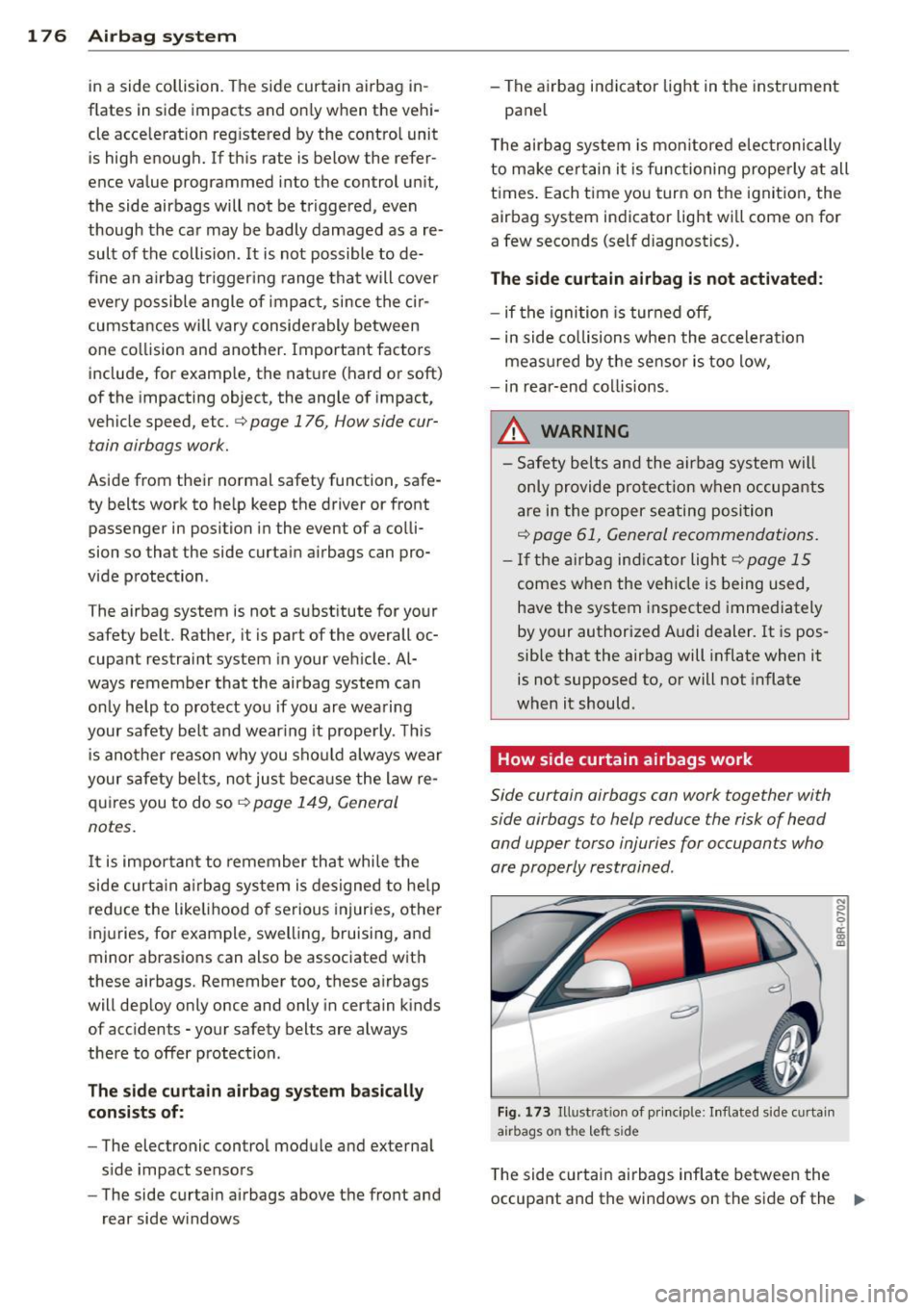
Fi g. 173 Illustration of p rinciple: I nflated side curtai n
a irbags on the left side
The side c urtain airbags inflate be tween the
occupant and the windows on the s ide of the
Ill-
Page 179 of 316

vehicle that is struck in a side collision
~ fig . 173.
When the system is tr iggered , the side c urtain
airbag is filled with propellant gas and breaks
through a seam above the front and rear side
windows identified by the AIRBAG label. In or
der to help provide this additional protection,
the side curtain airbag must inflate within the
blink of an eye at very high speed and w ith
great force. The side curtain airbag cou ld in
jure you if your seat ing pos ition is not proper
or upright o r if items are located in the area
where the suppleme nta l side cu rtain airbag
in flates . This appl ies espec ia lly to childre n
~page 178.
Although they are not a soft pillow, side cur
tain airbags can "cushion" the impact and in
this way they ca n he lp to reduce the r isk of in
jury to the head and the upper part of the
body .
A fi ne dust may develop when the airbag de
p loys. Th is is quite normal and does not mea n
there is a fire in the vehicle .
Important safety instructions on the
side curtain airbag system
Airbags are only supplemental restraints . Al
ways properly wear safety belts and ride in a
proper seating position.
There is a lot that you and your passengers
must know and do to help the safety be lts and
airbags do the ir job to provide supplementa l
protection.
A WARNING
Improperly wear ing safety belts and im
proper seating positions increase the risk
of serious personal injury and death when
ever a veh icle is being used .
- Never let occupants p lace any parts of
their bodies in the a rea from wh ich the
side cu rtain airbags inflate.
- Always make sure that the side curta in
airbags can inflate w ithout interference.
Uns uitable accessories fitted inside the
A irbag system 177
expansion range of a head airbag can
dangerously interfere with its funct ion. A
deploying head airbag develops enough
force to catapult any p iece of add-on
component out of its path of inflation
and into the passenger compa rtment. An
o cc u pant hit by such a projectile can suf
fer serious injury or death~
page 298,
Technical Modifications.
- Do not swive l the sun visors to the side i f
you have any ob jects clipped onto them
(for examp le pens) . If the airbag should
deploy, you could be injured by these ob
jects .
- Use the bui lt - in coat hooks only for ligh t
weight clothing . Never leave any heavy or
sharp-edged objects in the pockets that
may interfere with airbag dep loyment
and can cause personal injury in an acci
dent.
- Never use hangers to hang clothing from
the hooks.
- On ly use factory-installed sun shades or,
in the case of shades installed after the
veh icle leaves the factory, only Audi roll
up sunscreens may be used~
page 297,
Additional accessories and parts re
placement.
-Always sit in proper seat ing pos ition and
wear safety belts wh ile traveling so that
the side cu rtain airbag s can he lp p rov ide
protec tion.
- The airbag system can only be triggered
once . If the airbag has been triggered,
the system mus t be rep lace d by an au
thorized A udi dealer or qualified work
shop .
- Always have wor k involving the side cu r
tain airbag system, removal and installa
tion of the airbag components, or ot her
repairs per formed by an authorized Audi
dea ler or qualified works hop. Otherwise
the airbag system may not work co rrect
ly.
- Never attempt to mod ify any compo
nents of the airbag system in any way.
•
•
Page 206 of 316

204 Intelligent technology
With the engine turned off
If you listen to the radio, for example, with
the engine turned off or use othe r MMI* func
tions, the battery is being discharged .
If sta rting capability is jeopardized due to en
e rgy consumption, the following warning ap
pears in the radio or MMI* display:
Please start engine, otherwise system will
switch off in 3 minute s.
The warning ind icates that the system will be
turned off automatically after 3 m inutes .
If
you wish to continue using the functions , you
have to start the engi ne.
With the engine running
Although electrical energy is generated when
the vehicle is being driven, the battery can be
come discharged . This happens most ly when
l ittle energy is be ing generated and a great
deal consumed and the battery's state of
cha rge is not optimal.
To br ing the energy balance back into equili
brium, consumers which require especially
l arge amounts of energy are tempo rari ly cut
back or switched off. Heating sys tems in par
ticular requi re a great dea l of energy . If you
notice, for example , that the heated seats* or
the heated rear window are not heating, they
have been temporar ily cut back or switched
off. These systems will be ava ilable again as
soon as the energy balance has bee n restored.
You will a lso notice that engine idle speed has
been increased slightly. This is norma l and not
a cause for concern . By increasing engine idle
speed the add itional energy required is gener
ated and the battery is charged .
Page 211 of 316

Driving off road
Driving in difficult road
conditions and offroad
General information
The operation of the E lectronic Stabilization
Control (ESC) is expanded fo r operation away
from paved roads. In situations where slip or a
differential lock ing funct ion is required, the
ESC offroad mode can be act ivated
c> page 197 . Your Audi also has permanent
all-wheel drive in addition .
However, your Aud i is not a pure offroad ve hi
cle . It was not built for driving under extreme
conditions, e .g . for trips that are in the nature
of an expedition .
D riv e only on roads and offro ad sections
which match the des ign of your vehicle and
your abil it ie s as a driver . Ne ver take ri sks!
Before dri ving offroad
- Check the engine oi l level, tire pressure,
coolant leve l, and the fluid level in the w ind
shield washer reservo ir.
- Stow luggage items and other objects in the
lu ggage compartment, and secure them
against slid ing around .
After driv ing offroad
- After trips offroad, remove any twigs and other foreign objects from the grill, the un
derbody and the wheels. Pay specia l atten
t ion to fore ign objects (stones) which have
become lodged in the tire tread.
- Clean the body and the vehicle unders ide,
and inspect the veh icle for possible damage.
- Clean dirty windows, headlamp lenses, rear
lights, and license plates.
- Perform a brake check (particu larly after
trave lling through water) .
A WARNING
- Drive especially attentive ly and plan
ahead in difficult road conditions and
w hen offroad . Excess ive speed or incor-
-
Driving off road 209
rect maneuvers can cause injuries and
damage to the vehicle.
- Always adapt your speed and driving
style to road, offroad, traff ic, and weath
er conditions. Drive especially slowly off
road when your v iew is restricted.
- Please be aware that in ESC offroad
mode, particularly on a smooth and slip
pery road, the wheels may have an in
creased tendency to spin and the vehicle
may break away - danger of skidding!
- Stability is limited in the ESC offroad mode.
@) For the sake of the environment
Avoid damage to the environment and re
spect nature .
(D Tips
Only drive where it is permitted and stay
on marked roads and paths.
Explanation of some technical terms
The following data refer to ideal cond itions .
Depend ing on veh icle load and ground condi
tions and the environment, the numbers may
vary. It is the d rive r's responsibi lity to decide
whethe r a veh icle can overcome a specific s it
u at ion
c::> .&. .
Gradient angle
The number of meters in alt itude ga ined over
a d istance of 109 .4 yards or 100 meters
(grade) a re given as a pe rcentage o r degrees .
Info rmation abou t the gr ad ient the veh icle
can climb under i ts own power (depends in
part on the road surface and engine power).
Max imum permitted grade : 3 1
°
Late ral angle (slope of vehicle )
Ind icates the angle up to which the vehicle
can be d riven diagona lly or across the fall line
on a slope wi tho ut the vehicle tipping over
sideways (depends o n center of gravity) . Maxi-
mum permitted lateral angle: 25 ° .,.
•
•
Page 219 of 316
Automatic car wash
The vehicle can be washed in almost any
modern automatic car wash .
The vehicle paint is so durable that the vehicle
can normally be washed without problems in
an automatic car wash. However, the effect on
the paint depends to a large extent on the de
sig n of the fac ility, the filtering of the wash
water, the type of wash and care mater ial , etc.
If the paint has a dull appearance afte r go ing
through the car wash or is scratched, bring
this to the attention of the operator immedi
ately. If necessary, use a different car wash.
Before going through a ca r wash, be s ure to
take the usual precautions such as closing the
windows and the roof . Factory installed an
tennas m ust not be removed.
If you have installed additional accessor ies on
the vehicle -such as spoilers, roof rack, etc. -
it is best to ask the car was h operator if these
should be removed .
A WARNING
Please take note of the follow ing po ints
before going through an automatic car
wash with your vehicle, so that you can
avoid damage to your vehicle.
- Compare the track of your vehicle with
the distance between the gu ide rails of
the fac ility- there is a risk of damage to
the wheels and t ires.
- Compare the height and w idth of your
vehicle with the he ight and width of the
tunnel at the fac ility.
- Fold the exte rior mi rrors flat -there is a
r isk of damag ing the exte rior m irrors.
Power folding ex terior m irrors* must not
be folded in o r out by hand . Use the pow
er function !
- Do not a llow the wipe r blade to fall o nto
t he windsh ield after the vehicle is dried -
there is a r isk o f damag ing the pa int on
the hood .
- Always read and heed all WARN INGS and
other information ¢
page 216.
-
Cleaning and protec tion 217
Washing the vehicle by hand
A lot of water is needed when washing a vehi
cle by hand .
.,. Before you start washing, make sure you
have read and u nderstood the WARNINGS
Q .&. in General information on page 216 .
.,. First soak all dried d irt unt il it is soft, then
r inse it off.
.,. As you clean your vehicle , start w it h the
roof and wor k your way down to the bottom,
using a sponge, a sponge g love or a clean
brush.
.,. Rinse the sponge o r the sponge g love often,
flushing it clean each time.
.,. Use specia l car shampoo only for
very per
sistent d irt .
.,. Rinse the car thoroughly with water .
.,. Use a chamo is leather to gent ly w ipe the ex-
ter ior d ry.
Use a separate sponge for cleaning the
whee ls, door sills and othe r regions exposed
to road dirt . In this way, you w ill not scratch
the pa int w it h coarse par ticl es imbedded in
the sponge the next time you wash the ca r.
& WARNING ~ -
- Wash your vehicle only when the ignition
is switched off to red uce the risk of a
crash.
-A lways read and heed a ll WARNI NGS and
other information
~ page 216.
{(D Note
-Never try to remove dirt, mu d or dus t if
t he su rface o f the ve hicle is dry. Never
use a dry cloth or sponge, s ince this
co uld scratch your vehicle's paint or win
dows.
- Never wash your car in bright s unlight .
Drops of water act as magnifying lenses
and may damage yo ur paint .
- When you wash your car in the winter: if
you rinse yo ur vehicle with a hose, be
careful not to aim the stream of water
directly at locks, or at door or hatch
openings - they can freeze shut . •
•
Page 220 of 316
218 Clea ning and protec tio n
- Never use sp onges designed to remove
insects, or a ny kitchen scouring sponges
or similar products . They can dama ge
you r paint f inish.
- Never use a dry cloth or s ponge to clean
the headligh ts. On ly use wet clot hs or
sponges to prevent scratches.
It i s best
to use soapy water.
- You should rem ove debris (suc h as in
sects) from the headlight lenses on a
regular basis, fo r example when refuel
i ng your vehicle. Never clean the head
li ghts w ith a dry cloth or sponge. Use a
wet cloth or sponge.
It is best to use
soapy water.
@ For the sake of the environment
On ly wash the vehicle in facilit ies specially
designed for that pu rpose. This w ill reduce
t he risk of d irty water contami nated with
oil from en tering the sewer system. In
some areas, washing vehicles outside of
these facilities is prohibited .
Washing your vehicle with a power
washer
Cleaning the exterior of your car with a high
pressure power washer is safe as long as you
observe a few simple rules.
.. Before us ing the power washe r, make sure
you have read and understood the WARN
INGS¢
A in General information on
page 216 .
• Always follow the operating instructions for
the power washer .
• Make sure that the jet o n the spray hose
produces a "fan shaped sp ray ".
• Do
not ho ld the spray nozzle too close t o
soft materia ls.
Keep a d istance from soft mate rials such as
rubber hoses or insulat ing mater ial as well as
sensors and camera lenses .
When clea ning the veh icle w it h a power wash
e r
always fo llow the operating instructions.
This applies particul arly to the operating pres
sure and the spraying distance. Do not po int the spray di
rectly at the seals around the side
windows, around the doors, on the rear lid or
on the Panoram ic sliding sunroof* . Likewise,
do not po int it direct ly at tires, rubber hoses,
insulat ion material or sensors
¢ page 219.
Hold the spray nozz le at least 1.3 ft (0.4 m)
away from the vehicle.
Do not use a high-pressure power washer to
remove snow and ice .
Do not use a jet which sprays water in a direct
stream or one that has a rotating jet .
Water tempera ture sho uld no t exceed 140 ° F
(60 °().
_& WARNING
Neve r wash tires with a jet t hat sprays wa
ter in a direct stream . Th is could cause in
v is ible damage to the t ires and weaken
them, even if the spray is from a relative ly
l ong distance and for a short time. Dam
aged and weakened tires can fail and cause
accidents and personal in ju ry .
(D Note
To avoid damaging you r vehicle, always
make sure that there is suffic ient d istance
between the spray head and soft materia ls
l ike rubber hoses, plast ic pa rts and sound
deade ning mater ia ls as well as sensors
and camera lenses. Never a im the sp ray
head at the same point fo r a long time .
This also applies to cleaning headlights
and painted bumpers. Remembe r: the
closer the nozzle is to the surface of the
mater ia l, the greater the stress on the ma
terial.
Page 223 of 316
Aluminum trim
Use only neutral -pH products to remove spots
and depos its from alum in um s urfaces.
Chrome care products and alkaline cleaners
will attack aluminum surfaces and can dam
age them over time.
A WARNING
Always read and heed all WARNINGS and other information ¢
page 216.
Touch-up paint
Minor paint damages should be touched up
immediately.
"" Use either a touch-up pa int stick or spray
paint to cover minor scratches and nicks.
Your author ized A udi dealer has touch-up
pa int for minor sc ra tches and stone ch ips.
Scratches shou ld be touched up soon after
they occur to prevent corrosion .
If a spot starts to rust, howeve r, a simple
t ouch- up job w ill not be enough. The affected
sur face must be sanded smooth and coated
with an anti-r ust primer before the painted
finish can be restored.
The number for the origina l vehicle paint can
be found on the vehicle identi ficat ion labe l
¢page 290.
A WARNING
Always read and heed a ll WARNINGS and
other information
¢ page 216.
Windows
Clear vision to all sides .
Clea n all windows regularly to remove road
fi lm and ca r wash wax b uild up.
"" Remove snow from windows using a brush .
"" Use a plast ic ice scraper to remove ice from
windows and mirro rs.
"" Remove other res idue on the windows with
a sp ray -on glass cleaner.
Cleaning and protec tion
"" Wipe the windows dry with a clean piece of
cloth or kitchen paper towe l.
T he best way to remove snow from windows
and mirrors is to use a brush . Use a non-abra
sive
plastic ice scrape r -better sti ll, a spray
deicer - to remove
ice from windows and mir
rors.
T he windows must not be cleaned with insect
remover or wax since these can interfere with
the function of the windshie ld w iper blades
(chatter) .
Oil, grease, o r si licone residue can be removed
with
gla ss cleane r or silicone remove r. How
ever, wax residue requires the use of a specia l
ly formulated so lvent. Please contact your au
thori zed Audi dealer for advice on safe prod
ucts for wax removal.
Windows should also be cleaned on the inside
at regu lar intervals .
Never dry windows wit h the same chamo is
that you use to dry painted surfaces . Wax resi
due o n the chamois can impair vision through
the windows .
A WARNING
-Always read and heed all WARNINGS and
other information ¢
page 216.
-The windsh ield must not be treated with
water-repellent materials. They can in
crease glare under poor v is ibility condi
tions such as wetness, darkness, or when the sun is low on the hor izon. In addi
tion, they can ca use the w indshie ld w ip
ers to ch atter.
@ Note
- Never use warm o r hot wate r to remove
snow and ice from w indows and mirro rs.
T his could cause the glass to crack.
- T o prevent damage to the wires of the
rear defogger, do not place any adhesive
st ic kers on the ins ide of the rear w indow
over the wires.
221
•
•