fold seats AUDI Q5 2013 Owners Manual
[x] Cancel search | Manufacturer: AUDI, Model Year: 2013, Model line: Q5, Model: AUDI Q5 2013Pages: 316, PDF Size: 78.89 MB
Page 66 of 316
64 Seats and storage
Activating remote control key memory
Applies to vehicles: with seat memory
To assign the drive r's sea t settings to the re
mote contro l key when locking the vehicle, the
function must be activated in the radio or
MMI* .
• Se lect :
IC ARI fu nct ion button> S eat adjust
m ent > Driver's seat > Ke y mem . profile
>
On . Or
· • Se lect:
~ IC _A_ R~ I function button > Car sys
tems*
control button > Vehicle setting s >
Seats > Driver 's seat > Remote control ke y
> On.
@ Tips
If you do not want another driver's set
tings to be assigned to the remote control key, switch
off the memory f unction using
the radio o r MMI* or the
IOFF I button
~page 63.
Rear seats
General information
Safe transp ortation of passengers on the rear
seats requires proper safety precautions.
A ll passengers on the rear seats must be seat
ed i n complia nce w ith the safety g uidelines
explained in
~ page 149 and ¢page 157.
The correct seating posi tion is critical fo r the
safety of front
and rear seat passengers alike
~ page 142.
A WARNING
- Occ upants in the front and rear seats
must always be properly restrained.
- Do not let anyone ride in the vehicle
without the head restra ints provided.
Head restra ints help to reduce injuries.
- Loose items inside the passenger com partment, can f ly forward i n a crash or
sudden maneuver a nd injure occupa nts.
Always store art icles in the luggage com
partment and use the fastening eyes, es
pecially when the rear seatbacks have
been folded down. -
Read and heed all WARNINGS
¢ page 142 , Proper seating positions
for passengers in rear seats.
Adjusting seat
The fore-and-a~ adjustment of the seat cush
ion and the seatback angle can be adjusted.
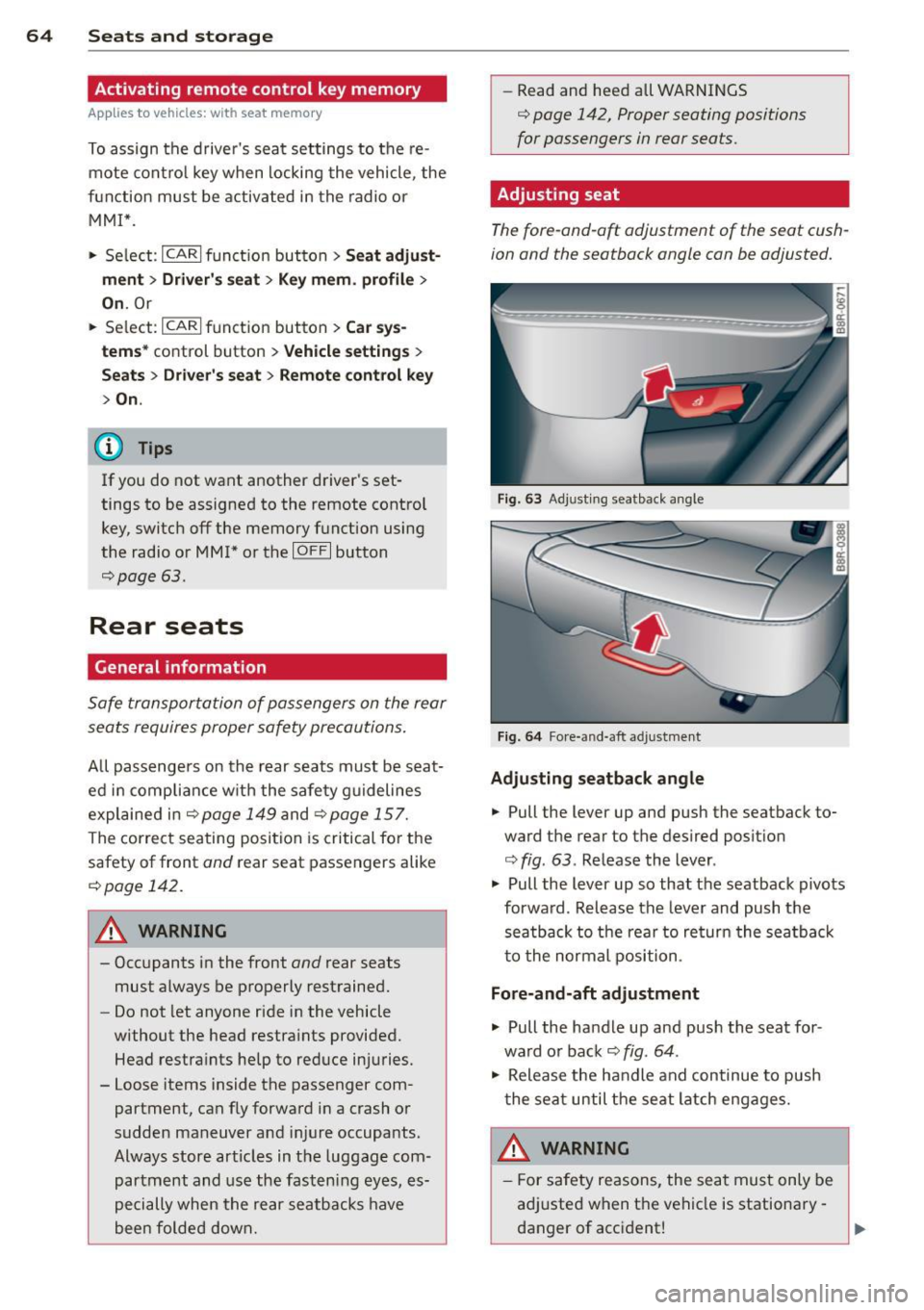
F ig . 63 Adjus ting seatback a ngle
Fig. 6 4 Fore-and-aft adjust ment
Adjusting seatback angle
• Pull the lever up and push the seatback to
ward the rear to the desired posit io n
¢ fig . 63 . Release the lever .
• Pull the lever up so that the seatback pivots
forwa rd . Release the lever and push the
seatb ack to the rear to re turn the sea tba ck
t o the normal position .
Fore-and-aft adjustment
• Pull the ha ndle up and pus h the seat for
wa rd o r back
~ fig . 64 .
• Release the ha ndle and continue to push
t he seat until the seat latch engages.
A WARNING
- F or safety re asons, the seat must only be
ad justed when t he vehicle is stationary-
danger of acc ident! ,..
Page 67 of 316
-Exercise caution when adjusting the seat.
Adjusting the seat without checking or
paying attention can pinch fingers or
limbs - danger of injury!
Head restraints
Front head restraints
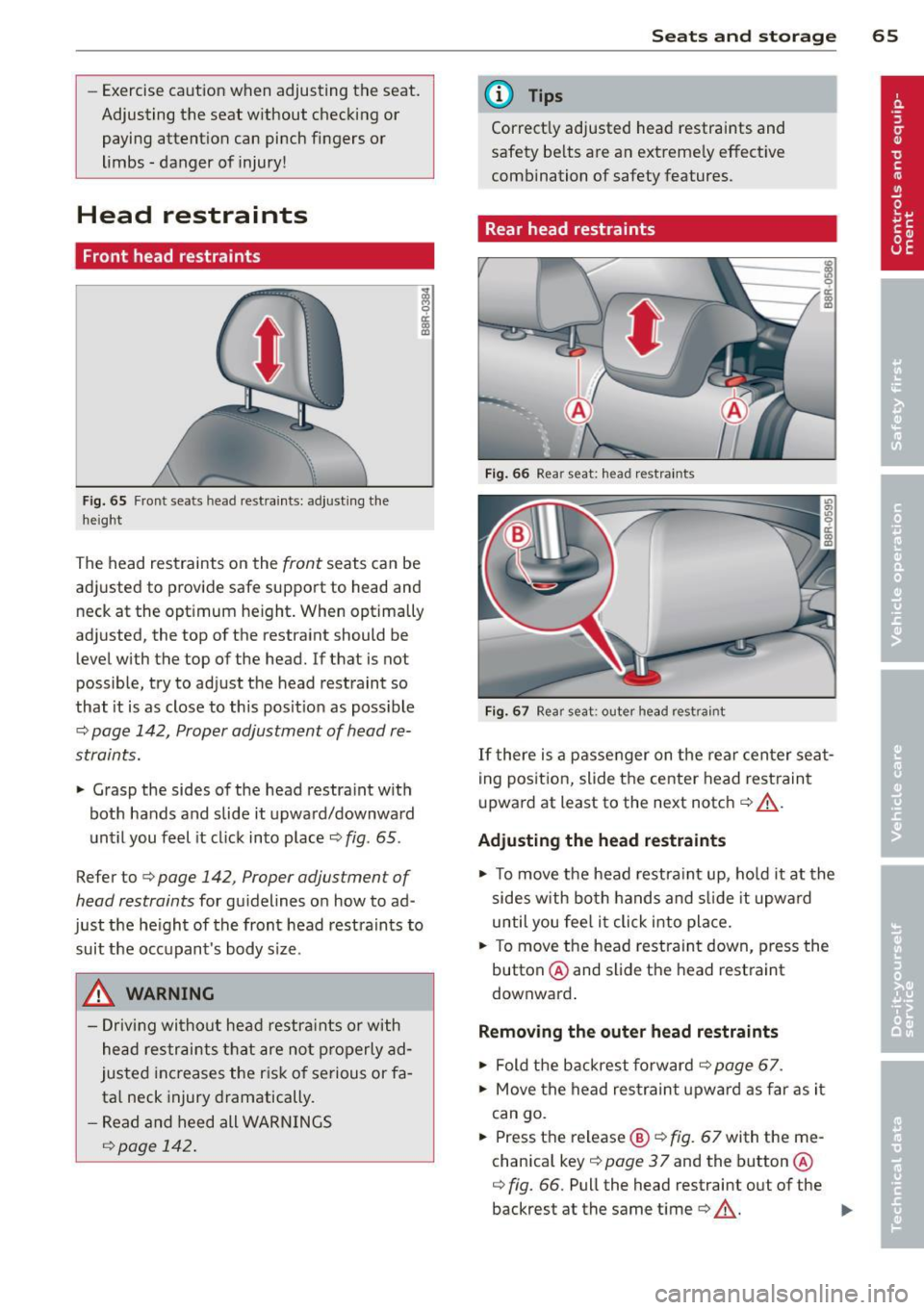
Fig. 65 Front seats head restra ints: adjusting the
height
The head restraints on the front seats can be
adjusted to provide safe support to head and
neck at the optimum he ight. When optimally
adjusted, the top of the restraint should be
level with the top of the head. If that is not
possible, try to adjust the head restraint so
that it is as close to this posit ion as poss ible
ca:> page 142, Proper adjustment of head re
straints.
.,. Grasp the sides of the head restraint w ith
both hands and slide it upward/downward
until you feel it click into place
c::> fig. 65 .
Refer to ¢
page 142, Proper adjustment of
head restraints
for guidelines on how to ad
just the height of the front head restraints to
suit the occupant's body s ize.
.&, WARNING
-Driving without head restra ints or with
head restraints that are not properly ad
justed increases the risk of serious or fa
tal neck injury dramatically.
- Read and heed all WARNINGS
ca:> page 142.
-
Seats and storage 65
@ Tips
Correctly adjusted head restraints and
safety be lts are an extreme ly effective
combination of safety features.
Rear head restraints
Fig. 66 Rear seat: head restra ints
Fig. 67 Rear seat: outer head restraint
If there is a passenger on the rear center seat
ing position, slide the center head restraint
upward at least to the next notc h
c::> &_.
Adjusting the head restraints
.,. To move the head restraint up, hold it at the
sides with both hands and slide it upward
until you feel it click into place.
... To move the head restraint down, press the
button @and slide the head restraint
downward .
Removing the outer head restraints
.,. Fold the backrest forward c::> page 67.
.,. Move the head restraint upward as far as it
can go.
... Press the release@¢
fig. 67 with the me
chanical key
c::> page 37 and the button @
c::> fig. 66. Pull the head restraint out of the
backrest at the same time¢,&.
IJJl-
Page 69 of 316
Luggage compartment
Expanding the passenger compartment
The rear seat backrests can be folded forward
separately or together.
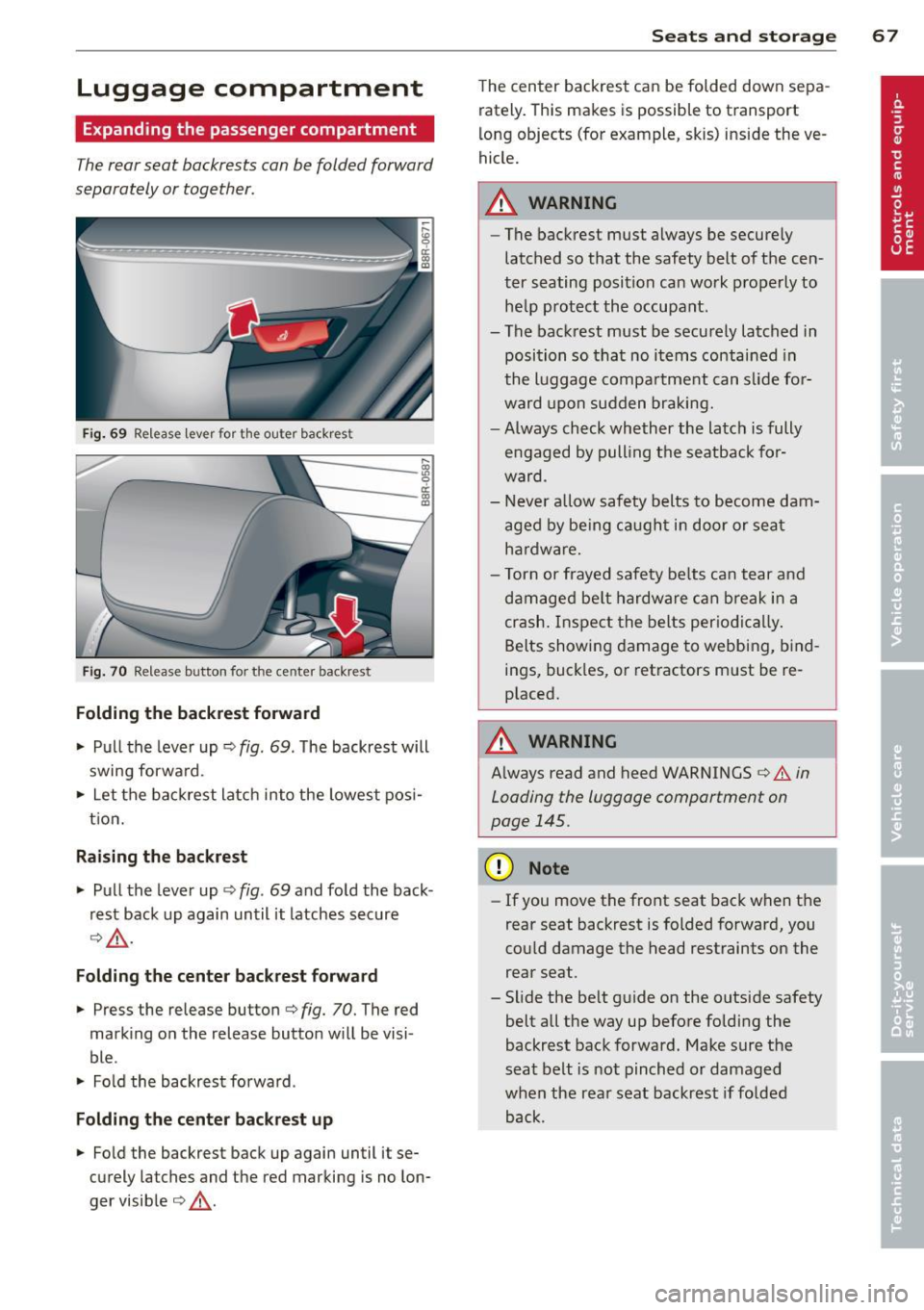
Fi g. 69 Re lease lever for th e outer bac kres t
,.._
18 0
~----ri: ~
Fig. 70 Release button for the ce nter backrest
Folding the backrest forward
• Pull the leve r up ¢ fig. 69. The backrest will
swing forwa rd.
• Let the ba ck rest latch into the lowest pos i
t io n .
Raising the backrest
• Pull the leve r up ¢ fig. 69 and fo ld the back
rest back up again until it latches sec ure
¢ &, .
Folding the center back rest forward
• Press the release button ¢ fig. 70. The red
mark ing o n the release button w ill be visi
ble .
• Fo ld the backrest forwa rd .
Folding the center back rest up
• Fo ld the backrest back up again until it se
curely latches and the red marking is no lon
ger visib le ¢
&, .
Seats and storage 67
The cen ter backrest can be folded down sepa
rately . This makes is possible to t ransport
l ong objects (for example, skis) inside the ve
hicle.
A WARNING
- The back rest must always be secure ly
latched so that the safety belt of t he cen
ter seating position ca n work p roperly to
he lp prot ect the occupant.
- The back rest must be securely latched in
posi tion so that no items contained in
the l uggage compa rtme nt can s lide fo r
ward upon su dden braking.
- Always ch eck whether the latc h is fully
e ngaged by pull ing t he seatback fo r
ward.
- Never a llow safety belts to become dam
aged by be ing c aught in do or or sea t
h ar dwa re .
- T orn or frayed safe ty be lts ca n tear a nd
da mage d be lt hardware can break i n a
cras h. I nsp ect the belts per io d ic all y.
Belts showing damage to webbi ng, bind
ings, buck les, o r retractors m ust be re
p laced.
A WARNING
A lways read and heed WARNINGS¢ A in
Loading the luggage compartment on
page 145.
(D Note
- If you move the front seat bac k w hen t he
rear seat backrest is folded forward, you
cou ld damage the head restraints on the
rear seat.
- Slide the be lt g uide on the o utside safety
belt all t he way up before folding the
backrest back forward. Ma ke sure the
seat belt is not pinched or damaged
when the rea r seat backrest if fo lded
b ack.
Page 70 of 316
68 Seats and storage
Expanding the luggage compartment
The rear seat backrests can be folded forward
separately or together.
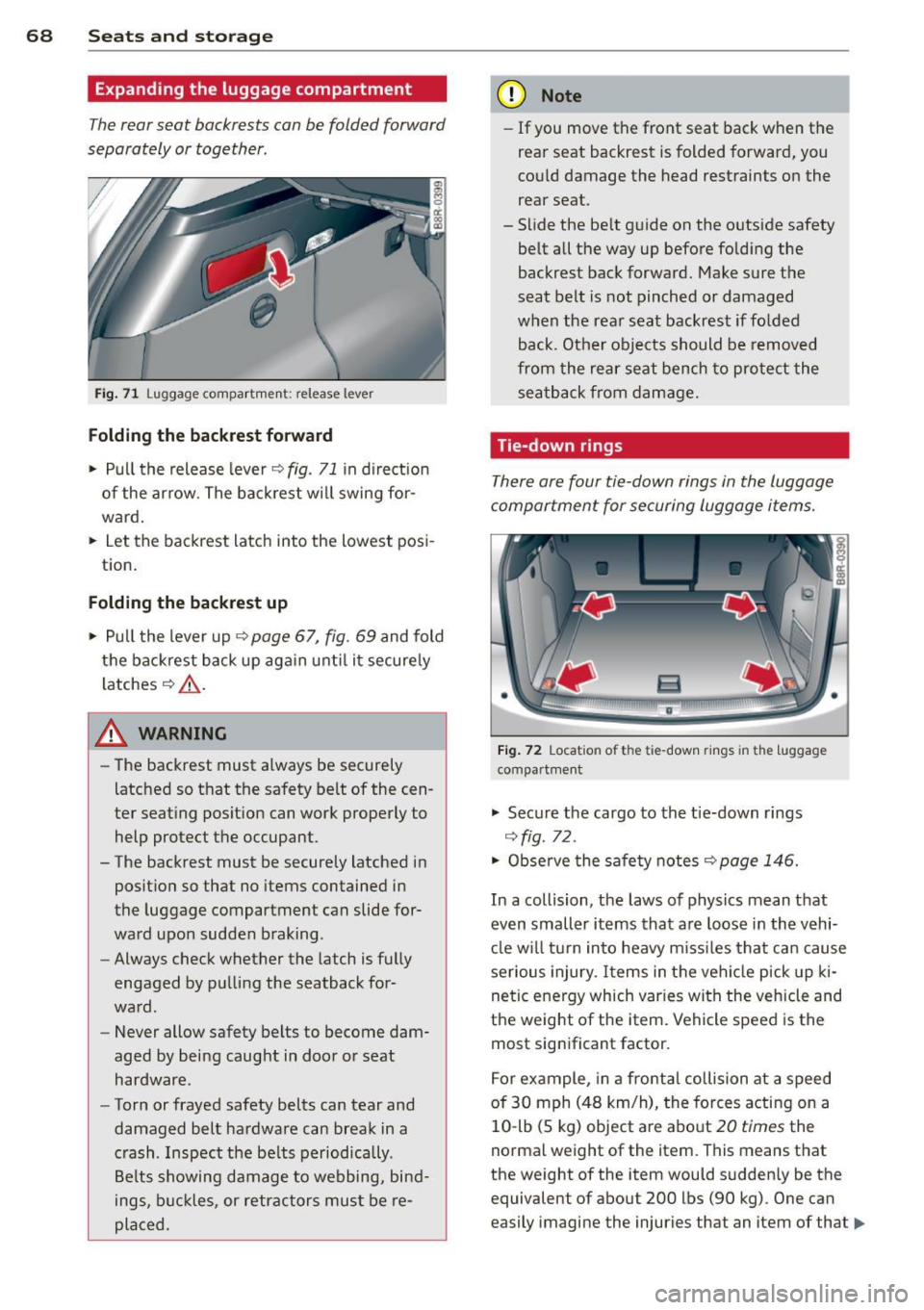
Fi g. 71 Luggage compartment: release lever
Folding the backrest forward
~ Pull the release lever ¢ fig . 71 in d irect ion
of the arrow . The ba ck rest w ill swing for
ward.
· ~ Let the backrest latch into the lowest pos i
tion .
Folding the backrest up
~ Pull t he lever up ¢ page 67, fig. 69 and fold
the backrest back up again unti l it secure ly
latches ~
&-
A WARNING -
-The backrest must a lways be securely
latched so that the safety belt of the cen
ter seat ing pos ition can work properly to
help protect the occupant.
- The backrest must be securely latched in
posit ion so that no items contained in
the luggage compartment can slide for
ward upon sudden braking .
- Always check whether the latch is fully
engaged by pu lli ng the seatback for
ward .
- Never allow safety belts to become dam
aged by being caug ht in doo r o r seat
hardware .
- Torn or frayed safety belts can tear and
damaged belt hardware can break in a
c rash . Inspect the be lts periodically .
Belts showing damage to webbing, bind
ings, b uckles, or retractors must be re
placed .
(D Note
-If you move the front seat back when the
rear seat backrest is folded forward, you
cou ld damage the head restraints on the
rear seat.
- Slide the be lt guide on the outside safety
belt all the way up before folding the
backrest back forward. Make sure the
seat belt is not pinched or damaged
when the rea r seat backrest if folded
back. Other objects should be removed
from the rear seat bench to protect the sea tback from damage.
Tie-down rings
There are four tie-down rings in the luggage
compartment for securing Luggage items.
Fig. 72 Locatio n of th e tie -dow n rin gs in the luggage
compart men t
~ Secure the cargo to the tie-down rings
~ fig. 72 .
~ Observe the safe ty notes ~ page 146.
In a collision, the laws of physics mean that
even smaller items that a re loose in the vehi
cl e w ill turn into heavy m iss iles that can cause
serious injury. Items in the vehi cle pick up ki
netic e nergy which var ies with the vehicle and
the weight of the item. Vehicle speed is the
most significant factor.
F or example, in a fronta l collision at a speed
of 30 mph (48 km/h), the forces acting on a
10 -lb (S kg) object a re abo ut
20 times the
normal weight of the item. This means that
the weight of the item would sudden ly be the
equivalent of about 200 lbs (90 kg). One can
easily imagine the injuries that an item of that""
Page 72 of 316
70 Seats and storage
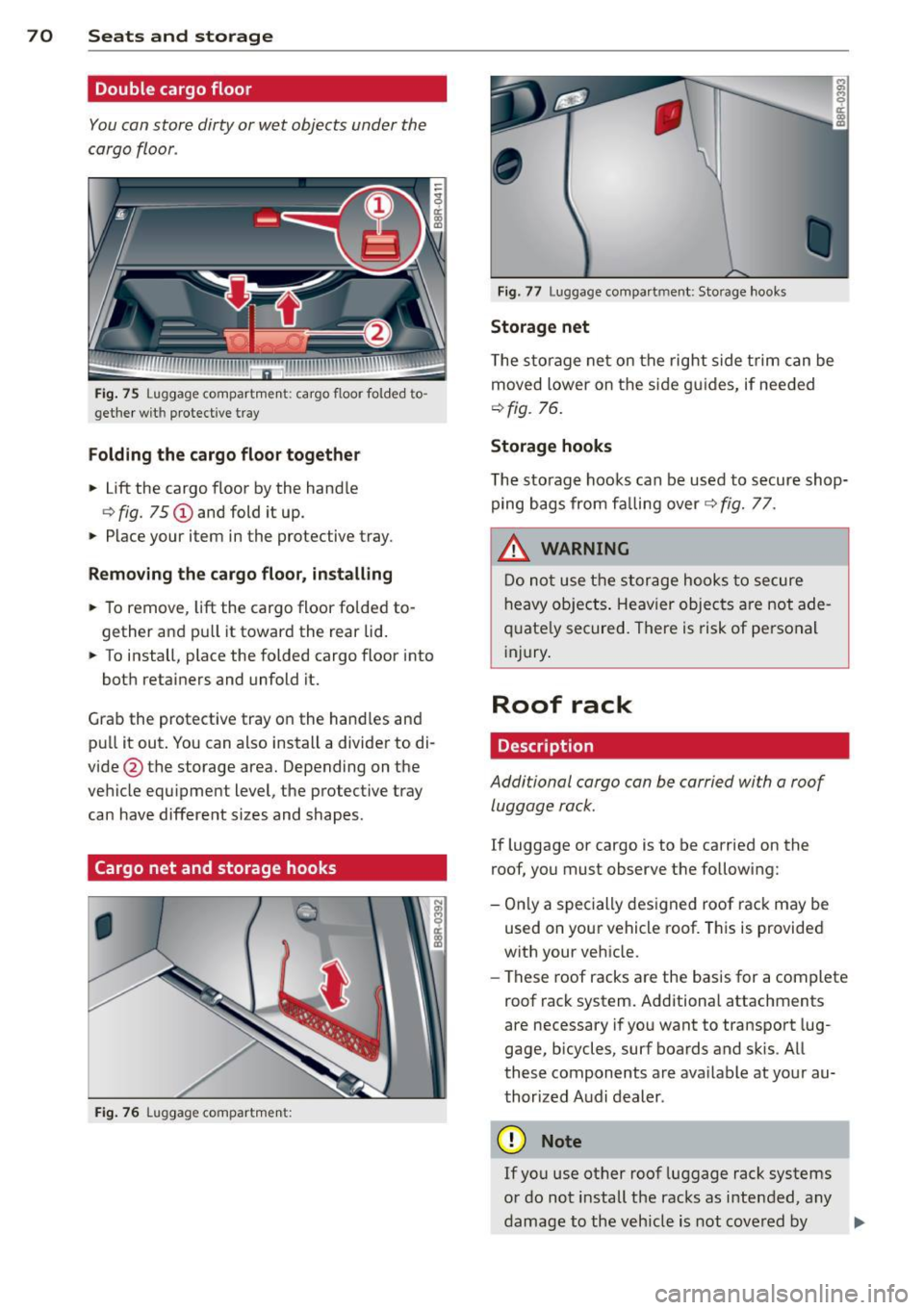
Double cargo floor
You can store dirty or wet objects under the
cargo floor .
Fig. 75 Luggage compartment: cargo floor folded to·
get he r wit h protective tray
Folding the cargo floor together
.. Lift the cargo floor by the hand le
c> fig. 75 (D and fold it up .
.. Place your item in the protective tray.
Removing the cargo floor, installing
.. To remove, lift the cargo floor folded to
gether and pu ll it toward the rear lid.
.. To install, place the folded cargo floor into
both retainers and unfold it.
Grab the protective tray on the hand les and
pull it out. You can also install a divider to di
vide @the storage area. Depending on the
vehicle equ ipment level, the protective tray
can have different sizes and shapes.
Cargo net and storage hooks
•
Fig. 76 Luggage compartment:
•
Fig. 77 Luggage compartment: Storage hooks
Storage net
The storage net on the right side trim can be
moved lower on the side guides, if needed
c>fig . 76.
Storage hooks
The storage hooks can be used to secure shop·
ping bags from falling over
c> fig. 77.
_& WARNING
-
Do not use the storage hooks to secure
h eavy objects. Heav ier objects are not ade
quately secured. There is risk of personal
injury .
Roof rack
Description
Additional cargo can be carried with a roof
luggage rack.
If luggage or cargo is to be carried on the
roof, you must observe the follow ing:
- Only a specially designed roof rack may be
used on your vehicle roof. This is provided
with your vehicle.
- These roof racks are the basis for a complete
roof rack system. Additional attachments
are necessary if you want to transport lug
gage, b icycles, surf boards and skis . All
these components are available at your au
thorized Audi dealer .
(D Note
If you use other roof luggage rack systems
or do not install the racks as intended, any
damage to the vehicle is not covered by ..,_
Page 79 of 316
To close glove compartment
• Push the glove compartment lid upward un-
ti l the lock engages.
There are holders for a pen and a pad of paper in the glove compartment lid.
On the right side in the glove compartment is
a holder with the key body into which the
emergency key must be cl ipped to be able to
start the vehicle .
A WARNING
To reduce the risk of personal injury in an
accident or sudden stop, a lways keep the
glove compartment closed whi le driving.
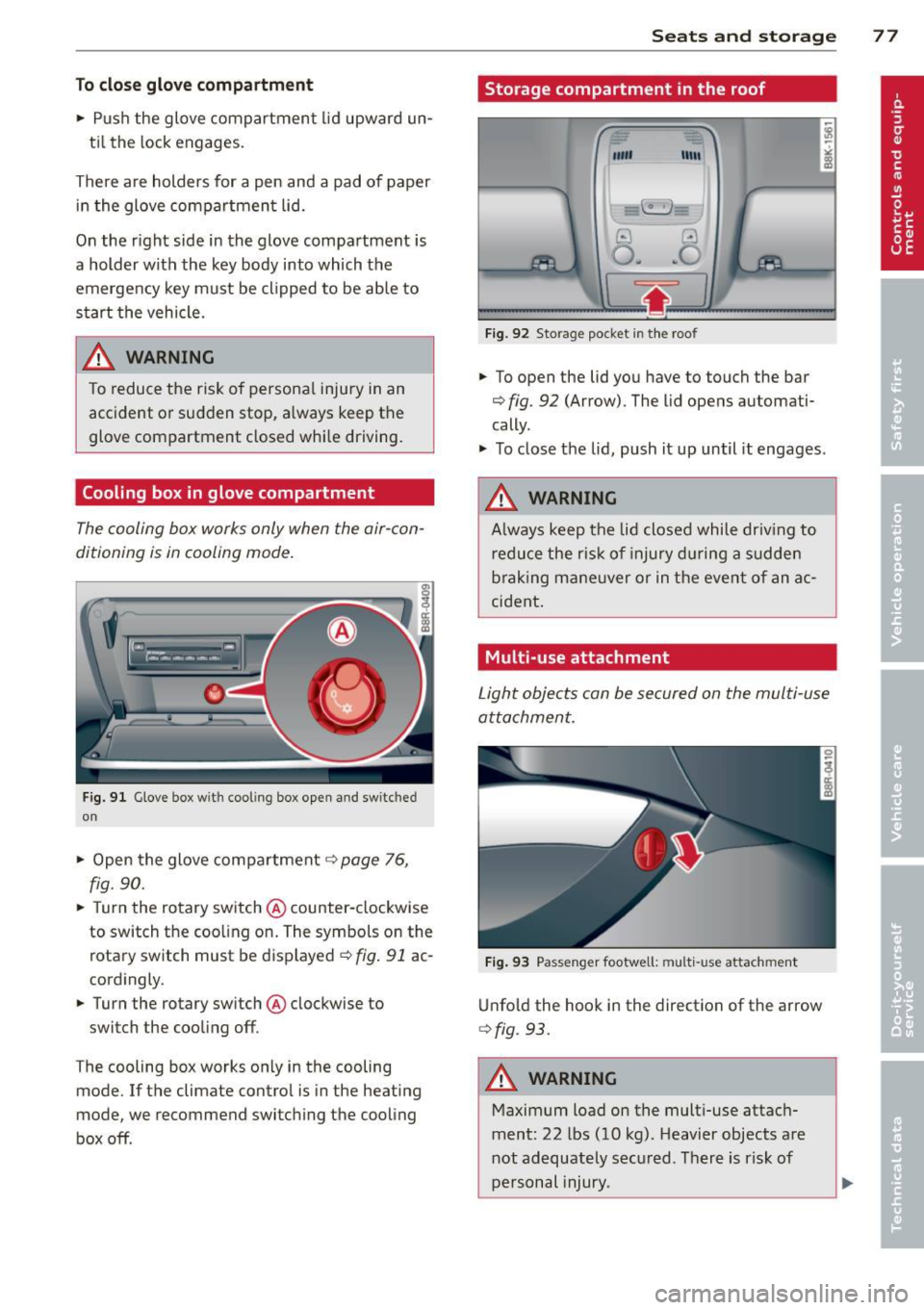
Cooling box in glove compartment
The cooling box works only when the air-con
ditioning is in cooling mode.
Fig. 91 Glove box w ith cool ing box open and switc hed
on
" Open the glove compartment c::> page 76,
fig. 90.
" Turn the rotary switch @counter-clockwise
to switch the coo ling on. The symbols on the
rotary switch must be displayed
c::> fig. 91 ac
cordingly .
• Turn the rotary sw itch @clockwise to
switch the cooling off .
T he cooling box works only in the cooling
mode. If the climate contro l is in the heating
mode, we recommend switching the cooling
box off .
Seats and storage 77
Storage compartment in the roof
""'
11111
Fig. 92 Storage pocket in the roof
" To open the lid you have to touch the bar
c> fig . 92 (Arrow). The lid opens automati
cally .
" To close the lid, push it up until it engages .
A WARNING
Always keep the lid closed while driv ing to
reduce the ris k of injury dur ing a sudden
braking maneuver or in the event of an ac
cident .
Multi-use attachment
Light objects can be secured on the multi-use
attachment.
Fig. 93 Passenger footwell: mult i-use attachment
Unfold the hook in the direction of the arrow
¢ fig . 93.
A WARNING
Maximum load on the multi-use attach
ment: 22 lbs (10 kg) . Heavier objects are
not adequately secured . There is risk of
personal injury .
Page 143 of 316
~ Always keep both feet in the footwell so
that you are in control of the vehicle at all
times.
For detailed information on how to adjust the
driver's seat, see
c:;, page 62.
A WARNING
Drivers who are unbelted, out of position
or too close to the airbag can be seriously
injured by an airbag as it unfolds. To help
reduce the risk of serious personal injury:
- Always adjust the driver's seat and the
steering wheel so that there are at least
10 inches (25 cm) between your breast
bone and the steering wheel.
- Always hold the steering wheel on the
outside of the steering wheel rim with
your hands at the 9 o'clock and 3 o'clock positions to help reduce the risk of per
sonal injury if the driver's airbag inflates.
- Never hold the steering wheel at the
12 o'clock position or with your hands at
other positions inside the steering wheel
rim or on the steering wheel hub. Hold
ing the steering wheel the wrong way
can cause serious injuries to the hands,
arms and head if the driver's airbag de
ploys.
- Pointing the steering wheel toward your
face decreases the ability of the supple
mental driver's airbag to protect you in a
collision .
- Always sit in an upright position and nev
er lean against or place any part of your
body too close to the area where the air
bags are located.
- Before driving, always adjust the front
seats and head restraints properly and
make sure that all passengers are prop
erly restrained.
- Never adjust the seats while the vehicle
is moving . Your seat may move unexpect
edly and you could lose control of the ve
hicle.
- Never drive with the backrest reclined or
tilted far back! The farther the backrests
are tilted back, the greater the risk of in-
Driving Safely 141
jury due to incorrect positioning of the
safety belt and improper seating posi
tion .
- Children must always ride in child safety
seats
c:;, page 178. Special precautions
apply when installing a child safety seat
on the front passenger seat
c:;, page 157 .
Proper seating position for the front
passenger
The proper front passenger seating position
is important for safe, relaxed driving .
For your own safety and to reduce the risk of
injury in the event of an accident, we recom
mend that you adjust the seat for the front
passenger to the following position :
~ Adjust the angle of the seatback so that it is
in an upright position and your back comes
in full contact with it whenever the vehicle is
moving .
~ Adjust the head restraint so the upper edge
is as even as possible with the top of your
head. If that is not possible , try to adjust
the head restraint so that it is as close to
this position as possible
c:;, page 142.
~ Keep both feet flat on the floor in front of
the front passenger seat .
~ Fasten and wear safety bel ts correctly
c:;, page 152.
For detailed information on how to adjust the
front passenger 's seat, see
c:;, page 61.
A WARNING ,_
Front seat passengers who are unbelted,
out of position or too close to the airbag
can be seriously injured or killed by the air
bag as it unfolds. To help reduce the risk of
serious personal injury:
- Passengers must always sit in an upright
position and never lean against or place
any part of their body too close to the
area where the airbags are located.
- Passengers who are unbelted, out of po
sition or too close to the airbag can be
seriously injured by an airbag as it
•
•
Page 144 of 316
142 Driving Safely
unfolds with great force in the blink of
an eye .
- Always make sure that there are at least
10 inches (25 cm) between the front
passenger's breastbone and the instru
ment panel.
- Each passenger must always sit on a seat of their own and properly fasten and
wear the safety belt belonging to that
seat.
- Before driving, always adjust the front
passenger seat and head restraint prop
erly .
- Always keep your feet on the floor in
front of the seat. Never rest them on the
seat, instrument panel, out of the win
dow, etc. The airbag system and safety
belt will not be able to protect you prop
erly and can even increase the risk of in
jury in a crash.
- Never drive with the backrest reclined or
tilted far back! The farther the backrests
are tilted back, the greater the risk of in
jury due to incorrect positioning of the
safety belt and improper seating posi
tion.
- Children must always ride in child safety
seats
c::> page 178. Special precautions
apply when installing a child safety seat
on the front passenger seat
c::> page 15 7 .
Proper seating positions for passengers
in rear seats
Rear seat passengers must sit upright with
both feet on the floor consistent with their
physical size and be properly restrained whenever the vehicle is in use .
To reduce the risk of injury caused by an incor
rect seating position in the event of a sudden
braking maneuver or an accident, your pas
sengers on the rear bench seat must always
observe the following :
.. If there is a passenger on the rear center
seating pos ition, slide the center head re
straint upward at least to the next notch
c::> page 65.
.. Make sure that the seatback is securely
latched in the upright position
c::> page 67.
.. Keep both feet flat in the footwell in front
of the rear seat.
.. Fasten and wear safety belts properly
c::>page 152.
.. Make sure that children are always properly
restrained in a child restraint that is appro
priate for their size and age
c::> page 178.
_& WARNING
Passengers who are improperly seated on
the rear seat can be seriously injured in a
crash .
- Each passenger must always sit on a seat
of their own and properly fasten and
wear the safety belt belonging to that
seat.
- Safety belts only offer maximum protec
tion when the seatback is securely latch
ed in the upright position and the safety
belts are properly positioned on the
body. By not sitting upright, a rear seat
passenger increases the risk of personal
injury from improperly positioned safety
belts!
-Always adjust the head restraint properly
so that it can give maximum protection.
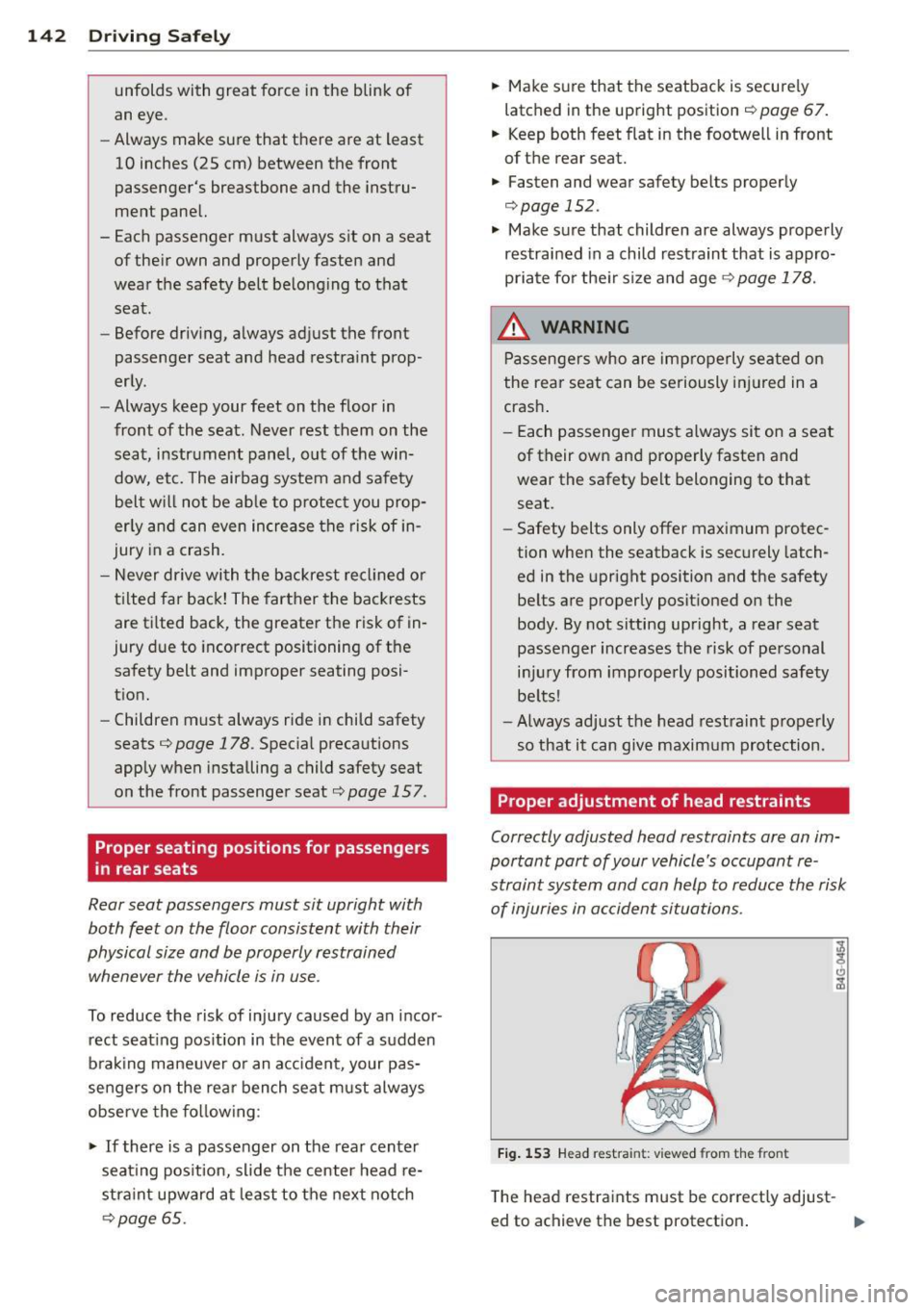
Proper adjustment of head restraints
Correctly adjusted head restraints are an im
portant part of your vehicle's occupant re
straint system and can help to reduce the risk
of injuries in accident situations.
Fig. 153 H ead restra int: vi ew ed from the front
The head restraints must be correctly adjust-
ed to achieve the best protection. .,.
Page 169 of 316
must always sit in an upright position,
must not lean against or place any part
of their body too close to the area where
the airbags are located .
- Occupants who are unbelted, out of posi
tion or too close to the airbag can be se riously injured by an airbag as it unfolds
with great force in the blink of an eye
~ page 158.
A WARNING
A child in a rearward-facing child safety
seat installed on the front passenger seat
will be seriously injured and can be killed if
the front airbag inflates -even with an Ad
vanced Airbag System.
- The inflating airbag will hit the child
safety seat or infant carrier with great
force and will smash the child safety seat
and child against the backrest, center
armrest, door or roof.
- Always install rear-facing child safety
seats on the rear seat.
- If you must install a rearward facing
child safety seat on the front passenger
seat because of exceptional circumstan
ces and the
PASSENGER AIR BAG OFF
light does not come on and stay on, im
mediately install the rear-facing child
safety seat in a rear seating position and
have the airbag system inspected by your
authorized Audi dealer .
A WARNING
Objects between you and the airbag will
increase the risk of injury in a crash by in
terfering with the way the airbag unfolds
or by being pushed into you as the airbag
inflates.
- Never hold things in your hands or on
your lap when the vehicle is in use.
- Never transport items on or in the area
of the front passenger seat. Objects
could move into the area of the front air
bags during braking or other sudden ma
neuver and become dangerous projec-
Airbag system 167
tiles that can cause serious personal in
jury if the airbags inflate.
- Never place or attach accessories or oth
er objects (such as cupholders, tele phone brackets, large, heavy or bulky ob
jects) on the doors, over or near the area marked "AIRBAG" on the steering wheel,
instrument panel, seat backrests or be
tween those areas and yourself. These
objects could cause injury in a crash, es
pecially when the airbags inflate.
- Never recline the front passenger's seat
to transport objects. Items can also
move into the area of the side airbag or
the front airbag during braking or in a
sudden maneuver. Objects near the air bags can become projectiles and cause
injury, particularly when the seat is re
clined.
A WARNING
The fine dust created when airbags deploy
can cause breathing problems for people
with a history of asthma or other breath ing conditions.
- To reduce the risk of breathing problems,
those with asthma or other respiratory
conditions should get fresh air right
away by getting out of the vehicle or
opening windows or doors.
- If you are in a collision in which airbags
deploy, wash your hands and face with mild soap and water before eating.
- Be careful not to get the dust into your
eyes, or into any cuts or scratches .
- If the residue should get into your eyes,
flush them with water. •
•
Page 225 of 316
& WARNING
Too much undercoating in the wrong pla
ces can cause a fire.
- Do not apply additional undercoating or
rustproofing on or near the exha ust
manifold, exhaust pipes, cata lytic con
verter or heat shie lds . Wh ile driving, the
substance used for undercoating could overheat and cause a f ire.
- Always read and heed all WARNINGS and other information
c:> page 216.
Exhaust tail pipes
-
Road sa lt and other corros ive materia ls will
damage the mater ial in the exhaust tail p ipes
if they are not cleaned regula rly . Do not clean
the ta il p ipes with whee l cleaner, paint polis h,
chrome polish or othe r abrasive cleane rs.
C lean the tail p ipes wi th car care prod ucts
that are s uitab le for stain less stee l.
Your authori zed Audi dealer can provide clean
in g p roducts t hat have been tested and ap
p roved for you r vehi cle.
Care of interior
Radio and MMI* display
.,. Clean the d isp lay w ith a soft clea n cloth and
an LCD cleane r.
The display can be cleaned w ith a professio
na lly available "LCD cleaner". The cloth shou ld
be slightly dampened with the clean ing flu id
to clean the display .
(D Note
To avoid scratching the display, you should
never clean it dry .
MMI control console
Applies to vehicles: with MMI
.. First clean the MMI control console with a
brus h to remove dust from the hous ing .
.,. The n w ipe the MMI con tro l c onso le w ith a
cl ean, soft, s ligh tly damp cloth .
Cleaning and protec tion 223
The M MI contro l console sho uld be cleaned
with a brush first so that no dirt is t rapped be
tween the buttons and the housing . We rec
ommend giving the MMI control conso le a fi
nal wipe with a cloth moistened with water
and dish washing detergent .
(D Note
To prevent damage, make s ure that no flu
i d ever gets into t he MMI contro l conso le.
Aluminum trim
Use only neutral-pH products to remove spots
and deposits from aluminum surfaces .
Chrome care products a nd a lkaline cleaners
will attack a luminum surfa ces and ca n dam
age them over t ime .
& WARNING ~
Always read and heed all WARN INGS and
other info rmation
c:> page 216.
Fabrics and fabric coverings
Fabrics and fab ric coverings (e.g . seats, door
trim pane ls, etc .) sho uld be cleaned at regular
intervals w ith a vacuum cle aner. This removes
su rface dirt particles which could become em
bedded in the fabric through use . Steam
cleaners sho uld not be used , because the
steam te nds to p ush the dirt deeper into the
fabric and lo ck it the re.
Normal cleaning
Generally, we recommend us ing a soft sponge
o r a lint -free microfibe r clo th to t he clean fab
r ic. B rushes s hou ld only be used for carpets
and floo r mats, since othe r fabr ic surfa ces
cou ld be harmed by br ushes.
Normal su rface stains can be cleaned using a
comme rc ially availab le foam cleaner . Spread
the foam o n the su rface of t he fabric with a
soft sponge and wo rk it in gently . D o no t satu
ra te the f abric. Then pat the foam dry using
absorbent, dry cloths (e .g . m icrofi ber cloth)
and vac uum it after it has dried compl etely .
Ill>
•
•