instrument panel AUDI Q5 2014 User Guide
[x] Cancel search | Manufacturer: AUDI, Model Year: 2014, Model line: Q5, Model: AUDI Q5 2014Pages: 316, PDF Size: 78.41 MB
Page 163 of 316
-Never place additional items on the seat
that can increase the total weight regis
tered by the weight-sensing mat and can
cause injury in a crash.
Front airbags
Description of front airbags
The airbag system can provide supplemental
protection to properly restrained front seat o ccupan ts.
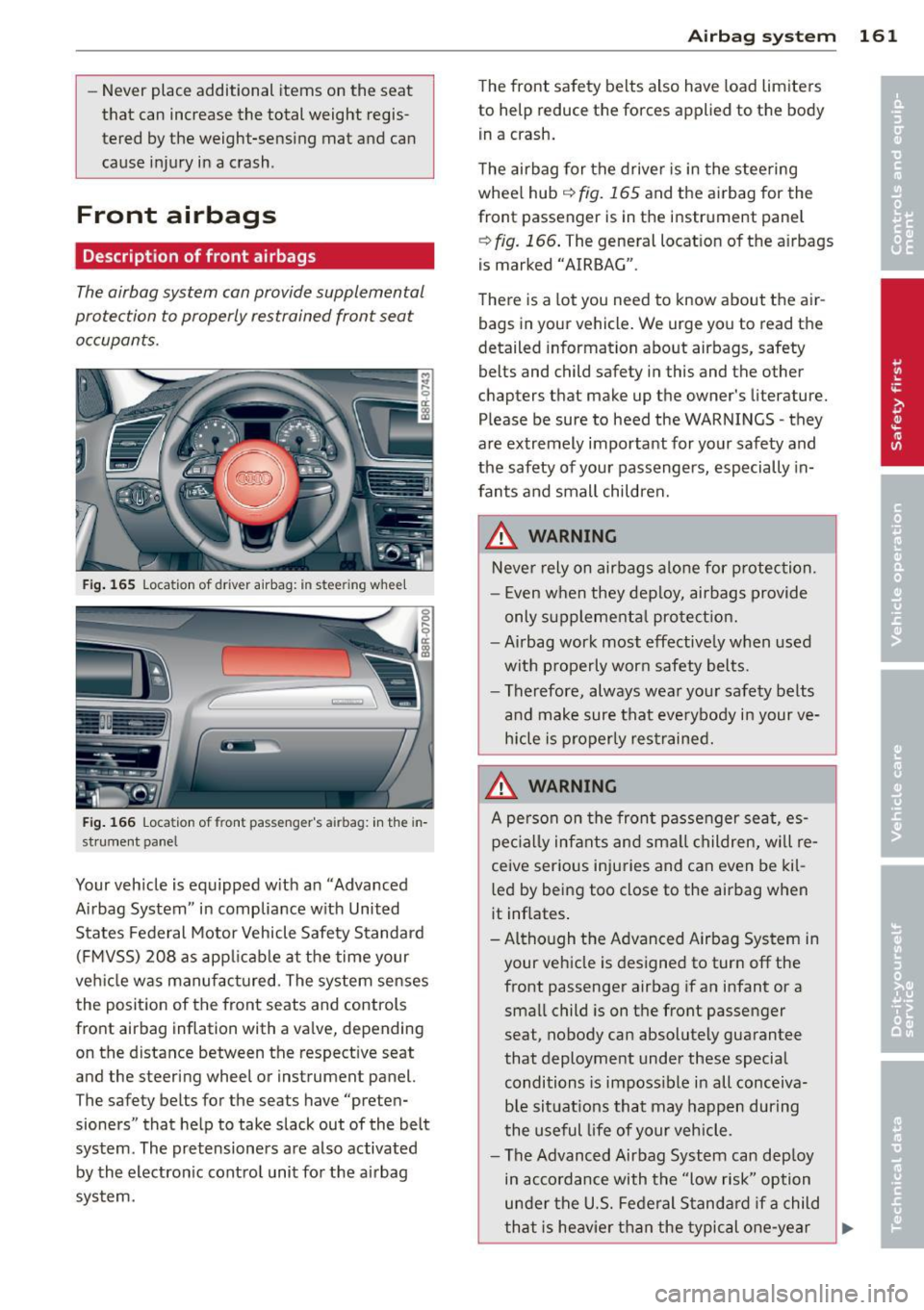
F ig . 165 Location of driver airbag: in steer ing whee l
Fig. 166 Location of front passenger's airbag: in the in
st rument panel
Your veh icle is equipped w ith an "Advanced
Ai rbag System" in compliance with United
States Federal Motor Vehicle Safety Standard (F MVSS) 208 as app licab le at the time your
ve hicle w as manufac tured. The system senses
the position of the front seats and controls
front airbag inflation with a va lve, depending
on the distance between the respect ive seat
and the steering wheel or instrument panel.
The safety belts for the seats have "preten
sioners" that he lp to take slack out of the belt
system . The pretensioners are also activated
by the electron ic contro l unit for the airbag
sys tem.
A irba g sy stem 161
The front sa fety belts also have load limiters
to help reduce the forces applied to the body
in a crash .
T he airbag for the drive r is in the stee ring
whee l hub
q fig. 1 65 and the airbag for the
front passenger is in the instrument panel
~fig. 166 . The general locat ion of the a irbags
is marked "AIRBAG".
There is a lot you need to know about the ai r
bags in your vehicle . We urge you to read t he
detailed information about airbags, safety
belts and child safety i n this and the other
chapters that make up the owner's literature. Please be sure to heed the WARNINGS -they
are extremely important for your safety and
the safety of yo ur passengers, especially in
fants and small children.
_&. WARNING
N ever rely on airbags alone for protec tion.
- E ven w hen they deploy, airbags provide
only s uppleme nta l pro tect ion .
- Airbag work most effective ly when used
wit h properly wor n safety belts.
- Therefore, always wea r you r safe ty belts
and make sure that eve rybody i n your ve
hicle is p rope rly res trained.
_&. WARNING
A pe rson on the fron t passe nger seat, es
pe cial ly infants and sma ll children, will re
ceive serious injuries and can even be kil l ed by being too close to the airbag when
it inflates .
- Altho ugh the Advanced Airbag System in
your veh icle is designed to tur n off the
front passenge r airbag if an infant or a
small child is on the front passenger
seat, nobody can absolutely guarantee
that deployment under these specia l
conditions is imposs ible in all conceiva
b le sit uat ions that may happen during
t he useful life of your vehicle.
- The Advanced Airbag System can dep loy
in acco rdance with t he "low risk" option
un der the U.S. Fede ral Standa rd if a child
that is he avie r than the typical one-year
-
..
Page 164 of 316
162 Airbag system
old child is on the front passenger seat
and the other conditions for airbag de
ployment are met .
- Accident statistics have shown that chil
dren are generally safer in the rear seat
area than in the front seating position.
- For their own safety, all children, espe cially 12 years and younger, should al
ways ride in the back properly restrained
for their age and size.
Advanced front airbag system
Your vehicle is equipped with a front Advanced
Airbag System in compliance with United
States Federal Motor Vehicle Safety Standard
208 as applicable at the time your vehicle was
manufactured.
The front Advanced Airbag System supple ments the safety belts to provide additional
protection for the driver's and front passeng
er's heads and upper bodies in frontal crashes .
The airbags inflate only in frontal impacts
when the vehicle deceleration is high enough.
The front Advanced Airbag System for the
front seat occupants is not a substitute for
your safety belts. Rather, it is part of the over
all occupant restraint system in your vehicle.
Always remember that the airbag system can
only help to protect you , if you are sitting up
right, wearing your safety belt and wearing it
properly . This is why you and your passengers
must always be properly restrained, not just
because the law requires you to be.
The Advanced Airbag System in your vehicle has been certified to meet the "low risk" re
quirements for 3 and 6 year-old children on
the passenger side and very small adults on
the driver side . The low risk deployment crite
ria are intended to help reduce the risk of in
jury through interaction with the front airbag
that can occur, for example , by being too
close to the steering wheel and instrument panel when the airbag inflates.
In addition, the system has been certified to
comply with the "suppression" requirements of the Safety Standard
, to turn
off the front
airbag for infants 12 months old and younger
who are restrained on the front passenger
seat in child restraints that are listed in the
Standard
¢ page 180, Child restraints and
Advanced Airbags .
"Suppression" requires the front airbag on the
passenger side to be turned
off if:
- a child up to about one year of age is re
strained on the front passenger seat in one
of the rear-facing or forward-facing infant restraints listed in Federal Motor Vehicle
Safety Standard 208 with which the Ad
vanced Airbag System in your vehicle was
certified . For a listing of the child restraints
that were used to certify your vehicle's com pliance with the US Safety Standard
¢page 180,
-weight less than a threshold level stored in
the control unit is detected on the front pas
senger seat.
When a person is detected on the front pas
senger seat, weighing more than the total
weight of a child that is about 1 year old re
strained in one of the rear-facing or forward
facing infant restraints (listed in Federal Mo
tor Vehicle Safety Standard 208 with which
the Advanced Airbag System in your vehicle
was certified), the front airbag on the passen ger side may or may not deploy.
The
PASSENGER AIR BAG OFF light comes on
when the electronic control unit detects a to
tal weight on the front passenger seat that re
quires the front airbag to be turned
off. If the
PASSENGER AIR BAG OFF light does not
come on, the front airbag on the passenger
side has not been turned
off by the control
unit and can deploy if the control unit senses
an impact that meets the conditions stored in
its memory.
If the total weight on the front passenger
seat is more than that of a typical 1 year-old ,
but less than the weight of a small adult, the
front airbag on the passenger side may deploy
(the
PASSENGER AIR BAG OFF light does not
come on).
ll-
Page 166 of 316
164 Airbag sys te m
- Always move the passenger seat into its
rearmost position in the seat's fore and
aft adjustment range, as far away from
the a irbag as poss ible, before insta lling
the forward-facing child restraint. The backrest must be adjusted to an upr ight
posit ion.
- Make sure that the
PASSENGER AIR BAG
OFF
light comes on and stays on all the
t ime w henever the ignition is switched
on.
Advanced Airbag System components
The fron t passenger sea t in your vehicle h as a
lot of very important par ts of the Advanced
Airbag System in it. These parts include t he
weight -sensing mat, sensors, wiring, brack
ets, and more. The function of the system in
the front passenger seat is checked by the
e lectronic control un it when the ignit ion is on.
The control unit mon itors the Advanced Air
bag System and turns the airbag indicator
l ight on when a ma lfunction in t he system
components is detected. The func tion of the
a ir bag ind icator light is described in greater
detai l be low . Because the front passenger
seat contains important parts of the Ad
vanced A irbag System, you m ust take care to
prevent it from be ing damaged. Damage to
the seat may prevent the Advanced Airbag for
the front passenger seat from doing its job in
a crash .
The front Advanced Airb ag Sy stem
consists of the following:
- Crash sensors in the front of the veh icle that
measure veh icle acceleration/deceleration
to provide information to the Advanced Air
bag System abou t the seve rity of the crash.
- An electron ic co ntrol unit, with integ rated
crash sensors for front and side impacts .
T he cont ro l unit "dec ides " w het her to fire
the front airbags based on the information
received from the crash senso rs . The contro l
unit a lso "decides" whethe r the safety be lt
pretensioners should be activated . -
An Advanced A irbag w ith gas generator and
cont ro l valve for the d river inside the steer
ing wheel h ub.
- An Advanced A irbag with gas ge nerator and
contro l valve inside the instrument pane l for
the front passenger.
- A weight-sensing mat under the up ho lstery
pad ding of the front passenger seat cushion
that measures the total weight on the seat.
The informat ion registered is sent continu
ously to the electronic contro l unit to regu
late deployment of the front Advanced Air bag on the passenger side .
- An airbag monitor ing system and i ndicator
light in the i nstr ument cluster ~
page 168 .
-A sensor in each front seat registers the dis
tance between the respective seat a nd the
steer ing whee l o r i ns trument panel. The i n
formation registered is sent cont inuously to
t he ele ctr onic cont ro l uni t to regula te de
p loyment o f the front Advance d Airbags .
- The
PASSENGER AIR BAG OFF ligh t comes
on and st ays on in the cen ter o f the instr u
ment panel
~ page 168, fig . 168 and tells
you whe n the front Advanced Airbag on the
passenger side has been tu rned off .
- A sensor below the safety be lt latch for the
front seat passenger to measure the tension on the safety be lt . The tension on the safety
be lt and the weight registered by the
weight-sensing mat he lp the control unit
"decide" whether the front airbag for the
front passenger seat should be turned off or
not
~ pag e 158, Child restraints on the
front seat -some important things to
know.
- A senso r in the safety belt latch fo r th e d riv
er and fo r the front sea t passenger tha t
senses w het he r th at safety bel t is latched or
not and transmi ts this information to the
electronic control unit.
A WARNING
Damage to the front passenger seat can
p revent the front airbag from work ing
properly.
-
Page 167 of 316
-Improper repair or disassembly of the
front passenger and driver seat will pre
vent the Advanced Airbag System from
functioning properly .
- Repairs to the front passenger seat must
be performed by qualified and properly
trained workshop personnel.
- Never remove the front passenger or
driver seat from the vehicle .
- Never remove the upholstery from the
front passenger seat .
- Never disassemble or remove parts from
the seat or disconnect wires from it.
- Never carry sharp objects in your pockets
or place them on the seat. If the weight
sensing mat in the passenger seat is
punctured it cannot work properly.
- Never carry things on your lap or carry
objects on the passenger seat . Such
items can increase the weight registered
by the weight-sensing mat and send the
wrong information to the airbag control
unit.
- Never store items under the front pas
senger seat. Parts of the Advanced Air
bag System under the passenger seat
could be damaged, preventing them and
the airbag system from working proper
ly.
- Never place seat covers or replacement
upholstery that have not been specifical
ly approved by Audi on the front seats.
- Seat covers can prevent the Advanced
Airbag System from recognizing child re
straints or occupants on the front pas
senger seat and prevent the side airbag in the seat backrest from deploying prop
erly.
- Never use cushions, pillows, blankets or
similar items on the front passenger
seat . The additional padding will prevent
the weight-sensing mat in the seat from
accurately registering the child restraint
or person on the seat and prevent the
Advanced Airbag System from function
ing properly.
- If you must use a child restraint on the
front passenger seat and the child re-
Airbag system 165
straint manufacturer's instructions re
quire the use of a towel, foam cushion or
something else to properly position the
child restraint, make certain that the
PASSENGER AIR BAG OFF light comes
on and stays on whenever the child re
straint is installed on the front passen
ger seat.
- If the
PASSENGER AIR BAG OFF light
does not come on and stay on, immedi
ately install child restraint in a rear seat
ing position and have the airbag system
inspected by your authorized Audi dealer .
How the Advanced Airbag System
components work together
The front Advanced Airbag System and the
side airbags supplement the protection of
fered by the front three-point safety belts
with pretensioners and load limiters and the
adjustable head restraints to help reduce the
risk of injury in a wide range of accident and
crash situations. Be sure to read the impor
tant information about safety and heed the
WARNINGS in this chapter.
Deployment of the Adv a need Airbag System
and the activation of the safety belt preten
sioners depend on the deceleration measured
by the crash sensors and registered by the
electronic control unit. The amount of infla
tion of the front airbags can also be adapted
to the front sea t position, depending on the
distance between the respective front seat
and the steering wheel or instrument panel as registered by sensors in the seats. Crash se
verity depends on speed and deceleration as
well as the mass and stiffness of the vehicle
or object involved in the crash.
On the passenger side, regardless of safety
belt use, the airbag will be turned off if the
weight on the passenger seat is less than the
amount programmed in the electronic control
unit. The front airbag on the passenger side
will also be turned off if one of the child safe-
ty seats that has been certified under Federal
Motor Vehicle Safety Standard 208 has been
recogni zed on the seat . The
PASSENGER AIR .,,.
•
•
Page 169 of 316
must always sit in an upright position,
must not lean against or place any part
of their body too close to the area where
the airbags are located .
- Occupants who are unbelted, out of posi
tion or too close to the airbag can be se riously injured by an airbag as it unfolds
with great force in the blink of an eye
~ page 158.
A WARNING
A child in a rearward-facing child safety
seat installed on the front passenger seat
will be seriously injured and can be killed if
the front airbag inflates -even with an Ad
vanced Airbag System.
- The inflating airbag will hit the child
safety seat or infant carrier with great
force and will smash the child safety seat
and child against the backrest, center
armrest, door or roof.
- Always install rear-facing child safety
seats on the rear seat.
- If you must install a rearward facing
child safety seat on the front passenger
seat because of exceptional circumstan
ces and the
PASSENGER AIR BAG OFF
light does not come on and stay on, im
mediately install the rear-facing child
safety seat in a rear seating position and
have the airbag system inspected by your
authorized Audi dealer .
A WARNING
Objects between you and the airbag will
increase the risk of injury in a crash by in
terfering with the way the airbag unfolds
or by being pushed into you as the airbag
inflates.
- Never hold things in your hands or on
your lap when the vehicle is in use.
- Never transport items on or in the area
of the front passenger seat. Objects
could move into the area of the front air
bags during braking or other sudden ma
neuver and become dangerous projec-
Airbag system 167
tiles that can cause serious personal in
jury if the airbags inflate.
- Never place or attach accessories or oth
er objects (such as cupholders, tele phone brackets, large, heavy or bulky ob
jects) on the doors, over or near the area marked "AIRBAG" on the steering wheel,
instrument panel, seat backrests or be
tween those areas and yourself. These
objects could cause injury in a crash, es
pecially when the airbags inflate.
- Never recline the front passenger's seat
to transport objects. Items can also
move into the area of the side airbag or
the front airbag during braking or in a
sudden maneuver. Objects near the air bags can become projectiles and cause
injury, particularly when the seat is re
clined.
A WARNING
The fine dust created when airbags deploy
can cause breathing problems for people
with a history of asthma or other breath ing conditions.
- To reduce the risk of breathing problems,
those with asthma or other respiratory
conditions should get fresh air right
away by getting out of the vehicle or
opening windows or doors.
- If you are in a collision in which airbags
deploy, wash your hands and face with mild soap and water before eating.
- Be careful not to get the dust into your
eyes, or into any cuts or scratches .
- If the residue should get into your eyes,
flush them with water. •
•
Page 173 of 316
There are some important things you have to know to make sure that the effectiveness of
the system will not be impaired and that dis
carded components do not cause injury or pol
lute the environment.
A WARNING
Improper care, servicing and repair proce
dures can increase the risk of personal in
jury and death by preventing an airbag from deploying when needed or deploying an airbag unexpectedly:
- Never cover, obstruct, or change the
steering wheel horn pad or airbag cover
or the instrument panel or modify them
in any way.
- Never attach any objects such as cu
pholders or telephone mountings to the
surfaces covering the airbag units.
- For cleaning the horn pad or instrument
panel, use only a soft, dry cloth or one
moistened with plain water. Solvents or
cleaners could damage the airbag cover
or change the stiffness or strength of the
material so that the airbag cannot de
ploy and protect properly.
- Never repair, adjust, or change any parts
of the airbag system.
- All work on the steering wheel, instru
ment panel, front seats or electrical sys
tem (including the installation of audio
equipment, cellular telephones and CB
radios, etc.) must be performed by a
qualified technician who has the training
and special equipment necessary.
- For any work on the airbag system, we
strongly recommend that you see your
authorized Audi dealer or qualified work
shop.
- Never modify the front bumper or parts
of the vehicle body.
- Always make sure that the side airbag
can inflate without interference:
- Never install seat covers or replace
ment upholstery over the front seat
backs that have not been specifically
approved by Audi.
Airbag system 171
-Never use additional seat cushions that
cover the areas where the side airbags
inflate.
- Damage to the original seat covers or
to the seam in the area of the side air
bag module must always be repaired
immediately by an authorized Audi
dealer.
- The airbag system can be activated only
once. After an airbag has inflated, it
must be replaced by an authorized Audi
dealer or qualified technician who has
the technical information, training and
special equipment necessary.
- The airbag system can be deployed only
once. After an airbag has been deployed, it must be replaced with new replace
ment parts designed and approved espe
cially for your Audi model version. Re placement of complete airbag systems
or airbag components must be per
formed by qualified workshops only.
Make sure that any airbag service action
is entered in your Audi Warranty
& Main
tenance booklet under
AIRBAG REPLACE
MENT RECORD.
- In accidents when an airbag is deployed,
the vehicle battery separates the alterna
tor and the starter from the vehicle elec
trical system for safety reasons with a
pyrotechnic circuit interrupter.
- Work on the pyrotechnic circuit inter
rupter must only be performed by a
qualified dealer - risk of an accident!
- If the vehicle or the circuit interrupter
is scrapped, all applicable safety pre
cautions must be followed.
{® For the sake of the environment
Undeployed airbag modules and preten
sioners might be classified as Perchlorate Material -special handling may apply, see
www.dtsc .ca.gov/hazardouswaste/per-
ch lorate. When the vehicle or parts of the
restraint system including airbag modules
safety belts with pretensioners are scrap ped, all applicable laws and regulations
must be observed. Your authorized Audi .,..
•
•
Page 178 of 316
17 6 Airbag syst em
in a side collision. The side curtain airbag in
f lates in side impacts and on ly when the vehi
cle acce lerat ion reg istered by the contro l unit
is high enough. If this rate is below the refer
ence value programmed into the control unit,
the side airbags will not be triggered, even
though the car may be badly damaged as a re
sult of the collision.
It is not possible to de
fine an a irbag tr igger ing range that will cover
every possible angle of impact, since the c ir
cumstances w ill vary considerably between
one co llision and another . Important factors
include, for examp le, the nat ure (hard or soft)
of the impacting object, the ang le of impact,
vehicle speed, etc.
c:> page 176, How side cur
tain airbags work.
Aside from their normal safety function, safe
ty belts work to he lp keep the driver or front
passenger in position in the event of a co lli
sion so that the side curtain airbags can pro
vide p rotection.
The airbag system is not a subst itute for your
safety belt. Rather, it is part of the overall oc
cupant restraint system in your veh icle. Al
ways remember that the airbag system can
only help to protect you if you are wea ring
your safety be lt and wear ing it prope rly. This
i s ano ther reason why you shou ld always wear
your safety be lts, not jus t be ca use the law re
qu ires you to do soc;,
page 149, General
notes.
It
is important to remember that whi le the
side curtain a irbag sys tem is designed to he lp
reduce the like lihood o f serious injuries, other
inj uries, for example, swelling, bruising, and
minor abrasions can also be associated with
these airbags. Remember too, these airbags
will dep loy only once and only in certain k inds
of acc idents - your safety belts are always
there to offer protection.
The side curtain airb ag system b asic all y
consists of:
- The electronic control module and externa l
s ide impact sensors
- The side curtai n airbags above the front and
rear side w indows -
The airbag indicator light in the instrument
panel
T he airbag system is mo nitore d elec tronically
to make certain i t is func tioning properly at all
t imes . Each t ime yo u turn on the ignition, the
airbag system indicator light will come on for
a few seconds (sel f diagnostics).
The side curtain airbag is not activated:
- if the ignition is tur ned off,
- in side co llisions whe n the accele ration
mea sured by the sensor is too low,
- in rear-end col lisions.
A WARNING
- Safety belts and the airbag system will
only provide pro te ction when occupant s
are i n the proper seating posi tion
c:>page 61, General recommendations.
- If th e airbag ind ic a tor light c:>page 16
comes when the veh icle is being used,
have the system ins pected immediately
by your authorized A udi dealer. It is pos
sible that the airbag will inflate when it
is not supposed to, or will not inflate
when it should.
How side curtain airbags work
Side curtain airbags can work together with
side airbags to help reduce the risk of head
and upper torso injuries for occupants who
are properly restrained.
Fi g. 172 Illustration of p rinciple: I nflated side curtai n
a irbags on the left side
The side c urtain airbags inflate be tween the
occupant and the windows on the s ide of the
Ill-
Page 181 of 316
-Always install rear-facing child safety
seats on the rear seat.
- If you must install a rearward facing
child safety seat on the front passenger
seat in exceptional circumstances and
the
PASSENGER AIR BAG OFF light does
not come on and stay on, immediately
install the rear-facing child safety seat in
a rear seating position and have the air
bag system inspected immediately by
your Audi dealer.
_& WARNING
If, in exceptional circumstances, you must
install a forward-facing child restraint on
the front passenger's seat:
- Always make sure the forward-facing
seat has been designed and certified by its manufacturer for use on a front seat
with a passenger front and side airbag.
- Always follow the manufacturer's in
structions provided with the child safety
seat or carrier.
- Always move the passenger seat into its
rearmost position in the seat's fore and
aft adjustment range, as far away from
the airbag as possible before installing
the child restraint. The backrest must be
adjusted to an upright position .
- Always make sure that the
PASSENGER
AIR BAG OFF
light comes on and stays
on all the time whenever the ignition is
switched on.
(D Tips
Always replace child restraints that were
installed in a vehicle during a crash. Dam
age to a child restraint that is not visible
could cause it to fail in another collision
situation.
Advanced front airbag system and children
Your vehicle is equipped with a front "Ad
vanced Airbag System" in compliance with United States Federal Motor Vehicle Safety
Child Safety 1 79
Standard (FMVSS) 208 as applicable at the
time your vehicle was manufactured.
The Advanced Airbag system in your vehicle
has been certified to meet the "low-risk" re
quirements for 3- and 6-year old children on
the passenger side and small adults on the driver side. The low risk deployment criteria
are intended to reduce the risk of injury
through interaction with the airbag that can
occur, for example, by being too close to the
steering wheel and instrument panel when
the airbag inflates . In addition, the system
has been certified to comply with the "sup
pression" requirements of the Safety Stand
ard, to turn off the front airbag for infants up
to 12 months who are restrained on the front
passenger seat in child restraints that are list
ed in the Standard.
Even though your vehicle is equipped with an
Advanced Airbag system, all children, espe cially those 12 years and younger, should al
ways ride in the back seat properly restrained
for their age and size. The airbag on the pas
senger side makes the front seat a potentially dangerous place for a child to ride . The front
seat is not the safest place for a child in a for
ward-facing child safety seat. It can be a very
dangerous place for an infant or a larger child
in a rearward-facing seat .
Advanced Airbags and the weight
sensing mat in the front seat
The Advanced Airbag System in your vehicle
detects the presence of an infant or child in a
child restraint on the front passenger seat us
ing the weight -sensing mat in the seat cush
ion and the sensor below the safety belt latch
on the front passenger seat that measures the
tension on the safety belt.
The weight -sensing mat measures total
weight of the child and the child safety seat
and a child blanket on the front passenger seat. The weight on the front passenger seat
is related to the design of the child restraint
and its "footprint", the size and shape of the
bottom of the child restraint as it sits on the ..,.
•
•
Page 233 of 316
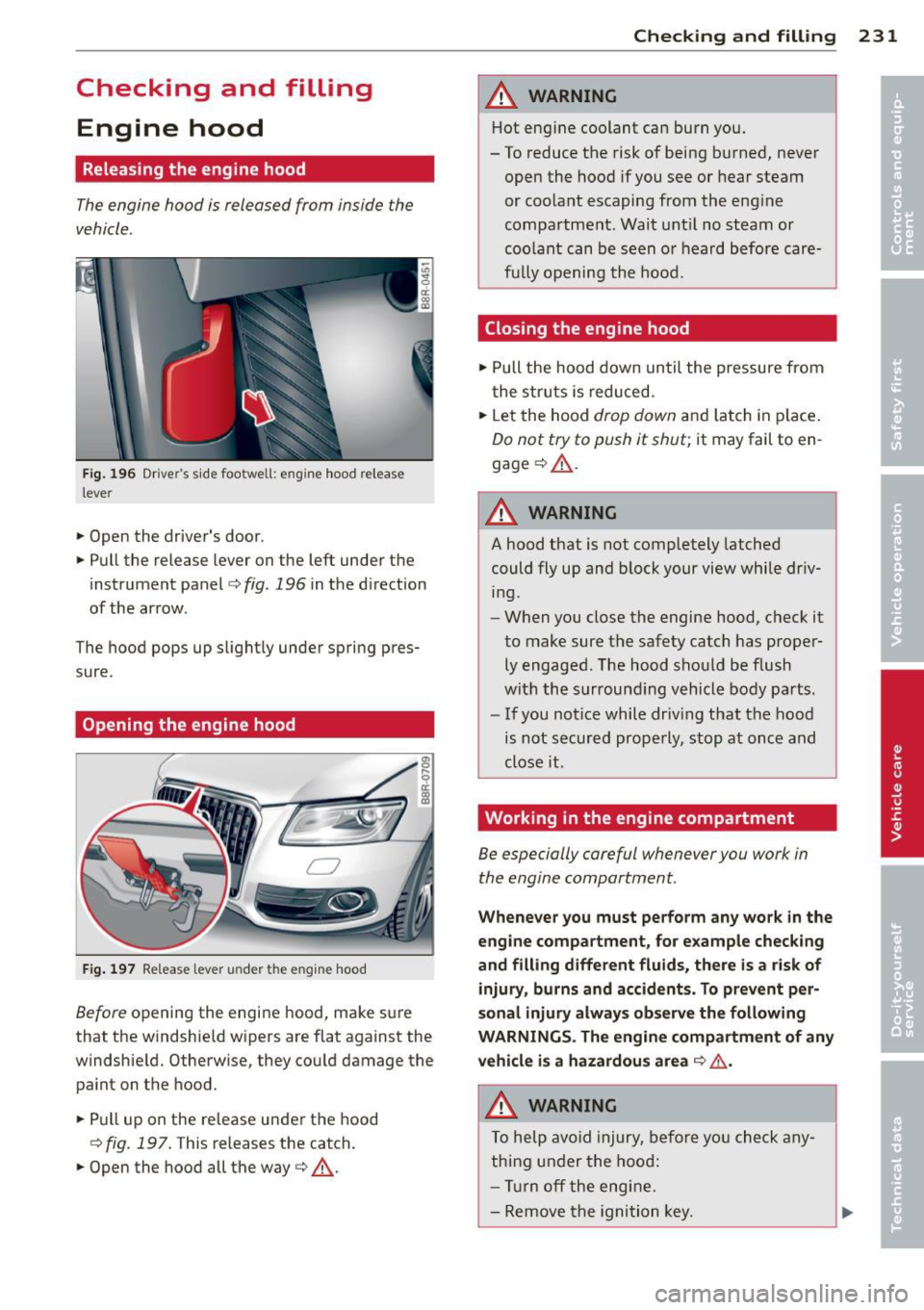
Checking and filling Engine hood
Releasing the engine hood
The engine hood is released from inside the
vehicle .
Fig. 196 Dr iver's side footwell: engin e hood release
lever
"' Open the driver's door .
"' Pull the release lever on the left under the
instrument panel
i=> fig. 196 in the d irection
of the arrow .
The hood pops up slightly under spring pres
sure.
Opening the engine hood
F ig . 197 Release lever under the engine hood
Before opening the engine hood, make sure
that the windshield wipers are flat against the
windshie ld. Otherwise, they could damage the
paint on the hood.
"' Pull up on the release under the hood
r::!> fig . 197 . This releases the catch.
"' Open the hood all the way
i=> .&,.
Checkin g and fillin g 231
A WARNING
Hot engine coolant can burn you.
- To reduce the risk of being burned, never
open the hood if you see or hear steam
or coolant escaping from the eng ine
compartment . Wait unt il no steam or
coolant can be seen or heard before care
fu lly opening the hood.
Closing the engine hood
"' Pull the hood down until the pressure from
the struts is reduced.
"' Let the hood
drop down and latch in p lace.
Do not try to push it shut; it may fail to en
gage
c;, .&, .
A WARNING
--
A hood that is not completely latched
could fly up and block your view while dr iv
ing.
- When you close the engine hood, check it
to make sure the safety catch has proper
ly engaged. The hood should be flush
with the surround ing vehicle body parts.
- If you notice while driv ing that the hood
is not secured properly, stop at once and
close it .
Working in the engine compartment
Be especially careful whenever you work in
the engine compartment.
Whenever yo u must pe rform any w ork in the
e n g ine com pa rt ment, for e xample ch ecki ng
and filling different fluids, th ere is a risk of
injury , burn s and accid ent s. T o pr eve nt per
so nal injury alwa ys obs erve the foll owing
WARNINGS . The en gine c ompa rtment of an y
vehicl e is a hazardou s are a
c;, Lh,.
A WARNING ~
To help avoid injury, be fo re you check any
thing under the hood:
- Turn off the engine.
- Remove the ignition key.
Page 282 of 316
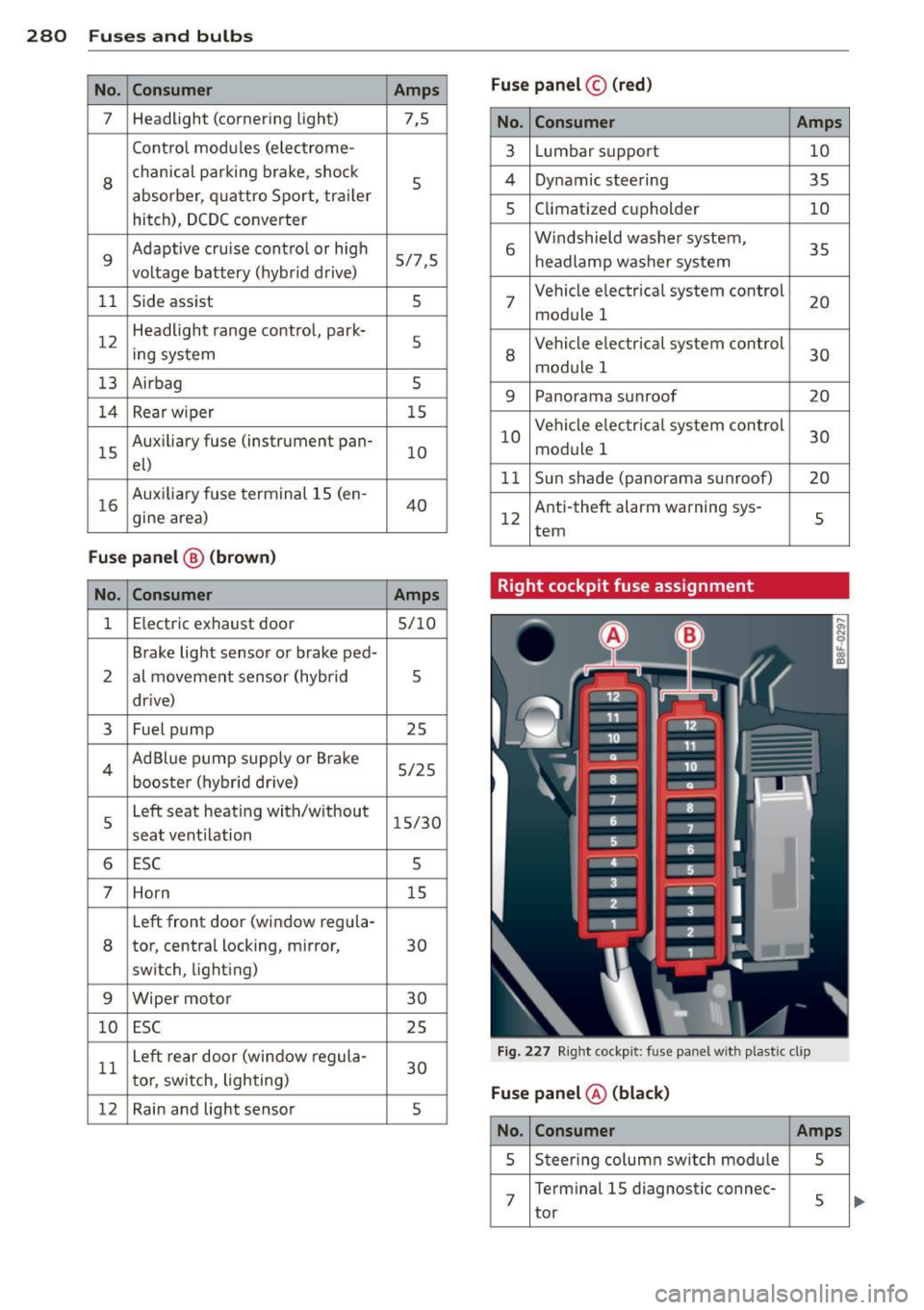
280 Fuses and bulbs
No. Consumer Amps Fuse panel
© (red )
7 Headlight (corner
ing light)
7,5 No. Consumer Amps
Contro l modu les (e lec trome-
3 Lum bar s upport 10
8
chanic al par king br ake, sho ck
5
absorber, q uatt ro Spor t, tra ile r
hitch), DCDC converter 4
Dynamic stee ring
35
5 Climat ized cu pholder 10
9
Adaptive cruise contro l or hig h
5/7,5
vo ltage battery (hybr id d rive) 6
W indshield w asher system,
35
h eadlamp washer sys tem
1 1 Side ass ist 5
7 Vehicle e
lectrical system control
20
module 1
12 H
eadlight range contro l, par k·
5
ing sys tem
8
Ve hicle e lec tric al syste m control
30
mod ule 1
13 Airbag
5
9 Panorama sunroof
20
1 4 Rear wiper 15
1 5 Aux
iliary fuse (instrument pan·
10
el)
16
Auxi liary fuse term inal 15 (en -
40
gine area) 10
Vehicle e
lectrica l system control
30
module 1
1 1 Sun shade (panorama s unroof) 20
1 2 Anti-theft alarm warning sys·
s
tern
Fuse panel
@ (brown)
No. Consumer Amps Right cockpit fuse assignment
1 Electric exhaust door
5/10
Brake lig ht sensor o r brake ped·
2 al movem ent s ensor (hybrid 5
dr ive)
3 Fuel pump 25
4 AdBl
ue p ump supp ly o r Br ake
5/25
booste r (hybr id drive)
5 Left seat heati
ng wit h/w ithout
15/30
seat vent ilation
6 ESC 5
7 Horn 15
Left front door (window regula ·
8 tor, central locking, m irror,
30
sw itch, light ing)
9 Wipe r moto r 30
10 ESC 25
11 Le
ft r ear do or (win dow regul a-
30
t o r, sw itch, lighting)
12 Rain and light se
nso r
5
Fig. 22 7 Right cockp it: fuse panel wit h plast ic clip
Fuse panel ® (black)
No. Consumer Amps
5 Steering column sw itch mod ule s
7
Terminal 15 diagnostic connec·
tor
5