fuel AUDI Q5 2014 Owner's Manual
[x] Cancel search | Manufacturer: AUDI, Model Year: 2014, Model line: Q5, Model: AUDI Q5 2014Pages: 316, PDF Size: 78.41 MB
Page 208 of 316
206 Driving and en vir onm ent
Catalytic converter
Appl ies to vehicles: with gasoline e ngin e
It is very important that your emission con
trol system (catalytic converter) is function
ing properly to ensure that your vehicle is run
ning in an environmentally sound manner .
.. Always use lead-free gasoline i=> page 222,
Gasoline .
.. Never run the tank down all the way to emp-
ty .
.. Never put too much motor oil in your engine
¢ page 236, Adding engine oil 'l=r. .
.. Never try to push- or tow-start your veh icle.
The catalytic converter is an eff ic ient "clean
up" device built into the exhaust system of
the vehicle. The catalyti c converter burns
many of the pollutants in the exhaust gas be
fore they are released into the atmosphere.
The exclus ive use of unleaded fuel is cr itically
important for the l ife of the cata lytic convert
e r and proper functioning of the engine.
A WARNING
T he temperature o f the exhaust system is
high, both when driving and after stopping
the engine .
- Never touch the exhaust tail pipes once
they have become hot. This could result
in burns.
- Do not park or operate the vehicle in
areas where the hot exhaust system may
come in contact with dry grass, brush,
fuel spill or other material which can
cause a fire.
- Do not apply additional undercoating or
rustproofing on or near the exhaust
man ifold, exhaust p ipes, catalytic con
verter or heat sh ields . During driving, the
substance used for u ndercoating cou ld
overheat and cause a fire.
@) Note
- Be aware that just one tank f illing with
leaded fuel will already seriously de
grade the perfo rmance of the cata lytic
conve rter. -
Do not exceed the correct engine oil level
i=>page 236.
-Do not drive until the fue l tank becomes
completely empty . The engine co uld m is
fire . Unburned fuel could also get into
the exhaust system and this cou ld cause
the catalytic converter to overheat.
- Do not turn off the ignition while the ve
hicle is mov ing .
- Do not continue to ope rate your vehicle
under these conditions, as otherwise fuel
can reach the catalyt ic converter. Th is
cou ld result in overheating of the con
verter, requir ing its replacement .
- To assure efficient operation of the Emis
sion Control System:
- Have you r vehicle maintained p roperly
and in accordance w ith the service rec
ommendations in your Warranty & Maintenance book let.
- Lack of prope r maintenance as we ll as
improper use of the vehicle wi ll impair
the function of the em ission contro l
system and could lead to damage.
@) For the sa ke of the en vironment
Even when the Emission Control System is
ope rat ing properly, the exhaust gas can
have a sulfur-like exhaust gas smell under
some operat ing states. This depends on
the sulfur content of the fuel being used .
Usi ng a different brand of fuel may help,
or f illing the tank with lead-free super
grade gasoline.
Diesel particulate filter
Applies to vehicles: with diese l eng ine
The diesel part icu late filter filters nearly all of
the soot pa rticles out of the exhaust . T he fil
te r cleans itself automat ica lly unde r no rma l
dr iv ing cond itions . If the filte r cannot clean it
self (for example, because you are on ly driving
short distances), the filter becomes clogged
with soot and the
II symbol for the diesel
particulate filter i lluminates
i=> page 34. ..,.
Page 209 of 316
A WARNING ,~
- Do not park your vehicle over flammable
materials such as grass or leaves because
the high temperature of the diesel par
t icu late filter could start a fire .
- Do not apply an underbody protectant in the exhaust system area or a fire could sta rt.
Avoid damaging the
vehicle
When you are driving on poor roads, o r over
curbs, steep ramps, etc., make ce rtain that
l ow -lying parts such as spoi lers and exhaust
system parts do not bottom out and get dam
aged.
This is especially true for vehicles with low
slung chassis (sports chassis)* and f ully load
ed vehicles.
Shutting down vehicle
I f you wou ld like your veh icle to remain inop
erative for a longer period of time, contact an
Audi or other specialized dealer. They can ad
vise you on necessary precautions e.g . corro
sion prevention, ma intenance and storage.
Pay attention to add itiona l information con
cerning the battery. Refer to
c::> page 242 .
Operate your vehicle
economically and
minimize pollution
General
Your personal style of driving will determine
the economy of your vehicle, as well as ex
haust and noise levels.
Fuel economy, environmental impact, and
wear on your engine, brakes and t ires largely
depend on th ree factors:
- you r persona l dr iving style
- operating conditions
- technica l lim itations
Dri vin g and en vironm ent 207
If you ant ic ipate what you need to do next and
drive economically, yo u can easily cut yo ur
fuel consumpt ion by 10 -15 percent. T his sec
tion w ill give you some tips on how you can
help the env ironment and your pocketbook.
Q) Tips
The consumption estimates as published
by ENVIRONMENTAL PROTECTION AGENCY
(EPA) and Transport Canada may not corre
spond to your actual consumption on the road, which will vary depending upon vehi
cle load and speed, road and weather con
dit ions, t rip leng th, etc.
Drive smoothly and keep a lookout
ahead
Vehicles use the most fuel when they are ac
celerating .
.,. Avo id u nnecessary accelerating and b rak ing.
Vehicles use the most fuel when they are ac
ce le rat ing . If you ant icipate what is going to
happen next, you will need to brake less and,
thu s, acce le rate less. Le t the vehicle coast
whenever possible -for examp le when you see
that the next t raff ic light is re d.
Avoid full throttle
Driving at moderate speeds saves fuel and
improves your mileage.
.,. Try and keep well below your car 's maximum
speed.
Acce le rat ing gently reduces fue l cons ump
tion, eng ine wear, and does not disturb the
environment.
Fuel consumpt ion, exhaust emiss ions and e n
gine noise inc rease disproport ionately at high
speeds . If you driv e at app rox imately th ree
quarte rs of top speed, fuel consumption w ill
be reduced by one ha lf. Never d rive fas ter
t han the pos ted speed limi t and weathe r con
ditions pe rmit.
•
•
Page 210 of 316
208 Driving and environment
Reducing unnecessary idling
Even when your car is just idling it burns up
fuel.
.,. Shut the engine off when you are not driving
the vehicle.
.,. Do not warm up the vehicle by letting the
engine run at idle .
The idling phase is automatically reduced for
vehicles with the Start-Stop -System* . It is ef
fic ient to sw itch
off the eng ine in vehicles
without the Start-Stop-System* when stopped
at railroad crossings and long red lights. Turn
ing the eng ine
off for just 30-40 seconds
saves more fuel than is burned by sta rting the
engine again .
It takes a long time for the engine to wa rm up
fu lly when it is running at idle. However , wear
and nox ious emissions are especially high
when the engine is warming up. So you should
drive away as soon as you start the engine and
avoid running at high rpms while the engine is
still warming up.
(D Note
Do not leave engine idling unattended af
ter starting. If warning lights should come
on to indicate improper operation, they
would go unheeded. Extended idling also
produces heat, which could resu lt in over
heat ing or other damage to the vehicle or
other property .
Regular maintenance
A badly tuned engine unnecessarily wastes a
lot of fuel .
.,. Have your vehicle serviced at regular inter-
vals.
By having your vehicle regularly serviced by an
author ized Audi dealer helps to ensure that it
runs properly and economically . The condition
of your vehicle not only affects its safety and
ab ility to hold its value, it also affects
fuel
consumption. Check
your oil each time you fill your tank.
The amount of oi l used is re lated to engine
load and speed.
It is normal for the oil consumption of a new
engine to reach its lowest value after a certa in
mileage has been driven .
You must drive your veh icle about 3,000 mi les
(5,000 kilometers) before you can properly
assess oil consumpt ion.
This also app lies to fuel consumption and en
gine output .
(0 Note
- Have your veh icle ma inta ined properly
and in accordance with the service rec
ommendations in your Warranty
& Ma in
tenance booklet. Lack of proper ma inte
nance as well as improper use of the ve
hicle will impair the function of the
em iss ion control system and could lead
t o damage.
- Do not alter or remove any component of
the Emission Control System unless ap
proved by the manufacturer.
- Do not alter or remove any device, such
as heat shie lds , switches, ignition wires,
valves, which are designed to protect
your vehicle's Emission Control System
and other important vehicle compo
nents.
' Fewer short trips
Fuel consumption will always be relatively
high on short trips.
... Try to avoid driving sho rt distances w it h a
cold engine .
T he eng ine and catalytic converter have to
reach their optimal
operating temperature to
reduce fuel consumpt ion and nox ious emis
sions effectively.
Jus t after starting, a cold engine in a mid-s ize
car only achieves a fuel economy of 6-8 mi les
per gallon (30 -40 l/100 km). After about a
half a mile, fuel economy climbs to 12 mpg .,..
Page 211 of 316
(20 l/1 00 km) . Afte r abo ut 2. 5 m iles ( 4 km),
the eng ine is at its proper ope rati ng tempera
ture and fue l economy has reached a no rma l
l eve l. So you ca n see that you shou ld avoid
short trips whenever possib le.
The
outside temperature is a lso c ritica l in this
regard. Your car cons umes more fuel in the
winter than in t he summer .
Driving and environment 209
•
•
Page 221 of 316
Vehicle care and cleaning 219
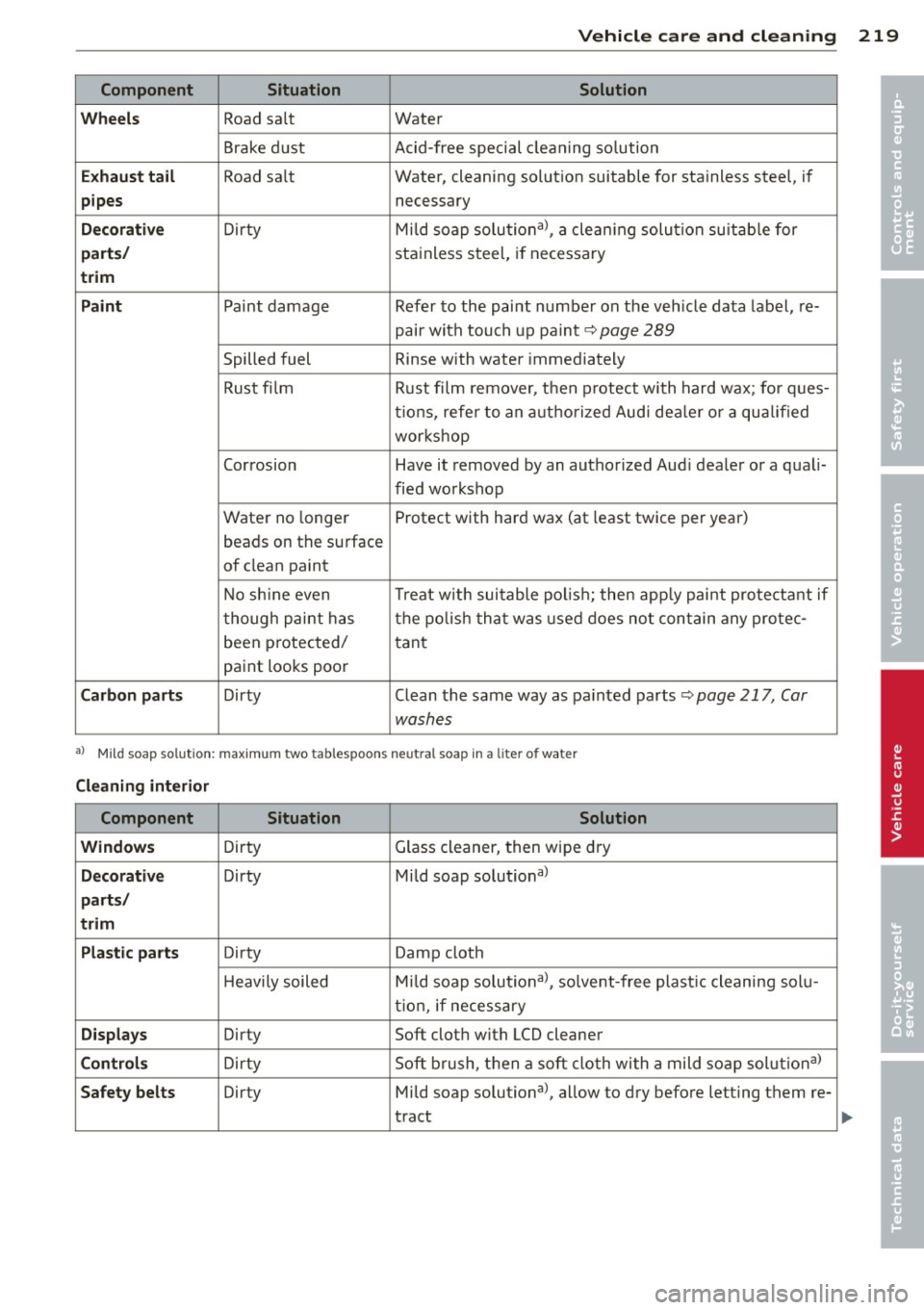
Component Situation Solution
Wheels
Road sa lt Water
Brake dust Acid-free special cleaning solution
Exhaust tail Road salt Water, cleaning solut ion suitable for stainless steel, if
pipes necessary
Decorative Dirty Mild soap
solutional, a cleaning solution suitab le for
parts/ stainless steel, if necessary
trim
Paint
Paint damage Refer to the paint number on the veh icle data label, re-
pair with touch up paint~
page 289
Spilled fuel R inse with water immediately
Rust fi lm Rust film1 remover, then protect with hard wax; for ques-
tions, refer to an authorized Audi dealer or a qualified
workshop
Corrosion Have it removed by an aut horized Audi dealer or a quali-
fied workshop
Water no longer Protect with hard wax (at least twice per year)
beads on th e surface
of clean paint
No shine even Treat
with suitable polish; then apply paint protectant if
though paint has the polish that was used does not contain any protec-
been protected/
tant
paint looks poor
Carbon parts Dirty Clean the same way as pa inted parts ~ page 217, Car
wash es
al Mild soap sol utio n: maximum two tablespoons neutral soap in a lite r of water
Cleaning interior
Component Situation Solution
Windows
D irty Glass
cleaner, then wipe dry
Decorative Dirty Mild soap solutional
parts/
trim
Plastic parts
Dirty Damp cloth
H eavily soiled Mild soap solutional, solvent-free plast ic cleaning solu-
tion, if neces sary
Displays Dirty Soft cloth with LCD cleaner
Controls Dirty Soft
bru5,h, then a soft cloth with a mild soap solut ional
Safety belts Dirty Mild soap solutional, allow to dry befo re letting them re-
tract
•
•
Page 224 of 316
222 Fuel supply and filling your fuel tank
Fuel supply and filling
your fuel tank
Fuel supply
Gasoline
Appl ies to vehicles: with gasoline engine
Using the right fuel helps keep the environ
ment clean and prevents engine damage .
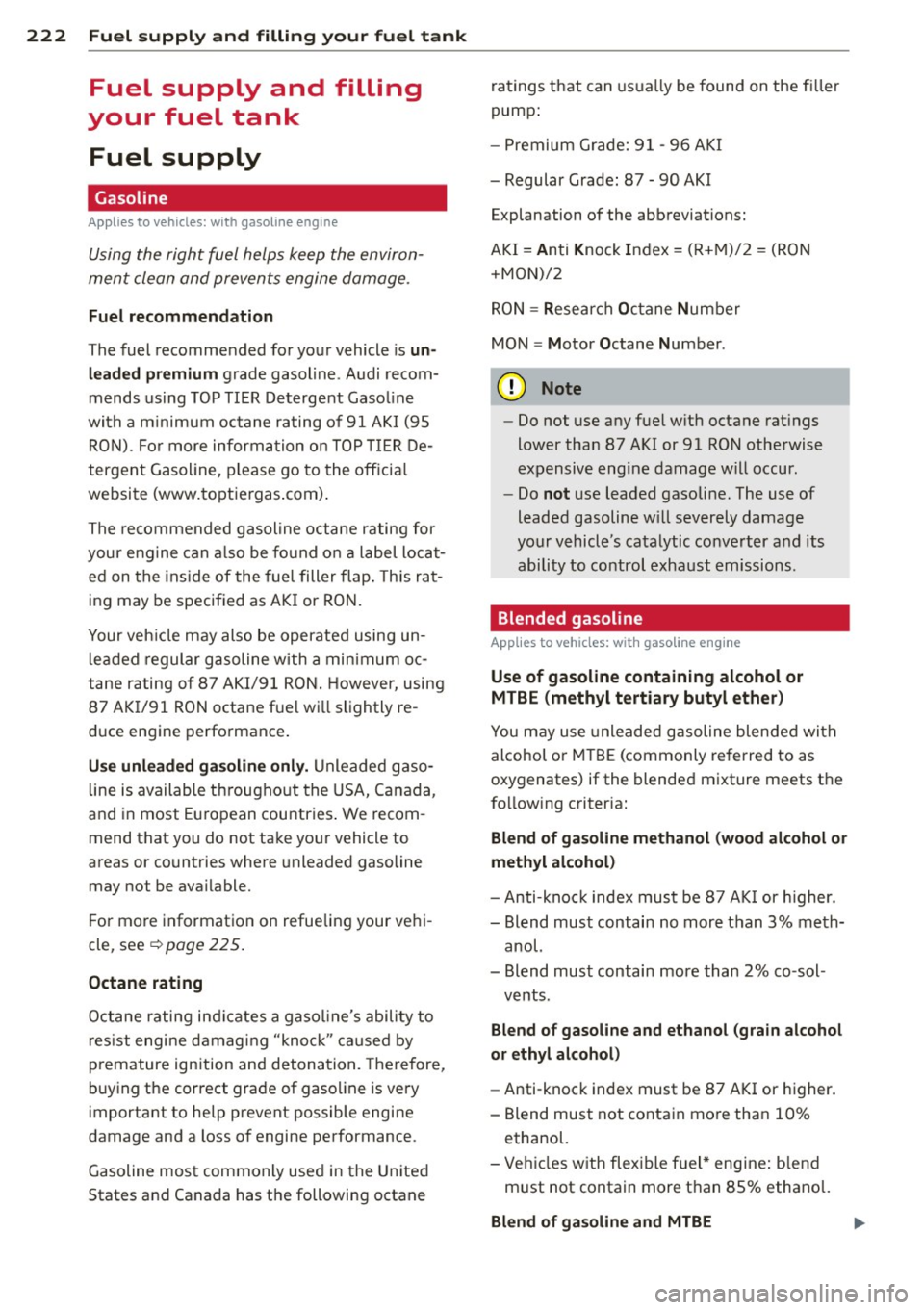
Fuel recommendation
The fuel recommended for yo ur vehicle is un
lead ed premium
grade gasolin e. Audi recom
mends us ing TO P TI ER D ete rgent Gaso line
wi th a m inimum octane ra ting of 91 A KI ( 95
RO N). For more inform ation o n TOP TIER De
tergent Gasoline, p lease go to the off icia l
websi te (www. topt iergas .com) .
T he re commended gasoline octa ne rating for
your engine can also be fo und o n a label loc at
ed on the ins ide of the fue l filler flap . This ra t
in g may be specified as AK I or RO N.
Your veh icle may also be operated u sing un
l eaded regular g asoline with a minimum oc
tane rating of 87 AKI/91 RO N. Howeve r, using
87 AKI/91 RON octa ne fue l wi ll slightly re
d uce eng ine perfo rmance .
Use unleaded ga soline only. Unleaded g aso
li ne is available th rougho ut the USA, Canada,
a nd i n most E uro pean countries . We recom
mend that you do not ta ke yo ur vehicle to
areas or countries where unleaded gasoline
may not be ava ilable.
F or mo re informat io n on refue ling your ve hi
cle, see~
page 225.
Octane rating
Octane rating ind icates a gaso line's ability to
r es ist engine dam ag in g "kno ck" cau sed b y
premature ign ition and detona tion. Therefore,
b uy ing the correct grade of gaso line is very
important to he lp prevent possible engine
damage and a loss o f engine performance.
G asoline mos t commonly used in the Unite d
States and Canada has the following octane r
atings t hat can usu a lly be found on the fi ller
pump:
- Premium Gr ade: 91 -9 6 A KI
- Regular Grade : 87 -90 AKI
Explanation of the abbreviations:
AKI = Anti Knock In d ex = (R+M) /2 = (RO N
+ MON)/2
R ON= Resea rch Octane Number
MON = Motor Octane Num ber.
(D Note
- Do not use a ny fue l w it h octane rat ings
lower tha n 87 A KI or 91 RO N othe rwise
e xpensive engine damage w ill occur.
- Do
not use leaded gasoline. The use of
leaded gasoline w ill severely damage
yo ur v ehicl e's cata lytic co nve rter a nd its
ability to co ntrol exha ust em issions .
Blended gasoline
Applies to vehicles: with gasoline engine
Use of gasoline containing alcohol or
MTBE (methyl tertiary butyl ether )
You may use unleaded g asoline blende d wi th
alcohol o r MTBE (commonly referred to as
oxygenates) if the blende d mixture meets t he
f o llow ing criteria:
Blend of gasoline methanol (wood alcohol or
methyl alcohol)
- Anti -kno ck index must be 87 A KI or higher.
- Blend must contain no more t han 3% meth-
anol.
- Blend must contain more than 2% co -sol -
vents.
Blend of gasoline and ethanol (grain alcohol
or ethyl alcohol)
- Anti -knock index must be 87 AKI or higher .
- Blend must not conta in mo re tha n 10%
ethanol.
- Ve hicl es w ith flex ible f uel * engine : blend
m ust not contain more t han 8S% ethano l.
Blend of gasoline and MTBE
Page 225 of 316

-Anti-knock index must be 87 AKI or higher.
- Blend must contain not more than 15%
MTBE.
Seasonally adjusted gasoline
Many gasoline grades are blended to perform
especially well for winter or summer driving. During seasonal change-over, we suggest that
you fill up at busy gas stat ions where the sea
sonal adjustment is more likely to be made in
time.
(D Note
- Fuels containing a high percentage of
ethanol such as ESO and E85 may only
be used in veh icles with flex ible fuel* en
gines. Using high ethano l fuel in vehicles
not equipped with flexib le fue l* engines
can cause severe engine damage .
- Methanol fuels which do not meet these
requirements may cause corrosion and
damage to plastic and rubber compo
nents in the fuel system.
- Do not use fuels that fail to meet the
specified criteria in this chapter.
- If you are unable to determine whether
or not a particular fuel blend meets the
specifications, ask your service station or
its fuel supplier.
- Do not use fuel for which the contents
cannot be identified.
- Fuel system damage and performance
problems resulting from the use of fuels
different from those specified are not
the respons ibility of Audi and are not
covered under the New Veh icle or the
Emission Control System Warranties.
- If you experience a loss of fuel economy
or driveability and performance prob
l ems due to the use of one of these fuel
blends, we recommend that you switch
to unblended fuel.
Fuel supply and filling your fuel tank 223
Ethanol fuel (Bio-ethanol)
Applies to veh icles: w it h flex ible fue l en gin e
You can recognize vehicles with a flexible fuel
engine by looking at the label on the inside of
the fuel filler flap .
Vehicles with flexible fuel engines may be op
erated with bio -ethanol fuels such as E85
(85% ethanol and 15% gasoline) or with un
leaded gasoline (91 AKI/ROZ 95) . T he vehicle
may also be operated with a mixture of these
fuels.
Your fuel consumption will increase when us
ing bio-ethanol fue ls due to the lower amount
of energy contained per unit volume in etha
nol.
Warming up the flexible fuel engine in
low temperatures
Due to the chemical composition of b io-etha
nol, a certain amount of fuel ends up in the
engine oil when driving short distances in ve ry
low temperatures. This fuel evaporates again
when the engine is warmed up.
D Please warm up engine.
If the driver message appears in the instru
ment cluster disp lay, drive with a warm en
gine to reduce the oil level.
(D Note
- Never fill with methanol or with a higher
percentage of b io-ethanol than 85%
(E85). A h igher percentage of bio-etha
nol in the fuel can cause damage to the
engine or to the fue l system.
- If you use only E85, it is recommended
to fill the fue l tank complete ly w ith un
leaded premium grade gaso line every
5,000 miles.
- If you experience starting, rough id le or
hesitation driveability problems, fill the
fuel tank comp letely with unleaded pre
mium grade gasoline and dr ive it nor
mally until the gasoline is used. See your
authorized Audi dealer if the problem
pers ists.
•
•
Page 226 of 316
224 Fuel supply and filling your fuel tank
-Inform yo ur au tho riz ed A udi d ealer t hat
you are operating or have operated the
vehicle with E85 .
- Rea d and follow t he informat ion a nd tips
abo ut gasoline
¢ page 222 .
@ Tips
It may take longer to star t the engi ne
w hen t he outside tempe rat ure is very cold.
I f p ossi ble, use wi nterized fue l if tempera
tures are below freez ing.
Gasoline additives
App lies to vehicles: with gasoline engine
A major concern among many auto manufac
turers is carbon deposit build-up caused by
the type of gasoline you use.
A lthough gasoline grades differ from one
manufacturer to another , they have certa in
things in common. All gasoli ne g rades contain
substances that can ca use depos its to co llec t
on vi tal engine parts, suc h as fu el injectors
and inta ke valves . Although most gasoline
b rands include addi tive s to kee p eng ine and
f u e l sys tems clean, they are no t eq ually e ffec
tive.
Au di r eco mmends using TOP TIER Dete rgen t
Ga soline. Fo r more inform ation o n TOP TI ER
D etergen t Gasoline, please go to the off icial
websi te (www. to ptie rgas .com) .
Afte r an ex tended pe riod of usi ng i nadequate
f u els, b uilt-up car bon deposi ts can ro b you r
engine o f peak perform ance .
(D Note
-Damage or malf uncti on due to poor fue l
qu ality i s n ot c overed by the A udi
New
Vehicle Limi ted War ranty .
- Do n ot ad d a fter ma rk e t fu el addit ive
p rodu cts to your fue l tank.
Diesel fuel
Applies to vehicles: wit h diese l eng ine
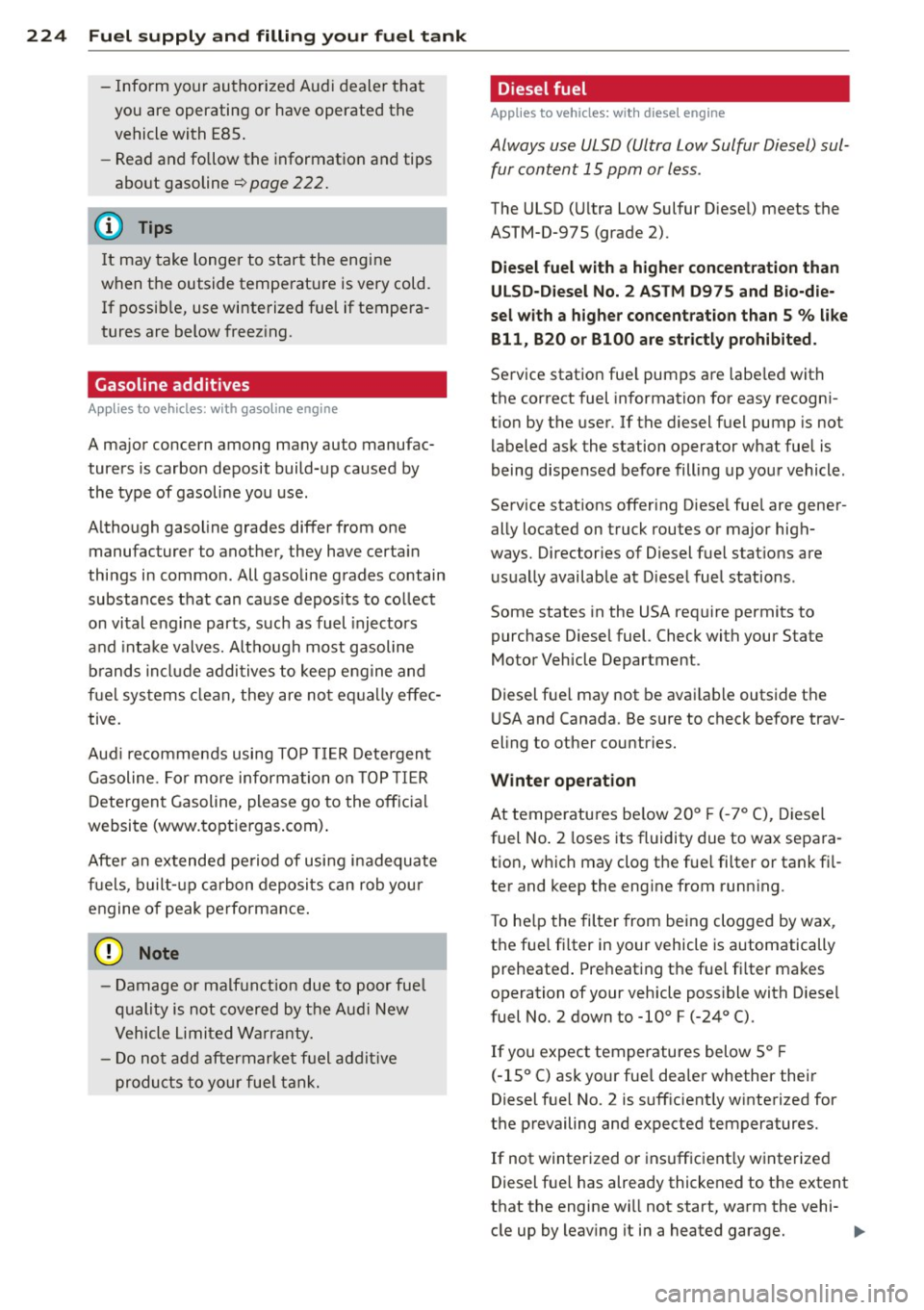
Always use ULSD (Ultra Low Sulfur Diesel) sul
fur content 15 ppm or less .
The ULSD (Ultra Low Sulfur Diese l) meets the
ASTM-D-97S (grade 2).
Die sel fuel with a higher con cent ration than
ULSD-Diesel No. 2 ASTM D9 75 and Bio-die
sel with a higher concentrat ion than 5
% like
Bl 1, B20 or B100 are strictly prohib ited.
Se rv ice stat ion fue l pum ps a re labe led with
the correct fuel information for easy recogn i
t ion by t he user. If the d iesel fuel pump is not
l abeled ask the station operator what fuel is
being dispensed before filling up you r vehicle.
Se rv ice stat ions offering Diese l fue l are gener
ally located on t ruck routes or major high
ways. Directories of Diesel f uel stat io ns are
u sua lly available at D iese l fuel stations .
Some states in the USA req uire permits to
purchase Diesel fuel. Check with your State
Motor Vehicle Department .
Diesel f uel may not be ava ila bl e outside t he
U SA and Canada. Be s ure to check before trav
eling to other countries.
Winter operation
At tempe ratu res be low 20° F (- 7° C), Diesel
fuel No. 2 loses its fluidity due to wax sepa ra
t ion, w hich may clog the fue l fi lter or tank fi l
ter and keep the eng ine from runn ing .
T o he lp the filte r from bei ng clogged by wax,
t h e f ue l fi lter in yo ur vehicle is automatically
preheate d. Pre heat ing t he f uel fi lter makes
operation of your vehicle poss ible with D iese l
fuel No. 2 down to -10° F (-24° C) .
If you expect temperatures below 5° F
( - 15° C) ask your fue l dea ler whether thei r
Diesel f uel N o. 2 is s uff icient ly w interized for
the prevailing and expected temperatures.
If not winter ized o r ins uff ic ient ly w interized
Diesel f uel has already thickened to t he extent
t h at the engine wi ll not start, warm the vehi -
cle up by leav ing it in a heated garage.
II>
Page 227 of 316
It is normal that the engine noise leve l (die
seling) is louder during the warm-up period in
winter.
It i s also norma l when whitish-blue
smoke comes out of the tailpipe after starting
and during warm-up . The amount of smoke
depends on the outside temperature.
Do not let your Diese l engine id le unnecessari
ly after a cold start. Driving off slowly will
shorten the warm-up period .
A WARNING
-Never use "starting assist fluids ." They
may be potent ially explosive or cause a
"run-away" engine condition. This cou ld
result in serious engine damage and per
sonal injury.
- Never use fuel line anti-freeze offered for
gasoline engines .
(D Note
- Refueling with gasoline when your vehi
cle has a d iesel engine can cause very se
rious and expens ive engine and fuel sys
tem damage that is not covered by any
A udi Limited Warranty.
- If you put any amount of incorrect fue l in
the fue l tank, do not start the engine un
der any circumstances. Immediately con
tact the nearest authorized Audi dealer
or authorized Audi Service Facility for as
sistance. These fuels contain substances
that can severely damage the fuel sys
tem and the engine if the engine is start
ed .
- Vehicles with diesel engines must never
be refueled or dr iven with gasoline, kero
sene, heat ing o il, or other non-specified
fuels that have not been expressly ap proved for use with the diese l eng ine.
Other kinds of fuel can cause se rious
damage to the fue l system and the en
gine that is not covered by any Audi Lim
ited Warranty.
- If Diesel fuel shou ld get on any rubber
hose, it must be wiped off immediate ly.
Then wash the contaminated hose por
tion with soap and warm water. Do not
-
Fu el su ppl y and fi lling yo ur fu el t an k 225
allow Diesel fue l to remain on connect
ing hoses . They may deve lop leaks and
cause serious damage .
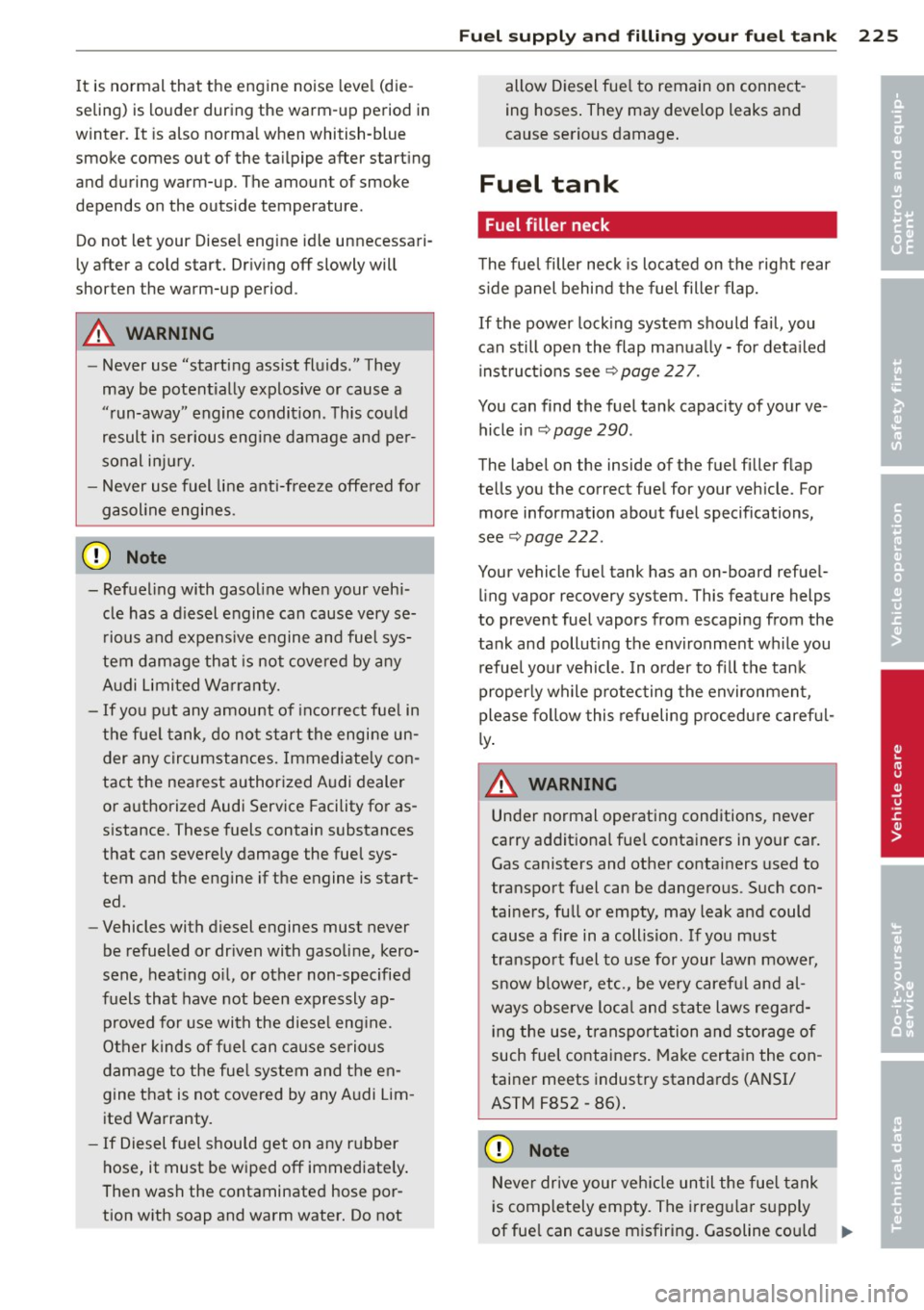
Fuel tank
Fuel filler neck
The fue l filler neck is located on the right rear
s ide panel behind the fuel filler flap.
If the power lock ing system should fa il, you
can still open the flap manually - for detailed
instruct ions see
¢ page 22 7.
You can find the fuel tank capacity of your ve
hicle in
~ page 290 .
The label on the inside of the fuel filler flap
tells you the correc t fuel for your vehicle. For
more information about fuel specifications,
see ~
page 222.
Your vehicle fue l tank has an on-board refuel
ling vapor recovery system. This feature helps
to prevent fuel vapors from escaping from the
tank and pollut ing the environment wh ile you
refue l your vehicle . In order to fi ll the tank
properly while protecting the environmen t,
please fo llow this refueling p rocedure caref ul
ly .
A WARNING
-
Under normal operating conditions, never
carry additional fue l containers in your car.
Gas canisters and other containers used to
transport fuel can be dangerous. Such con
tainers, full or empty, may leak and could
cause a fire in a collision. If you must
transport fuel to use for your lawn mower,
snow blower, etc., be very careful and al
ways observe loca l and state laws regard
ing the use, transportation and storage of
such fuel containers. Make certain the con
tainer meets industry standards (ANSI/
ASTM F852 - 86).
{[) Note
Never drive your veh icle until the fuel tank
is completely empty. The irregu lar supply
of fue l can cause misfiring. Gasoline cou ld
ll-
•
•
Page 228 of 316
226 Fuel suppl y and filli ng your fu el t ank
enter the exhaust system and damage the
catalytic converter.
Refuelling
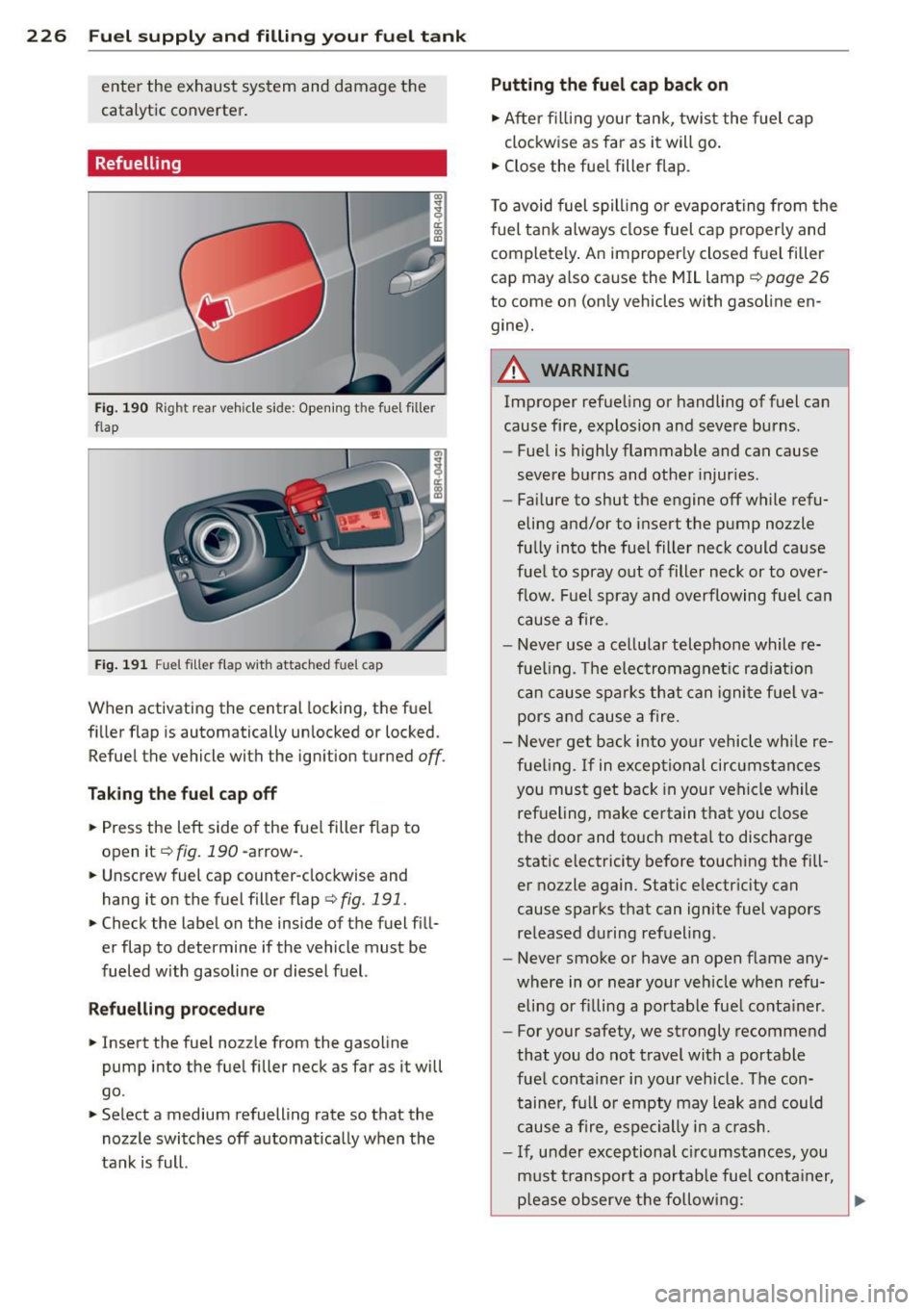
Fig. 190 Righ t rear ve hicle si de: Opening t he fuel filler
fl ap
Fig . 191 Fu el filler fla p w ith attached fuel cap
When activating the central locking, the fuel
filler flap is automatically unlocked or locked.
Refuel the vehicle with the ign ition turned
off .
Tak ing th e fu el cap off
• Press the Left side of the fue l filler flap to
open it ¢
fig. 190 -arrow-.
.. Unscrew fuel cap counter-clockwise and
hang it on the fuel filler flap ¢
fig. 191.
.. Check the Label on the inside of the fuel fill
er flap to determine if the vehicle must be
fueled with gasoline or diesel fuel.
Ref uelling pr ocedu re
.. Insert the fue l no zzle from the gasoline
pump into the fuel filler neck as far as it will
go .
.. Select a medium refuelling rate so that the
nozzle switches off automatically when the
tan k is full .
Putting the fu el cap b ack o n
• After f illing your tank, twist the fuel cap
clockwise as far as it will go .
.. Close the fue l filler flap.
T o avoid fuel spill ing o r evaporating from the
fuel tank always close fuel cap p roperly and
completely . An improperly closed fuel filler
cap may a lso ca use the
MIL Lamp ¢ page 26
to come on (on ly vehicles with gasoline en
gine).
A WARNING
-Improper refueling or handling of fuel can
cause fire, explosion and severe burns .
- Fuel is highly flammable and can cause
severe bu rns and other injur ies.
- Failure to shut the engine off while refu
eling and/or to insert the pump nozzle
fully into the fuel filler neck could cause
fuel to spray out of filler neck or to over
flow. Fue l spray and overflowing fuel can
cause a fire .
- Never use a cellular telephone while re
fue ling. The electromagnet ic rad iat ion
can cause spa rks that can ignite f uel va
pors and cause a fire .
- Never get back into your vehicle whi le re
fue ling.
If in exceptional circ umstances
you must get back in your vehicle while
refueling, make certain that you close
the door and touch metal to discharge
static e lectricity before touching the fill
er nozzle again . Static e lectr icity can
cause sparks that can ignite fuel vapors
released du ring refueling .
- Never smoke or have an open flame any
where in or near your vehicle when refu eling or filling a portable fuel conta iner.
- For your safety, we strongly recommend
that you do not travel with a portable
fuel conta iner in your vehicle . The con
tainer, fu ll o r empty may leak and could
cause a fire, especially i n a c rash.
- If , under exceptional c ircumstances, you
must transport a portab le fuel conta iner,
p lease observe the following: .,.