oil AUDI Q5 2014 Owner's Manual
[x] Cancel search | Manufacturer: AUDI, Model Year: 2014, Model line: Q5, Model: AUDI Q5 2014Pages: 316, PDF Size: 78.41 MB
Page 239 of 316
~ Top off the oil, if necessary.
~ Screw the cap back on the filling hole.
A WARNING
- While topping off, the oil must not come in contact with hot engine parts - fire
hazard!
- The oil filler cap must be properly se cured to prevent oil from being sprayed
on the hot engine and exhaust system
when the engine is running - fire hazard!
- If your skin has come in contact with the
engine oil, you must subsequently
cleanse it thoroughly .
(D Note
-Check the oil level using the radio or the
MM!*. If the message
Please reduce oil
level
appears, contact your authorized
Audi dealer or other qualified workshop
to have excess oil extracted if necessary.
-Audi does not recommend the use of oil
additives. They may damage the engine
and adversely affect your New Vehicle
Warranty.
@ For the sake of the environment
- Under no circumstances can the oil come
in contact with the sewage network or
the soil.
- Observe and follow legal regulations
when disposing of empty oil containers.
Changing the engine oil
We recommend that have your oil changed by
an authorized Audi dealer or a qualified serv
ice station .
Before you check anything in the engine com
partment,
always read and heed all WARN
INGS
c::> .&. in Working in the engine compart
ment on page 231.
The engine oil must be changed according to
the intervals specified in your Warranty
&
Maintenance booklet. This is very important
because the lubricating properties of oil di
minish gradually during normal vehicle use.
Checking and filling 237
Under some circumstances the engine oil
should be changed more frequently. Change
oil more often if you drive mostly short dis
tances, operate the vehicle in dusty areas or
under predominantly stop-and-go traffic con
dition s, or have your vehicle where tempera
tures remain below freezing for extended pe
riods.
Detergent addi tives in the oil will make fresh
oil look dark after the engine has been run
ning for a short time . This is normal and is not
a reason to change the oil more often than recommended.
Because of the problem of proper disposal,
along with the special tools and necessary ex
pertise required, we strongly recommend that
you have your oil changed by an authorized
Audi dealer or a qualified service station.
If you choose to change your oil yourself ,
please note the following important informa
tion:
A WARNING
To reduce the risk of personal injury if you
must change the engine oil in your vehicle
yourself:
- Wear eye protection.
- To reduce the risk of burns from hot en-
gine oil, let the engine cool down to the
touch.
- When removing the oil drain plug with
your fingers, stay as far away as possible.
Always keep your forearm parallel to the
ground to help prevent hot oil from run ning down your arm.
- Drain the oil into a container designed
for this purpose, one large enough to
hold at least the total amount of oil in
your engine.
- Engine oil is poisonous. Keep it well out
of the reach of children.
- Continuous contact with used engine oil
is harmful to your skin. Always protect
your skin by washing oil
off thoroughly
with soap and water.
•
•
Page 240 of 316
238 Check ing and filling
Never mix oil additives with your engine
oil. These additives can damage your en
gine and adversely affect your Audi Limit
ed New Vehicle Warranty.
@) For the sake of the environment
- Before changing your oi l, f irst make sure
you know where you can properly dispose of the used o il.
- Always dispose of used engine oil proper
l y. Do not dump it on garden so il, wood
ed areas, into open streams or down
sewage dra ins.
- Recycle used engine oil by taking it to a
used engine oil collection facility in your
area, or contact a service station .
Engine cooling system
Coolant
The engine coolant performs two functions: it
keeps the engine from overheating and it pro tects the engine from freezing in the winter.
The cooling system is sea led and generally re
q ui res little attention .
The cooling system has been filled at the fac
tory with a pe rmanent coolant which does not
need to be changed. The coolant consists of a
mixture o f spec ia lly condi tioned water and the
manufacturer's glycol -basedcoolant addi -
tive G l3 antifreeze with anticorrosion addi
tives (50% for USA models ; 60% for Canadian
models). This mixture both assures the neces
sary frost protection and protects metal com
ponents in the engine's cooling system from
corrosion and scaling . It also raises the boil
i ng po int of the coo lant .
Do not red uce the concentration of the coo l
ant in the summer by adding plain water.
The
proportion of coolant add iti ve mu st be at
least 50 % but not more than 60 %
to main
tain antifreeze protection and cooling efficie n
cy.
If t he coolant frost protect io n is too low,
the coo lant cou ld freeze and damage the veh i
cle heating and engine cooling system. F
or year -ro und driving, antifreeze is added a t
the factory for temperatures down to :
- -31°F(-35° C)USA
- -40°F ( -40°C) Canada.
If you must add coolant, use a mixture of wa
ter and coolant additive . Mix ing the coo lant
additive with distilled water is recommended .
.&, WARNING
--
Before you c hec k anyth ing in the engine
compartment, a lways read and heed a ll
WAR NIN GS~ .&.
in Working in the engine
compor tment on page 231 .
(J;) Note
-Before winter sets in, have the coo lant
checked to see if the coolant additive in
yo ur vehicle is sufficient to meet the cli
mate condi tions . This is especia lly impor
tant if you live in a region where the win
ter is extreme ly co ld . If necessary, in
crease the p roportion of coo lant add itive
to 60%.
- When adding coolant additive to yo ur
cooling system, remember :
- W e r ecommend using o nly coola nt ad
d itive G l2++ or Gl3 for your veh icle.
T his coolan t additive is av ail ab le a t au
thor ized Audi dealers. O ther types of
antifreeze can significant ly reduce cor
rosion protection . The resulti ng cor ro
sion can cause a loss o f coolant and se
rious engine damage.
- Do not add any type of rad iator leak seal
ant to your vehicle 's eng ine coolant.
Add ing radiato r repair flu id may adverse
ly affect the function and performance of
your cooling system and co uld resu lt in
damage not cover ed by yo ur New Ve hicle
Limited Warranty.
Page 241 of 316
Checking the engine coolant level
The engine coolant level can be checked with
a quick glance .
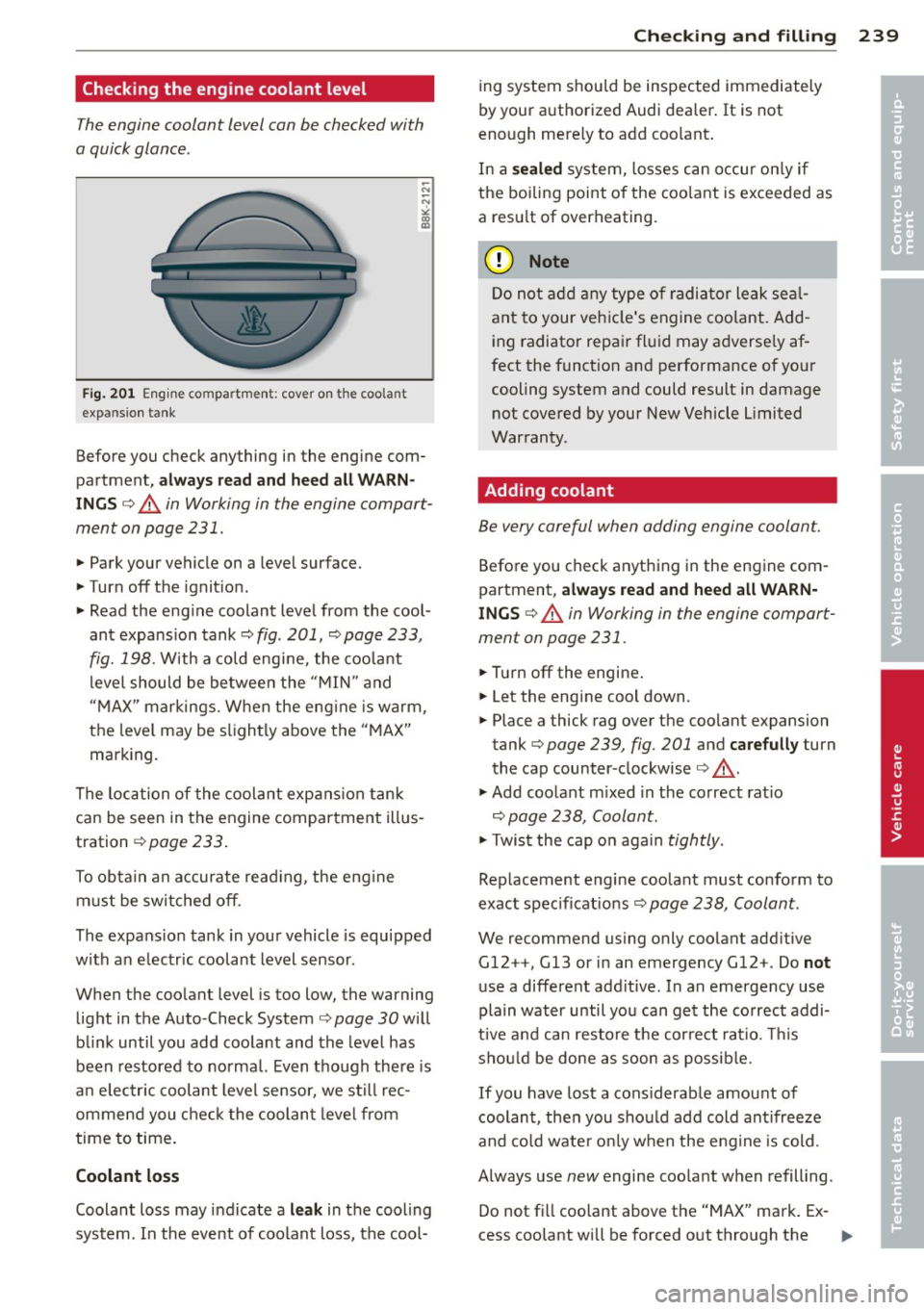
Fig. 201 Eng ine co mpa rtme nt: cove r on the coola nt
exp ansion tank
Before you check anything in the engine com
partment,
a lway s re ad and he ed all WARN
INGS ¢ A in Working in the engine compart
ment on page 231 .
.,. Park your vehicle on a level surface.
.,. Turn off t he ignit ion.
.,. Read the eng ine coolant level from the cool
ant expansion tank¢ fig . 201, ¢ page 233,
fig. 198 . With a cold eng ine , the coola nt
level should be between the "M IN " and
"MAX" markings . W hen the eng ine is warm,
the leve l may be slightly above the "MAX"
marking.
The location of the coolant expans ion tank
can be seen in the engine compartment illus
tration ¢page 233.
To obtain an accurate read ing, the eng ine
must be switched off.
The expans ion tank in your vehicle is equipped
with an e lectr ic coolant level sensor .
When the coo lant level is too low, the warning
light in the Auto -Check System ¢ page 30 will
blink until you add coo lant and the level has
been restored to normal. Even though there is
a n elec tric coolant leve l sensor, we s till rec
ommend you chec k the coolant leve l from
time to time .
Coolant loss
Coolant loss may indicate a leak in the cool ing
system. In the event of coolant loss, the cool-
Checkin g and fillin g 239
ing system shou ld be inspected immediately
by your authorized Audi dealer . It is not
eno ugh merely to add coo lant .
In a
s ealed system, losses can occu r on ly if
the boiling point of the coo lant is exceeded as
a resu lt of overheating.
(D Note
Do not a dd any type o f radiator leak se al
ant to your veh icle's engine coo lant. Add
ing radiator repa ir flui d may adverse ly af
fect the funct ion and performance of yo ur
cooling system and could result in damage not covered by your New Vehicle Limited
Warranty.
Adding coolant
Be very careful when adding engine coolant.
Before you check anything in the engine com
partment,
always read and heed alt WARN
INGS ¢ A in Working in the engine compart
ment on page 231 .
.,. Turn off the engine .
.,. Let the engine cool down.
.,. Place a thick rag over the coo lant expansion
tank ¢ page 239, fig. 201 and
carefully turn
the cap counter -clockwise ¢
_& .
.,. Add coolant m ixed in the co rrect rat io
¢ page 238, Coolant.
.,. Twis t the cap o n aga in tightly.
Rep lacement engine coo lant must conform to
exact spec ificat ions ¢ page 238, Coolant.
We recommend using only coolant add itive
Gl2 ++, Gl3 or in an emergency Gl2 +. Do not
use a different add itive . In an emergency use
plain water until you can get the correct addi
tive and can restore t he cor rect ratio . Th is
sho uld be done as soon as possib le.
If you have lost a cons iderab le amount of
coolant, then you sho uld add cold ant ifreeze
and co ld wate r on ly w hen the eng ine is cold.
Always use new engine coo lant when refill ing .
Do not fi ll coo lant above the "MAX" mark. Ex
cess coolant will be forced o ut through the
•
•
Page 243 of 316
Brake fluid
Checking brake fluid level
The brake fluid level can be checked with a
quick glance.
N
N
;:;;
" 03
"'
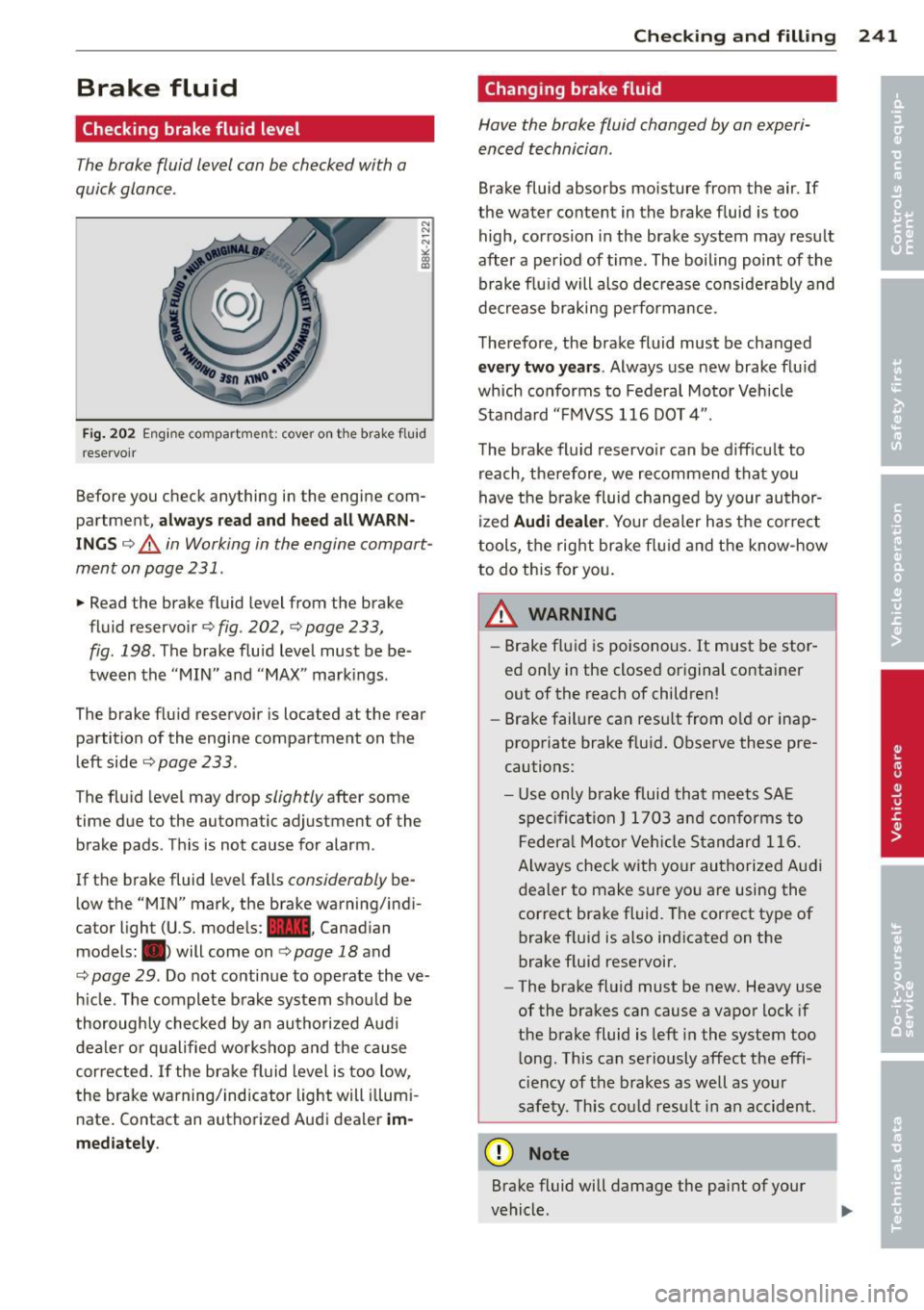
Fi g. 202 Eng ine compartment: cover on the brake flu id
reservoir
Before you check anything in the engine com
partment,
a lwa ys read and heed all WARN
ING S c:> .&.. in Working in the engine compart
ment on page 231 .
~ Read the brake fluid level from the brake
fluid reservoir
c:> fig. 202, <=> page 233,
fig . 198 .
The brake flu id level must be be
tween the "MIN" and "MAX" markings.
The brake fluid reservoir is located at the rear
partition of the engine compartment on the
left side
c::> page 2 33 .
The fluid level may drop slightly after some
time due to the automatic adjustment of the
brake pads . This is not cause for alarm .
If the brake fluid level falls
considerably be
low the "MIN" mark, the brake warning/indi
cator light (U.S. models:~, Canadian
models: .) will come on
c> page 18 and
c::> page 29 . Do not continue to operate the ve
h icle. The complete brake system should be
thoroughly checked by an authorized Aud i
dealer o r qualified workshop and the cause
corrected.
If the brake fluid level is too low,
the brake warning/indicator light will illum i
nate . Contact an authorized Audi dealer
im
m ediatel y.
Checkin g and fillin g 241
Changing brake fluid
Have the brake fluid changed by on experi
enced technician .
Brake fluid absorbs moisture from the air. If
the water content in the brake fluid is too
high, corrosion in the brake system may result
after a period of time . The boiling point of the
brake flu id will also dec rease considerably and
decrease braking pe rformance.
Therefore, the brake fluid must be changed
every two years. Always use new brake flu id
which conforms to Federal Motor Vehicle
Standard "F MVSS 116 DOT 4".
The brake fluid reservo ir can be d iff icult to
reach, the refore, we recommend that you
have the brake fluid changed by your author
i zed
Audi d ealer. Your dealer has t he correct
tools, the right brake fl uid and the know-how
to do this for you .
A WARNING -.
-Brake fluid is poisonous . It must be stor
ed only in the closed original container
out of the reach of children!
- Brake failure can resu lt from o ld or inap
propriate brake f luid. Observe these pre
cautions:
- Use only brake fluid that meets SAE
spe cificat ion
J 1 7 03 and conforms to
Federa l Moto r Ve hicl e Standard 116.
Always check with yo ur authorized Audi
dealer to make sure yo u are using the
correct bra ke fluid. The correct type of
brake f luid is also indicated on the
brake f luid reservoir.
- The brake fluid must be new. Heavy use
of the brakes can cause a vapor lock if
the brake fluid is left in the system too
l ong . This can seriously affect the effi
c iency of the brakes as well as your
safety. Th is cou ld resu lt in an accident.
(D Note
Brake fluid will damage the paint of your
vehicle .
Page 250 of 316
248 Tire s and whee ls
- Never mount used tires on yo ur vehicle if
you are not sure of their "previous histo
ry." Old used tires may have been dam
aged even though the damage cannot be
seen that can lead to sudden tire failure
and loss of vehicle control.
- If you notice unusual vibration or if the
vehicle pulls to one side when driving, al
ways stop as soon as it is safe to do so and check the wheels and tires for dam
age.
(D Note
Please note that summer and winter tires
are designed for the cond itions that are
Glossary of tire and loading terminology
Acces sory weight
means the comb ined we ight (in excess of
those standard items which may be rep laced)
of au toma tic tra nsmission, power steer ing,
power brakes, power windows, power seats,
radio, and heater, to the extent that these
items are availab le as factory -installed equip
ment (whether installed or not) .
Aspect ratio
means the ratio of the he ight to the w idth of
the tire in percent . Numbers of 55 or lower in
dicate a low sidewall for improved steering re
sponse and better overall handling on dry pavement .
Bead
means the part of the ti re that is made of
steel wires, wrapped or reinforced by ply cords
and that is shaped to fit the rim.
Bead s eparation
means a b reakdown of the bond between
components in the bead.
Cord
means the strands forming the plies in the
tire . typica
l in those seasons. Audi recommends
using winter tires during the winter
months. Low temperatures signif icant ly
decrease the e lasticity of summer tires,
which affects tract ion and brak ing ability.
If summer tires are used in very cold tem peratures, cracks ca n form on the tread
bars, resulting in permanent tire damage
that can cause loud driving no ise and un
balanced t ires. Audi is not responsible for
th is type of damage .
Cold tire inflation pre ssure
means the t ire p ressure recommended by the
vehicle manufacturer fo r a tire of a des ignated
s ize that has not bee n driven for more than a
coup le of miles (k ilometers) at low speeds in
the three hour period before the tire pressure
is measured or adjusted.
Curb weight
means the we ight of a motor ve hicle w ith
standard equipment including the max imum
capacity of fuel, oil, and coolant, air condi
tioning and additional weight of optiona l
equipment.
Extra load tire
means a t ire design to operate at higher loads
and at h igher inflation pressures than the cor
responding standard tire . Extra load tires may
be identified as "XL", "x l" , "EXTRA LOAD", or
"RF" on the sidewall.
Gross A xle Weight Rating ("GAWR ")
means the lo ad -carry ing capacity of a s ingle
axle system , measured at the tire-ground in
terfaces.
Gr oss Vehicle Weight Rating ("GVWR ")
means the maximum total loaded we ight of
t h e vehi cle. .,.
Page 260 of 316
258 Tires and wheels
Incorrect wheel alignment
Incorrect wheel alignment can cause exces
sive tire wear, impairing the safety of the vehi
cle . If tires show excessive wear, have the
wheel alignment checked by an authorized
Audi dealer or qualified workshop .
All-wheel drive
Vehicles with quattro must always have tires
of the same size, construction and tread type.
For details see Qpage 202 .
.&_ WARNING
Sudden tire failure can lead to loss of con
trol, a crash and serious personal injury!
- Never drive a vehicle when the tread on
any tire is worn down to the wear indica
tors.
- Worn tires are a safety hazard, they do
not grip well on wet roads and increase
your risk of"hydroplaning" and loss of
control.
- Always keep chemicals that can cause
tire damage, such as grease, oil, gasoline
and brake fluid away from tires.
- Tires age even if they are not being used
and can fail suddenly, especially at high
speeds. Tires that are more than 6 years
old can only be used in an emergency
and then with special care and at lower
speeds.
- Never mount used tires on your vehicle if
you a re not sure of their "previous histo
ry." Old used tires may have been dam
aged even though the damage cannot be
seen that can lead to sudden tire failure
and loss of vehicle control.
New tires and replacing tires and wheels
New tires and wheels have to be broken in .
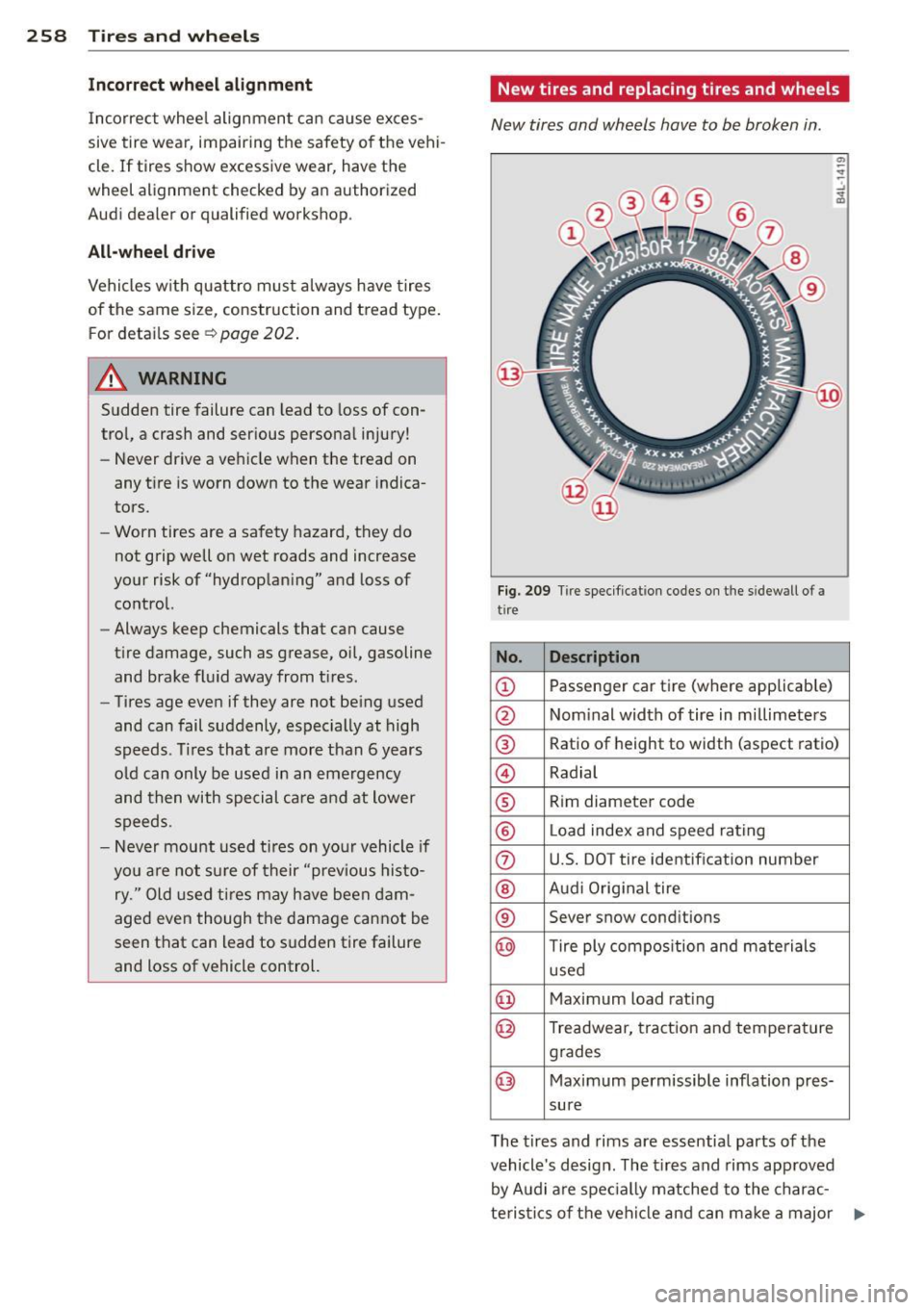
Fig. 209 Tir e specificat ion codes on t he s idewall o f a
t ire
No. Description
® Ratio of height to width (aspect ratio)
© Radial
® Rim diameter code
® Load index and speed rating
(J) U.S. DOT tire identification number
® Audi Original tire
® Sever snow conditions
@ Tire ply composition and materials
used
@ Maximum load rating
@ Treadwear, traction and temperature
grades
@ Maximum permissible inflation pres-
sure
The tires and rims are essential parts of the
vehicle's design . The tires and rims approved
by Audi are specially matched to the charac
teristics of the vehicle and can make a major .,..
Page 266 of 316
264 Tire s and wheel s
driving a few yards and correct if neces
sary. Follow the instructions from the
snow cha in manufacturer when doing so.
(D Tips
Where snow chains are mandatory oncer
tain roads, this normally also applies to
veh icles with all-wheel dr ive .
Wheel bolts
Wheel bolts must always be tightened to the
correct torque.
The design of whee l bolts is matched to the
factory insta lled rims . If different rims are fit
ted, the correct wheel bolts with the right l ength and correctly shaped bolt heads must
be used. This ensures that wheels are f itted
securely and that the brake system functions
correctly .
In certain circumstances, you may not use
wheel bolts from a different vehicle -even if it
is the same model
¢ page 295.
.&_ WARNING
Improperly tig htened or maintained wheel
bolts can become loose ca using loss of
cont ro l, a co llision and serious p ersona l in
Jury.
- Always keep the wheel bolts and the
threads in t he wheel hubs clea n so the
wheel bolts can tu rn easily and be prop
erly tigh tened.
- N ever grease or oil the wheel bo lts and
the threads in the wheel h ubs. They can
become loose w hile d riving if greased or
oiled, even if tightened to the specified
torq ue.
- Only use wheel bolts that be long to the
rim being installed.
- N ever use different whee ls bolts on your
vehicle.
- Always mai nta in the co rrec t tighte ning
tor que fo r the wheel bo lts to reduce the
risk of a wheel loss . If the tightening tor
que of the wheel bo lts is too low, they
can loosen and come out when the veh i- cle is moving.
If the tightening torque is
too high, the wheel bolts and threads
can be damaged and the wheel can be
come loose.
(D Note
The specified torque for the whee l bolts is
105 ft lb (140 Nm) with a to lerance of
± 7,4 ft lb(± 10 Nm). Torque wheel bolts
diagonally . After changing a wheel, the
torque must be checked as soon as poss i
ble with a to rque wrench -preferab ly by an
a uthorized Aud i dea le r or qualified wor k
shop.
Low aspect ratio tires
Your A udi is factory -eq uipped w it h low aspect
ratio tires. These tires have been thoroughly
tested and been se lected specifically for your
model for their superb performance, road fee l
and handling under a variety of driving condi
t ions . Ask your authorized Audi dealer for
more details .
The low aspect ratio of these tires is ind icated
by a numeral of
55 or less in the tire's s ize
designation . The numeral represents the ratio
of the tire's sidewall height in relation to its
t read width exp ressed in percentage. Conven
tiona l tires have a he ight/w idth rat io of 60 or
more.
Th e performanc e of low-a spect-ratio tire s is
pa rticularly sensi tive to improp er inflation
pre ssure. It i s ther efor e important that low
a spe ct ratio tir es are inflated to the spe cified
pre ssure and that the inflation pre ssure i s
regula rly checked and mainta ined. Tire pre s
sure s should be checked at lea st once a
month and al way s befo re a long trip
¢ page 2 53, Checking tire pressure.
What you can do to a void tire and rim
damage
Low aspect ratio tires can be damaged more
easily by impact w ith potholes, curbs, gul lies
or ridges on the road, particularly if the tire is
underinflated . ..,.
Page 273 of 316
Tire repair
General information and safety
precautions
Appl ies to vehicles: with tire repair kit
The tire r epair is only m eant for tempo rary
use.
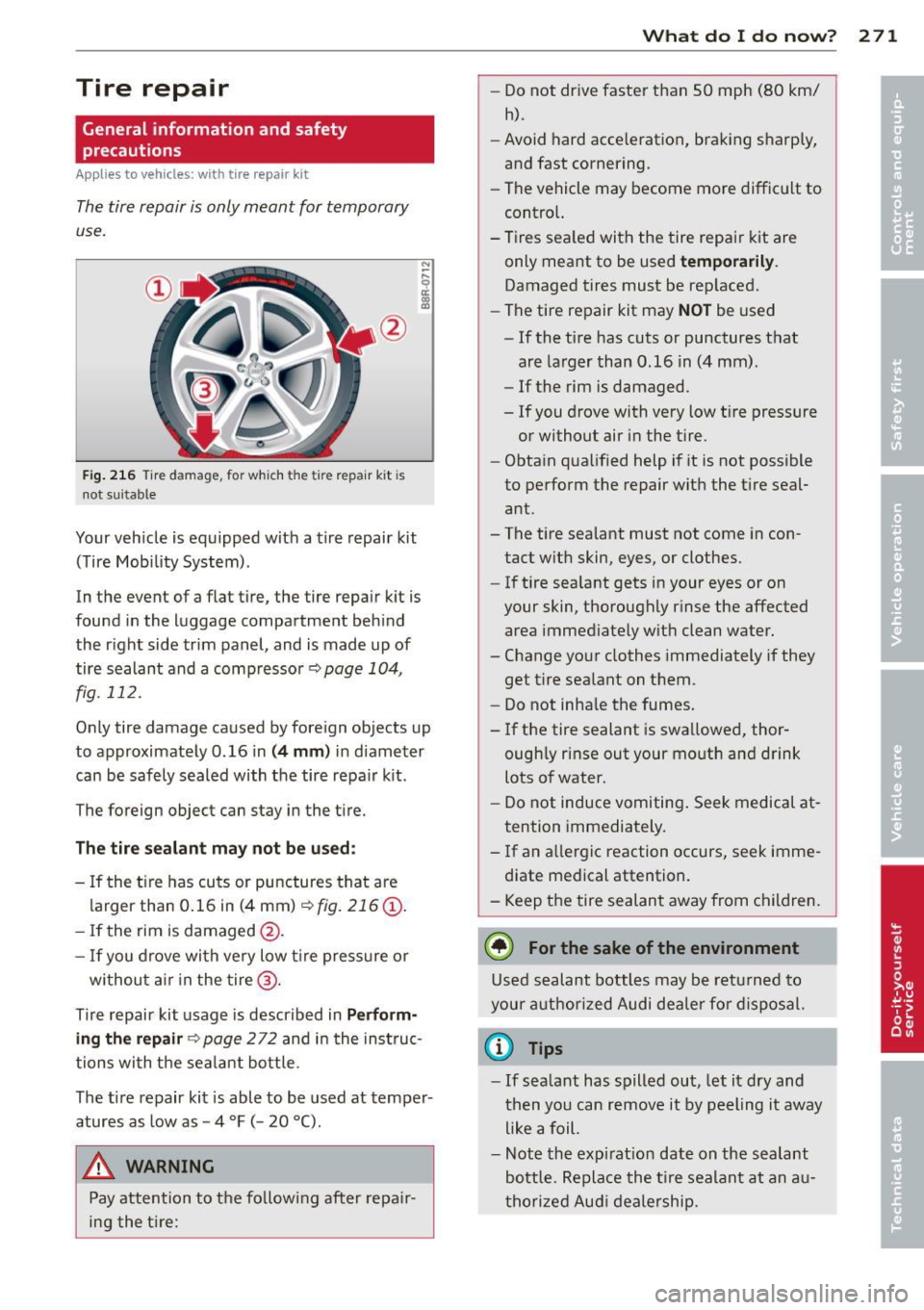
Fi g. 2 16 Tire damage, fo r which the tire repair kit is
not su itab le
Your veh icle is equipped with a tir e repair kit
(Tire Mob ility System) .
In the event of a flat tire, the tire repair kit is
found in the luggage compartment behind
the right side trim panel, and is made up of
tire sealant and a comp resso r
Q page 104,
fig. 112.
Only tire damage caused by fore ign objects up
to approximately 0.16 in
( 4 mm) in diameter
can be safely sealed with the tire repa ir k it .
The foreign object can stay in the t ire.
Th e tire sealant may not b e us ed :
- If the t ire has cuts or punctures that are
larger than 0 .16 in (4 mm)
Qfig. 216@.
-If the rim is damaged @.
-If you drove wi th very low t ire press ure o r
without a ir in the tire @.
Tire repair kit usage is descr ibed in
Perform
in g th e repair
Q page 2 72 and in the inst ruc
tions wi th the sea lant bottle.
The tire repair kit is able to be used at temper
atures as low as -4
°F ( -20 °().
A WARNING
Pay attention to t he fo llowing after repa ir
ing the t ire:
What do I d o now ? 271
-Do not dr ive faster than SO mph (80 km/
h).
- Avoid hard acce leration, braking s harply,
and fast cornering.
- The vehicle may become more diffic ult to
contro l.
- Tires sea led with the tire repai r kit are
only meant to be used
temporar ily .
Damaged tires must be rep laced .
- The tire repair kit may
NOT be used
- If the ti re has cuts or punctures that
are la rger than 0.16 in (4 mm).
- If the rim is damaged.
- If you drove with very low t ire pressure
or without air i n the tire.
- Obta in qua lified help if it is not poss ible
to perform the repair with the t ire seal
ant.
- The tire sea lant must not come in con
tact with skin, eyes, or clothes.
- If tire sea lant gets in your eyes or on
your skin, thoroughly rinse the affected
area immed iately w ith clean water .
- Change yo ur clothes immediately if they
get t ire sea lant on t hem.
- Do not inha le the fumes.
- If t he tire sealant is swa llowed, thor -
ough ly rinse out your mouth and drink
lots o f water.
- Do not induce vomiting . Seek medical at
tention immediately.
- If an a llergic reaction occurs , seek imme
diate medical attention.
- Keep the tire sealant away from children.
@ For the sake of the environment
Used sealant bottles may be retu rned to
your auth orized Audi dea le r for disposa l.
@ Tips
- If
sea lant has spilled out, let it dry and
then yo u can remove it by peeling it away
like a foil.
- Note the expi rat ion date on the sealant
bott le. Re pla ce the t ire sealant at an a u
t horize d Au di dealership.
Page 275 of 316
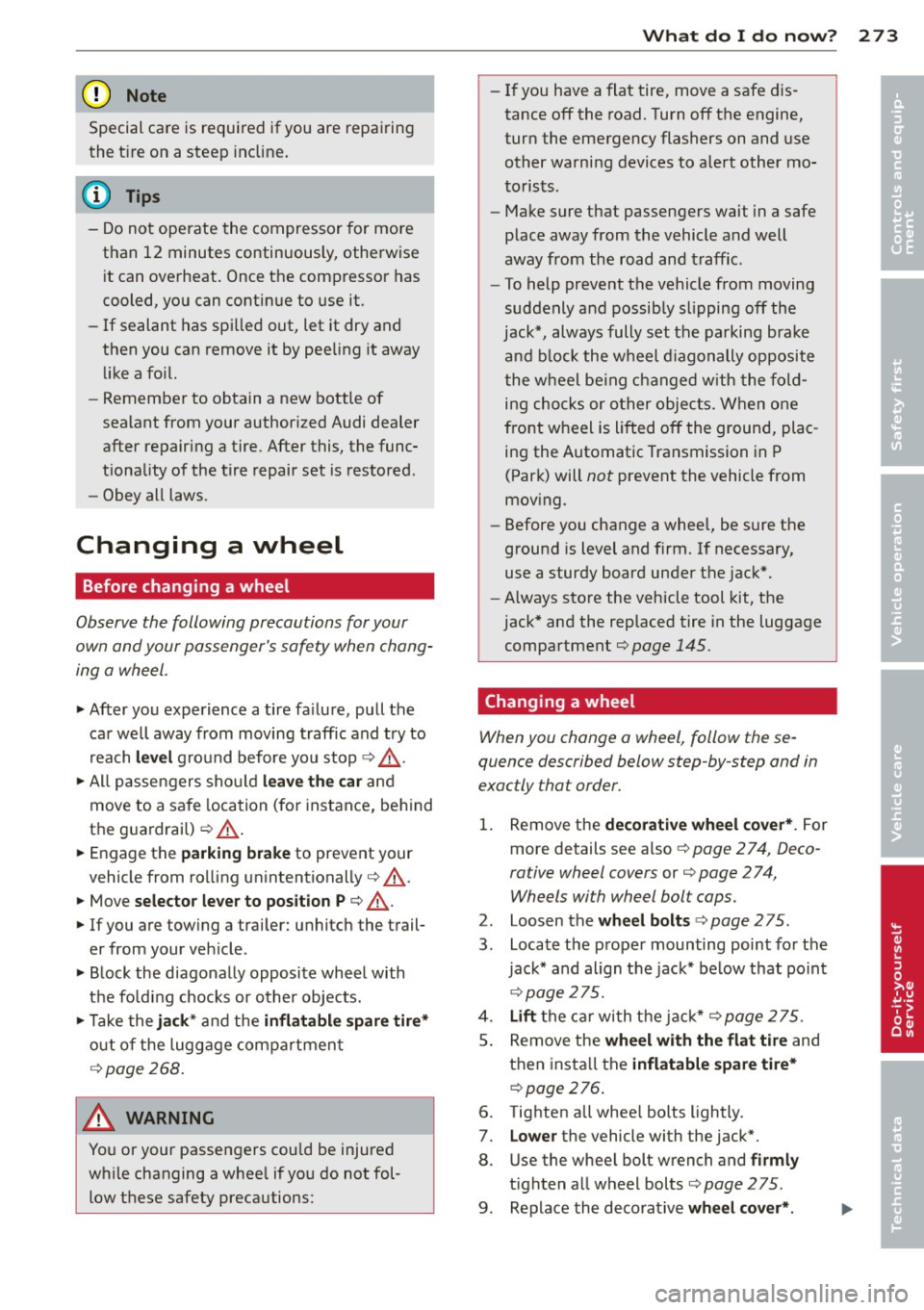
(D Note
Special care is required if you are repairing
the tire on a steep incline.
@ Tips
-Do not operate the compressor for more
than 12 minutes continuously, otherwise it can overheat. Once the compressor has
cooled, you can continue to use it.
- If sealant has spilled out, let it dry and
then you can remove it by peeling it away
like a foil.
- Remember to obtain a new bottle of
sealant from your authorized Audi dealer
after repairing a tire. After this, the func
tionality of the tire repair set is restored.
- Obey all laws.
Changing a wheel
Before changing a wheel
Observe the following precautions for your
own and your passenger's safety when chang
ing a wheel.
.,. After you experience a tire failure, pull the
car well away from moving traffic and try to
reach
level ground before you stop¢_& .
.. All passengers should
leave the car and
move to a safe location (for instance, behind
the guardrail) ¢
_&.
.. Engage the parking brake to prevent your
vehicle from rolling unintentionally¢_&.
.. Move
selector lever to position P ¢ _& .
.,. If you are tow ing a trai ler: unhitch the trail
er from your vehicle.
.,. Block the diagonally opposite wheel with
the folding chocks or other objects.
.. Take the
jack* and the inflatable spare tire*
out of the luggage compartment
¢page 268.
A WARNING
You or your passengers could be injured
while changing a wheel if you do not fol
low these safety precautions:
-
What do I do now? 273
- If you have a flat tire, move a safe dis
tance off the road. Turn off the engine,
turn the emergency flashers on and use
other warning devices to alert other mo
torists.
- Make sure that passengers wait in a safe
place away from the vehicle and well
away from the road and traffic.
- To help prevent the vehicle from moving
suddenly and possibly slipping off the
jack*, always fully set the parking brake
and block the wheel diagonally opposite
the wheel being changed with the fold
ing chocks or other objects. When one
front wheel is lifted off the ground, plac
ing the Automatic Transmission in P
(Park) will
not prevent the vehicle from
moving.
- Before you change a wheel, be sure the
ground is level and firm. If necessary,
use a sturdy board under the jack*.
- Always store the vehicle tool kit, the
jack* and the replaced tire in the luggage
compartment
¢page 145.
Changing a wheel
When you change a wheel, follow the se
quence described below step-by-step and in
exactly that order.
1. Remov e the decorative wheel cover*. For
more details see also
¢ page 274, Deco
rative wheel covers
or ¢ page 2 7 4,
Wheels with wheel bolt cops .
2. Loosen the wheel bolts¢ page 2 75 .
3. Locate the proper mounting point for the
jack* and align the jack* below that point
¢ page 275.
4. Lift the car with the jack* ¢ page 2 75 .
S. Remove the wheel with the flat tire and
then install the
inflatable spare tire*
¢page 276.
6. Tighten all wheel bolts lightly.
7.
Lower the vehicle with the jack*.
8. Use the wheel bolt wrench and
firmly
tighten all wheel bolts¢ page 2 75.
9. Replace the decorative wheel cover*.
•
•
Page 290 of 316
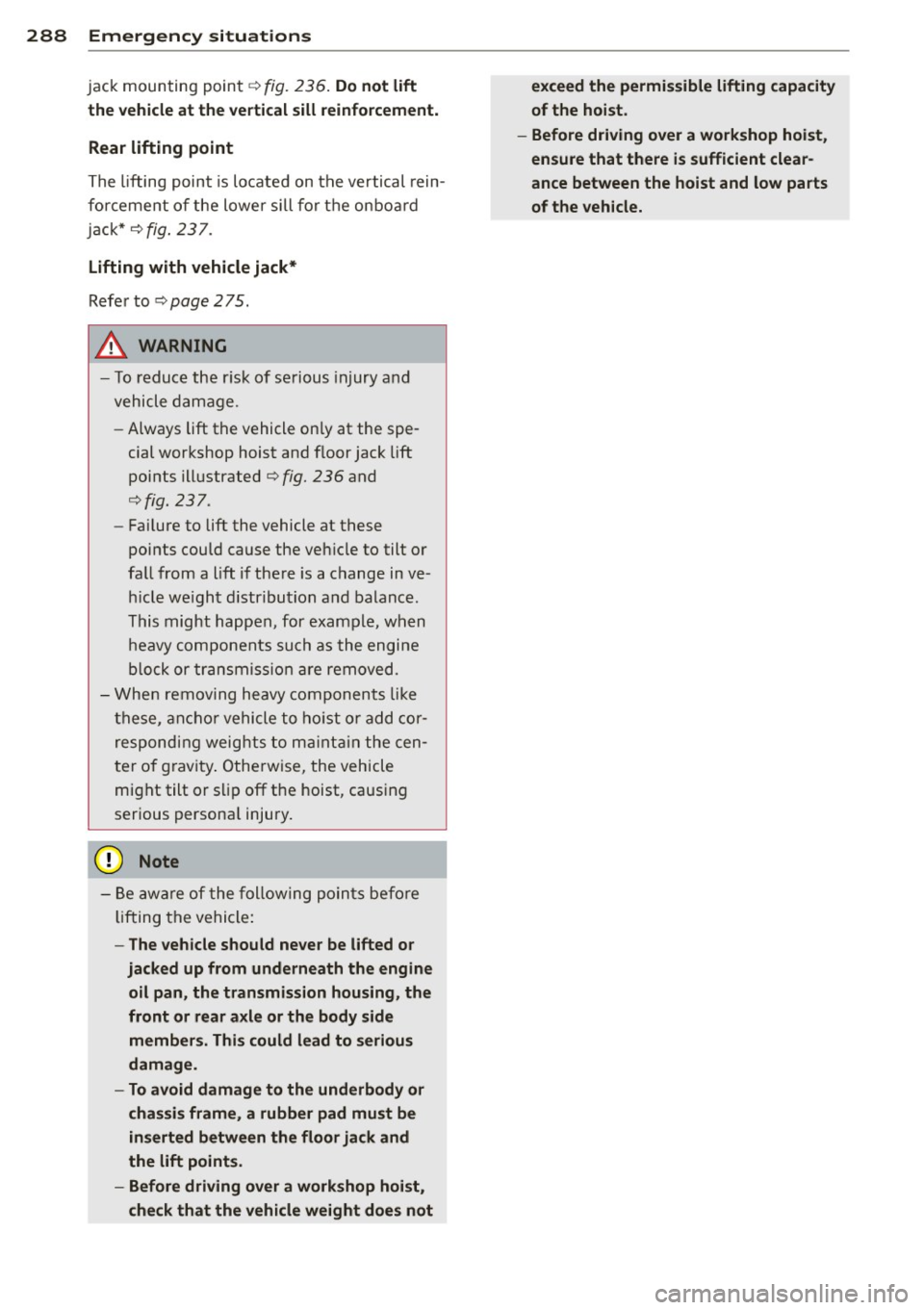
288 Emergency situations
jack mounting point¢ fig. 236 . Do not lift
the vehicle at the vertical sill reinforcement.
Rear lifting point
T he lifting point is lo cate d on t he ve rtical rein
fo rceme nt of the lower s ill fo r th e on bo ard
j ack *¢
fig . 23 7.
Lifting with vehicle jack*
Refe r to ¢ page 2 75 .
..&, WARNING
- T o redu ce t he r is k of se rious injury and
vehicle dam ag e.
- Always lift the vehicle on ly at the spe
cial wor kshop h oist and floor jack lift
points illustrated
¢ fig. 236 and
¢ fig. 237 .
-Fa ilure to lift the vehicle at these
points cou ld cause the veh icle to tilt or
fa ll from a lift if the re is a change in ve
h icle we igh t di stribu tion a nd ba lance .
This might happen, for exa mple, w hen
h eavy co mpo ne nts su ch as the engi ne
bl oc k or tra ns mis sion ar e removed .
- W hen re mov ing heavy co mpo nents like
t h ese , a nch or vehicle to hoist or add cor
res pond ing weig hts to maintain t he cen
te r of gravity . Othe rwise, the vehicle
mi gh t tilt o r slip off t he hoist , ca usi ng
serious persona l injury .
CJ) Note
- Be aw ar e of t he fo llow ing poin ts be fo re
lift ing t he vehicle:
- The vehicle should never be lifted or
jacked up from underneath the engine oil pan, the transmission housing, the
front or rear axle or the body side members. Thi s could lead to serious
damage.
- To avoid damage to the underbody or
chassis frame , a rubber pad must be
inserted between the floor jack and
the lift points.
- Before driving over a workshop hoist,
check that the vehicle weight does not
-
exceed the permissible lifting capacity
of the hoist .
- Before driving over a workshop hoist,
ensure that there is sufficient clear
ance between the hoist and low parts
of the vehicle.