door lock AUDI Q5 2014 Owner's Guide
[x] Cancel search | Manufacturer: AUDI, Model Year: 2014, Model line: Q5, Model: AUDI Q5 2014Pages: 316, PDF Size: 78.41 MB
Page 147 of 316

Stowing luggage
Loading the luggage compartment
All luggage and other objects must be prop
erly stowed and secured in the luggage com
partment.
Fig . 153 Safe load pos ition ing: place heavy objects as
low and as far forward as possible.
Loose items in the luggage compartment can
shift suddenly, changing vehicle handling
characteristics . Loose items can also increase
the r isk of serious personal injury in a sudden
veh icle maneuver or in a collision .
~ Distribute the load evenly in the luggage
compartment.
~ Always place and properly secure heavy
items in the luggage compartment as low
and as far forward as poss ible
<=> fig. 153.
~ Secure luggage using the tie-downs provid
ed
¢ page 68.
~ Make sure that the rear seatback is securely
latched in place.
A WARNING
Improperly stored luggage or other items
can fly through the vehicle causing serious
personal injury in the event of hard brak
ing or an acc ident. To help reduce the risk
of serious personal injury:
- Always put objects, for example, luggage
or other heavy items in the luggage com
partment.
- Always secure objects in the luggage
compartment us ing the tie-down eye lets
and suitable straps .
Drivin g Sa fely 145
A WARNING
Heavy loads will influence the way your ve
h icle handles. To help reduce the risk of a
loss of control leading to serious personal
injury:
-Always keep in mind when transporting
heavy objects, that a change in the cen
ter of gravity can also cause changes in
veh icle handling:
- Always distribute the load as evenly as
possible.
- Place heavy objects as far forward in
the luggage compartment as possible.
- Never exceed the Gross Axle Weight Rat
ing or the Gross Vehicle Weight Rating
specified on the safety compliance stick
er on the left door jamb. Exceeding per
missible weight standards can cause the
veh icle to slide and handle differently.
- Please observe information on safe driv
ing<=>
page 139 .
A WARNING
To help prevent poisonous exhaust gas
from being drawn into the vehicle, a lways
keep the rear lid closed while driving.
- Never transport objects larger than
-
those fitting comp letely into the luggage
area because the rear lid cannot be fu lly
closed.
- If you absolutely must dr ive with the rear
lid open, observe the following notes to
reduce the risk of poisoning:
- Close all windows,
- Close the Panoramic sliding sunroof *,
- Open all air outlets in the inst rument
panel,
- Switch off the air rec irculat ion,
- Set the fresh a ir fan to the highest
speed.
A WARNING
A lways make sure that the doo rs, all win
dows, the Pano ramic s liding sunroof* and
the rear lid are securely closed and locked
Page 171 of 316
If the fron t passenger seat is not occupied,
the front airbag will not deploy, and the
PAS
SENGER AIR BAG OF F
light will stay on. Nev
er in sta ll a rearward-fac ing ch ild restra int on
t he fron t passenger seat, the safest place for
a child in any kind of child restraint is at one
of the seating positions on the rear seat
¢ page 158, Child restraints on the front seat
- some important things to know
and
¢ page 178, Child Safety .
If the PASSENGER AIR BAG OFF light c om es
on
when one of the conditions listed above is
met, be sure to check the light regularly to
make certa in that the
PAS SENGER AIR BAG
O FF
light stays on cont inuous ly whenever the
ignition is on . If the
PASSENGER AIR BAG
OFF
light does not appear and not stay on all
the time, stop as soon as it is safe to do so
and
- reactivate the system by turning the ignition
off and then t urning it on again;
- remove and reinstall the child restraint .
Make sure that the child restraint is properly
installed and that the sa fety be lt for the
front passenger seat has been correct ly
routed around the child restraint a s desc ri
bed in the child restraint manufacturer 's in
structions;
- make sure that the convertible locking fea
ture on the safety be lt for the front passen
ger seat has been activated and that the
safety belt has been pulled tight . The belt
mus t not be loose o r have loops of slack so
that the sensor below the safety be lt latch
on the seat can do its job ¢
page 188.
-make su re that th ings that may increase the
weight of the ch ild and child safe ty seat are
not being transported on the front passen
ger seat ;
- make su re that the safety bel t tension sen
sor is not b locked . Shake t he safety belt
l atch on the front passenger seatback and
forth;
- If a strap or tether is being used to tie the
child safety seat to the front passenger
seat, make sure that it is not so tight that it
A irbag system 169
causes the weight -sensing mat to measure
more weight than is act ually on the seat .
If the PASSENGER AIR BAG OFF light still
d oes not come on
and does not stay on con
tin uous ly (when the ignition is switched on) ,
- take the child rest ra int off the front passen-
ge r seat and install it properly a t one of the
rear seat positions. Have the airbag system
inspected by yo ur authorized Audi dealer
immediate ly .
- move the child to a rear seat position and
make sure t hat the child is properly restrain
ed in a c hild restra int that is appropriate for
its size and age.
T he
PASSENGER AIR BAG OFF light sho uld
NOT come on when the ignition is on and an
adult is sitting in a proper seating position on
the front passenger seat. If the
PASSENGER
AIR BAG OFF
ligh t comes on and stays on or
flashes for about 5 seconds wh ile driving, un
der these c ircumstances , make sure that:
- the adult on the front passenger seat is
properly seated on the center of the seat
cushion wi th his or her back up aga inst the
backrest and the backrest is not recl ined
¢ page 140, Proper occupant seating posi
tions,
- the adult is not tak ing weight off the seat by
holding on to the passenger assist handle
above the front passe nger door or support
ing their weight on the armrest ,
- the safety belt is being properly wo rn and
tha t there is not a lot of s lack in the safety
be lt webbing ,
- ac cesso ry seat covers or cushions o r other
t hings tha t may cause an incorrect reading
or impression on the we ight-sensing mat
under the upho lstery of the seat have been
removed from the front passenger seat,
- a sa fety belt exten der has not been left in
the safety belt latch for the front passenger
seat.
In add it ion to the
PASSENGER AIR BAG OFF
li ght in the cente r of the instrumen t panel,
the message
PASSENGER AIR BAG OFF or
PASSENGER AIR BAG ON wi ll briefly appear ll-
•
•
Page 186 of 316
184 Child Safet y
Child safety seats
Infant seats
Babies and infants up to about one year old
and 20 lbs. or 9 kg need special rearward-fac
ing child restraints that support the back,
neck and head in a crash.
-- /
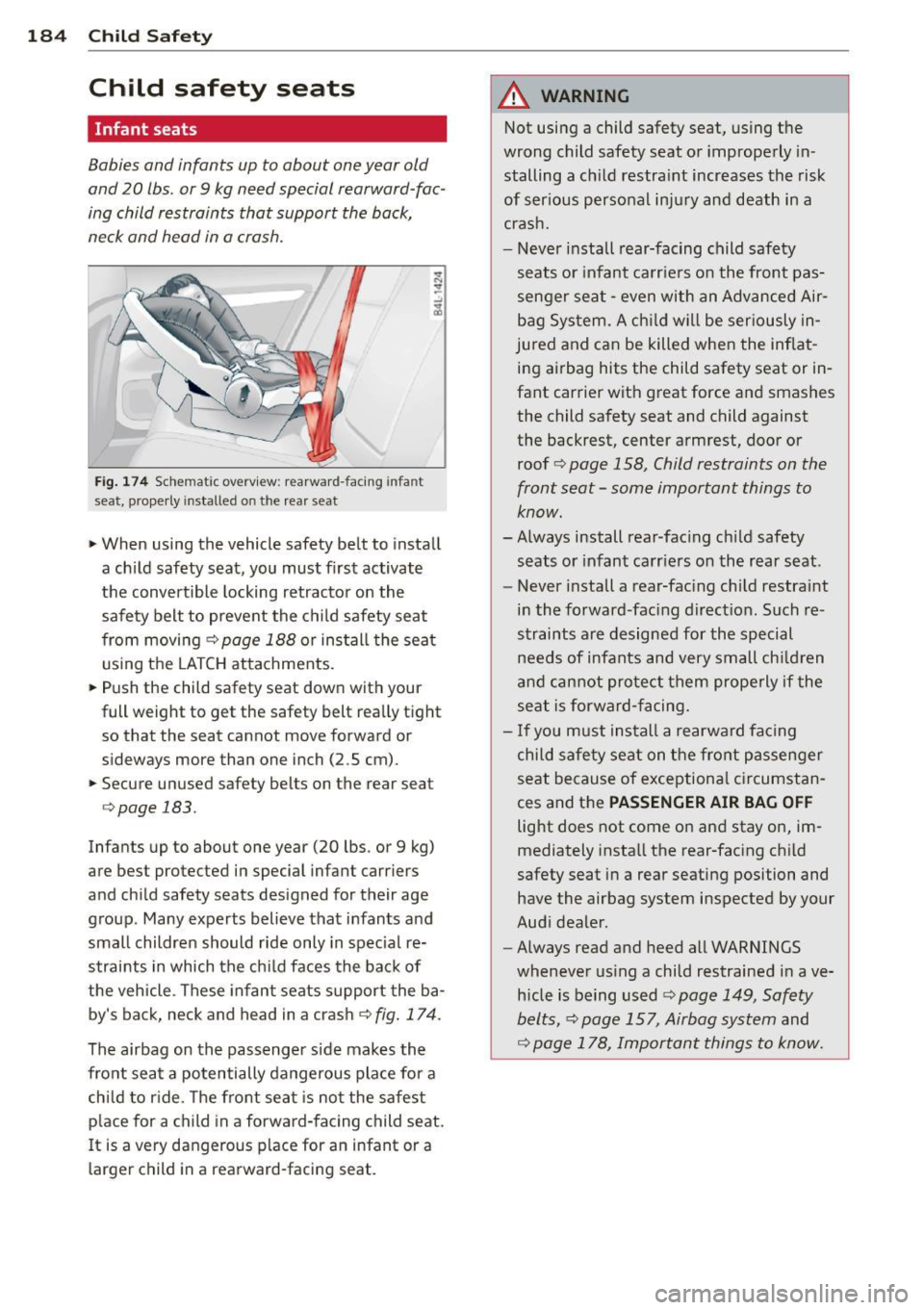
Fig . 174 Sche matic overview: rearward- facing infant
seat, properly installed o n the rear seat
> When using the vehicle safety belt to install
a ch ild safety seat, you must first activate
the convertible locking retractor on the
safety belt to prevent the child safety seat
from moving ¢
page 188 or install the seat
using the LATCH attachments.
> Push the child safety seat down with your
full weight to get the safety belt rea lly tight
so that the seat cannot move forward or
sideways more than one inch (2.5 cm).
> Secure unused safety belts on the rear seat
¢page 183.
Infants up to about one year (20 lbs. or 9 kg)
are best protected in special infant carriers
and child safety seats designed for their age
group . Many experts believe that infants and
small children should ride only in spec ial re
straints in which the ch ild faces the back of
the vehicle . These infant seats support the ba
by's back, neck and head in a crash ¢
fig. 174.
The airbag on the passenger side makes the
fro nt seat a potentially dangerous place for a
child to r ide . The front seat is not the safest
p lace for a child in a forwa rd-facing child seat.
I t is a very dangerous p lace for an infant or a
larger child in a rearward-facing seat.
A WARNING
-Not using a child safety seat, using the
wrong child safety seat o r improperly in
stalling a ch ild restra int increases the risk
of ser ious personal in ju ry and death in a
crash.
- Never install rear-facing child safety
seats or infant ca rr ie rs o n the front pas
senger sea t -even with an Advanced Air
bag Sys tem. A c hild will be ser iously in
jured and can be killed whe n the inflat
ing ai rbag hits the child safety seat or in
fant carrier with great force and smashes the child safety seat and child against
the backrest, center armrest, door or
roof ¢
page 158, Child restraints on the
front seat -some important things to
know.
- Always install rear-facing ch ild safety
seats or infant ca rr ie rs on the rear seat .
- Never install a rear-fac ing ch ild restra int
in th e forward-fac ing direct ion. Such re
straints are designed for the special needs of infants and very small ch ild ren
an d cannot protect them prope rly if the
seat is forward- facing.
- If you m ust insta ll a rearwa rd fa cing
child safety seat on the fro nt passenger
seat be cause of exceptiona l circumstan
ces and the
PASSENGER AIR BAG OFF
light does not come o n and stay on, im
mediately insta ll the rear-fac ing child
safety seat in a rear seating position and
have the airbag system inspected by your
Aud i deale r.
- Always read and heed all WARNINGS
whenever us ing a child restrained in ave
h icle is being used
¢ page 149, Safety
belts, ~page 157, Airbag system
and
c::> page 178, Importan t things to know.
Page 228 of 316
226 Fuel suppl y and filli ng your fu el t ank
enter the exhaust system and damage the
catalytic converter.
Refuelling
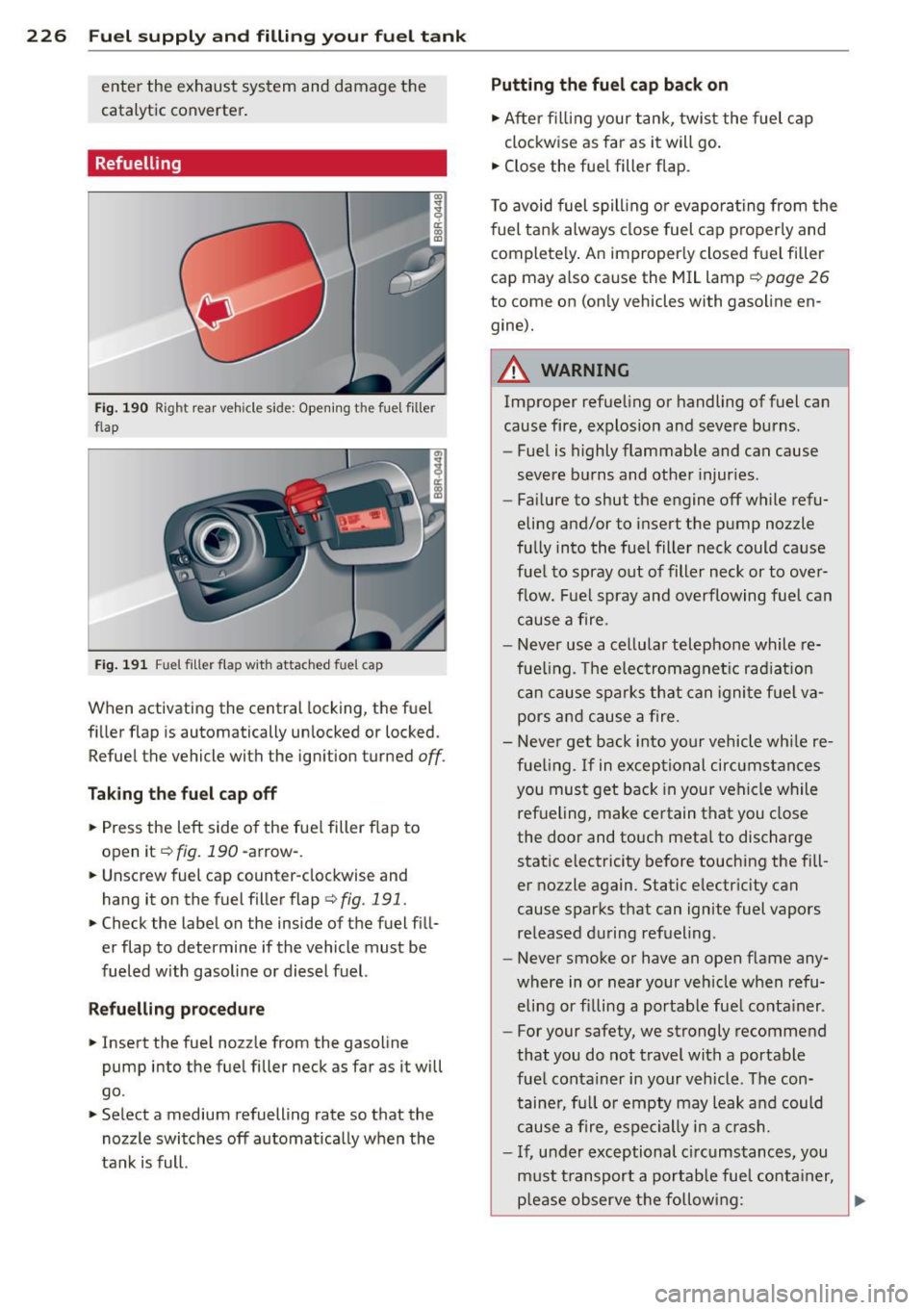
Fig. 190 Righ t rear ve hicle si de: Opening t he fuel filler
fl ap
Fig . 191 Fu el filler fla p w ith attached fuel cap
When activating the central locking, the fuel
filler flap is automatically unlocked or locked.
Refuel the vehicle with the ign ition turned
off .
Tak ing th e fu el cap off
• Press the Left side of the fue l filler flap to
open it ¢
fig. 190 -arrow-.
.. Unscrew fuel cap counter-clockwise and
hang it on the fuel filler flap ¢
fig. 191.
.. Check the Label on the inside of the fuel fill
er flap to determine if the vehicle must be
fueled with gasoline or diesel fuel.
Ref uelling pr ocedu re
.. Insert the fue l no zzle from the gasoline
pump into the fuel filler neck as far as it will
go .
.. Select a medium refuelling rate so that the
nozzle switches off automatically when the
tan k is full .
Putting the fu el cap b ack o n
• After f illing your tank, twist the fuel cap
clockwise as far as it will go .
.. Close the fue l filler flap.
T o avoid fuel spill ing o r evaporating from the
fuel tank always close fuel cap p roperly and
completely . An improperly closed fuel filler
cap may a lso ca use the
MIL Lamp ¢ page 26
to come on (on ly vehicles with gasoline en
gine).
A WARNING
-Improper refueling or handling of fuel can
cause fire, explosion and severe burns .
- Fuel is highly flammable and can cause
severe bu rns and other injur ies.
- Failure to shut the engine off while refu
eling and/or to insert the pump nozzle
fully into the fuel filler neck could cause
fuel to spray out of filler neck or to over
flow. Fue l spray and overflowing fuel can
cause a fire .
- Never use a cellular telephone while re
fue ling. The electromagnet ic rad iat ion
can cause spa rks that can ignite f uel va
pors and cause a fire .
- Never get back into your vehicle whi le re
fue ling.
If in exceptional circ umstances
you must get back in your vehicle while
refueling, make certain that you close
the door and touch metal to discharge
static e lectricity before touching the fill
er nozzle again . Static e lectr icity can
cause sparks that can ignite fuel vapors
released du ring refueling .
- Never smoke or have an open flame any
where in or near your vehicle when refu eling or filling a portable fuel conta iner.
- For your safety, we strongly recommend
that you do not travel with a portable
fuel conta iner in your vehicle . The con
tainer, fu ll o r empty may leak and could
cause a fire, especially i n a c rash.
- If , under exceptional c ircumstances, you
must transport a portab le fuel conta iner,
p lease observe the following: .,.
Page 233 of 316
Checking and filling Engine hood
Releasing the engine hood
The engine hood is released from inside the
vehicle .
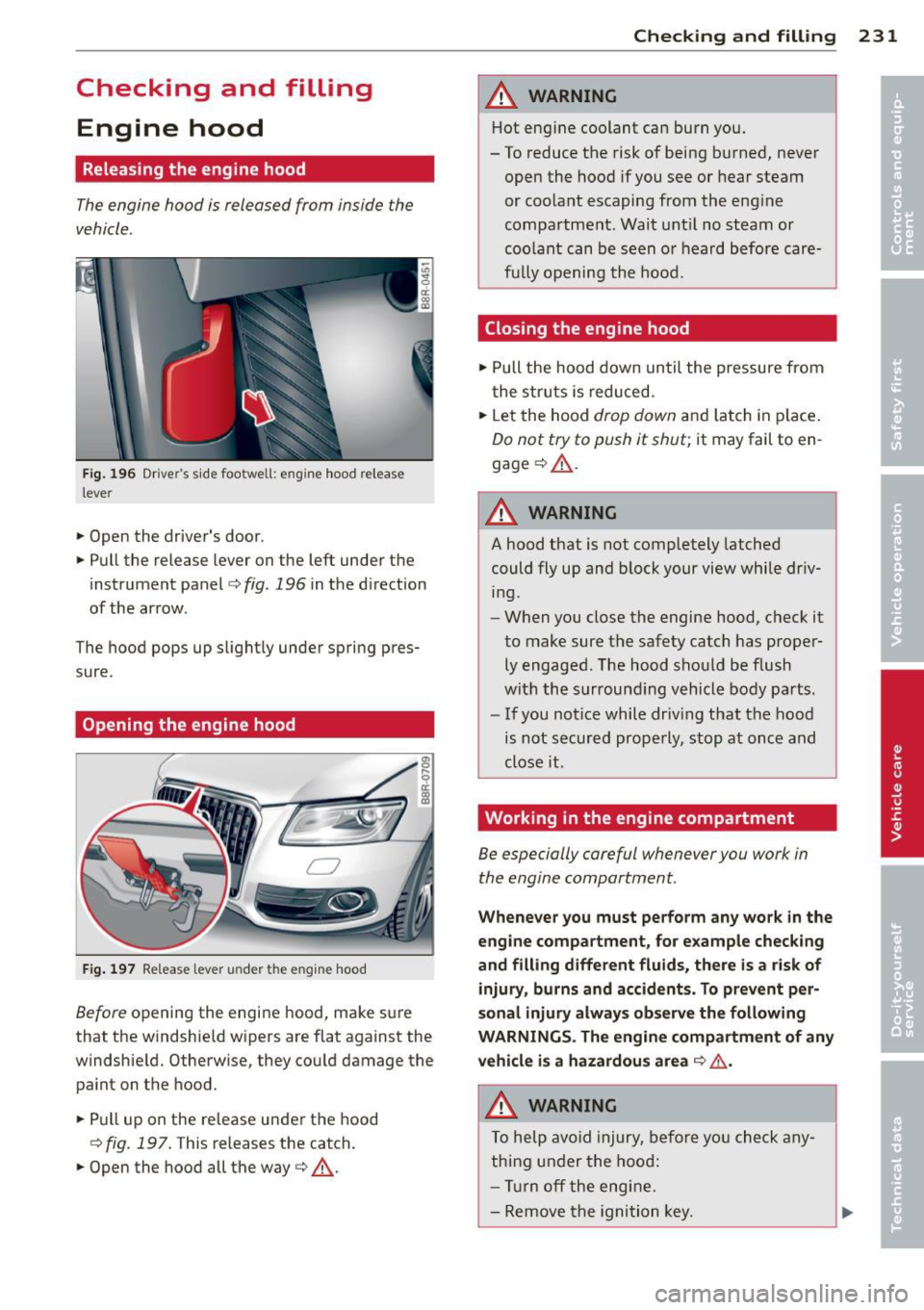
Fig. 196 Dr iver's side footwell: engin e hood release
lever
"' Open the driver's door .
"' Pull the release lever on the left under the
instrument panel
i=> fig. 196 in the d irection
of the arrow .
The hood pops up slightly under spring pres
sure.
Opening the engine hood
F ig . 197 Release lever under the engine hood
Before opening the engine hood, make sure
that the windshield wipers are flat against the
windshie ld. Otherwise, they could damage the
paint on the hood.
"' Pull up on the release under the hood
r::!> fig . 197 . This releases the catch.
"' Open the hood all the way
i=> .&,.
Checkin g and fillin g 231
A WARNING
Hot engine coolant can burn you.
- To reduce the risk of being burned, never
open the hood if you see or hear steam
or coolant escaping from the eng ine
compartment . Wait unt il no steam or
coolant can be seen or heard before care
fu lly opening the hood.
Closing the engine hood
"' Pull the hood down until the pressure from
the struts is reduced.
"' Let the hood
drop down and latch in p lace.
Do not try to push it shut; it may fail to en
gage
c;, .&, .
A WARNING
--
A hood that is not completely latched
could fly up and block your view while dr iv
ing.
- When you close the engine hood, check it
to make sure the safety catch has proper
ly engaged. The hood should be flush
with the surround ing vehicle body parts.
- If you notice while driv ing that the hood
is not secured properly, stop at once and
close it .
Working in the engine compartment
Be especially careful whenever you work in
the engine compartment.
Whenever yo u must pe rform any w ork in the
e n g ine com pa rt ment, for e xample ch ecki ng
and filling different fluids, th ere is a risk of
injury , burn s and accid ent s. T o pr eve nt per
so nal injury alwa ys obs erve the foll owing
WARNINGS . The en gine c ompa rtment of an y
vehicl e is a hazardou s are a
c;, Lh,.
A WARNING ~
To help avoid injury, be fo re you check any
thing under the hood:
- Turn off the engine.
- Remove the ignition key.
Page 277 of 316
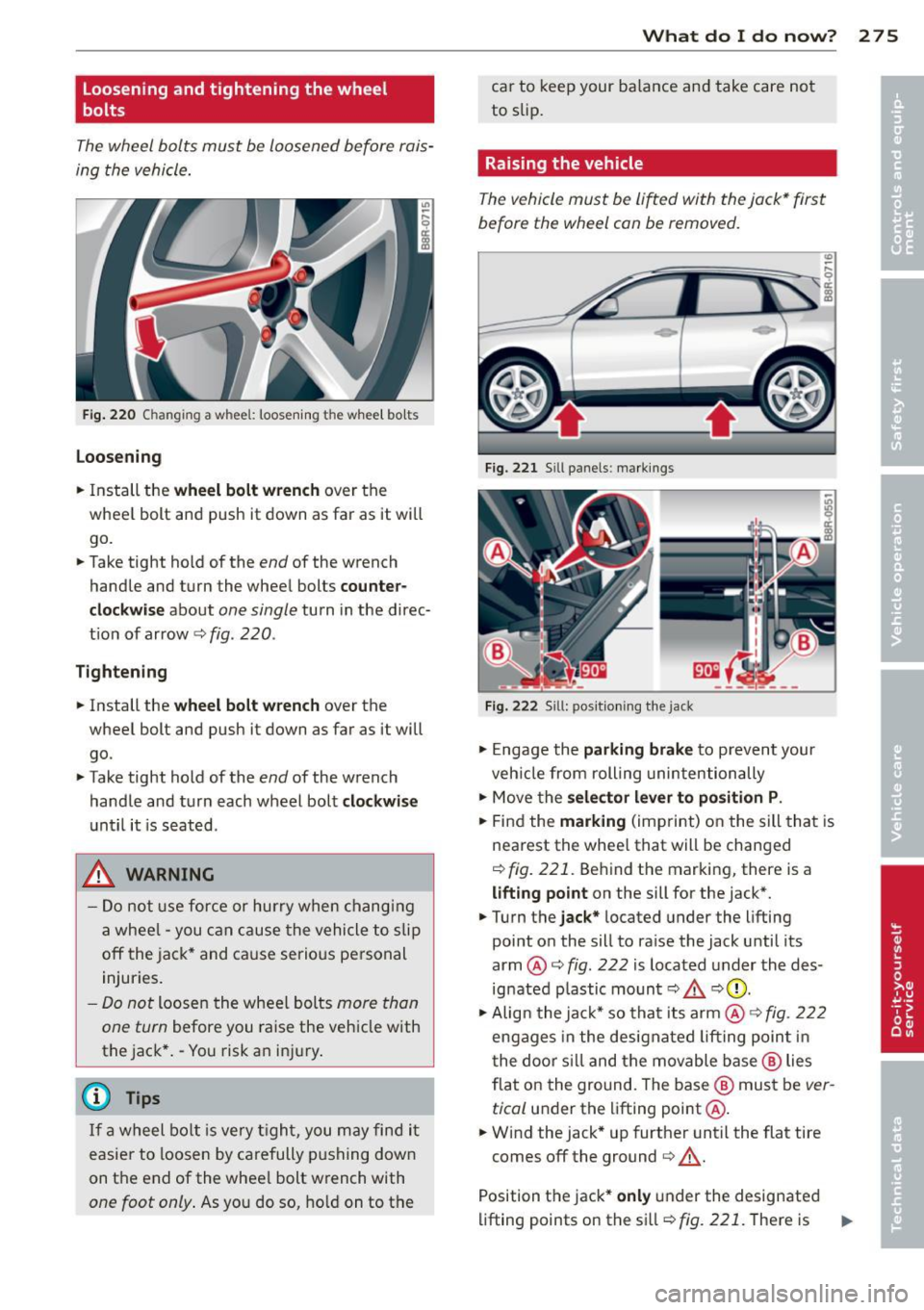
Loosening and tightening the wheel
bolt s
The wheel bolts must be loosened before rais
ing the vehicle.
Fig . 220 Changing a wheel: loosening the whee l bo lts
Loosening
.. Install the wheel bolt wrench over the
wheel bolt and push it down as far as it will
go .
.. Take tight hold of the
end of the wrench
handle and turn the wheel bolts
counter
clockwise
about one single turn in the direc
t ion of arrow c::>
fig. 220.
Tightening
.. Install the wheel bolt wrench over the
wheel bolt and push it down as far as it will go.
.. Take tight hold of the
end of the wrench
handle and turn each wheel bolt
clockwise
until it is seated .
.&, WARNING
-Do not use force or hurry when changing
a whee l -you can cause the vehicle to slip
off the jack* and cause serious personal
injuries.
- Do not loosen the wheel bolts more than
one turn
before you raise the veh icle with
the jack*. -You risk an injury .
(D Tips
If a wheel bolt is very tight, you may find it
easier to loosen by carefully pushing down
on the end of the whee l bolt wrench with
one foot only . As you do so, hold on to the
What do I do now? 275
car to keep your ba lance and take care not
to slip.
Raising the vehicle
The vehicle must be lifted with the jock* first
before the wheel con be removed.
Fig . 221 Sill panels : marking s
Fig. 222 Sill: positio ning the jack
.,. Engage the parking brake to prevent your
vehicle from rolling unintentionally
.. Move the
selector lever to position P .
.. Find the marking (imprint) on the s ill that is
nearest the whee l that will be changed
c::>fig . 221. Behind the marking, there is a
lifting point on the sill for the jack*.
.. Turn the
jack* located under the lifting
point on the sill to raise the jack until its
arm @c::>
fig. 222 is located under the des
ignated p lastic mount c::>
& c::>0.
.,. Align the jack* so that its arm@
c::> fig. 222
engages in the designated lifting point in
the door s ill and the movable base® lies
flat on the ground. The base@ must be
ver
tical
under the lifting point@.
.. Wind the jack* up further until the flat tire
comes off the ground
c::> & .
Position the jack* only under the designated
lifting points on the s ill
c::>fig. 221. There is ll-
Page 282 of 316
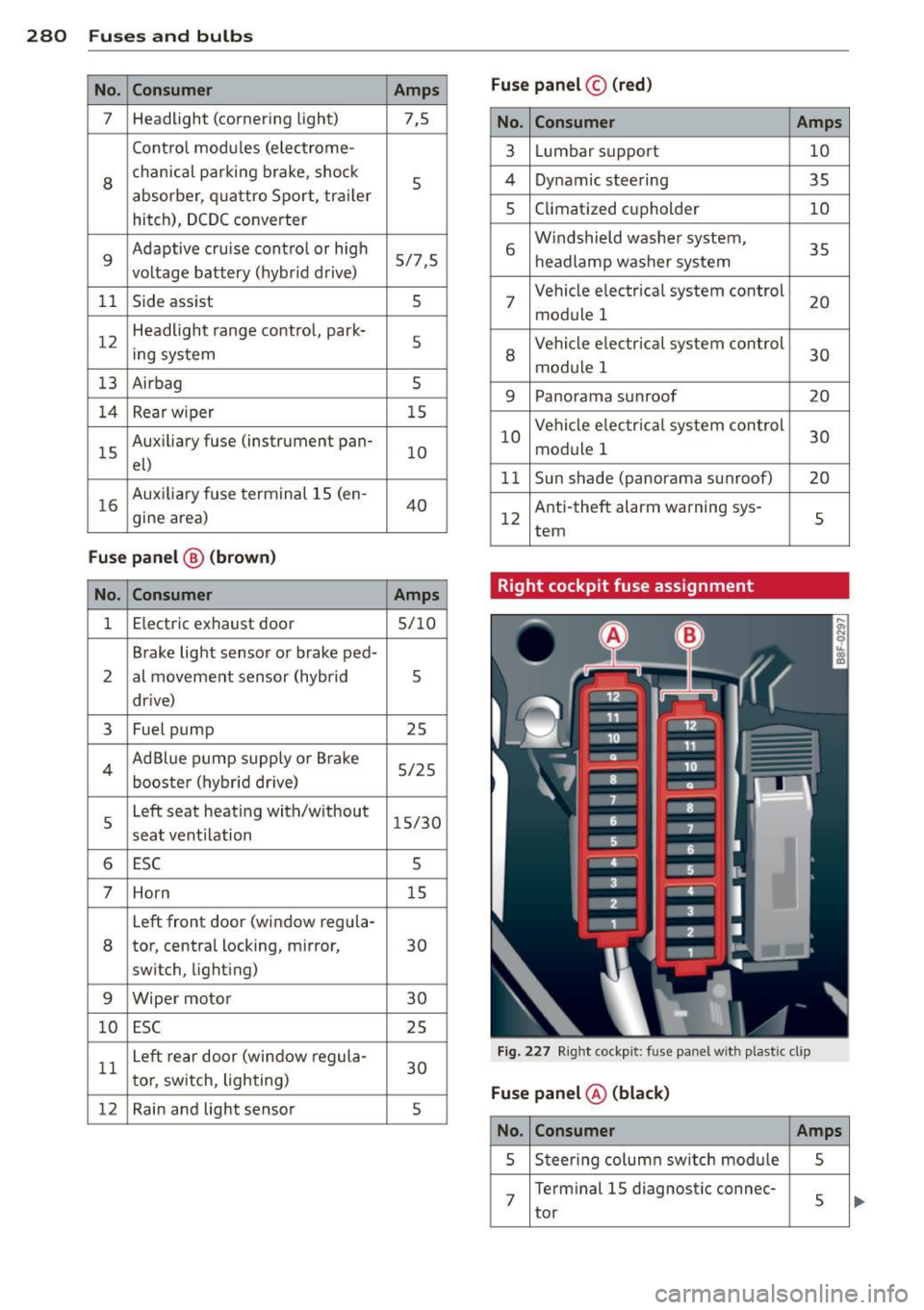
280 Fuses and bulbs
No. Consumer Amps Fuse panel
© (red )
7 Headlight (corner
ing light)
7,5 No. Consumer Amps
Contro l modu les (e lec trome-
3 Lum bar s upport 10
8
chanic al par king br ake, sho ck
5
absorber, q uatt ro Spor t, tra ile r
hitch), DCDC converter 4
Dynamic stee ring
35
5 Climat ized cu pholder 10
9
Adaptive cruise contro l or hig h
5/7,5
vo ltage battery (hybr id d rive) 6
W indshield w asher system,
35
h eadlamp washer sys tem
1 1 Side ass ist 5
7 Vehicle e
lectrical system control
20
module 1
12 H
eadlight range contro l, par k·
5
ing sys tem
8
Ve hicle e lec tric al syste m control
30
mod ule 1
13 Airbag
5
9 Panorama sunroof
20
1 4 Rear wiper 15
1 5 Aux
iliary fuse (instrument pan·
10
el)
16
Auxi liary fuse term inal 15 (en -
40
gine area) 10
Vehicle e
lectrica l system control
30
module 1
1 1 Sun shade (panorama s unroof) 20
1 2 Anti-theft alarm warning sys·
s
tern
Fuse panel
@ (brown)
No. Consumer Amps Right cockpit fuse assignment
1 Electric exhaust door
5/10
Brake lig ht sensor o r brake ped·
2 al movem ent s ensor (hybrid 5
dr ive)
3 Fuel pump 25
4 AdBl
ue p ump supp ly o r Br ake
5/25
booste r (hybr id drive)
5 Left seat heati
ng wit h/w ithout
15/30
seat vent ilation
6 ESC 5
7 Horn 15
Left front door (window regula ·
8 tor, central locking, m irror,
30
sw itch, light ing)
9 Wipe r moto r 30
10 ESC 25
11 Le
ft r ear do or (win dow regul a-
30
t o r, sw itch, lighting)
12 Rain and light se
nso r
5
Fig. 22 7 Right cockp it: fuse panel wit h plast ic clip
Fuse panel ® (black)
No. Consumer Amps
5 Steering column sw itch mod ule s
7
Terminal 15 diagnostic connec·
tor
5
Page 283 of 316
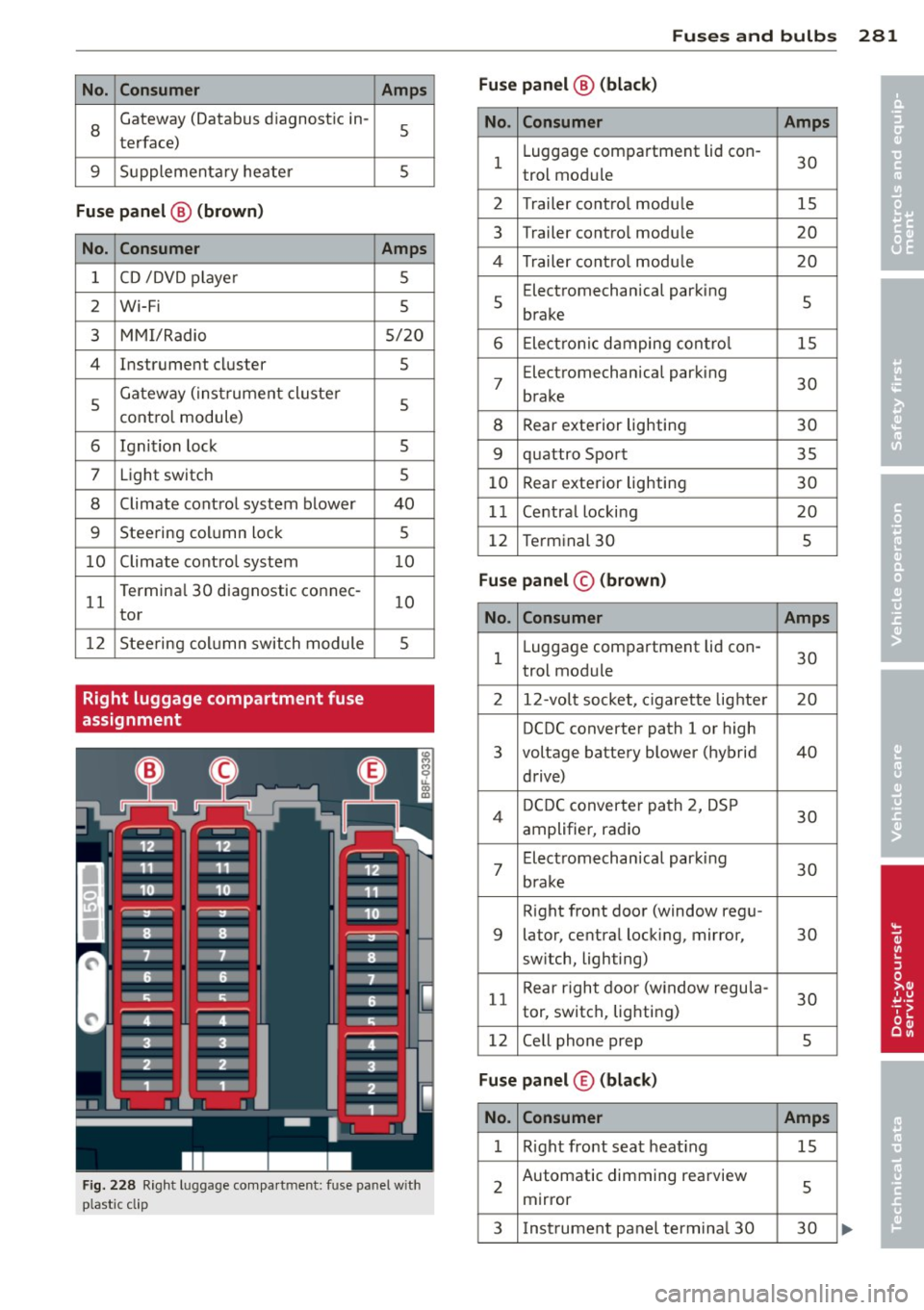
No. Consumer
8
Gateway (Databus d iagnostic in-
terface)
9 Supplementary heater
Fuse p anel @ (b rown )
N o. Con sumer
1 CD /DVD player
2 Wi-Fi
3 MMI/Radio
4 Instrument cluster
5 Gateway
(instrument cluster
cont rol module)
6 Ignition lock
7 Light switch
8 Climate control system blower
9 Steering column lock
10 Climate contro l system
11 T
erminal 30 diagnostic connec-
tor
12 Steering column switch module
Right luggage compartment fuse
assignment Amps
5
5
Amps
5
5
5/20
5
5
5 5
40
5
10
1 0
5
Fig. 228 Right luggage compa rtment: fuse panel w ith
ptastic cl ip
Fu ses and bulb s 281
Fus e panel@ (bla ck)
•
N o. Consumer Amps •
1 Luggage
compartment lid con-
30
trol module
2 Trailer contro l modu le 15
3 Trailer contro
l modu le
20
4 Trailer cont ro l modu le 20
5 Electromechanical
parking
5
brake
6 Electronic damping contro l 15
7
Electromechanical parking
30
brake
8 Rear exterior lighting
30
9 quattro Sport
35
10 Rear
exterior lighting
30
1 1 Centra l locking 20
12 Terminal 30 5
Fuse pan el© (brown )
No . Consumer Amps
1 Luggage compartment lid con-
30
trol module
2 12-vo lt socket, c igarette lighte r 20
DCDC converter path 1 or high
3 voltage
battery blower (hybrid 40
drive)
4 D
CDC converter path 2, DSP
30
amplifier, radio
7
Electromechan ical parking
30
brake
Right front door (window regu-
9 lator, central locking, mirror,
30
switch, lighting)
11 Rear
right door (window regu la-
30
tor, switch, lighting)
12 Cell phone prep
5
Fuse panel ® (bla ck )
No. Consumer Amps
1 Right front seat heat ing 15
2 Automatic dimming
rearview
5
mirror
3 Instrument panel termina l 30 30
Page 302 of 316
300 Index
Center armrest
Adjusting . ................. ..... .. 66
Storage compartment . . . . . . . . . . . . . . . 66
Certification . . . . . . . . . . . . . . . . . . . . . . . 296
Changing A flat tire .. .......... ...... ... .. . 273
A wheel .. .. ................ ... ... 273
E ng ine oil ... ............ .. .. .. .. . 237
Checking Engine coolant level ....... .. .. .... . 239
Tire pressure .............. ... .. .. . 253
Child restraints Danger of using child restraints in the
front seat .... ........... .. .. .... . 158
System anchors .......... .. .. .. .. . 191
Where can I get additional information
about child restraints and their use? . . 196
Chi ld safety ................. .. .... . 178
Convertible locking retractor .. .. ..... 188
Important safety instructions for using
child safety seats ............. .. ... 181
Important things to know when dr iving
with chi ldren . ... ..... ... .. .. .. .. . 178
I nstalling a child restraint using the
L A T CH system . ......... .. .. .. .. .. . 193
Mounting and releasing the anchorage
hook .... ................ ... .... . 193
Tether anchors ............ ... .... . 194
Tether straps .............. .. .... . 194
Ch ild safety locks
Rear doors ............... ... .... .. 46
Child safety seats . .......... ... .. .. . 184
Booster seats ............. ... .. ... 186
Conve rtible child seats .... .. .. .. .. . 185
Conve rtible locking retractor .. .. .. .. . 188
Danger of using child restraints in the
front seat .. ................ ..... . 158
How do I properly install a child safety
seat in my vehicle? ........ .. .. .... . 181
Infant seats ............. .. .. .. .. . 184
Installing ................. .. .... . 188
LA TCH system ......... .... ... .. .. . 193
Lower anchorages ......... ... .. .. . 192
Safety instructions ... ..... .. .. .... . 181
Unused safety belts on the rear seat .. 183
Cigarette lighter ........... .. .. .. .. .. 75
C leaning .................... ..... . 217 Climate control
.... ............. ..... 79
Air vents . ..... .. .. .............. .. 81
Automatic recircu lation .......... ... . 81
Operation . . . . . . . . . . . . . . . . . . . . . . . . . 80
Setup .... .... .. ............. .... . 81
Supplementary .. ................ .. 82
Synchronizing . ... ....... ...... .. .. . 81
Climatized cupholder ................. 74
Clock .. .. .. .... .. ............. ..... 12
Closing Panoramic sliding sunroof ........ ... . 47
Coat hooks ..... .. .. .............. .. 77
Cold tire inflation pressure .......... .. 251
Compass mirror . . . . . . . . . . . . . . . . . . . . . 59
Compliance ..... .. .. .............. . 296
Consumer Information . . . . . . . . . . 146, 293
Contacting NHTSA . ............... .. 146
Controls Cleaning .. .... .. .. .............. . 219
Convenience Closing ...... ... .. .............. .. 47
Open ing .. .... .. ............. .... . 47
Convenience key . .. ............. .... . 40
Indicator lights .. ..... ........... .. 87
Locking and unlocking vehicle ........ . 40
Start ing engine (START ENGINE STOP
button) ..... .. .. .. ........... .... . 86
Stopping the engine (START ENGINE
STOP button) .... ............... .. . 87
Switching on ignition ............ ... . 86
Convertible child safety seats . .. ... ... 185
Convertible locking retractor Activating . .... .. ............. .... 190
Deactivat ing . ... . ... ... .... ... .. .. 191
Using to secure a child safety seat 1.88, 190
Coolant system .... ................ . 238
Cooled cupholder ............... .... . 7 4
Cooling box in glove compartment . . . . . . 77
Cooling mode (climate control) ..... ... . 80
Cooling System Expansion tank ... ............. .... 239
Cornering light .. .. ............. .... . 51
Cruise control
Changing speed
Preselect speed .
. ................ .. 95
96
Switching off .. .. ............. .. .. . 96
Page 303 of 316
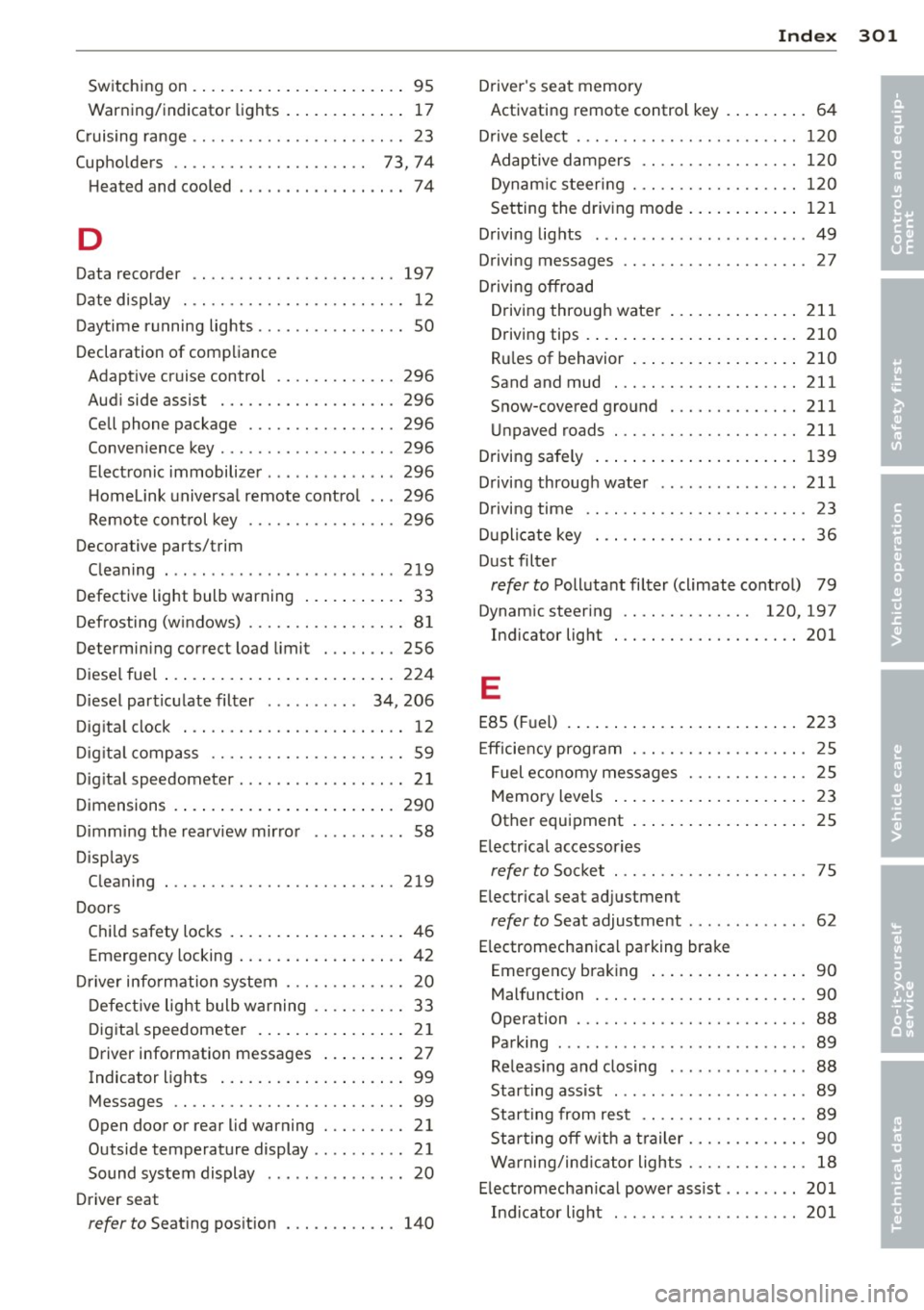
----------------------------~I~n ~d ~e ~x 301
Switching on . ..... .... ... .. .. .. .... 95
Warning/indicator lights ... .. .. .. .. .. 1 7
C ruising range . . . . . . . . . . . . . . . . . . . . . . . 23
(upholders . . . . . . . . . . . . . . . . . . . . . 73, 74
H eated and cooled . . . . . . . . . . . . . . . . . . 7 4
D
Data recorder ............. .... .. .. . 197
D ate display . . . . . . . . . . . . . . . . . . . . . . . . 12
Daytime running lights . . . . . . . . . . . . . . . . SO
Declaration of comp liance
Adapt ive cruise control ............. 296
Aud i side assist .......... .. .. .. .. . 296
Cell phone package ................ 296
Conven ience key ................... 296
E lect ronic immobilize r ...... ... .. .. . 296
H omelink universa l remote cont ro l .. . 296
Remote control key ................ 296
Decorative parts/trim Cleaning . ..................... .. . 219
Defective light bulb warning ... .. .. .... 33
D efrosting (windows) ................. 81
Determin ing correct load limit ... ... .. 256
D iese l fue l ... ... .. ..... ... .. .. .. ... 224
D iese l particu late filter . . . . . . . . . . 34, 206
Dig ita l clock . .. .. ......... .. .. .. .... 12
D ig ita l compass ..................... 59
Dig ita l speedometer .................. 21
D imensions
.. .. .... .... ... .. .. .. ... 290
D imm ing the rearview mir ro r . . . . . . . . . . 58
Disp lays
C leaning . .. .. ........... .. .. .. ... 219
D oors
C hil d safety locks . ..... ... .. .. .. .. .. 46
Emergency locking . . . . . . . . . . . . . . . . . . 42
D river information system . . . . . . . . . . . . . 20
D efect ive light bulb warning .. .. .. .. .. 33
D ig ita l speedometer ... ... .. .. .. .. .. 21
Driver information messages ... .. .. .. 27
Indicator lights . . . . . . . . . . . . . . . . . . . . 99
Messages . . . . . . . . . . . . . . . . . . . . . . . . . 99
Open door or rear lid warning . . . . . . . . . 21
Outside temperature display .. .. .. .. .. 21
Sound system display . . . . . . . . . . . . . . . 20
Driver seat
refer to Seating pos ition 140 Driver
's seat memory
Activating remote contro l key . . . . . . . . . 64
D rive select . .. .. .. ................. 120
Adaptive dampers .... ......... .. .. 1 20
Dynam ic steer ing . ............. .... 120
Setting the dr iv ing mode ..... ... .. .. 121
D rivi ng lights ..... .. ................ 49
Driving messages . . . . . . . . . . . . . . . . . . . . 27
Drivi ng offroad
D riving through wate r ....... ... .. .. 211
Driving tips . ..... .. . .. .. ..... ... .. 210
Ru les
of behavior ... . .. ..... ... .. .. 210
Sand and mud . .. ................. 211
Snow-covered gro und . ............. 211
Un paved roads . .. ............. .. .. 211
Driving safely
Driving through wate r
Driving time .. .. .. ... ............ .. . 139
211
23
D uplicate key . .. .. ................. . 36
Dust filter
refer to Pollutant filter (climate co ntrol) 79
Dynam ic steering . . . . . . . . . . . . . . 120, 197
Ind icator light ... ................. 201
E
E85 ( Fuel)
223
E fficiency prog ram . .... ............. . 25
F uel economy messages ........ .. .. . 25
Memo ry levels . . . . . . . . . . . . . . . . . . . . . 23
Other equipment ... . ... ...... ... .. . 25
E lectrica l accessories
refer to So cket . .. ............. .. .. . 75
E lectrical seat adjustment
refer to Seat adjustment . . . . . . . . . . . . . 62
E lectromechanica l pa rking brake
Emergency braking ... ... ..... ... .. . 90
Malfunction . .. .. .. . .............. . 90
Operation . . . . . . . . . . . . . . . . . . . . . . . . . 88
Pa rking ... .. .. .. .. . .. .... ...... .. . 89
Re leas ing and closing ............... 88
Starting assist . . . . . . . . . . . . . . . . . . . . . 89
Star ting from rest ............. .... . 89
Star ting off w it h a tr ailer ........ .. .. . 90
Warning/ind ic at or lights ........ .. .. . 18
E lectromechanical powe r assist ....... . 201
Ind icator lig ht ... .. . .. .... ...... .. 201
•
•