belt AUDI Q5 2014 Repair Manual
[x] Cancel search | Manufacturer: AUDI, Model Year: 2014, Model line: Q5, Model: AUDI Q5 2014Pages: 316, PDF Size: 78.41 MB
Page 199 of 316
Intelligent technology Notice about data
recorded by vehicle
control modules
Your vehicle is not equipped with an Event Da
ta Recorder (EDR), installed by some manu
facturers for the express purpose of capturing
data for retrieval after an accident or crash
event. EDR's are sometimes called "crash re
corders".
Some state laws restrict the retr ieval or down
loading of data stored by EDR's that were in
stalled in a vehicle for the express purpose of
retrieving data after an accident or crash
event without the owner's consent.
Although your vehicle is not equipped with an
EDR, it is equipped with a number of electron
ic control modules for various vehicle systems
such as, for examp le, engine function, emis
sion control, as well as for the airbags and
safety belts.
These electronic control modules also record
vehicle-related data during norma l vehicle op
eration for diagnostic and repair purposes.
The recording capacity of the electronic con
trol modules is limited to data (no sound is re
corded) and only a small amount of data is ac
tually recorded over a very limited period of
time and stored when a system fault or other
condition is sensed by a control unit. Some of
the data then stored may relate to vehicle
speed, direction, braking as we ll as restraint
system use and performance in the event of a
crash or other condition. Stored data can only be read and downloaded with special equip
ment.
Electronic Stabilization
Control (ESC)
Description
The Electronic Stabilization Control (ESC) rein
forces driver safety. It reduces the risk of slip
ping and improves driving stability. ESC de
tects critical s ituations such as the vehicle
Intelligent technology 197
oversteering and understeering or the whee ls
spinning . The vehicle is stabilized by applying
the brakes or reducing eng ine torque . Once
the ESC is active, the indicator light
G1 blinks
in the instrument cluster.
ESC includes the anti-lock brake system (ABS),
brake assist system, anti-slip regulation
(ASR), electronic differential lock (EDL), dy
namic steering*, hill descent assist and selec
tive wheel torque control.
Anti-lock brake system (ABS)
ABS prevents the whee ls from locking up
when braking . The vehicle can still be steered
even during hard braking. App ly steady pres
sure to the brake pedal. Do not pump the ped
al. A pulsing in the brake pedal indicates that
the system is helping you to brake the vehicle .
Brake assist system
The brake assist system can decrease braking
distance. It increases braking power when the
driver presses the brake pedal quickly in emer
gency situations . You must press and hold the
brake pedal until the situation is over . In
vehicles with adaptive cruise control*, the
brake assist system is more sensitive if the
distance detected to the vehicle ahead is too
small.
Anti-slip regulation (ASR)
ASR reduces engine power when the drive
wheels beg in to sp in and adapts the force to
the road conditions. This makes it easier to
start, accelerate and drive up hill s.
Electronic differential lock (EDL)
The EDL brakes wheels that are spinning and
transfers the drive power to the othe r whee ls .
T his function is available up to about 78 mph
(125 km/h) .
In extreme cases, EDL automatically switches
off to help keep the brake on the braked wheel
from overheat ing. EDL will switch on again au
tomatically when conditions have returned to
normal.
•
•
Page 221 of 316
Vehicle care and cleaning 219
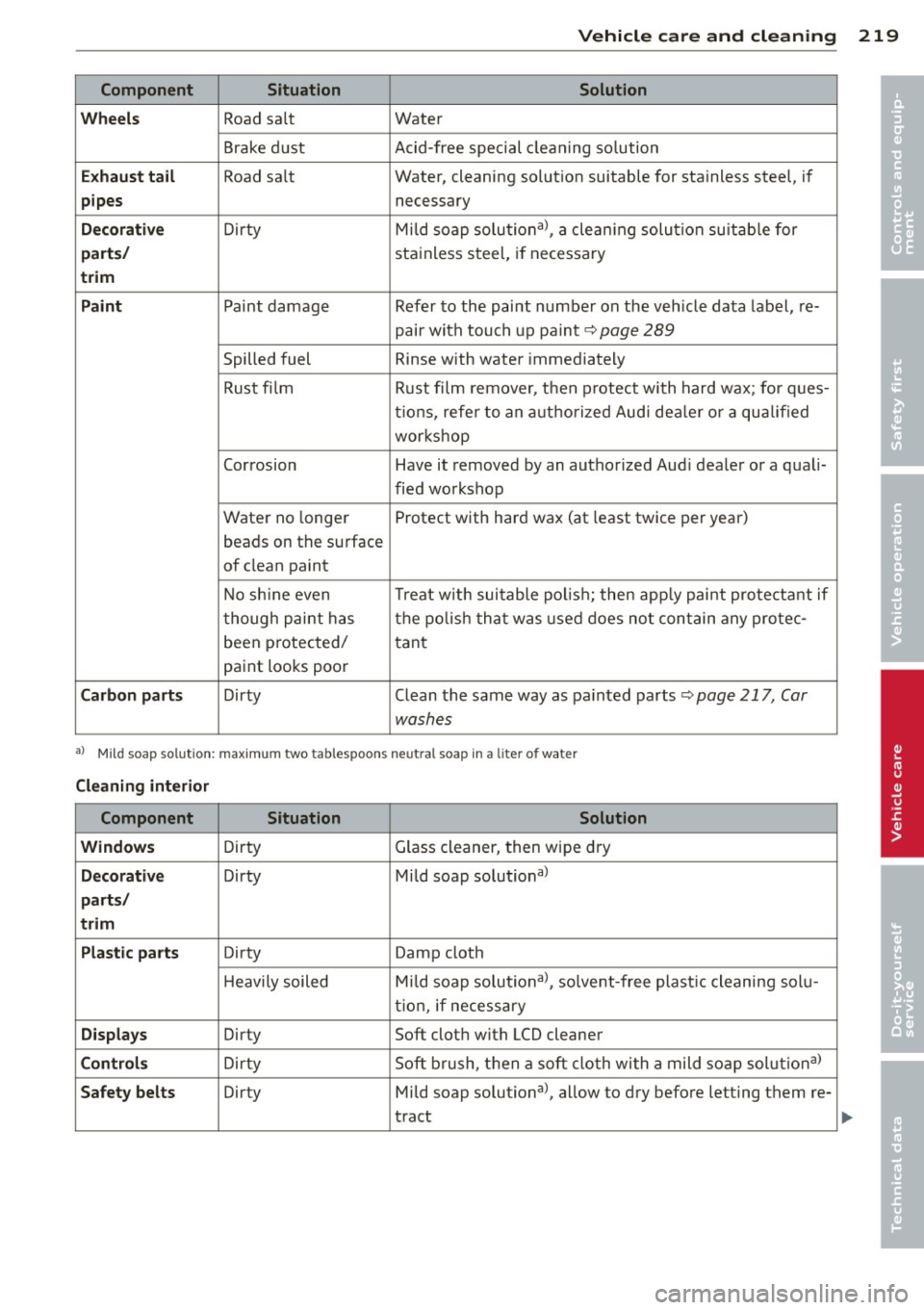
Component Situation Solution
Wheels
Road sa lt Water
Brake dust Acid-free special cleaning solution
Exhaust tail Road salt Water, cleaning solut ion suitable for stainless steel, if
pipes necessary
Decorative Dirty Mild soap
solutional, a cleaning solution suitab le for
parts/ stainless steel, if necessary
trim
Paint
Paint damage Refer to the paint number on the veh icle data label, re-
pair with touch up paint~
page 289
Spilled fuel R inse with water immediately
Rust fi lm Rust film1 remover, then protect with hard wax; for ques-
tions, refer to an authorized Audi dealer or a qualified
workshop
Corrosion Have it removed by an aut horized Audi dealer or a quali-
fied workshop
Water no longer Protect with hard wax (at least twice per year)
beads on th e surface
of clean paint
No shine even Treat
with suitable polish; then apply paint protectant if
though paint has the polish that was used does not contain any protec-
been protected/
tant
paint looks poor
Carbon parts Dirty Clean the same way as pa inted parts ~ page 217, Car
wash es
al Mild soap sol utio n: maximum two tablespoons neutral soap in a lite r of water
Cleaning interior
Component Situation Solution
Windows
D irty Glass
cleaner, then wipe dry
Decorative Dirty Mild soap solutional
parts/
trim
Plastic parts
Dirty Damp cloth
H eavily soiled Mild soap solutional, solvent-free plast ic cleaning solu-
tion, if neces sary
Displays Dirty Soft cloth with LCD cleaner
Controls Dirty Soft
bru5,h, then a soft cloth with a mild soap solut ional
Safety belts Dirty Mild soap solutional, allow to dry befo re letting them re-
tract
•
•
Page 223 of 316
-Never use abrasive cleaning materials
or alcohol to clean the camera lens.
Th is could cause scratches and cracks .
-Window s
-Remove snow and ice on w indows and
exterior mirrors with a plastic scraper.
To avoid scratches, move the scraper only in one direction and not back and
forth.
- Never remove snow or ice from w in
dows and m irrors using wa rm or hot
wate r because this cou ld cause crac ks
to form.
- To avoid damage to the rear window
defogger, do not apply any stickers on
the heating wires on the inside of the
w indow .
-Dec or ati ve p arts /trim
-Never use chrome care or cleaning
products.
-Paint
-To reduce the risk of scratches, the ve-
hicle must be free of dirt and dust be
fore polishing or waxing.
- To prevent paint damage, do not polish
or wax the veh icle in direct sunlight.
- To reduce the risk of paint damage, do
no t polish away rust film .
-Di splay s
-To avoid scratches, do not use dry
cleaning methods on displays .
-Controls
- Make sure that no flu ids enter the con-
trols, because this cou ld cause dam
age .
-Safet y belts
- Do not remove the safety belts to clean
t hem.
- Never clean safety belts or their com
ponents chemically or with cor ros ive
fluids or solvents and never a llow
sharp objects to come into contact
with the safety belts . This cou ld cause
damage to the belt webbing.
- If the re is damage to the webb ing, the
connections, the retractors or the buck
les, have them rep laced by an author-
V ehicl e ca re a nd cl eanin g 221
ized A udi dealer or a qualified work
shop.
- Te xtile s/Vin yl/ Alcant ara
- Never treat Vinyl/Alcantara w ith leath-
er care products, solvents, floor polish,
shoe polish, stain remover or s imilar
p rod ucts.
- To avoid damage, have stubborn stains
removed by an authorized Aud i deale r
or a qualif ied workshop.
- Never use steam cleaners, brushes,
hard sponges, etc. when cleaning.
- Objects w ith sharp edges such as zip
pers, rivets on clothing or be lts can
cause damage to the surface.
- Open hook and loop fastene rs, for ex
ample on cloth ing, can damage seat
covers. Make sure hook and loop fas
tene rs a re closed.
- Natural leather
- Neve r treat leather w ith solvents, floor
polish, shoe polish, stain remover or
similar products.
- Objects with sharp edges such as zip·
pers, rivets on clothing or be lts can
cause damage to the surface.
- Never use steam cleaners, brushes,
hard sponges, etc. when cleaning.
- To help prevent the leather from fad
ing, do not leave the vehicle in d irect
sunlight for long per iods of t ime. If
leaving the vehicle parked for long pe
riods of time, you should cover the
leather to protect it from d irect sun
light.
(D Tips
- Insects are easier to remove from paint
that has been freshly waxed.
- Regular waxing can prevent rust film
from forming.
•
•
Page 234 of 316
232 Checking and filling
-Apply the parking brake.
- Move selector lever of automatic trans- mission to P (Park).
- Always let the engine cool down. Hot components will burn skin on contact.
- To reduce the risk of being burned, never
open the hood if you see or hear steam
or coolant escaping from the engine
compartment. Wait until no steam or
coolant can be seen or heard before care
fully opening the hood.
- Keep children away from the engine com partment.
- Never spill fluids on hot engine compo
nents. They can cause a fire.
- Never touch the radiator fan. The auxili
ary electric fan is temperature controlled
and can switch on suddenly.
- Never open the coolant reservoir cap
when the engine is still warm. The cool
ant system is pressurized and hot cool ant could spray out .
- Protect your face, hands and arm from
steam or hot engine coolant by placing a
thick rag over the cap when you open the
coolant reservoir .
- Do not remove the engine cover under
any circumstances. This increases the
risk of burns.
- If work on the fuel system or the electri
cal system is necessary:
- Always disconnect the battery.
- Never smoke or work near heaters or
open flames. Fluids in the engine com
partment could start a fire.
- Keep an approved fire extinguisher im
mediately available.
- To avoid electrical shock and personal in
jury while the engine is running or being
started, never touch:
- Ignition cables
- Other components of the high voltage
electronic ignition system.
- If you must perform a check or repair
with the engine running: -
First, fully apply the parking brake,
move selector lever of automatic trans
mission to P (Park).
- Always use extreme caution to prevent
clothing, jewelry, or long hair from get
ting caught in the radiator fan, V-belts
or other moving parts, or from contact ing hot parts. Tie back hair before
starting, and do not wear clothing that
will hang or droop into the engine.
- Minimize exposure to emission and
chemical hazards
c:> &, .
&_ WARNING
California Proposition 65 Warning:
- Engine exhaust, some of its constituents,
and certain vehicle components contain
or emit chemicals known to the State of
California to cause cancer and birth de
fects and reproductive harm. In addition,
certain fluids contained in vehicles and
certain products of component wear con
tain or emit chemicals known to the
State of California to cause cancer and
birth defects or other reproductive harm.
- Battery posts, terminals and related ac
cessories contain lead and lead com
pounds, chemicals known to the State of
California to cause cancer and reproduc
tive harms. Wash hands after handling.
(D Note
When adding fluids, always make sure that
they are poured into the proper container
or filler opening, otherwise serious dam
age to vehicle systems will occur.
@ For the sake of the environment
To detect leaks in time, inspect the vehicle
floor pan from underneath regularly. If
you see spots from oil or other vehicle flu
ids, have your vehicle inspected by an au
thorized Audi dealer.
Page 242 of 316
24 0 Ch eck ing and filling
pressure relief valve in the cap when the en
gine becomes hot.
A WARNING
- The coo ling system is under pressure and
can get very hot. Reduce the risk of
sca lding from hot coolant by following
these steps.
- Turn off the eng ine and a llow it to cool
down.
- Protect your face, hands and arms from escap ing fl uid and steam by cover ing
the cap with a large, thick rag.
- T urn the cap slowly and very carefully
in a counter-clockwise direction while
applying light, downward pressure on
the top of the cap.
- To avo id being burned, do not sp ill an
tifreeze or coolant on the exhaust sys
tem or hot engine parts. Under certain
conditions, the ethylene glyco l in en
g ine coolant can catch fire.
- Antifreeze is poisonous. Always store an
t ifreeze in its or iginal container and well
out of the reach of children.
- If you drain the coolant, it must be caught and safely stored in a proper con
tainer clear ly marked "poison".
- Coolant pollutes the environment and
could cause an engine fire. Excess coo l
ant will be forced out through the pres
sure re lief valve in the cap when the en
gine becomes hot.
- If, in an emergency, only water can be
added, the correct ratio between water
and antifreeze~
page 238 must be re
stored as soon as possib le.
@ For the sake of the environment
Dra ined coolant should not be reused. Al
ways dispose of used coolant while observ
ing all environmental regulations.
Radiator fan
The radiator fan switches on automatically by
itself.
The radiator fan is driven by the engine via the
V-belt. The viscous clutch regulates the speed
of the fan according to the temperature of the
coolant .
An auxiliary electric radiator fan* sw itches on
and off depending on coolant temperature
and other vehicle operat ing condit ions.
After you switch the engine off, the aux iliary
fan can continue running for up to 10 m inutes
- even w ith the ignition off. It can even switc h
on again later by itself
c> &. , if
- the temperature of the engine coo lant r ises
due to the heat build-up from the engine in
the engine compartment, or
- the engine compartment heats up because the vehicle is parked in intense sunlight.
A WARNING
- To reduce the risk of personal injury nev
er touch the radiator fan .
- The auxiliary electric fan is temperature
controlled and can sw itch on suddenly
even when the engine is not running.
- The auxiliary radiator fan sw itches on au
tomatically when the engine coo lant
reaches a certain temperature and w ill
con tinue to run until the coolant tempe r
a ture drops.
Page 257 of 316
th e f unct ion of the tire pressure monitor
ing system*.
- Always inflate tires to the recommended
and correct tire pressure before driving
off.
- Driving with under inflated tires bend
more, letting them get too hot resu lting
in tread separation, sudden t ire failure
and loss of control.
- Excessive speed and/overloading can
cause heat build-up, sudden tire fail ure
and loss of control.
- If the t ire pressure is too low or too high,
the tires w ill wea r prematurely and the
vehicle will not hand le we ll.
- If the t i re is not flat and you do not have
to change a w heel immed iate ly, dr ive at
reduced speed to the nearest serv ice sta
t ion to check the tire pressure and add
air as requi red.
{Q) Note
Dr iving without va lve stem caps ca n cause
damage to the tire va lves . To preve nt this,
always ma ke s ure t hat facto ry installed
va lve stem caps on all wheels a re secu re ly
mounte d on the va lve.
@ For the sake of the environment
Unde rinflat ed tires will a lso inc reas e the
fue l cons umption .
Tires and vehicle load limits
There are l imits to the amo un t of load or
weight that any vehicle and any tire can carry .
A veh icle that is overloaded w ill not handle
w ell and is more difficult to stop. Overload ing
can not only lead to loss of vehicle contro l,
but c an a lso damage import ant parts of the
ve hicle and can lead to sudden tire failure, in
cluding a blowout and sudden deflation that
can cause the ve hicle to crash .
Your safety and that of your passengers a lso
depends on making sure that load limits are n ot exceeded. Vehicle load includes everybody
and everyth ing in and on the vehicle . Th ese
Tire s an d wheel s 255
load lim its are technically referred to as the
vehicle's
Gross Vehicle Weight Rating
("GVWR").
T he "GVWR" incl udes the weight of the basic
vehicle, a ll factory installed accessories, a f ull
tan k of fuel, oi l, coo lant and other fluids plus
max imum load. The max imum load incl udes
the n umber of passengers t hat the vehicle is
intended to carry ("seat ing capac ity") with an
ass umed we ight of 150 lbs (68 kg) fo r each
passenger at a designated seating posi tion
and the tota l weight of a ny luggage i n the ve
hicle. If you tow a tra ile r, the we igh t of the
tra iler hi tch and the tongue we igh t of t he
loaded tra iler mus t be included as part of the
vehicle load .
T he
Gro ss Axle Weight Rating (" G AWR ") is
the max imum load th at can be appl ied a t each
of the veh icle's two axles .
T he Gross Vehicle Weight Rat ing and t he
G ross Ax le Weig ht Ra ting are listed on the
sa fe ty comp lian ce sti cke r la bel lo cate d on the
driver's side B-pillar. Yo ur Audi has
5 seat ing
pos itions , 2 in the front and 3 in the rea r for
total seating capacity of 5. Eac h seating posi
tion has a seat be lt
c:> page 149, Safety belts.
T he fac t that there is an upper limit to yo ur
vehicle's Gross Vehicle Weight Rating means
that the total weight of whatever is being car ried in the vehicle ( includ ing the weight of a
trailer hitch and the tongue weight of the
loaded tra iler) is lim ited. The more passen
gers in the vehicle or passengers w ho are
heavier than the sta ndard we ights assumed
mea n that less we ight can be ca rried as lug
gage.
T he tire pressure label on your Audi also lists
the max imum combined weight of all of the
occupants and l uggage or other cargo that
the ve hicl e can ca rry . Fo r th e lo cat ion of the
la bel
c:> page 251, fig. 205 .
_&. WARNING
--==
Overloading a vehicle can cause loss o f ve -
h icle cont ro l, a crash or other accide nt, se-
rious pe rsonal in ju ry, and even death. ..,
•
•
Page 297 of 316
-Always make sure the transm ission se
lector lever (automatic transmiss ion) is
in P (Park position) and the park brake is
applied.
@) For the sake of the environment
- Changing the eng ine settings w ill ad
versely affect em ission levels. This is det
rimental to the environment and increas
es fuel consumption .
- Always observe env ironmental regula
tions when d isposing of old engine oil,
used brake fluid, dirty engine coolant,
spent batter ies or worn out t ires.
- Undeployed airbag modules and preten
s ioners might be classified as Perchlo
rate Material -specia l hand ling may ap
ply, see www.dts c.ca .gov/hazardous
waste/perch lorate. When the veh icle or
parts of the restraint system includ ing
airbag modules safety belts with preten
sioners are scrapped, all applicable laws
and regulations must be observed. Your
a uthorized Audi dea ler is familiar w ith
these requirements and we recommend
that you have your dea ler perform this
serv ice for you .
Additional accessories,
modifications and
parts replacement
Additional accessories and parts
replacement
Always consult an authorized Audi dealer be
fore purchasing accessories.
Your veh icle incorporates the latest safety de
sig n featu res ensu ring a high standard of ac
tive and passive safety.
This safety could be compromised by non-ap proved changes to the veh icle. For this reason,
if parts have to be replaced, please observe
the following points when install ing addition
a l accessories:
Con sumer In formation 295
Approved Audi accesso ries and genuine Audi
parts are available from authorized Audi deal
ers.
T hese dea lers a lso have the necessary facili
ties, tools and trained specialists to install the
parts and accessories proper ly.
A WARNING
Using the wrong spare parts or using non
approved accessories can cause damage to
the vehicle and serious persona l injury.
- Use on ly accessories express ly approved
by Audi and genu ine Audi spare parts
- These parts and accessories have been
specially designed to be used on your ve
hicle .
- Never install accessories such as tele
phone cradles or beverage holders on air
bag covers or within the airbag deploy
ment zones . Do ing so will increase the
risk of injury if a irbags are triggered in an
accident!
- Before you check anything in the engine
compa rtment, always read and heed all
WARNINGS
~ page 231.
(D Note
-If items other than genuine Audi spare
parts, add-on equipment and accessory
items are used or if repair work is not
performed accord ing to specified meth
ods, this can result in severe damage to
your vehicle's engine and body (such as
corrosion) and adversely affect your vehi
cle's warranty .
- If emergency repairs must be performed
elsewhere, have the vehicle examined by
an authorized Audi dealer as soon as
possible.
- The manufacturer cannot be held liable
for damage wh ich occurs due to failure
to comply with these stipulations.
•
•
Page 301 of 316
-----------------------------~I~n~d~e~x 299
Audi Service Repair Manuals and Litera-
ture ...... .. ................. .. ... 293
Auto-Check Control ........ .. .. .. .. .. 27
Auto locking ... ........... .. .. .. .... 38
Automatic belt retractor ....... ... .. . 1S2
Automatic driving light control ... ... ... 49
Automatic Shift Lock (ASL) ... ... .. .. . 124
Automatic transmission .............. 123
Automatic Shift Lock (ASL) ... .. .. .. . 124
Driving . . . . . . . . . . . . . . . . . . . . . . . . . . 125
Emergency mode ............ ... .. . 128
Emergency release .............. .. . 128
Hill descent control ................ 126
Kick-down
. . ............. .... .. ... 127
Manual shift program .............. 127
Removal lock (ignition key) . .. .. .. .. .. 83
Selector lever ..................... 123
Shift buttons ............ .... .. ... 127
Automatic wipe/wash system . . . . . . . . . . 54
Auto Safety Hotline .............. .. . 146
AUTO (climate control) . . . . . . . . . . . . . . . . 80
Average speed . . . . . . . . . . . . . . . . . . . . . . . 23
Avoid damaging the vehicle .. .. .. .. .. . 207
B
Bass box .......................... 269
Battery . . . . . . . . . . . . . . . . . . . . . . . . . . . 242
Battery location inside the luggage com-
partment ................ ...... .. 242
Charging . . . . . . . . . . . . . . . . . . . . 105 , 244
Important warnings when working on
the battery . . . . . . . . . . . . . . . . . . . . . . . 242
Jump starting . ........... .. .. .. ... 283
L ow ............................. 203
Replacing the battery ........ ... .. . 245
State of charge .............. ... ... 203
Voltage ........................... 34
Winter operation .................. 242
Working on the battery . . . . . . . . . . . . . 242
Before driving ................. .. ... 139
Bio-ethanol (Fuel) ........... ... ... .. 223
Blended gasoline .......... .. .. .. .. . 222
Blow er (climate control) . . . . . . . . . . . . . . . 80
Booster seats .............. ...... .. 186 Brake fluid
Changing the brake fluid ............ 241
Checking the brake fluid level ...... .. 241
Reservoir . .. .. .. ................. 241
What is the correct brake fluid level? .. 241
What should I do if the brake fluid warn-
ing light comes on? .. .. .. ..... ..... 241
Brake system . ... .. .. ............... 241
Anti-lock brake system . . . . . . . . . . . . . . 17
Brake assist system ................ 197
Brake booster .. .. ................. 200
Brake fluid .. .. .. .. . .. ... .... .... . 241
Brake fluid specifications for refill and re-
placement .. .. .. ................. 241
Brak e light defective . . . . . . . . . . . . . . . . 33
Brak e pads . ... .. .. ............... 205
Electromechanical parking brake ..... . 88
General information .............. . 200
How does moisture or road salt affect the
brakes? ... .. .. .. .... ........... .. 200
Malfunc tion . . . . . . . . . . . . . . . . . . . . . . . 29
Warning/indicator lights ............. 18
Worn brake pads symbol . . . . . . . . . . . . . 33
Braking guard . . . . . . . . . . . . . . . . . 107, 113
Messages . .. .. .. ............... . .
Settings .. .. .. .. ................ .
Switching on and off .............. .
Break-in period . ..... .............. .
Brake pads . ... .. .. .............. .
Tires
B reakover angle ... ............... . .
Bulbs ......... ... .. .............. .
C
California Proposition 65 Warning ... . .
Battery specific ... ............... .
Capacities
Carbon parts 114
114
114
205
205
205
210
282
232
244
290
Cleaning . . . . . . . . . . . . . . . . . . . . 219,220
Care .............................. 217
Cargo area
refer to Load ing the luggage compart
ment
..... .. .. .. .. .. ........... .. 145
Cargo floor . . . . . . . . . . . . . . . . . . . . . . . . . 70
Catalytic converter ... .............. . 206
•
•
Page 302 of 316
300 Index
Center armrest
Adjusting . ................. ..... .. 66
Storage compartment . . . . . . . . . . . . . . . 66
Certification . . . . . . . . . . . . . . . . . . . . . . . 296
Changing A flat tire .. .......... ...... ... .. . 273
A wheel .. .. ................ ... ... 273
E ng ine oil ... ............ .. .. .. .. . 237
Checking Engine coolant level ....... .. .. .... . 239
Tire pressure .............. ... .. .. . 253
Child restraints Danger of using child restraints in the
front seat .... ........... .. .. .... . 158
System anchors .......... .. .. .. .. . 191
Where can I get additional information
about child restraints and their use? . . 196
Chi ld safety ................. .. .... . 178
Convertible locking retractor .. .. ..... 188
Important safety instructions for using
child safety seats ............. .. ... 181
Important things to know when dr iving
with chi ldren . ... ..... ... .. .. .. .. . 178
I nstalling a child restraint using the
L A T CH system . ......... .. .. .. .. .. . 193
Mounting and releasing the anchorage
hook .... ................ ... .... . 193
Tether anchors ............ ... .... . 194
Tether straps .............. .. .... . 194
Ch ild safety locks
Rear doors ............... ... .... .. 46
Child safety seats . .......... ... .. .. . 184
Booster seats ............. ... .. ... 186
Conve rtible child seats .... .. .. .. .. . 185
Conve rtible locking retractor .. .. .. .. . 188
Danger of using child restraints in the
front seat .. ................ ..... . 158
How do I properly install a child safety
seat in my vehicle? ........ .. .. .... . 181
Infant seats ............. .. .. .. .. . 184
Installing ................. .. .... . 188
LA TCH system ......... .... ... .. .. . 193
Lower anchorages ......... ... .. .. . 192
Safety instructions ... ..... .. .. .... . 181
Unused safety belts on the rear seat .. 183
Cigarette lighter ........... .. .. .. .. .. 75
C leaning .................... ..... . 217 Climate control
.... ............. ..... 79
Air vents . ..... .. .. .............. .. 81
Automatic recircu lation .......... ... . 81
Operation . . . . . . . . . . . . . . . . . . . . . . . . . 80
Setup .... .... .. ............. .... . 81
Supplementary .. ................ .. 82
Synchronizing . ... ....... ...... .. .. . 81
Climatized cupholder ................. 74
Clock .. .. .. .... .. ............. ..... 12
Closing Panoramic sliding sunroof ........ ... . 47
Coat hooks ..... .. .. .............. .. 77
Cold tire inflation pressure .......... .. 251
Compass mirror . . . . . . . . . . . . . . . . . . . . . 59
Compliance ..... .. .. .............. . 296
Consumer Information . . . . . . . . . . 146, 293
Contacting NHTSA . ............... .. 146
Controls Cleaning .. .... .. .. .............. . 219
Convenience Closing ...... ... .. .............. .. 47
Open ing .. .... .. ............. .... . 47
Convenience key . .. ............. .... . 40
Indicator lights .. ..... ........... .. 87
Locking and unlocking vehicle ........ . 40
Start ing engine (START ENGINE STOP
button) ..... .. .. .. ........... .... . 86
Stopping the engine (START ENGINE
STOP button) .... ............... .. . 87
Switching on ignition ............ ... . 86
Convertible child safety seats . .. ... ... 185
Convertible locking retractor Activating . .... .. ............. .... 190
Deactivat ing . ... . ... ... .... ... .. .. 191
Using to secure a child safety seat 1.88, 190
Coolant system .... ................ . 238
Cooled cupholder ............... .... . 7 4
Cooling box in glove compartment . . . . . . 77
Cooling mode (climate control) ..... ... . 80
Cooling System Expansion tank ... ............. .... 239
Cornering light .. .. ............. .... . 51
Cruise control
Changing speed
Preselect speed .
. ................ .. 95
96
Switching off .. .. ............. .. .. . 96
Page 306 of 316
304 Index
Heated (upho lder . .... . ...... ... .. .. .... .. 74
Exterior m irrors ... .... ... .. .. .... .. 57
Rear window ............. .... ...... 81
Seats .. ...... ........... ........ .. 81
Washer fluid nozz les . . . . . . . . . . . . . . . . 54
H eating ...... .. .. ..... ... .. .. .... .. 79
H eavy clothing and safety belts . .. ..... 1 52
High beam . .. ............. .. .. .. ... . 52
War ning/ indicato r lights ... .. .. .. .. . . 17
High voltage warning labe l .. .. .... .. . 289
H ill descent assist . . . . . . . . . . . . . . . . . . . 199
Hill descent control ........ .. .. .... . 126
H omelink (remote con tro l)
H ood 135
Opening . .. .. .. .. .......... ... .. . 23 1
Release lever . ........... .. .. .... . 23 1
Ho rn . .. ...... ........... .... .... .. . 8
H ow are c hild restra int sys tem anchors re -
l ated to child sa fe ty ..... ... .. .. .... . 19 1
H ow many airbags does my vehicle have? 164
How often sho uld I check my t ire pres-
sures? .. .. ................. .. .... . 254
H ow sa fety belt pretensioners wo rk ... . 1 55
H ybr id d rive .. .. .. ...... .... ... .. .. .. 97
12 vo lt batteries .... ... .. .. .. .. .. . 105
Consumpt io n disp lay ...... .. .. .... . 10 4
E fficien t drive mode ....... .. .. .... . 10 2
E ne rgy flow d isplay .. ... .. .. .. .... . 103
EV mode ... ... .. ..... ... .. .. .... . 100
H igh vo ltage battery . . . . . . . . . . . 97, 105
High vo ltage system .......... .. .. .. 97
Operating modes ......... .... .... . 100
Power meter . . . . . . . . . . . . . . . . . . . . . . . 98
Start ing the veh icle ...... ... .. .. .... 98
Transport . . . . . . . . . . . . . . . . . . . . . . . . 106
H ydroplaning ............... .. .... . 258
I
Ignition
Switching on/off . ..... ... .. .. .... .. 83
I gnition key
E mergency unloc king . . . . . . . . . . . . . . . . 3 8
Ignition lock . . . . . . . . . . . . . . . . . . . . . . . . 83
M alfunct io n . . . . . . . . . . . . . . . . . . . 31, 3 5
Important things to do before driving .. 139 Improperly worn sa
fety belts . ... .. .. .. 155
Ind icator lig hts . . . . . . . . . . . . . . . . . . 14 , 99
Airbag system ................ .... 168
P ASS ENG ER A IR BAG OF F ....... .. .. 168
Infant seats .. .. .. .... .... ..... .. .. 184
Inflatab le spare tire . .. .. ..... ... .. .. 269
I n flating . ..... .. .. ... ..... ... .. .. 270
Installing child safety sea ts
S af ety be lts . . . . . . . . . . . . . . . . . . . . . . 188
Installing the upper tether strap on the
ancho rage .. .. .. .. ... .. .. ... ..... .. 195
Instrument cluster .... .. ..... ... .. .. . 98
Instrument ligh ting ............. .... . 51
Instruments and controls ........ .. .. . 10
General illustration . . . . . . . . . . . . . . . . . . 8
Interior lights
Dimming .. ..................... .. . 53
Front . .. .. .... ............... ..... 53
Rea r ..... .. .. .. .. ........... .... . 53
Interval wiping .... ... .. ..... .... . .. . 54
Rain sensor . . . . . . . . . . . . . . . . . . . . . . . . 54
J
Jump-star ting 283
Jumper cables ... .. ... .. .. ... ..... .. 284
Jump start ing .................. .... 105
K
Key ... ... .. .... .. .. ... .. ..... ... .. . 36
Battery replacement . . . . . . . . . . . . . . . . 3 7
Check light . . . . . . . . . . . . . . . . . . . . . . . . 3 7
Emergency key . . . . . . . . . . . . . . . . . . . . . 85
Ig nit io n/engine o n/off .............. . 83
Key replacement . . . . . . . . . . . . . . . . . . . 36
Master key with remote control . . . . . . . 36
Mechan ica l key . .. .... .... ..... .. .. . 37
Removing . .. .. .. ... .......... .... . 85
K ick-down
t iptro nic .. .. .. .. ... .. .. ... ..... .. 127
L
Lane Change Assistant
refer to Side assist . . . . . . . . . . . . . . . . . 116